

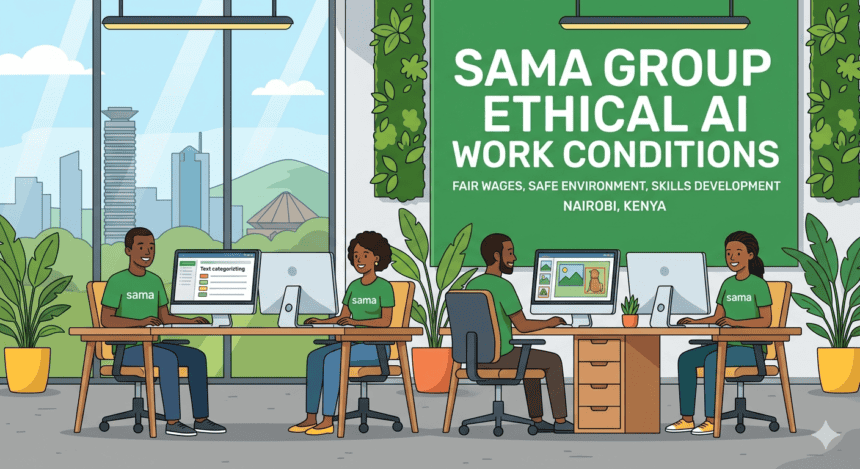

An investigation into how Silicon Valley’s most celebrated “ethical AI” company built its reputation on the labor of some of Africa’s most exploited workers.
- The Setup: A Factory Floor with a Halo
- The Wages That Tell the Story
- Daniel Motaung and the Union That Could Not Be
- The Silencing Attempt
- The Gap Between Branding and Practice
- The Layoffs and What They Revealed
- Ruto, the Law, and Whom the State Serves
- The Broader Architecture of Invisibility
- What “Ethical” Actually Requires
There is a phrase that travels well in Silicon Valley boardrooms and ESG investor decks: “give work, not aid.” It sounds righteous. It sounds like something a person says after genuinely wrestling with the failures of global charity. Sama Group, the San Francisco-based AI outsourcing company, made this phrase something close to a motto. For years, it worked beautifully. Contracts rolled in from Google, Microsoft, Meta, OpenAI, Walmart, GM, and Ford. The company won B Corp certification, earned praise from MIT researchers, collected awards for workplace culture across two continents, and told anyone willing to listen that it had lifted more than 50,000 people out of poverty in East Africa.
Then people started talking.
What they described, once the silence broke, was something very different from dignity. What came out of Nairobi, from the mouths of workers, through Kenyan courtrooms, and across the pages of investigative journalism, was a story about what “ethical AI” looks like when the ethics apply to everyone but the people doing the work.
The Setup: A Factory Floor with a Halo
Sama was founded in 2008 by Leila Janah as a nonprofit called Samasource. The premise was clean and appealing: train people in low-income communities in digital skills, connect them with data work from global tech companies, and create what Janah called “dignified digital work.” It was an idea built on genuine idealism, and in its early years, it attracted genuine admiration.
By the time Sama started doing serious work for Meta, the company had shed its nonprofit status and become a for-profit B Corporation. The B Corp label matters here. B Lab1, the nonprofit behind the certification, awards it to companies that meet what it calls “rigorous standards of social and environmental performance, transparency, and accountability.”
Getting that stamp requires a score of at least 80 points on its B Impact Assessment. Sama scored 98.5 in 2020 and later improved that to 118.4.
The company was, on paper, a model corporate citizen.
The relationship with Meta had begun around 2017. Sama started by labeling data and training Meta’s artificial intelligence systems, then expanded into content moderation. Its Nairobi office became, according to court documents, Meta’s main hub for moderating content in sub-Saharan Africa. The workers there spoke at least 11 African languages between them. They watched Facebook, Instagram, WhatsApp, and Messenger for the worst material human beings are capable of producing and distributing: beheadings, child sexual abuse, rape, torture, war crimes.
They did this work largely in secret. Workers were reportedly told not to mention Facebook by name, not to speak about the nature of their jobs. “Sama used to tell us don’t talk to Facebook, don’t mention Facebook,” Daniel Motaung, the South African whistleblower who would later become the public face of the workers’ case, told The Africa Report2.
The Wages That Tell the Story
In February 2022, Time Magazine3 published an investigation into Sama’s Nairobi facility that put numbers to what workers had been experiencing. The findings were difficult to dismiss. Some workers were taking home as little as $1.50 per hour after taxes. Despite being, in Time’s words, “among the lowest-paid workers for the platform anywhere in the world,” these were the people responsible for keeping Facebook’s African content free of its most violent, abusive material.
The scale of the arrangement only became clearer the following year. In January 2023, another Time4 investigation revealed that OpenAI had also used Sama’s Nairobi workers to make ChatGPT less toxic. OpenAI contracted the work to Sama at a rate of $12.50 per hour per worker. The Kenyan workers themselves received between $1.32 and $2 per hour, depending on seniority and performance. Starting in November 2021, those workers were sent tens of thousands of text snippets describing child sexual abuse, bestiality, murder, suicide, torture, self-harm, and incest. The task was to label the content so OpenAI could train a safety filter.
One Sama worker told Time what that experience was like:
“That was torture. You will read a number of statements like that all through the week. By the time it gets to Friday, you are disturbed from thinking through that picture.”
Sama canceled its OpenAI contract in February 2022, eight months early, citing the traumatic nature of the content. But it had taken the contract in the first place.
The math here is worth sitting with. OpenAI paid Sama $12.50 per hour per worker. The workers got $2. That gap is not a rounding error. It is a margin built on the assumption that the people doing the most psychologically damaging part of AI development were living in a place where desperation would keep them from asking questions.
Daniel Motaung and the Union That Could Not Be
Daniel Motaung arrived in Nairobi from South Africa in 2019. He was recruited by Sama to moderate Zulu-language content for Facebook. The job advertisement, he later said, had not mentioned that he would be watching beheadings. The first video he moderated was exactly that.
After six months, his mental health was collapsing. “I was actually dysfunctional. I wasn’t able to think properly,” he told Context5, the Thomson Reuters Foundation’s news service. He had developed what was later confirmed as post-traumatic stress disorder.
What Motaung did next was the kind of thing that companies like Sama claim to encourage and then move to destroy. He tried to organize his colleagues. He led more than 100 of them in a unionization effort, demanding better pay and adequate mental health support for workers exposed to the content they were reviewing daily. Time6 reported that he was fired in 2019.
The pattern here is instructive. In 2020, Facebook had agreed to pay $52 million in compensation to more than 11,000 content moderators in the United States who had developed mental health problems on the job. American workers, with legal representation and the weight of US labor law behind them, received settlements. Kenyan workers who tried to demand even the right to organize were terminated.
In May 2022, Motaung filed a lawsuit in Nairobi against both Meta and Sama. The allegations were sweeping: union-busting, insufficient pay, inadequate mental health support, forced labor, and human trafficking. The human trafficking allegation was specific. Motaung and other plaintiffs argued that Sama had transported workers from poorer regions of Africa, where they had no choice but to remain in the company’s employment regardless of the conditions.
Meta’s lawyers responded by arguing that a Kenyan court had no jurisdiction over an American company that was “not resident, trading or domiciled in Kenya.” It was a legal argument that, if successful, would have meant a company could harm workers anywhere in the world through a contractor and face no accountability in the country where the harm occurred.
The Silencing Attempt
After Motaung went public, things became more complicated for everyone involved. In the summer of 2022, it emerged that Meta and Sama were considering seeking a gag order against Motaung and his legal team, the NGO Foxglove. The letter drafted to Zuckerberg and Sama CEO Wendy Gonzalez and signed by more than 80 organizations, lawyers, and campaigners from around the world was unambiguous:
“We are writing to demand that you drop all attempts to silence whistleblower Daniel Motaung.”
Among the signatories was Frances Haugen, the Facebook whistleblower whose own testimony before the US Senate had shaken the company’s credibility in 2021. The letter noted the obvious contrast: Frances Haugen’s revelations had been received with concern and engagement. Daniel Motaung, a Black South African worker in Nairobi, was facing court proceedings designed to silence him.
Both Meta and Sama ultimately said they would not file a gag order. But the attempt, and the international outcry that followed, revealed something about how both companies understood the situation. A worker in Nairobi who tried to organize his colleagues was, in their framing, a legal threat to be managed rather than a person with legitimate grievances.
The Gap Between Branding and Practice
I want to be specific about what makes the Sama story unusual rather than simply typical. Labor exploitation in outsourcing is not new. The BPO industry across the Global South has long operated on the logic that geography makes certain human beings cheaper to use and easier to discard. What makes Sama’s case different, and worth this level of scrutiny, is the explicit branding.
Sama did not claim to be a neutral market actor. It claimed to be an ethical one. It marketed itself with the specific language of social justice, poverty alleviation, and dignified work. It won B Corp certification. It published impact reports. Sama7 cited an MIT-led randomized controlled trial confirming its programs created sustainable pathways out of poverty. It partnered with the Haas Center for Equity, Gender, and Leadership. It told investors and clients that doing business with Sama was doing well.
The academic journal AI and Society8 published fieldwork conducted at three of Sama’s East African delivery centers in April and May 2023. The research, conducted as part of the Fairwork project, found something that cut against Sama’s narrative at every turn. The accounts collected from workers described “low wages, insecure work, a tightly disciplined labour management process, gender-based exploitation and harassment and a system designed to extract value from low-paid workers to produce profits for investors.”
This was not journalism working from anonymous tips. This was peer-reviewed research conducted inside Sama’s own facilities with the cooperation of management.
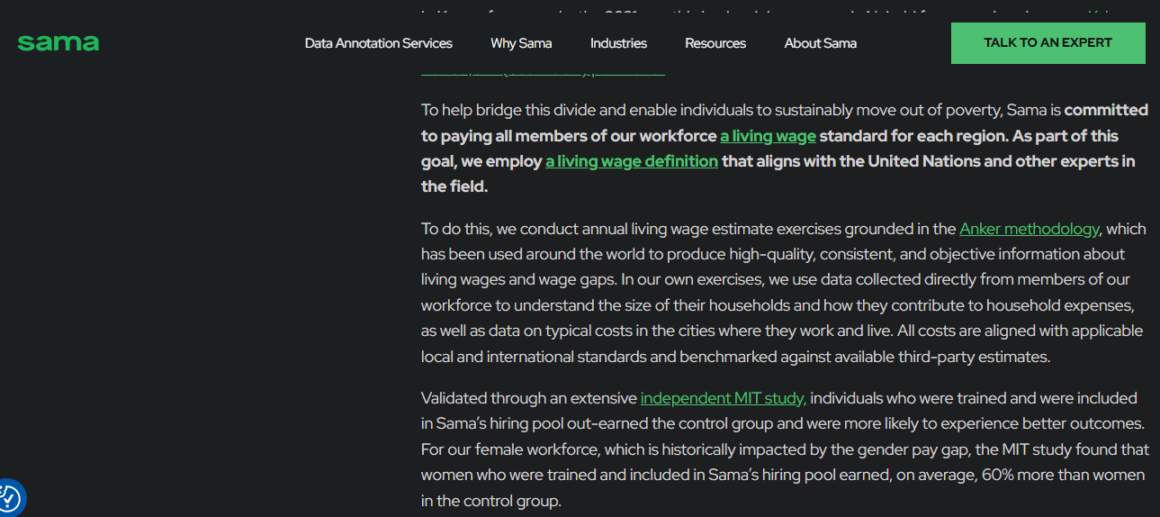
Sama has consistently maintained that it pays workers three times Kenya’s minimum wage and twice the living wage. Its own website states this, and the claim may be arithmetically accurate. But arithmetic and ethics are not the same discipline. A wage that is triple the legal minimum in a country where informal employment affects 8 in 10 workers is still, by any global measure, poverty pay for work that causes documented psychological harm.
The Layoffs and What They Revealed
In April 2026 Yahoo!Finance9 reported that Sama announced that Meta had ended its major engagement at the Nairobi office. More than 1,100 workers received layoff notices. The formal count was 1,108.
The collapse happened because of something that anyone who has studied the outsourcing industry would recognize immediately: the anchor client had walked. Sama and Meta had been working together since 2017. A significant portion of Sama’s Nairobi headcount was dedicated entirely to Meta work. When Meta shifted its content moderation strategy and ended the contract, there was no cushion. No other client was waiting to absorb 1,100 workers.
An analysis by Wee Tracker10 put it plainly:
“The layoffs expose the risk of over-reliance on a small number of large international clients, a vulnerability few outsourcing firms in Kenya openly discuss. It’s often the case that when one of those clients leaves, the entire operation buckles.”
Sama said it was offering mental health support to affected workers for 12 months after employment ended and was paying undisclosed severance. It also said it was “actively supporting affected employees with care and respect.” These are the words of a company trying to exit gracefully from a situation it helped create.
What makes the layoffs significant is the timing. Just weeks before the redundancy notices went out, the Kenyan Court of Appeal had ruled that Meta could be sued in Kenya over the original dismissals. The 184 former moderators still seeking justice, alleging illegal dismissal and blacklisting from similar roles with other contractors, were asking for $1.6 billion in damages. The lawsuit was not going away.
Ruto, the Law, and Whom the State Serves
The most troubling development in this entire story does not involve Sama or Meta directly. It involves a government.
In December 2024, Kenyan President William Ruto addressed a gathering in Nairobi. He was remarkably candid. “Those people were taken to court, and they had real trouble,” he said, referring to the lawsuit against Sama. “They really bothered me. Now I can report to you that we have changed the law, so nobody will take you to court again on any matter.”
Ruto said that Sama had threatened to relocate to Uganda because of the legal pressure from Kenyan workers. His response was not to examine the workers’ complaints. It was to change the law.
According to DailyNation11, the Business Laws (Amendment) Bill 2024, sponsored by Senate Majority Leader Aaron Cheruiyot, would grant tech companies legal immunity against lawsuits filed by workers at their contractors. The workers being sued over, the people who watched beheadings for $1.50 an hour, would lose their right to hold the company that designed and managed their work accountable in their own courts.
Thirty-five tech workers filed a petition at the High Court challenging the bill. They argued that it was unconstitutional, that the Senate had fast-tracked it without public participation after intensive lobbying by Big Tech, and that it amounted to the Kenyan state legislating in the interests of foreign corporations rather than its own citizens.
Mercy Mutemi12, the lawyer representing the original content moderators claimed that the constitutional nature of the underlying case likely protects it regardless of what the new law says.
“We agree that the law needs to be amended to reflect the new categories of work,” she said. “However the bill that’s currently in parliament does not offer any protections to the workers. As a matter of fact, it seems to be prioritizing the protection of the [outsourcing companies] and the tech companies at the expense of workers’ rights.”
The picture this creates is not subtle. A sitting head of state admitted publicly, at a business event, that a company lobbied him to change his country’s laws after being held legally accountable by his country’s workers. He obliged.
The Broader Architecture of Invisibility
There is a reason the people who built ChatGPT, trained Meta’s content filters, and labeled the data that powers half the AI products sold to Western consumers remain largely invisible to the consumers of those products. The architecture is designed that way.
Sama’s Nairobi workers were not on OpenAI’s payroll. They were not on Meta’s payroll. They worked for a contractor whose clients could, and did, argue in court that the labor arrangements were none of their business. The outsourcing chain creates distance, and distance creates deniability.
The Institute for Human Rights and Business13 described this pattern as a “new factory floor of exploitation” in which conditions that would not be tolerated under US or European labor laws are routinely offloaded to workers in places where those laws do not apply and where local governments are more anxious to attract investment than to protect the people doing the work.
The AI ethicist Andrew Strait wrote, in the wake of the ChatGPT revelations, that these systems are “not magic — they rely on massive supply chains of human labor and scraped data, much of which is unattributed and used without consent.” That is the clinical version of what Daniel Motaung experienced in a Nairobi office building in 2019, watching a beheading on his first day at work.
Richard Mathenge, recognized in Time’s 100 Most Influential People in AI14 for his work organizing the African Content Moderators Union, said that members largely fear revealing their union membership out of concern for their employment. This is the state of labor organizing in the industry that sells itself as the future.
Kauna Malgwi, one of the former moderators, described the work with the directness that only comes from experience: “You’d sift through murders, rapes, and suicides. It sticks with you.”
What “Ethical” Actually Requires
Sama is not uniquely evil. It sits at an intersection of pressures that would compromise almost any company in the same position: a Silicon Valley client base with enormous pricing power, a labor market in East Africa shaped by 67% youth unemployment in Nairobi, and a global tech industry that has been extraordinarily successful at convincing the world that the social value of its products excuses whatever is required to build them.
But Sama chose the “ethical AI” branding. It chose to make its moral claims central to its market identity. That choice creates a particular kind of obligation. When a company says it is in the business of dignity, the gap between the claim and the reality is not a PR problem. It is a lie with consequences.
The workers who developed PTSD watching Facebook content were not lifted out of poverty. They were hired into trauma. The workers who were fired for organizing were not being treated with dignity. They were being managed as a threat. The workers who were laid off when Meta ended its contract were not the beneficiaries of an ethical supply chain. They were the casualties of a client relationship that had no structural protections for the people at the bottom of it.
B Lab told that after the initial lawsuits emerged, that it would not pursue independent investigations while legal proceedings were ongoing but that further action “may also be taken” after the case concluded. That case has been grinding through Kenya’s courts since 2022. B Lab has continued to certify Sama, including a re-certification in 2025 with an improved score of 118.4.
The certification has been, in other words, almost entirely useless as a tool for worker protection. It is a document that companies can display while their workers are in court seeking compensation for forced exposure to child sexual abuse material. That is not a criticism of B Corp certification as a concept. It is an observation about what it currently means in practice.
According to Kenyan Wall Street15, by April 2026, more than 1,108 Sama workers in Nairobi had been told their jobs were ending. A lawsuit seeking $1.6 billion in damages was continuing through the courts. A Kenyan law designed to protect the companies those workers were suing had been challenged on constitutional grounds by 35 of their colleagues. The Court of Appeal had ruled that Meta could be held accountable in Kenya. And Sama was offering 12 months of mental health support to people it was laying off.
Sama Nairobi will cut 1,108 jobs following a formal redundancy notice issued 16 April 2026 after Meta ended a major client engagement at the Kenyan AI data annotation centre.
— Kenyan Wall Street (@kenyanwalstreet) April 16, 2026
Samasource Impact Sourcing said it tried to retain the work but negotiations failed. The redundancies… pic.twitter.com/WV2xrl3iZK
I think about what it took for Daniel Motaung to become a public figure. He was a 27-year-old from South Africa working in a foreign country on a job that had been misrepresented to him. He developed PTSD. He tried to organize his colleagues and was fired. Then, rather than disappear, he filed a lawsuit and kept talking. “Don’t die in silence,” he has said to other moderators. That is not the language of corporate mission statements. That is the language of someone who knows exactly what silence costs.
The AI that most people interact with daily, the tools that write emails and answer questions and generate images, required thousands of hours of work from people like the workers in Nairobi. That work involved reading descriptions of child abuse so that the AI would recognize and flag them. It involved watching beheadings so that the AI would learn to remove them. The model that feels effortless to use was made less harmful by people working in conditions that caused them lasting harm.
That is the transaction that the phrase “ethical AI” is supposed to describe. What happened in Nairobi is what happens when the ethics only flow one way.
Sources
- “B Labs Logo” Home Link, www.bcorporation.net/. Accessed 24 May 2026. ↩︎
- “Letter calls for Facebook to stop trying to silence South African whistleblower Daniel Motaung” 21 July 2022, www.theafricareport.com/225150/letter-calls-for-facebook-to-stop-trying-to-silence-south-african-whistleblower-daniel-motaung/. Accessed 24 May 2026. ↩︎
- Perrigo, Billy. “Inside Facebook’s African Sweatshop” 14 Feb. 2022, time.com/6147458/facebook-africa-content-moderation-employee-treatment/. Accessed 24 May 2026. ↩︎
- Perrigo, Billy. “Exclusive: The $2 Per Hour Workers Who Made ChatGPT Safer” 18 Jan. 2023, time.com/6247678/openai-chatgpt-kenya-workers/. Accessed 24 May 2026. ↩︎
- Harrisberg, Kim. “Respect African content moderators, says Facebook whistleblower” Context by TRF, 11 May 2023, www.context.news/big-tech/respect-african-content-moderators-says-facebook-whistleblower. Accessed 24 May 2026. ↩︎
- Time, time.com/6193231/facebook-crack-whip-black-whistleblower/. Accessed 31 May 2026. ↩︎
- Sama. “Sama by the Numbers | Sama” Sama, 11 Feb. 2022, www.sama.com/blog/building-an-ethical-supply-chain. Accessed 2 June 2026. ↩︎
- Cant1, Callum. “The poverty of ethical AI: impact sourcing and AI supply chains” Springer Nature Link, 20 Dec. 2023, link.springer.com/article/10.1007/s00146-023-01824-9. Accessed 2 June 2026. ↩︎
- Yahoo!Finance, finance.yahoo.com/sectors/technology/articles/former-meta-contractor-sama-lay-162851793.html. Accessed 2 June 2026. ↩︎
- Nzekwe, Henry. “How Losing One Client Suddenly Collapsed 1000+ Jobs In Kenya’s AI Hub” 16 Apr. 2026, weetracker.com/2026/04/16/sama-layoffs-meta-contract-termination-kenya/. Accessed 2 June 2026. ↩︎
- DailyNation, nation.africa/kenya/business/kenyan-draft-law-sparks-outrage-for-shielding-tech-companies-from-lawsuits–5154948. Accessed 2 June 2026. ↩︎
- Sumbi, Mercy. “Case challenging the unfair working conditions Facebook content moderators face” My Site, 21 Dec. 2022, www.mercymutemi.com/post/case-challenging-the-unfair-working-conditions-facebook-content-moderators-face. Accessed 2 June 2026. ↩︎
- Abedin, Eiffel. “Content moderation is a new factory floor of exploitation – labour…” Content moderation is a new factory floor of explo, 26 June 2025, www.ihrb.org/latest/content-moderation-is-a-new-factory-floor-of-exploitation-labour-protections-must-catch-up. Accessed 2 June 2026. ↩︎
- “TIME100 AI 2023: Richard Mathenge” 7 Sept. 2023, time.com/collections/time100-ai/6308980/richard-mathenge/. Accessed 2 June 2026. ↩︎
- Street, Kenyan Wall. “Kenyan Wall Street (@kenyanwalstreet) on X” 16 Apr. 2026, x.com/kenyanwalstreet/status/2044806591933710701. Accessed 19 July 2026. ↩︎


