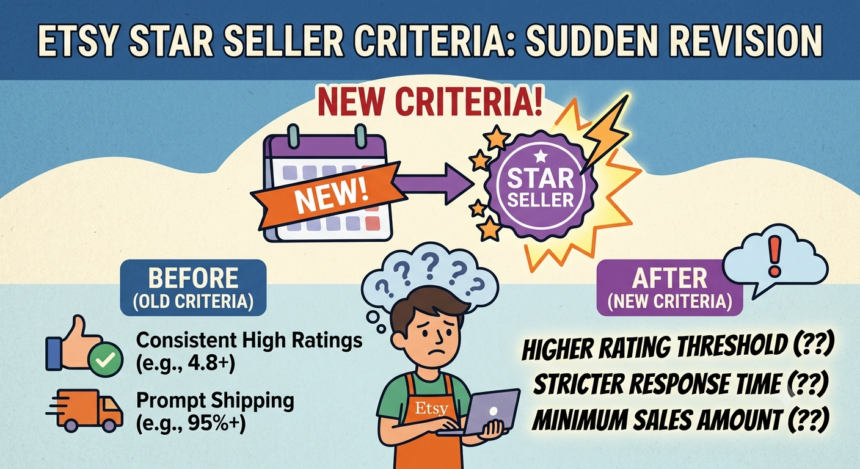

How a program sold as a reward became a lever of control, and why sellers keep losing badges they earned
There is a particular kind of anxiety that visits Etsy sellers on the first of every month. Not the anxiety of whether orders came in, or whether a new collection landed well. This is quieter and more specific. It is the anxiety of checking whether the purple star badge is still on their shop page. Whether the algorithm’s verdict, delivered at midnight with no appeal process and no human reviewer, has decided they still deserve to be seen.
The Etsy Star Seller program1 launched in September 2021. The pitch was clean: shops that responded to messages quickly, shipped on time, and earned strong reviews would get a badge that told buyers they could trust this seller. The badge would appear on storefronts. Star Sellers would get featured in Etsy2 marketing. The message was simple: do right by your customers, and Etsy will do right by you.
What followed was messier. The criteria shifted. The rules around what counted and what did not turned out to be more complicated than the announcement suggested. Sellers who thought they had done everything right found the badge gone on the first of the month, with no explanation that felt adequate and no path to reinstatement before the next 90-day review window closed. And through it all, the stakes kept rising, because the badge was never really just a badge.
What the Program Actually Measures
To understand what changed, you have to understand what the program measures and how it has evolved since launch.
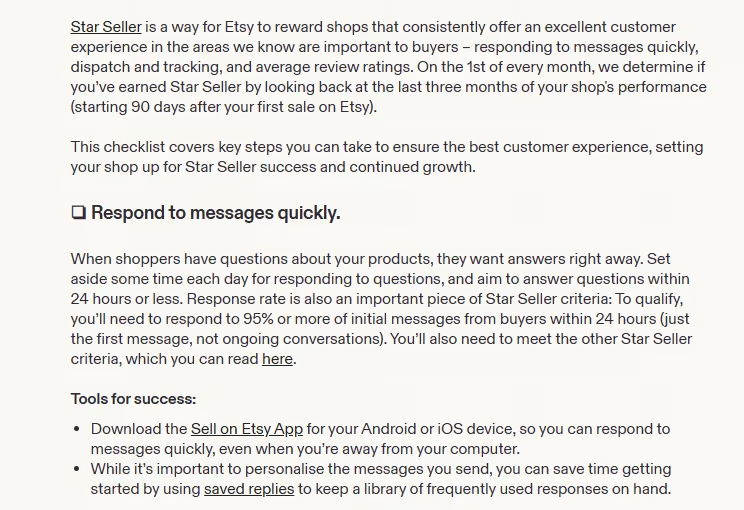
When Etsy’s3 Star Seller first launched, sellers needed to respond to 95% or more of initial messages within 24 hours, ship 95% or more of orders on time with tracking, and earn 5-star ratings on 95% or more of reviews. They also needed at least 10 orders and $300 in sales within the three-month review period.
That last criterion, the 95% five-star rating floor, became a flashpoint almost immediately. A four-star review, the kind most customers leave when they’re genuinely happy but not effusive, could torpedo a seller’s badge. One criticism that stood out early on was that any review below 5 stars impacted sellers negatively, even when the review itself was not negative. A 4-star review is objectively positive, yet the original system treated it as a deficiency.
In April 2022, The Guardian4 reported that thousands of Etsy sellers held a week-long strike, placing their shops in vacation mode to protest a 30% fee increase and a range of other grievances. Among their demands: ending the Star Seller program entirely. Striking sellers felt they were being asked to operate with the scale and margins of Amazon while maintaining the responsiveness of a boutique. Etsy did not end the program. It revised it.
Starting in July 2022, Etsy5 lowered the order minimum from 10 to 5 orders within the three-month review period. They also updated the ratings threshold from requiring 95% five-star reviews to requiring a 4.8 average rating, so that four-star reviews would count positively rather than as failures. The new-and-improved messaging experience would also start combining messages from the same buyer into a single thread, reducing the number of first-contact threads a seller had to track.
These changes were framed as listening to sellers. In some ways, they were. The 4.8 average is meaningfully more forgiving than the original 95% five-star floor. The combined messaging threads reduced the cognitive load on small shops. But the revisions also clarified something that the original launch announcement had understated: this program was not just recognition. It was infrastructure.
The Hidden Weight of the Badge
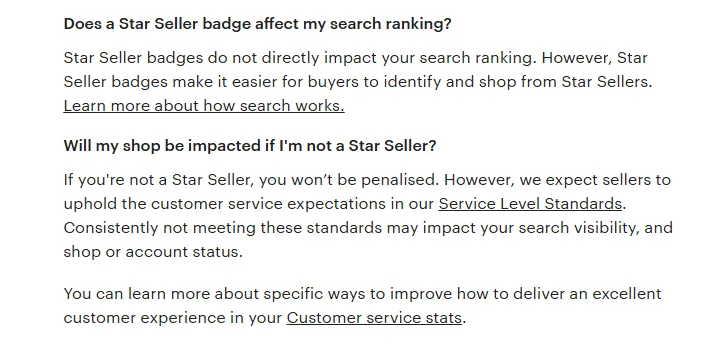
Etsy6 says, in its own help documentation, that Star Seller badges do not directly impact search ranking. However, the badges make it easier for buyers to identify and shop from Star Sellers. If a seller consistently fails to meet customer service standards, it may impact search visibility and shop or account status.
That framing is worth sitting with. The badge does not directly impact search ranking. But Etsy’s own search product now includes a Star Seller filter. If a seller loses their badge, they instantly disappear from the search results of any buyer using that filter. Industry data suggests that shops displaying the Star Seller badge see up to a 22% higher conversion rate compared to similar shops without it.
The Star Seller badge is no longer just a nice-to-have sticker. It is one of the quickest ways to signal to a potential buyer that a shop is professional and reliable. And the Star Seller search filter means that shoppers can toggle to only see results from Star Sellers. If a shop does not have the badge, it disappears from those searches entirely.
This is the gap between what Etsy says and what Etsy does. Officially, the badge does not affect ranking. Practically, it affects whether a shop appears to a meaningful segment of buyers at all. For a handmade ceramics maker in Ohio or a jeweler in Scotland, losing the badge does not just mean losing a purple star. It means stepping behind a filter that an increasing number of buyers use as a shortcut for trust.
Etsy’s 2026 SEO guidance now explicitly states that sellers should aim for Star Seller status because it provides a measurable ranking lift across an entire shop’s catalog. The platform is telling sellers one thing in its help documentation and another thing through its ranking guidance. The contradiction is not accidental. It is the product of a program that has grown well beyond its original framing.
What makes the Star Seller program genuinely difficult to defend is not that it sets high standards. High standards are defensible. What is harder to defend is that the measurement methodology contains structural flaws that have been documented, criticized, and largely ignored.
David Bowman7, a chain jewelry artist with more than 25 years of experience in program evaluation and an instructor at the University of New Mexico, wrote a detailed analysis of the program shortly after launch that remains the sharpest critique of it. Bowman wrote that the Star Seller program’s measurement system is not a valid process and does not determine whether or not a seller has good customer service, and that in designing the system Etsy clearly did not employ statisticians or research scientists. He argued the program would be laughed out of any research journal or credible trade publication.
His core argument was methodological. On message response rates: the analysis does not consider whether or not the seller responded to a buyer’s question that needed a response, only that the seller did not respond to a message, whether or not it was from a buyer and whether or not it needed a response. The measure is not reliable because it will not indicate whether or not the seller responded to a buyer’s question that needed a response, and it is not valid because it does not actually measure a seller’s service to buyers.
On shipping: Etsy uses the lack of a tracking number as an indication of late delivery. The data cannot be used in this way. The lack of a tracking number is not an indication of a customer service level. There is only one thing you can conclude from the lack of a tracking number: the seller did not enter a tracking number in the Etsy system. Nothing else can be concluded.
These criticisms were published in late 2021. The 2022 revisions did not address them. The program still measures a proxy for shipping (tracking confirmation) rather than actual delivery. It still counts all first messages without distinguishing between messages that require a response and messages that do not. The methodology has not changed. The stakes attached to it have only grown.
The Messaging Trap
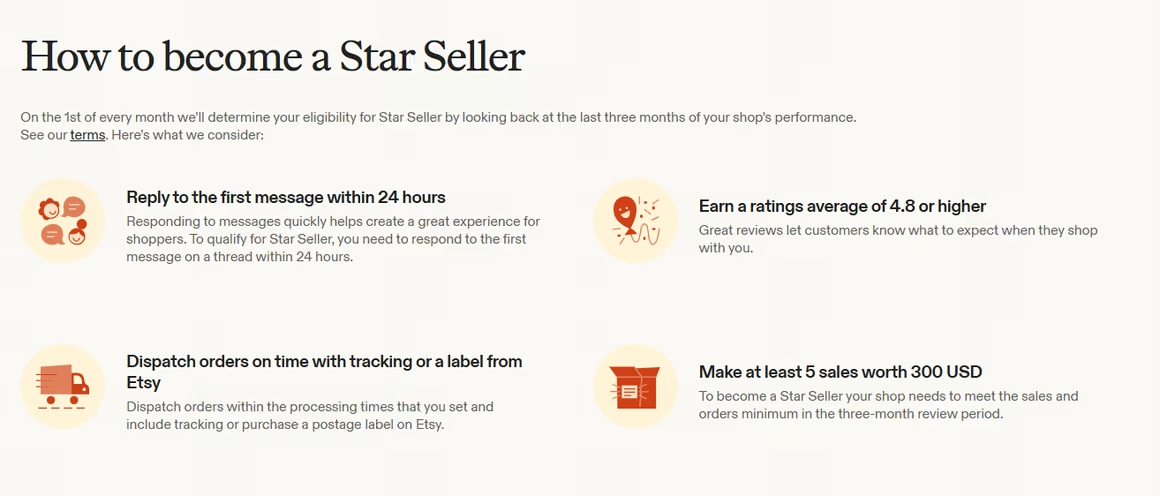
The place where the program most reliably fails sellers is messaging. The rules, on paper, seem simple: respond to 95% of initial messages within 24 hours. In practice, the edges are jagged in ways that catch sellers repeatedly and without recourse.
Sellers who make purchases on Etsy using their seller account find themselves penalized for not responding to messages from sellers they bought from, because those count as new incoming message threads. One seller lost their Star Seller badge for not responding to a message received while completing an order, and assumed it was a technical glitch. The guidance from the Etsy community was clear: there was no glitch. The rules say to reply to the first message of every new incoming thread.
One frustrated use wrote in Facebook8:
Help! Why am I penalized for messages that don’t require a response? I.e. seller letting me know the shipped the item. Has nothing to do with my selling account, but penalizes me for it.
The harder edge case involves message splitting. One user lost Star Seller status after months of effort because of Etsy’s messaging system. A single customer message, split into two threads by the platform itself, resulted in a missed reply. That led to a three-month badge suspension despite the seller responding promptly to what they saw as a single conversation.
Another seller received a Star Seller strike after a customer submitted a cancellation request through a help form, and the seller actioned the request and sent a follow-up message well within the hour. Etsy’s system registered a non-response because the seller had replied in the cancellation workflow rather than separately in the messages section. Etsy’s position was explicit: they do not manually adjust Star Seller data.
This is the operational reality. The platform built a messaging system with multiple parallel channels. Sellers can respond through the cancellation flow, through the help request system, through direct messages. Each of these may or may not satisfy the Star Seller criterion depending on which channel the system registers as the “initial message in the thread.” Sellers cannot always tell in advance which actions will count. When they get it wrong, they lose three months.
On the Etsy community forums, one seller reported that their Star Seller dashboard showed a 100% message response rate while simultaneously finding, after downloading the CSV export of their message history, that only 4 messages appeared in the data. They were certain more than 4 initial messages had arrived and been answered. The dashboard said 100%. The badge was still gone.
There is something important in that gap between the dashboard display and the badge outcome. It suggests the system is not always internally consistent, and that the arbiter of the dispute, the platform, has already issued its verdict. Sellers have no meaningful appeals process. Etsy has stated plainly that they will not adjust badges after they are awarded.
Small Shops and the Math of Margins
The program’s tolerance for variance is not neutral. It scales inversely with volume, and that scaling is structurally hostile to the small sellers who were supposed to be the program’s primary beneficiaries.
Large-volume shops are more resilient to a bad review than small-volume shops. The 95% on-time shipping threshold is punishing for handmade sellers who cannot control supplier delays or carrier issues. Sellers in jurisdictions where common shipping methods do not include tracking are disadvantaged against those who can purchase Etsy shipping labels.
The math on this is stark. If a seller only receives 10 messages in a month and answers one of them late, their response rate drops to 90%, and they fail the requirement. A single missed message can severely damage a small shop’s percentage in a way that would be absorbed without consequence by a shop receiving 200 messages a month.
The minimum order count reduction from 10 to 5 was presented as relief for small sellers. It is, marginally. But the review period metrics still punish statistical outliers, and statistical outliers are far more likely to occur in small-volume shops. A handmade seller who completes 10 orders in a quarter and has one delayed by a carrier strike has a 90% on-time shipping rate. They fail. A shop that completes 200 orders in the same period and has 10 delayed can still pass. The criteria do not adjust for scale. They treat a one-person ceramics studio the same as a print-on-demand operation moving hundreds of units a month.
The badge question does not exist in isolation. It sits inside a broader set of changes to how Etsy surfaces listings and what determines whether a shop can be found at all.
According to Value Added Resource9, in November 2025, Etsy sellers began reporting that their listings were not appearing in search results at all. Sales had dropped sharply. A seller wrote in a community thread created on November 8 that they had noticed their items were not even showing up in the Etsy search engine. The episode was eventually investigated by Etsy, but the incident illustrated something sellers had been saying for years: search visibility on this platform is opaque, fragile, and not entirely within a seller’s control.
Etsy’s Q4 2025 earnings10 call emphasized that conversion rate was the metric the platform cared about. Search updates in early 2026 added new ranking penalties for high shipping prices, new guidelines around title length, and a Search Visibility Dashboard meant to show sellers exactly which of their listings were underperforming and why.
In 2026, Etsy’s algorithm places greater weight on buyer behavior signals, including click-through rate, add-to-cart rate, and purchase completion relative to search impressions. The era of set-it-and-forget-it listings is over.
Into this environment, the Star Seller badge functions as a passive filter. Sellers who maintain the badge stay visible to buyers who use the Star Seller filter. Those who lose it become invisible to that segment. The badge criteria are reset every month. A shipping delay in January can cost a seller visibility in February, March, and April.
What “Customer Service” Means to the Platform
There is a useful irony buried in how this program works. Etsy requires its sellers to offer excellent customer interaction to qualify for Star Seller status even as the marketplace itself has had a long reputation for slow customer support. Striking sellers pointed out they were expected to respond within 24 hours while Etsy’s own support could take days.
That asymmetry is not incidental. It describes the relationship between Etsy and its sellers with some precision. The platform sets standards it does not hold itself to. It enforces them with automated systems that do not accept edge cases. And it does so from a position of structural advantage: sellers need Etsy’s traffic more than Etsy needs any individual seller.
Star Sellers also gain priority access to Etsy’s11 live chat support, which is crucial when dealing with account issues or fraudulent buyers. That benefit alone reveals something about how the platform works. Support access, the ability to reach a human when something goes wrong, is rationed by badge status. Sellers who have already been most impacted by the program’s algorithmic decisions are also least likely to have access to the mechanism for challenging those decisions.
When Etsy12 revised the Star Seller criteria in 2022, it framed the changes as responsiveness to seller feedback. In some respects, moving from a 95% five-star threshold to a 4.8 average genuinely improved the program. But the revision also served a different function. It quieted the loudest complaints, the ones that had organized into a public seller strike, while leaving the program’s structural logic intact.
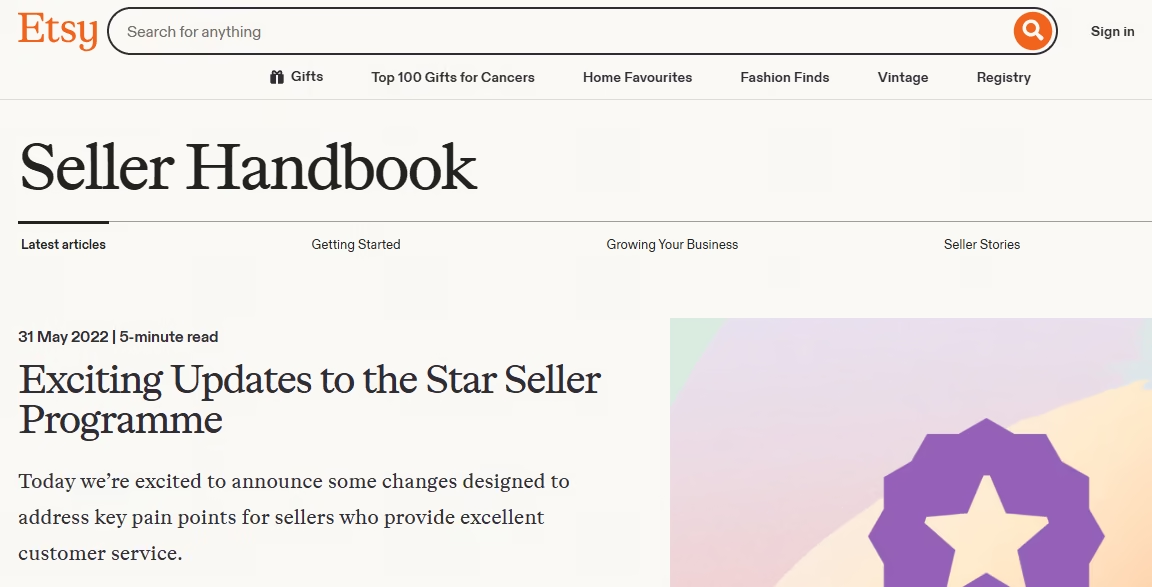
The criteria have shifted twice since launch. The program has evolved since it launched in 2021, and the criteria have changed more than once. Each revision has been announced in the Etsy Seller Handbook with language about listening to sellers and making the program more attainable. Each revision has left in place the fundamental architecture: a rolling 90-day review, automated measurement, no manual adjudication, and consequences that scale across search visibility without being officially described as search penalties.
What the revisions have not changed is the power dynamic. Etsy controls the criteria. Etsy controls the measurement. Etsy controls whether an individual seller’s badge is displayed or removed. Sellers have no vote on the criteria, no appeal process for disputes, and no alternative platform that offers equivalent traffic. That combination, mandatory participation, unilateral rules, no recourse, is not a recognition program. It is compliance infrastructure with a badge on top.
The honest answer to whether the Star Seller badge is worth pursuing is: yes, and that is exactly the problem.
One seller reported that earning the badge took three months, improved buyer trust, increased credibility, and resulted in better revenue. Another maintained Star Seller status for over a year and believed it helped earn buyer trust. One reddit user stated:
Star seller is a great look. I’ve been able to keep mine for over a year. I should really dig in and see if it helps. I think my sales increase because I list so much. I don’t know how much Star Seller helps. I know it does but I would love to know how much
Another user claimed:
Back in the day obtaining Star Seller was easier than today’s standards and it doesn’t mean a thing. I still get 5 star reviews, ship on time, etc, but because my income from Etsy is under the threshold now, I don’t get Star Seller status. It’s pointless to me as I’m still legit and have return customers.
The divergence in those reports is revealing. For newer shops trying to establish credibility against established competitors, the badge provides a real signal to buyers. For shops with long track records and loyal return customers, the badge matters less. The sellers for whom the badge matters most, smaller, newer, lower-volume shops, are also the sellers most vulnerable to losing it over a single missed message or one carrier delay.
Star Seller is generally worth pursuing, especially for newer or smaller shops that need visible credibility. However, for established shops with loyal customers, the badge may matter less.
The program, then, taxes the sellers who can least afford the tax. It demands constant vigilance, automated systems the platform does not provide for free, and tolerance for an appeals process that does not exist. It offers visibility to those who comply and withdrawal of visibility from those who do not. It calls this a reward.
What Would Actually Work
There are things that could be fixed without dismantling the program. A meaningful appeals process, staffed by humans with the authority to examine context, would address the most common complaints. Messaging channels should be unified so that a response in the cancellation workflow and a response in the direct message thread are equivalent for the purposes of the metric. The response rate calculation should adjust for volume, so that a low-volume seller’s one missed message does not carry the same penalty as a high-volume seller’s twenty. And carriers’ delays, postal strikes, and platform-side failures in label purchasing should be automatically excluded from the shipping metric, rather than falling on sellers to document and dispute.
None of these changes would undermine the program’s stated purpose. They would make it do what Etsy says it does: measure genuine customer service rather than proxies for customer service applied without judgment across wildly different operating contexts.
Until those changes happen, the badge remains something more complicated than a reward. It is a compliance regime whose criteria shift without notice, whose metrics cannot always be appealed, and whose consequences are felt most sharply by the sellers who were supposed to benefit most from it. The purple star looks like recognition. Underneath, it is a monthly audit that the platform conducts on its sellers. And delivers its verdict in the middle of the night.
Sources
- “Etsy.Com” www.etsy.com/seller-handbook/article/2021-seller-year-in-review/1065543348931. Accessed 2 July 2026. ↩︎
- “Etsy.Com” www.etsy.com/seller-handbook/article/introducing-star-seller/1021005855344. Accessed 2 July 2026. ↩︎
- “Etsy.Com” www.etsy.com/seller-handbook/article/1020956976086. Accessed 30 June 2026. ↩︎
- Britten, Fleur. “Thousands of Etsy sellers to strike over rising transaction fees” The Guardian, 12 Apr. 2022, www.theguardian.com/technology/2022/apr/12/thousands-etsy-sellers-strike-fees-online-shops. Accessed 30 June 2026. ↩︎
- “Etsy.Com” www.etsy.com/seller-handbook/article/1106055490875. Accessed 30 June 2026. ↩︎
- “Star Seller” How it works and how to earn your badge, www.etsy.com/starseller. Accessed 1 July 2026. ↩︎
- Bowman, David. “An Evaluation of Etsy’s New Star Seller Badge Program” Craft Industry Alliance, 13 Sept. 2021, craftindustryalliance.org/an-evaluation-of-etsys-new-star-seller-badge-program/. Accessed 1 July 2026. ↩︎
- “Etsy and Tedooo app Sellers Support Community | Help! Why am I penalized for messages that don’t require a response | Facebook” Help! Why am I penalized for messages that dont re, www.facebook.com/groups/1919359608205619/posts/2562311850577055/. Accessed 2 July 2026. ↩︎
- Morton, Liz. “Visibility Crisis: Etsy’s Unresolved Search Bug Pushes Holiday Sellers To Black Friday Breaking Point” 28 Nov. 2025, www.valueaddedresource.net/etsy-search-visibility-bug/. Accessed 1 July 2026. ↩︎
- “Etsy, Inc. Reports Fourth Quarter and Full Year 2025 Results” 19 Feb. 2026, investors.etsy.com/news-events/press-releases/detail/218/etsy-inc-reports-fourth-quarter-and-full-year-2025-results. Accessed 1 July 2026. ↩︎
- “Etsy.Com” www.etsy.com/seller-handbook/article/1083608630250. Accessed 2 July 2026. ↩︎
- “Etsy.Com” www.etsy.com/seller-handbook/article/1085067202187. Accessed 1 July 2026. ↩︎