
Every morning across America, tens of thousands of people climb into their own cars, load up Amazon packages, and drive routes they have never driven before. They are not employees. They carry no union card. There is no HR department with a warm desk to call if something goes wrong. They are Amazon Flex drivers, and they exist in a particular category of American labor that is simultaneously indispensable and disposable.
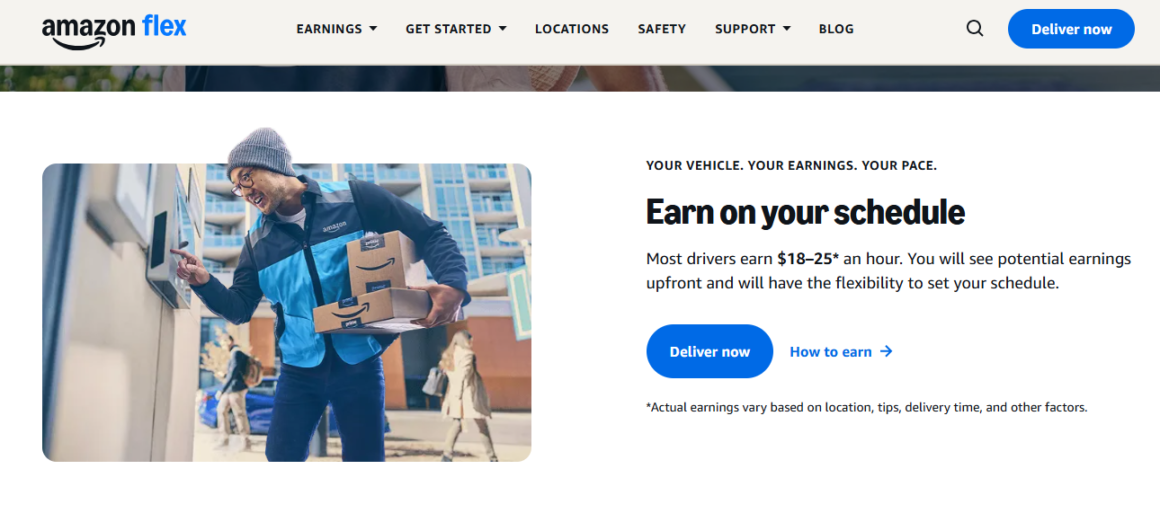
The premise of the program is simple enough. Amazon Flex1, launched in 2015, allows independent contractors to sign up for delivery blocks through a smartphone app, pick up packages from Amazon warehouses, and deposit them at front doors across whatever zip code the algorithm assigns. The company advertised pay of $18 to $25 an hour. In cities like Seattle and Los Angeles and Atlanta, hundreds of thousands of people took that deal. What the company did not advertise with the same clarity was the weight of what drivers were agreeing to carry along with those packages.
I have spent time reading court documents, forum threads, industry analyses, labor reports, and federal agency filings to understand one specific problem inside this system: what happens to an Amazon Flex driver when a package they delivered disappears before the customer opens the door. The answer is not comfortable, and it follows a pattern that has repeated itself enough times that calling it a flaw begins to feel generous. It may be a feature.
Drop and Walk
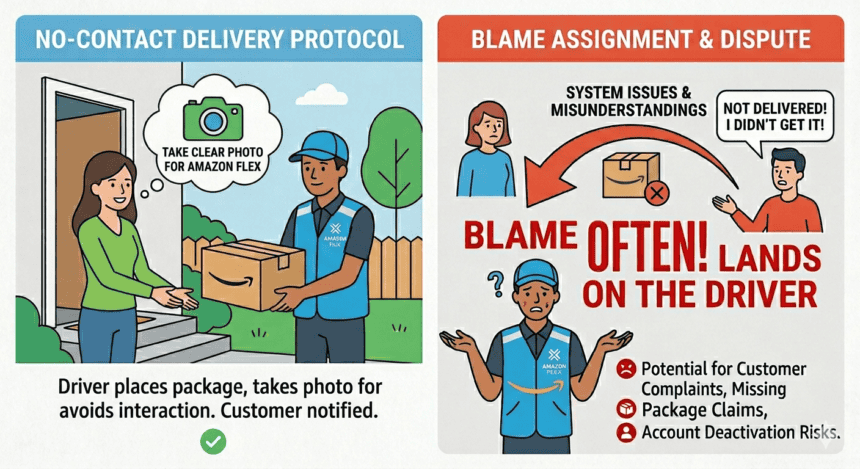
Amazon’s model for last-mile delivery relies heavily on what the industry calls no-contact delivery. The driver arrives, takes a photograph of the package at the door, marks it as delivered in the app, and leaves. No knock required. In many cases, drivers delivering for Amazon will not typically ring the doorbell or knock unless a signature or one-time password is required. The parcel sits. The customer gets a notification. The transaction is, in Amazon’s accounting, complete.
The photograph is supposed to be the safeguard. It is proof. A timestamp, a location, a frame showing the box resting against someone’s door. Drivers lean on this. They are told to lean on this. Resources for Flex drivers across the internet say the same thing: take a good photo, document everything, build your paper trail.
The problem is that the photo proves almost nothing once a customer claims non-receipt.
When a package is marked as delivered by the driver but reported as not received by the customer, the blame goes on the driver every time. As one driver told local news, the experience is deeply personal:
“It’s personal, they’re basically calling you a liar and a thief.”
That quote is from a news segment that Flex Swag2, a blog tracking Amazon Flex news, covered years ago. The segment described the situation as a flaw in the system. The flaw has not been repaired.
Amazon sends drivers an email when a customer claims a package was not received, and tracks each driver’s “Recent delivered/not received count”: the number of their last 500 packages that were marked delivered but not reported received by customers. That metric becomes part of a driver’s standing score. Enough of those flags, and a driver’s standing slips from Fantastic to Great to Fair to At Risk. At Risk means the next slip could end the account.
The Porch Between Delivery and Receipt
Here is the gap that Amazon’s system never fully accounts for: the time and space between a driver walking away and a customer opening their door.
According to Yahoo! Finance3, in 2024 alone, porch pirates stole an estimated 241 million parcels in the United States, representing a $15.7 billion problem. California, New York, and Texas together accounted for 41 percent of national losses. Forty-one percent of Americans have been a victim of porch piracy, up from 35 percent in 2022, and 25 percent say they had a package stolen in the past year.
These numbers describe a national infrastructure of theft that operates entirely in the window after delivery and before receipt. Every one of those stolen parcels was, at some point, delivered correctly. A driver left it where they were supposed to. The chain broke after the driver left their hands.
With at least 58 million packages stolen in 2024, as reported by the Postal Service Office of Inspector General4, theft creates substantial financial burdens and operational disruptions across the delivery and ecommerce ecosystems. The prevalence of theft may also erode consumer trust in ecommerce merchants, postal operators, and private delivery providers.
But eroded consumer trust does not land on those thieves. It lands, through Amazon’s rating system, on the last person who touched the package.
This is the mechanism worth understanding. When a customer claims non-receipt, Amazon’s default response is to process a replacement. The company’s A-to-z Guarantee handles that. The customer is made whole. The driver is flagged. One of the biggest criticisms of the Flex ratings system is that drivers can be held responsible for circumstances beyond their control, which can lead to fewer orders and deactivation. The standing system is very sensitive. Great ratings from hundreds of successful deliveries can be ruined by one or two customer claims.
The company, in other words, absorbs the financial cost of the theft through its guarantee. The human cost, the reputational and employment cost, lands on the driver’s metrics.
You Against the Machine
Ryan Cope drove for Amazon Flex in the Denver area. He did not last long. Driving miles along winding dirt roads outside Denver in the snow, he often shook his head in disbelief that Amazon expected the customer to get the package within two hours.
“Whenever there’s an issue, there’s no support,” he said. “It’s you against the machine, so you don’t even try.”
That quote comes from a Bloomberg5 investigation that documented how Amazon’s largely automated system fires Flex drivers by email, sometimes for reasons that have nothing to do with actual misconduct. Amazon algorithms scan incoming data for performance patterns and decide which drivers get more routes and which are deactivated. Human feedback is rare. Drivers occasionally receive automated emails, but mostly they are left to obsess about their ratings. Former Amazon managers told Bloomberg that the company knew delegating work to machines would lead to mistakes, but decided it was cheaper to trust the algorithms than pay people to investigate mistaken firings, so long as drivers could be replaced easily.
Locked gates, inclement weather, and bad selfies are among the reasons drivers report that they were fired by the bots that apparently run human resources for Amazon’s Flex delivery program.
The appeal process offers little comfort. As independent contractors, Flex drivers have little recourse when they believe they have been deactivated unfairly. There is no paid administrative leave during an appeal. According to Law Insider6, drivers can pay $200 to take their dispute to arbitration, but few do, seeing it as a waste of time and money.
Read that again. The burden of appeal costs $200 out of the driver’s own pocket in a job where, by many accounts, margins are already thin. One reviewer on a driver platform noted that with mileage and wear factored in, some blocks pay out below minimum wage. Amazon is not legally required to retain any independent contractor for a specific duration, and has the legal right to terminate or deactivate such contractors for any reason or even no reason at all, provided it is not based on illegal discrimination.
This is the legal architecture under which these workers operate. The company sets the rules, the metrics, and the enforcement mechanism. The driver has no union, no HR department, no guaranteed income. The contract that appears to offer flexibility also transfers almost all operational risk to the person doing the work.
The Specifics of the No-Contact Trap and the Fraud Variable
Think about what no-contact delivery actually demands of a driver in a neighborhood with regular porch piracy.
A driver pulls up to an apartment building in a major city. They buzz in or tailgate through the door. They find the unit. They leave the package in a hallway, or against the door, or at a communal mailroom that has no lock. They photograph it. They mark it delivered. They leave.
Drivers can potentially lose standing even in situations like these: when they cannot deliver a package because there is no safe location and the customer will not answer calls or texts, when they cannot access a locked or restricted location and cannot contact the customer, or when app glitches prevent them from scanning packages or cause them to lose delivery information.
The photograph matters for Amazon’s purposes, but it does not prevent theft. It creates a record that could exonerate the driver in theory but in practice is rarely weighed against a customer’s complaint. When something goes wrong, drivers are advised to always email support to begin a paper trail, to remind Amazon to check the delivery photo, and to ask if the same address had other deliveries that may have been mixed up. There is a chance that another driver misdelivered a package, and you took the blame for it.
“You took the blame for it.” That phrase appears in survival guides written by and for Flex drivers. It is not a warning about exceptional circumstances. It is standard operating procedure.
It would be unfair to write about this system without acknowledging the real theft that does happen on the other side. Some drivers steal. The evidence is clear and documented.
According to People.com7, in Iowa, Brandon and Madison Kelderman pleaded guilty to theft charges after working as Amazon Flex drivers and stealing nearly $58,000 worth of packages that they were assigned to deliver to customers. The alleged thefts took place over roughly two weeks in 2025.
In Washington State, a Parkland Amazon Flex driver was arrested after neighbors reported hundreds of undelivered, open packages worth $12,000 piled on her property. The suspect admitted to accepting delivery routes and pay despite having no intention of delivering the items, citing a lack of gas money.
In Florida, a driver was caught on camera delivering a package and returning 30 seconds later to take it back. The customer was shocked. The driver, when the customer complained, eventually returned the item. The customer said he was angrier at himself for not being home.
These cases are real, and they are ugly. They also represent a fraction of the complaints lodged against Flex drivers, many of which describe packages that were delivered and then taken by strangers who had nothing to do with Amazon.
The difficulty is that Amazon’s internal systems do not appear to make that distinction cleanly. A customer who clicks “package not received” triggers a flag against the last driver to touch that order, whether the package was stolen by a neighbor, taken by a passing opportunist, or never delivered at all. The algorithm does not know. And critically, according to the accounts of many drivers, it does not ask.
What the Numbers Say About Who Pays
Amazon Flex8 uses a system called “Standing” to assess its drivers, which comprises two significant metrics: quality of delivery and reliability. A driver’s position can be one of four ratings: Fantastic, Great, Fair, or At Risk. At Risk puts a driver at risk of deactivation.
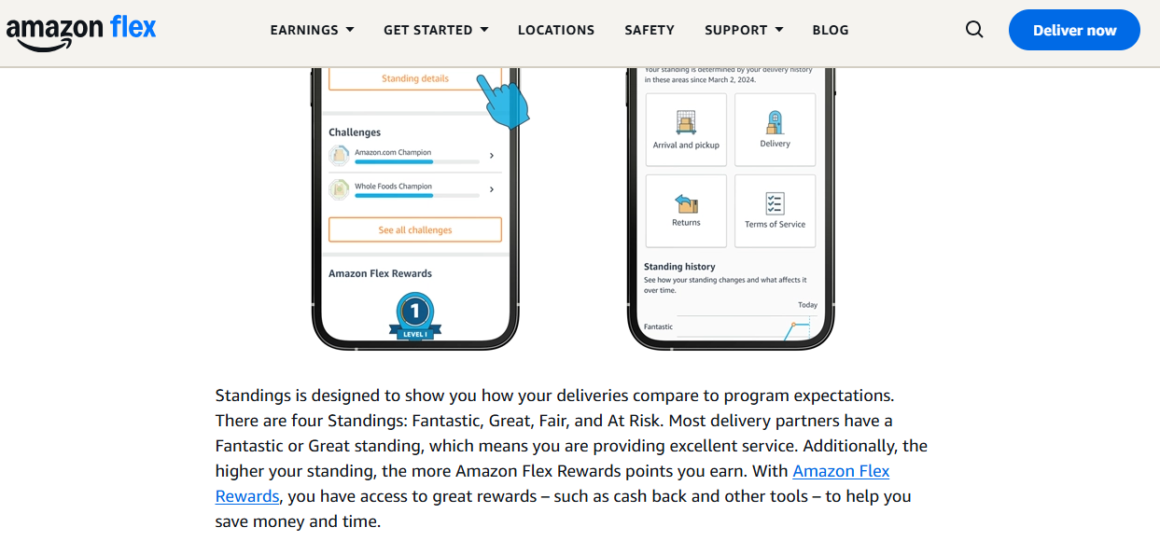
The “Delivered/Not Received” rate sits inside the quality metric. It counts every complaint where a customer says a package marked delivered never showed up. Drivers will get a flag on their account or a policy violation notice if customers mark that a package was not received, or was delivered to the wrong address.
What the system cannot flag is whether that customer then received a full refund or replacement from Amazon, suggesting the claim was accepted as legitimate. It cannot flag whether surveillance cameras in the area later showed a third-party theft. It cannot flag whether the driver has a 99 percent delivery rate across 2,000 packages and one anomalous stretch of bad luck with a high-theft neighborhood.
One current Flex driver said:
“I am committed to my job as a Flex driver and providing a good service, but it is disheartening to know that the automated system could deactivate my account at any time, without warning, just as happened to other members of my family.”
That quote appeared in a brief published by the National Employment Law Project9, which called Amazon’s Flex model a system of precarious labor that harms workers in structural ways.
The same report recommended that policymakers regulate workplace digital surveillance and algorithmic management, and increase public enforcement of Amazon’s independent contractor misclassification of Flex drivers.
The Contractor Label Doing Heavy Lifting
The independent contractor classification is doing enormous work in this story.
Because Flex drivers are contractors and not employees, Amazon does not owe them the protections that employment law would otherwise require. No paid leave. No unemployment benefits. No obligation to carry out a fair investigation before termination. No obligation to explain the specific evidence behind a deactivation decision.
Human Rights Watch documented that platforms including Amazon Flex unilaterally set pay rates and deny avenues for wage negotiations. Workers’ earnings are frequently at the mercy of complex algorithmic systems that regulate the frequency and profitability of job requests offered to each worker based on their compliance with performance metrics. Without labor protections or bargaining power, platform workers are vulnerable to wages below living and minimum wage standards, wage theft, income insecurity, physical injury while on the job, and unexplained firings.
The legal challenges have been piling up. In October 2025, the New Jersey Attorney General10 and the Department of Labor and Workforce Development sued Amazon and its Amazon Logistics delivery network for misclassifying Flex delivery drivers as independent contractors and unlawfully depriving them of rightful wages, benefits, and legal rights and protections afforded to employees.
In Spain, a court ruled that Amazon must employ delivery drivers as employees rather than contractors. The Spanish Labor Court emphasized that when working conditions are controlled by an algorithm, there is an employment relationship. The court called for algorithm transparency and the establishment of protection for workers.
That phrase, algorithm transparency, is worth sitting with. In the United States, drivers do not know exactly how many flags will trigger a deactivation. They do not know the weighting applied to different types of complaints. They do not know whether the photo they take, the call they log, or the email they send to support will be reviewed by anyone before their account is shut down.
Seattle’s Office of Labor Standards11 reached a $3.78 million settlement with Amazon Flex over alleged violations of three city laws intended to protect gig workers, including the Gig Worker Premium Pay and Gig Worker Paid Sick and Safe Time ordinances. It was the second-largest settlement in the office’s history.
The deactivation experience, as described by former drivers across forums, Reddit threads, and legal filings, follows a recognizable pattern. An email arrives. It says the account has been deactivated due to violations of the delivery quality standard or for behavior inconsistent with Amazon’s independent contractor terms. It may or may not specify which deliveries triggered the action. It offers a ten-day window to appeal.
The appeal goes to an email address. There is no special appeals process or dedicated deactivation team to contact. Amazon will instruct drivers to send them an email providing additional information within 10 days of the reactivation request. Amazon may reactivate the account, but drivers are advised to keep their messages short and professional to increase their chances of success.
One former driver described on a ridesharing forum having a 98 percent positive rating and more than 1,000 deliveries completed before a sudden deactivation with no clear reason given. The appeal was denied. No specific explanation was ever provided. This kind of account appears with regularity across Uber Drivers Forum, Reddit communities for Flex drivers, and Trustpilot reviews of the program.
Amazon has many drivers in places like Los Angeles and will deactivate for whatever reason unless an issue is reported. The bottom line: always call support and ask for any problem resolution to cover your tail.
That framing, cover your tail, captures something important about the power dynamic. A worker who is technically an independent contractor is advised to proactively build a legal defense record against their own client on every shift, because that client may eliminate their access to work at any time with minimal explanation.
A Structural Problem Wearing an Operational Face
The clearest way to understand the no-contact delivery blame problem is not as a customer service failure or a logistics issue. It is a structural feature of a labor model that places maximum accountability on the people with the minimum power.
Amazon’s delivery photograph requirement creates an accountability record. But it is a one-sided record. It proves the driver dropped the package. It does not prove what happened in the seconds, minutes, or hours afterward. In a country where 63 percent of porch piracy victims say at least one of their stolen packages originated from Amazon or Walmart, the exposure is enormous.
Amazon12 introduced Photo on Delivery to provide a degree of accountability in its delivery process and proof that the package was in fact delivered. The photo may show up in the customer’s order history and can be viewed by customer service representatives when a package goes missing. That is the company’s own stated purpose for the feature: accountability and proof. But when a dispute arises, the proof has not, by most driver accounts, been enough to prevent flags from accumulating.
A driver named Omary, working out of the Monroe, New Jersey, delivery station, put it plainly in a statement included in the National Employment Law Project brief:
“Amazon has lined its pockets by cutting our rates, forcing us to work too fast, and making us pay costs that should be its own.”
The costs he refers to include the real cost of porch theft, which Amazon partially absorbs through its consumer guarantee, but redistributes in career-ending form through its driver rating system.
This is the deal, stripped to its essentials: Amazon replaces the stolen package for the customer and builds goodwill. The driver absorbs the career cost of the loss. The porch pirate walks away clean. And Amazon, which designed and maintains this entire system, bears none of the employment consequences.
What a Better System Would Look Like
There are obvious interventions that would change this calculus. Amazon already has GPS data from every delivery. It has timestamped photographs. In theory, it has access to neighborhood-level theft data. If three packages on the same block go missing in the same week, and multiple drivers took photographs showing the packages at the door, the common factor is not the drivers. It is the block.
A system that grouped “delivered/not received” complaints by geography, time of day, and theft-rate clusters would tell a very different story than one that simply attaches each complaint to the last known human who touched the package. It would distinguish between a driver who systematically fails to complete deliveries and a driver who works a high-theft urban corridor where residents report theft repeatedly.
Such a system would require Amazon to invest in the investigation it currently outsources to an algorithm. It would require the company to treat drivers as participants in a shared accountability model rather than as the terminal point of all liability.
It would also, incidentally, be more accurate. And accuracy, in a system this large, matters. Amazon delivers millions of packages every day. Even a small misattribution rate represents thousands of drivers incorrectly flagged, some of whom will lose their accounts over complaints that had nothing to do with their conduct.
For now, the driver takes the photo, marks the delivery, and drives away. The clock starts. And somewhere between the doorstep and the customer’s hands, the chain breaks, and the break finds its way back to the person who no longer has the package and no longer has any control over what happens next.
The machine has already decided.
Sources
- “Amazon Flex” Use Your Own Vehicle to Deliver Packages, flex.amazon.com/. Accessed 13 July 2026. ↩︎
- “Blog” Flex Swag, 20 Oct. 2025, flexswag.us/blog/. Accessed 13 July 2026. ↩︎
- Yahoo! Finance, finance.yahoo.com/news/americans-lost-15-7-billion-120000316.html. Accessed 13 July 2026. ↩︎
- “Package Theft in the United States” Office of Inspector General, 30 Oct. 2024, www.uspsoig.gov/reports/white-papers/package-theft-united-states. Accessed 13 July 2026. ↩︎
- “Bloomberg” Are you a robot?, www.bloomberg.com/news/features/2021-06-28/fired-by-bot-amazon-turns-to-machine-managers-and-workers-are-losing-out. Accessed 13 July 2026. ↩︎
- “Independent Contractor Arbitration Clause from Amazon” Articles, 20 May 2026, www.lawinsider.com/resources/contract-teardown/independent-contractor-arbitration-clause-from-amazon. Accessed 13 July 2026. ↩︎
- People.com, people.com/amazon-delivery-drivers-plead-guilty-to-usd58k-fraud-scheme-of-keeping-customers-packages-11896801. Accessed 14 July 2026. ↩︎
- 30, June. “Using Standings to succeed with Amazon Flex” 12 Dec. 2024, flex.amazon.com/blog/using-standings-to-succeed-with-amazon-flex. Accessed 13 July 2026. ↩︎
- Cooney, Eleanor. “New Brief Sheds Light on the Amazon’s Dangerous ‘Flex’ Labor Model” National Employment Law Project, 9 July 2025, www.nelp.org/new-brief-sheds-light-on-the-amazons-dangerous-flex-labor-model/. Accessed 13 July 2026. ↩︎
- NJOAG, www.njoag.gov/wp-content/uploads/2025/10/www.njoag.gov/wp-content/uploads/2025/10/2025-1020_AMZ_Stamped-complaint.pdf. Accessed 13 July 2026. ↩︎
- “October – December 2025” Seattle.Gov, www.seattle.gov/laborstandards/investigations/resolved-investigations/october-%E2%80%93-december-2025. Accessed 13 July 2026. ↩︎
- Amazon, www.amazon.com/gp/help/customer/display.html?nodeId=GEE76GMYKN4HEYLK. Accessed 13 July 2026. ↩︎