

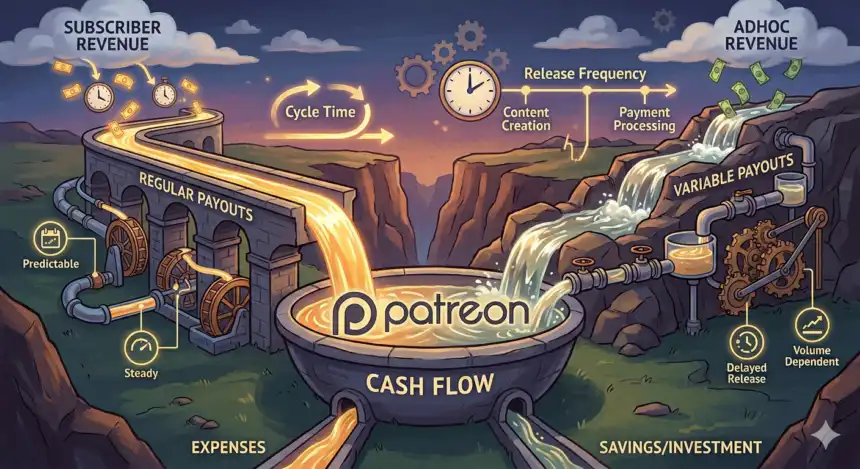

The 28th of every month can be a scary time for creative people. Not the anxiety of whether the work is good. Not the fear of a blank page. It is the quieter, more corrosive worry of whether the rent is going to clear before the credit card autopay hits. It is a money problem dressed up as a calendar problem, and for hundreds of thousands of creators on Patreon, it has been the defining feature of their financial lives for years.
- The Basic Architecture: Layers of Delay
- The Billing Model Problem: When You Post Is When You Get Paid
- The First-of-the-Month Trap
- The Float: Patreon’s Hidden Revenue Stream
- How Smart Creators Game the System
- Timezone Chaos: When the Clock Is Itself a Problem
- The Subscription Billing Migration: A Forced Reckoning
- The Bigger Picture: Rented Land, Borrowed Time
- What Creators Can Actually Do
Patreon was supposed to fix this. According to TIME1, Jack Conte, one half of the YouTube music duo Pomplamoose, co-founded the platform in 2013; the pitch was elegant: fans would pay creators directly, on a recurring basis, cutting out the ad-revenue middleman that had turned content creation into an algorithmically miserable experience. A musician who got a million YouTube views but cleared $300 in ad revenue could instead charge 300 fans $10 a month and make a real living. The idea was sound. The execution, a decade on, is considerably more complicated.
What nobody tells you when you set up a Patreon page is that the platform is not just a payment processor. It is a timing machine. The moment you decide when to post your content, which billing model to use, and when to withdraw your earnings, you are participating in a system designed with its own logic. And that logic does not always point in the direction of the creator’s financial health. Understanding how Patreon’s payout architecture works is not a trivial matter of administrative housekeeping. It is, for many full-time creators, the difference between a sustainable business and a month-to-month scramble.
The Basic Architecture: Layers of Delay
Let’s start with the mechanics, because the mechanics matter.
Patreon’s2 automatic payout system fires on the 5th of each month, sweeping your available balance into whatever bank account or PayPal you have connected. Deposits typically arrive within 10 days after that. That last detail is important and underreported: when creators talk about being “paid on the 5th,” what they often mean is that the money leaves Patreon on the 5th and arrives somewhere between the 8th and the 15th of the month, depending on your bank, your country, and which payout method you are using.
Direct deposit through ACH, available to U.S. creators, typically takes 3 to 7 business days to process. PayPal is generally faster, usually arriving within two business days. For creators outside the United States, the timeline gets longer. International creators using Payoneer can sometimes wait even longer, and if there are blockers or documentation issues, creators must work through Payoneer’s own verification process before funds arrive at all.
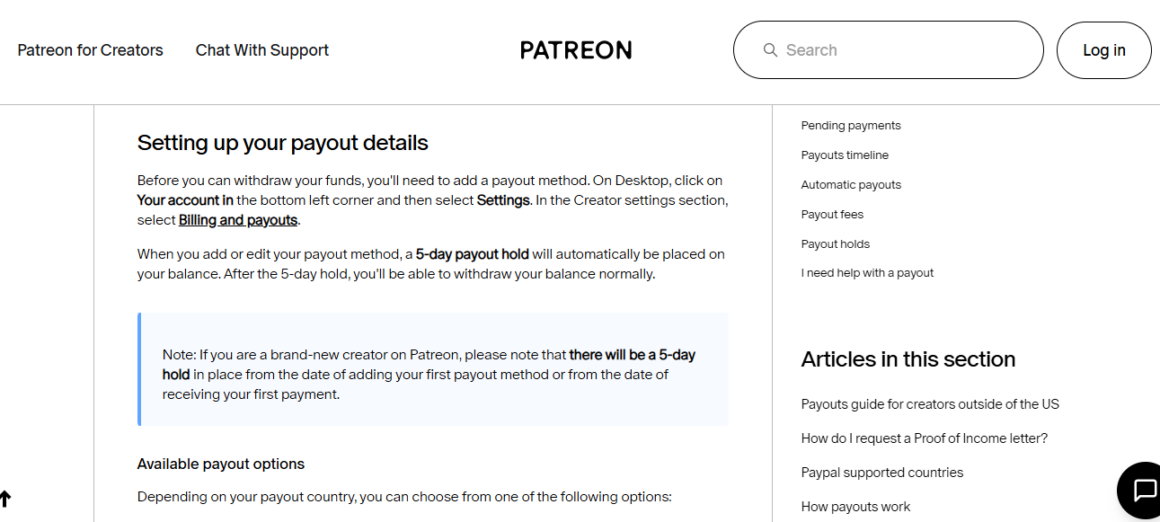
This is before we get to the holds. A 5-day payout hold is placed on your account whenever you add your payout method for the first time, or when you update your payout information. That might sound minor, but for a creator who changes banks, moves internationally, or is simply new to the platform, it means a week of frozen earnings on top of the already substantial processing lag. There is also a W-9 requirement for U.S. creators who hit certain income thresholds: all payouts are locked until Form W-9 is successfully submitted. Tax compliance as a financial chokepoint. Welcome to the creator economy.
Then there is the Apple problem, which is newer and considerably more dramatic. Patreon Support3 states that funds from product sales made via iOS in-app purchases remain pending for up to 75 days before they are available for payout, reflecting the time Apple requires to process and confirm the funds. Seventy-five days. Two and a half months. Commerce funds from iOS sales are held for up to 75 days before payout, compared to 7 days for web purchases. That gap, 7 days versus 75 days, is not a rounding error. It is a structural feature of the platform that has reshaped how financially literate creators think about which device they want their fans to subscribe from.
The Billing Model Problem: When You Post Is When You Get Paid
The deeper manipulation story, though, is not about processing delays. It is about billing models and the way they create powerful incentives and disincentives around the timing of creative work itself.
Patreon4 has historically offered several billing structures. The monthly (non-charge upfront) model charges paid members on the 1st of each month for the access they had the previous month. The per-creation model charges members for each paid post the creator makes, with those charges processed on the 1st of the following month.
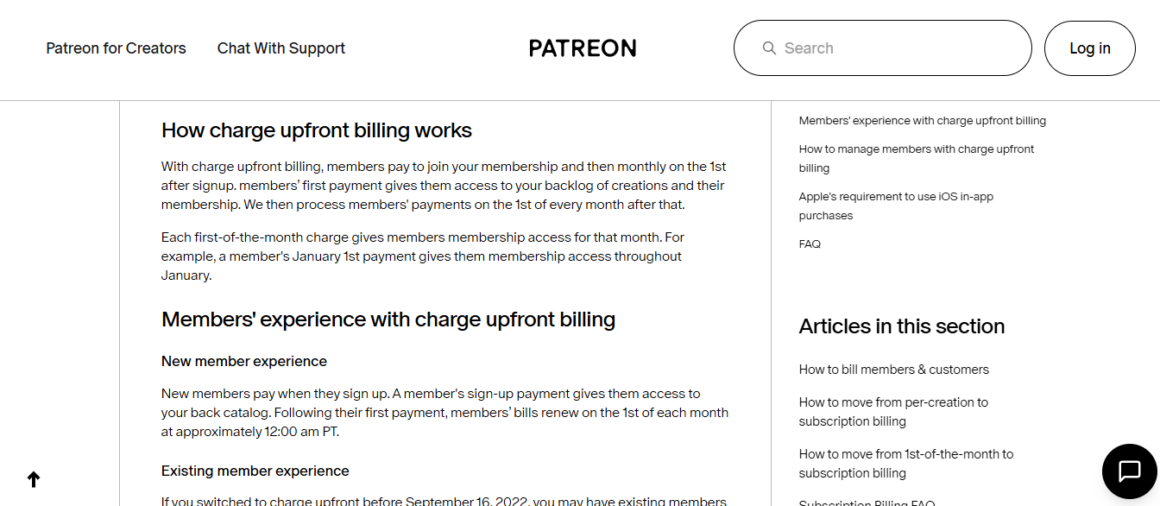
That per-creation model, now retired for new creators but still in use by a substantial portion of the existing creator base, introduced a particular kind of timing leverage. If a creator makes a paid post on June 1st, a pending bill is placed on active members’ accounts, and those pending bills are processed on July 1st. A creator posting on June 30th and a creator posting on June 1st both get paid on July 1st. One of them waited 30 days for that money to move. Neither of them had any ability to accelerate it.
The psychological effect of this structure was significant. Patreon creator Proxxie5, writing in a candid 2024 post about switching billing models, put it bluntly:
“The billing schedule sometimes affected the release schedule, which I didn’t really like. In the past, I was usually hesitant to release things late in the month. New releases usually lead to new signups, but if it’s late in the month those people end up getting kinda shafted. Or I might try to release something on the last day of the month, so that existing supporters would get access to it, but new signups would only have to wait a day to avoid getting hosed.”
Read that twice. A creator was making decisions about when to release their art based on when the billing cycle rolled over. The creative calendar was being shaped by the payment calendar. This is the quiet, underappreciated distortion at the heart of Patreon’s payout timing system: it does not just delay money, it warps the work itself.
The First-of-the-Month Trap
The first-of-the-month billing structure, which was Patreon’s default for years, created a compounding problem that the platform’s own data eventually made undeniable. Under this system, new patrons who joined mid-month would be charged immediately upon signup. And then charged again on the 1st of the following month, sometimes just days later. To a patron who joined on the 27th, two charges in three days looked like double billing even if it technically was not. The perception was the damage.
Patreon’s own internal data showed most patron cancellations in the first week of every month compared with the rest of the month. More than half again as many people leaving as on any other week. And the cause was largely structural: the confusion and frustration of the first-of-the-month billing reset, which made patrons feel like they were being squeezed even when everything was technically working as designed.
For creators, this monthly cancellation spike was a cash-flow nightmare with a predictable shape. Revenue would build through the month as new patrons signed up, and then a predictable chunk of it would evaporate in the first week as confused or frustrated patrons cancelled. Creators could see it coming. They knew from experience that the 1st through the 7th was going to be ugly, but they could not stop it. The billing architecture made them helpless observers of their own revenue volatility.
Creators on subscription billing saw a steady flow of new patrons throughout the month, overcoming the end-of-month drop-off from patrons who didn’t want to pay twice in a short amount of time. According to Influence Marketing Hub6, creators who promote their membership once a week earn 31% more than creators who only promote once a month. That second data point is worth dwelling on. The platform’s own research shows that promotional frequency directly correlates with income, but the old billing model actively punished creators for promoting at the wrong time of the month, because a new patron joining on the 28th would be double-charged within days, complain, cancel, and leave a bad taste that spread through word of mouth.
The system, in other words, was not neutral. It had a preference. And that preference was for early-month signups.
The Float: Patreon’s Hidden Revenue Stream
There is a more pointed critique buried in all this, and it requires thinking about where the money actually sits while all these delays are accumulating.
Sacra7 estimates that Patreon generated $179 million in revenue in 2025, up 28% year-over-year from $140 million in 2024. The company is valued at $4 billion following its $155 million Series F round in April 2021. That is a substantial operation built on, fundamentally, holding creator money and disbursing it on a schedule.
When a patron pays their monthly subscription, that money does not teleport into the creator’s bank account. It sits in Patreon’s8 payment infrastructure, processed by Stripe or handled through Apple, for days or weeks before it becomes available to withdraw. The average monthly payout to creators has gone from $12.44 million in January 2019 to $24.31 million by October 2024. At any given moment, given the multi-day processing delays on hundreds of millions of dollars in monthly transactions, there is a meaningful pool of money sitting in transit. The interest earned on that float, while never disclosed by Patreon, is a real if opaque financial benefit to the platform.
This is not unique to Patreon. Every payment processor in existence benefits from float. But the unusually long hold periods on the platform, particularly the 75-day Apple IAP hold, magnify the effect in ways that deserve scrutiny. The most damaging change hit in November 2024, when Apple forced all new Patreon memberships purchased via iOS to use in-app purchases. According to Hacker News9, Apple takes 30% of every iOS transaction, meaning creators receive only 70 cents for every dollar pledged.
The Apple tax, as creators have taken to calling it, is not Patreon’s fault in the conventional sense. The platform openly disagreed with the decision, writing in a company blog post:
“Creators need consistency and clarity in order to build healthy, long-term businesses.”
Patreon noted that the policy reversal was “the third such change from Apple in the past 18 months.” But the result for creators is a system where a significant and growing share of their revenue is subject to either a punishing 30% fee or a 75-day cash lockup, conditions that make short-term financial planning extremely difficult.
According to Ruzuku10, when combined with standard payment processing fees of typically 2.9% plus $0.30 per transaction, creators report total deductions reaching 13 to 14% or even 20 to 30% in some instances. For a creator making $3,000 a month, a figure that puts them in roughly the top 10% of Patreon earners, that can mean $400 to $900 in platform costs before a single dollar hits their account.
How Smart Creators Game the System
Given this architecture, it should come as no surprise that experienced Patreon creators have developed sophisticated timing strategies to maximize their take-home pay and minimize the damage from cash-flow gaps.
The per-creation billing model, despite being discontinued for new accounts, created a particular kind of strategic opportunity that creators with access to it actively exploited. Under that model, the timing of a “paid post” determined when members were charged. A creator who understood the billing cycle could publish a paid post on the 29th or 30th of the month, trigger charges for all existing members, and then also attract new signups who would be charged the following month. Done carefully, particularly with the “last day of the month” strategy, this allowed a creator to essentially double-dip on conversion events without the double-charging problem.
The artist behind Darkest Desire11, explaining per-creation billing to their own community in 2022, was unusually transparent about the mechanics:
“With this billing system you won’t be charged until I release another set anyway, so there is no reason to downgrade after my release! But, of course, you can still do it. Decreasing your membership will not change the amount of any pending bills already posted to your billing history.”
This is a creator actively teaching their patrons how the billing logic works in order to prevent unnecessary churn. The educational impulse is genuine, but notice what it reveals: the creator had mapped the system well enough to explain its pressure points to an audience.
On the subscription billing side, the strategic landscape shifts. The key difference between subscription billing and first-of-the-month billing is how your account balance accumulates steadily throughout the month or as a larger amount at the start. The total accumulation remains the same if payouts are made at the same time each month. But the steady accumulation model, while smoother, creates its own timing opportunities. A creator who knows their payout auto-fires on the 5th and takes up to 10 days to arrive can plan large expenses, equipment purchases, freelancer payments, and software subscriptions to land after the 15th, when the money is reliably in the bank.
Manual withdrawals offer a different kind of control. Once your balance is above the minimum threshold, you can withdraw funds at any time, but no more than once in 24 hours. Manual withdrawals give you control over the timing of your transfer. You can avoid fees by waiting to have a bigger balance, or wait until exchange rates are favorable. For international creators dealing with currency conversion, this is not trivial. A creator in the UK, Australia, or Canada who is paid primarily in USD can save meaningful money by timing their withdrawals to coincide with favorable exchange rate windows, rather than taking the automatic 5th-of-the-month payout regardless of market conditions.
Some creators prefer to generate considerable cash over time, from which they can withdraw and run a larger project or even a business. Others prefer much more regular, smaller payments against various cash flows. These are not just aesthetic preferences. They are genuine financial strategies with real differences in outcomes, shaped by the creator’s tax situation, their fixed monthly costs, and the volatility of their patron base.
Timezone Chaos: When the Clock Is Itself a Problem
In July and August 2025, Patreon12 processed all charges at 12 am UTC, which meant many U.S. creators saw their earnings appear later in the day. Some charges were processed on the evening of the last day of the month, after 5 pm PT, and the rest were processed on the 1st of the month, also after 5 pm PT. This split caused some of the usual 1st-of-the-month earnings to appear earlier or later than expected, and totals for July and August looked lower as a result.
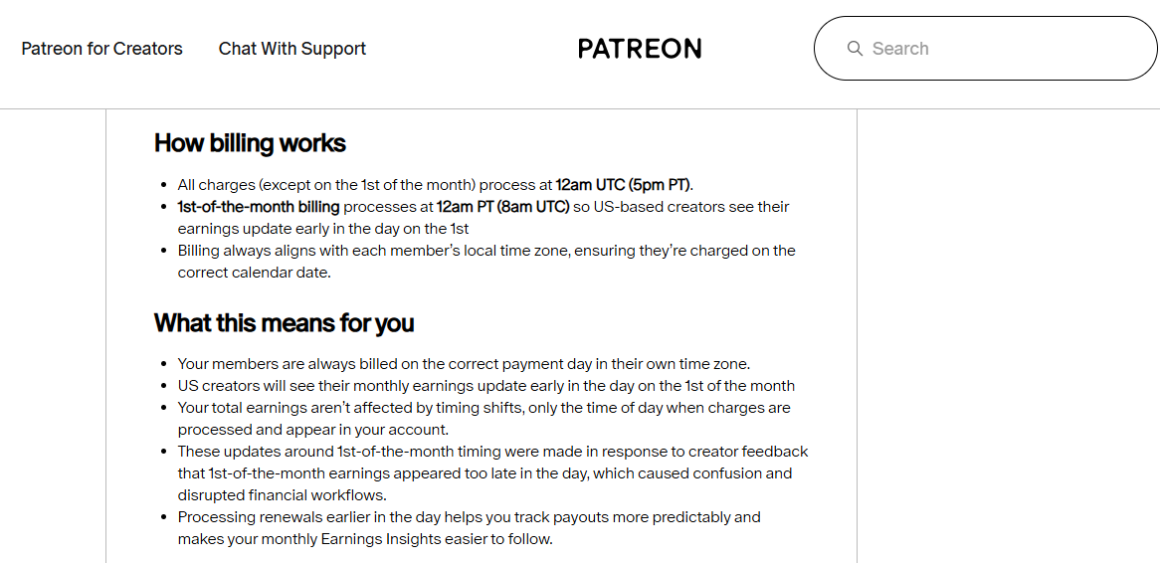
Patreon has since acknowledged the problem. These updates around 1st-of-the-month timing were made in response to creator feedback that 1st-of-the-month earnings appeared too late in the day, which caused confusion and disrupted financial workflows. The phrase “disrupted financial workflows” does a lot of work. What it means in practice: creators who had rent due on the 1st, or automated transfers scheduled for the morning of the 1st, found themselves short because their Patreon income landed later in the day than expected. The platform’s internal clock was, quite literally, causing people to miss payments.
This is not a minor UX complaint. For a creator running on a thin margin (and many are) the difference between money arriving at 9 am and money arriving at 11 pm is not trivial. It is the difference between an on-time payment and a late fee.
The Subscription Billing Migration: A Forced Reckoning
Patreon13 is now forcing the issue. All creators still using legacy billing will be required to switch to subscription billing by November 1, 2026. The deadline is firm, and the implications for creators who have built their content calendar around the old billing logic are significant.
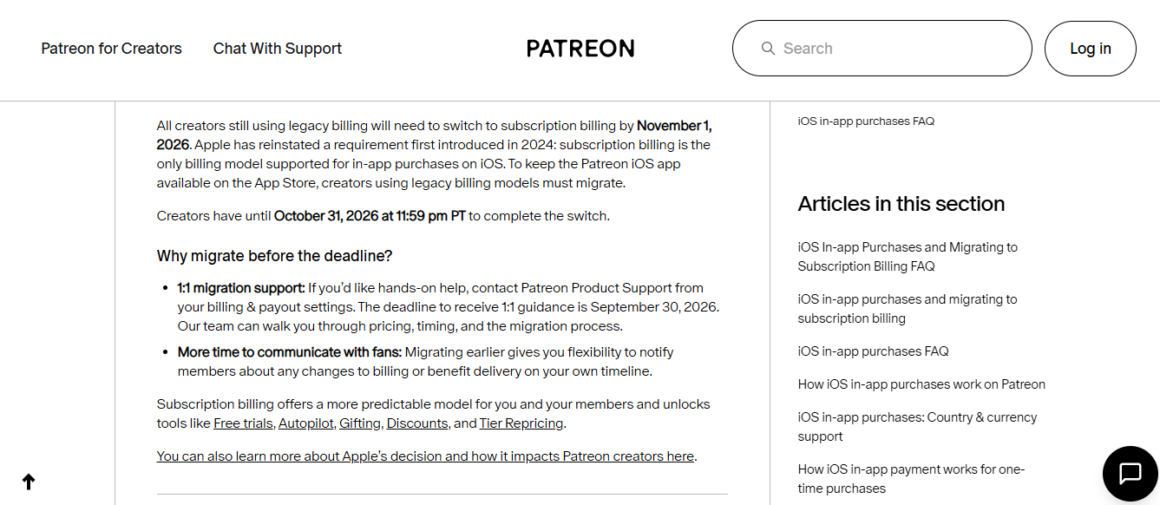
Under first-of-the-month billing, a creator could predict with reasonable confidence when their money would land each month: charges processed on the 1st, auto-payout fired on the 5th, money in the bank by the 15th at the latest. The rhythm was predictable if not ideal.
Under subscription billing, funds become available as soon as they are settled. Most creators choose automatic payouts on the fifth of each month, but you can also manually withdraw a lump sum whenever you prefer. The total accumulation remains the same over a month, but the shape of it changes; instead of one large deposit on roughly the 15th, creators on subscription billing see a rolling trickle of smaller amounts arriving throughout the month as individual patron anniversaries hit. For a creator with 50 patrons, those 50 billing events are now spread across 30 days rather than concentrated on one day.
For creators who currently rely on 1st-of-the-month billing workflows, like those who deliver physical benefits monthly, subscription billing requires fundamentally rethinking benefit delivery. A creator on subscription billing needs to filter by Last Charge Date rather than delivering benefits to everyone at once. Rory Blank14, a creator who ships physical zines to subscribers, wrote about this with characteristic practicality:
“My current plan is to schedule mail days to be around the last day of a month or the first day of the next month, and filter it to everyone who was a paid subscriber during that month. That seems like the tidiest way to handle it.”
What sounds like a logistical shrug is actually a meaningful operational pivot. A creator redesigning their entire fulfillment process because the platform changed the payment architecture.
The Bigger Picture: Rented Land, Borrowed Time
The hard truth about Patreon’s payout timing system is that it reflects a deeper structural reality of the creator economy. According to Passion15, one Reddit creator whose account was deactivated in August 2024 after two years advised others:
“A company having the right to destroy your livelihood on a whim is a basket you don’t wanna put all your eggs in.”
This is not hyperbole. Every dollar a creator earns on Patreon is, until it clears their bank account, money that lives on someone else’s infrastructure. The timing delays, the holds, the Apple lockups, the timezone confusion. None of these are accidental features. They are the friction inherent in operating a financial intermediary at scale. Patreon16 takes a platform fee of 10% for creators on the standard plan, while legacy plan creators may pay 5%, 8%, or 11%. Apple takes 30% of iOS transactions. Payment processors take their cut. What reaches the creator at the end of this chain is a number that often bears only passing resemblance to what appeared on the patron’s credit card statement.
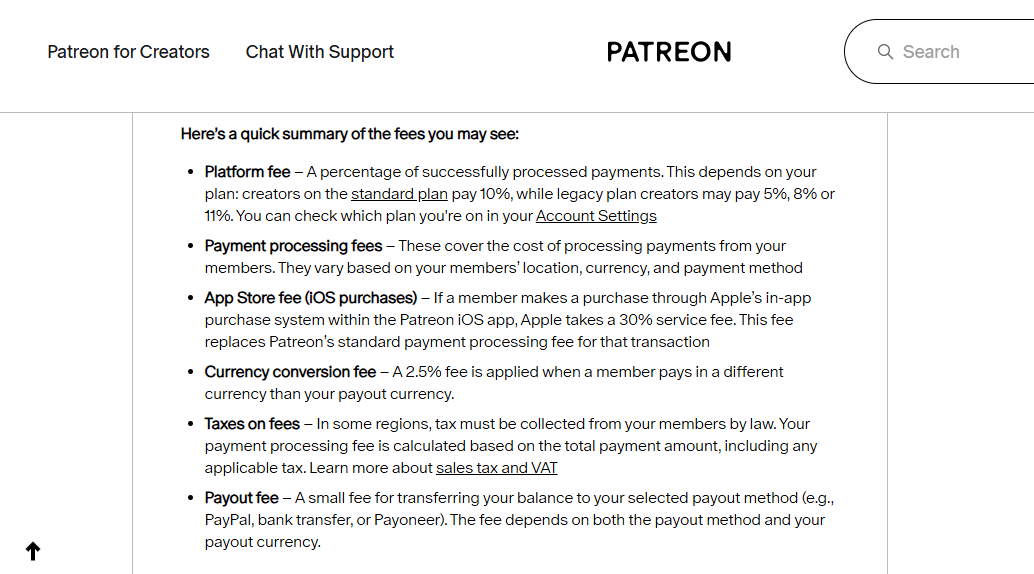
According to The Outline17, comic artist Gibson Twist captured the sentiment when Patreon changed its fee structure:
“They’re trying to sell it to us as ‘You get a bigger percentage of the money!’ but a bigger percentage of less money isn’t a selling point.”
The language of creator empowerment has always been Patreon’s strongest marketing asset. The platform talks about creators running businesses, building communities, achieving financial independence. But the payout timing system tells a more honest story. One of creators waiting for their money to clear, adjusting their release schedules to avoid billing confusion, planning physical fulfillment around rolling subscription dates, and hoping the bank deposit arrives before the car payment autopays.
Platforms like Patreon and YouTube follow fixed monthly cycles, while OnlyFans and Substack offer more frequent access to earnings. That comparison matters. Substack, for instance, processes payments and makes funds available much faster than Patreon’s standard cycle. For a writer choosing between platforms, the payout timing is not a minor consideration. It is a cash-flow question with real consequences.
What Creators Can Actually Do
The practical guidance, after all this, is not complicated, but it requires that creators engage with their payout settings with more attention than most do.
First, understand your billing model and what it means for when your money actually moves. On subscription billing, your balance builds daily; on legacy monthly billing, it concentrates at the start of the month. Neither is objectively better, but one may suit your expense rhythm better than the other.
Second, use manual withdrawals strategically if you are an international creator. Waiting to withdraw until you have a larger balance, or until exchange rates are favorable, can make a meaningful difference in your final take-home amount.
Third, if any meaningful portion of your income comes from iOS users, build the 75-day Apple hold into your cash-flow projections. Apple processes transactions and then remits payment to Patreon, which can take up to 75 days after the transaction date. That money is real; it is yours, but it is not available. Treat it as a receivable on a long payment term, not as liquid cash.
Fourth, watch the timezone problem. Any payout hold on your account will interfere with the auto-withdrawal process. If you add or update your payout method within 5 days of the 5th of the month, your balance payout lock will prevent auto-withdrawal. Do not make payout method changes close to the 5th unless you are prepared to trigger a manual withdrawal later.
Finally, think carefully about when you release premium content. The days when the per-creation billing model made late-month releases actively risky are winding down as the migration to subscription billing progresses. But the underlying truth remains: release timing and billing timing are not independent variables. They interact in ways that either cost you money and patrons, or don’t.
The creator economy runs on a promise: that talented people can find an audience, charge that audience fairly for their work, and build something sustainable. Patreon has helped make that promise real for a meaningful number of people. According to Electro IQ18, the number of paid creators on Patreon grew from 25,646 in February 2017 to 279,566 by November 2024, and monthly payouts to creators have grown from $12.44 million in January 2019 to $24.31 million by October 2024. Those are not small numbers. The platform works.
But working and being fair are different things. The timing architecture of Patreon’s payout system, its holds, its processing delays, its Apple-imposed lockups, its first-of-the-month cancellation spikes, is not designed around the financial needs of creators. It is designed around the operational requirements of a payment intermediary operating at scale in a regulatory environment shaped by banks, Apple, and the U.S. tax code. The result is a system that creators must learn to navigate, not because they are financially sophisticated, but because the alternative is being surprised every month by money that arrives late, less than expected, and on a timeline that does not respect the rent cycle.
The calendar problem is a money problem. It always was.
Sources
- Luckerson, Victor. “Patreon Crowdfunding Platform for YouTube Stars KickStarter Jack Conte” 21 July 2014, time.com/3012914/patreon-kickstarter-youtube-crowdfunding/. Accessed 9 July 2026. ↩︎
- Patreon, support.patreon.com/hc/en-us/articles/208656246-How-payouts-work. Accessed 9 July 2026. ↩︎
- Patreon, support.patreon.com/hc/en-us/articles/31147260274957-What-to-expect-with-iOS-in-app-purchases. Accessed 9 July 2026. ↩︎
- Patreon, support.patreon.com/hc/en-us/articles/210291283-How-does-charge-upfront-billing-work. Accessed 9 July 2026. ↩︎
- “Switch to Subscription/Anniversary Billing” Proxxie on Patreon, 13 Jan. 2024, www.patreon.com/proxxie/posts/switch-to-96414008. Accessed 9 July 2026. ↩︎
- Molenaar, Koba. “24 Patreon Statistics for 2024: Revenue, Earnings, and Creator Data” 13 July 2021, influencermarketinghub.com/patreon-stats-revenue-users/. Accessed 9 July 2026. ↩︎
- “Patreon revenue, valuation & funding” Sacra, sacra.com/c/patreon/. Accessed 9 July 2026. ↩︎
- Patreon, support.patreon.com/hc/en-us/articles/214796706-Where-is-my-Payout. Accessed 9 July 2026. ↩︎
- “Apple to soon take up to 30% cut from all Patreon creators in iOS app” Hacker News, news.ycombinator.com/item?id=46801419. Accessed 9 July 2026. ↩︎
- Crystal, Abe. “Patreon Pricing 2026: What It Actually Costs Creators” Ruzuku, 26 Mar. 2026, www.ruzuku.com/learn/articles/patreon-pricing. Accessed 9 July 2026. ↩︎
- Patreon, www.patreon.com/posts/everything-you-63777162. Accessed 9 July 2026. ↩︎
- Patreon, support.patreon.com/hc/en-us/articles/36755487985677-Patreon-billing-time-zones-overview. Accessed 9 July 2026. ↩︎
- Patreon, support.patreon.com/hc/en-us/articles/28801582599181-iOS-In-app-Purchases-and-Migrating-to-Subscription-Billing-FAQ. Accessed 9 July 2026. ↩︎
- Patreon, www.patreon.com/posts/patreon-changing-110036856. Accessed 9 July 2026. ↩︎
- Gil, Julieta. “The Patreon Exodus: Why Creators Are Building Their Own Branded Apps” 10 Jan. 2025, passion.io/blog/the-patreon-exodus-why-creators-are-building-their-own-branded-apps. Accessed 9 July 2026. ↩︎
- Patreon, support.patreon.com/hc/en-us/articles/22581195376909-Creator-fees-FAQ. Accessed 9 July 2026. ↩︎
- Knepper, Brent. “No one makes a living on Patreon” The Outline, 7 Dec. 2017, theoutline.com/post/2571/no-one-makes-a-living-on-patreon. Accessed 9 July 2026. ↩︎
- Dey, Maitrayee. “Patreon Statistics And Facts (2025)” 21 May 2025, electroiq.com/stats/patreon-statistics/. Accessed 9 July 2026. ↩︎


