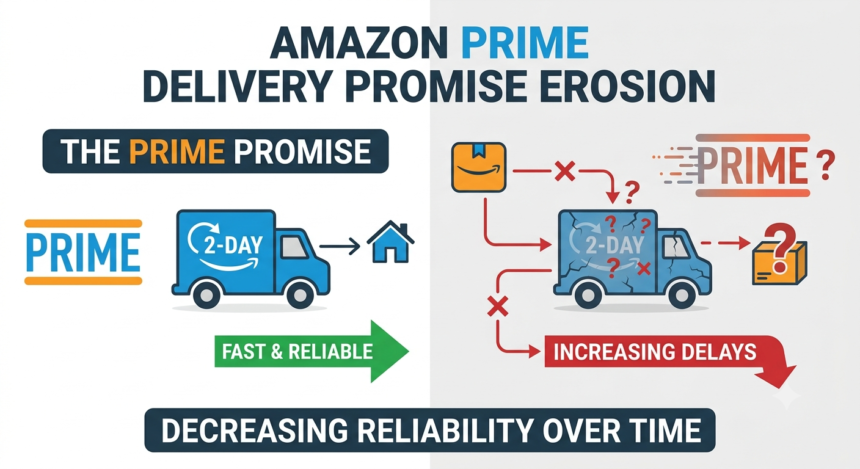

Amazon built an empire on the guarantee of fast, free delivery. Now it is quietly walking that promise back, one fine-print update at a time. And hoping you won’t notice.
There is a moment most Amazon Prime members remember. The specific date varies, but the feeling is the same. You order something you need by Thursday. The product page shows a confident delivery date. You don’t think twice about it, because this is Prime. You pay $139 a year, and Amazon delivers. Then Thursday comes and goes. Then Friday. The package arrives Saturday, and when you try to find a mechanism to complain, you realize there isn’t much of one. A promotional credit, maybe. If you push hard enough, maybe $10. The company that built its entire brand on the speed of delivery has essentially trained its customer base to absorb the disappointment quietly.
What began as one of the most audacious and transformative promises in retail history, free two-day shipping on millions of items, for a flat annual fee, has become something considerably more elastic. The two-day standard is now a suggestion as much as a guarantee. The streaming service bundled into the membership now runs ads, and if you want to remove them, you pay more on top of what you already pay. The ZIP code you live in may determine whether you receive Prime’s core benefit at all, even if no one at Amazon will tell you that. And the process for signing up for Prime was, until recently, deliberately engineered to be far easier than leaving it.
This is a story about how a membership product that once felt genuinely revolutionary has been slowly, methodically diluted, and how the fine print, the legal battles, and the internal documents now expose exactly how that happened.
The Original Promise Was Real
When Amazon launched Prime in 2005, the pitch was disarmingly simple. About Amazon1 states that we had to pay $79 a year, get free two-day shipping on one million items.
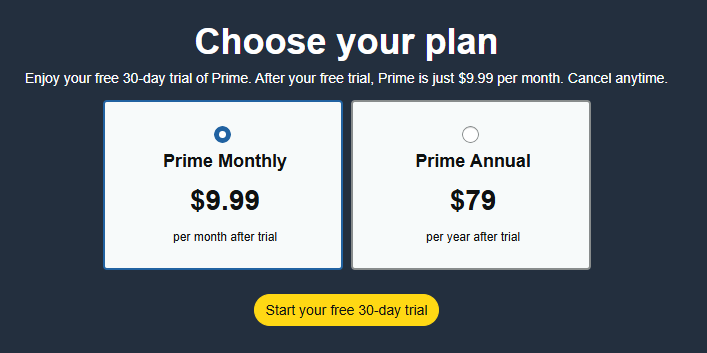
In a world where customers routinely paid $8 or $12 per delivery, the math was obvious. If you ordered more than a handful of things per year, Prime paid for itself. The speed was almost incidental to the economics.
But speed turned out to matter enormously. Amazon discovered early that faster delivery windows didn’t just satisfy customers. They changed shopping behavior entirely. As Doug Herrington, CEO of Amazon Worldwide Stores, explained at the National Retail Federation conference in January 2025:
“We know speed is important to customers, because the faster we deliver, the more they shop. When it’s got a faster promise, the conversion rate will go up.”
He added that a customer who experiences faster delivery “will come back to us sooner and shop more with us when they do.” Retail Brew2 states that Amazon reported delivering 7 billion items same-day or next-day in 2023, including more than 4 billion in the US, and claimed a 60% increase in same-day delivery locations.
Those numbers are not fabricated. Amazon’s logistics machine is genuinely impressive. A network of fulfillment centers, delivery stations, and contract drivers that has made it the largest parcel carrier in the United States. About Amazon3 says it delivered over 9 billion items in a single day in 2024. But aggregate speed statistics obscure something important: they describe what Amazon can do at its best, in its best markets, for its best customers. They say nothing about the growing number of customers for whom Prime no longer reliably delivers what it promises.
The Language Changed First
The most consequential shift in Amazon Prime’s delivery story is one that most customers never noticed because it happened in the fine print.
The original Prime pitch was a guarantee: two-day shipping. That word “guarantee” carried weight. It implied a commitment that, if broken, came with a consequence. Over time, Amazon’s language evolved. Listings began showing not a guarantee but an “estimated delivery date.” The platform replaced the confident two-day promise with language like “FREE One-Day or Two-Day Delivery if available.” This subtle shift indicates that speed isn’t guaranteed anymore. It depends on various factors like inventory availability and item location.
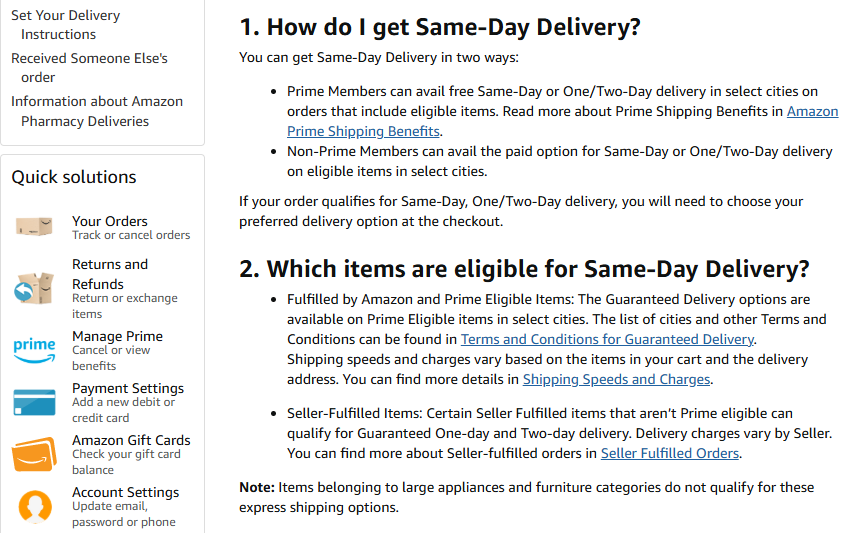
This matters more than it might seem. When courts have been asked to weigh in on Amazon’s delivery promises, they have pointed to Amazon’s terms of service, which describe delivery windows as “estimates” unless specifically marked as guaranteed. According to Reuters4, a Washington State judge in early 2025 dismissed a class-action lawsuit accusing Amazon of misleading Prime subscribers over late deliveries, citing precisely this distinction. Amazon had successfully constructed an escape hatch into its own terms of service, and customers, who experienced Prime as a guarantee every time they saw that Prime badge on a product listing, were buying a promise the company had quietly walked back in its legal documents.
The gap between the marketing and the contract is where most of the Prime erosion lives. Amazon advertises Prime on television, in checkout flows, and across its website as a fast-delivery service. The badge, blue and familiar, signals speed and reliability. But the underlying obligation has been carefully limited to something far more conditional.
A Geography of Service
In December 2024, The Washington Post5 reported that Washington D.C.’s attorney general filed a lawsuit that made explicit what many customers in lower-income and minority neighborhoods had suspected for years. The lawsuit alleged that since 2022, Amazon had secretly excluded two historically underserved D.C. ZIP codes from its expedited delivery service while charging Prime members living there the full subscription price.
The numbers in the complaint are stark. According to The Economic Times6, in 2023, even though Prime members nationwide received their packages within two days of checkout 75% of the time, subscribers in the excluded ZIP codes received their packages within two days only 24% of the time. Before the exclusion, more than 72% of Prime packages in those ZIP codes were delivered within two days. That number dropped to as low as 24% following the change.
What makes this case more than a local logistics story is what D.C. Attorney General Brian Schwalb alleged happened when affected residents complained. Amazon representatives falsely informed customers that slow delivery times were “never on purpose” or implied they were one-time occurrences caused by circumstances outside Amazon’s control. In other words, according to the lawsuit, Amazon’s customer service representatives were actively misleading customers about a deliberate operational decision.
This is not the first time Amazon has faced allegations of discriminatory service geography. A Bloomberg7 analysis in 2016 found that Amazon excluded predominantly Black ZIP codes to varying degrees from same-day delivery in six major cities. The company denied that race was a factor at the time. The December 2024 lawsuit renewed those questions with fresh evidence and a different legal mechanism: consumer protection law, which does not require proof of discriminatory intent, only proof of deception.
A parallel class action filed in April 2025 expanded the scope beyond D.C., alleging that Amazon covertly stopped providing its fastest delivery to Prime members in historically underserved communities across the United States, relying exclusively on third-party carriers like UPS and USPS instead of its own faster in-house delivery systems.
Amazon denied the allegations in both cases. But the existence of multiple simultaneous lawsuits making the same core claim, that Prime members are being charged for service they do not receive, in specific geographies, without disclosure, is not easily dismissed.
The Third-Party Problem
Part of what makes Prime’s delivery erosion difficult to measure is that it doesn’t have a single cause. One major structural factor is the growth of third-party sellers on Amazon’s marketplace, and the expanding definition of which products qualify for the Prime badge.
Amazon’s Fulfillment8 by Amazon (FBA) program,where sellers ship inventory to Amazon’s warehouses and Amazon handles delivery, is the most reliable path to true Prime delivery speeds. But a growing portion of Prime-badged listings come from sellers who fulfill their own orders, either through Seller Fulfilled Prime (SFP) or through various third-party arrangements. When those sellers underperform on delivery times, the customer experiences a Prime failure even though the failure originated outside Amazon’s own logistics network.
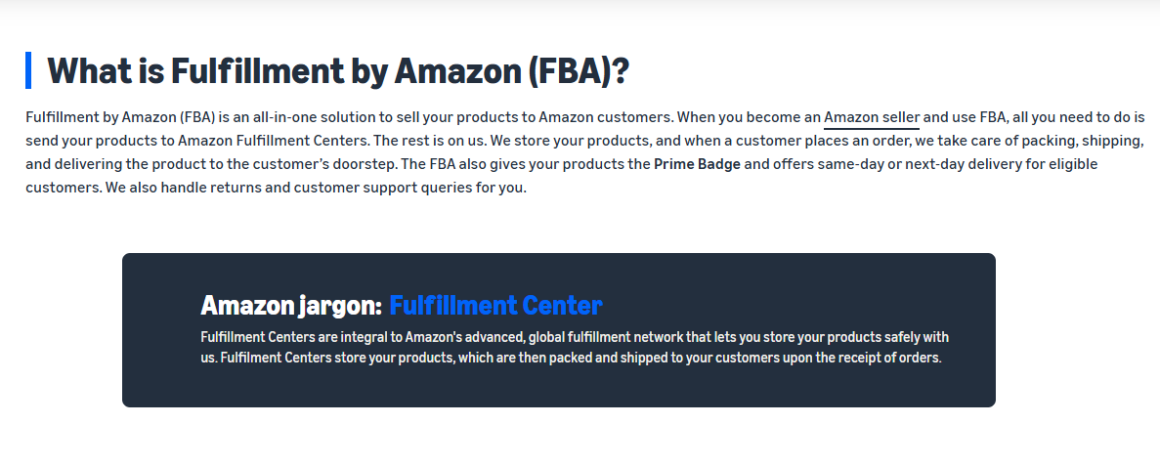
There is an increasing reliance on third-party sellers who handle their own shipping. While these listings can carry the Prime badge promising expedited service, they don’t always adhere to Amazon’s logistical standards unless they utilize Fulfillment by Amazon. Consequently, buyers may unknowingly select slower options when choosing cheaper listings over faster FBA alternatives.
Amazon has tried to address this through policy pressure. According to Amazon Seller Central9, effective September 2024, third-party sellers fulfilling their own orders were required to maintain a minimum on-time delivery rate of 90%, with sellers not meeting this threshold risking having their listings deactivated. But enforcement creates its own problems. One seller posted a blunt assessment of the dilemma in a seller forum:
“It will be impossible to maintain perfect 100% OTDR any longer. The only way to be over 90% is to increase your settings for transit and handling time, which will reduce your ability to be eligible for a Featured Offer. This puts all FBM in even bigger disadvantage compared to FBA.”
What this means for customers is that the Prime badge has become a less reliable signal than it once was. Two products can sit side by side in a search result, both sporting the Prime logo, with very different delivery realities attached to each one.
The Subscription Trap
While the delivery promise was eroding on one end, Amazon was simultaneously making it harder to walk away from Prime. This is the story that drew the most aggressive legal scrutiny, and it ended with consequences that Amazon’s shareholders felt directly.
In September 2025, Amazon agreed to pay $2.5 billion to settle Federal Trade Commission10 charges that it enrolled millions of consumers in Prime without their consent and deliberately sabotaged their attempts to cancel. The settlement included $1.5 billion in direct refunds to approximately 35 million affected customers.
The settlement documents revealed something that was already an open secret among consumer advocates: Amazon had internally named its Prime cancellation process the “Iliad Flow,” after Homer’s epic poem about the decade-long Trojan War. Amazon’s Prime cancellation process allegedly required consumers to navigate a four-page, six-click, fifteen-option sequence that included repeated diversions, such as discount offers or reminders of Prime benefits. According to an FTC attorney, whenever Amazon ceased these practices, Prime sign-ups dropped, leading Amazon to quickly reverse the changes.
Internal emails were worse. Employees described the practice as “a bit of a shady world” and called unwanted subscriptions “an unspoken cancer.” The enrollment side was no better. Amazon used what it internally called “misdirection.”A prominent yellow button encouraging Prime sign-up, and a much smaller, harder-to-find blue text link for customers who wanted to continue without subscribing.
According to Fair Patterns11, on September 17, 2025, Judge John Chun ruled that Amazon violated federal subscription law by collecting billing information before disclosing Prime’s $139 annual cost and auto-renewal terms. The settlement required Amazon to simplify both enrollment and cancellation, bring in an independent monitor, and change the design of the interfaces that had trapped tens of millions of customers.
The settlement was historic in size, but also limited in scope. It addressed the front door. Getting people in and keeping them from leaving. It did not require Amazon to change what happened to the product once people were inside.
Pay More, Get Less
Amazon’s most recent move against its own members may be the most brazen, because it was executed not through hidden design patterns but in plain sight.
For years, Prime Video was ad-free. This was not a minor perk. For many subscribers, particularly those who had cut cable, access to streaming content without advertisements was a core reason to maintain the membership. About Amazon12 reported that starting on January 29, 2024, the standard Prime Video plan suddenly included unskippable ads before and during shows and movies.
The move came without a price reduction in the underlying Prime membership. Instead according to CNBC13, Amazon added an ad-free option for an additional $2.99 per month, meaning members who wanted to restore what they already had were expected to pay more. By mid-2025, Amazon had quietly doubled the ad volume it originally promised to keep limited. Then in April 2026, it raised the price to remove those ads to $4.99 per month.
A class-action lawsuit was filed by subscribers who felt blindsided by the change, but a federal judge dismissed the case in July 2025, ruling that the addition of ads was a “benefit modification” authorized under Amazon’s subscriber agreements, not a price increase.
This ruling matters because of what it tells us about the structure of Prime as a product. Amazon does not actually promise you a fixed set of benefits in exchange for your annual fee. It reserves the right to modify those benefits at any time. The $139 you pay does not buy a defined experience. It buys membership in a program whose terms Amazon controls entirely.
The pattern here is the same one playing out across Prime’s delivery promise. The marketing communicates one thing. The legal fine print permits another. And the gap between the two is where Amazon extracts additional value.
Techdirt described the trajectory bluntly as “enshittification.” A term coined by writer Cory Doctorow for the process by which platforms that have captured enough users begin extracting value from them rather than delivering it. The word is inelegant but the concept is precise. Amazon built Prime into an indispensable part of American consumer life, then began adjusting the terms once escape became unlikely.
The Price Has Only Gone One Direction
The price of an Amazon Prime annual membership has jumped from $79 a year a decade ago to $139 a year today. That is a 76% increase over ten years. Variety14 reported that the most recent price hike, from $119 to $139, took effect in February 2022 for new members and March 2022 for existing ones, a nearly 17% increase.
According to CNBC15, analysts at J.P. Morgan have predicted a further increase to $159 per year as early as 2026, estimating the move could generate an additional $3 billion in annual revenue for Amazon. They are probably right that most members will absorb it. About 97% of monthly Prime subscribers renew, compared with 99% for annual members, according to Consumer Intelligence Research Partners. The retention numbers are extraordinary. But they reflect lock-in as much as satisfaction. Prime members’ purchasing behavior on Amazon is shaped by the membership itself: the shopping habits, the digital infrastructure, the video content, the music, the photo storage. Leaving Prime doesn’t just mean slower shipping. It means dismantling an entire consumer operating system.
One commenter on EcommerceBytes put the underlying skepticism plainly: “The ‘savings’ are a made up number. Because it now has such a huge logistics apparatus, Amazon could easily deliver most packages on the same timeline as Prime promises without anyone paying for a Prime membership… Instead, Amazon convinces everyone that they need to pay for Prime and collects the membership fee as gravy.”
That cynicism may be somewhat overstated. Amazon’s logistics investments are real, and same-day delivery requires genuine infrastructure. But the commenter is pointing at something true: the gap between what Prime costs to deliver and what Amazon charges for it has grown significantly, and the benefits haven’t kept pace with the price.
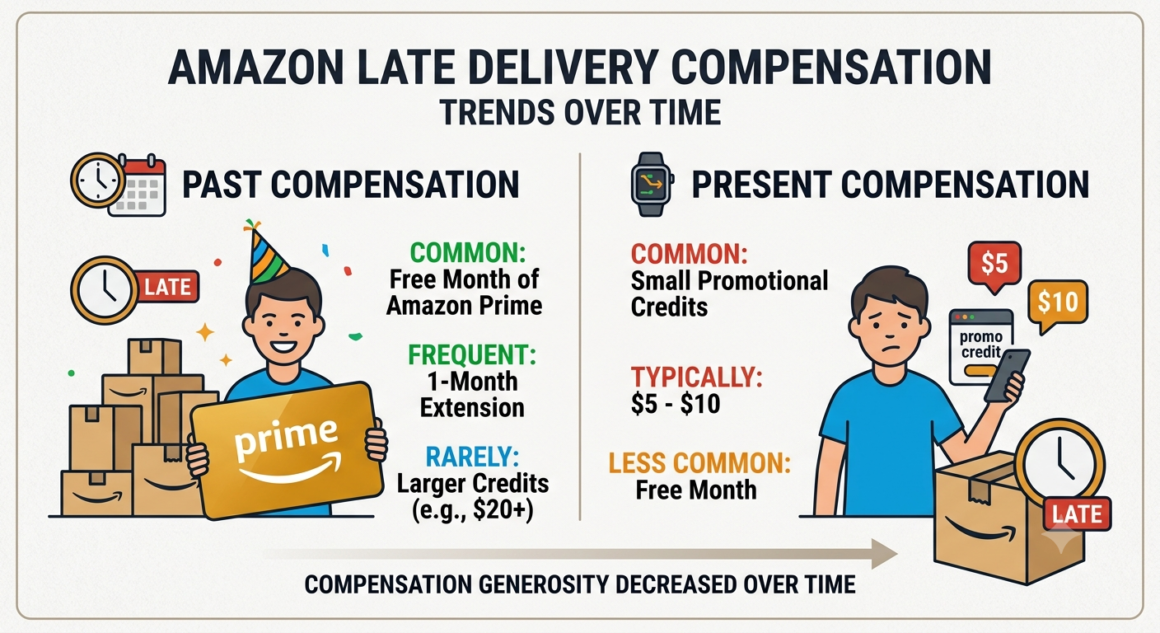
For members whose deliveries arrive late, the formal remedy is theoretically straightforward: contact customer service, report the delay, and receive a refund or credit. In practice, customers suggest that Amazon has become less generous with late delivery compensation over time. While free months of Prime membership used to be common, many shoppers now report receiving smaller promotional credits, typically in the $5 to $10 range. Decisions are sometimes subjective rather than strictly policy-driven, with different outcomes depending on the channel used to reach support.
Documented community complaints and analysis of Amazon’s own policies show a recognizable pattern: promise fast delivery to close the sale, downgrade when inconvenient, then create hurdles that discourage full redress and keep money locked in the ecosystem.
The compensation architecture matters as much as the compensation amount. Amazon’s default remedy for a late delivery is a promotional credit, not a cash refund. That credit can only be spent on Amazon. This is not a consumer protection policy. It is a customer retention mechanism dressed up as one.
What Amazon Would Have You Believe
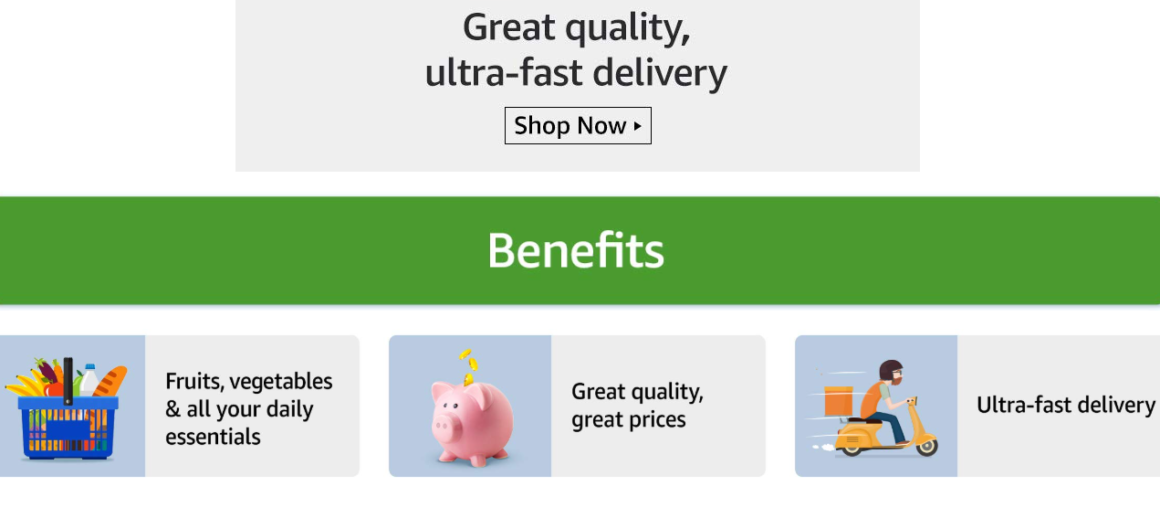
Amazon’s public position is that Prime is better than it has ever been. Technically, in aggregate, this may be true. Business Wire16 states that Amazon Prime delivered over 8 billion items same-day or next-day to U.S. customers in 2025, a 30% increase from the previous year. The company is investing in faster fulfillment, more same-day locations, and ultrafast delivery experiments like Amazon Now, which promises 30-minute delivery for groceries and household essentials in select cities.
These improvements are real. But they exist in tension with a simultaneous set of decisions that have made Prime worse for a meaningful segment of its membership: the language change from guarantee to estimate, the geographic exclusions in lower-income neighborhoods, the introduction of ads to a formerly ad-free service, the legally documented difficulty of cancellation, and the steady price increases that outpace what many members receive in return.
Amazon is not a company that makes these decisions accidentally. It is one of the most data-intensive organizations in the world, and it measures the downstream effects of every interface change and policy modification with precision. When Doug Herrington tells an audience that Amazon measures the effect of delivery speed on conversion rates “quite precisely on a product detail page,” he is describing a company that knows exactly what it is trading when it allows delivery standards to erode. It knows that lock-in is high enough to absorb some disappointment. It knows that most customers will not do the math on what their membership actually delivers relative to what they paid for.
That is not the behavior of a company that has lost its way. It is the behavior of a company that has found a new one.
The Structural Question Nobody Asks
The more interesting question is not whether Amazon has broken its delivery promise — the lawsuits, the settlement, and the pattern of customer experience make that fairly clear. The more interesting question is why it was ever framed as a promise in the first place, rather than what it actually is: a pricing mechanism for behavioral lock-in.
Two-day shipping was never purely a consumer benefit. It was a conversion lever. Amazon figured out, before anyone else did, that fast delivery makes people shop more, spend more, and stop comparison shopping elsewhere. The two-day promise trained an entire generation of consumers to reach for Amazon first, reflexively, for everything from batteries to birthday gifts. Prime created an ecosystem so comprehensive that leaving it feels disorienting rather than liberating.
Prime members spend considerably more on Amazon than non-Prime customers, and they also shop more often. This is not a coincidence. It is the product. The delivery promise was the acquisition cost. The thing Amazon spent enormous sums building and maintaining to create the behavioral dependence. Now that the dependence is established, the costs can be trimmed while the membership fee rises.
None of this is unique to Amazon. Subscription businesses face this trajectory constantly. But Amazon is different in scale, in the centrality of the service to daily life, and in the gap between how Prime is marketed and what it actually delivers. The blue badge is still everywhere. The delivery windows are still visible on every product page. The language still implies speed and reliability. And the fine print, updated for legal protection against exactly the kind of consumer complaints now flooding the courts, says something considerably more modest.
The promise that built one of the most successful subscription products in history has been quietly renegotiated. Amazon hopes you have not been reading the terms.
Sources
- Staff, Amazon. “An update on Prime Video” 22 Sept. 2023, www.aboutamazon.com/news/entertainment/prime-video-update-announces-limited-ads. Accessed 24 June 2026. ↩︎
- Choudhary, ByVidhi. “Amazon’s Prime delivery service picked up speed in 2024” 5 Feb. 2024, www.retailbrew.com/stories/2025/02/05/amazon-s-prime-delivery-service-picked-up-peak-speed-in-2024. Accessed 27 June 2026. ↩︎
- Staff, Amazon. “Amazon Prime members enjoyed fastest-ever delivery speeds in 2024, and US members saved on average over $500 on delivery fees” 4 Feb. 2025, www.aboutamazon.com/news/retail/prime-members-us-savings-fastest-delivery-2024. Accessed 27 June 2026. ↩︎
- “Reuters.Com” www.reuters.com/legal/litigation/amazon-defeats-us-consumers-class-action-over-whole-foods-delivery-fees-2024-07-19/. Accessed 27 June 2026. ↩︎
- 4 Dec. 2024, www.washingtonpost.com/technology/2024/12/04/amazon-deliveries-slow-lawsuit-dc/. Accessed 27 June 2026. ↩︎
- “Amazon hit with US consumer lawsuit over ‘excluded’ fast delivery zones” The Economic Times, m.economictimes.com/tech/technology/amazon-hit-with-us-consumer-lawsuit-over-excluded-fast-delivery-zones/articleshow/116064398.cms. Accessed 27 June 2026. ↩︎
- “Bloomberg” Are you a robot?, www.bloomberg.com/graphics/2016-amazon-same-day/. Accessed 27 June 2026. ↩︎
- “Amazon FBA – Get the Prime advantage” Fulfillment by Amazon, sell.amazon.in/shipping-and-fulfillment/fulfillment-by-amazon. Accessed 27 June 2026. ↩︎
- “Amazon” sellercentral.amazon.com/help/hub/reference/external/G200847280. Accessed 27 June 2026. ↩︎
- 25 Sept. 2025, www.ftc.gov/news-events/news/press-releases/2025/09/ftc-secures-historic-25-billion-settlement-against-amazon. Accessed 27 June 2026. ↩︎
- “Amazon’s $2.5B dark patterns settlement: What all e-retailers must change now” Oct 16, 2025, 16 Oct. 2025, www.fairpatterns.ai/post/amazons-2-5b-dark-patterns-settlement-what-all-e-retailers-must-change-now. Accessed 27 June 2026. ↩︎
- Staff, Amazon. “An update on Prime Video” 22 Sept. 2023, www.aboutamazon.com/news/entertainment/prime-video-update-announces-limited-ads. Accessed 27 June 2026. ↩︎
- Palmer, Annie. “Amazon to hike price of ad-free Prime Video tier by $2 a month” 13 Mar. 2026, www.cnbc.com/2026/03/13/amazon-to-hike-price-of-ad-free-prime-video-tier-by-2-a-month.html. Accessed 27 June 2026. ↩︎
- Spangler, Todd. “Amazon Prime U.S. Price Is Increasing to $139 per Year, up 17%” 3 Feb. 2022, variety.com/2022/digital/news/amazon-prime-us-price-increase-1235171635/. Accessed 27 June 2026. ↩︎
- Likos, Paulina. “JPMorgan says Amazon Prime is worth 10x what members pay — a compelling case to hike fees” 23 June 2026, www.cnbc.com/2026/06/23/jpmorgan-says-amazon-prime-is-worth-10x-the-cost-a-compelling-case-to-hike-fees.html. Accessed 27 June 2026. ↩︎
- Business Wire, www.businesswire.com/news/home/20260511411227/en/Amazon-Rolls-Out-Amazon-Now-to-Dozens-of-Cities-Across-the-U.S.-Providing-30-Minute-Delivery-to-Millions-of-Customers. Accessed 27 June 2026. ↩︎