

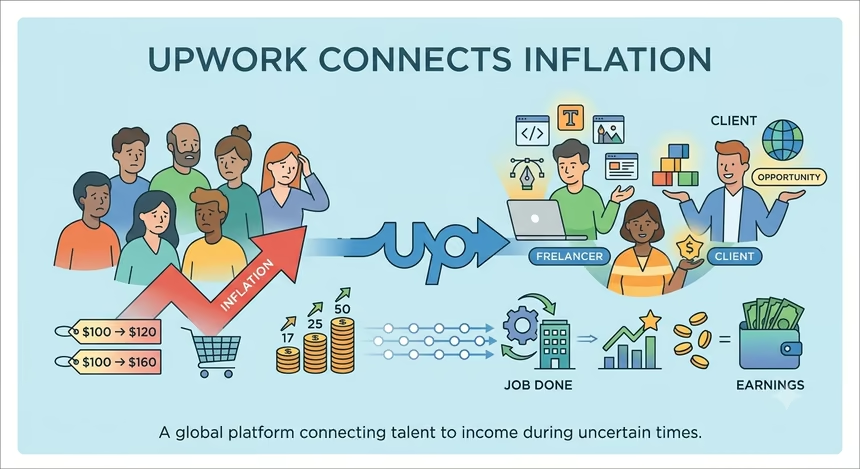

I started this story the way I start most of them, by opening a forum thread at midnight and refusing to close the laptop until I understood the anger in it. The thread was on Upwork’s own community board, posted by a freelancer who had given up trying to be polite. The freelancer compared the company to Yahoo and Nokia, companies that once believed their own dominance made them untouchable. Buried in the rant was a phrase that stuck with me, an accusation that Upwork treats its own proposal credits like a “freelancer gold mine,” a resource freelancers will keep feeding money into no matter what it costs them.
That phrase is the whole story, really. Upwork calls them Connects. You cannot submit a proposal without them. You cannot boost a proposal to the top of a client’s inbox without them. You cannot even flip on the little green badge that tells clients you’re available right now without spending them. They are priced at fifteen cents apiece, a number that has not moved since 2024 and that Upwork is happy to point to whenever anyone accuses the company of raising prices. Fifteen cents. It sounds like nothing. It is designed to sound like nothing. The real cost lives somewhere else, in a number Upwork controls but does not advertise on its pricing page: how many Connects it takes to say hello to a client in the first place.
A Nickel Became a Toll
Go back to 2016 and Connects barely existed as a cost center. Freelancers got a stack of them for free every month, and most proposals cost zero or two. Upwork ran the marketplace like a library card system, a way to keep people from spamming clients, not a revenue line. The company was still figuring out how to make money off a platform where the actual cash, the payments between client and freelancer, moved through fee percentages that freelancers already resented.
The shift started quietly. Upwork’s pricing history, the company made three major changes in six years, in 2016, 2019, and 2022, each one nudging more of the platform’s cost burden onto the people least able to push back. Then, in a rollout freelancers still bring up years later, Upwork announced that Connects would stop being free in May, 2019 as explained in this Medium1 guide. Proposals that once cost freelancers nothing would now run somewhere between fifteen cents and ninety cents each, a range Upwork justified by saying it would help clients wade through fewer, more serious applications. The logic sounded reasonable on paper. Charge a small fee, and only the freelancers who actually want the job will bother applying.
What nobody quite said out loud in 2019 is what would happen to that “small fee” once Upwork discovered it could adjust the required Connects per job without touching the sticker price per Connect at all.
The Number Nobody Can Predict
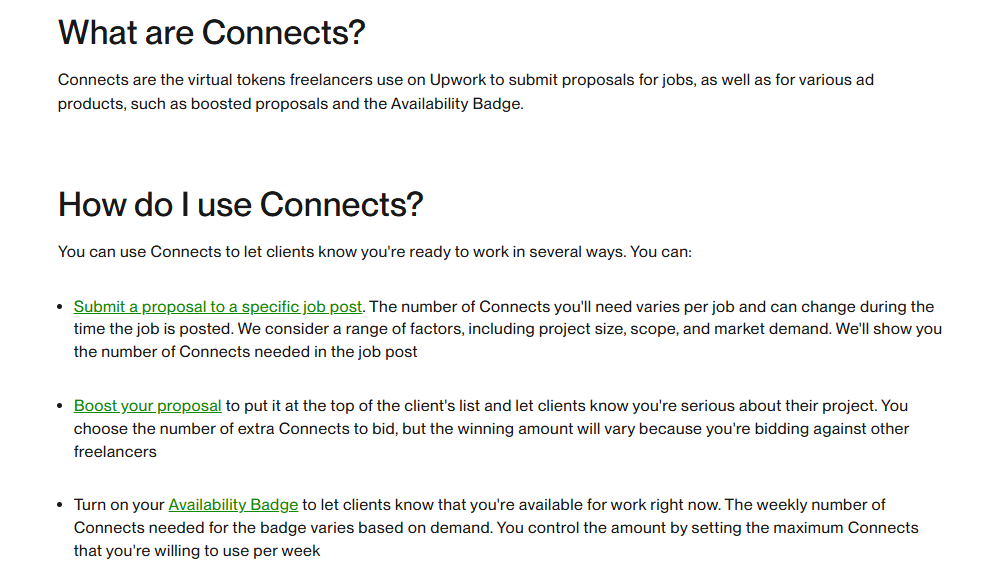
Here is the mechanic that makes Connects strange, and that makes the word “inflation” fit better than “price increase.” Upwork’s2 own help center confirms that the number of Connects required to apply for a specific job is not fixed. It floats, based on the project’s size, how much interest the post is getting, and what Upwork calls current market trends. The company also confirms, almost as an aside, that this number can change while the job posting is still live, with no edit to the listing itself.
I want to sit with that for a second, because it is a genuinely unusual pricing structure. Imagine walking up to a store, checking the price tag on a jacket, walking around the block, and coming back to find the same jacket, same tag, same rack, now costs forty percent more. No sale happened. No new stock arrived. The store just decided, based on how many other people looked at the jacket while you were gone, that you should pay more to try it on.
That is roughly the experience one freelancer described on Reddit, in a post that has been quoted across half a dozen freelancing blogs since. Applied yesterday for 19 connects. Today the same job costs 24. No edits made. It is a small complaint on its face. Five extra Connects is seventy five cents. But multiply that unpredictability across a freelancer applying to dozens of jobs a month, and the budget stops being a budget. It becomes a guess.
The scale of the drift is the part that gets buried in Upwork’s own messaging. Freelancer blogs and agency tools that track proposal costs report that a standard proposal in 2022 typically ran about six Connects, roughly ninety cents. By 2026, that same category of job commonly requires sixteen to thirty two Connects, or between two dollars forty and four dollars eighty, with high demand categories like AI, development, and marketing routinely climbing past forty. The per unit price never moved. The toll to cross the bridge did.
Boosting, or Paying to Be Seen at All
If the base proposal cost were the whole story, this would be a modest gripe about a subscription fee creeping upward. It isn’t the whole story, because Upwork layered a second market on top of the first one. It’s called Boosting, and it works like an auction. A freelancer can pay extra Connects to push their proposal into the top slots a client sees first. Upwork’s3 own description of the feature admits the mechanic directly: you choose how many Connects to bid, but you’re bidding against other freelancers, so the winning amount varies.
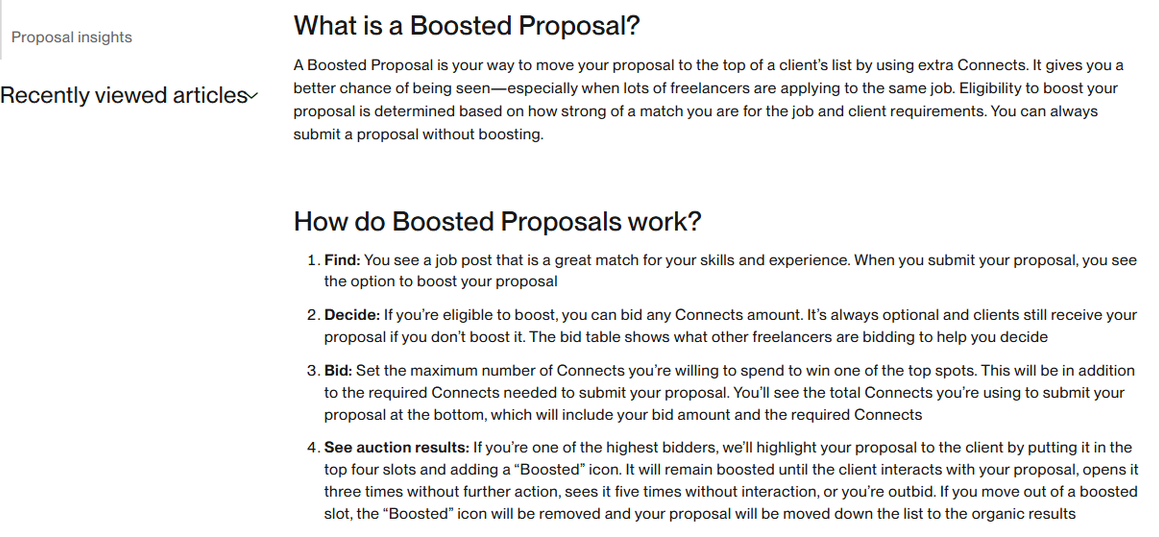
This matters because of a statistic that keeps surfacing in the freelancer advice ecosystem that has sprung up around Connects anxiety. GigRadar4 tracking Upwork proposal data report that most clients only read the first twelve to fifteen proposals on a job post before making a decision. If a freelancer applies at hour twelve, after fifty other people already have, the odds are structurally against them no matter how strong the pitch is. Boosting exists to solve exactly that problem, for a price. A single boosted bid can cost as much as four standard proposals combined.
So the system now has two toll booths instead of one. The first charges you to enter the race. The second charges you extra to not start from the back of the pack. Both booths are collecting the same currency, and Upwork is the only entity that mints it.
What the Freelancers Are Actually Saying
I went looking for more voices than the one that started this story, because a single angry forum post is an anecdote, not a pattern. It did not take long to find more.
One Reddit account, posting in the r/Upwork5 community and picked up by an agency blog that tracks freelancer cost-per-hire data, described spending three hundred Connects, roughly forty five dollars, and landing about thirty interviews that went nowhere. The freelancer’s own summary of those thirty conversations was blunt: price shopping, free knowledge picking, or looking for a free audit. Forty five dollars is not a ruinous sum for most people running a business. But the freelancer’s larger point, echoed across the threads I read, is that the Connects themselves were never the expensive part. The expensive part was the unpaid labor of writing thirty tailored proposals and sitting through thirty calls that were never going to convert, a cost Upwork does not have to absorb because it isn’t denominated in Connects at all.
Another Reddit6 user circulating in the same corner of the internet lays out the math even more starkly: two hundred dollars spent on Connects, forty two proposals sent, eighteen viewed by a client, eight interviews, three actual hires. Run the arithmetic and that’s a seven percent win rate and something close to sixty seven dollars in Connects alone for every contract landed, before counting a single hour of unpaid proposal writing.
I took Upwork seriously for a month, here are the results and some insights.
by u/RufusisRitten in Upwork
They wrote:
You need to spend money to make money. If you can’t afford to spend $100-$200 a month on connects, you may not see the results you want. For context, the jobs i’ve landed were $2600, $500, $500. Spending $200 on connects is trivial compared to the money coming in.
Agencies that bid on Upwork at higher volume have started building their own calculators just to answer a question the platform doesn’t answer for them: what does it actually cost, in real dollars, to win one client. GigRadar7 estimates that a standard proposal today runs about two dollars forty in Connects, and that the real cost per hire, once you factor in typical reply and close rates, lands somewhere between sixty and two hundred and forty dollars depending on how well targeted the bidding is. On a two thousand dollar contract, the low end of that range is a reasonable acquisition cost. The high end eats nearly ten percent of the job before a single deliverable gets written.
The Business Case Nobody States Plainly
Here is where the story stops being just a freelancer complaint and starts looking like a business strategy, and it’s worth saying plainly that Upwork has never hidden the fact that Connects generate revenue. What the company doesn’t say plainly is how convenient the timing of the squeeze has been.
Upwork’s8 own investor disclosures show the marketplace take rate, the cut of every dollar that moves through the platform that ends up in Upwork’s pocket, climbing steadily. According to SQ Magazine9, it sat around eighteen percent in early 2025 and rose to nineteen percent by the fourth quarter, part of a full year performance that produced a record twenty nine percent adjusted EBITDA margin. At the same time, the number of active clients on the platform actually fell, from roughly eight hundred thirty two thousand to seven hundred eighty five thousand, a six percent drop that one market research firm bluntly called “intentional rationalization” in Upwork’s own earnings language.
Read those two facts side by side and a pattern emerges that should sound familiar to anyone who has followed the last decade of platform economics. The buyer pool is shrinking. The take rate is climbing anyway. Fewer clients are spending money on the platform, and Upwork is extracting a larger percentage of every dollar that does move, while simultaneously making freelancers pay more, in effective terms, just to be seen by that smaller pool of clients. Connects inflation and take rate inflation are not the same line item on Upwork’s balance sheet, but they rhyme.
It gets more layered still. In May of 2025, Upwork10 replaced its old service fee structure, a flat rate freelancers had at least been able to predict, with a variable fee running anywhere from zero to fifteen percent depending on category.
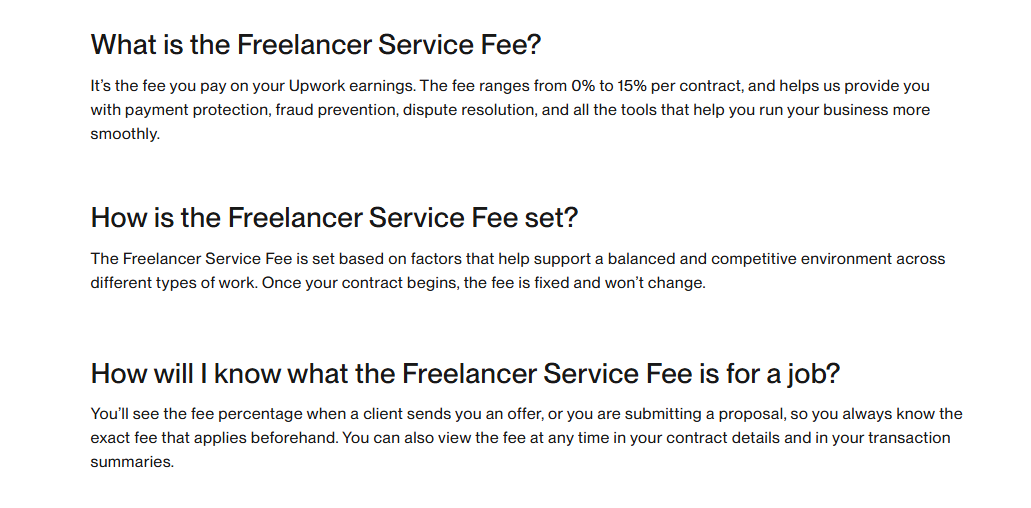
Commodity work, the general virtual assistant gigs, the basic content writing jobs that make up a huge share of the platform’s volume, tends to land at the high end of that range. Specialized, scarce skill categories land lower. So the freelancers most likely to be applying broadly, sending the most proposals, spending the most Connects chasing volume because their skill set is common rather than scarce, are also the freelancers paying the highest percentage fee on whatever they do manage to win. The Connects toll and the service fee toll both fall hardest on the same group of people.
I don’t think Upwork is lying when it says Connects exist to fight spam. Before the paid model, clients genuinely did complain about being buried under low effort, copy paste proposals from freelancers with nothing to lose by applying to everything. A price, any price, changes that calculus. It forces a moment of consideration before a freelancer clicks apply. Upwork’s help documentation frames the variable Connects requirement as a response to real signals, project scope, market demand, competitiveness within a category, and there’s a coherent argument that a flat, unchanging price per proposal would actually serve freelancers worse, because it would ignore how differently a two hundred dollar logo gig and a fifty thousand dollar enterprise software contract deserve to be priced.
There’s also a freelancer facing option that genuinely softens the blow for people who bid often. The Freelancer Plus membership, running about twenty two dollars a month, bundles in eighty Connects, which works out to roughly twenty seven cents each once the subscription fee is factored in, worse than buying loose Connects but paired with other perks like visibility into what competitors are bidding. For a freelancer applying constantly, the subscription math can make sense. It’s a real option, not a trap dressed up as one.
And Upwork is not wrong that speed and targeting matter more than raw Connects spend. Every piece of freelancer advice I read, whether written by Upwork itself or by a scrappy third party tool trying to sell freelancers a monitoring service, converged on the same point. The freelancers who complain loudest about Connects burn are very often the same freelancers applying broadly, late, and without much regard for whether a client is actually a good match. Tighten the targeting, apply within the first fifteen minutes of a posting, and the same Connects budget stretches three to five times further. That’s a real, actionable finding, not just a platform trying to shift blame onto its users.
Who Actually Pays the Toll
The Connects economy doesn’t fall evenly on Upwork’s freelancer base, and that unevenness matters more than most of the pricing guides let on. The platform draws roughly two thirds of its freelancer population from the United States, with India supplying the next largest share, somewhere near nine percent, and the rest spread across more than a hundred and eighty countries. A fifteen cent Connect means something very different depending on which of those countries you’re logging in from. For a freelancer billing eighty dollars an hour out of Austin, a bad month of wasted Connects, say sixty dollars burned on proposals that went nowhere, is an annoyance. For a freelancer in Lagos or Karachi competing for the same entry level writing and data entry jobs, charged the identical fifteen cents per Connect in a currency that doesn’t stretch nearly as far locally, that same sixty dollars is a meaningful bite out of a month’s income before a single client has said yes.
Upwork prices Connects in a single global currency, adjusted only for local payment processing, not for purchasing power. That’s not unusual for a platform business, plenty of software subscriptions work the same way, but it does mean the Connects tax compounds hardest exactly where freelancers have the least room to absorb it. The freelancers I saw complaining most bitterly in forum threads and Reddit posts were not, for the most part, established consultants with years of five star reviews. They were newer accounts, the ones still building a Job Success Score, still needing to send dozens of proposals just to land the reviews that would eventually let them apply more selectively. The system asks the most Connects tolerance from precisely the freelancers who can least afford to pay it.
One measure of how real this pain point has become is the small economy that has sprung up entirely around helping freelancers avoid wasting Connects. I lost count of the number of third party tools I found while reporting this, alert services and AI powered job scoring dashboards, all promising some version of the same pitch, stop burning Connects on jobs you were never going to win. Several of these tools now publish their own cost per hire calculators, essentially building spreadsheets to answer a question Upwork itself doesn’t put in front of freelancers before they click apply, what will this specific proposal actually cost me once I count the odds against it.
There’s something worth noticing in the fact that this cottage industry exists at all. Marketplaces that feel fair and transparent to their users rarely generate a secondary market of tools built solely to help people navigate the marketplace’s own pricing. Nobody built a popular browser extension to help shoppers avoid overpaying at a well run grocery store, because a well run grocery store doesn’t move its prices while you’re standing in the aisle. The fact that freelancers are paying, in some cases, real monthly subscription fees to third party services just to protect themselves from Upwork’s own dynamic Connects pricing says something about how that pricing feels from the inside, regardless of what Upwork intended when it built the system.
Still. Knowing why a system exists doesn’t erase what it costs the people paying into it every day. I keep coming back to the freelancer who called Connects a gold mine Upwork believes it can keep drilling forever. That’s the frustration underneath every forum thread and Reddit post I read while reporting this, a sense that the platform holds every lever, the price per Connect, the Connects required per job, the timing of when that number can shift, the design of the boost auction, and freelancers hold none of them. They can optimize their targeting. They can apply faster. They cannot see the algorithm deciding, in real time, that the job they looked at an hour ago now costs more to try for.
Upwork would say that’s the price of a functioning marketplace, a mechanism that keeps the platform useful for the client side of the equation even as it grows less predictable for the freelancer side. Freelancers would say it’s a toll booth that keeps moving further down the road every time they think they’ve found the edge of the map. Both of those things can be true. I’m not sure the story ends anywhere tidy, and I’m not sure it’s supposed to. The Connects keep costing fifteen cents. Everything around that number keeps quietly changing.
Sources
- Medium, medium.com/@howtofreelance/free-connects-will-be-removed-on-upwork-in-may-10dd0ba4ca0f. Accessed 7 Sept. 2026. ↩︎
- Upwork, support.upwork.com/hc/en-us/articles/211062898-Understanding-and-using-Connects. Accessed 31 Aug. 2026. ↩︎
- Upwork, support.upwork.com/hc/en-us/articles/4406395531795-How-to-boost-your-proposal. Accessed 31 Aug. 2026. ↩︎
- “Upwork Proposal Response Rate: Hit 15% (Free Diagnostic Tool)” 17 Aug. 2026, gigradar.io/blog/upwork-proposal-response-rate. Accessed 7 Sept. 2026. ↩︎
- Reddit, www.reddit.com/r/Upwork/. Accessed 31 Aug. 2026. ↩︎
- Reddit, www.reddit.com/r/Upwork/comments/1dfpus9/i_took_upwork_seriously_for_a_month_here_are_the/. Accessed 31 Aug. 2026. ↩︎
- “Upwork Connects Cost Per Hire for Agencies: Free Calculator (2026)” 18 Aug. 2026, gigradar.io/blog/upwork-connects-cost-per-hire. Accessed 7 Sept. 2026. ↩︎
- Upwork Investors, investors.upwork.com/static-files/f9dd0cca-277d-43fe-8a56-7b5e102a2faa. Accessed 7 Sept. 2026. ↩︎
- SQ Magazine, sqmagazine.co.uk/upwork-statistics/. Accessed 7 Sept. 2026. ↩︎
- Upwork, support.upwork.com/hc/en-us/articles/211062538-Learn-about-the-Freelancer-Service-Fee. Accessed 7 Sept. 2026. ↩︎


