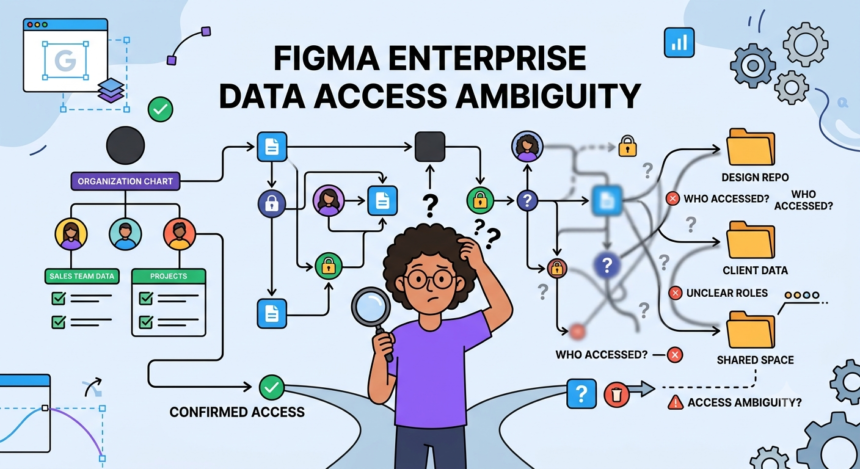

Henry Daggett asked a simple question on Figma’s community forum1 in April 2025. He wanted to know if he, as an enterprise admin, could view an employee’s draft files. It seemed like a reasonable thing to want. He was paying for the seats. He was responsible for the security of everything built on them. A Figma support representative named Celine answered him directly. Drafts remain private, she wrote, even from admins, unless a user moves them into a team project. Daggett pushed back. In an enterprise setting, he wrote, there’s no real reason for private drafts to exist at all, since everything made on a company device belongs to the company anyway. He said his team spends time every month reminding staff to move their files out of private drafts and into shared folders, a task he compared to herding cats with company IP in their pockets.
Ten replies later, the thread ends with a Figma employee promising to “share your feedback internally.” That is where it sits today, a small monument to a bigger problem. Figma, the design software that more or less runs the visual language of the modern internet, has spent years telling enterprise customers that they own everything created inside their organization. Its own privacy documentation for organizations states plainly that ownership extends to files sitting in a member’s private drafts. Its own support staff, on the same platform, tell customers something close to the opposite. Drafts are private. They stay invisible to admins unless someone chooses to move them. Two truths, contradicting each other in public, on the company’s own forum, under the company’s own name.
Figma sits in an unusual spot in that lineup. It isn’t collecting your medical history. It’s holding something quieter and, for a lot of people, more valuable: unreleased product designs, trade secrets, confidential client work, the visual proof of what a company is about to become. And when I went looking for a clean answer to who can see that material inside a company’s own paid Enterprise account, I didn’t find one. I found a stack of contradictions, a class action lawsuit filed in November, and a forum full of admins asking the same question Daggett asked, closed threads and all.
What “Enterprise-grade” Actually Promises
Figma’s2 enterprise sales page reads like most enterprise sales pages. It promises rigorous security and compliance features, advanced admin controls, and data protection built into every tier above Professional. Admins get an activity log. They get SCIM provisioning to sync employee records with an identity provider. On the higher-end Governance+ add-on, they get Enterprise Key Management, which lets a company encrypt its file data with its own AWS key rather than trusting Figma’s default encryption. All of that sounds like control. It sounds like the company selling you the keys to your own building.
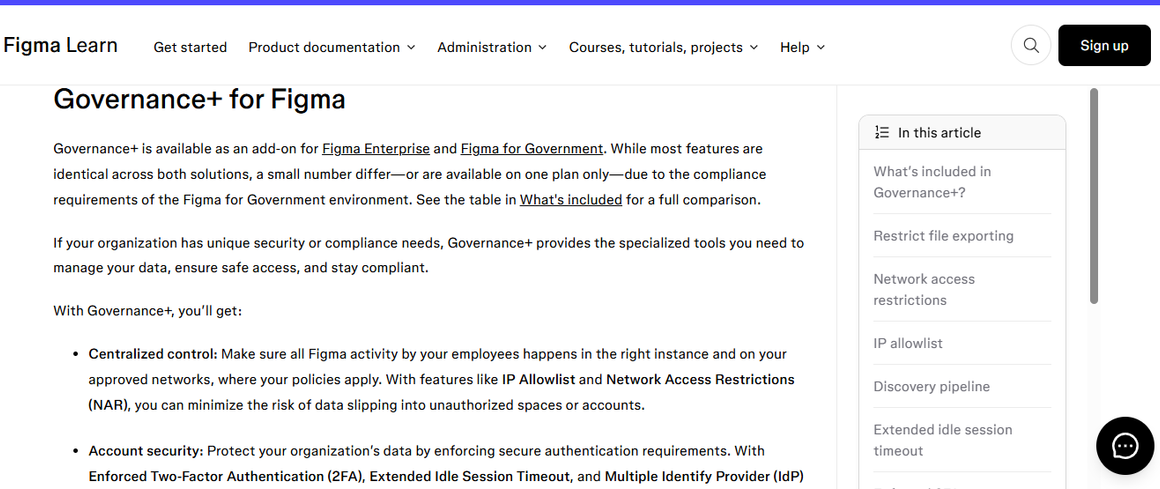
But control over infrastructure and control over content turn out to be two separate promises, and Figma has been vague about which one it’s actually making. Its own help center states it without much hedging in one place and walks it back in another. The article on privacy in organizations says the organization owns every file created inside it, and specifies that this includes files sitting in a member’s drafts. Read that sentence next to what Celine told Henry Daggett and you get a contradiction sitting in plain daylight on Figma’s own website. Ownership, according to Figma, is total. Access, according to Figma, is not.
The gap only shows up when something goes wrong, which is usually the point at which a company’s fine print starts to matter. A different Figma forum thread3, this one about a file that vanished from someone’s account, walks through the mechanics of what happens when an employee is offboarded.
I am facing an issue accessing a very important Figma design file that is critical for our organization. We can’t find it at all as of 1 hour back. I’ve tried to check in trash, and in all the other places the guides recommend without any success.
When someone leaves an organization, their draft files get dumped into a shared project that an admin then has to manually locate and reassign before anyone else can use it. It isn’t seamless. It isn’t instant. It is, by the company’s own description, “unassigned,” a term Figma uses in its error messages when a user tries to reopen a file that got orphaned this way. One user, locked out of her own personal draft after leaving a team, got a message telling her to “ask any admin” for access to work she’d made alone, on her own time, in a file she never shared with a soul. She wasn’t trying to hide anything. She just wanted her own drawing back, and the system had already decided that request needed managerial sign-off.
I went back to the original complaint, the one from August 2025, the one Buchanan Jeff filed under “Report a Problem” rather than “Suggest a Feature,” because he didn’t think of it as a nice-to-have. He called the lack of full admin visibility a security and intellectual property risk, and said the current setup lets sensitive or proprietary design work exist outside administrative oversight, which is a plain way of saying his company doesn’t actually know everything that’s sitting inside its own paid workspace. He asked Figma to treat it as a governance requirement for organizations in regulated industries, not a feature request to be shelved.
The silence tells you something the marketing copy won’t. A company that sells “enterprise-grade security” to hospitals, banks, and government agencies has, sitting in its own community forum, an unanswered post from a paying enterprise customer describing exactly the kind of blind spot those industries exist to prevent. Massachusetts4 runs its state digital services team on a Figma Enterprise account, precisely because centralized ownership is supposed to protect institutional knowledge even when staff turn over. If ownership doesn’t reliably translate into visibility, that promise gets thinner than the state’s IT department probably assumes.
I called the ambiguity structural rather than accidental, and here’s why. Figma’s drafts architecture wasn’t built as an oversight. It was built, deliberately, to give individual designers a private sandbox to sketch in before anything is ready for a team to see. That’s a genuinely good product decision for a freelancer or a two-person startup. The trouble is that Figma sells the exact same drafts mechanic to a 40,000-person bank, and never quite tells that bank’s security team that the private sandbox travels with the feature, unmodified, into the enterprise tier. One admin on the Figma forum5, managing a large org, said he ends up nagging somewhere between 40 and 100 employees a month to move their private drafts into shared team spaces, because otherwise that work sits invisible to the company that’s paying for it and, arguably, owns it.
In an enterprise setting there’s really no need to have private drafts – everything they make on their work device or work Figma account will belong to the company anyway and in a lot of secure environments it’s a real risk to allow people this kind of private access. Having to constantly remind people not to create private drafts is a pain and we end up reminding ~40-100 people every single month to move their drafts.
Then Came the AI Question, and It Got Worse
If drafts access were the only ambiguity, this would be a niche IT complaint. It isn’t the only one. In June 2024, Figma announced it would begin training its AI models on user content starting that August. The company set the default differently depending on how much a customer paid. For Starter and Professional accounts, content training was switched on automatically, and users had to go find a settings toggle to opt out. For Organization and Enterprise accounts, the same setting defaulted to off. Nobody at Figma explained, at the time, why a freelance designer’s confidential client mockups deserved less protection by default than a Fortune 500 company’s internal product roadmap. Hall of Shame6 later cataloged the episode summed up the practical effect: your privacy and intellectual property rights ended up directly tied to your subscription tier, and free and professional users got automatically enrolled while enterprise customers did not.
That distinction became the spine of a lawsuit. According to Cryptorank7, on November 21, 2025, a startup founder named Raza Khan filed a proposed class action against Figma in the Northern District of California, Khan v. Figma Inc., case number 3:25-cv-10054. The complaint doesn’t lean primarily on copyright law, which is the well-worn battlefield in most AI training disputes. It leans on contract law and trade secret misappropriation, arguing that Figma spent years assuring customers their files belonged to them and would never feed Figma’s own product roadmap, then quietly changed that arrangement through a background terms update rather than through anything a reasonable user would notice. Legal analysts have called that framing more dangerous for Figma than a copyright claim would be, because courts tend to take specific broken promises more seriously than abstract fair-use arguments.
I read the complaint itself, filed as a PDF and now circulating on legal-tracking sites. It draws a direct line between the tiered opt-in decision and Figma’s own understanding of what it was doing. The Case Filing Alert8 document states that Figma excluded enterprise customers from its auto-opt-in training programs, which the plaintiffs argue proves the company understood exactly how sensitive that data was and chose to protect it only for the customers large enough to notice or complain. A privacy researcher quoted in the complaint put it about as bluntly as a legal filing allows, saying the deliberate choice to protect enterprise data while quietly enrolling individual designers sends a clear signal that privacy protection scales with how much a customer pays.
Figma disputes the underlying claim. A spokesperson told Reuters the company only uses customer data for AI training with explicit authorization, that it strips identifying details from anything it does use, and that its models are built to learn general design patterns rather than to memorize any one customer’s unique work, according to reporting picked up by CTOL Digital Solutions9. That defense would carry more weight if it were the first time Figma’s AI ambitions had run into a credibility problem.
Apple’s Weather App, and a Pattern Taking Shape
It wasn’t the first time. A year earlier, at Figma’s Config 2024 conference, CEO Dylan Field stood in front of ten thousand designers and demoed a new “Make Designs” AI feature live on stage, typing a prompt and watching a full interface generate in seconds. Days later, a developer named Andy Allen, who builds a well-known third-party weather app, tested the feature himself and found it kept spitting out interfaces that looked unmistakably like Apple’s own Weather app. He posted about it publicly, accusing Figma of training the tool heavily on existing, copyrighted app designs. Figma pulled the feature days after launch. Field denied the training accusation, but the company temporarily disabled Make Designs while it investigated what its own tool was doing.
Whatever the technical explanation turned out to be, the optics were bad, and they’ve aged worse. DesignWhine10 argued the incident showed something more fundamental than a buggy launch, that when an AI tool produces near-replicas of existing commercial products, nobody can be fully certain where its “inspiration” actually came from, which is a genuinely uncomfortable thing to admit about software your company is charging enterprise customers a premium to trust with unreleased work.
Put the Apple Weather episode next to the AI training lawsuit next to the drafts visibility complaints, and a shape starts to emerge. It isn’t one scandal. It’s a company whose product architecture, legal terms, and public statements have not been keeping pace with how aggressively it’s been trying to build an AI business on top of design data it was originally collected to just store. Figma went public in 2025 at a valuation that reportedly touched $1.2 billion in new capital raised, and the Khan complaint argues explicitly that AI capability, built in part on customer content, was one of the things that drove that valuation up, a claim Figma’s own SEC filings11 arguably support simply by how much they credit proprietary datasets derived from user activity as a growth driver worth highlighting to investors.
There’s a third layer to this, quieter than the drafts fight and the lawsuit, but familiar to anyone who has actually read a SaaS vendor’s compliance documents instead of skimming the sales deck. Figma publishes a lengthy Privacy and Data Protection FAQ for enterprise procurement teams, the kind of document a company’s legal department pulls up before signing a six-figure contract. It lays out, in careful GDPR language, that Figma is the data processor and the customer is the data controller for any personal data that ends up inside Figma files, meaning the customer is legally on the hook for how that data gets handled even though Figma is the one physically holding it. That’s a standard arrangement across the SaaS industry, and not unreasonable on its face. But it puts the burden of knowing what’s actually in a company’s Figma files, drafts included, squarely on the customer’s shoulders, at the exact moment the product itself makes that knowledge hard to get.
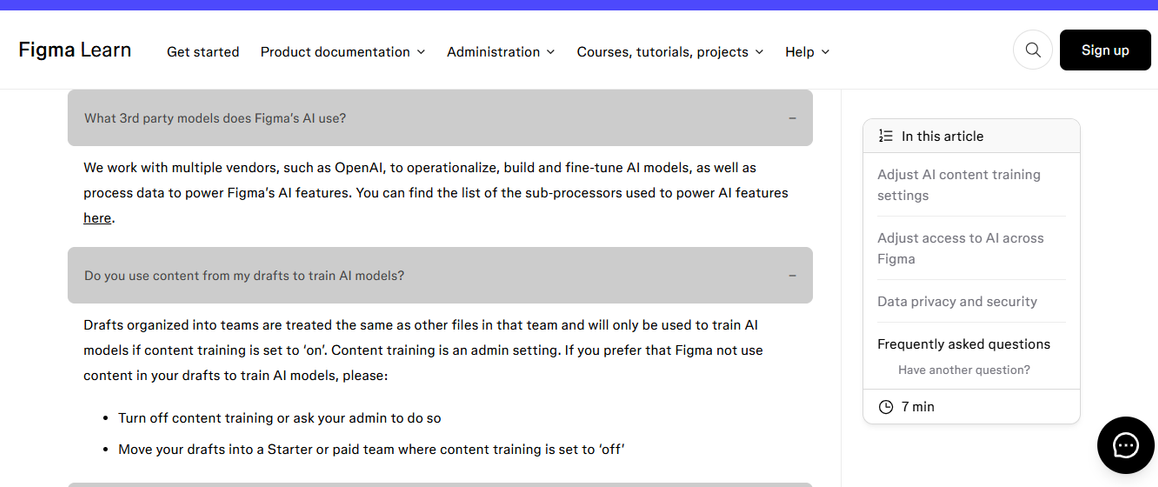
Figma12 also lists a rotating set of third-party subprocessors it works with to power AI features, including model providers like OpenAI, and points enterprise customers to a subprocessor list they’re expected to review on their own initiative. Admins can toggle content training off, and on Organization and Enterprise plans that’s the default, but the help documentation itself admits the setting has been effectively frozen in place, noting that content training is currently disabled for Organization and Enterprise plans and can’t be toggled on right now. Read generously, that’s Figma being cautious after the Khan lawsuit. Read less generously, it’s a company admitting that its own admin controls, the ones sold as a headline enterprise feature, aren’t fully under the customer’s control either. A toggle that can’t be toggled isn’t really a toggle. It’s a promise with an asterisk, and the asterisk isn’t explained anywhere near the switch itself.
None of this is illegal. None of it, on its own, is even unusual for a company managing this many product surfaces at once, from Figma Design to FigJam to Dev Mode to the newer Figma Sites and Figma Make. But taken together, the pattern is consistent. Wherever Figma has a choice between building a system that’s simple and legible for an enterprise admin to reason about, and building one that’s flexible enough to keep shipping new AI features fast, it has consistently chosen speed. The admin gets a dashboard full of toggles. Some of those toggles do exactly what they say. Others, like content training on Enterprise plans right now, are cosmetic, locked in place by a company decision the admin had no part in making and, in most cases, no real way of finding out about unless they happen to read a specific help article closely enough to catch the caveat buried in the third paragraph.
Who Actually Gets to Say No
There’s a reason the drafts question and the AI training question keep circling back to the same core issue. Both come down to a single unanswered question: who inside an organization actually gets to decide what a piece of design data is used for, and who finds out about that decision after the fact. Figma’s org-level admin dashboard makes it look like the answer is “the company.” Its privacy documentation says the same thing outright, ownership over everything, drafts included. But the lived experience of admins on the company’s own forum, and the lived experience of individual designers who got auto-enrolled into AI training with no real notice, both tell a story where the actual locus of control sits somewhere murkier. Sometimes it’s the individual employee quietly keeping something in a private draft. Sometimes it’s a background terms update nobody read. Sometimes it’s a support agent typing out an answer that contradicts the company’s own help article, in real time, in front of a paying customer who came looking for a straight answer and left the thread more confused than when he arrived.
None of this makes Figma unusual among cloud software vendors selling to the enterprise market. It makes Figma typical, which is the more unsettling finding. Nearly every SaaS company with a free or low-tier consumer product and a lucrative enterprise arm has faced some version of this same tension, protecting the customers large enough to negotiate custom contracts while treating everyone else as raw material for the next model. What sets Figma apart, at least for now, is how visible the contradiction has become, sitting out in the open on its own forum, in its own help documentation, and now in a federal courtroom in California. Companies that build products designers can’t imagine working without get a certain amount of benefit of the doubt. That doubt has a shelf life. Khan v. Figma is still in its early stages. Buchanan Jeff’s thread is still closed. Henry Daggett is, as far as I can tell, still reminding people every month to move their drafts somewhere he can actually see them.
Sources
- “View user’s Drafts as an Enterprise Admin” Figma Forum, 23 Apr. 2025, forum.figma.com/suggest-a-feature-11/view-user-s-drafts-as-an-enterprise-admin-39529. Accessed 11 Oct. 2026. ↩︎
- “Figma Enterprise” Building Great Products at Scale, www.figma.com/enterprise/. Accessed 11 Oct. 2026. ↩︎
- Nikolic, Dusan. “Design file is GONE” Figma Forum, 17 Mar. 2026, forum.figma.com/report-a-problem-6/design-file-is-gone-50531. Accessed 12 Oct. 2026. ↩︎
- “Why we use Figma” Mass.gov, www.mass.gov/info-details/why-we-use-figma. Accessed 12 Oct. 2026. ↩︎
- “View user’s Drafts as an Enterprise Admin” Figma Forum, 23 Apr. 2025, forum.figma.com/suggest-a-feature-11/view-user-s-drafts-as-an-enterprise-admin-39529. Accessed 12 Oct. 2026. ↩︎
- Author. “Figma: How to opt out of AI features?” Dark Patterns, 4 Sept. 2025, hallofshame.design/figma-how-to-opt-out-of-ai-features/. Accessed 12 Oct. 2026. ↩︎
- Cryptorank, cryptorank.io/news/feed/245e9-figma-hit-with-class-action. Accessed 12 Oct. 2026. ↩︎
- Case Filing Alert, casefilingsalert.com/wp-content/uploads/2025/12/casefilingsalert.com/wp-content/uploads/2025/12/Lawsuit-Accuses-Figma-re-AI.pdf. Accessed 12 Oct. 2026. ↩︎
- CTOL, www.ctol.digital/news/figma-class-action-ai-trained-customer-designs-without-permission/. Accessed 12 Oct. 2026. ↩︎
- Team, DesignWhine Editorial. “Figma AI Feature Suspended Amid Allegations Days After Config 2024 Rollout” DesignWhine, 3 July 2024, www.designwhine.com/figma-ai/. Accessed 13 Oct. 2026. ↩︎
- SEC, casefilingsalert.com/wp-content/uploads/2025/12/casefilingsalert.com/wp-content/uploads/2025/12/Lawsuit-Accuses-Figma-re-AI.pdf. Accessed 13 Oct. 2026. ↩︎
- “Manage AI settings and content training for your team or organization” Help Center, help.figma.com/hc/en-us/articles/17725942479127-Access-or-opt-out-of-AI-features. Accessed 13 Oct. 2026. ↩︎