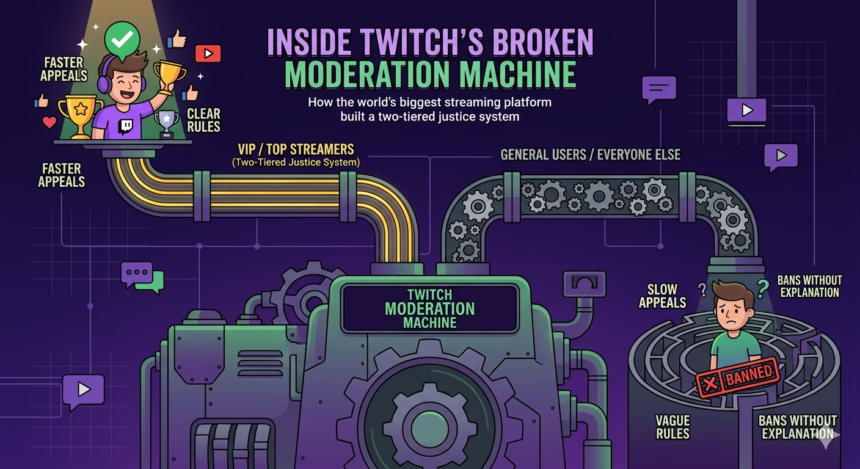

How the world’s biggest streaming platform built a two-tiered justice system, and why even its own CEO can’t explain how it works.
There is a moment every Twitch streamer knows. You are mid-stream. The chat is moving fast. Then the screen goes dark. A message appears: your channel has been suspended for violating community guidelines. No clip. No context. No explanation. Just silence where there was once a community.
For a creator with 200 followers, this is a crisis. For a creator with 200,000, it is often a weekend inconvenience.
That gap, between what Twitch says its rules are and how those rules actually land on real people, is the central failure at the heart of the platform’s moderation system. It is not a new problem. But in 2024 and into 2025, it became impossible to ignore.
The CEO Who Can’t Tell Violet from Purple
According to Yahoo1, Twitch CEO Dan Clancy went live to address mounting frustration about the platform’s moderation practices. He was joined by the platform’s Head of Community and a VTuber named GEEGA. What followed was the kind of corporate transparency that manages to confirm everything while explaining nothing.
Clancy admitted that inconsistent moderation exists on Twitch. He told viewers that bans are often subjective. He compared the difficulty of drawing enforcement lines to distinguishing between the colors violet and purple. Then he offered his primary solution to the inconsistency problem: he told streamers to stop living “too close to the line.” As reporetd by Deltias Gaming2, during the stream Clancy said:
“I encourage people, if you’re trying to get as close to the line without going over the line, and then sometimes you get caught for going over the line — stop trying to live so close to the line,”
It was a remarkable statement. The CEO of a platform that processes millions of pieces of content daily was essentially telling creators that if the rules are unclear, the solution is to self-censor further. He did not announce new guidelines. He did not commit to a timeline for fixing the system. He pinned blame on the people being moderated.
What Clancy did not address is the fact that the inconsistency cuts across every category of content on Twitch, and has for years. The problem is not that streamers are trying to game the system. The problem is that the system itself does not work the same way for everyone.
The List That Said Everything
To understand how deeply favoritism is baked into Twitch’s DNA, you have to go back to October 2021, when a massive data breach dumped roughly 125 gigabytes of internal company data onto the internet as posted by NEWS CENTER Maine3.
Buried inside that leak was a file called “do_not_ban_list.”
The list contained names of prominent streamers who had been flagged for behavior that would normally result in a ban. Instead of facing suspension, their cases were to be escalated to a specific senior employee for review. Among the names on the list: Tyler1, RiceGum, and TimTheTatman.
Twitch moved to contain the damage quickly. Former employees speaking to The Washington Post said the list was five years old and tied to a deprecated internal tool called Better Desk. The company insisted the practice was no longer in use. But the damage was already done — not because the list revealed a current practice, but because it confirmed what creators had been saying for years.
One anonymous Twitch employee told The Washington Post4 that some streamers were on the list because they “got viewership” for the platform.
Another said,
“I do remember RiceGum and Tyler1 both being given way more grace than they should have been.”
Revenue protection wearing the mask of rule enforcement. It is an old story in platform economics. But Twitch’s version came with receipts.
The data breach gave a documentary paper trail to something streamers had long described in anecdote. One of the most direct accounts came from QTCinderella, a streamer who described a conversation she had about her then-boyfriend Ludwig, one of Twitch’s top creators at the time.
She described a moment where Ludwig received a donation containing content that would have gotten most streamers banned. Before he could even take action on his own, she said she received a message from a Twitch employee. The employee reportedly told her that Ludwig would not be banned because his boss liked him.
This is what favoritism looks like at the ground level. Not a formal policy. Not a memo. Just a phone call from the right person that makes a potential ban disappear. The kind of informal protection that scales only upward. To the creators whose viewer counts generate meaningful revenue for the platform.
As Sportskeeda5 put it:
“Twitch has showcased disregard for streamers who break or bend the rules while penalizing those who barely do something wrong.”
The well-known political streamer Steven “Destiny” Bonnell experienced this from the other side. He was permanently banned in March 2022 for “hateful conduct”. His appeal was rejected. He moved to Kick. In June 2024, he shared the rejection email online. The same week that another banned streamer, Sneako, had his account reinstated. The contrast was not lost on him or his community. The r/LivestreamFail subreddit made the story one of its top posts. Streamers who make money for Twitch get back on Twitch. Streamers who do not, often do not.
The Automation Problem
Beyond favoritism, there is a second structural failure: Twitch’s automated detection systems make decisions that no human would make, and the appeals process is built in a way that disadvantages small creators.
In May 2024, Valorant streamer DoctorFreeze was banned mid-stream for “cheating in a multiplayer game.” He had just gone 27/10/12 in a match. The ban was visible in real time. His viewers watched the channel go dark as he asked his friends on comms whether Twitch had gone down. There was no evidence of cheating. It was a false positive from an automated system that had no mechanism to account for the fact that skilled players sometimes post impressive scores.
The ban went viral precisely because it was so absurd. But the same process plays out quietly for small creators every week, with none of the social media traction needed to force a reversal.
For years, streamers complained about receiving strikes without being told what caused them. Twitch would inform a creator that they had done something wrong, but would not specify what. This made the problem impossible to fix and the rules impossible to follow. Dexerto6 reported that at TwitchCon 2024, the platform announced changes to give banned creators more context, including chat excerpts and clips showing the specific violation.
It was a welcome move. But it arrived years late, and was announced without a firm implementation date.
In February 2025, Twitch7 rolled out an overhauled strike system that allowed low-severity violations to expire over time and gave creators a new appeals portal to track their violation history. The platform said the changes would “reduce the risk that streamers lose their communities and livelihoods for low severity violations.” Severe violations would still result in permanent bans.
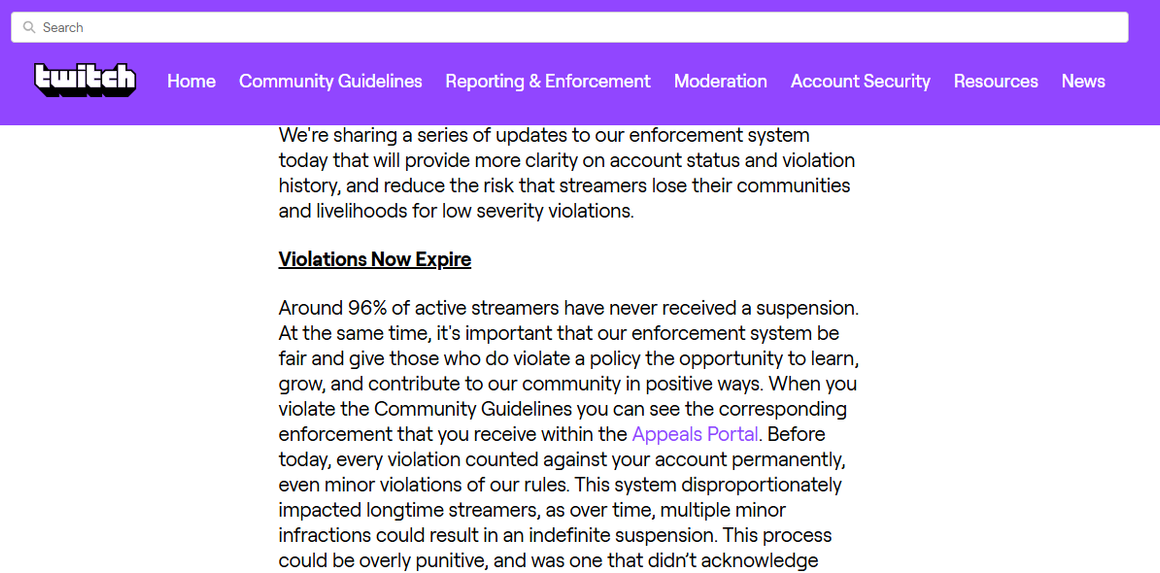
It was progress. But it left unanswered the core question of how severity gets determined, and by whom. On a platform where the same off-color joke earns one streamer a two-week ban and another a pass, a tiered system without consistent application just creates a better-documented version of the same problem.
The Sexual Content Policy Spiral
No area of Twitch moderation has been more chaotic than sexual content. The platform’s repeated U-turns on what is and is not acceptable have created a category where enforcement is not just inconsistent. It is structurally incoherent.
In December 2023, Twitch announced it would allow “fictionalized” nudity in art streams. The policy lasted days. TechCrunch8 wrote that the platform reversed course after an influx of hyperrealistic AI-generated nude images raised red flags, leaving art streamers, VTubers, and regular creators confused about where the lines were.
Then, in March 2024, Twitch updated its sexual content policy to ban streams that focused on “intimate body parts.” The rules went live on March 29, 2024, and several prominent female streamers were immediately banned. Then, hours later, those same accounts were reinstated. No explanation. No statement from the company about what had happened.
Asmongold, watching the chaos unfold, titled a video “Twitch Has No Idea What They’re Doing.” He was not wrong.
Critics pointed out a gendered double standard running through the platform’s attire rules: male streamers can go shirtless on stream, but female-presenting streamers cannot show the same amount of skin. Twitch affiliate Ren_Nyx put it plainly in an X reply to Twitch’s own policy announcement: “it makes no sense that men can be shirtless on stream, but if women do it and aren’t even visible it’s somehow a problem.”
We want Twitch to be a place where all communities feel welcome. You spend so much time with us and it’s important that you have a consistently positive experience. Read up on recent changes to our attire policy that serve this goal.https://t.co/sbdCauhX9h
— Twitch (@Twitch) January 3, 2024
The platform’s own 2021 policy documents acknowledged the problem, noting that the former sexually suggestive content policy “resulted in female-presenting streamers being disproportionately penalized.” They revised the language. They did not fix the enforcement.
The VTuber Trap
The sexual content chaos hit the VTuber community with particular force. In October 2024, Twitch updated its community guidelines to clarify that VTubers must cover “genitalia, buttocks, hips, female-presented nipples, and underbust” — rules that apply to human creators as well, but which carry different practical implications for virtual streamers whose avatar designs may cost hundreds or thousands of dollars to modify.
VTuber NeonHarper was hit with a “sexual content warning” in October 2024 for wearing a onesie. She asked Twitch directly for an explanation. The response she got:
“I cannot tell you if your content was appropriate to broadcast.”
Think about that for a moment. A creator is told she has done something wrong. She asks what the violation was. She is told the platform cannot tell her. This is what enforcement without accountability looks like.
The VTuber community pointed out an additional wrinkle: the same avatar model that would be flagged as violating Twitch’s attire policy when used for a regular stream could be imported into the game VRChat and used with complete impunity. The rules applied to creators, not to game characters, even when the “game character” and the streamer’s avatar were the same digital object.
VTuber creator Harper told Passionfruit9:
“I can literally take the model I use every day, do whatever I want with it to hyper sexualize it, and track myself in VRchat and be completely fine.”
VTuber MissusMummy, responding to a Twitch support post about the rules, was direct:
“We can only hope that you put your money where your mouth is and actually enforce these new rules toward everyone it applies to — not just small streamers and vtubers. The big named money makers need to know they are not exempt from following the rules.”
That sentence is doing a lot of work. It is saying what the community believes: that smaller creators get hit first and hardest, while the rules bend for anyone who brings enough revenue through the door.
The Political Test Case
If the sexual content moderation shows how Twitch’s rules are structurally ambiguous, the platform’s handling of political and hateful conduct shows how that ambiguity gets weaponized — or at least, how it looks like it does, depending on which community you ask.
The Asmongold situation is the clearest case study. According to BBC10, in October 2024, the streamer made remarks about Palestinian culture during a livestream that drew widespread condemnation. Twitch banned him for two weeks under its Hateful Conduct policy. He apologized. He was unbanned. He made similar remarks again in 2026. He was banned again.
His supporters argued that other streamers with different political alignments had said comparably inflammatory things and faced no consequences. This “double standard” claim resonated deeply within his audience, who felt that Twitch’s moderation team applied rules based on political bias rather than consistent principle.
Asmongold himself had said as recently as the period before his ban:
“I think Twitch is really bad and inconsistent with bans too. I’ve made tons of videos about it, and I think it continues to be true every day.”
Comment
by u/Asmongold from discussion
in Asmongold
The political bias question is hard to answer definitively because Twitch does not publish granular data about who it bans and why. But the perception of bias is itself a policy failure. When creators cannot predict whether a remark will result in a two-week ban or no action at all, the rule is effectively unenforceable. It becomes a tool of selective punishment rather than a standard of community conduct.
Richard Lewis11, writing about Twitch’s politics problem in detail, described what he called a “two-tiered system of moderation” that had emerged on the platform. Streamers on different ends of the political spectrum interpreted the tiers differently. Each side convinced the other was getting the better deal. That is itself a sign of how thoroughly Twitch has failed to communicate a coherent enforcement standard.
Money Still Talks
The clearest pattern, when you look across the full history of Twitch moderation controversies, is not political. It is financial.
Streamer Amouranth has been banned from Twitch multiple times for content that pushed the boundaries of the platform’s sexual content rules. Each time, the ban was temporary. Critics pointed out that she was among the platform’s highest-earning creators. As one Sportskeeda12 analysis noted:
“Amouranth has been banned five times already this year, but is yet to be permanently banned.”
The underlying dynamic is not subtle. Large partnered creators bring ad revenue, subscription revenue, and audience retention. A permanent ban costs Twitch money. A short ban protects the appearance of enforcement while minimizing financial damage. For smaller creators, the math runs the other way: a permanent ban costs Twitch almost nothing.
This is the implicit logic behind what happened in the Asmongold case, or the Amouranth cases, or the QTCinderella story about Ludwig. The rules bend where the money is. That may not be a conscious policy decision on the part of every moderator or executive involved. But it is the pattern that results from a system where financial stakes are allowed to influence enforcement outcomes with no public accountability.
There is also the appeals question. When a ban happens, what recourse does a creator have? Destiny’s appeal of his indefinite suspension was rejected in “record time,” as he described it, with Twitch citing “hateful conduct” without further specifics. His situation stood in sharp contrast to Sneako, whose ban for similar-category conduct was lifted without public explanation. The comparison generated significant discussion on Reddit. The basic question, why did one appeal succeed and the other fail, went unanswered.
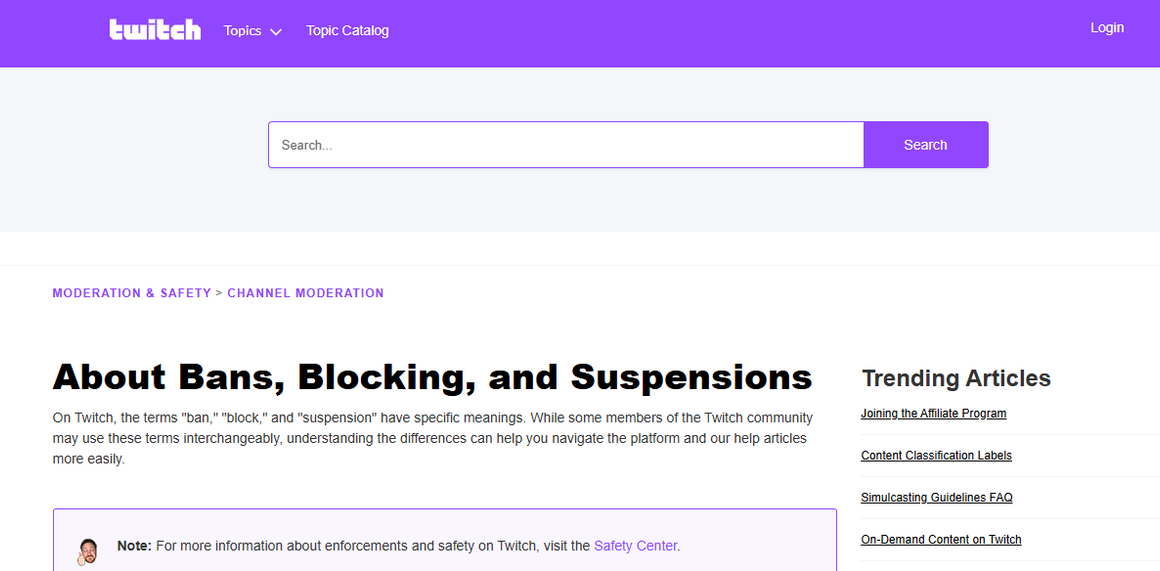
In April 2025, a separate situation illustrated how chaotic Twitch’s ban administration had become at a basic operational level. Content creator Dan Saltman, banned for “extreme harassment,” alleged that Twitch continued charging his subscribers after his ban and refused to delete his account despite a legal obligation to do so within 90 days of a deletion request. He claimed the platform may have been collecting subscription revenue from banned streamers’ accounts across the board. The platform did not publicly respond.
What Transparency Actually Requires
According to Statista13, in the first half of 2024, Twitch took 1.8 million enforcement actions on reported behavior violations, including 1.55 million related to hateful conduct. Those are large numbers. They suggest an active enforcement operation. They also suggest a system operating at a scale where individual human review of every case is essentially impossible.
That scale is the root of the automation problem. Twitch uses machine detection to flag a significant portion of violations before any human reviews them. When the machine is wrong, as it was with DoctorFreeze, creators pay the price. The appeals process is the supposed safety valve. But when 70% of streamers do not understand the rules, appeals often fail not because creators are guilty but because they cannot explain themselves in the terms the platform recognizes.
The February 2025 changes, expiring strikes, violation tracking, the new appeals portal, are steps in the right direction. Twitch said the changes would give creators the ability to track their violation history and reduce the risk of losing their communities for minor infractions. But the changes do not address favoritism. They do not address the gendered enforcement gaps in the attire rules. They do not address the VTuber carveout. They do not address the absence of any external oversight or appeal mechanism beyond Twitch itself.
What real transparency would require is a public log of ban categories by creator tier. Aggregate data showing whether partnered creators face the same suspension rates as affiliates and unpartnered creators for similar violations. A structured appeals process with defined timelines and criteria. And an explanation, finally, of what “severity” means in practice. Not in abstract policy language, but in the concrete terms that would let a creator know, before they say something, whether it will get them banned.
Twitch has never published that data. It has never subjected its enforcement practices to external audit. It operates as the judge, the appeals court, and the sentence, with no public accounting for whether any of those functions work consistently.
The Platform’s Real Accountability Problem
I want to be careful about one thing here. Platform moderation is genuinely difficult. At Twitch’s scale, millions of concurrent streams, real-time content, global communities with different cultural norms, the idea that every enforcement decision will be consistent is probably a fantasy. Some degree of case-by-case judgment is unavoidable.
But Twitch’s problem is not that it fails to achieve perfection. The problem is that it has built a system with structural incentives toward inconsistency, and then repeatedly denied that the inconsistency exists until the evidence becomes undeniable, as Clancy was forced to admit in January 2025.
The “do not ban” list showed that the platform once formally protected high-revenue creators from consequences that small creators faced routinely. The QTCinderella story showed the informal version of the same dynamic. The Amouranth ban pattern showed it in practice. The VTuber enforcement fiasco showed it operating even against the platform’s own stated rules. The DoctorFreeze case showed it applied blindly by automation with no meaningful correction mechanism.
None of these are isolated incidents. They are data points in a consistent pattern. A pattern where the rules exist primarily as tools of selective enforcement, applied most heavily against those with the least power to push back.
The platform’s own data confirms that Twitch took 1.55 million enforcement actions for hateful conduct in the first half of 2024 alone. At that volume, who gets banned and who does not is not random variation. It is policy, whether Twitch wants to call it that or not.
The next time a creator with 200 followers gets banned mid-stream, no explanation given, no appeal acknowledged, they will be operating inside a system that has been this way for years. The CEO has admitted it. The data confirms it. The leaked documents documented it. The streamers have described it.
The question is not whether Twitch knows it has a problem. The question is whether fixing it would cost the platform more than maintaining it does. Based on available evidence, the answer is still no.
And so the hammer keeps falling differently.
Sources
- Yahoo, www.yahoo.com/news/articles/twitch-ceo-dan-clancy-apologizes-201112988.html. Accessed 23 June 2026. ↩︎
- “Twitch CEO Dan Clancy Breaks Silence On Inconsistency In Platform’s Moderation” deltiasgaming.com/twitch-ceo-dan-clancy-breaks-silence-on-inconsistency-in-platforms-moderation/. Accessed 23 June 2026. ↩︎
- “NEWS CENTER Maine” NEWS CENTER Maine, www.facebook.com/newscentermaine/posts/the-company-confirmed-the-leak-hours-after-an-anonymous-user-posted-125gb-of-dat/10158760901484613/. Accessed 25 Aug. 2026. ↩︎
- 15 Oct. 2021, www.washingtonpost.com/video-games/2021/10/15/twitch-leak-do-not-ban-streamers-tyler1-ricegum/. Accessed 23 June 2026. ↩︎
- Sportskeeda, sportskeeda.com/esports/favoritism-plaguing-twitch. Accessed 23 Aug. 2026. ↩︎
- Gwilliam, Michael. “Twitch is finally telling streamers exactly why they’re banned in massive change” Dexerto, 20 Sept. 2024, www.dexerto.com/twitch/twitch-is-finally-telling-streamers-exactly-why-theyre-banned-in-massive-change-2906363/. Accessed 23 Aug. 2026. ↩︎
- “Twitch Safety Center” safety.twitch.tv/s/article/An-Update-to-our-Enforcement-System. Accessed 23 Aug. 2026. ↩︎
- Sung, Morgan. “Twitch attire policy update shuts down the viral topless meta” TechCrunch, 3 Jan. 2024, techcrunch.com/2024/01/03/twitch-shuts-down-topless-meta-with-attire-policy-update/. Accessed 23 Aug. 2026. ↩︎
- Asarch, Steven. “Hips Don’t Lie: How Twitch’s Latest Attire Policy Change Is Causing Chaos for Vtubers” 10 Oct. 2024, passionfru.it/twitch-vtuber-attire-policy-change-91075/. Accessed 25 Aug. 2026. ↩︎
- News, BBC. “Asmongold: Twitch streamer suspended after Palestinian rant” 16 Oct. 2024, www.bbc.com/news/articles/c75606vd3l6o. Accessed 25 Aug. 2026. ↩︎
- Lewis, Richard. “Twitch Has A Politics Problem And It’s Not The One You Think” Richard Lewis, 3 Nov. 2024, richardlewis.substack.com/p/twitch-has-a-politics-problem-and. Accessed 25 Aug. 2026. ↩︎
- Sportskeeda, sportskeeda.com/esports/favoritism-plaguing-twitch. Accessed 25 Aug. 2026. ↩︎
- 20, Jan. “Twitch behavior violation enforcement actions by type 2024| Statista” 20 Jan. 2025, www.statista.com/statistics/1484171/twitch-behavior-violation-enforcement-actions-type. Accessed 25 Aug. 2026. ↩︎