

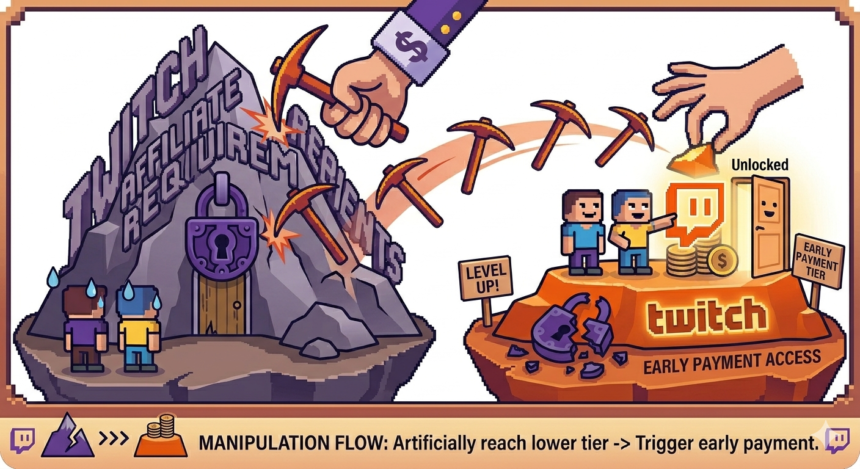

The threshold is never just a number. It is a gate. And Twitch decides who gets through.
There is a particular kind of financial cruelty that doesn’t announce itself. It doesn’t come as a sudden cut or an outright ban. It arrives in small print, in default settings that quietly reroute your money, in contractual timers ticking down on earnings you thought were already yours. For hundreds of thousands of streamers on Twitch, that cruelty has a specific shape. It looks like a payout threshold that keeps moving, a revenue split that favors the platform at every tier, a legal agreement that can reclassify money you already earned as abandoned property, and a “feature” shipped on by default that dips directly into your monthly check.
I have spent time in the forums, the legal text, and the creator dashboard trying to understand how Twitch’s monetization machine actually works for the small affiliate straining to reach the withdrawal minimum. What I found is a system built not to fail, but to float. To hold. To accumulate. And in many cases, to keep.
The Threshold That Wasn’t What It Said
For years, the number circulating in streaming communities was $100. That was the floor. You had to accumulate at least $100 in your Twitch affiliate balance before the platform would release a payment to you. If you finished a month at $92, the money stayed on Twitch’s books. If you spent months grinding toward that number and then took a break or hit a dead stretch, it kept sitting there.
In 2024, Twitch1 quietly adjusted this policy for most payout methods, lowering the standard minimum to $50 for ACH/direct deposit, eCheck, PayPal, and check. Wire transfers still require $100, citing the bank fees involved. On the surface, the change looked like a concession to small creators. The reality was more complicated.
The minimum threshold is only the first gate. There is a second one. Twitch2 operates on a Net-15 structure, meaning earnings from a given calendar month are processed roughly around the 15th of the following month.
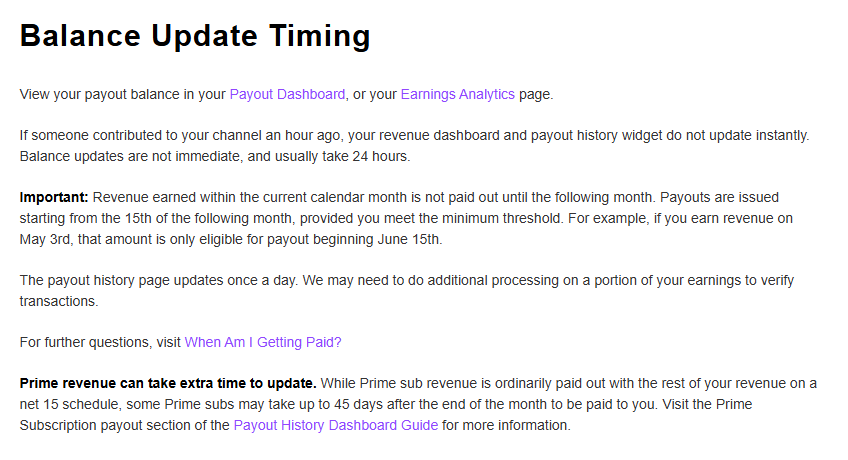
But the Monetized Streamer Agreement gives the platform a much wider window: up to 45 days after the end of each calendar month. In practice, this means a streamer who crosses the $50 threshold in June may not see funds until mid-to-late August. And if a verification flag is triggered on any portion of the earnings, StreamScheme3 says that Twitch can hold that slice for a minimum of 45 days beyond the normal window, potentially longer, “as necessary.”
What counts as a “verification flag”? Twitch does not say publicly.
The 180-Day Trap
Here is the clause most affiliates never read.
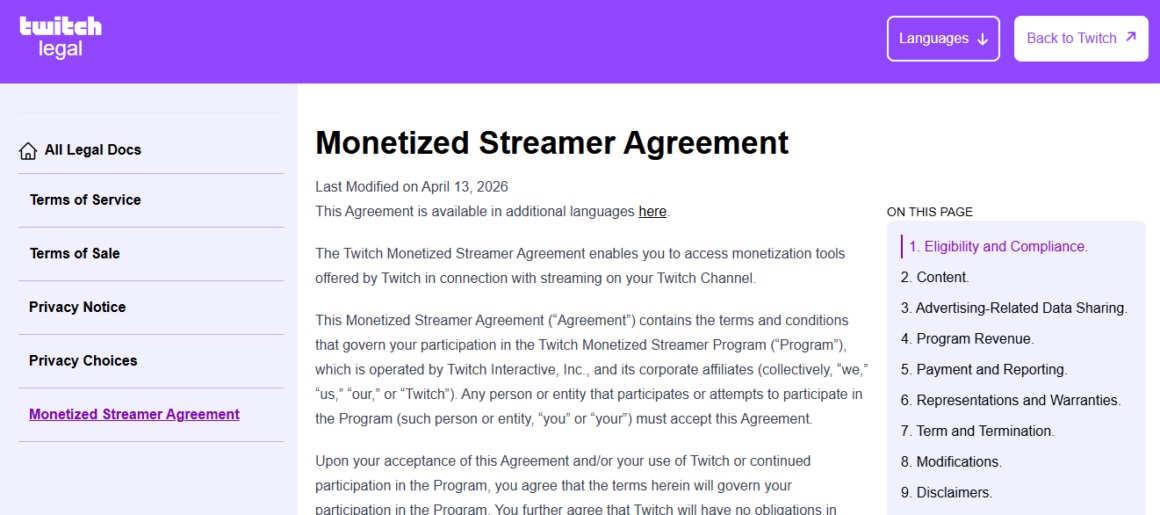
Twitch’s Monetized Streamer Agreement4 states explicitly that if a streamer fails to provide required tax information and documentation within 180 days of earnings becoming payable, those earnings are forfeited on a month-to-month rolling basis until the documentation is submitted.
The documentation is not obscure. It is the standard IRS Form W-9 for U.S. residents or Form W-8BEN for non-U.S. streamers. But the process runs through Amazon Tax Central, and it is the part, as one creator resource puts it, that “most new streamers stall on.” The routing is not straightforward. The forms require residency decisions. Non-U.S. streamers must identify whether their country has a tax treaty with the United States and, if so, at what rate. Streamrise5 states that without a completed form, Twitch defaults to withholding 30% from royalty income.
Here is what this looks like in practice for a small streamer in, say, Southeast Asia or Latin America. They reach affiliate status after weeks of consistent streaming. They accumulate $40 in bits and subscription revenue. They don’t hit the $50 threshold for a few more months. By the time they try to set up a payout, they find the tax interview stalled, the documentation incomplete, and a 180-day clock they didn’t know was running. The money they earned doesn’t disappear immediately. But the mechanism for its disappearance is already written into the agreement they accepted.
A licensed attorney writing under the name MyLawyerFriend at Medium6 published a detailed analysis of the Monetized Streamer Agreement when Twitch updated it in 2023, noting that the agreement introduced a minimum content and engagement requirement with language so vague it is “likely up to Twitch” to interpret. The phrase “consistent amount of live content” doesn’t define hours, frequency, or viewer count. What it does is give Twitch a contractual basis to remove affiliates from the monetized program at any time for any reason.
Two Years Away and the Money Is Gone
The more recent version of the agreement goes further.
Twitch’s updated Monetized Streamer Agreement, analyzed in detail by industry commentator Zach Bussey on Threads7, introduced what he called a “2-Year Inactivity Clause.” The text is straightforward. The agreement states that if there is “no logged-in activity on your Twitch account for two years,” any unpaid, accrued program fees above the payment threshold “may be subject to escheatment under applicable abandoned property law or become extinct by applicable statute of limitation.”
Twitch’s attorneys were careful with that language. “May be subject to escheatment” is technically a reference to state abandoned property laws, which do exist and which normally require companies to remit unclaimed funds to the state, not keep them. But the operative phrase for a streamer who doesn’t know the legal terrain is what a legal analysis blog put bluntly: Twitch is going to sweep up that abandoned revenue.
The same analysis from the legal blog promise.legal8 drew the sharpest distinction. Section 4.1 introduces the two-year inactivity clause, converting earned-but-unwithdrawal money into a platform asset. “This is not a penalty for a rule violation,” the analysis notes. “It is a contractual mechanism that converts money you already earned into revenue for the platform, triggered solely by inactivity.” The piece then offers an analogy worth sitting with: a landlord who evicts a tenant cannot also keep the wages the tenant deposited before leaving. On Twitch, the equivalent of exactly that is contractually permitted.
Who is most likely to have two years of inactivity? Not the full-time streamers with 2,000 concurrent viewers. Those people are watching their dashboards. The two-year clause primarily hits part-time and occasional streamers, which is most of the affiliate base. These are people who stream for a semester and then graduate, who have a run of consistent output during a job transition, who stream for six months and then have a baby. Their earned balance sits. The clock runs. And one day, if they don’t log in, the money shifts categories.
The Split That Never Moved
The revenue share is the other side of the same story.
When a viewer subscribes to a Twitch affiliate channel at the standard $4.99 Tier 1 price, the streamer receives approximately $2.50 before taxes. According to Digiday9, the 50/50 split has been the default since Twitch standardized it in 2022, when the platform announced it was ending the premium 70/30 arrangements that had previously been offered to select streamers without any public criteria for who qualified.
When those arrangements ended and the nature of the former two-tiered system became public, the community reaction was swift. A streamer, whose clip circulated widely, addressed her viewers live: “How about Twitch doesn’t take half the money you guys give me? Am I being unreasonable?” The clip was amplified across Twitter, and the answer from much of the community was no, she wasn’t being unreasonable. But it also didn’t change anything.
According to Variety10, Twitch’s response to the 70/30 controversy was the Partner Plus program, launched in October 2023. It promised a path to a 70/30 split but attached a requirement: 350 recurring paid subscriptions maintained for three consecutive months. Gifted subs didn’t count. Prime subscriptions didn’t count. The community immediately identified the problem. TechCrunch11 says that smaller streamers complained that the 350 monthly subscriber minimum was unattainable, particularly because the very types of subscriptions that drive community engagement, namely gifted subs and Prime subs, were explicitly excluded from the qualification math.
Twitch revised the program in January 2024, announcing a new Plus Program with a 60/40 tier at 100 Plus Points across three consecutive months and a 70/30 tier at 300 Plus Points. The thresholds became point-based rather than raw sub counts. The change was genuine, but it exposed something worth examining. Twitch12 Plus Points are calculated as Tier 1 subs multiplied by 1, Tier 2 by 2, Tier 3 by 6. Gifted subs and Prime subs still do not contribute. The path to a better split is effectively a path that excludes the most community-driven forms of subscription.
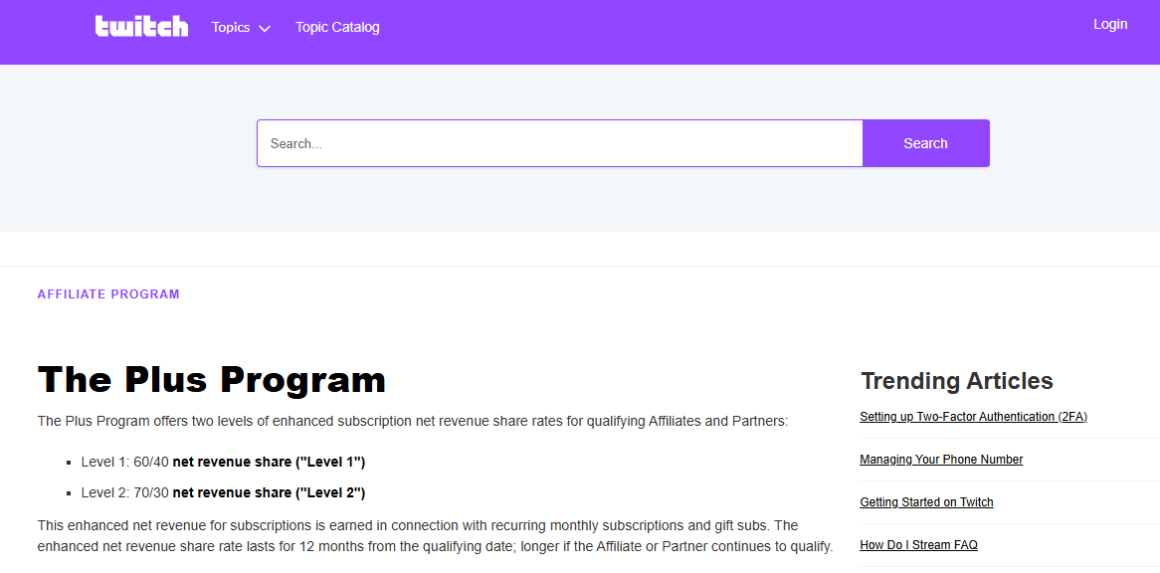
For context: a streamer with 100 Plus Points is one who has sustained 100 recurring paid individual subscriptions for three consecutive months. At $4.99 per Tier 1 sub, those 100 subscribers are giving their streamers roughly $499 per month. Of that, under the standard split, the streamer takes home $250 before platform processing and taxes. Only once they sustain that level does the split improve to 60/40, and only at 300 recurring paid subs, which represents $1,497 in monthly subscription revenue, does the 70/30 tier unlock.
The vast majority of the over 2.4 million Twitch affiliates as of 2024 never come close to these numbers. They are on 50/50, forever, unless they escape the affiliate tier entirely.
Default Settings and Opt-Out Deception
In May 2025, a more immediate problem surfaced.
According to Sportskeeda13, in May 27, streamer LuluLuvely flagged on X that a setting called “Shared Discount Promotions” was enabled by default in creator dashboards. The feature, tied to discounted gifted subscription promotions, required streamers to share the cost of the discount with Twitch. In other words, when a viewer bought gifted subs at a promotional price, the difference between the discounted price and the standard price was partially absorbed by the streamer’s payout.
“A setting that takes money out of your own Twitch paycheck,” LuluLuvely wrote, “should not be on by default.”
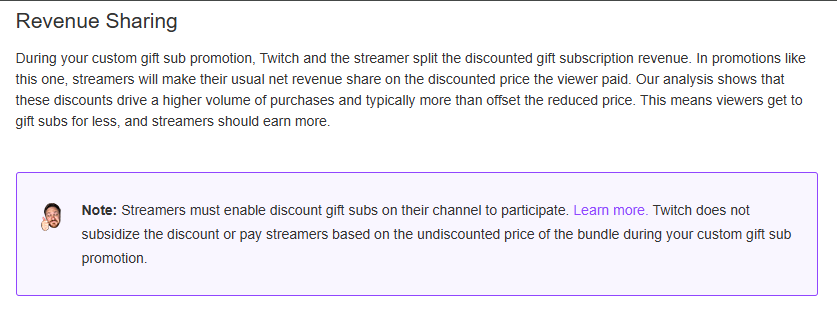
Twitch’s official documentation14 explained the logic: streamers receive their normal revenue share on the discounted price, and the platform’s analysis showed discounts drove higher purchase volume that “more than offset” the reduced per-unit price. That claim may or may not be true for high-traffic channels. For small affiliates who never activated the feature and didn’t know it existed, it was simply a default that quietly extracted money from their payouts. An opt-out was made available in March 2025, but the opt-out only surfaced after community pressure. The default remained opt-in.
The design pattern here is not unique to this feature. It is the standard playbook of dark UX applied to creator monetization: ship defaults that serve platform economics, rely on the majority of users never adjusting settings, and make the opt-out available only to the fraction of creators paying close enough attention to notice they need one.
The Bits Currency Exchange
The bits system deserves attention on its own terms because it operates as a currency exchange that almost no one examines from the right angle.
When a viewer buys 100 bits, they pay approximately $1.40 to Twitch. When they cheer those 100 bits in a streamer’s chat, the streamer earns $1.00. According to TheViewBot15, Twitch takes the $0.40 markup on the purchase side. This is described, accurately, as a model where Twitch does not take a cut from the streamer’s earnings. The $0.01 per bit rate is fixed and has been since bits launched in 2016. The streamer receives the full face value.
But the face value was set by Twitch. It has not been raised in ten years. And the markup at the viewer-purchase end has shifted with bundle size. Smaller purchases carry a higher per-bit markup. Streamlabs16 says that a viewer buying 100 bits pays $1.40 for $1.00 worth of streamer value, a 40% platform margin. The streamer has no mechanism to negotiate this rate, no ability to offer their community a better per-bit price, and no visibility into what Twitch’s cost basis is for running the bits infrastructure.
The $0.01 fixed rate functions as a price control applied against the streamer’s interest while being presented as a neutral “we take nothing” deal. The neutrality is in the final transaction. The extraction has already happened upstream, at the moment the viewer bought the currency.
For small affiliates, this structural asymmetry compounds through the payout threshold. A streamer who needs $50 to trigger a withdrawal needs 5,000 bits cheered across their channel. That is 5,000 viewer micropayments, each of which cost those viewers $0.014 on average, totaling roughly $70 in consumer spending to produce $50 in streamer earnings. The gap between what the community spent and what reached the creator is $20. That $20 is Twitch’s. It is taken before the $50 threshold clock even starts.
The Bigger Architecture
The payout threshold, the 180-day forfeiture clause, the two-year abandonment provision, the opt-in-by-default discount sharing, the bits markup, the 50/50 split that only improves for streamers who have already largely made it. None of these are individually catastrophic. That is the point. Each mechanism is defensible in isolation. Twitch would tell you, accurately, that they lowered the minimum threshold. That Net-15 is faster than the old Net-45. That the Plus Program gives affiliates a path to 70/30 that didn’t exist before. That bits pay out at full face value.
What they will not say is how these systems interact. A streamer accumulating earnings slowly across a 90-day stretch, whose tax documentation is incomplete, whose bits revenue is depressed by the purchase-side markup, who activated shared discount promotions without knowing it, who will eventually take a year off and might not log in for two: that person is surrounded by mechanisms for revenue extraction at every stage of their relationship with the platform.
The political economy of this is not accidental. Twitch is an Amazon property. Amazon operates the AWS infrastructure that runs the streams. Amazon Prime members generate Twitch subscriptions that count as subs to the viewer but don’t count toward the Plus Program points threshold that would give the streamer a better revenue split. The structural relationship between Amazon Prime and Twitch’s creator compensation is one in which Amazon’s subscriber base drives enormous goodwill and traffic to Twitch channels, while the financial benefit of those same subscriptions is deliberately excluded from the math that would improve those creators’ pay.
The creator economy discourse has largely focused on the top of Twitch’s pyramid, on the handful of streamers whose leaked payout data from the 2021 data breach showed eight-figure earnings over two years, on xQc and HasanAbi and Pokimane. What happened at the bottom of the pyramid during those same years is a less visible story of accumulated micro-extractions from an enormous base of small creators who were offered a monetization program, earned money into it, and then encountered a series of friction points designed to keep as much of that money on Twitch’s books as long as possible, or permanently.
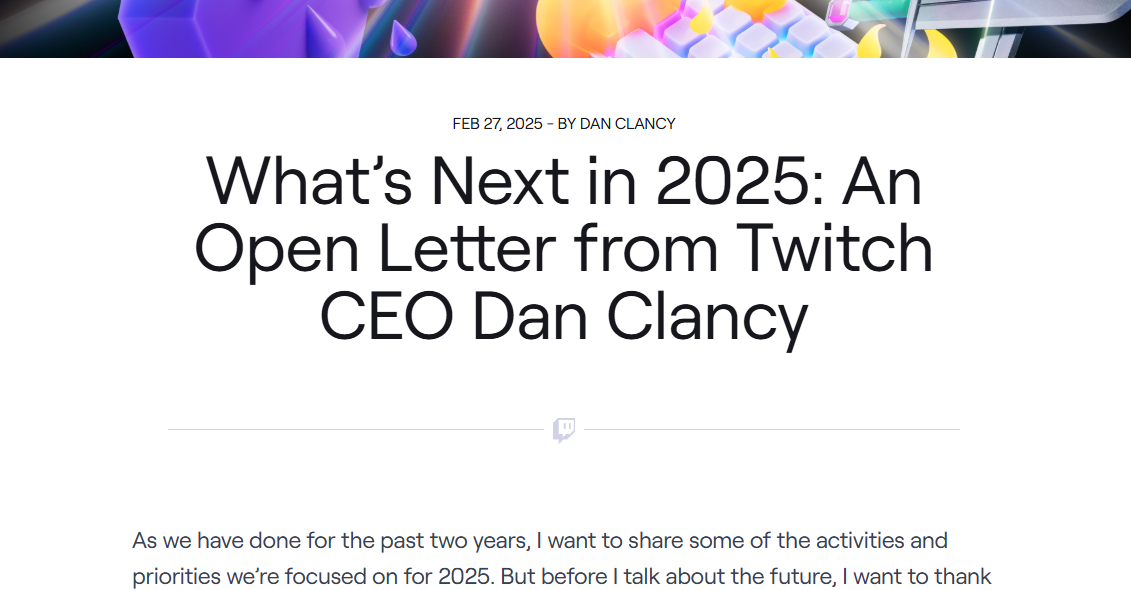
In 2025, Twitch17 CEO Dan Clancy published an open letter announcing that subscriptions and bits would be opened to “most” creators regardless of follower count, framing the move as a democratization of the platform’s monetization tools. The change opened the door to a larger group of streamers. What it didn’t do was change the threshold logic, the forfeiture clauses, the inactivity provisions, or the default opt-in settings that govern what happens to earnings once they accumulate.
Opening more people to a system and making the system fair are different things.
The Exit Problem
There is a complication in calling for streamers to simply leave. According to Epidemic Sound18, Kick, the competing platform backed by gambling streamer Trainwreck, offered a 95/5 split and same-day withdrawal when it launched in 2022. Those terms are genuinely better in the narrow sense. But Kick’s audience is a fraction of Twitch’s, its discovery infrastructure is immature, and a streamer who walks away from Twitch walks away from the network effects, the community, the VOD library, the chat history, and the emote culture that took years to build.
The lock-in is the product. The community that grows on Twitch is inseparable from Twitch’s systems. You can leave. But leaving costs you everything you built there except your streaming skills. For most affiliates, that is not a real option.
This is the same structural trap that governs gig platforms more broadly. The driver who spent years learning which neighborhoods and time slots work for UberEats can leave for DoorDash, but the spatial knowledge doesn’t transfer perfectly and the rating doesn’t transfer at all. The Twitch affiliate who has 3,000 followers, a community with inside jokes and shared emote lore, and a specific rhythm of engagement built over two years: that person’s relationship with their community is mediated by Twitch’s infrastructure. Twitch owns the pipes.
What Twitch does with that ownership is enforce financial terms that would be difficult to accept in any employment contract. A flat 50% commission. A payment timeline that can stretch to two months. A forfeiture clause for incomplete paperwork. An inactivity clause that reclassifies earned income as the platform’s property. And a steady stream of default settings that funnel money from creator accounts toward platform revenue until someone catches it.
The house always wins. But on Twitch, the house built itself into the payout dashboard, the tax interview, the default toggle, and the fine print that 2.4 million affiliates agreed to without reading.
Sources
- “Twitch Help Portal” help.twitch.tv/s/article/when-am-i-getting-paid?language=en_US. Accessed 14 July 2026. ↩︎
- “Twitch Help Portal” help.twitch.tv/s/article/your-first-payout-walkthrough. Accessed 14 July 2026. ↩︎
- Chris. “Twitch Payout Schedule (2026): When Twitch Pays Streamers” StreamScheme, 11 Jan. 2026, www.streamscheme.com/twitch-payout-schedule/. Accessed 14 July 2026. ↩︎
- “Monetized Streamer Agreement” Twitch.tv, legal.twitch.com/legal/monetized-streamer-agreement/. Accessed 14 July 2026. ↩︎
- Streamrise, stream-rise.com/blog/twitch-affiliate-program-faq. Accessed 14 July 2026. ↩︎
- Medium, medium.com/@MyLawyerFriend/lets-take-a-minute-to-talk-about-twitch-s-new-monetized-streamer-agreement-a948cd2d8ba4. Accessed 14 July 2026. ↩︎
- “Zach Bussey (@zachbussey) on Threads” www.threads.com/@zachbussey/post/DMs2K3APEq5/. Accessed 14 July 2026. ↩︎
- Staff, Promise Legal. “Streaming Platform ToS: Bans, Demonetization & Appeals Explained” 5 May 2026, blog.promise.legal/streaming-platform-tos-bans-demonetization-appeals/. Accessed 14 July 2026. ↩︎
- Lee, Alexander. “Creators react to Twitch’s updated revenue share model” 17 Oct. 2022, digiday.com/marketing/creators-react-to-twitchs-updated-revenue-share-model/. Accessed 14 July 2026. ↩︎
- Spangler, Todd. “Twitch Will Pay Out 70% of Subscription Revenue to Qualifying Streamers Under New ‘Partner Plus’ Program” 15 June 2023, variety.com/2023/digital/news/twitch-partner-plus-70-percent-revenue-split-streamers-1235645488. Accessed 14 July 2026. ↩︎
- Sung, Morgan. “Twitch announces 60/40 revenue split in expanded Plus Program” TechCrunch, 24 Jan. 2024, techcrunch.com/2024/01/24/twitch-announces-60-40-revenue-split-in-expanded-plus-program/. Accessed 14 July 2026. ↩︎
- “Twitch Help Portal” help.twitch.tv/s/article/plus-program. Accessed 14 July 2026. ↩︎
- “Human Verification” www.sportskeeda.com/us/streamers/news-twitch-enables-feature-default-reportedly-causing-streamers-earn-less-money. Accessed 14 July 2026. ↩︎
- “Twitch Help Portal” link.twitch.tv/ManageCustomGiftSubDiscounts. Accessed 14 July 2026. ↩︎
- TheViewBot, blog.theviewbot.com/what-are-twitch-bits-worth/. Accessed 14 July 2026. ↩︎
- Robinson, Mika. “How Much Are Twitch Bits Worth? (And Should You Buy Them)” Streamlabs , 10 Mar. 2023, streamlabs.com/content-hub/post/what-are-twitch-bits-worth?srsltid=AfmBOopBJZMX-iYwhSAUpLqAaLHI4utfRMpfuXbFUpx2f5SbQq8w2MW6. Accessed 14 July 2026. ↩︎
- “What’s Next in 2025: An Open Letter from Twitch CEO Dan Clancy” 27 Feb. 2025, blog.twitch.tv/en/2025/02/27/what-s-next-in-2025-an-open-letter-from-twitch-ceo-dan-clancy/. Accessed 14 July 2026. ↩︎
- Chillingworth, Alec. “What is Kick streaming?” Epidemic Sound, 27 Apr. 2026, www.epidemicsound.com/blog/kick-streaming/. Accessed 14 July 2026. ↩︎


