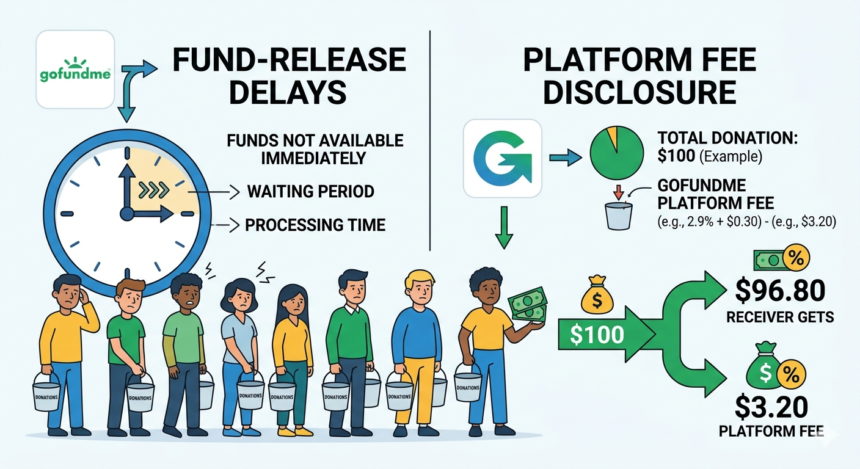

How the world’s largest crowdfunding platform built a system that holds desperate people’s donations hostage, profits from donor confusion, and answers to almost no one.
There is a particular kind of cruelty in raising money for a dying parent and then watching it sit frozen inside a platform’s systems while emails go unanswered and support agents repeat the same script about “ongoing review.” You have the funds. The donors gave generously. The need is real and urgent. But the money doesn’t move.
This is the experience that turns up again and again across GoFundMe’s Better Business Bureau complaint log, its Reddit threads, and its public record. A pattern that runs beneath the platform’s polished surface of feel-good fundraising stories and $40 billion raised.
GoFundMe is, by its own telling, a global movement. In May 2025, the company announced it had surpassed $40 billion raised across nearly 200 million people and organizations since its founding in 2010. The platform logged 42 million donations to individuals and 23 million to nonprofits in 2024 alone. Its revenue reached $55 million in 2024, roughly double the prior year. Those are impressive numbers, all of them pointing upward. What they don’t tell you is what happens when someone in crisis tries to actually get their money out.
The Hold Problem
In April 2026, someone filed a complaint with the Better Business Bureau1 about a fundraiser they had launched for a family dealing with a terminal medical condition. The campaign had raised approximately $65,000 in three days. The funds were urgently needed for medical care, end-of-life support, and funeral expenses. GoFundMe had confirmed that the beneficiary was fully verified, bank details were in order, identity documents were submitted. And yet the funds sat frozen.
The complaint reads:
“I have contacted GoFundMe support multiple times and am consistently told that another team will follow up via email. No timeline, explanation, or status update has been provided.”
The family, in the last days of crisis, was waiting. GoFundMe’s response, when it came, was a form apology acknowledging the delay.
Another complaint filed that same spring describes a father who died suddenly, a family setting up a campaign to cover immediate expenses, and GoFundMe placing a hold on the funds. The person had submitted government-issued ID, completed the bank transfer setup, and done everything asked. Then, they wrote, GoFundMe changed the explanation for the hold. First it was a standard review. Then it was about sanctions laws. Then anti-money-laundering rules. Then an inability to confirm funds could be delivered.
“These new reasons contradict their original explanation,” the complaint states. “At no point did GoFundMe say I violated any law or policy.”
A third complaint, one that the BBB log shows remained unresolved weeks after it was filed, describes a user who submitted documents by May 1, followed up on May 7, resubmitted on May 8, received confirmation of receipt that same day, and then heard nothing. The exact words:
“They confirmed receipt same day, and since then have completely ghosted me. I have tried customer service chat almost daily, and they continuously say they’ll escalate the issue with the transfer hold team (who is not available via chat, phone — nothing but email, which they do not ever respond to despite many follow-ups).”
This is not an isolated frustration. The BBB’s review of GoFundMe complaints, completed in March 2026, explicitly identifies “paused/held transfers” as one of the core categories of complaints it consistently receives.
How GoFundMe Explains Itself
To be fair to the platform, GoFundMe2 does have reasons for holding funds. The company operates in a complex compliance environment involving payment processor requirements, anti-money-laundering obligations, and its own Terms of Service. Its Transparency Center acknowledges that holds can be placed when the team needs more information about how funds will be used or delivered, when a fundraiser may violate law or the platform’s terms, or when a court order is involved.
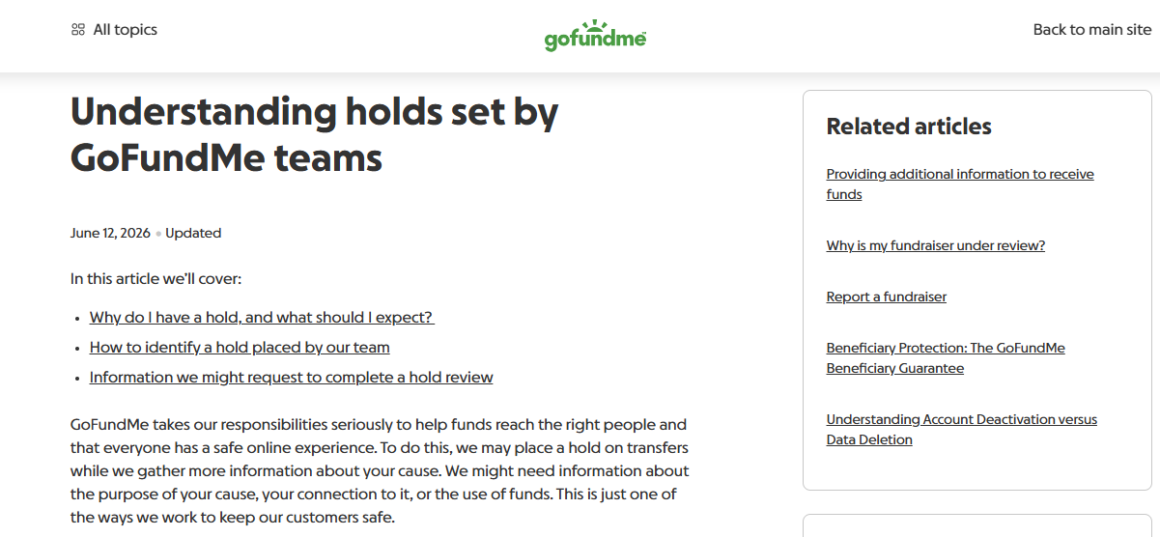
GoFundMe’s help documentation3 on holds lists the typical information requests: details about how funds will be used, documentation establishing the organizer’s connection to the beneficiary, verification of where the money will go. All of that is reasonable in principle. The trouble is in the execution. The help page instructs users to “check your email often to keep the process moving” and warns that “as you share information, new questions may come up.” What it does not say is how long any of this will take, what standards govern the review, or what recourse exists when the team simply stops responding.
GoFundMe’s bank transfer troubleshooting page4 offers a window of 2 to 5 business days for funds to reach a bank account after a transfer is initiated. But that clock only starts after the hold is lifted. And the hold timeline is, apparently, whatever the internal team decides it is.
The company’s Terms of Service grants it broad authority to place holds for compliance reasons, telling users to check their email for information about any hold. It does not define a maximum hold duration. It does not commit to a response timeline. It does not specify what happens to funds when a hold cannot be resolved.
This creates an accountability vacuum. You hand money to a platform for safekeeping while a campaign is active. The platform can freeze that money for reasons it determines unilaterally, on a timeline it does not disclose, with no guaranteed right of appeal. For someone raising funds for a medical emergency or a funeral, that gap between theory and practice can be devastating.
The Business Model Question
The hold problem is one face of GoFundMe’s accountability gap. The other is the money the platform takes before the hold is ever placed. And how transparent it actually is about that process.
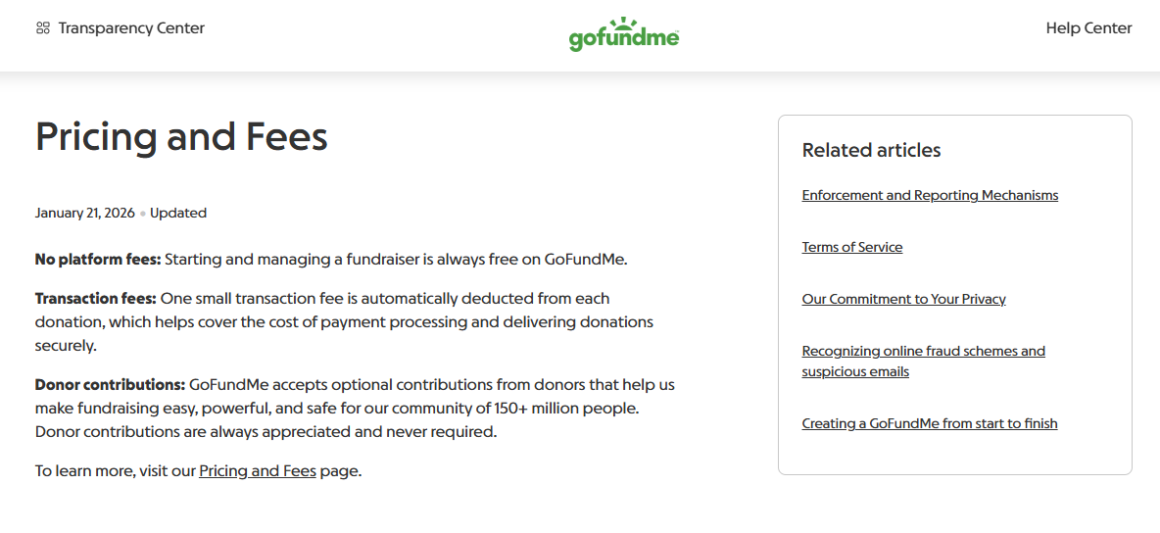
GoFundMe’s5 pitch to fundraisers has been simple since 2017: it is free to start a campaign. The platform eliminated its original 5% platform fee that year and reframed its revenue model around optional tips from donors. The only mandatory cost for personal fundraisers is a transaction fee of 2.2% to 2.5% plus $0.30 per donation, which covers payment processing.
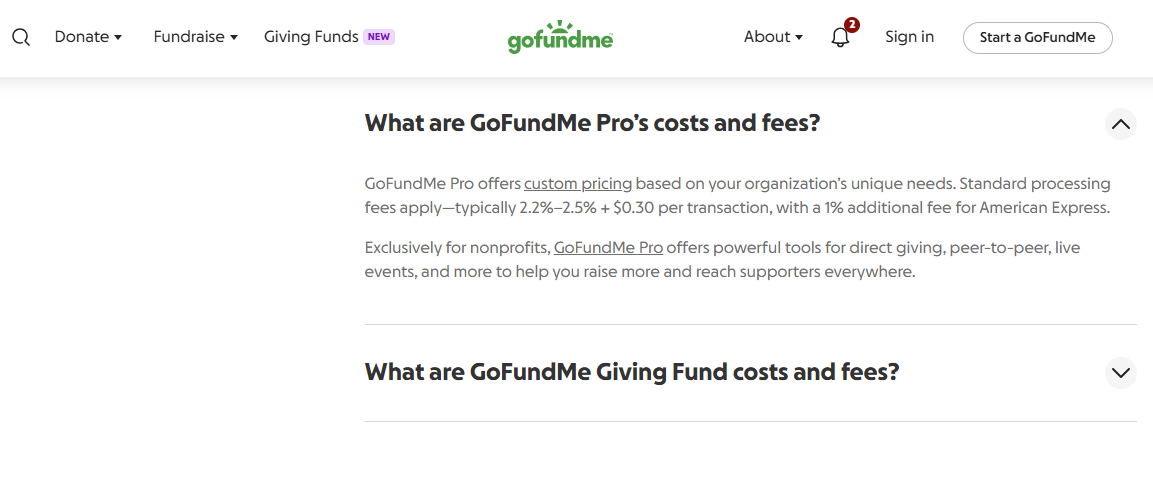
That sounds clean. The problem is the tip.
When a donor lands on the payment page, GoFundMe presents a sliding scale and asks them to contribute an additional amount directly to the platform. According to Bloomerang6, that tip is set by default to somewhere between 13.5% and 16.5%, depending on the campaign type and the moment in time. The tip is opt-out, not opt-in. To pay zero, a donor must actively slide the scale down to zero. If they do not notice the slider, or assume the pre-filled amount is standard, they pay it.
One user, quoted in a Donorbox7 review roundup, described donating $100 to a friend who had lost her mother and discovering the next day that $117.50 had been charged. The $17.50 excess was labeled a tip. Her response:
“Who would I be tipping? I was not receiving any type of service that would warrant a tip.”
Another user wrote that after setting up a campaign, every donor was automatically charged an additional 18% on top of their donation. GoFundMe described it as optional, but the donor-side interface did not present any option to decline. Donations dried up. The organizer felt responsible and tried to refund donors out of their own pocket.
Research published in 2026 by the fundraising platform Emma8 found that 76% of donors reported feeling frustrated by what they described as “tip traps,” where a portion of their gift went to the platform rather than the cause. The same research described what behavioral economists call default bias: when a high percentage is pre-filled, many donors simply accept it as the standard amount. Moving a slider takes effort. Accepting the default takes none.
GoFundMe’s own statement to USA TODAY9 during the Los Angeles wildfire crisis of January 2025 acknowledged the structure plainly:
“GoFundMe is primarily powered by voluntary tips and relies on these completely optional contributions from donors to maintain our quality customer service, trust and safety protections, and world-class fundraising technology.”
The company is technically correct that tips are optional. The debate is whether “optional” means anything when the default choice is to pay and opting out requires navigating a UI element that many donors do not notice.
When the Supervisor Couldn’t Figure It Out Either
The confusion is not limited to ordinary donors. According to The Daily Beast10, in January 2025, as wildfires tore through Los Angeles County, Kathryn Barger, a member of the LA County Board of Supervisors, tried to donate $500 through GoFundMe to a friend who had lost their home. She found herself staring at a charge of $95 and went off-script during a public press briefing.
“I was shocked to find out that to give $500, they were going to charge me $95,” she said. “These families are suffering.”
She announced she would reach out to GoFundMe’s CEO and ask the company to cut costs so money flows directly to the people who need it.
GoFundMe’s response was that Barger had almost certainly included the optional tip, which had pre-loaded at around 14%, and that her statement was inaccurate. The company pointed out that its mandatory transaction fee on a $500 donation would be less than $15.
That’s true. But the episode illustrates the core design problem precisely. A sitting elected official with professional staff, attempting to donate through a platform during a highly publicized disaster, was confused enough about the fee structure to publicly mischaracterize it during an emergency press conference. GoFundMe blamed her misunderstanding. The more uncomfortable read is that the interface produced that misunderstanding, and the platform had designed it to do exactly that.
GoFundMe CEO Tim Cadogan, speaking to Raconteur11 in March 2025, acknowledged speaking with Barger and characterized the situation as a misunderstanding. He said the company would not waive the transaction fees handled by its payment processor, but described GoFundMe as “bending over backwards” during the crisis.
1.4 Million Unauthorized Pages
The transparency problem extends past individual donations. Fox2Now12 reported that GoFundMe generated donation pages for more than 1.4 million charities using publicly available IRS information, without those organizations’ knowledge or consent. The pages looked affiliated with the charities. Some contained inaccurate information about the organizations. And some applied the standard default tip of around 16.5%, which went to GoFundMe rather than to the nonprofit whose name was on the page.
According to WCNC13, a coalition of 24 state attorneys general, led by California Attorney General Rob Bonta, sent a demand letter to GoFundMe in early 2026, calling for proof that the pages had been removed and asking for clarity on how the company’s practices had changed. Pennsylvania’s Attorney General David Sunday put it plainly:
“By creating fundraising pages in charities’ names without their knowledge or consent, GoFundMe misled donors and put public trust in charitable giving at risk.”
GoFundMe reversed course and took the pages down after the controversy broke. But as nonprofit management platform Bloomerang14 noted, even with the pages gone, the episode revealed a structural willingness to generate revenue-producing donation pages on behalf of organizations that had never agreed to the terms. And to do so with default tips that the charities themselves could not control, see, or remove.
The episode is instructive not just for what it reveals about the tip model, but for what it reveals about GoFundMe’s relationship with accountability. The platform moved unilaterally, at scale, using data it had not been given permission to use, in a way that benefited its revenue while potentially confusing donors about where their money was going. It took a multi-state regulatory letter to produce a public response.
The Float Question Nobody Asks
There is a dimension of the hold problem that rarely gets examined, and it is this: when GoFundMe places a hold on funds, whose money is sitting where?
The donations have cleared. They have been processed by the payment system. They exist as real money. GoFundMe holds them in transit. The company is not a bank. It is not a financial institution subject to the same reserve and disclosure requirements that govern how long financial institutions can hold your deposits. It is a platform company operating under its own terms of service, subject to its own internal review timelines.
In aggregate, at any given moment, GoFundMe is almost certainly holding significant amounts of donated funds in various stages of review, pending transfer, or active hold. GoFundMe’s transparency center15 does not disclose the float: the aggregate of funds held in transit at any time. The annual reports published by GoFundMe.org, the related nonprofit arm, do not reflect the for-profit platform’s financial mechanics. GoFundMe Inc. is privately held and not required to report its finances publicly.
This means that the people whose money sits in review have no way to know how common their situation is, how large the pool of held funds is at any moment, or how the company benefits, if at all, from the time between donation and disbursement. That opacity is not necessarily evidence of wrongdoing. But it is evidence of a gap between GoFundMe’s image as a transparent giving platform and the actual structure of how it handles money.
The Failed Campaign Problem Underneath It All
The delays and fee questions exist inside a larger structural reality that GoFundMe has little incentive to publicize. A Fast Company16 analysis of nearly 2 million GoFundMe campaigns found that the platform is built to surface its most successful campaigns. The ones that generate the most donations, which are also the ones that generate the most tips and fees for GoFundMe. The neediest cases, the ones that fail to gain algorithmic traction and raise little, are hidden from GoFundMe’s Discover page. The platform profits from viral success and benefits from presenting success as the norm.
This creates a double bind. The fundraisers that succeed are visible and generate revenue. The ones that fail are invisible and generate nothing. For the people who fall into the first category and raise significant funds, they then face the hold system. A compliance infrastructure that can freeze those funds at precisely the moment they are most needed, with no disclosed timeline and no guaranteed escalation path.
What Reform Would Look Like
The UK Fundraising Regulator introduced new rules in late 2025 requiring platforms to give the zero-tip option equal visual prominence to suggested amounts. That is the kind of structural intervention that GoFundMe’s voluntary tip system has, so far, avoided in the United States. The shift from opt-out to opt-in tipping would likely reduce platform revenue substantially, but it would also produce a situation where every dollar a donor chooses to give GoFundMe is a dollar they chose, without defaults doing the work for them.
On the hold side, meaningful reform would look like disclosed maximum review timelines. A commitment that no hold lasts more than, say, ten business days without a human response. It would mean a named escalation contact, reachable by means other than an email address that goes unanswered. It would mean transparency about the aggregate funds currently held in review, and about the standards the review team applies.
None of that is currently required by law. GoFundMe is not regulated as a financial institution. Its accountability to users is largely contractual, governed by terms of service that it writes and can revise. The attorneys general who sent the demand letter over the unauthorized charity pages had to rely on public reporting rather than regulatory investigations to make their case.
There is something worth sitting with here. GoFundMe has become, in the United States especially, a de facto social safety net for people whom the formal safety net has failed. Medical emergencies, funeral costs, disaster recovery. The platform fills a real gap that the American healthcare system and federal disaster relief leave open. That role is real and the help it enables is real. But it has also given the platform enormous leverage over vulnerable people at their most vulnerable moments, with limited structural accountability for how it handles their money.
When a family’s medical fundraiser sits frozen inside a review system with no timeline and no live contact, and the platform’s public face is a $40 billion success story, something is off-balance. The story GoFundMe tells about itself is genuinely true, in the aggregate, over time. The story its worst-case users tell is also true. The problem is that the platform controls which story gets told.
Sources
- BBB, Better Business Bureau, www.bbb.org/us/ca/redwood-city/profile/crowdfunding/gofundme-1116-876254/complaints. Accessed 5 Aug. 2026. ↩︎
- GoFundMe, transparency.gofundme.com/hc/en-us/articles/25144243589019-Enforcement-and-Reporting-Mechanisms. Accessed 5 Aug. 2026. ↩︎
- GoFundMe, support.gofundme.com/hc/en-us/articles/21281826060571-Understanding-holds-set-by-GoFundMe-teams. Accessed 5 Aug. 2026. ↩︎
- GoFundMe, support.gofundme.com/hc/en-us/articles/360061242091-Troubleshoot-bank-transfers. Accessed 5 Aug. 2026. ↩︎
- “Pricing and Fees” www.gofundme.com/c/pricing. Accessed 6 Aug. 2026. ↩︎
- Fellman, Ann. “What’s a GoFundMe Tip & who’s receiving it?” 24 Oct. 2025, bloomerang.com/blog/gofundme-asks-donors-to-tip-them-whats-up-with-that. Accessed 6 Aug. 2026. ↩︎
- DonorBox, donorbox.org/nonprofit-blog/gofundme-reviews. Accessed 5 Aug. 2026. ↩︎
- “The Psychology of Tipping on Fundraising Platforms | How Voluntary Tips Work” Emma, www.emma-live.com/post/the-psychology-of-tipping-on-fundraising-platforms. Accessed 5 Aug. 2026. ↩︎
- USA TODAY, “Access Restricted” 11 Jan. 2025, www.usatoday.com/story/money/2025/01/11/gofundme-california-fire-donations-fees-tips/77628258007/. Accessed 16 Oct. 2026. ↩︎
- Hamadeh, Yasmeen. “GoFundMe Ripped by L.A. Official Over Fire Fundraiser Fees: ‘Families are Suffering’” 11 Jan. 2025, www.thedailybeast.com/gofundme-ripped-by-la-official-over-fire-fundraiser-fees-families-are-suffering/. Accessed 6 Aug. 2026. ↩︎
- Forsdick, Sam. “GoFundMe’s CEO on how the LA wildfires brought him closer to his customers” 5 Mar. 2025, www.raconteur.net/leadership/gofundme-ceo-la-wildfires. Accessed 6 Aug. 2026. ↩︎
- “Fox2Now” The platform allegedly established web pages for.., www.facebook.com/FOX2Now/posts/the-platform-allegedly-established-web-pages-for-more-than-14-million-charities-/1484834919899800/. Accessed 6 Aug. 2026. ↩︎
- WCNC, www.wcnc.com/article/news/nation-world/state-attorneys-general-gofundme-concerns-unauthorized-charity-donation-pages/507-d97fda68-af51-443c-9fb4-5f27d5ba44ed. Accessed 6 Aug. 2026. ↩︎
- DaSilva, Evan. “GoFundMe Created 1.4M Donation Pages: What You Need to Do (Update)” 31 Oct. 2025, bloomerang.com/blog/gofundme-autogenerated-donation-page. Accessed 6 Aug. 2026. ↩︎
- GoFundMe, transparency.gofundme.com/hc/en-us/articles/25144121631643-Pricing-and-Fees. Accessed 6 Aug. 2026. ↩︎
- “Fastcompany.Com” www.fastcompany.com/91164910/we-analyzed-nearly-2-million-gofundme-campaigns-this-what-they-dont-tell-you. Accessed 6 Aug. 2026. ↩︎