


I started looking into print-on-demand because I heard of someone who had quit her Etsy shop after two years. Not because nobody bought her shirts. People bought them. She quit because she did the math one night, after her kid went to bed, and found out she’d cleared four dollars an hour. Four dollars. Less than what she paid her own niece to babysit.
That number stuck with me. So I went looking for where it went.
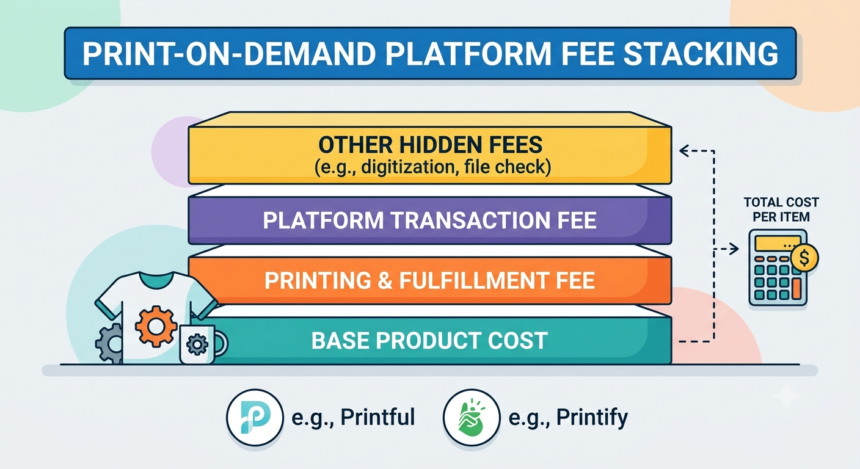
What I found wasn’t a single villain. It was a system. Printful and Printify, the two biggest print-on-demand fulfillment platforms, sit at the center of a chain of costs that compounds at every link. The seller pays a base product cost. Then a print fee. Then shipping. Then a subscription fee to lower those first three costs. Then a marketplace cut on whatever’s left. Then a payment processing fee on top of that cut. Each fee looks small and defensible on its own. Stacked together, they quietly eat the difference between a real business and a hobby that loses money.
The Pitch and the Catch
Printful and Printify both sell the same dream. No inventory. No upfront cost. List a design, make a sale, the platform prints it, packs it, ships it, and you keep the markup. Printful1 advertises that there are no upfront costs when selling with the platform, since you only pay for fulfillment once a customer orders, and there are no monthly fees to create products or connect a store.
Printify2 makes a nearly identical promise.
That pitch is true in the narrowest sense. Nobody pays a setup fee to start. The free plan is genuinely free. But “free to start” is doing a lot of work in that sentence, and it’s the kind of phrase that survives contact with a profit and loss statement only if you stop reading after the headline.
Here’s where it gets interesting. A breakdown of Printful’s costs found a six-line cost stack hiding behind the free-to-start headline: an optional Growth or Business subscription, the per-product base cost, printing add-ons for things like sleeve prints and embroidery, branding charges for custom packaging, shipping that climbs with each additional item, and a set of easily missed reserve costs including currency conversion fees on non-USD payouts and the cost of reprints or refunds, which the seller absorbs unless the defect is Printful’s fault. Six lines. Not one of them is a lie. All six of them together are the story nobody puts in the onboarding email.
Base Costs: The First Markup
Start with the product itself. A blank t-shirt costs the platform a few dollars wholesale. By the time it reaches a seller’s dashboard as a “base cost,” that number has already absorbed the platform’s margin. A Bella Canvas t-shirt runs $9.04 through Printify with its Premium subscription applied, compared to $11.69 through Printful, a difference of roughly 23 percent. That gap exists before a single sale happens. It’s baked into the catalog.
Sellers on forums talk about this gap like weather. It’s just there. Branvas3 after comparing the two platforms put it about as bluntly as I’ve seen: they asked how anyone makes profit using Printful, since its prices run 20 to 30 percent above Printify’s, and even Printify leaves sellers with very thin margins. Read that twice. The complaint isn’t that one platform is bad and the other is good. The complaint is that both leave margins so thin a stiff breeze knocks them over.
And Printful’s base costs don’t sit still. The platform makes annual or semi-annual base cost adjustments, most recently a 0.4 to 2.4 percent increase in February 2026 across most apparel categories, alongside a smaller shipping rate adjustment on accessories. The increases don’t automatically update a seller’s storefront retail price, so if a seller isn’t tracking the change, their gross margin compresses by exactly the increase amount. Nobody emails to tell a seller their margin just shrank. The platform raises its number. The seller’s number stays the same. The difference vanishes into the platform’s pocket, silently, sale after sale, until somebody happens to notice.
The Subscription You Need to Avoid the Fees You’re Already Paying
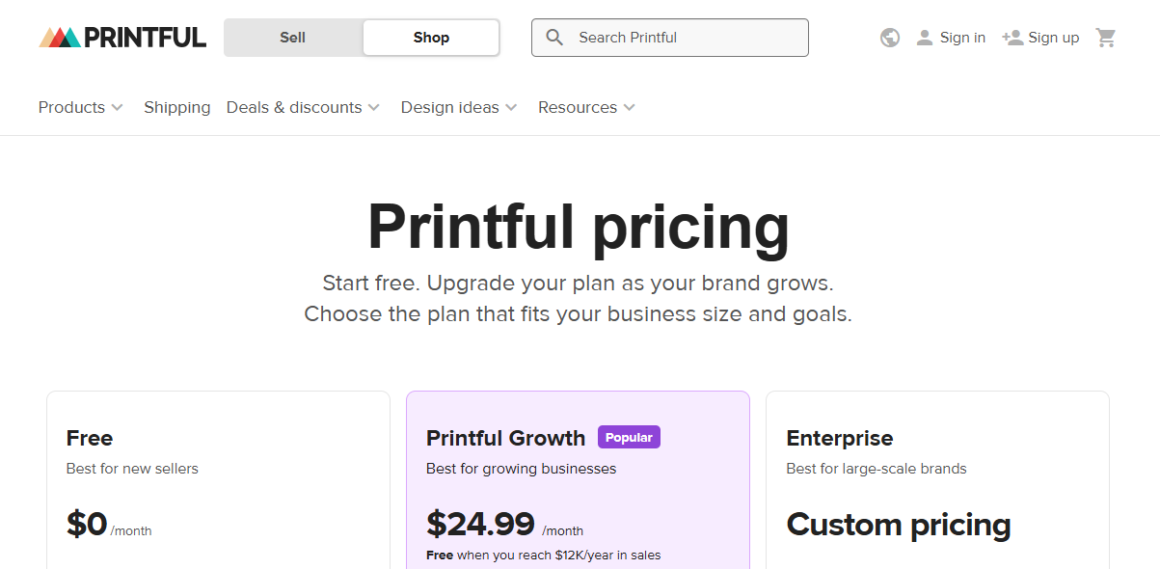
This is where the stacking starts to feel less like a cost structure and more like a maze designed to be confusing. Both platforms offer a paid subscription that exists, functionally, to discount the base costs the free tier charges you. Printful’s4 Growth plan costs $24.99 a month and unlocks up to a 33 percent product discount, becoming free once a seller crosses $12,000 in annual sales. Printify’s5 Premium plan works the same way, at a steeper recent price.
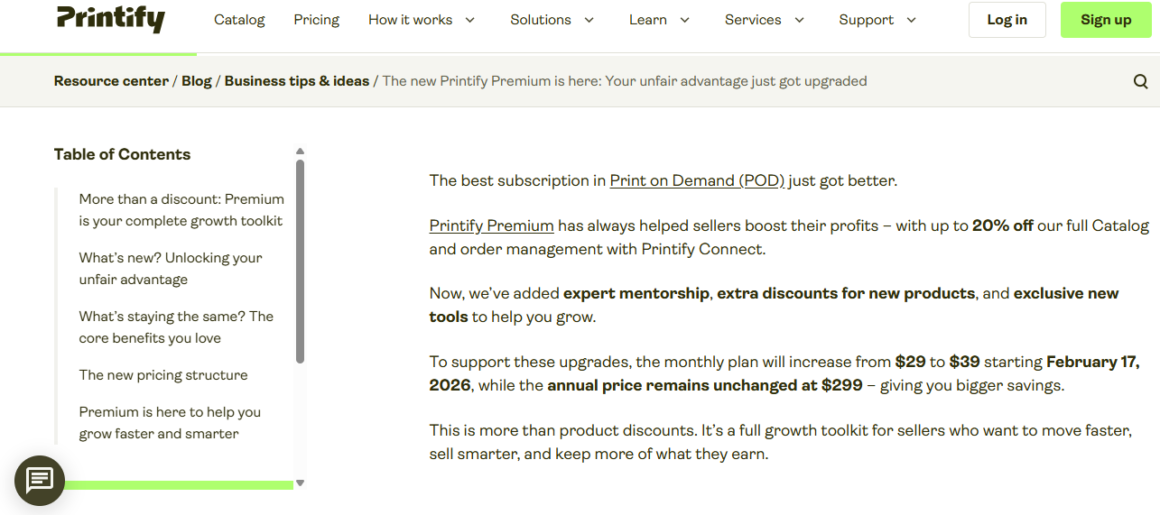
Printify’s6 monthly Premium plan jumped from $29 to $39 in February 2026, a 34 percent increase, while the annual plan held steady at $24.99 a month. The Reddit reaction was immediate and not subtle. One industry blogger covering the change wrote that they’d already seen the Reddit threads, the Facebook group meltdowns, and the posts asking what the best Printify alternative might be, flooding every print-on-demand community they follow.
I want to sit with that pricing structure for a second, because it’s the cleanest example of fee stacking I found in this whole investigation. The platform’s free tier charges full price. The platform’s paid tier charges a monthly fee to discount that full price back down to something resembling a normal wholesale rate. A seller doing real volume has no real choice. They pay the subscription, because the alternative is paying more per unit forever. The subscription isn’t really an upgrade. It’s an unlock fee for a price the platform was always capable of offering.
A break-even calculation makes this plain. At 50 monthly orders, Printify’s7 20 percent discount saves a seller $120 against a $39 subscription, a net gain of $81 a month. Switch to the annual plan at $299 a year and the break-even point drops to around 11 orders a month. Fine math, if you’re already moving volume. But notice what the math assumes. It assumes the seller has already cleared the first hurdle, the one where they’re selling enough to make the subscription rational in the first place. Below that volume, sellers are stuck paying the higher, undiscounted price, the exact price the platform set knowing most beginners can’t yet justify the workaround.
Shipping: Where the Real Damage Happens
If base costs are death by a thousand cuts, shipping on Printify is closer to a single, well-aimed gut punch, and it comes from the platform’s defining structural choice. Printify isn’t a single fulfillment company. It’s a marketplace of more than a hundred independent print providers, each with its own warehouse, its own pricing, and its own shipping rate.
That structure is the selling point and the trap at once. If a customer orders a t-shirt printed by one provider and a mug printed by another, Printify charges shipping twice, and sellers need to factor that into their retail pricing or try to use a single provider for as many products as possible. Two items, one order, two separate shipping charges, because the platform routed the parts of that order to two different warehouses that have nothing to do with each other.
Forum sellers describe this as one of the platform’s most disorienting traps for beginners, the kind of thing nobody warns you about until you’ve already eaten the cost. One Trustpilot8 reviewer described ordering eight poster prints through Printify and watching shipping alone hit $56, compared to an estimated $9 for the equivalent order through Printful. A Reddit user summarized the underlying mechanic in plainer terms, warning that orders routed through three different suppliers come with three separate shipping charges tacked on, one for each.
International orders make it worse. Shipping to destinations like Australia or parts of Asia can run as high as $127 per item on Printify, a number that destroys any retail margin a seller might have built in. I read that figure twice because it seemed implausible. It isn’t. It’s a real number sellers report eating, on actual orders, because they didn’t restrict their shipping zones in time.
Printful avoids this particular trap by fulfilling almost everything in-house. The platform automatically routes orders to its nearest fulfillment center, while Printify requires manual intervention or specific settings to route orders efficiently, with mixed-provider orders resulting in multiple shipping fees. Printful’s prices run higher up front. But the seller isn’t gambling on whether their order happens to touch two warehouses instead of one.
Quality Control as a Hidden Cost
There’s a fee here that doesn’t show up on any pricing page, and it’s the one I think matters most, because it’s the one sellers don’t see coming until the refund requests start piling up. Print quality on Printify varies wildly by provider, because Printify doesn’t print anything itself. It just routes the order.
One frustrated seller on the r/Printify9 forum reported that 30 percent of their products required reprints, calling the quality inconsistent and noting reviews seemed to be declining. Thirty percent. Run that against a seller’s margin. If a third of all orders need a reprint, and the seller eats that reprint cost unless they can prove the defect was the platform’s fault, the “savings” from Printify’s lower base price evaporate fast.
30% of products require reprint. Printify is beginning to look like a garbage business venture.
In the same thread, another user added:
I just had a customer order 28 shirts for their Christmas family vacation. The print quality was horrible. I wouldn’t even give it 1 star. My customer was so disappointed and asked for a refund. $498. They ga ve her $19! Absolutely unacceptable! I’ve been creating her shirts for years and I may have lost a customer because the print quality was horrible and customer servce was a slap in the face! 0 stars!
Trustpilot reviewers describe stitching visibly unraveling and faded prints, with one order taking fourteen days to arrive only to require a return on arrival. A return isn’t free. It’s shipping cost twice over, a refund to the customer, and the seller’s own time spent fielding the complaint, none of which appears anywhere on a pricing comparison chart.
This is the part of fee stacking that’s hardest to quantify and easiest for a platform to wave away. It isn’t a line item. It’s an operating cost disguised as bad luck.
Etsy Stacks Its Own Layer on Top
Most print-on-demand sellers don’t sell through their own storefront. They sell through Etsy, because that’s where the buyers already are. Which means the print-on-demand fee stack isn’t the only stack a seller is climbing. Etsy charges its own layered set of fees on top of whatever Printful or Printify already took.
Etsy10 charges a flat listing fee of twenty cents per item, charged whether or not the item ever sells, plus a 6.5 percent transaction fee on the total order amount, including shipping and gift wrap. On top of that, a separate payment processing fee applies to every transaction run through Etsy Payments, a set rate plus a percentage of the total sale price that varies by country, and this fee comes in addition to the 6.5 percent transaction fee, not instead of it. For U.S. sellers, that processing fee runs three percent plus a quarter, stacked directly on top of the 6.5 percent Etsy already took.
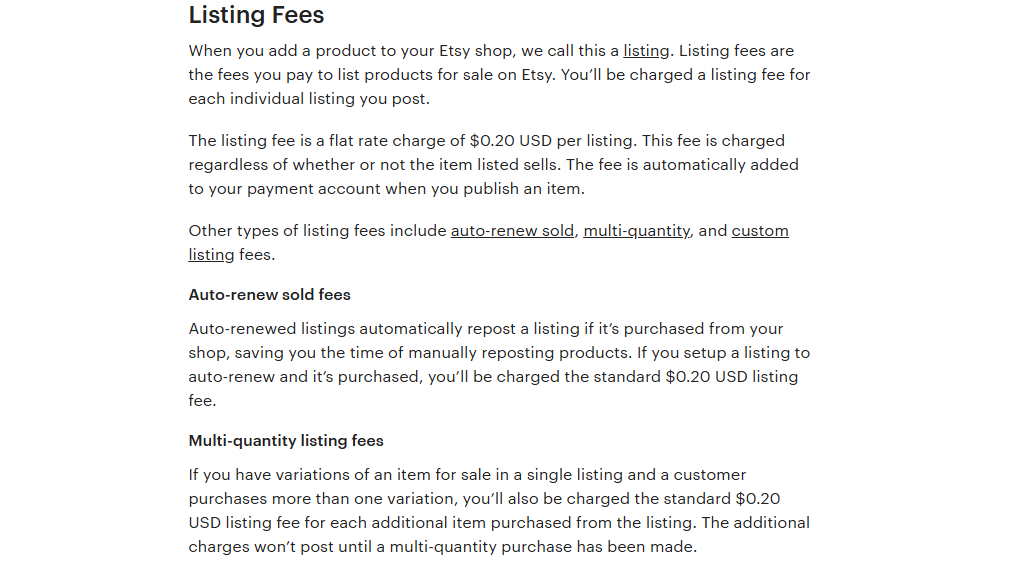
Run an actual sale through that math and the abstraction turns concrete fast. On a forty dollar necklace with five dollars shipping, Etsy’s listing fee11 runs twenty cents, the transaction fee comes to $2.93, and the payment processing fee adds another $1.60, before any cost of goods or print-on-demand fulfillment fee enters the picture at all. And that’s before factoring in Printful’s or Printify’s own cut for actually making the product.
Sellers who run the offsite ads gauntlet pay even more. If a sale results from a customer clicking an Etsy offsite ad, and the seller has made less than ten thousand dollars in the past twelve months, Etsy charges an additional fifteen percent of the order on top of everything else. Fifteen percent. On a sale the seller didn’t choose to advertise. Etsy opts smaller sellers into offsite ads by default, and there’s no clean way to know in advance which sale will trigger that fee until the statement arrives.
One seller writing about three years of running Etsy shops summed up the emotional toll better than any spreadsheet could. She described the combination of transaction fees, processing fees, offsite ads, multi-quantity orders, and renewal fees making pricing a moving target, and said the only way she found to stay profitable was running every listing through a fee calculator before publishing it, not after. Before, not after. That’s the whole game in five words. The fees move first. The seller reacts.
Every cost breakdown I found treated fees as dollars. None of them priced in hours. But the hours are real, and they’re the cost that turns a four dollar profit into something worse than minimum wage.
Sourcing samples from multiple print providers to find one that doesn’t produce thirty percent reprint rates takes hours. Setting up shipping profiles to block high-cost international zones takes hours. Recalculating margins every time a platform quietly adjusts its base cost by half a percent takes hours. None of that shows up in a Printful or Printify pricing table. All of it is real labor, performed for free, by a seller trying to stay ahead of a fee structure built to shift faster than they can track it.
This is the part that made me think of my friend and her four dollars an hour. She wasn’t bad at her business. She was running a margin calculation against a moving target, on her own time, with no visibility into when the target would move next.
Why Nobody Builds the Whole Picture for You
I went back through every pricing page, every help center article, every comparison guide I could find from Printful and Printify themselves, looking for one document that laid out the full stack in a single place. There isn’t one. Each company publishes its own piece of the puzzle, accurately, and stops at its own border.
Printful’s pricing page tells a seller about product costs, shipping, and the Growth plan. It doesn’t mention Etsy’s transaction fee, because why would it. Etsy isn’t Printful’s product.
Etsy’s fee policy12 lays out the listing fee, the transaction fee, and the payment processing fee in careful, accurate detail. It doesn’t mention that the seller might also be paying Printify twice for shipping because their order touched two warehouses, because that isn’t Etsy’s fee to explain. Each platform is honest within its own four walls and silent about everything outside them.
That division of labor isn’t conspiracy. It’s just how separate companies write documentation. But the effect on a new seller is the same either way. Nobody is lying. Nobody is also telling the whole truth. A seller has to assemble the full picture themselves, fee by fee, platform by platform, usually after the first month’s numbers come in lower than expected and they go looking for why.
This is where the forums earn their keep. Reddit threads and Trustpilot reviews are messy, anecdotal, and sometimes wrong about the specifics. But they’re the only place where the stack gets described end to end, because the people writing them are the only ones who’ve actually climbed it. A pricing page tells you what one company charges. A frustrated seller comparing notes with strangers online tells you what it actually costs to run the business, fee stacked on fee, platform stacked on platform.
I’d argue that gap, between official documentation and lived seller experience, is itself a kind of cost. It’s the tax a new seller pays in confusion and false starts before they learn what every veteran already knows by instinct. Nobody bills for it. Everybody pays it.
The Sellers Who Make It Work Anyway
It would be unfair to leave the impression that nobody makes money in this business, because plenty of sellers do. The ones who do tend to share a few habits that amount to defense against fee stacking rather than escape from it.
They restrict shipping to domestic or regional markets where rates stay predictable, accepting smaller addressable markets in exchange for not getting blindsided by a hundred and twenty dollar shipping charge on a single poster. They structure their catalogs around a single print provider wherever possible, so an order never quietly splits into two shipping charges without their knowledge. They calculate margin before listing, not after, running every product through a spreadsheet or calculator that accounts for the full stack rather than just the base cost. And they treat subscription tiers as a volume decision, not a default, upgrading only once the break-even math genuinely favors them.
None of that erases the stack. It just means these sellers have learned to read the whole tower before they start building on it, instead of discovering its true height one fee at a time, the way most beginners do.
Strip away the marketing language and the stack looks like this, in order, for a typical t-shirt sold through Etsy and fulfilled through Printify on the free plan. Base product cost, full undiscounted price because the seller hasn’t hit subscription-worthy volume. Shipping, possibly doubled if the order crosses two providers. Etsy’s twenty cent listing fee. Etsy’s 6.5 percent transaction fee on the full order including shipping. Etsy’s payment processing fee on top of that. Possibly a fifteen percent offsite ads fee, assigned without the seller’s direct consent. And, lurking underneath all of it, the time cost of catching every one of those numbers before they quietly drift against the seller’s favor.
A seller running that math by hand on a thirty-five dollar item with five dollars shipping found their actual payout landed around $32.03, and after subtracting an item cost of twelve dollars to make and ship, real profit came to just over twenty dollars. Twenty dollars sounds fine until you remember it has to cover the design work, the customer service, the time spent comparing print providers, and every hour spent doing the math in the first place.
None of these fees, on their own, is unreasonable. A payment processor charging three percent to move money is a normal cost of doing business. A fulfillment platform charging for the physical product it prints and ships is not a scam. A marketplace charging rent for access to its buyers is, in the most literal sense, just rent. The problem isn’t any single fee. The problem is that nobody designed the stack on purpose, and nobody at any of these companies is responsible for telling a new seller what the whole tower looks like before they start climbing it.
That’s the quiet trick of platform fee stacking. Each company can point to its own line item and call it fair, call it standard, call it the cost of the service it provides. And each of those claims, taken alone, is probably true. It’s only when you lay every fee end to end, the way my friend did at her kitchen table after her kid fell asleep, that you see the shape of the thing. A business that looks like it should work, that’s marketed as though it should work, quietly engineered by accumulation to leave almost nothing behind for the person who actually made the shirt.
Sources
- “How to Start an Online Store Without Inventory” Printful, www.printful.com/start-your-online-store-without-inventory. Accessed 2 July 2026. ↩︎
- “Pricing – Printify” printify.com/pricing/. Accessed 2 July 2026. ↩︎
- Cui, Yi. “Printful vs Printify 2026: Margins, Quality & Best Pick” Branvas, 30 June 2026, branvas.com/blogs/news/printful-vs-printify. Accessed 2 July 2026. ↩︎
- “Printful Growth: Get More Profit per Sale” Printful, www.printful.com/plans. Accessed 2 July 2026. ↩︎
- Printify, help.printify.com/hc/en-us/articles/4483625875601-How-does-Printify-s-Premium-plan-work. Accessed 2 July 2026. ↩︎
- “The new Printify Premium: Your complete POD growth toolkit” 17 Feb. 2026, printify.com/blog/new-printify-premium/. Accessed 2 July 2026. ↩︎
- Mucenieks, Andris. “Printify Free vs Premium: Which subscription do you need?” 15 Apr. 2026, printify.com/blog/printify-free-vs-premium/. Accessed 2 July 2026. ↩︎
- Trustpilot, www.trustpilot.com/review/printify.com. Accessed 2 July 2026. ↩︎
- Reddit, www.reddit.com/r/Printify/comments/1onle1k/30_of_products_require_reprint_printify_is/. Accessed 2 July 2026. ↩︎
- Etsy, help.etsy.com/hc/en-us/articles/360035902374-Etsy-Fee-Basics. Accessed 2 July 2026. ↩︎
- Etsy, help.etsy.com/hc/en-us/articles/360000344908-Fees-and-Listing-Multiple-Quantities. Accessed 2 July 2026. ↩︎
- “Etsy.Com” www.etsy.com/in-en/legal/fees/. Accessed 2 July 2026. ↩︎


