

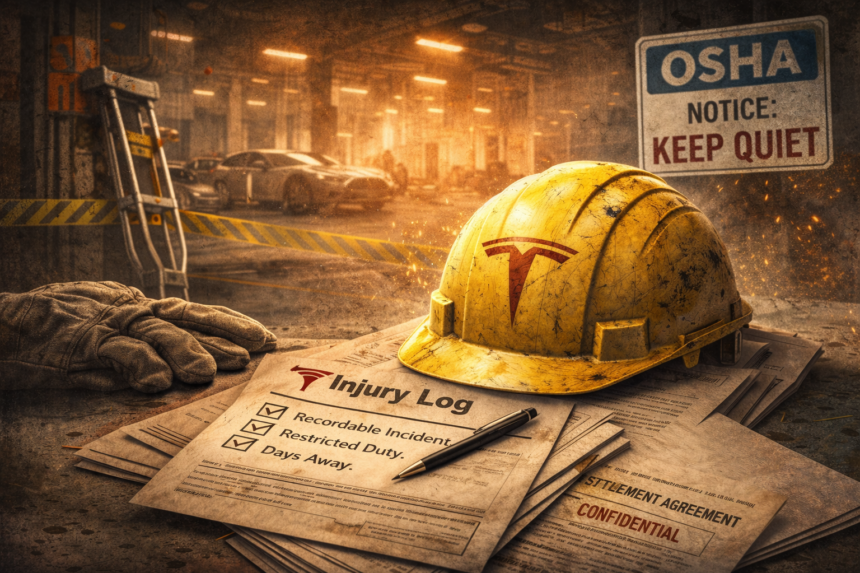

From the outside, Tesla’s factories look like temples of modern manufacturing. The shiny floors, the whir of machines, and Elon Musk’s promise to electrify the future paint a picture of progress. But beneath that veneer are histories of injury, uncertainty, and questions that go unasked in most media coverage. What happens to the workers after they are hurt, after the ambulance leaves, and after the OSHA report closes?
I began this investigation wondering not how many workers get hurt, but what it means for their lives when they do. What I found is a story of pain, resilience, and often abrupt endings to careers meant to last a lifetime.
Counting Incidents but Losing People
Tesla publishes high-level safety statistics, and regulators collect injury logs, but these numbers only tell part of the story. They measure what is easily recorded: days away from work, medical treatment, or restricted duty. They do not capture what happens to the people behind those numbers—their struggles to return to a fast-paced assembly line, the physical pain that lingers, or the careers that quietly derail.
Official injury logs from the U.S. Occupational Safety and Health Administration (OSHA)1 record incidents that meet specific reporting thresholds. Any injury requiring medical attention beyond first aid, time off, or modified duties becomes a “recordable incident.” But these logs are snapshots, not narratives. They tell regulators and corporate executives that the numbers are down or up, but they say little about the lived experience of returning to work, the anxiety about re-injury, or the subtle pressures from supervisors to meet production quotas despite ongoing pain.
According to WSWS2, the Gigafactory in Austin, Texas, reported 1,049 injuries among roughly 13,444 workers, placing it among the highest in the nation for reported incidents. The Fremont, California, factory also logged thousands of injuries. These figures suggest a level of risk far above the industry average and raise questions about how management and safety systems handle the aftermath.

I spent hours reviewing official logs alongside news reports, and what stood out was the silence between the lines. A serious injury might be counted, but the aftermath: the reassignment, the chronic pain, the career stalls, they are all invisible.
Workers themselves describe experiences that numbers cannot capture. The platform X3 is full of such stories. One employee recounted seeing colleagues collapse on the floor and be wheeled away by stretchers.
“I’ve seen seizures here more times than I expected,” they wrote, illustrating the physical intensity and unpredictability of factory life.
Another long-running thread shared a $13 million settlement from a life-altering injury. Users described a janitor whose lower body was pinned under a car, leaving her unable to walk. Comments reflected not only sympathy but frustration at the apparent gap between the severity of injuries and public awareness.
Official reporting confirms some of these worst-case scenarios. In 2025, Reuters4 reported that federal regulators cited Tesla after an electrician was electrocuted at the Austin plant.
Yet even when the data captures the most serious injuries, it remains silent on the human cost. It does not tell us who struggles to return to work, who is reassigned permanently to less desirable roles, or who quietly leaves the company. It does not reflect the lingering physical pain, the emotional stress, or the fear of retaliation that many injured workers describe in forums and interviews.
Numbers can suggest risk. They can indicate trends. But they cannot convey what it is like to exist behind them—to live the aftermath. And that is the space this investigation seeks to illuminate.
Returning to a Different Job
Workers who return after an injury rarely go back to the same status they had before. The factory continues to run at speed, but the person who was hurt is never quite in the same place.
Public reporting on what happens after injuries is scarce. OSHA logs and company statistics capture days lost or restricted duty, but they do not track how a worker’s role, responsibilities, or career prospects change after recovery. Legal records and firsthand accounts suggest a recurring pattern: serious injuries often lead to reassignment to less desirable roles, changes in shifts, or work duties that are more restrictive—and what is meant to be temporary often becomes permanent.
Forum posts reveal the subtle ways this plays out on the floor. One former employee on Reddit recounted an eye injury from metal shavings that led to a corneal abrasion. They described the experience in blunt terms: despite reporting unsafe conditions and inadequate safety gear, they faced a hostile work environment and difficulty securing proper treatment. The New York Times5 reported the story of one such worker.
“They treated me like I was fragile, then forgot I was a person,” they wrote.
These narratives echo patterns in legal filings. Workers returning from injury frequently report being moved to positions that are physically less demanding or slower-paced. While this might sound like an accommodation, the effect is often a demotion in all but name: fewer opportunities for overtime, reduced visibility with management, and limited paths for promotion. The reassignment is quiet. No announcement. No documentation in public records. Just a subtle shift in the worker’s trajectory.
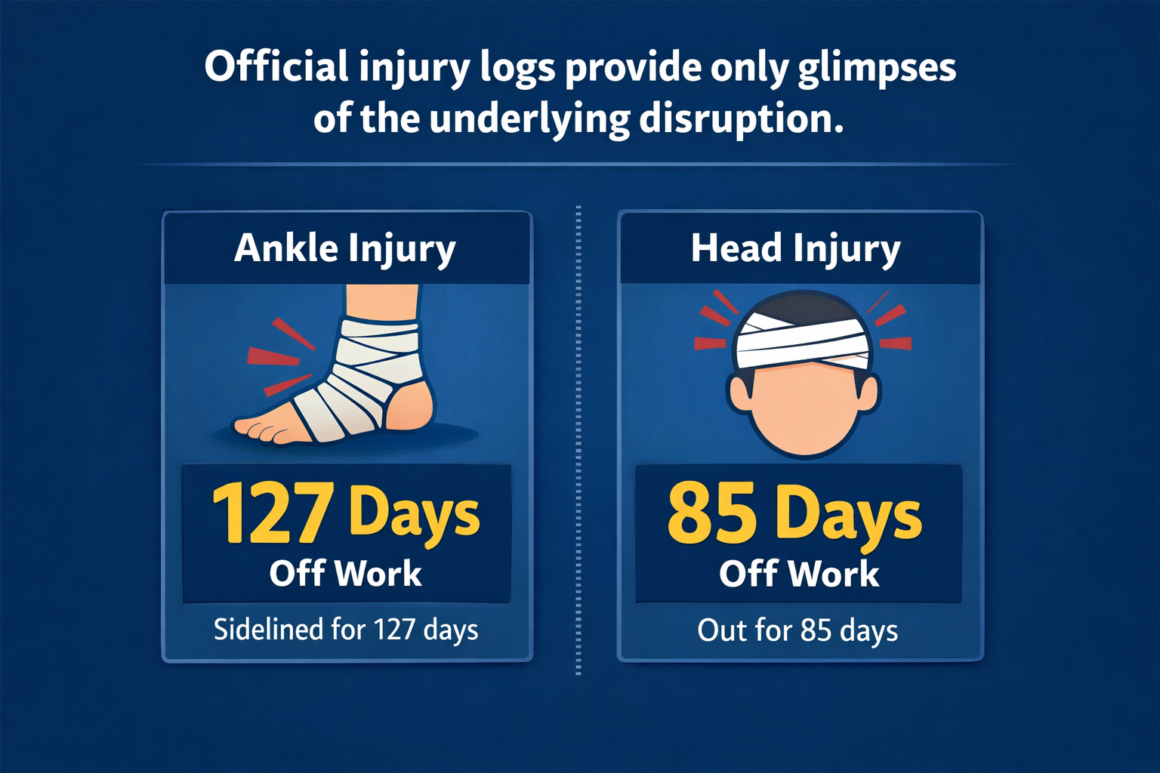
Official injury logs provide only glimpses of the underlying disruption. The Economic Times6 showed a Tesla report that recorded an ankle injury that sidelined a worker for 127 days. Another head injury kept a worker off the floor for 85 days.
When a worker finally returns, the job is rarely the same. Tasks that were once considered desirable or high-status may be reassigned, while roles that are slower, less visible, or lower-paying become the new default. Workers clock in, perform the work, and leave. But the career trajectory they had before the injury often vanishes overnight. Some describe it as a kind of silent punishment; others see it as a structural inevitability in a fast-moving production environment where efficiency outweighs individual accommodation.
I read through multiple worker accounts and OSHA reports, and it struck me how common these patterns are. The logs capture the absence, the forums capture the resentment, and together they hint at a reality the public rarely sees: returning to work does not mean returning to normal. The body might be on the line, but the worker’s place in the factory hierarchy often has shifted permanently.
Medical Clearance, Accountability, and the Cost of “Healing”
At the heart of what happens after injury is a deceptively simple question: when is a worker truly fit to go back to work? For many injured Tesla employees, the answer is shaped less by their recovery than by a system that emphasizes rapid return, minimal recordable injuries, and uninterrupted production.
What medical clearance means at Tesla is a key part of this story. Former health clinic staff who spoke publicly about their experiences describe a culture that prioritized minimizing official injury counts over worker well-being. In one detailed account, medical personnel said injured workers were routinely sent back to full duty even when they could not physically manage the tasks assigned to them. According to Workplace Fairness7, workers were often declared “fit for duty” without sufficient consideration of lingering pain, mobility limitations, or the demands of their original roles.
These practices were not just about paperwork. They shaped how injuries were classified, how much time workers had to recover, and how easily someone could be assigned back to a full production role. In effect, the process of medical clearance became tangled with internal priorities about safety metrics, insurance costs, and production targets.
Injury logs fail to tell this full story when companies influence how injuries are classified. A former clinic employee described instances in which Tesla’s workers’ compensation officials intervened to challenge diagnoses they felt could be counted as work-related. One worker who was initially suffering from severe electrical exposure and significant restrictions later had their diagnosis changed after internal discussions and reclassification.
According to the Portside8 account, what was first understood as a genuine impairment became, after internal review, a less severe or non‑work‑related injury for reporting purposes.
These internal dynamics reveal a broader tension that injured workers rarely see in real time: the articulated goal of worker safety colliding with institutional pressure to reduce the number of recordable injuries. It is one thing to have clear safety policies on paper; it is another to see how those policies are enacted under the daily pressures of production targets, staffing shortages, and managerial oversight.
Behind the line, the question of who decides what happens to an injured worker is complicated by overlapping responsibilities. Supervisors and line managers control immediate workflows and assignments. Human resources manages return‑to‑work policies, attendance tracking, and compliance documentation. Medical staff determine readiness to return. Executive leadership sets the tone on safety culture, production priorities, and how much emphasis is placed on injury reporting.
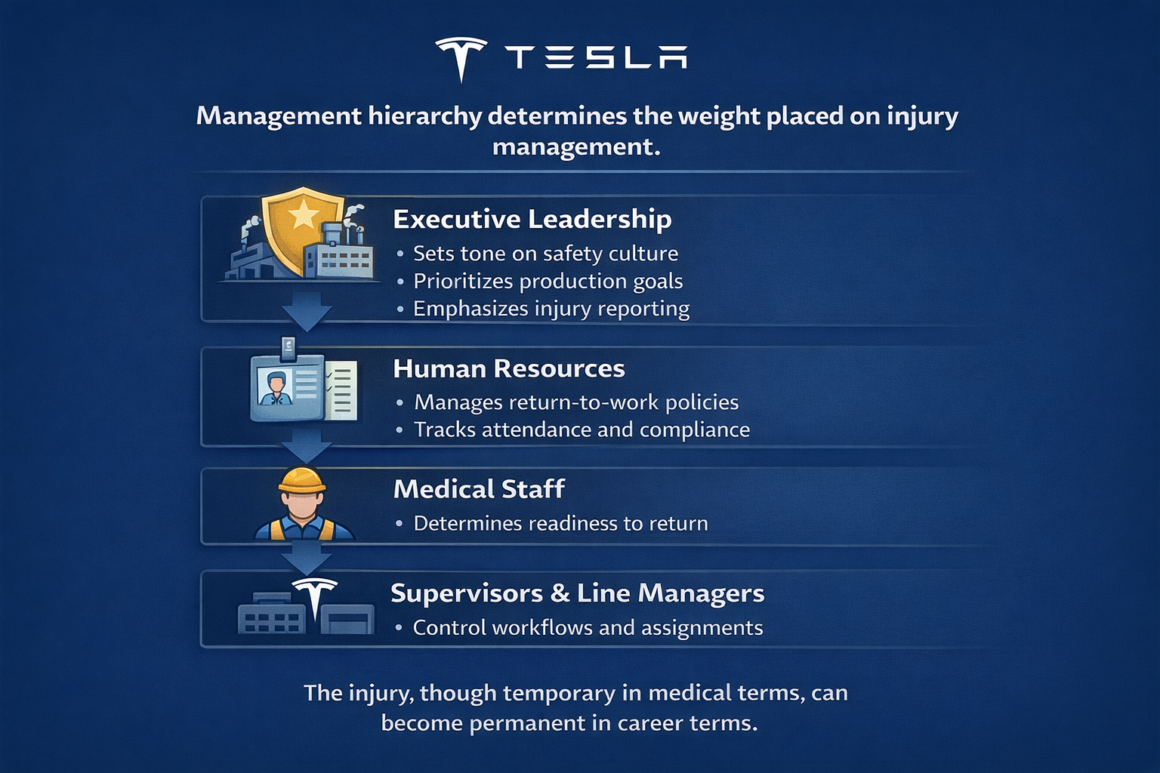
This diffusion of responsibility means that accountability is difficult to trace. Workers and former staff alike describe decision‑making that feels invisible, with each layer pointing to another for answers. Forum comments from self‑identified employees often reflect this confusion, with one commenter stating simply:
“They cleared me back to the line. Nobody checked if I could lift the parts safely.”
That sense of being passed back into the line without real assessment of fitness for duty is echoed in multiple online accounts, even when details vary. Some describe being cleared by clinicians who never asked them to try the actual tasks they would be expected to perform. Others recount supervisors treating medical recommendations as negotiable based on production needs.
Regulatory oversight plays a role, but often feels reactive rather than preventative. OSHA9 inspections and fines occasionally highlight lapses in workplace practices, but enforcement typically focuses on egregious violations rather than the everyday decisions that shape worker outcomes after injury. Critics argue that follow‑up on career consequences for injured workers is largely absent from regulatory frameworks. Safety enforcement looks at whether an injury was reported properly, not whether the worker is set up for a fair and sustainable return to work.
I found it striking how easily responsibility can diffuse in practice. When a worker suffers a serious injury, the documentation focuses on the incident, not the trajectory that follows. Medical clearance is recorded, and then the worker is returned to duty, all while the real questions about long‑term accommodation and career impact go unasked.
Yet these decisions have lasting consequences. An injured shoulder that has not fully healed can lead to chronic pain in a job that demands repetitive lifting. A back condition that was minimized in a clinic can become a lifelong burden when a worker returns to weighty tasks five days a week.
And the costs go beyond individual well-being. Workers who feel their injuries were dismissed or downgraded are less likely to raise future safety warnings. They fear being seen as liabilities or simply as someone who cannot keep up. That fear, in turn, can dampen collective awareness about hazards that might otherwise be improved for everyone.
Accountability in this context is hard to pinpoint. Is it the clinic staff who made the clearance? The supervisors who accepted it? The HR team that filed the paperwork? Or the leadership whose production targets cascade down through every layer of decision‑making? The answer is all of the above, and yet none of the above in isolation. It is the system as a whole that shapes the post‑injury experience, and in that system, individual responsibility is easily obscured.
This diffuse responsibility can leave injured workers without clear recourse. A worker who was misclassified and then reassigned might not know whom to hold accountable. The company’s safety reports will show a low number of recordable incidents. The OSHA logs will be up to date. But the worker, day after day, feels the cost of decisions made in meeting rooms and clinics that they never see.
Injury and recovery are not just clinical events. They are organizational experiences, shaped by policy, pressure, and priorities. In Tesla’s case, the systems designed to protect workers often intersect with incentives to minimize disruption. That intersection determines not just when a worker can return to the floor, but how their future unfolds once they do.
Stalled Promotions, Quiet Demotions, and Exits
Injuries at Tesla do not just leave physical marks. They leave invisible imprints on careers, often emerging only when a worker attempts to climb the ladder or claim the opportunities they earned before being hurt. The factory may keep running at full speed, but the trajectory of an injured worker’s career often slows or shifts without formal acknowledgment.
In worker forums, former Tesla employees describe subtle ways in which injuries can derail career advancement. One Reddit10 commenter explained being sent back to work after a hand injury with restrictions that were only partially considered.
“It felt like they wanted me on the line more than they wanted me healed,” they wrote. “I could do the job, but only if I ignored the pain. Promotion? That wasn’t even on their radar.”
These anecdotes reveal a recurring pattern. Attendance metrics, shift bidding, and overtime allocations. The very systems that determine promotions and visibility can shift subtly against injured employees.
Missing days due to recovery or restricted duty can be recorded as negative attendance, even when they are legally justified. Workers who cannot take on extra shifts or high-demand tasks due to lingering injuries often lose the chance to demonstrate productivity in ways valued by management. Over time, these small disadvantages compound into what looks like stalled advancement or a quiet demotion.
The shift is rarely formal. There are no memos, no announcements, no official change in status. But in practice, the result is the same: the injured worker occupies a role with less influence, less visibility, and fewer growth opportunities. Tasks that once counted toward performance reviews and promotions are no longer available. Roles that were central to the workflow are now off-limits due to physical restrictions or safety considerations. While the worker is present on the floor, their career trajectory has diverged sharply from their peers.
Some workers describe this as a form of invisible punishment. They did not break company rules. They did not underperform. Yet the injury alone, paired with a system focused on productivity metrics, becomes a limiting factor. One former employee wrote that after returning from a back injury, their assignments were shifted to “lower-traffic stations that nobody noticed,” effectively freezing any chance of advancement.
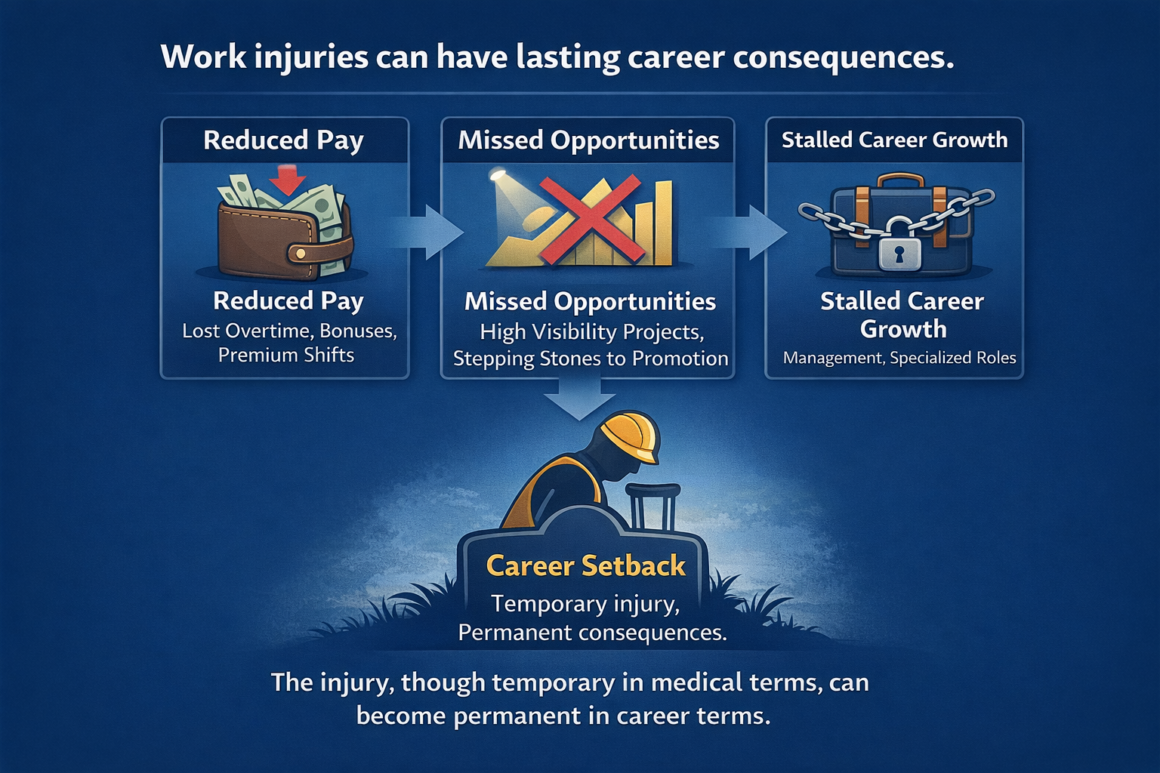
The economic impact of this invisible demotion can be severe. Workers may see reductions in overtime pay, bonuses, or access to premium shifts. Opportunities to work in high-visibility projects, which are often stepping stones to management or specialized positions, may vanish. The injury, though temporary in medical terms, can become permanent in career terms.
Many injured workers choose to leave. The combination of chronic pain, reduced earnings, and stalled advancement often makes leaving the most viable option. One worker summed it up succinctly:
“I could stay and be stuck or leave and start over.”
Departure from the workforce has another consequence: erasing visible evidence of the human cost of injury. OSHA11 logs and company reports capture the initial incident and days away from work, but once a worker exits, their story rarely appears in official data. The systemic impact—the lost experience, the knowledge, and the mentorship potential—is invisible. Former colleagues might remember the person, but in statistics and corporate reports, they disappear.
This silence can obscure patterns. It becomes difficult for regulators, researchers, or journalists to understand whether post-injury policies are effective or if the culture of reassignment and quiet demotion is widespread. It also allows the company to report low turnover or smooth return-to-work numbers while, behind the scenes, careers are being quietly redirected or ended.
The psychological toll is another dimension rarely measured. Workers report frustration, resentment, and a lingering sense of injustice. Injuries that once seemed like discrete, recoverable events can leave workers doubting their value to the company.
“It wasn’t just the pain,” one former employee reflected in a forum post. “It was knowing that I was suddenly invisible, even if I was still there.”
For some, leaving is a deliberate choice to regain agency. Others feel forced out by the system: unable to compete for overtime, excluded from desirable roles, or subtly marginalized in evaluations. Both paths reflect the hidden consequences of injuries that are not captured in injury logs or public reporting. The human story of recovery extends beyond healing the body; it encompasses navigating a workplace that often measures value in ways that do not account for diminished capacity or lingering effects.
In examining these patterns, I was struck by how routine this appears to be. Injured workers are not anomalies. They are part of a system that prioritizes production metrics over the long-term well-being of employees. And yet, because much of this happens quietly. Through reassignments, shift adjustments, and unrecorded decisions. There is little accountability and little public recognition of the true costs.
Injuries at Tesla, then, are not just medical events. They are career events. They shape who gets promoted, who gets noticed, and who remains visible in a fast-moving environment where efficiency often outweighs human experience. The quiet nature of this process is what makes it both effective and insidious. Workers who leave take their stories with them, leaving a record that is almost impossible to reconstruct, but whose consequences ripple across careers, teams, and the company’s long-term knowledge base.
Silence, Fear, and Why It Matters
Most media reporting focuses on the moment of injury. The ambulance arrives, the OSHA report is filed, and the news covers the accident. But that is not where the story ends. For workers, the aftermath, the months and years that follow, is where the human cost truly emerges.
Worker voices on Reddit, Glassdoor, and other forums offer rare glimpses into what this period feels like. They describe fear, sarcasm, resignation, and the quiet calculation of risks that every day on the floor entails. One long-running Reddit thread discussed penalties after a worker death and captured a mix of disbelief and frustration. Commenters were astonished at the comparatively low fines relative to the severity of the consequences.
“They pay a small fine, the floor keeps running, and nothing changes for the rest of us,” one user wrote.
Other forums reveal concern over underreporting. Injuries that meet OSHA’s thresholds are sometimes not disclosed to regulators, either by corporate pressure or fear of consequences. Workers report being told not to fill out formal incident reports or that minor injuries would be classified as non-recordable if possible. One Reddit discussion described a culture in which “every scrape, every strain, is measured against production goals before it counts as real.”
The silence surrounding these experiences has real effects. Experts argue that regulatory gaps compound the problem. OSHA relies heavily on accurate reporting by employers and employees. Whistleblower files can be difficult to access, and weak follow-up procedures often fail to ensure that reported hazards are addressed long-term. Some safety experts, as reported by WIRED,12 warn that this creates a chilling effect. Workers are less likely to report unsafe conditions if they believe doing so could threaten their jobs or slow their career advancement.
The consequences of this silence are far-reaching. After returning from injury, workers may find themselves reassigned to slower, lower-visibility roles. Promotions can stall, overtime opportunities shrink, and specialized projects may no longer be accessible. Economic uncertainty compounds the physical and emotional toll of recovery. In some cases, workers leave quietly, abandoning a company and a career path that once promised stability. Their stories, while deeply consequential, vanish from both public view and official statistics. The numbers tell regulators that injuries were limited or resolved, but they cannot capture the nuanced career impacts and long-term effects on health.
This silence also shapes culture. Workers who experience quiet demotions or reassignment may stop advocating for safety improvements. Fear of retaliation or stigmatization becomes a powerful motivator to conform and avoid scrutiny. In forums, several ex-employees describe a pervasive sense of watching one’s own health and career trajectory slowly erode under a system that rewards endurance over transparency.
“You learn to keep quiet,” one user reflected. “If you don’t, you’re just another problem to manage.”
Tesla claims that their factory is safer, but the reality speaks differently. Reveal News13 reported that there were 722 workplace injuries in 2017, averaging roughly two per day. The proportion of serious injuries, those requiring time off or work restrictions, was 30 percent higher than the previous year’s industry average.
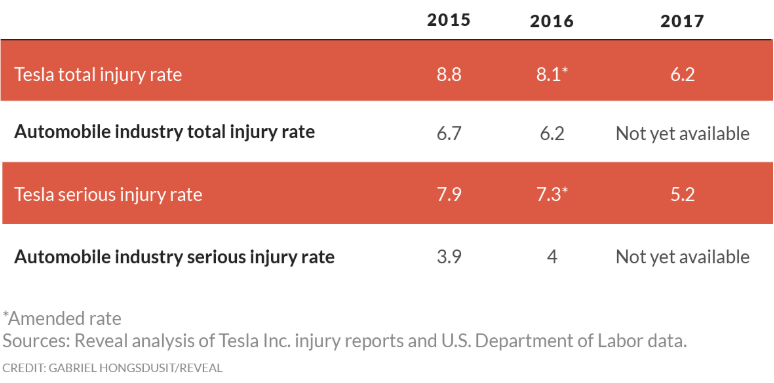
When I reviewed OSHA logs, legal filings, and forum posts, the patterns became clear. Injuries at Tesla are not isolated events with neat beginnings and endings. They are experiences that ripple through a worker’s career, health, and future prospects. Even when a worker returns to the floor, the environment has shifted around them: expectations remain the same, but accommodations may be inadequate, and opportunities once available may no longer exist. Chronic pain, lingering restrictions, and reduced visibility in the workplace combine to create a kind of ongoing penalty that is not reflected in official numbers.
These gaps in reporting, oversight, and accountability underscore a broader problem: the systems that govern workplace safety and career progression are complex, diffuse, and often reactive. They fail to measure or address the human costs of injury in ways that matter. This leaves regulators, journalists, and the public with an incomplete understanding of what happens to workers long after the cameras and headlines have moved on.
The aftermath of injury is also a story of lost potential. Experienced workers who leave take skills, institutional knowledge, and mentorship with them. Teams are disrupted, projects may slow down, and the social fabric of the workplace changes. Yet these effects are invisible unless someone digs into forum posts, personal testimonies, and the fragments left in legal and regulatory filings. By the time a pattern is recognized, workers who have been sidelined, demoted, or pushed out are often gone.
Ultimately, what struck me most in assembling these accounts is the quiet accumulation of consequences. One worker’s injury may seem like a discrete incident. But viewed collectively, the experiences reveal a systemic pattern: the moment of injury is only the beginning. The real costs unfold in years of silent struggle. Physically, economically, and psychologically. A worker’s career, health, and opportunities can be altered permanently by decisions made in clinics, offices, and meeting rooms they may never fully see. The human story continues long after the incident is over, even when the logs say everything is resolved.
In the end, silence, fear, and invisible career impacts are not just individual experiences—they are symptoms of a system that prioritizes production over people. They matter because they shape who thrives, who survives, and who leaves quietly. And they matter because the workers who endure these consequences rarely have a public voice to tell the full story.
Sources
- “Occupational Injury and Illness Recording and Reporting Requirements” Occupational Safety and Health Administration, 19 Jan. 2001, www.osha.gov/laws-regs/federalregister/2001-01-19. Accessed 29 Jan. 2026. ↩︎
- “OSHA investigating work-related death at Tesla Gigafactory in Austin, Texas” World Socialist Web Site, 9 Aug. 2024, www.wsws.org/en/articles/2024/08/09/tsla-a09.html. Accessed 29 Jan. 2026. ↩︎
- “X.com” x.com/alyssajperry/status/1128047568464764928. Accessed 29 Jan. 2026. ↩︎
- “Reuters.Com” www.reuters.com/business/autos-transportation/tesla-cited-by-us-regulators-over-workers-death-2025-02-19/. Accessed 29 Jan. 2026. ↩︎
- “Nytimes.Com” 25 Mar. 2021, www.nytimes.com/2021/03/25/business/musk-labor-board.html. Accessed 29 Jan. 2026. ↩︎
- “Tesla: Tesla workers report robot injuries, explosions at US Cybertruck factory” The Economic Times, m.economictimes.com/tech/technology/tesla-workers-report-robot-injuries-explosions-at-us-cybertruck-factory/articleshow/105403810.cms. Accessed 29 Jan. 2026. ↩︎
- Cyril, Max. “Workplace Fairness, Empower Worker – Employment Law” 8 Nov. 2018, www.workplacefairness.org/hiding-injuries-at-tesla-where-the-worker-still-doesnt-matter/. Accessed 29 Jan. 2026. ↩︎
- Board, Sun-Times Editorial. “Archive” Portside, 6 Nov. 2018, portside.org/archive?f%5B0%5D=categories%3A12&f%5B1%5D=portside_date%3A2018&search=&sort_by=field_pub_date&sort_order=DESC&page=4. Accessed 29 Jan. 2026. ↩︎
- “Occupational Safety and Health Administration (OSHA) Inspections” 23 Oct. 2018, www.osha.gov/sites/default/files/publications/www.osha.gov/sites/default/files/publications/factsheet-inspections.pdf. Accessed 29 Jan. 2026. ↩︎
- Reddit, www.reddit.com/r/RealTesla/. Accessed 29 Jan. 2026. ↩︎
- “Recording days away and/or restricted work activity when employee is able to work part of a shift.” Occupational Safety and Health Administration, www.osha.gov/laws-regs/standardinterpretations/2010-09-07. Accessed 29 Jan. 2026. ↩︎
- Haskins, Caroline. “Labor Leaders Fear Elon Musk and DOGE Could Gain Access to Whistleblower Files” WIRED, 10 Apr. 2025, www.wired.com/story/elon-musk-doge-osha-whistleblower-files/. Accessed 29 Jan. 2026. ↩︎
- Evans, Will. “Tesla says its factory is safer. But it left injuries off the books” Reveal, 16 Apr. 2018, revealnews.org/article/tesla-says-its-factory-is-safer-but-it-left-injuries-off-the-books/. Accessed 29 Jan. 2026. ↩︎


