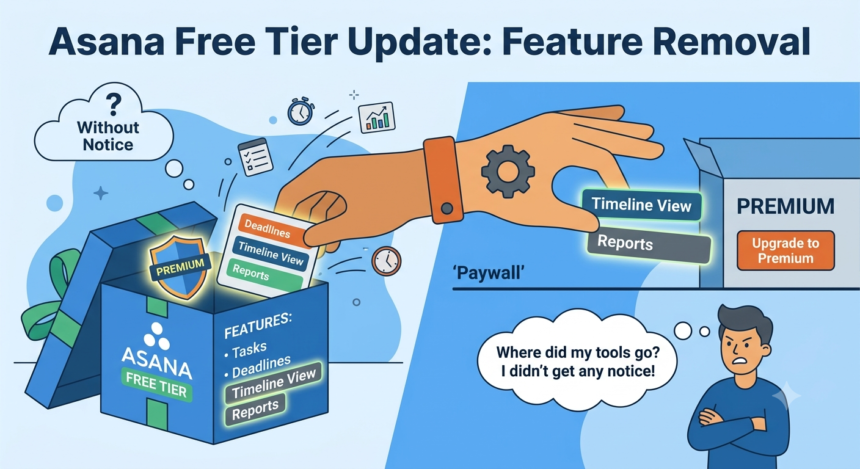

Marie-Claire Silfer runs two nonprofit communities. Five people, total, keep them running. Last February she finished her Asana trial, opened the billing screen, and found a number she hadn’t expected. She had read, somewhere in her research before signing up, that the free plan covered ten members. The screen in front of her said two. “I don’t have the funds to pay for a paid plan,” she wrote to the Asana Forum1, asking the community what she was supposed to do now. A moderator named Larry answered within half an hour. The limit had changed, he told her, a few months earlier. It hadn’t touched existing accounts. It had touched hers. The response explained:
…sorry; the limit was changed by Asana a few months ago, though it didn’t affect those with existing plans, I believe, only new accounts. There’s a 50% nonprofit discount that most nonprofits can qualify for, but I think that’s your only option.
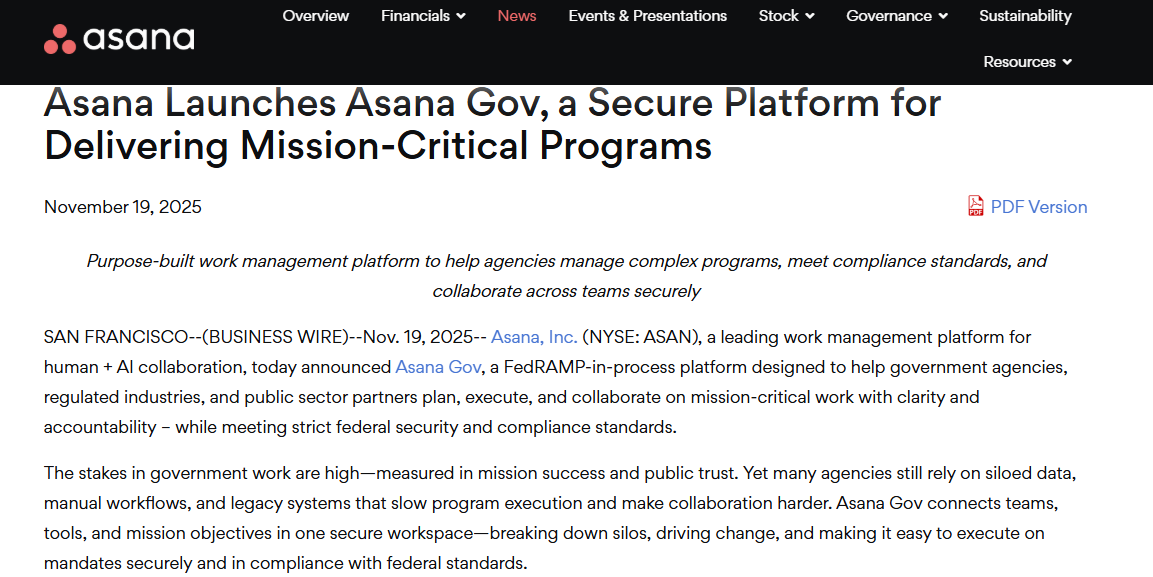
That exchange, buried on page one of a support forum, is about as close as Asana has come to a public explanation of one of the more consequential changes it has made to its product in years. There was no press release. There was no blog post with a founder’s name attached, the kind of thing Asana publishes freely when it launches something it wants credit for. When Asana rolled out AI Teammates in September, it wrote a full announcement with a headline built for pickup. When Asana Gov launched in November, that got a headline too. The change to the free plan got a documentation update and a line in a forum thread from a volunteer moderator explaining what had happened to a confused nonprofit director.
I’ve spent the past several weeks reading through Asana’s pricing history, its support forums, and the small, scattered trail of user complaints that make up the only public record of this decision. What I found is a company that has spent three years quietly narrowing the gate on its free tier, in increments small enough that no single change looks like news, while its paid-tier marketing and AI ambitions get the full press treatment. Taken individually, each cut looks like housekeeping. Taken together, they describe a pattern.
From Fifteen to Two
Go back to 2019 and you’ll find G2 reviews describing an Asana free plan that covered up to fifteen people, unlimited tasks, unlimited projects, unlimited conversations, no credit card required. That number held for years. It’s still what old reviews and outdated comparison charts reference, which is part of why people like Silfer walk in expecting something the product no longer offers. By 2023, the ceiling on the free plan had already come down to ten members, a figure confirmed in the Asana Forum’s2 own archives, where confused users asked moderators to explain why the comparison chart said one thing and the community boards said another.
Then, on November 12, 2025, the floor dropped again. According to multiple pricing guides published in the weeks after, including one from BridgeApp3, Asana introduced a hard cap of two collaborators on new free accounts. Anyone who had signed up before that date kept what BridgeApp calls a Legacy Personal Plan, with room for up to ten seats. Anyone who signed up after got two. Two people. Not a team. A pair.
I want to sit with that word, legacy, for a second, because it does a lot of quiet work. It sorts Asana’s free users into two classes without ever using the word class. If you got in early, you’re grandfathered. If you show up now, expecting the product that reviews and forum posts and old comparison charts describe, you get a fraction of what the person next to you has, and nothing on the sign-up page tells you that. TechnoGraphx’s4 guide to the free plan, updated for 2026, states the two-user cap plainly and calls it, without much comment, “a notable change from earlier versions.” That’s one way to put it. Another way is that the free tier of a tool used by more than 169,000 paying organizations, according to Asana’s own investor materials, has been cut by eighty-seven percent since 2019, and almost nobody outside a support forum noticed it happening.
The Wall, and Who Hits It
Here’s what the two-user wall actually does. It doesn’t take away tasks, or storage, or projects. Those stay unlimited on paper, which lets Asana5 keep using the words “unlimited tasks and projects” on its pricing page without technically lying. What it takes away is people. The third teammate. The volunteer coordinator. The freelance designer brought in for one project. The moment a free account needs a third human being, Asana stops being usable and, as one analysis of the pricing structure put it, does exactly what it’s designed to do: force an upgrade.
I don’t think that’s an accident, and I don’t think anyone who has built freemium software would pretend it is. A free tier’s job, in this business model, isn’t to be generous. It’s to be a showroom, a place to fall in love with a workflow just before the floor gets narrow enough that you have to pay to keep standing on it. What changed at Asana isn’t the existence of that wall. It’s how close to the front door the wall now sits. Ten seats gave a small team room to actually run something before hitting friction. Two seats put the wall at the doorway.
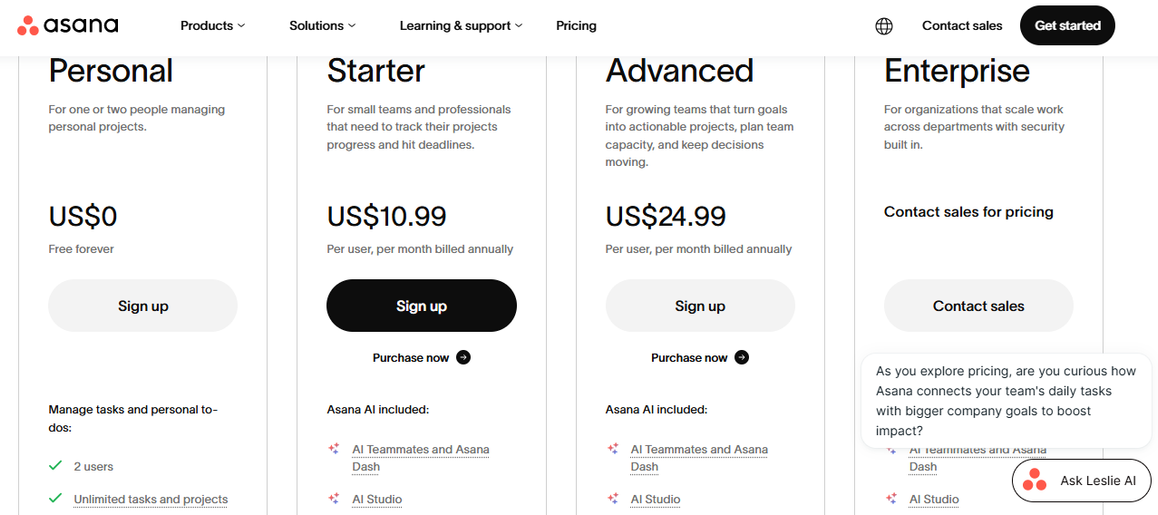
The nonprofit sector feels this first, because nonprofits run lean by necessity and often can’t absorb a sudden $10.99-per-seat bill, the current Starter plan price, especially when paid tiers require a two-seat minimum with no single-user option. Silfer’s post is one example, not an outlier. A parallel thread on the Asana forum6, titled simply “Free Plan” in its Spanish-language section, shows the same confusion playing out in another language a few weeks later. These are small threads. Nobody’s writing congressional testimony about them. But they are, cumulatively, a record of a company changing the terms of a free product on people who had no way of knowing the terms had changed.
One said:
I created a workspace, but it only allows me and one other colleague, and I read that the free plan allows 10-15 people. I also don’t know how to check which plan I’m on, and switching to the free basic plan isn’t easy.
The response was brief and simple:
Welcome to the Asana Forum. Currently, the Personal (free) plan is limited to 2 users. Previously, it could have up to 15 members, and later this was reduced to 10. Now, the limit is 2 people in a Personal plan team.
I read through several hundred pages of Capterra7 reviews looking for a pattern, and I found one, though it’s easy to miss if you’re only counting stars. Asana still pulls a 4.4 or 4.5 average almost everywhere. People like the product. That’s not in dispute. But scattered through the five-star reviews are complaints that read less like nitpicks and more like fatigue. A director at an e-learning company, eight years into using Asana, wrote in December that she “so wish the interface had a cleaner UX and less options behind paywalls.” A digital strategist called out automations specifically, noting they’re “tough to use, or stuck behind paywalls.” Neither of these reviewers was writing about the free-tier seat cap. They were writing about a broader feeling, one that shows up again and again once you start looking for it: the sense that Asana has been moving the floor under long-time users, one feature and one seat at a time, without ever quite announcing it.
That feeling has a name in the freemium software world, and it isn’t flattering. Reviewers of Asana alternatives on sites like Clever Project Management8 describe a “growing irritation with paywalled basics” across the category, not just at Asana, pointing to Monday.com’s own two-seat free plan as evidence that the whole industry is converging on the same tight ceiling. Trello, by contrast, still offers unlimited users on its free tier, capped instead by board count. The contrast matters. It shows that a two-user free plan isn’t some unavoidable cost of doing business. It’s a choice, and Asana made it in November, quietly, on a date that shows up only in comparison charts and pricing guides, never in a headline of its own.
Why Now?
I don’t think you can separate this decision from what’s been happening to Asana’s business. The company has spent the past two years fielding one downgrade after another, and the language analysts use is unambiguous. In September 2024, Seeking Alpha’s9 Gary Alexander downgraded Asana to hold, pointing to net revenue retention that had sunk below 100 percent, a signal, in plain English, that Asana was losing more revenue from existing customers than it was gaining. By December 2025, the same analyst had moved to a sell rating, citing what he called persistent churn and a lack of any growth catalyst strong enough to offset it. RBC Capital’s Rishi Jaluria went further, cutting Asana to underperform and warning that project management software is discretionary spending, the first thing companies cut when budgets tighten, in a market he considers too competitive and too small to support Asana’s ambitions.
Set against that backdrop, a narrower free tier looks less like a rounding error and more like a lever. Every user who hits the two-seat wall and doesn’t leave is a user who has to either pay or shrink their team inside the product. Asana’s10 own investor materials tout growth among customers spending $100,000 or more annually, a segment that has kept expanding even as the free and low-end tiers get squeezed.
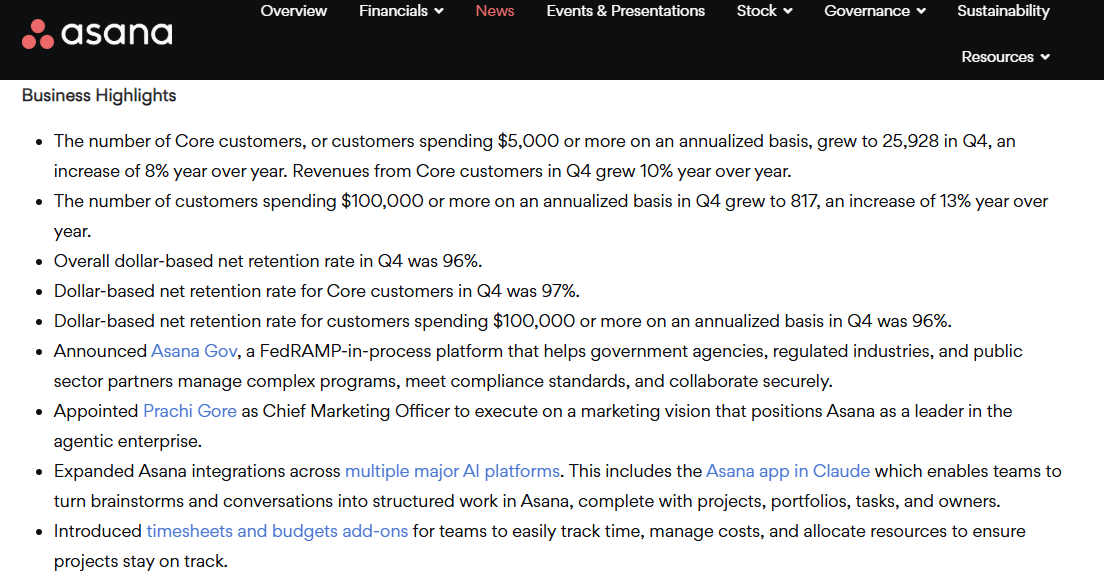
That’s not a coincidence I’m willing to write off. A company under pressure to show growth in large accounts while retention among smaller ones erodes has an obvious incentive to make the free tier a shorter on-ramp and a harder floor. I can’t prove intent from a forum thread and an SEC filing. But I can show you the timing, and the timing is hard to read as anything else.
What strikes me most, going through all of this, is where the record actually lives. Asana is a public company. It has an investor relations page, a press office, a blog that gets updated every time there’s a product launch worth bragging about. None of those channels mention the free-tier cut. The only place you can find out what happened, and when, is a support forum built for troubleshooting broken automations and confused billing questions, where a volunteer moderator with the username lpb spends his evenings explaining policy changes the company itself never announced in public. I went looking for an official post from Asana11 laying out the reasoning, the way the company did back in 2023 when it renamed its plans and published a full explanation of what was changing and why. I didn’t find one for this change. What I found instead was documentation, updated quietly, and a comparison chart that now says two where it used to say ten.
That’s the real story here, more than the number itself. Two seats instead of ten is a business decision, and businesses are allowed to make those. What’s harder to defend is doing it in a way that only the people who already hit the wall ever find out about, after the fact, from a stranger on a forum, instead of from the company that built the wall.
What This Means For Free-tier Asana
If you signed up before November 12, 2025, you’re probably fine, at least for now, riding on the Legacy Personal Plan with room for up to ten collaborators. If you’re new, or if you’re about to recommend Asana to a small nonprofit, a scrappy freelance collective, a five-person book club trying to organize a fundraiser, you should know what you’re actually signing up for before you build a workflow around it. The unlimited tasks and unlimited projects are real. The unlimited storage is real. The room for more than two humans is not, not anymore, not unless you pay.
I keep coming back to Silfer’s post, because it’s such a small thing, and because it’s exactly the kind of small thing that adds up into a pattern nobody notices until they’re the one it happens to. She wasn’t complaining about a missing feature. She was trying to figure out how to keep two nonprofit communities running on a tool she’d chosen in good faith, based on information that was true when someone else wrote it down and wasn’t true anymore by the time she needed it. Larry, the moderator, gave her the only real answer anyone at Asana has given anyone, as far as I can tell: the limit changed a few months ago, and it isn’t changing back.
Where that leaves the rest of us, the people still deciding whether “free forever” means what it says, I honestly don’t know yet. Maybe the two-seat wall is just where the free tier settles for good. Maybe it gets narrower still. The company hasn’t said, and based on how quietly it moved the last time, it may not say again until someone else stumbles onto the new number and asks a stranger on a forum what happened.
Sources
- Silfer, Marie-Claire. “Free Plan” Asana Community, 23 Feb. 2026, forum.asana.com/t/free-plan/1127182. Accessed 26 Sept. 2026. ↩︎
- “Free users – 10 or 15” Ask the Community, 11 Dec. 2023, forum.asana.com/t/free-users-10-or-15/631260. Accessed 27 Sept. 2026. ↩︎
- Math. “Asana Pricing Plans Explained” BridgeApp, 2 Mar. 2026, bridgeapp.ai/resources/blog/asana-pricing-plans-explained. Accessed 27 Sept. 2026. ↩︎
- Mitchell, Sophia. “Asana Free Plan Explained: What You Get (and What You Don’t)” TechnoGraphx, 6 Apr. 2026, technographx.com/asana-free-plan-explained-what-you-get-and-what-you-dont/. Accessed 27 Sept. 2026. ↩︎
- “Asana Pricing | Personal, Starter, Advanced, & Enterprise plans • Asana” Personal, Starter, Advanced, & Enterprise plans A, asana.com/pricing. Accessed 27 Sept. 2026. ↩︎
- “Como accedo al plan gratuito?” Asana Community, 3 Mar. 2026, forum.asana.com/t/como-accedo-al-plan-gratuito/1128635. Accessed 27 Sept. 2026. ↩︎
- Capterra, www.capterra.com/p/184581/Asana-PM/reviews/. Accessed 27 Sept. 2026. ↩︎
- Clever Project Management, cleverprojectmanagement.com/free-software/free-project-management-plans-how-many-users/. Accessed 27 Sept. 2026. ↩︎
- Seeking Alpha, seekingalpha.com/article/4723189-asana-challenges-reflected-stock-price-sales-momentum-slowing-rating-downgrade. Accessed 27 Sept. 2026. ↩︎
- “Asana Announces Fourth Quarter and Fiscal Year 2026 Results” Asana, Inc., 2 Mar. 2026, investors.asana.com/news-releases/news-release-details/asana-announces-fourth-quarter-and-fiscal-year-2026-results/. Accessed 27 Sept. 2026. ↩︎
- Hanna, Emily. “Upcoming Updates to Asana’s Product Tiers” Asana Community, 14 Nov. 2023, forum.asana.com/t/upcoming-updates-to-asanas-product-tiers/599641. Accessed 27 Sept. 2026. ↩︎