
How Meta quietly restructured the cost of doing business on the world’s most popular messaging app, and why millions of companies are only now beginning to feel it.
- The Architecture of Ambiguity
- The July 2025 Rupture
- A Real Billing Disaster, Described on the Internet
- The Geography Problem Nobody Warned You About
- The Three-Layer Bill
- Volume Tiers: Discounts That Most Companies Will Never See
- The Enforcement Trap
- Free Windows, Paid Templates, and the Timing Game
- The BSP Opacity Problem
- What $2 Billion Buys You
- The Practical Audit
- The Bigger Picture
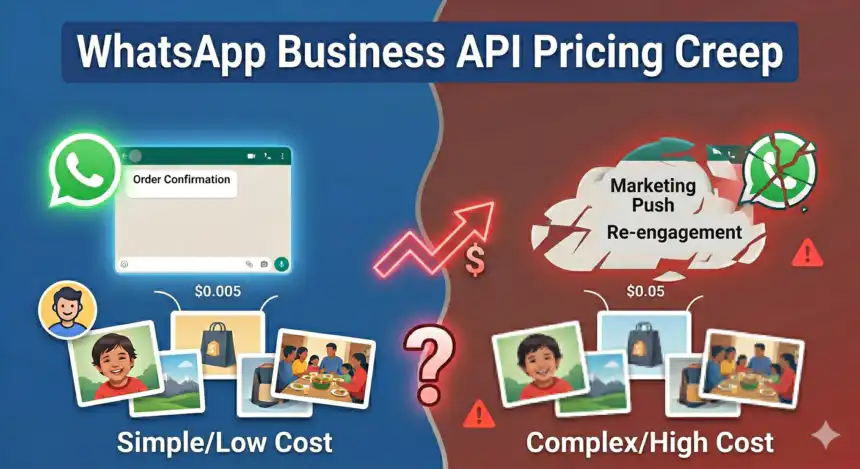
There is a moment that many developers and marketing managers can describe with surprising precision. It usually comes mid-month, when someone logs into their billing dashboard and the number sitting there does not match the number they planned for. The invoice is three times larger than last month. No volume spike. No new campaign. Just a label change. A message template that WhatsApp decided looked less like a shipping update and more like a sales pitch. Welcome to the new economics of the WhatsApp Business API.
The platform’s pricing has shifted dramatically over the past two years, and the full weight of those changes is still landing on businesses. According to WizMessage1, WhatsApp crossed a $2 billion annualized revenue run-rate from paid business messaging by Q4 2025, up from roughly $1.7 billion in 2024. Behind that growth is a monetization architecture that rewards Meta every time a company’s message slips into the wrong category, and the lines between those categories are, by design, not always clear.
The Architecture of Ambiguity
The story begins with categories. Meta’s2 WhatsApp Business API organizes every template message a business can send into four buckets: Marketing, Utility, Authentication, and Service. Service messages, replies to customers who reached out first, are free. Authentication messages (one-time passwords, verification codes) and Utility messages (order confirmations, delivery updates) carry moderate per-message fees. Marketing messages, which cover promotions, product announcements, and re-engagement campaigns, sit at the top of the pricing ladder.
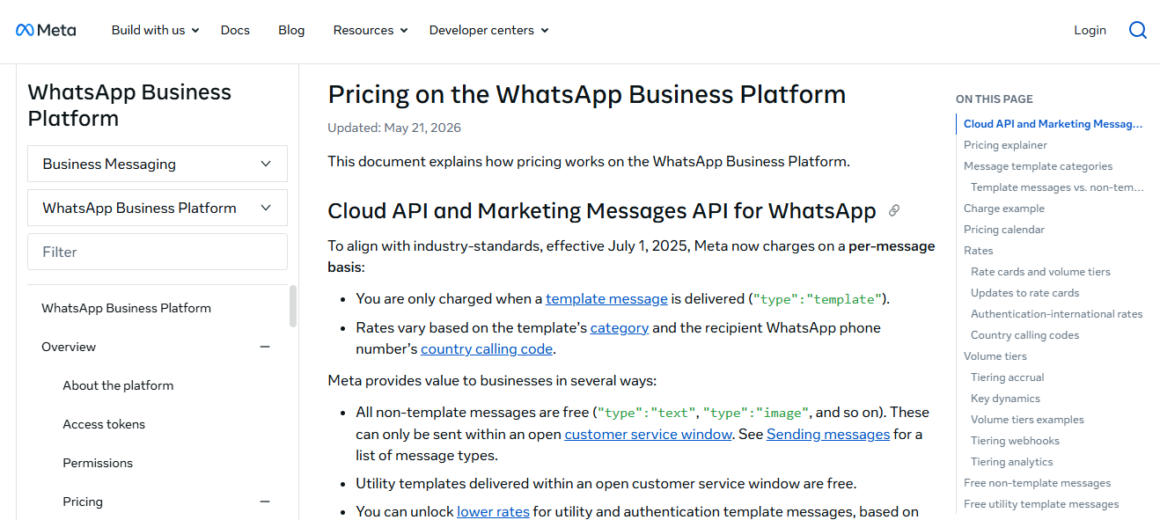
The price gap between those tiers is not trivial. According to Setsmart3, in the United States, a utility message costs $0.004 per delivered template. A marketing message costs $0.025, more than six times as much. In Germany, that marketing rate climbs to around $0.1365. Marketing message rates across 2026 range from roughly $0.0094 per message in India to over $0.124 in Germany . A gap of more than 13 times between the cheapest and most expensive markets for the same category. The classification of a message, therefore, is not a bureaucratic label. It is a financial decision that can reshape a company’s entire communication budget.
The problem is that these categories require interpretation, and interpretations can shift. Meta reviews each template during registration and may automatically reclassify it if it does not follow category guidelines. Templates that combine promotional and transactional content are always classified as marketing. A single phrase added to an order update.
“Check out today’s featured items while you’re here” can pull the whole template from the utility column into the marketing column.
If a utility message contains promotional elements such as discounts or calls to action, WhatsApp may reclassify it as marketing, triggering higher rates.
This is where the billing surprises begin.
The July 2025 Rupture
Before July 1, 2025, the pricing model worked on 24-hour conversation windows. A company opened a conversation by sending a template, paid a single fee, and could then send multiple messages of the same category within that session at no extra charge. Previously, sending a template message opened a 24-hour conversation window, allowing for unlimited additional messages without extra charges. It was not cheap, but it was predictable. One fee per window, regardless of how many messages flew back and forth inside it.
Effective July 1, 2025, Meta4 switched to a per-message pricing model. Each delivered template message is now billed individually, regardless of category or frequency. Every marketing broadcast, every shipping notification, every authentication code now carries its own explicit unit cost.
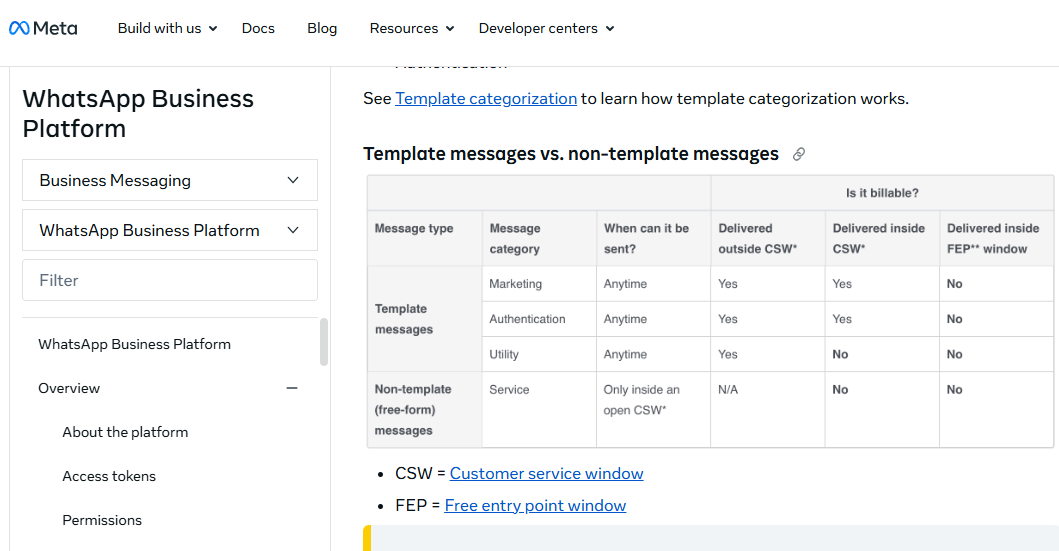
For businesses that sent one marketing template per conversation window, the math did not change much. For businesses running sequences. A promotional message followed by a cart reminder followed by a delivery confirmation. The math changed dramatically. A SaaS company sending five marketing nudges per active user per month previously paid for one conversation. Now it pays for five messages. An e-commerce store sending an order confirmation, a shipped notification, a delivered update, and a review request now faces four separate utility charges per order, unless all four land within the same open service window, which for orders spread over several days, they frequently do not.
Meta framed this as simplification. The messaging around the change emphasized transparency and clarity. But the practical effect for multi-message workflows was a cost multiplication that caught many businesses mid-campaign. The July 2025 transition represented one of the biggest upheavals in the history of the WhatsApp Business API.
A Real Billing Disaster, Described on the Internet
The clearest way to understand what these category reclassifications actually do to a company’s finances is to read what operators say when they think no one important is listening.
A developer on r/SaaS as reported by Whapi5 described the experience in early 2025:
“Our order confirmation template was approved as utility for six months. One day the category in the dashboard just said Marketing, no email, no explanation from the BSP. We were sending 80,000 messages a month to Brazilian users. The monthly bill tripled in a single billing cycle. Support told us to resubmit and it might get re-reviewed.”
This account, documented by API pricing analysts who track the WhatsApp developer community, is consistent with how the system mechanically operates. The classifier threshold is not published. A single promotional sentence in a transactional template is enough to trigger reclassification. Developer intent does not determine billing category. The classifier does. The developer may have written a shipping notification. The algorithm reads a sales pitch. The difference costs, in this case, hundreds of thousands of dollars annualized.
Brazil is a particularly unforgiving market for this kind of mistake. A marketing message to a Brazilian user costs around $0.0625 per message according to EngageLab6. Roughly 3.2 times more than the equivalent send in India. For a business running 80,000 monthly messages to Brazilian subscribers and suddenly flipping from utility to marketing categorization, the arithmetic is brutal.
The Geography Problem Nobody Warned You About
Pricing on the WhatsApp Business API is not just about category. It is also about geography. Specifically, the geography of the recipient, not the sender. WhatsApp Business API costs are based on the recipient’s country code, not the sender’s location. A company in the United Kingdom sending a marketing message to a customer in Brazil pays Brazil’s rate, not the UK rate. A company in India sending authentication codes to Germany pays Germany’s authentication rate, not India’s.
Marketing message rates in 2026 range from roughly $0.0094 per message in India to over $0.124 in Germany. The German rate is approximately thirteen times the Indian rate for the same category of message. For companies with globally distributed customer bases, this geographic spread is not an abstract concern. It is a line item that can define whether a WhatsApp-first communication strategy is profitable.
The authentication category carries its own geographic trap. According to Whautomate7, 9 markets have a separate authentication-international rate that applies when businesses send verification codes to users in those countries from a WhatsApp Business Account registered outside that country: Egypt, India, Indonesia, Malaysia, Nigeria, Pakistan, Saudi Arabia, South Africa, and the UAE. These international rates are not marginally higher. India’s authentication-international rate is over 20 times the domestic authentication rate. For a fintech company running OTP verification for Indian users from a non-Indian account, this single classification decision can cost tens of thousands of dollars per year.
The fix exists. Register a WhatsApp Business Account in the destination country to access domestic rates, but it requires knowing the trap exists in the first place. Most businesses discover it on their second or third invoice.
The Three-Layer Bill
When a business calculates its WhatsApp API costs, it often starts and ends with Meta’s published per-message rates. This is an incomplete calculation. The true cost consists of three layers: Meta’s per-message charges, BSP platform fees, and per-message markups from the Business Solution Provider.
BSPs, the companies that sit between businesses and Meta’s API, providing the actual user interfaces, automation tools, and customer support dashboards, are a necessary reality of the ecosystem. Meta does not offer direct API access with a working user interface for most companies. You need a BSP. BSP fees range from around $29 per month for basic plans to $500 or more for enterprise features, and many BSPs add a per-message markup ranging from roughly 10 to 30 percent on top of Meta’s published rates.
According to Message Central8, some providers add 50 percent variable markup on top of Meta’s rates. Others use flat per-message fees. The variance is significant at scale. For a business sending 100,000 messages per month to a mixed-country audience, the difference between a transparent flat-rate BSP and a percentage-markup BSP can easily reach thousands of dollars monthly.
A documented example: a retail business sending weekly marketing broadcasts to 50,000 subscribers, across mixed countries at a blended rate of $0.045 per message, generates roughly $9,000 per month in Meta fees alone. Add a BSP hosting fee and per-message markup, and the total climbs past $10,000, with marketing messages accounting for 86 percent of the total bill. That number assumes correct category classification throughout. Add a mid-month reclassification event and the figure can spike without warning.
Volume Tiers: Discounts That Most Companies Will Never See
Meta’s pricing architecture includes a volume discount mechanism for utility and authentication messages. Send enough messages in a given country-category combination, and the per-message rate decreases automatically. The system is designed to reward scale.
There are three significant limitations to this mechanism worth understanding.
First, volume tiers are market-category specific. WhatsApp tracks message volume separately for each category and each market. According to WANotifier9, sending 1 million utility messages to India and 1 million to Brazil creates two separate volume tracks, neither of which benefits from the other. Scale across markets does not aggregate unless your entire volume concentrates in the same country.
Second, volume tier discounts do not apply to marketing messages at all. Marketing messages are always billed at the standard rate with no discounts. For most businesses, marketing is the most expensive and highest-volume category. The one category generating the largest bills receives no volume relief.
Third, Meta10 shows that tiers reset monthly. At the start of each new month, message count returns to zero and businesses begin accruing toward tiers again from scratch. Reaching Tier 3 by the 28th of one month provides no carryover advantage on the 1st of the next.
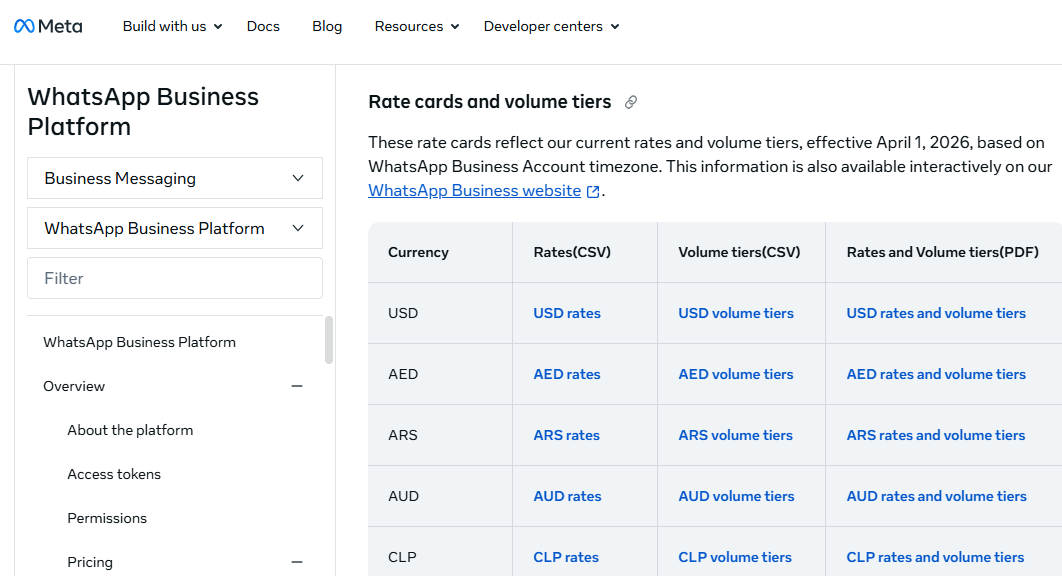
For typical SME volumes, volume tier discounts are not a practical factor. The list rate applies. The discount architecture benefits the largest senders almost exclusively.
The Enforcement Trap
When a utility template gets reclassified as marketing, the financial impact is immediate. But for businesses that push back against the reclassification, or repeatedly submit borderline templates trying to stay in the cheaper category, the consequences extend beyond billing.
According to Chat2Desk11, businesses that repeatedly mislabel or disguise marketing content as utility may be temporarily restricted from submitting new utility templates, typically for 7 to 30 days. During that restriction window, every utility-category message the business would otherwise send must be sent as a paid marketing message, or not sent at all.
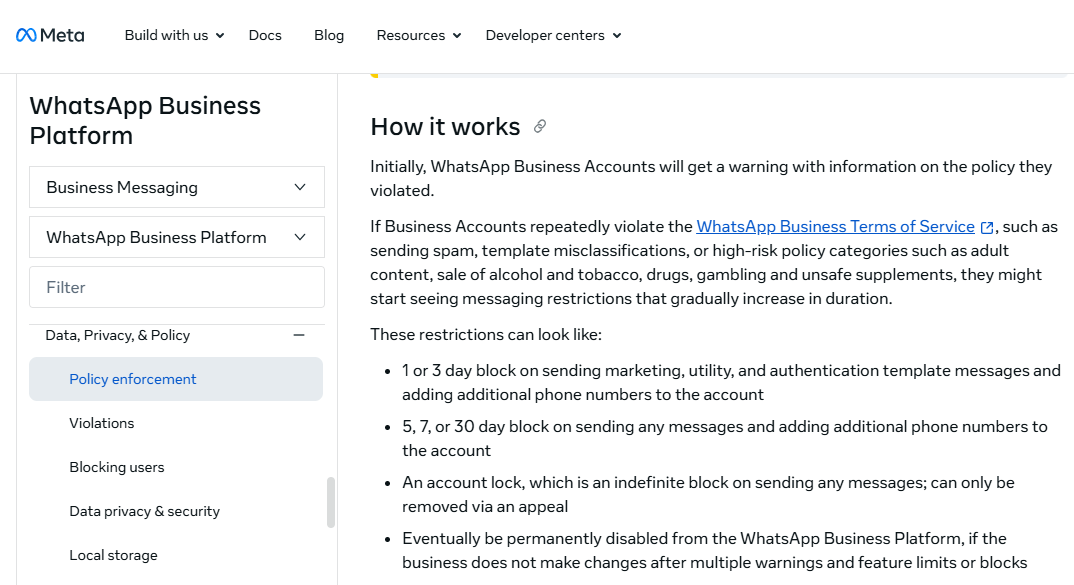
Meta’s12 enforcement escalation follows a documented path: initial warnings, followed by 1 to 3 day blocks on sending marketing, utility, and authentication templates, escalating to 5, 7, or 30-day blocks on sending any messages at all, then account locks, then permanent disabling from the WhatsApp Business Platform. For businesses that built their entire customer communications infrastructure on WhatsApp, and there are now hundreds of millions of such businesses globally, the threat of account suspension is existential.
The ambiguity of the classification rules creates a compliance burden that falls entirely on the business. Templates with unclear content. A template that just contains a variable placeholder or says simply “Congratulations!” are automatically considered marketing. The conservative safe harbor is to write every template as if it contains no ambiguity whatsoever, stripping out any language that could be read as persuasive. That constraint shapes how companies write to their customers in ways the customers rarely see and the companies rarely discuss publicly.
Free Windows, Paid Templates, and the Timing Game
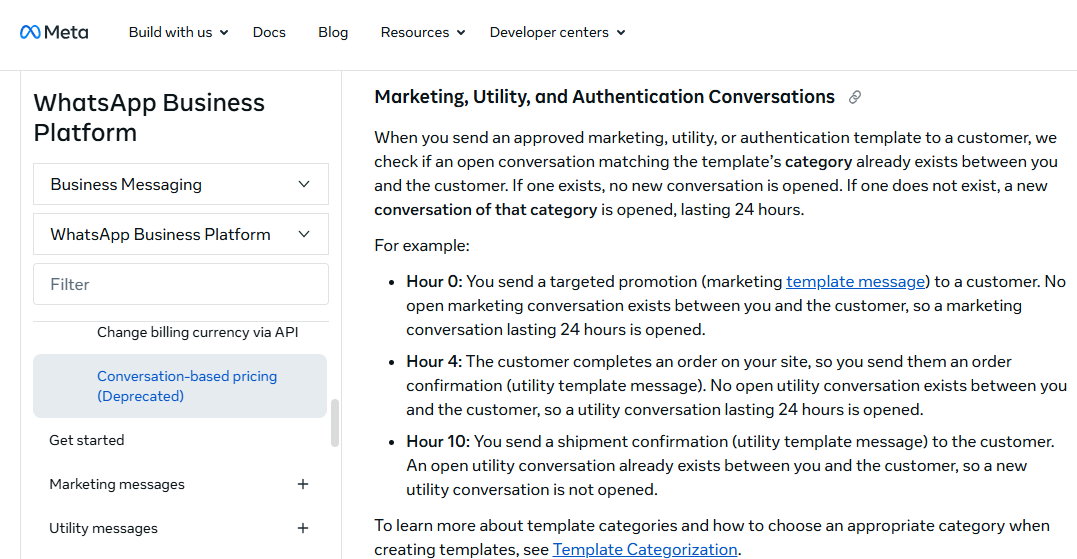
The current model does provide genuine mechanisms for cost reduction. The 24-hour customer service window, which opens when a user messages a business first, allows free-form replies and free utility templates for the duration. Starting July 1, 2025, utility templates sent within an active customer service window are free, which represents a meaningful cost-saving opportunity for businesses with high inbound engagement.
The 72-hour free entry point window, triggered when a customer reaches a business through a Click-to-WhatsApp advertisement on Facebook or Instagram, allows all messages, including marketing templates, to be sent at no charge for three days. For companies running paid Meta ad campaigns that direct traffic into WhatsApp conversations, this window represents a genuine subsidy.
But these free windows require user action to open. A business cannot manufacture a service window by sending a marketing message and hoping the customer replies. The business has to actually generate inbound conversation first. For companies whose customers do not initiate contact regularly, which describes the majority of outbound marketing use cases, the free windows are structurally unavailable.
The practical effect is a bifurcation of WhatsApp’s API economics. Companies that use WhatsApp primarily for inbound customer service benefit enormously from the post-November 2024 changes, under which all user-initiated service conversations became completely free and unlimited. Companies that use WhatsApp primarily for outbound marketing, which is, after all, the primary commercial use case that drives Meta’s business messaging revenue, pay for every message at the full marketing rate with no volume discounts and limited free windows.
The BSP Opacity Problem
The layer between Meta and business customers, the BSP ecosystem, is where transparency most consistently fails. Dozens of BSPs compete for WhatsApp API customers with pricing pages that range from admirably clear to deliberately obfuscated.
Some providers publish their exact markup on Meta’s rates. Most do not. Common markups range from around 10 percent to 30 percent depending on the provider, but some add 50 percent variable markup. A startup comparing BSP pricing based on headline per-message rates may be comparing incompatible numbers. One provider quoting Meta’s base rate, another quoting Meta’s base rate plus a 25 percent markup without making the distinction clear in the initial pricing documentation.
WATI users have reported discovering that automation tier limits hit before they notice the per-conversation charges appearing as a separate line from the subscription. By month two, three distinct billing items can appear on a single invoice. The subscription fee, the Meta pass-through charges, and the BSP markup all arrive together, and untangling them requires either a detailed line-item breakdown that not every provider supplies or a direct conversation with a sales representative.
This opacity is not illegal and arguably not unusual. Cloud service pricing has its own long tradition of surprising invoices. But WhatsApp’s position as effectively the only scalable messaging channel for large parts of Asia, Latin America, the Middle East, and Africa means businesses face limited negotiating leverage. There is no functionally equivalent alternative for reaching a WhatsApp user. Flowcall13 reported that the platform counts more than 3.14 billion users globally. In India alone, WhatsApp penetration makes it the default communication layer for entire market segments. Switching costs are not just technical. They are relational. Customers do not move.
What $2 Billion Buys You
StocksGuide14 reported that Meta’s Family of Apps “other revenue,” driven primarily by WhatsApp paid business messaging, reached $801 million in Q4 2025 alone. The pace of change in WhatsApp’s pricing architecture over 2024 and 2025 does not resemble a company optimizing for business customer experience. It resembles a company optimizing for monetization of a captive channel.
According to PPC Land15, revenue considerations appear central to Meta’s decision-making about the WhatsApp Business Platform. WhatsApp’s Business API represents one of the primary monetization methods for the messaging service, which Meta acquired in 2014 for $19 billion. Key challenges for businesses using the platform include dependency on Meta, which unilaterally controls pricing, template policies, and API features. That dependency is not incidental. It is the product.
The pricing changes since 2024 have followed a pattern. Each major update comes framed as simplification, transparency, or alignment with industry standards. Each one, examined operationally, increases the complexity of staying in the cheapest tier. The 24-hour conversation window, which gave businesses a cost buffer for multi-message sequences, is gone. The category enforcement that could retroactively reclassify six months of approved templates is tightening. Meta rates may be updated as frequently as quarterly. The rule set governing what qualifies as a utility versus a marketing message is deliberately imprecise. Businesses cannot plan budgets with confidence because the cost of their most common messages is subject to algorithmic revision with limited appeal rights and unclear review criteria.
The Practical Audit
For businesses already operating on the API, or evaluating whether to build on it, the math requires three distinct calculations that most planning templates skip.
The first is category audit. A utility message that qualifies as utility is 80 to 90 percent cheaper than a marketing message. The difference between correct and incorrect classification, at meaningful volumes, can exceed total BSP subscription costs. Every active template should be reviewed against Meta’s current utility guidelines before it is sent.
The second is country-mix analysis. Because pricing is charged based on the recipient country, not the sender’s, a business with customers in Germany, India, and Brazil is running three different cost structures simultaneously. A single campaign “budget” that averages across those markets will overestimate costs for Indian sends and dangerously underestimate costs for German sends.
The third is BSP comparison at actual volume. Total monthly cost equals volume multiplied by country mix, multiplied by category mix, multiplied by Meta rate, plus BSP platform fee, plus volume multiplied by BSP per-message markup. That formula should be applied to each BSP under consideration using realistic estimates before any commitment is made. For a business sending 50,000 monthly messages with a 70/30 utility-marketing split across India, Brazil, and Mexico, Meta fees alone come to roughly $571 per month before BSP charges. At a BSP with a transparent flat markup, the total lands around $770. At a BSP applying a 30 percent markup, the same volume costs closer to $1,200.
The Bigger Picture
There is something worth sitting with in all of this. WhatsApp is not a telecom. It does not operate expensive physical infrastructure that needs to be amortized against per-message fees. The marginal cost of delivering a text template message on Meta’s cloud infrastructure is effectively zero. The pricing structure is not cost recovery. It is rent extraction from businesses that have no practical exit.
That is not a moral argument against using the platform. The 98 percent open rates, the billion-plus daily active users, the frictionless commerce flows. These are real advantages that justify real costs. But businesses entering the WhatsApp API ecosystem should do so with clear eyes about what they are signing up for. They are leasing access to a captive audience on a platform whose pricing rules are set unilaterally, enforced algorithmically, and subject to change quarterly with limited notice.
The utility template your developer submitted last November might be a marketing template next April. The BSP that seemed competitively priced in January might be charging 50 percent over Meta’s base rates on a different line of your invoice. The campaign that cost $3,000 to India might cost $25,000 to the same volume of German subscribers.
The message has been delivered. The question is what category you think you are in, and whether WhatsApp’s algorithm agrees.
- Team, WizMessage. “50+ WhatsApp Business Statistics You Need to Know in 2026” WizMessage, 12 Mar. 2026, wizmessage.com/blog/whatsapp-business-statistics. Accessed 27 May 2026. ↩︎
- “Developer Platform” developers.facebook.com/documentation/business-messaging/whatsapp/pricing. Accessed 27 May 2026. ↩︎
- D, Octave. “WhatsApp Business API Pricing 2026: Hidden Fees” SetSmart, 20 Apr. 2026, setsmart.io/blog/whatsapp-business-api-pricing. Accessed 27 May 2026. ↩︎
- “Developer Platform” developers.facebook.com/documentation/business-messaging/whatsapp/pricing. Accessed 27 May 2026. ↩︎
- “WhatsApp BSP Pricing in 2026: Hidden Costs for Developers” Whapi.cloud, 24 Apr. 2026, whapi.cloud/blog/whatsapp-bsp-pricing-hidden-costs-2026. Accessed 27 May 2026. ↩︎
- “WhatsApp Business API Pricing: 2026 Complete Cost Guide” 6 May 2026, www.engagelab.com/blog/whatsapp-business-api-pricing. Accessed 27 May 2026. ↩︎
- “WhatsApp Business API Pricing: The Complete 2026 Guide” Whautomate Tools, 1 Apr. 2026, whautomate.com/whatsapp-business-api-pricing. Accessed 27 May 2026. ↩︎
- Mishra, Kashika. “WhatsApp Business API 2026: Complete Guide to Setup, Cloud API, Chatbots, Pricing and BSPs” Message Central, 24 Apr. 2026, www.messagecentral.com/blog/whatsapp-business-api-pricing. Accessed 27 May 2026. ↩︎
- Shengale, Ram. “WhatsApp API Pricing & Cost of WhatsApp Marketing in 2026” WANotifier, 12 Jan. 2024, wanotifier.com/whatsapp-api-pricing/. Accessed 27 May 2026. ↩︎
- “Developer Platform” developers.facebook.com/documentation/business-messaging/whatsapp/pricing. Accessed 27 May 2026. ↩︎
- Nikulin, Pavel. “WhatsApp Business API Billing To Change from July 1, 2025. What Is New and What to Expect” Chat2Desk.com Blog, chat2desk.com/en/blog/articles/whatsapp-business-api-billing-to-change. Accessed 27 May 2026. ↩︎
- “Developer Platform” developers.facebook.com/documentation/business-messaging/whatsapp/policy-enforcement. Accessed 27 May 2026. ↩︎
- Raj, Amrit. “WhatsApp Business API Pricing 2026: Complete Cost Guide with Country Rates” 18 Nov. 2025, www.flowcall.co/blog/whatsapp-business-api-pricing-2026. Accessed 27 May 2026. ↩︎
- StocksGuide, stocksguide.com/en/stock/Meta-Platforms-US30303M1027. Accessed 27 May 2026. ↩︎
- Rijo, Luis. “WhatsApp bars AI chatbots as Meta solidifies messaging monopoly” 15 Jan. 2026, ppc.land/whatsapp-bars-ai-chatbots-as-meta-solidifies-messaging-monopoly/. Accessed 27 May 2026. ↩︎