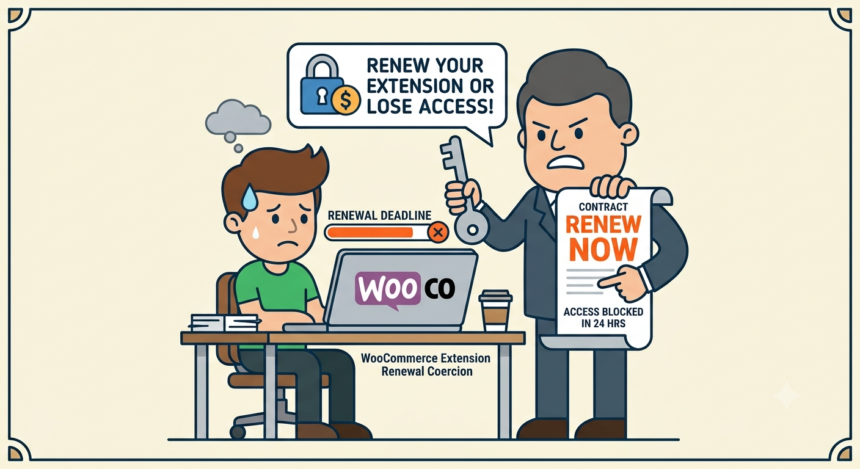

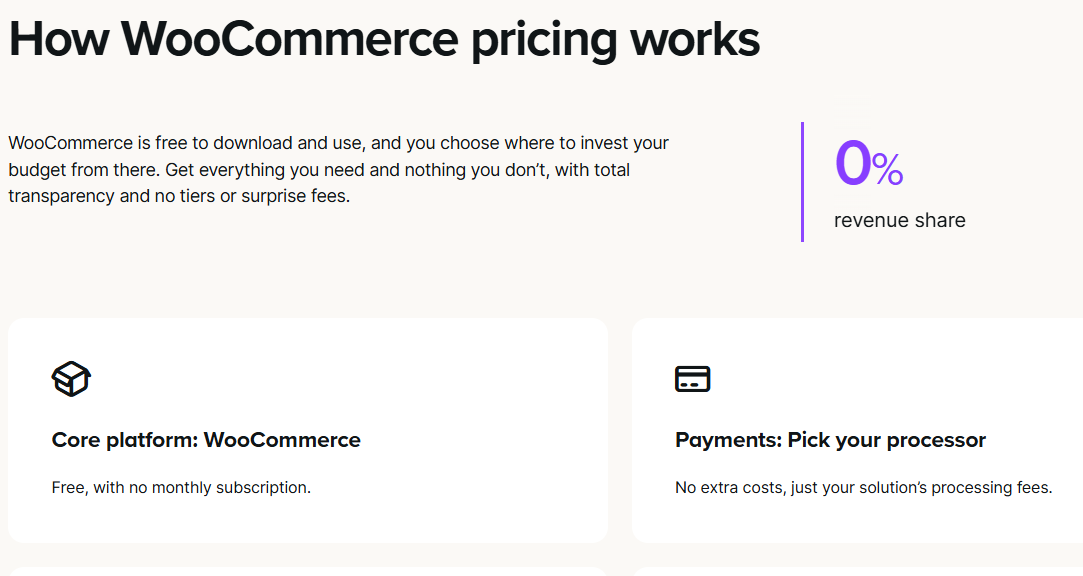
WooCommerce itself costs nothing. That is the pitch, repeated on the pricing page like scripture: no revenue share, no forced bundles, unlimited products and orders. The plugin is open source, licensed under the GPL, free to download and free to run. What is not free is almost everything that makes the plugin useful for a real business. Shipping rules by weight and zone. Subscriptions and recurring billing. Bookings, memberships, advanced tax handling, product bundles. Each of those lives in a separate extension, and each extension carries its own yearly toll, priced anywhere from twenty nine dollars to nearly three hundred, according to WooCommerce’s own numbers. Add up a working stack of five or six extensions and a small merchant can be paying several thousand dollars a year just to keep a “free” store standing upright.
The pricing itself is not the scandal. Software costs money to build and maintain, and nobody is owed free labor from a development team because the word “open source” appears in a plugin description. The scandal is quieter than that. It lives in what happens the day after you decide not to pay.
What “Expired” Actually Means
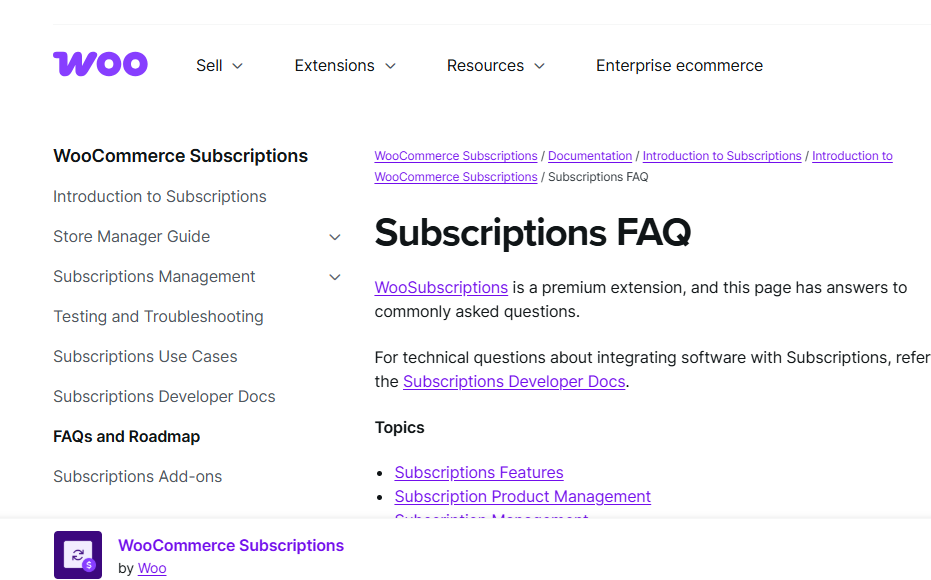
Ask WooCommerce1 directly and the answer sounds almost gentle. Their own FAQ explains that a lapsed subscription means you lose access to updates and support, and that you are welcome to renew manually to restore an active license. No mention of anything breaking. No countdown clock. Just a polite door closing on future help.
Most vendors in the WordPress plugin economy tell a similar story, and on paper it is a reasonable one. A beginner’s guide to license keys from hosting company Liquid Web2 lays it out plainly: an expired license means the plugin keeps functioning, you just stop receiving new updates or premium support. WPDeveloper’s3 own documentation says the same thing almost word for word. So does EMD Plugins4, which frames the arrangement as a kind of quiet transfer of responsibility. Once your license lapses, you inherit the job of keeping your own code alive.
That word, updates, is doing enormous work in these sentences. Updates are not a luxury feature, like a new button color or a nicer dashboard chart. Updates are how a plugin author patches the holes that hackers are actively scanning for. A blog post from security firm Sucuri5 makes the mechanism explicit. Premium plugins authenticate with a developer’s update server using a license key, and once that connection breaks, the plugin stops receiving version updates, bug fixes, and security patches, while automated bots continue scanning the open internet for exactly that kind of stale target. A separate WordPress security guide from InspectWP6 puts a number on the stakes, noting that over half of all documented WordPress vulnerabilities originate in plugins, not in WordPress core itself.
Put those two facts side by side and the “gentle” framing starts to look different. A lapsed license does not disable your store. It disables your defenses. You keep the car, but the mechanic quietly stops telling you when the brakes wear thin. Renewal, in other words, is not really being sold as a feature upgrade. It is being sold as continued permission to stay safe.
The Plugin that Decided to Just Turn Itself Off
Most vendors stop at that soft pressure. One did not, and the response from actual users tells you everything about where the line sits.
In the spring of 2022, MemberPress7, a popular membership plugin priced from $179 a year with no free tier, quietly changed its renewal policy. Once a license expired, the plugin would keep running on the front end of a site indefinitely, according to the company’s own support documentation. But the admin screens, the actual controls a store owner needs to issue a refund, add a member, or manage who has access to what, would simply stop working. WP Tavern covered the fallout after a Reddit thread lit up with users who had discovered the change the hard way. One commenter, quoted in the WP Tavern piece8, summed up the emotional gap between an ordinary “no updates for you” policy and what MemberPress had built: “You had better keep paying me or else I’ll hurt you.”
That is a strong sentence, and it is worth sitting with rather than rushing past. It is not describing theft. Nobody’s money disappeared. It is describing something closer to a landlord changing the locks on furniture you already bought, unless you keep paying rent on the apartment you own. MemberPress’s defenders had a real argument too. The Free Software Foundation, cited in the same coverage, has long held that this kind of feature gating is a legitimate way to fund GPL-licensed software, since the code itself remains free to inspect, fork, and modify, even if a particular vendor’s hosted convenience is not. Jason Coleman, CEO of rival plugin Paid Memberships Pro, made his own position clear in a public piece the coverage references, describing “the WordPress way” as building software that keeps functioning fully even after a license lapses, and positioning that choice as a competitive advantage rather than a moral obligation.
Both of those are honest positions. What made the MemberPress case land as a story, rather than a footnote, is that it exposed the gap between what users assumed they had bought and what the fine print actually promised. A one time purchase in most software categories means you own a copy forever. In this corner of the plugin economy, a purchase increasingly means you own a lease with a landlord who reserves the right to relock a door you thought was yours.
Marketing pages describe renewal policies in careful, neutral language. Support forums do not.
On WordPress.org’s9 own support boards, a user running the QuadLayers WhatsApp Chat plugin hit a wall trying to validate a purchased license and did not hold back. “for you to sell your premium support you are pushing your customers in a corner with this error which is your responsibility, all of us are complaining about this,” they wrote in a public thread, adding that the broken validation was making sites vulnerable while the vendor kept steering people back toward paid support as the fix. A similar thread on the popular UpdraftPlus backup plugin turned into an informal public service announcement, with one user warning fellow site owners that running an out of date premium feature after a lapsed license meant knowingly and willingly putting your users at risk.
The reviews aggregate the same frustration at scale. On Trustpilot10, where WooCommerce’s own marketplace carries a mixed public record, one reviewer accused a WooCommerce-adjacent vendor of using strong arm tactics to push a business toward a much higher recurring fee than originally advertised. Another reviewer, further down the same platform, complained that “EVERYTHING has a hidden extra plugin that you have to purchase,” describing a support team that had been quietly shrunk even as prices rose, turning what used to be same day chat support into a multi day wait. On G211, the pattern repeats in more measured, business-analyst language, with reviewers noting that WooCommerce’s reliance on third party extensions tends to increase maintenance effort and cost as a store scales, even as the core platform advertises itself as free.
None of these are cherry picked outrage bait from anonymous trolls. They are the ordinary texture of running a small business on top of infrastructure you do not fully control, written by the kind of people who actually read their own support tickets.
Nobody Built This By Accident
It helps to remember that WooCommerce is not a scrappy independent plugin anymore. It has not been for a decade.
According to TechCrunch12, in 2015, Automattic, the company behind WordPress.com and one of the most influential forces in the open web, acquired WooCommerce’s parent company WooThemes for a reported thirty million dollars, in what founder Matt Mullenweg called Automattic’s largest acquisition to date. At the time, WooCommerce already powered around six hundred thousand stores, and Mullenweg framed the deal in almost civic terms, telling WP Tavern the goal was to make selling online as easy as WordPress had made publishing a blog. The framing was generous. The business logic underneath it was straightforward. Automattic was not just buying a shopping cart. It was buying a customer base that would need to keep paying for extensions, forever, to keep that cart fully stocked.
Four years later, the pattern repeated with a more specific target. Prospress, the small independent team behind WooCommerce Subscriptions, had built the single highest revenue extension in the entire WooCommerce Marketplace, according to reporting from industry outlet Freemius13. Automattic acquired the company outright in 2019, folding what had been an independent, competitive product directly into WooCommerce’s own first party lineup. That single extension now anchors much of the recurring billing infrastructure across the entire ecosystem, priced around two hundred forty dollars a year according to a breakdown from GoDaddy’s blog14, which means the same company that owns the free core platform also owns the paid tool most merchants need to sell anything on a recurring basis themselves. It is a closed loop dressed up as an open marketplace.
None of this makes WooCommerce unusual among modern software businesses. It makes WooCommerce honest about a strategy that most open source companies pursue more quietly. Give away the foundation. Charge for the load bearing walls. Once a merchant’s entire catalog, checkout flow, and customer data live inside that foundation, walking away stops being a technical decision and becomes something closer to a hostage negotiation with your own business.
I want to push back on my own argument here, because it deserves the pushback.
Building and maintaining a plugin that runs on millions of unpredictable server configurations, plugin combinations, and PHP versions is genuinely hard, unglamorous work. Every forum thread I quoted above sits next to dozens of others where a developer patiently walked a confused user through a fix for free, on a Saturday, for a product that costs less per year than a single hour of a freelance developer’s time. The GPL license that WooCommerce and most of its extensions are built on does not obligate any vendor to support that software forever, only to keep the underlying code inspectable and forkable. That distinction matters, and it is the entire legal and philosophical foundation the Free Software Foundation leans on when it validates gated support models like MemberPress’s. A plugin that stops working on the back end when you stop paying is not committing theft. It is enforcing a contract that was, in most cases, disclosed somewhere in the fine print before you clicked buy.
The trouble is that disclosure and expectation are two different things, and the entire renewal economy is built on the gap between them. Nobody buys a “subscription” to a shopping cart shipping calculator expecting to think about it again in eleven months. Nobody reads a nine hundred word terms of service page before installing a plugin to handle their tax rates. The friction of the renewal reminder, the vague red banner, the security warning that arrives conveniently timed to a lapsed payment, all of it works precisely because most site owners are not lawyers and do not have the bandwidth to litigate every fine print clause against every plugin they install. Eric Karkovack, writing for design outlet Speckyboy15, captured the emotional core of the problem better than any legal argument could. He described a broader industry trend of vendors treating lapsed customers “like scofflaws,” in a piece that argued developers deserve to be paid but that aggressive lockout tactics risk permanently alienating exactly the customers most likely to eventually renew.
What a Merchant is Actually Choosing Between
Say you run a small store and your Subscriptions extension license lapses because a card expired, or because a bookkeeper missed an invoice, or because you genuinely could not afford the renewal that quarter. You now have three real options, and none of them are comfortable.
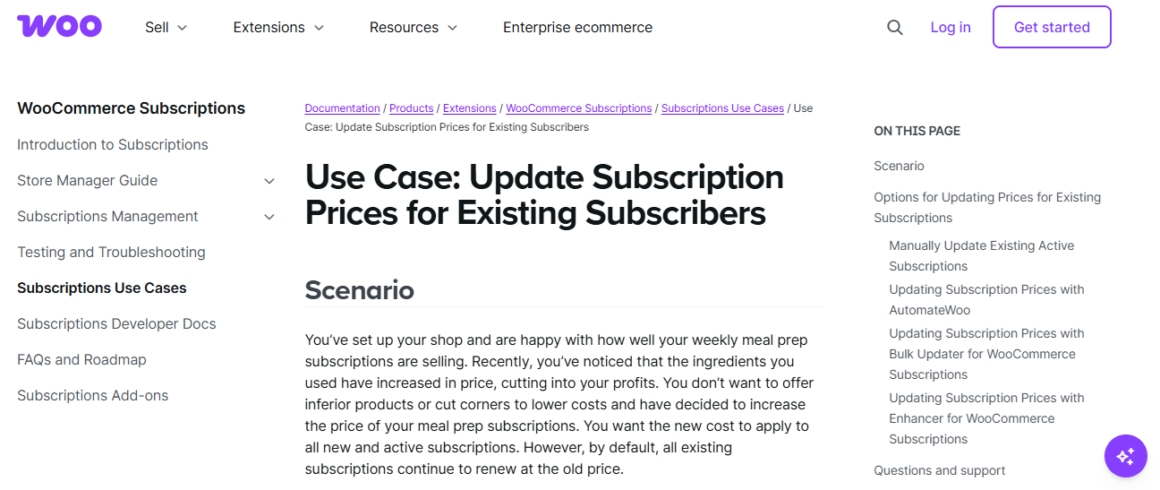
You can pay the renewal, often at a price that has quietly increased since your last cycle, since WooCommerce’s16 own documentation on updating subscription prices makes clear that vendors routinely raise prices for existing customers and simply notify them by email before the next charge goes through. You can limp along on the old version, betting that a WordPress core update or a competing plugin’s own update does not eventually break compatibility, a bet that a Code Clinic17 breakdown of plugin licensing describes as reasonable only for stable, low stakes sites with minimal security exposure. Or you can migrate to a different extension entirely, ripping out a tool that is embedded in your product catalog, your customer accounts, and your checkout flow, a process expensive enough in developer hours that most small merchants simply never attempt it.
That third option almost never happens, and every vendor in this ecosystem knows it. Switching costs are the actual product being sold here, more than any individual feature. The extension itself is often replaceable in a weekend by a competent developer. The migration of live subscriber data, active memberships, and years of transaction history is not. Renewal fatigue is not really about the thirty dollars or the three hundred dollars. It is about the fact that walking away costs so much more than paying does, and every vendor’s pricing team understands that math perfectly.
The Math Nobody Puts in the Sales Page
Do the actual arithmetic on a modest store and the pattern gets easier to see. A merchant selling a recurring box product needs, at minimum, WooCommerce Subscriptions for the billing engine, a table rate shipping extension for anything beyond flat rate, and some kind of tax automation once they cross a few state sales thresholds. That is three extensions before a single marketing tool enters the picture. At WooCommerce’s18 own advertised range of twenty nine to two hundred ninety nine dollars per extension per year, a merchant with even a modest five extension stack is looking at somewhere between six hundred and a thousand dollars annually, every year, forever, just to keep the lights on at their current feature set. Add a hosting bill built for WooCommerce’s server demands and a maintenance retainer for a developer who can actually troubleshoot plugin conflicts, and the total cost of ownership for a “free” platform lands anywhere from twenty five hundred to nine thousand dollars a year for a business that cannot manage its own technical maintenance.
None of that is disclosed anywhere near the moment a new merchant decides WooCommerce sounds like the affordable option compared to a Shopify subscription. It shows up later, extension by extension, renewal notice by renewal notice, until the total cost of the “free” platform quietly exceeds what the paid alternative would have charged from day one. The framing of WooCommerce as the budget conscious choice is not exactly false. It is just measured at the wrong moment, on day one of a relationship that is designed to get more expensive every year after.
I do not think that makes WooCommerce, or Automattic, or MemberPress, or any single vendor named in this piece a villain in a story that needs one. I think it makes the modern open source economy a place where “free” has quietly become the beginning of a sentence rather than the whole promise, and where the fine print that used to sit in a EULA nobody read now sits in a dashboard banner nobody can avoid. Somewhere between those two documents is a version of this business that is honest about what it costs to keep a small store standing, without dressing the invoice up as a security warning.
I have not found that version yet. I am not sure the incentives allow it to exist.
Sources
- “Frequently Asked Questions” WooCommerce, 23 May 2022, woocommerce.com/document/frequently-asked-questions/. Accessed 3 July 2026. ↩︎
- “What are WordPress plugin license keys? A beginner’s guide” www.liquidweb.com/wordpress/plugin/license-keys/. Accessed 3 July 2026. ↩︎
- “Renew License and What Happens If You Don’t.” WPDeveloper, 29 Apr. 2019, wpdeveloper.com/docs/plugin-work-not-renew-license/. Accessed 3 July 2026. ↩︎
- Author, About. “What Happens If My Plugin License Expires?” EMD Plugins Support, 16 Dec. 2015, support.emdplugins.com/questions/what-happens-if-my-plugin-license-expires. Accessed 3 July 2026. ↩︎
- “Sucuri WebSite Firewall” Access Denied, blog.sucuri.net/2026/03/the-security-risks-of-using-nulled-wordpress-plugins.html. Accessed 3 July 2026. ↩︎
- “How to Keep WordPress Plugins Updated and Secure” InspectWP, 8 Feb. 2026, inspectwp.com/en/knowledge-base/how-to-keep-wordpress-plugins-updated-and-secure. Accessed 3 July 2026. ↩︎
- M, Nikola. “What happens when my subscription ends?” MemberPress, 13 Feb. 2024, memberpress.com/docs/what-happens-when-my-subscription-ends/. Accessed 3 July 2026. ↩︎
- Gooding, Sarah. “MemberPress Plugin Is Locking Users Out After Support License Expires” WP Tavern, 27 Apr. 2022, wptavern.com/memberpress-plugin-is-locking-users-out-after-support-license-expires. Accessed 3 July 2026. ↩︎
- Author, Plugin. “License not working any more” WordPress.org, 7 Feb. 2023, wordpress.org/support/topic/license-not-working-any-more/. Accessed 3 July 2026. ↩︎
- Trustpilot, www.trustpilot.com/review/woocommerce.com. Accessed 3 July 2026. ↩︎
- “G2.Com” www.g2.com/products/woocommerce/reviews. Accessed 3 July 2026. ↩︎
- Kumparak, Greg. “Automattic Buys WooCommerce, The Popular Plugin For Turning WordPress Into A Store” TechCrunch, 19 May 2015, techcrunch.com/2015/05/19/automattic-buys-woocommerce-the-popular-plugin-for-turning-wordpress-into-a-store/. Accessed 3 July 2026. ↩︎
- Murcott, Scott. “Is the WooCommerce Marketplace a Good Platform to Sell Your WooCommerce Extensions?” Freemius Blog, 8 Mar. 2022, freemius.com/blog/woocommerce-marketplace-wordpress-sell-extensions-ecommerce/. Accessed 3 July 2026. ↩︎
- Grant, Ashley. “7 WooCommerce subscription plugins” GoDaddy Blog, 23 Feb. 2024, www.godaddy.com/resources/skills/woocommerce-subscription-plugins. Accessed 3 July 2026. ↩︎
- Karkovack, Eric. “What Should Happen When a WordPress Theme or Plugin License Expires? — Speckyboy” 9 Mar. 2026, speckyboy.com/wordpress-theme-plugin-license-expires/. Accessed 3 July 2026. ↩︎
- Ray, Ryan. “Use Case: Update Subscription Prices for Existing Subscribers” WooCommerce, 24 May 2023, woocommerce.com/document/use-case-apply-updated-subscription-prices-to-existing-subscribers/. Accessed 3 July 2026. ↩︎
- 3 Dec. 2024, www.codeclinic.de/en/2024/12/wordpress-plugin-license-renewals/. Accessed 3 July 2026. ↩︎
- Pérez, Fernando José. “WooCommerce Pricing Puts You In Control” WooCommerce, 23 Apr. 2026, woocommerce.com/pricing/. Accessed 3 July 2026. ↩︎