


In June of 2023, a writer named Nathan Steinmetz opened his laptop and found that someone had stolen his monster.
Not a real monster. A purple, blob-shaped McDonald’s mascot named Grimace, whose entire modern biography, real-world appearances, voice actor history, and even a note about a regional Malaysian Happy Meal variant, Steinmetz had assembled over years of unpaid work on the McDonald’s Wiki. He had done it the way tens of thousands of people do it, for free, on a site called Fandom, because he thought Grimace deserved a real biography and nobody else was going to write one. Then McDonald’s paid Fandom directly to swap his article for an advertisement pushing a birthday milkshake, and the company did it without asking him. The edit log left a blunt little confession behind it, a note that read the change was happening “at mcdonald’s request, just for the length of this campaign in 2023,” as Fanlore’s1 archive of the incident shows.
Steinmetz told Kotaku2 that the swap “sets a really bad precedent,” and he was right, though maybe not in the way he meant. The precedent wasn’t that a burger chain would pay to hijack a wiki page about its own mascot. Companies buy influence wherever they can. The precedent was smaller and colder than that. It was the reminder, delivered to one guy who happened to be a Grimace expert for fun, that none of it was ever his. Not the words, not the research, not the years. He had been building on land he didn’t own, for a landlord who could paint over his mural whenever a check cleared.
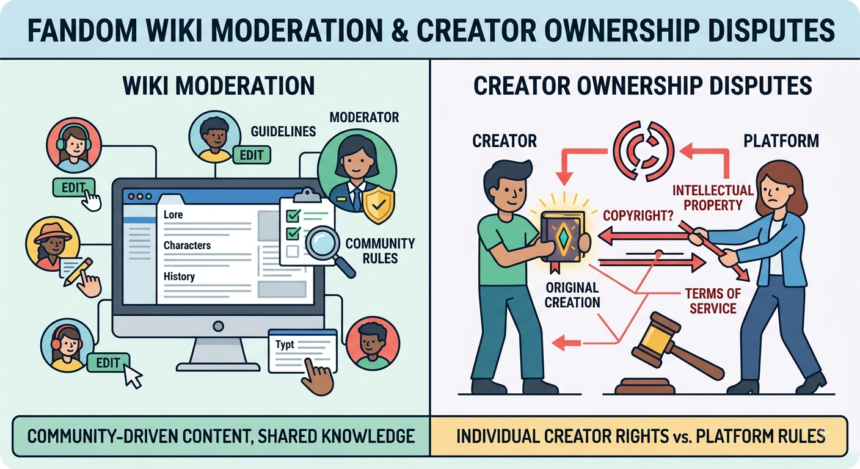
That is the story hiding underneath almost every fight happening on fan wikis right now, from petty admin power trips on a Doctor Who fan page to entire game communities packing up and leaving a platform that hosts a quarter million of them. It is a story about who gets to run a community that never had a boss to begin with, and what happens when the free labor holding that community together finally notices the company standing behind the curtain.
The House that Wikia Built
Fandom started as Wikicities in 2004, founded by Wikipedia’s Jimmy Wales and Angela Beesley, and it rebranded to Wikia before settling on its current name. It runs on the same open-source MediaWiki software as Wikipedia itself, which is part of why the two get confused so often, even though Fandom is a private, for-profit company and Wikipedia is not. Fandom was bought out in 2018 by the private equity firm TPG and executive Jon Miller, and it has spent the years since buying up rivals and running the whole operation as an advertising business, according to a summary compiled at EPFL’s graph search project3. The company now claims more than 350 million monthly visitors and over 250,000 individual wikis, according to a bio published by CEO.com4.
Here is the arrangement, stripped down. A fan picks a franchise, video game, or show they love and starts a wiki. They recruit other fans. Together they build out thousands of pages documenting lore, item stats, character histories, episode summaries, whatever the audience wants. Fandom hosts the servers, runs the software, and sells ads against the pages. Nobody on the editing side gets paid. Ever. One editor put it to the outlet The Game of Nerds5 in a line that has been circulating in wiki circles for a while now, that fans build the house while Fandom charges admission at the door.
A longtime volunteer editor who writes under the name Frisk6 laid out the economics of it more precisely on her own blog. She has been editing wikis since 2013 and spent five years as an unpaid member of Fandom’s volunteer anti-vandalism squad, and she argues that the imbalance between what editors put in and what they get back creates a real ethical problem, not just an annoying one. Charities lean on volunteers all the time, she notes, and nobody blinks. But Fandom is not a charity. It is a company that depends on people doing, for free, the exact kind of creative and research labor that professional writers get paid for elsewhere.
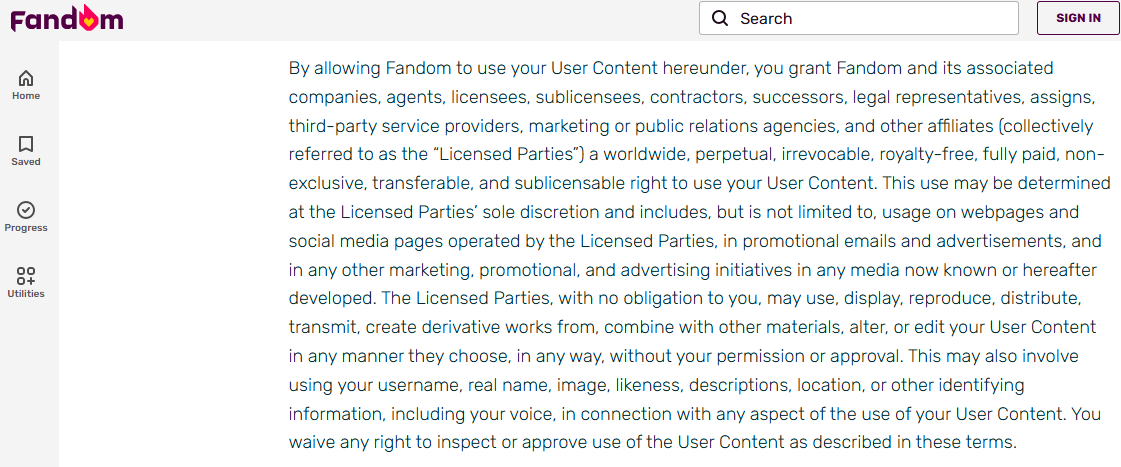
And the legal paperwork backs her up. Fandom’s7 terms of use require every editor to grant the company a worldwide, perpetual, irrevocable, royalty free license to their work, usable in ads, marketing, and just about anything else the company decides to do with it. Wiki text is also released under a Creative Commons license, per Fandom’s8 own copyright policy, which sounds generous until you notice who actually profits most from that openness. You wrote the article. The company owns the right to sell it, forever, and never has to cut you in.
Little Kingdoms, Little Tyrants
Grimace was a corporate intrusion into a wiki. Most of the actual moderation fights on Fandom never involve a corporation at all. They involve one editor with a mouse and a grudge.
Every Fandom wiki runs its own local government, more or less. A founder starts the page and automatically becomes both admin and bureaucrat, the two highest local ranks, and can then appoint other trusted editors to help run things, according to Fandom’s9 own help documentation. For a long time the platform’s actual policy on this, stated almost proudly, was that an admin could block another user for any reason or for none at all, a line pulled straight from a staff blog post announcing that the company would finally start reining that in. The same post insists that a wiki ultimately belongs to its community rather than to any single admin, bureaucrat, or founder, which is a nice sentiment that most day-to-day editors will tell you does not hold up once you’re actually banned.
Scroll through Fandom’s own community forums and you find the same complaint on a loop, phrased a hundred different ways by a hundred different teenagers and adults. On one thread, a user vents that admins are handed too much unchecked authority and that there should be some way to formally report the ones who abuse it, especially the ones “who were appointed and did not actually create the wiki in the first place,” as they put it on Community Central. On another, someone describes a bureaucrat who indefinitely banned a friend just for politely asking to contribute, then justified it by falsely accusing them of being linked to a doxxing incident, a story laid out in detail in a help request thread. A user on Quora10, asked to name admins who abuse their power, rattled off three by username without hesitation, in an answer that reads less like an accusation and more like a shrug, as if this were simply a known feature of the ecosystem.
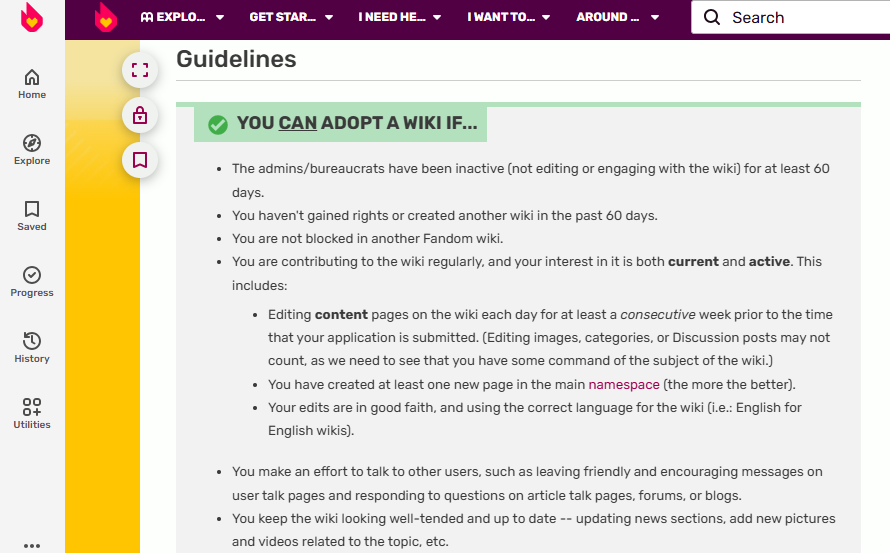
It usually is. Wiki bureaucracies run on the same social physics as any other small, mostly anonymous online hierarchy. The people who show up the most and stay the longest accumulate power, and there is very little built into the system to keep that power in check once it calcifies. Founders vanish for a year to go live their lives, and by the time anyone notices, someone else has quietly taken over the whole operation through Fandom’s adoption process, which lets any active editor request full control of a wiki once its founder has gone dark for sixty days, according to the Fandom’s11 adoption guidelines. Sometimes that is exactly the mercy killing an abandoned wiki needs. Sometimes it is a coup.
One founder, writing years after the fact, described logging back into a childhood project, The Jetsons Wiki, only to discover his own admin rights were gone, quietly reassigned to somebody else while he wasn’t looking. The reply he got from staff was polite and final. Because you were inactive, someone adopted your wiki. That is not a hack. That is not against any rule. That is simply what the system is built to do, and it does not care how you feel about the thing you built.
The Exodus
Eventually enough editors decided that the deal wasn’t worth it anymore, and they started to leave, taking their entire wikis with them.
The most public break came from the Minecraft Wiki, one of Fandom’s largest properties, in the summer of 2023. Editors ran a formal, months-long discussion and vote on whether to abandon Fandom entirely, and the result wasn’t close. Of forty seven substantive responses, only five wanted to stay, a tally one contributor walked through by hand and reported in PC Gamer12. The wiki’s own migration page lists the reasoning in plain terms, citing a new host with far fewer ads, better technical infrastructure, and more transparency than Fandom ever offered, according to the official announcement. By October, the move was finished and the English Minecraft Wiki was gone from Fandom’s domain for good, an outcome PC Gamer described as the wiki fleeing what one longtime editor called the oppression of a giant yellow navigation bar.
Minecraft wasn’t first and it wasn’t alone. The RuneScape wikis broke away years earlier under a group called Weird Gloop, and since then a long list of major properties have followed the same script, among them Terraria, Zelda, Fallout, Hollow Knight, and the World of Warcraft wiki known as Wowpedia, according to reporting from the Hypixel Forums13 and a detailed community history posted on Medium14. That Medium piece points to a specific technical last straw for Wowpedia, an AI powered feature called Quick Answers that started spitting out incoherent, factually scrambled responses editors had no way to fix or delete themselves. The Wowpedia team eventually put it to a community vote, phrasing the choice bluntly by saying the hosting relationship with Fandom had become untenable, and the vote came back a resounding yes to leave.
What makes this exodus different from an ordinary customer boycott is that the customers were also the product. A gamer who quits a subscription service just stops paying and moves on. A wiki editor who quits Fandom has to somehow take years of collaboratively built research with them, fight Google’s search algorithm for relevance all over again, and convince a whole reader base to bookmark a new URL. It is less like canceling a subscription and more like an entire tenant association deciding to physically relocate a building, because they never owned the building and eventually got tired of asking the landlord for basic repairs.
Some communities can’t or won’t make that leap, so they’ve adopted a nastier tactic instead. On the Steam discussion boards for the game Deep Rock Galactic, editors openly admit to deliberately vandalizing their own Fandom wiki, not to destroy it but to make it useless enough that readers give up and migrate to the independent version. It’s happening across dozens of wikis right now, one commenter noted, adding that people dislike Fandom enough to justify it even if the tactic itself is messy, in a thread on Steam15. Another poster in the same conversation made the darker point that vandalism actually helps Fandom in the short term, since chaos still drives traffic, and traffic is the entire business model. Salt the earth to save the crop, in other words, and hope the search engines eventually notice the difference.
The Corner Office Notices, Sort Of
Fandom has not been quiet about any of this, exactly, but it hasn’t exactly reckoned with it either.
CEO Perkins Miller, who took the job in 2019 after Fandom’s private equity buyout, spent years publicly framing the tension as a balancing act between user experience and the advertising revenue that keeps the servers running, a tightrope act he described candidly during a 2023 appearance on the tech podcast Decoder, referenced in a writeup from TechBuzz AI16. Under his watch, Fandom spent roughly fifty million dollars acquiring GameSpot, Giant Bomb, Metacritic, and TV Guide from Red Ventures in 2022, a spree that came with layoffs to the editorial staff at those very properties. Miller quietly stepped down last year with no successor named and no real explanation offered beyond a brief confirmation from a company spokesperson that he was no longer working there.
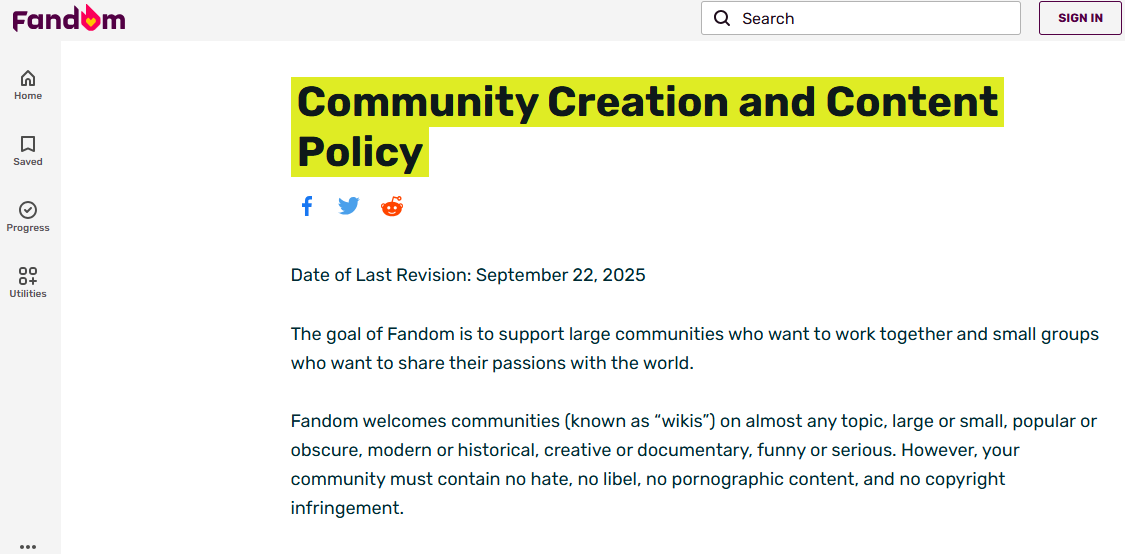
None of it addressed the actual complaint. Editors were never really arguing about pop-up ad density, though the ads gave them plenty to point at. They were arguing about consent and control, about a platform that treats an eight-year labor of love the same way it treats a banner ad slot, interchangeable inventory to be optimized against a quarterly revenue target. Fandom’s own community creation policy is honest about this trade-off in a way that almost reads like an admission, noting that the free license required of every wiki isn’t always what creators are looking for in a hosting service, according to the Fandom’s17 policy page itself. That’s about as close to a company confessing the arrangement is lopsided as you’re likely to get from a company whose entire model depends on that lopsidedness holding.
The Ones Who Can’t Leave
Big properties get to fork. Minecraft had the traffic and the goodwill to survive a year in Google’s search penalty box. Most wikis do not have that luxury, and their editors know it, which makes the moderation disputes on smaller wikis sadder than the corporate ones, because there’s no exit ramp waiting at the end of them.
Search Fandom’s own help forums and you find a steady drip of these smaller tragedies, the kind that never make a gaming outlet’s front page. One user described a wiki whose founder had, in their words, gone dark after some unrelated drama on a different site entirely, leaving behind a page filled with underage editors, constant fighting, and no real oversight, laid out in a request posted to Fandom’s Community Central18 adoption board. Another thread describes a newer wiki founder locking every single page behind admin-only editing and posting a message warning that certain named users would be blocked on sight, a situation one commenter flatly called straight up admin abuse in a help thread from last year. A separate poster in that same thread, apparently the accused party, pushed back by insisting they were still learning how to moderate and that the community around them was the toxic one, which is the kind of he-said-she-said stalemate that Fandom’s support staff has no real appetite or authority to referee.
That’s the quieter injustice sitting underneath the loud corporate one. Fandom built an elaborate internal bureaucracy, admins, bureaucrats, an adoption system with waiting periods and eligibility rules, a volunteer anti-vandalism task force, and then largely stepped back and let it run itself. Most of the time that works fine, the same way most small towns manage without much outside intervention. But when it doesn’t work, when a founder goes quiet and leaves an unsupervised group of mostly teenage editors to fight it out over who gets to lock which pages, the company’s posture is closer to a landlord who owns the whole apartment complex but only shows up once the fire alarm won’t stop ringing. Even then, the fix is usually procedural rather than personal. Somebody waits out a sixty-day inactivity clock. Somebody else files a report that may or may not get read.
An Open Ending, Because There Isn’t One Yet
I don’t think this story has a tidy conclusion, and I’m suspicious of anyone who tells you it does. Fandom is not going away. It still owns the search engine real estate, the decade of backlinks, the habit loop of a reader who types a game’s name into Google and clicks whatever comes up first. Migrating a wiki buys editorial independence and costs traffic, sometimes for years, and not every community has the size or the stubbornness to survive that trade. The Minecraft Wiki could make the leap because Minecraft is enormous. A wiki about a niche visual novel or a decade-old cartoon usually can’t.
What has changed, permanently I think, is the myth. For a long time, editors could tell themselves a comforting story about stewardship, that they were caretakers of something collectively owned, something closer to a public library than a rental property. Grimace’s biography broke that story for a lot of people who had never thought hard about it before. So did the McDonald’s ad campaign, and the AI slop dumped into Wowpedia’s talk pages, and the quiet, procedurally correct theft of a grown man’s childhood wiki because he took a year off to live his life. The fine print was always there. It just took a purple milkshake mascot to make people actually read it.
What replaces the myth, if anything does, remains an open question, and one worth watching. A generation of wiki editors is now fluent in exit as a form of protest, and fluency, once learned, doesn’t go away.
Sources
- Fanlore, fanlore.org/wiki/McDonald’s. Accessed 26 Aug. 2026. ↩︎
- Plunkett, Luke. “McDonalds & Fandom Replaced A Wiki Page With An Advertisement” Kotaku, 19 June 2023, kotaku.com/mcdonalds-grimace-wiki-ad-happy-meal-fandom-history-1850552640. Accessed 26 Aug. 2026. ↩︎
- EPFL, graphsearch.epfl.ch/en/concept/26296277. Accessed 26 Aug. 2026. ↩︎
- “Fandom CEO Perkins Miller” CEO.com, www.ceo.com/c/podcast/fandom-ceo-perkins-miller. Accessed 26 Aug. 2026. ↩︎
- Author, About The. “The Monetization Backlash: How Fandom (Wiki) Sites Are Losing Community Trust” The Game of Nerds, 15 Nov. 2025, thegameofnerds.com/2025/11/15/the-monetization-backlash-how-fandom-wiki-sites-are-losing-community-trust/. Accessed 26 Aug. 2026. ↩︎
- Frisk. “Fandom and the multimillion dollar business of monetizing volunteer work” Frisk, 23 Mar. 2025, frisk.space/posts/fandom-and-the-multimillion-business-of-monetizing-volunteer-work/. Accessed 26 Aug. 2026. ↩︎
- Fandom, www.fandom.com/terms-of-use. Accessed 26 Aug. 2026. ↩︎
- Fandom, community.fandom.com/wiki/Copyright. Accessed 26 Aug. 2026. ↩︎
- Fandom, community.fandom.com/wiki/Help:User_rights. Accessed 26 Aug. 2026. ↩︎
- Quora, www.quora.com/Do-you-know-any-admins-who-abuse-their-power-on-fandom-wikis. Accessed 26 Aug. 2026. ↩︎
- Fandom, community.fandom.com/wiki/Adoption_talk:Requests. Accessed 26 Aug. 2026. ↩︎
- Stanton, Rich. “Official Minecraft wiki editors so furious at Fandom’s ‘degraded’ functionality and popups they’re overwhelmingly voting to leave the site” PC Gamer, 10 July 2023, www.pcgamer.com/official-minecraft-wiki-editors-so-furious-at-fandoms-degraded-functionality-and-popups-theyre-overwhelmingly-voting-to-leave-the-site/. Accessed 26 Aug. 2026. ↩︎
- Hypixel, hypixel.net/threads/the-wiki-has-moved-on-from-fandom.6089061/. Accessed 26 Aug. 2026. ↩︎
- Medium, medium.com/@lindenclayton/you-dont-understand-why-wikis-are-leaving-fandom-6378372ad06e. Accessed 26 Aug. 2026. ↩︎
- Denker, Kugelblitz. “What happened to the fandom wiki? :: Deep Rock Galactic General Discussion” 13 Nov. 2024, steamcommunity.com/app/548430/discussions/1/4630357755180375949. Accessed 26 Aug. 2026. ↩︎
- “Fandom CEO Perkins Miller Steps Down After Six Tumultuous Years” The Tech Buzz, www.techbuzz.ai/articles/fandom-ceo-perkins-miller-steps-down-after-six-tumultuous-years. Accessed 26 Aug. 2026. ↩︎
- Fandom, www.fandom.com/community-creation-policy. Accessed 26 Aug. 2026. ↩︎
- Fandom, community.fandom.com/wiki/Adoption:Toxic_Fandoms_and_Hatedoms_Wiki_(2). Accessed 26 Aug. 2026. ↩︎


