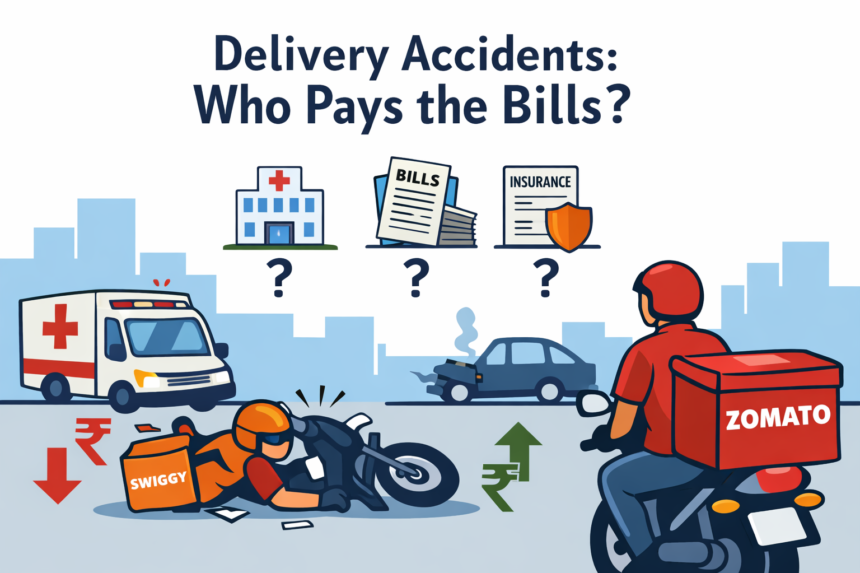

I began this investigation with a simple question. When a Swiggy or Zomato delivery rider gets hit by a car while rushing to meet a timer on an app, who pays the hospital bill?
The answer looks simple on paper. Both companies say they provide insurance. Both publish press releases detailing crores spent on coverage. Government rules now require gig worker protections under India’s Code on Social Security.
But the riders I encountered in forums, complaint threads, and interviews told a different story. They spoke about forms, confusion, delayed payments, and sudden silence from support. Some described being logged out of the app within days of an accident. Some said insurance exists only until you try to use it.
This article examines the collision between policy and reality.
Insurance on Paper and the Fine Print that Riders Discover Later
Both Swiggy and Zomato publicly position accident insurance as a core part of their commitment to delivery partners. On corporate blogs, in investor disclosures, and in media interviews, the language is reassuring. Protection exists. Claims are paid. Crores have been disbursed.
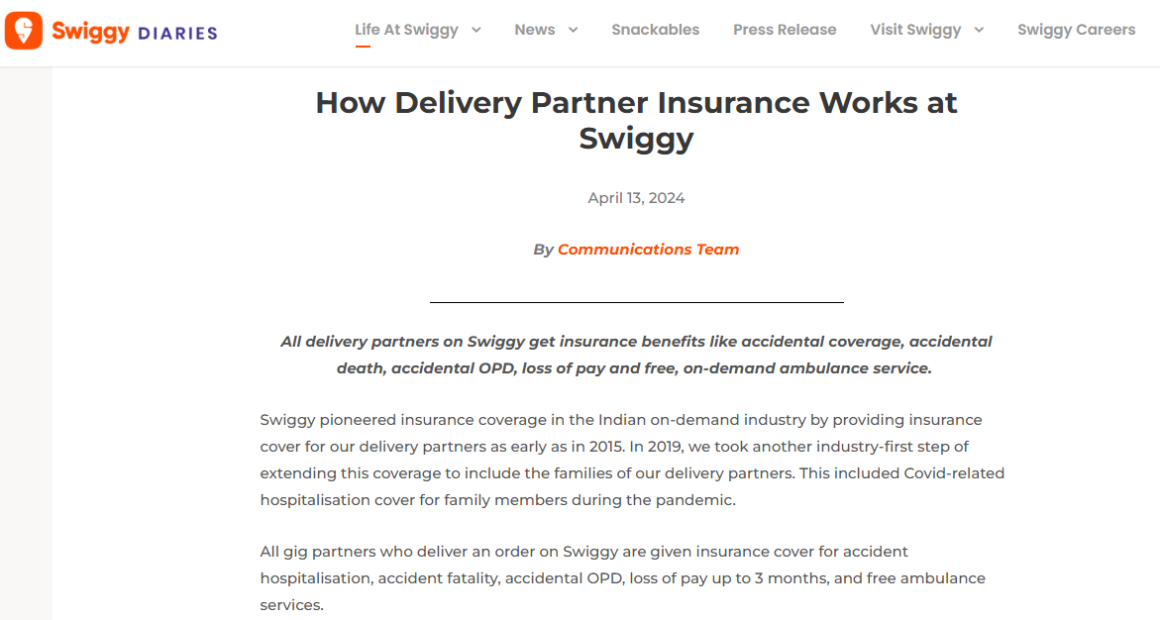
Swiggy1 says it has offered insurance coverage to delivery partners since 2015. According to the company’s official statement, partners are covered for accidental death up to ₹10 lakh, along with medical expenses arising from on-duty accidents. Swiggy reported that it paid more than ₹30 crore in claims in FY23 alone.
Zomato reports similar provisions. In FY22, Fortune India2 disclosed that Zomato disbursed ₹15.95 crore in medical cover for delivery partners. The stated coverage includes medical reimbursement, accidental death benefits, and some level of income loss compensation in case of injury.
According to Business Today3 in January 2026, Zomato CEO Deepinder Goyal publicly stated that the company spent over ₹100 crore on insurance coverage for gig workers. He also highlighted additional benefits such as maternity support and SOS emergency services, framing them as part of a broader commitment to gig worker welfare.
On paper, this appears comprehensive. There is accidental death cover. There is medical expense reimbursement. There is a mention of loss of pay support. There are crores spent and public claims of impact.
But insurance is rarely judged by the announcement. It is judged at the moment of crisis.
The gap between having insurance and successfully claiming it is where the real story lies.
A Times of India4 report from Pune examined how delivery agents struggle to secure insurance payouts after on-duty accidents. The report found that riders frequently face documentation hurdles, confusion about claim procedures, and delays in reimbursement. Insurance technically exists, but many riders only discover the procedural complexity once they are already injured.
One rider quoted in the report described the process as confusing and slow, explaining that he had to repeatedly follow up before receiving reimbursement. During that time, he bore the medical expenses upfront.
Several riders I reviewed across forums expressed a similar concern. Insurance is conditional. It often requires that the rider be actively logged into the app at the exact time of the accident. The order must be marked active. Some policies include activity or performance-related conditions. Riders working part-time or irregular shifts worry that inactivity could complicate eligibility.
In a Reddit5 discussion about Swiggy’s insurance structure, one user claimed that coverage was tied to order thresholds and activity levels, suggesting that riders who did not meet certain benchmarks risked losing benefits. Another Reddit thread described the difficulty of reporting a Swiggy rider accident through the app. The user wrote that the process was unclear and that emergency escalation options were hard to find.
A Hindustan Times6 report quoted a 20-year-old student working part-time as a Swiggy delivery partner. He said,
“They don’t let us claim easily.” He described the insurance experience as full of obstacles once a claim was initiated.
Reading through these accounts, a consistent pattern emerges. Riders are told during onboarding that insurance exists. It is presented as reassurance. Few are given a clear breakdown of exclusions, caps, documentation timelines, or hospital network requirements.
Then an accident happens.
The language shifts from promise to procedure.
Was the rider officially online at the moment of the crash? Was the delivery status active in the system? Was a police report filed immediately? Are the hospital bills itemized in an approved format? Was pre-authorization required for certain treatments? Is there a cap on room rent or specific exclusions for certain injuries?
The burden shifts quickly. What began as a corporate guarantee becomes an individual administrative test. The rider who was hit in traffic is now expected to navigate claim forms, upload documents, and respond to insurer queries while recovering from injury.
Insurance on paper offers comfort. Insurance in practice demands compliance.
The difference between the two is where many delivery partners say they feel most exposed.
Accident Costs: The Immediate Financial Shock
Motorcycle accidents are not rare events in Indian cities. They are routine. Congested intersections, unpredictable lane changes, potholes, sudden braking, and aggressive driving patterns form the daily terrain of urban traffic. Delivery riders operate inside this environment for eight to twelve hours at a stretch. Many work through peak lunch and dinner rushes when traffic is at its worst.
According to road safety data published by the Ministry of Road Transport and Highways7, two-wheeler riders account for a significant share of road accident fatalities in India. In several recent annual reports, two-wheelers have represented well over a third of total road deaths nationwide.
That statistic alone changes how we should think about food delivery. The job is not simply about logistics and speed. It is about exposure. Exposure to impact, to unpredictable drivers, to slippery roads during monsoon months, and to fatigue at the end of long shifts.
Delivery riders are not just passing through traffic. They are embedded in it all day.
When an accident happens, the financial impact begins immediately.
In multiple forum discussions across Reddit and Quora, riders describe medical bills ranging from ₹20,000 to ₹1 lakh for fractures, stitches, minor surgeries, and hospital stays. For context, many delivery partners report earning between ₹15,000 and ₹25,000 a month, depending on city, incentives, and hours worked. A single accident can wipe out several months of income in one evening.
In one discussion, a former delivery rider described the sequence bluntly. After a crash, he wrote,
“the hospital demanded cash first. The company told me to submit documents later.”
That sentence captures the time gap at the heart of the problem.
Hospitals do not wait for claim approvals. They demand deposits before treatment continues. Private facilities often require advance payment before surgery. Even government hospitals incur costs for medicines, diagnostics, and follow-up care.
For riders without savings, the immediate options are limited. Borrow from family. Take high-interest informal loans. Pawn personal belongings. Delay treatment. In some cases, riders continue working with untreated injuries because they cannot afford time off.
Even when insurance reimbursement is eventually approved, the gap between accident and payout can stretch for weeks. Claims require submission of discharge summaries, FIR copies in some cases, itemized bills, bank details, and sometimes verification calls. For daily wage earners, a delay of two or three weeks is not an inconvenience. It is a crisis.
Loss of income compounds the shock. A rider recovering from a fracture cannot accept deliveries. App-based systems do not provide automatic wage continuation. If a rider logs out for 30 days, earnings drop to zero.
Some insurance policies mention compensation for loss of pay, but riders frequently say they do not understand how it is calculated. Is it based on average earnings from previous months? Is it capped? Is there a waiting period? These questions rarely become clear until a claim is underway.
A delivery partner interviewed in the Times of India8 report described receiving reimbursement only after repeated follow-ups and document submissions. During that waiting period, he relied on loans from family members to cover expenses and household costs.
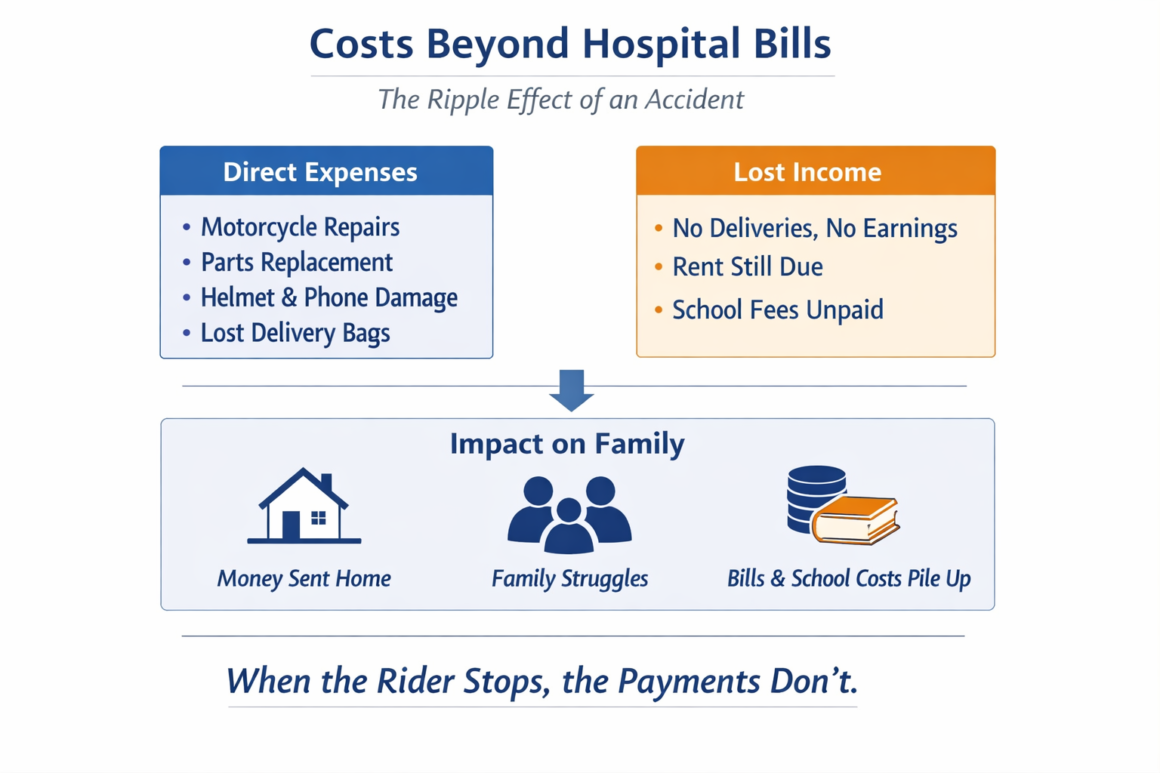
There is also the cost beyond hospital bills. A damaged motorcycle must be repaired. Replacement parts are not covered under personal accident insurance. If the vehicle is off the road, income remains stalled. Helmet replacement, phone damage, and lost delivery bags add smaller but meaningful expenses.
For riders who migrate to cities and send money home, the impact spreads to families. Rent still needs to be paid. Children’s school fees do not pause because of an accident. The economic structure of gig delivery assumes constant motion. When that motion stops, the financial system around the rider does not adjust automatically.
The shock is immediate. The support is procedural. The rider absorbs the difference.
Insurance policies often include caps on room rent, exclusions for certain procedures, and requirements for approved hospitals. Riders rarely have time to study policy documents in advance.
They discover exclusions when bills are rejected.
In fatal accident cases, companies often announce compensation packages. News reports have documented instances where delivery partners who died on duty were offered insurance payouts.
Yet families sometimes struggle with documentation and claim verification.
Public records show that gig workers historically lacked social security benefits. According to a British Safety Council9 analysis, over 95 percent of gig workers in India previously had no formal social security coverage.
Insurance announcements signal progress. But access remains uneven.
The Legal Framework: Social Security Code and Gig Recognition
In recent years, India introduced the Code on Social Security, which recognizes gig workers and platform workers as distinct categories entitled to certain benefits.
Under the framework, as reported by The Indian Express10, aggregators like Swiggy and Zomato are required to contribute to social security funds for gig workers.
This is a structural shift. For the first time, gig workers are formally acknowledged in labour law.
However, implementation details remain critical. Contribution percentages, fund disbursement mechanisms, and enforcement procedures determine whether benefits reach injured riders promptly.
Legal recognition does not automatically translate to accessible care.
One of the most striking patterns I observed during this investigation is how quickly injured riders are replaced.
Gig platforms operate on scale. Their strength lies in volume and density. High onboarding rates ensure that supply consistently meets demand. Thousands of new delivery partners sign up every month across major cities. When a rider stops logging in, the algorithm does not wait. Orders are reassigned within seconds to someone else in the vicinity.
From the system’s perspective, this is efficiency. From the rider’s perspective, it can feel like erasure.
There is no formal layoff notice. No guaranteed retention period. No contractual obligation to hold a position during recovery. Delivery partners are classified as independent contractors. That classification allows flexibility for both sides, but it also allows rapid turnover without a formal process.
When an injured rider cannot log in for weeks, the platform does not technically replace them in a traditional employment sense. The system simply continues operating without them.
In online discussions, riders often describe this churn in blunt terms. One user wrote,
“If I don’t deliver, someone else will. That’s it.”
The sentence is not emotional. It is a matter of fact. It reflects how interchangeable the role can feel in a high-volume marketplace.
Public disclosures from platforms acknowledge significant partner turnover, though exact figures vary by region and are not always published in detail. Analysts covering gig companies frequently note high attrition as a structural feature of the model. Many riders treat delivery work as transitional. Others leave due to earnings fluctuations, safety concerns, or lack of long term security.
Replacement is not malicious. It is structural.
The platform is designed to ensure that a dropped rider does not disrupt service levels. The customer continues to receive food on time. The app continues to function smoothly. The system absorbs the shock.
But for injured workers, the system does not pause when they fall.
An accident that removes a rider from active status may reduce their incentive eligibility. It may affect performance metrics. It may reset streak-based bonuses. Even if account access remains technically open, the economic position weakens quickly.
The human body needs time to heal. The app does not.
To be fair, both Swiggy11 and Zomato12 emphasize that safety and welfare are priorities. Their public communications highlight insurance coverage, emergency assistance features, and significant sums disbursed in claims. They note that millions of deliveries are completed daily and that serious incidents represent a small fraction of total orders.
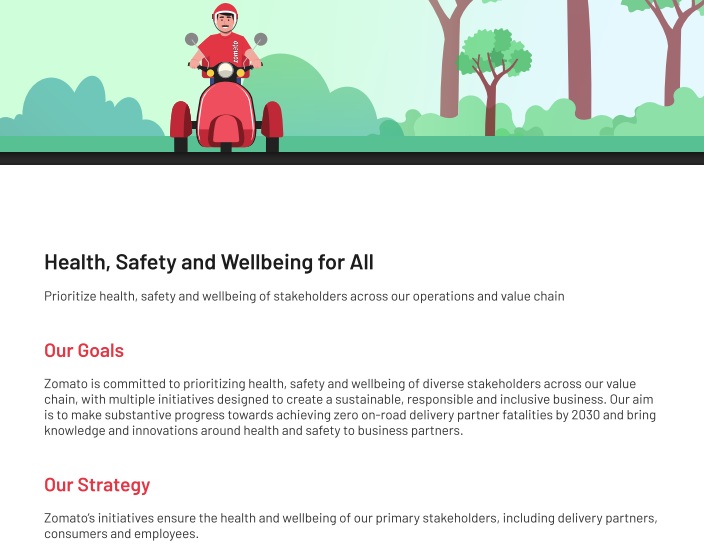
Corporate statements stress flexibility as a benefit. Riders can log in when they choose. They are not bound by fixed shifts. Insurance applies while active on the platform. Emergency support systems, including SOS buttons and helplines, are available in the app.
From a legal standpoint, companies argue that they comply with regulatory requirements and, in some cases, exceed them. With the introduction of social security provisions for gig workers, platforms have pointed to their insurance frameworks as evidence of proactive welfare measures.
There is truth in this evolution. Insurance coverage today is more visible and more structured than it was five years ago. Public scrutiny, media reporting, and policy pressure have pushed platforms to formalize benefits. Corporate leaders publicly cite crores spent on claims and highlight improvements in partner support.
The system is not static. It has changed.
But the tension remains in execution.
The corporate model is built for scale and flexibility. The human body is not.
When everything works, the system appears efficient and modern. When an accident occurs, the gap between structural efficiency and personal vulnerability becomes visible. The company can demonstrate policy compliance. The rider must still navigate recovery, lost income, and paperwork alone.
The defense rests on compliance and aggregate spending. The critique rests on individual experience.
Both can be true at the same time.
Where the System Breaks Down and What Could Change
After reviewing corporate policy documents, regulatory updates, field reports, and dozens of rider testimonies, the stress points become clear. The insurance exists. The friction exists, too. The breakdown rarely happens in one dramatic moment. It happens in layers.
The first pressure point is awareness.
Many riders do not fully understand the terms of their coverage. During onboarding, insurance is presented as a benefit. But detailed policy language is often buried in app menus or lengthy documents. Riders who join primarily to earn income quickly may not read exclusions, caps, or claim timelines in depth. The result is a false sense of certainty. Protection feels automatic. In reality, it is conditional.
The second pressure point is claim complexity.
Documentation requirements can delay payouts. Riders must often provide hospital bills in prescribed formats, discharge summaries, sometimes police reports, and proof that they were active on the app at the time of the accident. Any missing document can stall the process. For someone recovering from injury, managing the administrative back and forth with insurers is exhausting. The process becomes technical at the moment when clarity is most needed.
The third pressure point is income interruption.
Even when reimbursement is eventually approved, lost earnings hit immediately. If a rider cannot work for a month, there is no automatic wage continuation. Insurance policies may include limited loss of pay compensation, but riders frequently say they do not understand how that compensation is calculated or when it will be credited. For workers living week to week, a delay of even ten days can disrupt rent payments and household expenses. Medical reimbursement does not restore missed income in real time.
The fourth pressure point is contractor status and replacement speed.
Independent contractor classification enables flexibility. Riders can log in and log out freely. But that same structure means there is no obligation to hold a position open during recovery. When a rider stops accepting orders, the system reallocates work instantly. The platform does not freeze or slow down. For the injured worker, this creates a psychological as well as economic impact. The system continues smoothly without them. It reinforces the feeling of disposability.
None of these breakdowns requires bad faith. They arise from design.
Insurance policies are written by insurers to manage risk. Platforms are designed for scale and responsiveness. Hospitals operate on immediate payment cycles. Riders operate on daily earnings. When these systems intersect after an accident, friction becomes inevitable.
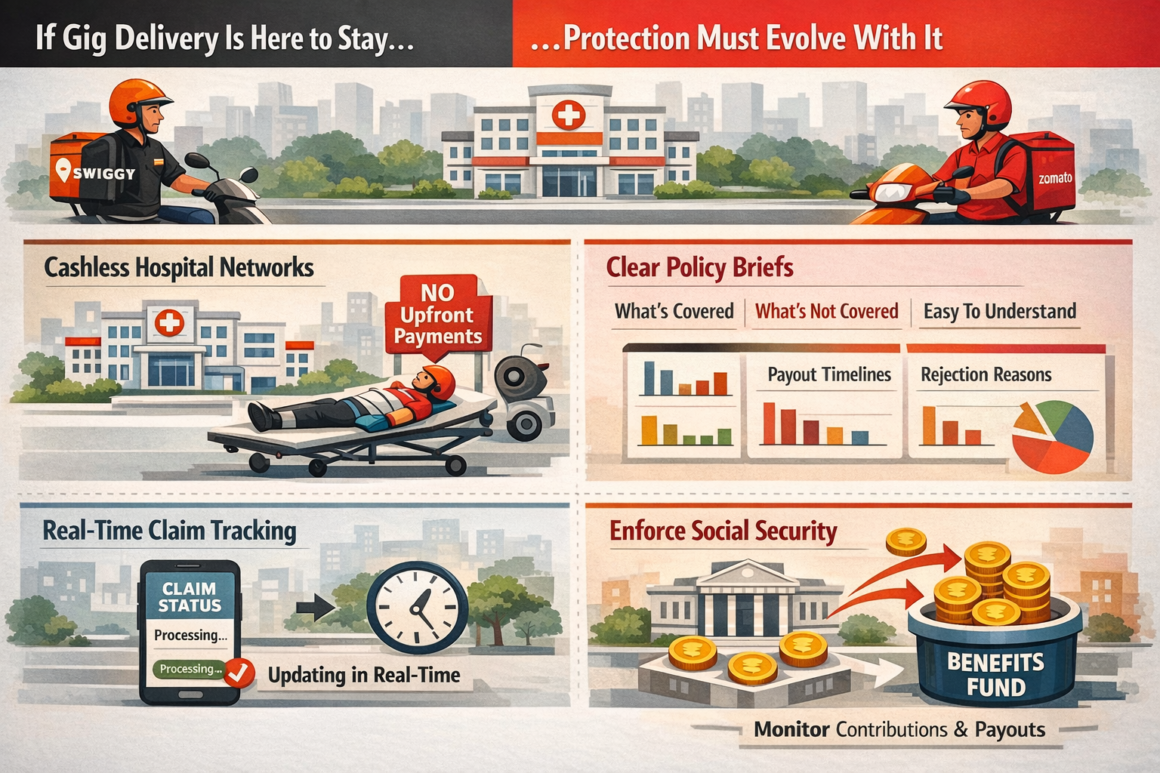
If gig delivery is here to stay, protection must evolve with it.
The first reform is practical. Automatic hospital tie-ups could reduce upfront payment burdens. Cashless treatment networks are common in traditional employee insurance plans. Extending robust, city-wide hospital networks for delivery partners would remove the need for injured riders to arrange large deposits before treatment.
Second, clear multilingual policy summaries should be mandatory during onboarding. Not legal fine print. Plain language explanations. What is covered? What is not covered? What documents are required? How long do payouts usually take? Riders should not learn policy details only after an accident.
Third, digital claim tracking systems should be transparent and real-time. If a rider can track food orders to the minute, they should be able to track insurance claims with similar clarity. Status updates, estimated processing timelines, and clear reasons for rejection would reduce uncertainty.
Fourth, platforms could publish anonymized data on approval rates, average payout timelines, and common claim rejection reasons. Transparency builds trust. Aggregate spending figures are useful, but they do not reveal how long individuals wait or how many claims are partially rejected.
Finally, the enforcement of social security contributions must be monitored publicly. Regulatory recognition of gig workers is an important step, but implementation determines impact. Contributions must flow into accessible, functional benefit systems rather than existing only as statutory compliance.
Gig work offers flexibility. It allows students, migrants, and part-time earners to participate in urban economies quickly. That flexibility has value. But flexibility without security creates fragility. The faster the system becomes, the more visible its weak points become under stress.
Food delivery in India runs on speed. Orders arrive in minutes. Riders race against countdown timers. Customers track movement in real time. Efficiency is the selling point.
But when speed collides with asphalt, the app timer disappears.
What remains is a hospital bill, a fractured bone, a damaged motorcycle, and a rider trying to understand a policy document from a hospital bed.
Who pays?
The companies say they do. They point to crores spent and policies issued. The riders say sometimes. They describe paperwork, follow-ups, and waiting. The documentation says it depends on conditions, timestamps, and forms.
The truth sits somewhere in between.
The future of gig delivery will not be defined only by how quickly food reaches a doorstep. It will be defined by how quickly and fairly protection reaches a rider when something goes wrong. Speed built these platforms. Security will determine whether they remain sustainable for the people who power them.
Sources
- Team, Communications. “How Delivery Partner Insurance Works at Swiggy” Swiggy Diaries, 13 Apr. 2024, blog.swiggy.com/press-release/how-delivery-partner-insurance-works-at-swiggy/. Accessed 15 Feb. 2026. ↩︎
- India, Fortune. “Zomato disbursed ₹15.95 cr ‘medical cover’ for delivery partners in FY22” 27 Sept. 2022, www.fortuneindia.com/enterprise/zomato-disbursed-1595-cr-medical-cover-for-delivery-partners-in-fy22/109813. Accessed 15 Feb. 2026. ↩︎
- “₹100 crore on insurance, flexible hours: Deepinder Goyal makes case for Zomato’s gig economy model” BusinessToday, 2 Jan. 2026, www.businesstoday.in/latest/corporate/story/rs100-crore-on-insurance-flexible-hours-deepinder-goyal-makes-case-for-zomatos-gig-economy-model-509255-2026-01-02. Accessed 15 Feb. 2026. ↩︎
- Kothari, Priya. “‘On-time’ trend hides hazards: Delivery agents struggle to get insurance claims for accidents on the job” The Times of India, 20 July 2025, timesofindia.indiatimes.com/city/pune/on-time-trend-hides-hazards-delivery-agents-struggle-to-get-insurance-claims-for-accidents-on-the-job/articleshow/122790017.cms. Accessed 15 Feb. 2026. ↩︎
- Reddit, www.reddit.com/r/unitedstatesofindia/comments/1c27vvp/. Accessed 15 Feb. 2026. ↩︎
- Hindustan Times, www.hindustantimes.com/business/20yearold-student-working-part-time-for-swiggy-in-delhi-calls-firms-insurance-useless-they-don-t-let-us-101740579837812.html. Accessed 15 Feb. 2026. ↩︎
- Jha, Sumit. “RA Draft.cdr” 29 Oct. 2023, morth.nic.in/sites/default/files/morth.nic.in/sites/default/files/RA_2022_30_Oct.pdf. Accessed 15 Feb. 2026. ↩︎
- Kothari, Priya. “‘On-time’ trend hides hazards: Delivery agents struggle to get insurance claims for accidents on the job” The Times of India, 20 July 2025, timesofindia.indiatimes.com/city/pune/on-time-trend-hides-hazards-delivery-agents-struggle-to-get-insurance-claims-for-accidents-on-the-job/articleshow/122790017.cms. Accessed 15 Feb. 2026. ↩︎
- Bandyopadhyay, Orchie. “Indian gig workers fight for social security benefits” British Safety Council India, 15 Dec. 2022, www.britsafe.in/safety-management-news/2022/indian-gig-workers-fight-for-social-security-benefits. Accessed 15 Feb. 2026. ↩︎
- “Amazon, Flipkart, Swiggy, Zomato to contribute to fund for gig workers’ welfare” The Indian Express, 22 Nov. 2025, indianexpress.com/article/business/companies/amazon-flipkart-swiggy-zomato-to-contribute-to-fund-for-gig-workers-welfare-10379251/. Accessed 15 Feb. 2026. ↩︎
- Swiggy, www.swiggy.com/corporate/wp-content/uploads/2025/08/www.swiggy.com/corporate/wp-content/uploads/2025/08/Health-and-Safety-Policy.pdf. Accessed 15 Feb. 2026. ↩︎
- Zomato, b.zmtcdn.com/data/file_assets/b.zmtcdn.com/data/file_assets/93720629bed5214e067c1a3a7f4362fb1743054722.pdf. Accessed 15 Feb. 2026. ↩︎