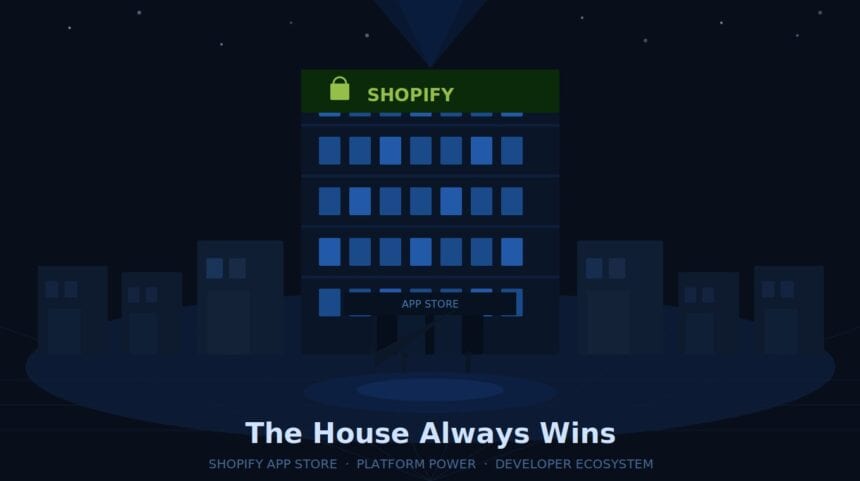

There is a street in every city where the most prominent stores sit at the corner, with the best foot traffic and the cleanest windows. Other shops line the blocks behind them, and some of those shops are quite good. But they are not at the corner. In the digital world, the Shopify App Store is that street, and the question of who gets the corner has never been more contested.
Shopify is a commercial phenomenon. According to Ringly1, with more than 5.6 million live stores worldwide as of 2026, and $292.3 billion in gross merchandise volume processed in 2024 alone, the Ottawa-based platform has become the backbone of a significant slice of global commerce. Its App Store, which now houses over 16,000 apps at the end of 2024, as reported by Popular Fintech2, is the scaffolding on which that empire sits. Independent developers built much of it. The question increasingly asked in developer forums, Slack channels, Reddit threads, and coding communities around the world is whether those same developers are now competing against a landlord who can change the rules of tenancy without notice.
The complaint is not just about algorithms. It is about structure. Shopify operates the marketplace, sets the review criteria, decides which apps get premium placement, creates its own competing tools, acquires promising third-party apps, and invests directly in select developers. That is a remarkable concentration of power for any single entity to hold over a market it also participates in. Whether Shopify wields that power fairly is the central question this investigation attempts to answer.
The Store Within the Store
Let me start with the basics, because they matter. When a merchant searches for, say, an email marketing tool on the Shopify App Store, what they see is not random. It is the product of an algorithm that Shopify controls, a ranking system that weighs hundreds of signals, and a certification program that explicitly elevates certain apps above others. At every level, Shopify makes choices. And those choices have consequences measured in installs, revenues, and survival.
The ranking system, as Shopify3 has publicly described it, incorporates behavioral data about how merchants interact with results after they search. Apps that merchants find most relevant rank higher. That sounds neutral. But relevance is partly a function of visibility: apps that rank high get more clicks, more installs, and more reviews, all of which feed back into higher rankings. It is a compounding cycle that heavily favors incumbents and disadvantages newcomers.
According to Medium4, the app listing page traffic, visit-to-install conversion rate, review count, and average review score all carry significant weight. In a marketplace with over 16,000 apps and only a first page, the math is brutal for the unknown.
Market research firm data published by Market Clarity5 found that the median revenue for a new Shopify app in its first three months is literally zero dollars, with an average of just $39.72 across 700 tracked launches. More than 54 percent of all developers earn less than $1,000 per month. Getting to a first $1,000 in monthly recurring revenue typically takes three to six months, and that is only possible for apps that launch entirely free to accumulate the social proof reviews that the algorithm then rewards. You need installs to get reviews, and reviews to get installs. It is a catch-22 that makes the first six months feel less like a business launch and more like a slow bleed.
“The quality is awful, the market is oversaturated, merchants are tired of endless apps.” — Developer review on Trustpilot, 2025
A developer writing a review on Trustpilot6 in late 2025 put it with exhausted directness:
“App review requirements are barely documented, the process is not transparent. They declare the waiting time before the review to be five days, but in practice it takes two months.”
The same reviewer added that Shopify’s developer tools were so unreliable that developers in the community had reached a de facto consensus not to use them, and that merchants themselves were simply tired of being pitched more apps.
The Built for Shopify Badge: Quality Standard or Competitive Moat?
In early 2023, Shopify7 introduced the Built for Shopify (BFS) program, a certification that it described as recognition for apps meeting its “highest quality standards” across performance, design, and integration. On paper, it looks like a good idea. In practice, it looks like something more complicated.
The benefits of the BFS badge are not subtle. Shopify8 claims that certified apps receive preferential ranking in its App Store search results. They appear in featured sections of the app store homepage. They are recommended by Sidekick, Shopify’s AI assistant embedded in merchant dashboards. They receive priority placement in “Recommended for you” sections across category pages.
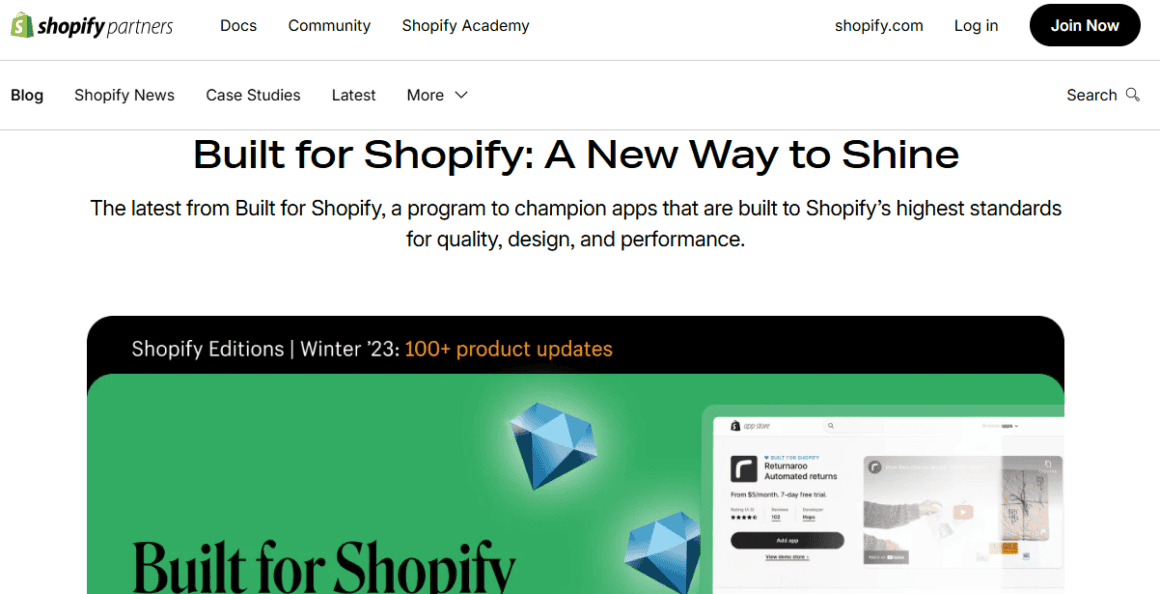
BFS developers also get priority review queues when submitting new apps, which effectively cuts the waiting time that non-certified developers endure. Exclusive advertising capabilities allow BFS developers to target ads at specific merchant plan tiers, including Shopify Plus merchants, the most valuable segment.
That is a powerful stack of advantages. And fewer than one percent of apps in the store carry the badge, according to Toki9, one certified app developer. Which raises the question: is this a merit-based quality program, or is it a structural barrier that privileges well-resourced developers over bootstrapped ones?
At Medium10, a developer who achieved BFS certification for two of his apps documented the experience in detail. His findings were surprising. The badge did not move the needle on keyword rankings the way he expected.
“We were monitoring our main keyword rankings with SASI after getting BFS,” he wrote. “For the next two days, we were expecting an email with a lot of green numbers, but nothing happened. We were very disappointed.”
What did improve was Google search ranking, thanks to internal backlinks from the BFS section of the app store, plus some general trust signals. But the primary ranking boost that Shopify promises? In his experience, the data did not show it.
This discrepancy between Shopify’s marketing of the BFS program and the lived experience of certified developers is worth sitting with. If the ranking boost is real but selective, or if it manifests in some surfaces but not others, that is itself a form of opacity. Developers invest an enormous engineering effort to qualify. Movsumov rewrote his app entirely, migrating a three-year-old Laravel codebase to meet Shopify’s technical requirements. For small teams and solo developers, that is months of work. The cost of entry to the prestige tier is high, and the payoff is uncertain.
The Platform Competing with Its Own Developers
Here is where the story gets genuinely uncomfortable. Shopify is not just a neutral marketplace operator. It is also an active app developer, with a collection of native tools that compete directly with the third-party apps it hosts. And in recent years, that competition has intensified.
Ruslan Leteyski11, who spent years building Shopify apps before walking away from the business, wrote a thorough post-mortem that became something of a definitive document of developer discontent.
“In recent years, Shopify has also slowly cannibalized its own ecosystem by either developing free app alternatives or obsoleting apps by making a feature part of its core product,” he wrote.
The examples were not abstract. When Shopify launched Shopify Inbox, it entered the customer support category. When it launched Shopify Email, it moved into the email marketing space. When it launched Shopify Collabs, it competed in influencer marketing. When it expanded its native Reviews tool, apps that had been building their businesses on that exact product suddenly found themselves competing against a free native offering from the platform itself.
“It’s not like people are going to stop building on Shopify. But is the love gone a little bit?” — Anonymous developer, quoted in The Logic
Leteyski’s most pointed observation was about the complacency in how developers framed this threat.
“There’s the common belief by many app developers that Shopify’s apps are nothing to worry about as they are targeting the lowest-tier of customers,” he wrote. “I believe that’s completely wrong.”
His analysis was that Shopify’s first-party tools, even if less feature-rich than specialist competitors, had an inherent structural advantage: they were free, native, and installed by default or actively promoted to new merchants. That is not a small thing. When 87 percent of Shopify merchants use apps, and a meaningful share of those merchants are newly onboarded and still deciding which tools to adopt, the apps that arrive pre-promoted or pre-suggested have an enormous head start.
As reported by Uptek12, in the customer support category, Shopify Inbox had already become the fourth-largest app among Plus merchants within a single year of launch. In the affiliates category, Shopify Collabs launched in August 2022 and quickly captured eight percent market share, double its nearest third-party competitor. The analyst who compiled that report wrote with some understatement:
“If I was a provider in this space, I would be concerned about how quickly Shopify Collabs has grown.”
The concern is not hypothetical. These are real market share numbers being taken from developers who had invested years building products in those categories.
And then there is the question of acquisitions. In June 2024, TechCrunch13 reported that Shopify acquired Checkout Blocks, a checkout customization app that had debuted on the Shopify App Store in September 2022 and grown into one of the most popular tools in its category. The acquisition made the starter version of Checkout Blocks free for all Shopify Plus merchants. For competing developers in the checkout customization space, this was not a neutral event. An app that was once a paid competitor became a free native feature owned by the platform itself overnight. Competing against free, when you are a bootstrapped team paying hosting costs and engineering salaries, is an extremely difficult thing to do.
The Antitrust Question Nobody Is Asking Loudly Enough
There is a legal dimension to all of this that has so far received less attention than it deserves. Vass Bednar14, executive director of McMaster University’s Master’s of Public Policy Program, noted in a detailed analysis of Shopify’s marketplace dynamics that Shopify had “been generally absent from antitrust or competition scrutiny” even as Apple and Google faced mounting regulatory pressure over their app store practices. That analysis was written in 2021. The situation has shifted.
In June 2024, a company called Sezzle filed a federal antitrust lawsuit against Shopify. The complaint, which Law36015 described as an early antitrust test of “buy now, pay later”, alleged that Shopify used its market power to favor its own Shop Pay Installments product over competing buy-now-pay-later platforms, including Sezzle. According to the complaint, when consumers selected Sezzle at checkout, Shopify redirected them to a form associated with Shop Pay Installments instead. Within three years of Shopify launching its own installment product, Shop Pay Installments processed 75 percent of all buy-now-pay-later transactions for Shopify merchants. Sezzle called this a classic tying claim. Shopify moved to dismiss, arguing the relevant market had been defined too narrowly. The case was still pending as of early 2026.
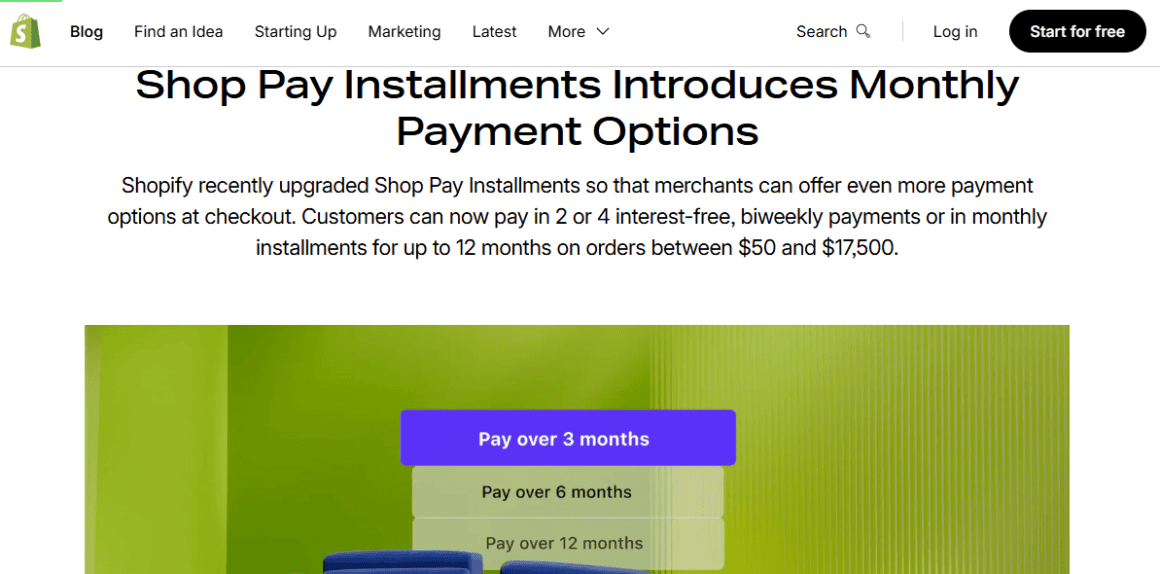
The Sezzle case is significant not just for its specific facts but for the pattern it reveals. A company builds a product in a space that Shopify does not occupy. The product gains traction on the Shopify platform. Shopify launches a competing native product. The native product, aided by deep integration and default placement, rapidly captures market share. The third-party developer finds itself either marginalized or, as Sezzle alleges, actively redirected away from. Swap out the names, and the same story applies in email marketing, customer support, checkout customization, and reviews.
Bednar’s analysis identified several antitrust frameworks potentially applicable to Shopify, including the pattern of building apps that copy third-party apps in its store. She flagged the 2019 falling out between Shopify and Mailchimp over customer data, which preceded Shopify’s launch of its own email marketing product, as a case worth examining. The proposed “Ending Platform Monopolies Act” in the US would bar companies from giving their own products preference over rivals, and while it had not passed, the direction of regulatory travel was clear. The EU’s Digital Markets Act, which specifically addresses scenarios where platform operators disadvantage third-party apps competing with their own services, applies to Apple and Google. Shopify, for now, remains outside its scope.
The Investment Problem: Picking Favorites
There is another layer to this that does not fit neatly into either the ranking story or the antitrust story, but sits uncomfortably between them. Shopify has, over the past several years, begun investing directly in third-party developers who build apps for its platform.
An in-depth investigation by The Logic16, a Canadian technology publication, documented this pattern in detail. Shopify had backed companies, including Loop Returns, a returns management platform used by around 1,800 Shopify merchants. The investment relationship came with product collaboration. Loop’s CEO described working directly with Shopify to build new APIs, giving the invested company early access to platform architecture.
“We’re helping build that architecture to make sure that Shopify’s data actually scales with what merchants need,” he said.
He was describing a relationship where an invested developer had influence over the platform’s infrastructure development. That is a significant advantage that no unaffiliated competitor has.
The developers interviewed were not angry enough to leave the platform because the merchant base was too large and too valuable. But they were not happy either. The publication quoted an anonymous developer with a memorably clean formulation of the problem:
“It’s not like people are going to stop building on Shopify. But is the love gone a little bit?”
That quote is doing a lot of work. The dependency is real. According to Acowebs17, Shopify paid out more than $1 billion to developers in 2024 alone. There are real fortunes being made in the ecosystem. The platform has democratized something genuinely important: the ability for small developers and independent teams to reach millions of merchants with specialized tools. That is not nothing. The developers who have built successful businesses on Shopify are not wrong to be grateful for the platform.
But gratitude and dependency are different things. When the platform that distributes your product also builds competing products, decides your ranking, certifies your quality, invests in your competitors, and can acquire you at any moment, the power relationship is not between peers. It is between a landlord and a tenant. The landlord may be benevolent. The landlord may even be generous. But the tenant does not set the terms, and the tenant cannot appeal to any authority that the landlord does not control.
What Developers Actually Experience
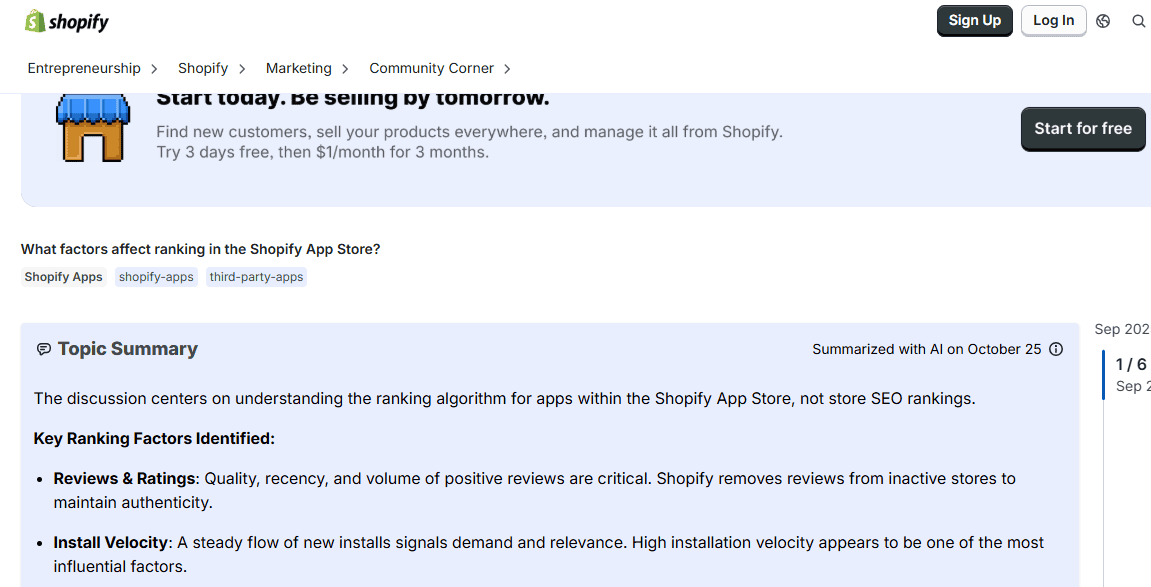
The forums tell a story that press releases do not. In Shopify’s own developer community forum18, a thread from September 2025 asking about App Store ranking factors attracted dozens of developers sharing what they had observed. The consensus was that reviews, install counts, and retention were the dominant signals, but that the opacity of the algorithm made it impossible to optimize with confidence. Developers reported seeing rankings shift dramatically without a clear explanation, and noted that Shopify’s own guidance offered little more than advice to “build a great app,” which is true as far as it goes, but provides no map of the actual terrain.
A Hacker News thread about the economics of the Shopify App Store captured a different flavor of concern. One commenter wrote:
“I suspect that the major players negotiate exceptions. I don’t for a second believe that the large companies you see on the Shopify App Store pay their 20% cut. They would never agree to that.”
There is no public evidence that Shopify offers differential revenue-sharing to large developers, and the official policy is a uniform 15 percent above the first million dollars in revenue. But the perception that large players operate under different rules than small ones is itself a symptom of the opacity that erodes trust.
On Indie Hackers19, a community for independent software entrepreneurs, discussions about the Shopify ecosystem frequently circle back to platform risk. One developer noted that the closest historical parallel was Microsoft’s history with third-party developers on Windows, where the operating system’s owner periodically absorbed popular third-party functionality into the native product. The lesson from that era was not that building on Microsoft was a mistake, but that any business built entirely on top of someone else’s platform was vulnerable in ways that businesses built on open infrastructure were not. Shopify’s tightly managed ecosystem is the opposite of open infrastructure.
The fake review problem adds another dimension. In 2020, developer Johnathan Winder documented on Medium20 how easy it was to climb the App Store rankings by purchasing fake five-star reviews on Fiverr. He tracked one app that posted 80 reviews over ten days and jumped from rank 231 to rank 62. He reported the exploit to Shopify repeatedly. The response was inadequate. The underlying problem, that the algorithm places a heavy weight on review count and score, creates a powerful incentive for fraud. Legitimate developers who refuse to game the system face a structural disadvantage against those who do. And Shopify, as the platform governing the review system, has both the responsibility and the tools to address this more aggressively than it has.
The Economics of a Crowded Marketplace
The sheer size of the marketplace is itself part of the problem. There are over 11,900 apps in the store as of late 2024, according to Uptek’s21 analysis of App Store statistics, after a pruning that removed around 8 percent of apps following quality reviews. Eighty-two new apps are added every month. At the time of writing, the most-installed free app on the platform is Shopify Inbox, Shopify’s own native customer support tool, installed on over 388,000 stores. The data on which apps dominate is revealing: when you are the platform, you can distribute your own app to nearly every merchant, by default, without competing for rankings.
The business mathematics for independent developers is correspondingly brutal. Development costs range from $5,000 for basic apps to over $75,000 for complex features, plus $6,000 to $30,000 in annual maintenance. With median app pricing at just $4 per month and average pricing at $19 per month, the payback period on development costs is measured in years, not months. And during those years, the developer must battle for ranking visibility against incumbents with thousands of reviews, against venture-backed competitors spending aggressively on growth, and, increasingly, against Shopify’s own native tools.
The email marketing category is instructive. Klaviyo dominates the category and has Shopify’s visible backing, having raised a $200 million Series C and eventually gone public. Smaller email marketing developers must compete against Klaviyo’s scale, against Mailchimp’s brand recognition, and against Shopify Email, which is free and deeply integrated. The category is not crowded with opportunity. It is crowded with competition at multiple tiers, and the structural advantages flow upward.
The Shopify Plus Certified App Program, launched in 2023, creates yet another tier within the ecosystem. Apps certified for Plus merchants gain access to the most valuable merchant segment but face additional requirements and scrutiny. As one analysis at Fabrikatör22 noted, app preferences vary significantly between standard Shopify and Plus stores, and competition differs by country. The Plus certification is another gateway controlled by Shopify, another filter through which independent developers must pass to reach the premium segment of the market.
The Defense of the System
Fairness demands engaging with the counterargument. Shopify has done things that genuine bad actors do not do. In 2021, according to TechCrunch23, the company cut its commission on the first million dollars in developer revenue to zero, matching and in some ways exceeding similar moves by Apple and Google. For small and independent developers, that is a real financial benefit. A developer generating $800,000 in annual app revenue keeps all of it, which is not nothing when you consider that Apple and Google were both collecting 30 percent before regulatory pressure forced them to reduce that cut.
The Built for Shopify program, for all its exclusivity, sets clear technical standards that the vast majority of apps in the store do not meet. Those standards are available to any developer willing to do the work. The fact that they are demanding is not inherently unfair: slow-loading, insecure, or poorly-integrated apps genuinely harm merchants. A certification that elevates apps meeting quality thresholds is not the same thing as a certification that elevates Shopify’s own apps.
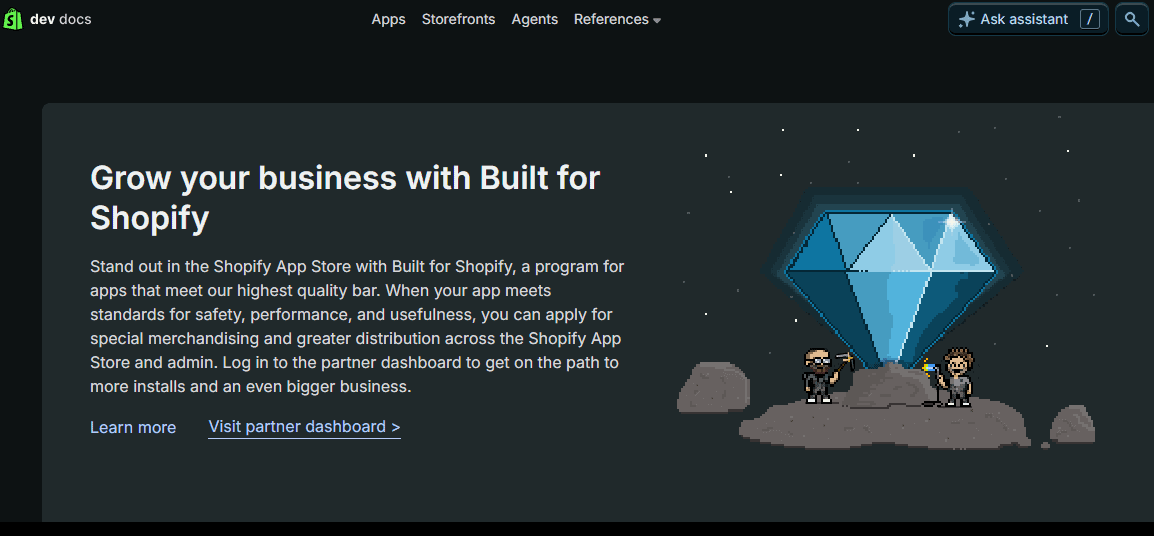
Shopify’s argument, when pressed, is essentially that the platform is the product. The merchant experience is what drives the entire ecosystem. When merchants succeed, developers succeed. If a first-party app serves merchants better than a third-party alternative in a given category, the merchant-first logic dictates that the better tool should win. The company has also been transparent about the BFS criteria in its developer documentation, listing actionable standards rather than vague quality claims. Any developer who meets those standards is eligible, regardless of whether Shopify built the app or an independent team in a different country did.
And the ecosystem has produced real wealth. App developers collectively earned more than $1.5 billion since the App Store’s inception, with Shopify paying out $1 billion in 2024 alone. Companies like Klaviyo, Gorgias, and Yotpo built significant independent businesses on the foundation of Shopify’s merchant base. The platform genuinely enabled a developer economy that did not exist before Shopify created it. That is a legitimate point in Shopify’s favor, and it should not be dismissed.
The Problem with Legitimacy
But here is the thing about legitimate defenses of a system: they do not make the structural tensions disappear. They make them more interesting.
The BFS program may well elevate quality. It also happens to create a two-tier marketplace where a small number of certified apps receive ranking benefits that uncertified apps do not. When you are the entity that decides what “quality” means, that defines the criteria for certification, and that administers the certification process while also competing in the same market, the fact that the criteria are published does not fully resolve the conflict. The criteria themselves can embed preferences, consciously or not, that favor certain development approaches over others. And the question of who designed the criteria, and whose interests shaped them, is not a question that Shopify’s documentation answers.
The investment in selected developers is perhaps the most structurally problematic element of all, precisely because it is dressed in the language of partnership. When Shopify invests in Loop Returns and then co-develops APIs with Loop, the result is a developer with privileged access to the platform architecture that its competitors do not have. The other developers in the returns management category are not wrong to feel disadvantaged. They are disadvantaged, by design, because Shopify chose to invest in one of them and not the others. That is not a neutral act. It is a competitive choice, made by the platform, that shapes the market the platform is supposed to be governing impartially.
The acquisition of Checkout Blocks is, similarly, not simply a product decision. It is a market decision. When the platform acquires a popular app and makes it free, it removes a revenue opportunity from every developer who was building competing products in that space. The message sent to the developer community is clear: if you build something good enough, Shopify may buy it. If you build something adjacent to what Shopify wants to build, you may find yourself competing against a free native version of your own product.
This is not a criticism unique to Shopify. Amazon does the same thing. Apple does the same thing. Google does the same thing. The pattern of platform operators entering markets pioneered by third-party developers is so well-documented in the technology industry that it has acquired a nickname: the “kill zone”, the category near a dominant platform where rational investors and developers hesitate to build because the risk of platform competition is too high. The question is not whether Shopify is the only company doing this, but whether the developers building on Shopify understand the game they are playing.
What Developers Can Do
This is the part of the story where most investigative pieces pivot to recommendations, and I am going to offer some, while being honest that they are imperfect.
The most important strategic move for any independent Shopify developer is to build for multiple platforms simultaneously. According to DigiDay24, Big Commerce has roughly 900 apps in its ecosystem; WooCommerce has hundreds more. The merchants using those platforms have many of the same needs as Shopify merchants. Building cross-platform from the start means that no single platform’s decisions about ranking or certification can threaten your entire business. The developers who said they were “considering speeding up plans to expand their offerings to Shopify’s competitors” were not being naively optimistic. They were applying sensible risk management.
The BFS certification, whatever its limitations as a ranking signal, is worth pursuing. Not because the ranking boost is guaranteed, but because the process of achieving it forces engineering discipline that tends to make apps genuinely better. Movsumov’s experience was that keyword rankings did not improve dramatically, but Google search rankings did, and the app earned credibility in the developer community. Those are real benefits, even if they differ from Shopify’s marketing claims.
Building in categories where Shopify is unlikely to compete is also rational, even if the category of “things Shopify will not eventually want to own” keeps shrinking. Highly specialized vertical apps, deeply technical integrations, and niche tools for specific merchant segments are less attractive acquisition targets than broadly applicable categories like email, reviews, or customer support.
And the community matters. The Shopify Partners25 Slack Community, developer forums, and events like EcommerceTech.io are where real information about platform changes and ranking shifts circulates before it makes it into official documentation. In a system with opaque rules, informal intelligence networks are not just useful. They are essential.
The Larger Reckoning
The question at the center of this story is not whether Shopify is evil. It is not. The question is whether a company that is simultaneously a marketplace operator, an app developer, a venture investor, a certification authority, and an acquisition entity can govern its own market fairly. The answer is that the incentives are badly aligned, and good intentions are not a substitute for structural safeguards.
The EU’s Digital Markets Act offers one template for what those safeguards might look like: prohibiting self-preferencing, requiring transparent ranking criteria, and mandating data portability. It was not written with Shopify in mind, but its principles apply. The Sezzle lawsuit against Shopify may force the question into US courts. Regulatory attention tends to follow market concentration, and Shopify’s 30 percent share of the US ecommerce software market is a concentration that eventually draws scrutiny.
The developer who wrote that “the love gone a little bit” was not predicting Shopify’s downfall. He was describing an emotional shift that often precedes a strategic one. When the independent developers who built the ecosystem begin to hedge their bets, diversify their platforms, and treat Shopify as a channel rather than a home, the ecosystem becomes less innovative, less diverse, and ultimately less valuable, for merchants, for Shopify, and for the developers themselves.
The house may always win on any given hand. But the smart money watches whether the other players keep sitting down at the table. If Shopify wants to keep the best developers in the room, it may need to give them a better reason to believe the game is fair.
Sources
- Boonzaaijer, Ruben. “50 Shopify store statistics and trends for 2026” Ringly.io, 21 Mar. 2026, www.ringly.io/blog/shopify-store-statistics-2026. Accessed 24 Mar. 2026. ↩︎
- Popular FinTech, www.popularfintech.com/p/shopify-s-second-act-b9a4b83c5ae30642. Accessed 24 Mar. 2026. ↩︎
- Paula, Tess De. “Search Improvements on the Shopify App Store” Shopify, www.shopify.com/partners/blog/search-improvements. Accessed 24 Mar. 2026. ↩︎
- Medium, medium.com/@horoscopesapi/shopify-app-store-ranking-algorithm-exploit-1d2e580919de. Accessed 24 Mar. 2026. ↩︎
- Team, Market Clarity. “How Much Money Can You Make With Shopify Apps in 2025?” Market Clarity, 30 Sept. 2025, mktclarity.com/blogs/news/shopify-app-make-money. Accessed 24 Mar. 2026. ↩︎
- TrustPilot, www.trustpilot.com/review/www.shopify.com. Accessed 24 Mar. 2026. ↩︎
- “About Built for Shopify” Shopify, shopify.dev/docs/apps/launch/built-for-shopify. Accessed 24 Mar. 2026. ↩︎
- Paula, Tess De. “Built for Shopify: A New Way to Shine” Shopify, www.shopify.com/partners/blog/built-for-shopify. Accessed 24 Mar. 2026. ↩︎
- “Built for Shopify: What It Means and Why Toki Earned the Badge” Toki – Shopify Loyalty App, www.buildwithtoki.com/blog-post/built-for-shopify-what-it-means-and-why-toki-earned-the-badge. Accessed 24 Mar. 2026. ↩︎
- Medium, faridmovsumov.medium.com/is-built-for-shopify-worth-it-418b323be0d4. Accessed 24 Mar. 2026. ↩︎
- Leteyski, Ruslan. “Why I’m leaving the Shopify Apps business” Leteyski’s blog, 10 Apr. 2023, blog.leteyski.com/p/why-im-leaving-the-shopify-apps-business. Accessed 24 Mar. 2026. ↩︎
- Ahmed, Junaid. “Shopify App Store Statistics 2026: What the Numbers Show” Uptek, 4 Mar. 2026, uptek.com/shopify-statistics/app-store/. Accessed 24 Mar. 2026. ↩︎
- Forristal, Lauren. “Shopify acquires Checkout Blocks, a checkout customization app” TechCrunch, 3 June 2024, techcrunch.com/2024/06/03/shopify-checkout-blocks-acquisition/. Accessed 24 Mar. 2026. ↩︎
- Bednar, Vass. “🔍 Digital Marketplaces” Regs To Riches, 13 July 2021, www.regs2riches.com/p/-digital-marketplaces. Accessed 24 Mar. 2026. ↩︎
- Law 360, www.alston.com/en/insights/publications/2026/01/shopify-suit-is-an-early-antitrust-test. Accessed 24 Mar. 2026. ↩︎
- Hemmadi, Murad. “Shopify’s app store is its secret weapon. Now it’s investing millions in some developers. What about the rest?” The Logic, 29 Nov. 2022, thelogic.co/news/the-big-read/shopifys-app-store-is-its-secret-weapon-now-its-investing-millions-in-some-developers-what-about-the-rest/. Accessed 24 Mar. 2026. ↩︎
- Raghavan, Rithesh. “How Shopify’s App Store Shapes the Future of Custom eCommerce” 5 Nov. 2025, acowebs.com/shopify-shapes-future-custom-ecommerce/. Accessed 24 Mar. 2026. ↩︎
- “What factors affect ranking in the Shopify App Store?” 3 Sept. 2025, community.shopify.com/t/what-factors-affect-ranking-in-the-shopify-app-store/563020. Accessed 24 Mar. 2026. ↩︎
- Terault, Mark. “Shopify app ecosystem about to see an upheaval (why I’m getting into app development)” Indie Hackers, 16 Mar. 2023, www.indiehackers.com/post/shopify-app-ecosystem-about-to-see-an-upheaval-why-i-m-getting-into-app-development-2b1f8a000f. Accessed 24 Mar. 2026. ↩︎
- Medium, medium.com/@horoscopesapi/shopify-app-store-ranking-algorithm-exploit-1d2e580919de. Accessed 24 Mar. 2026. ↩︎
- Ahmed, Junaid. “Shopify App Store Statistics 2026: What the Numbers Show” Uptek, 4 Mar. 2026, uptek.com/shopify-statistics/app-store/. Accessed 24 Mar. 2026. ↩︎
- “Shopify’s Growth Fuels Opportunities for Ecosystem Partners” Fabrikator IO Information Technologies UG, 13 Oct. 2025, www.fabrikator.io/pr/shopifys-growth-fuels-opportunities-for-ecosystem-partners. Accessed 24 Mar. 2026. ↩︎
- Perez, Sarah. “Shopify drops its App Store commissions to 0% on developers’ first million in revenue” TechCrunch, 29 June 2021, techcrunch.com/2021/06/29/shopify-drops-its-app-store-commissions-to-0-on-developers-first-million-in-revenue/. Accessed 24 Mar. 2026. ↩︎
- Wheless, Erika. “‘Developers have what they need’: How Shopify’s app ecosystem boosted its core business” 10 Mar. 2021, digiday.com/marketing/how-shopifys-app-ecosystem-boosted-its-core-business/. Accessed 24 Mar. 2026. ↩︎
- Lindberg, Oliver. “7 Shopify Development Trends You Need to Consider in 2023” Shopify, www.shopify.com/partners/blog/development-trends-2023. Accessed 24 Mar. 2026. ↩︎