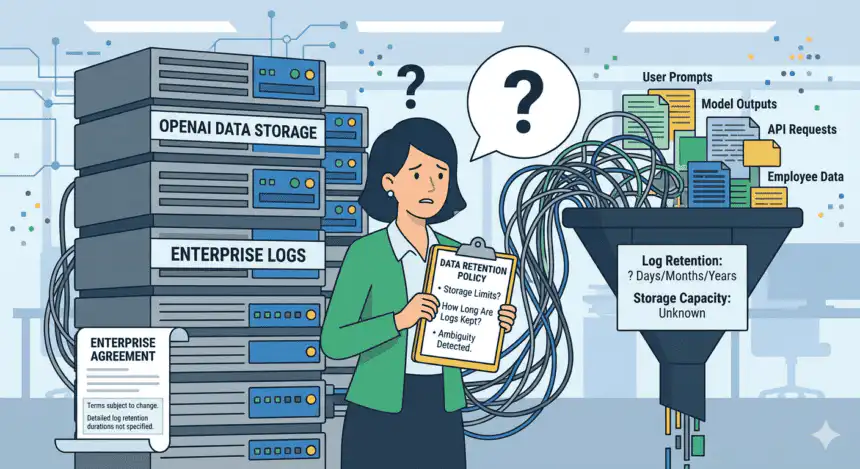

There is a sentence buried inside OpenAI’s developer documentation that most enterprise customers will never find unless they know to look for it. It sits inside a technical table listing API endpoints and their data-handling properties, and it reads something like this: “Zero Data Retention ineligible endpoints or capabilities may still store application state, even if Zero Data Retention is enabled.”
- The Default Nobody Told You About
- Zero Data Retention: A Premium Feature You Have to Ask For, Then Wait For
- The Azure Problem: A Separate, Slower, More Opaque Process
- The 2025 Court Order: When “Deleted” Did Not Mean Deleted
- Third-Party Tracking: The Layer Nobody Discussed in the Sales Pitch
- The Compliance Logs Gap
- What Enterprise Customers Actually Need to Know
- The Trust Deficit Is Structural
Read that again. Even if you paid for zero data retention, certain parts of your data are still being stored.
That is the story I keep coming back to when I look at how OpenAI markets its enterprise data controls versus how they actually work in practice. The company has a formidable PR machine that pushes out phrases like “you own your data,” “we don’t train on your business data,” and “you control how long data is retained.” But the details inside the actual policy documents, the developer docs, the forum complaints, and the litigation filings tell a more layered, more uncomfortable story.
I spent time reading through OpenAI’s enterprise privacy pages, its data controls documentation, its Data Processing Addendum, and the court filings from the ongoing New York Times copyright case. I also looked at hundreds of posts across the OpenAI developer community forums and Microsoft’s own Q&A boards, where enterprise engineers express genuine confusion about what OpenAI actually stores, for how long, and under what conditions. What I found paints a picture of a company whose public-facing promises are technically accurate but operationally ambiguous, a gap that costs enterprises real risk every single day.
The Default Nobody Told You About
Let me start with the baseline because most enterprise customers get this wrong.
When you build a product on top of the OpenAI API, your data does not automatically vanish after the conversation ends. According to Medium1, by default, OpenAI retains API inputs and outputs for up to 30 days for abuse monitoring. That 30-day window is an operational default, not a setting you chose. You are logged in by default. Your prompts are sitting in OpenAI’s systems, whether you asked for that or not.
This matters enormously in practice. A startup building a healthcare assistant, a law firm automating document review, a financial services company querying earnings data. All of these organizations are sending sensitive prompts into OpenAI’s infrastructure, and all of them are, unless they’ve gone through a specific approval process, having that data stored for a month.
The question I’d ask any enterprise buyer is: Did your sales representative tell you this on the first call? Because for most companies, the answer is no. The discovery usually comes later, buried inside a conversation with a compliance officer or a security engineer who started reading the actual policy documents.
Security operations professionals who track this space have flagged the same gap. As quoted in Huntress2 Blog, Dray Agha, Security Operations Manager at Huntress, put it:
“OpenAI privacy policy states that content you submit can be used to improve its models unless you opt out through settings. Users can disable chat history or request exclusion from training, but most don’t realize they need to take those steps.”
Most don’t realize. That’s the key phrase. The opt-out exists. The default is the problem.
Zero Data Retention: A Premium Feature You Have to Ask For, Then Wait For
OpenAI offers something called Zero Data Retention, or ZDR. Under ZDR, any data processed by OpenAI is not stored beyond what is immediately needed. Prompts and completions are used to fulfill the task and then deleted. They are never saved to logs and never seen by human reviewers.
This sounds like exactly what a regulated enterprise would want. And it is, which is precisely why OpenAI treats it as a premium offering rather than a standard setting.
ZDR is not the default for standard API access and normally requires qualifying enterprise arrangements or sales engagement. It is a gated capability. You have to request it. You have to be approved for it. And according to the developer community forums, the path to approval is anything but transparent.
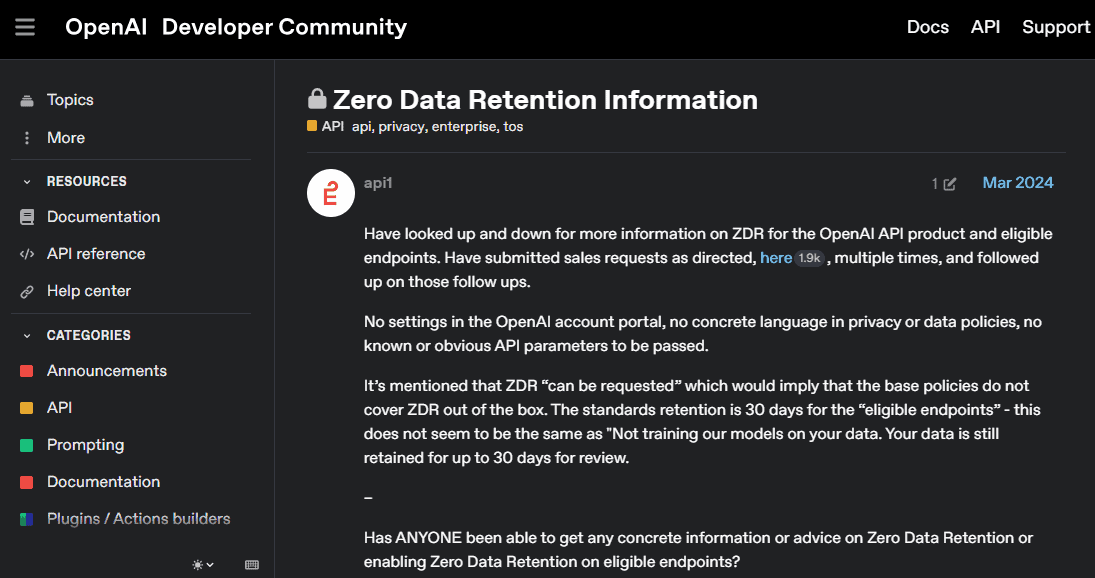
One post on the OpenAI Developer Community forum3 from March 2024 captures the frustration well. The developer wrote:
“Have looked up and down for more information on ZDR for the OpenAI API product and eligible endpoints. Have submitted sales requests as directed, here, multiple times, and followed up on those follow-ups. No settings in the OpenAI account portal, no concrete language in privacy or data policies, no known or obvious API parameters to be passed.”
This was not a fringe complaint. The thread attracted dozens of responses from engineers in similar positions, all trying to navigate an approval process that had no visible entry point in the product interface, no clear timeline, and no self-serve option.
Once you do get approved, there is another wrinkle. The ZDR designation does not automatically cover every endpoint or every feature you might use. OpenAI’s own documentation4 notes that certain endpoints are not “ZDR eligible,” and warns that they may store application state even if ZDR is enabled for your organization. So you can have ZDR turned on and still be generating persistent data through ineligible endpoints, and the documentation assumes you know to cross-reference that technical table against your integration architecture.
Specific carve-outs include audio outputs, which are stored for one hour to enable multi-turn conversations. Extended prompt caching stores key-value tensors to GPU-local storage. Background mode stores response data for roughly 10 minutes to enable polling and is not compatible with Zero Data Retention, even though the background=true flag is still accepted for legacy ZDR keys. The Code Interpreter tool cannot be used at all when ZDR is enabled.
Read that last one again. If your enterprise workflow uses Code Interpreter, you are forced to choose between the tool and your data protection guarantee. That is not a footnote. That is a fundamental trade-off that should be disclosed in every sales conversation with a regulated enterprise customer.
The Azure Problem: A Separate, Slower, More Opaque Process
If you are running OpenAI models through Azure, which many enterprises do for integration reasons or existing Microsoft licensing arrangements, you face a parallel and in some ways more opaque version of the same problem.
A February 2025 exchange on Microsoft’s own Q&A platform5 showed an enterprise developer who had found that the Azure OpenAI privacy documentation used to explicitly state that all prompts and generated content were stored securely for up to 30 days. Then, that sentence was simply removed from the documentation. No announcement. No replacement. The developer wrote, with evident frustration:
“I don’t mean to be difficult, I’m honestly just confused.”
The response from Microsoft’s documentation team? They escalated to the internal documentation team and promised more details. That kind of answer does not help a compliance officer trying to write a GDPR impact assessment on a Tuesday afternoon.
On Azure, ZDR is not a self-service portal setting. It is a gated capability that requires Microsoft approval and is only available to customers on an Enterprise Agreement or Microsoft Customer Agreement. It is not available for Pay-As-You-Go subscriptions. That means a startup or a small organization using Azure OpenAI on a pay-as-you-go basis has no path to ZDR at all, regardless of the sensitivity of the data they’re sending through the API.
And it gets more granular still. Once approval is granted, the Modified Access Review team determines whether a deployment receives full ZDR or partial ZDR, but the approval notification typically does not explicitly state which category was granted. You receive confirmation that ZDR was approved, not confirmation of what that approval actually covers. To find out, you have to contact your Microsoft account manager, who then contacts the MAR review team directly. The answer is not visible in any portal, any CLI output, or any configuration interface.
For a Microsoft Q&A response from late 2025 to describe this as the only “authoritative source” for a detail this important to enterprise compliance is remarkable. It means the governance structure of a company’s AI data handling can hinge on a phone call with a sales contact.
The 2025 Court Order: When “Deleted” Did Not Mean Deleted
The ambiguity in OpenAI’s data retention practices stopped being theoretical in May 2025. That month, U.S. Magistrate Judge Ona T. Wang, in the Southern District of New York, issued an order compelling OpenAI to “preserve and segregate all output log data that would otherwise be deleted on a going forward basis until further order of the Court”. The order stemmed from the ongoing copyright lawsuit brought by The New York Times and other publishers who alleged that ChatGPT was trained on and was reproducing their copyrighted content.
The implications of this order were immediate and significant. Users who had deleted conversations under the expectation that OpenAI would purge them from its systems within 30 days. Exactly as the company’s standard policies promised, they learned that those conversations had been preserved by court order. According to Magai6, the order required OpenAI to maintain all existing ChatGPT logs, including those users believed were permanently deleted under the company’s standard 30-day deletion policy.
OpenAI appealed. OpenAI’s COO Brad Lightcap called it a sweeping and unnecessary demand that “fundamentally conflicts with the privacy commitments we have made to our users.” Sam Altman posted on social media that the ruling set a bad precedent and compromised user privacy. And legally, they may well be right that the order was overcautious or overbroad. But none of that changes the core fact that millions of users discovered, in the middle of 2025, that OpenAI was storing data they had assumed was gone.
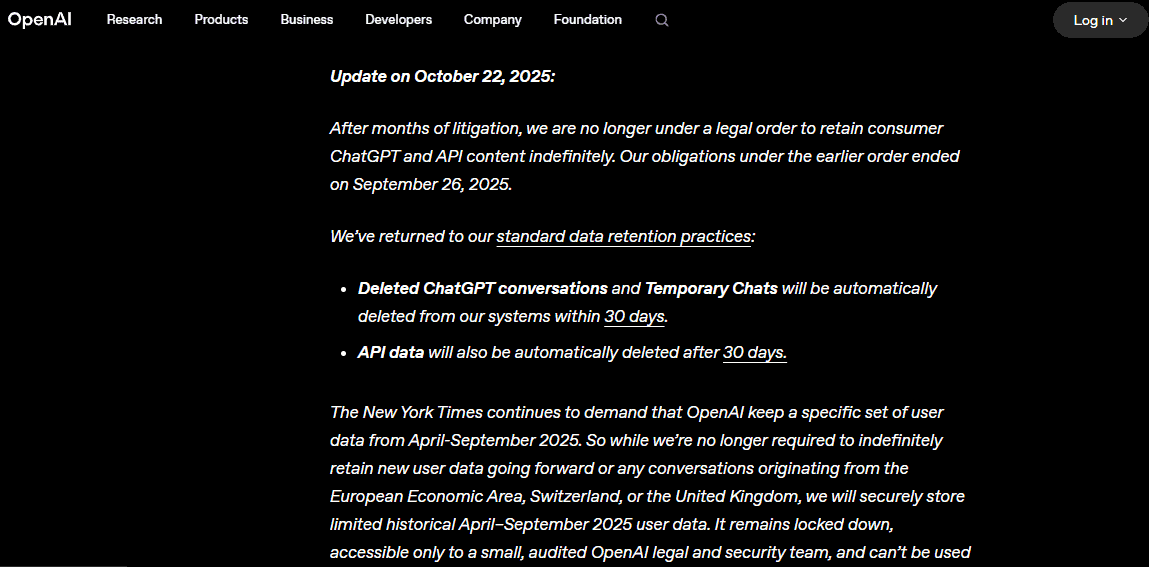
The order was eventually lifted in late September 2025. After months of litigation, OpenAI7 returned to its standard data retention practices, with deleted conversations and temporary chats scheduled for removal within 30 days and API data also deleted after 30 days. But conversations from the April through September 2025 window remain in secure storage pending the ongoing litigation.
Then, in November 2025, a further discovery order came down. According to Bloomberg Law News8, the U.S. District Judge Sidney Stein affirmed a ruling compelling OpenAI to produce 20 million de-identified ChatGPT logs to the news plaintiffs and class plaintiffs. That ruling confirmed what the entire episode had been quietly establishing: OpenAI was storing tens of billions of conversation logs, not just the 30-day rolling window its policies described. The 30-day figure, it turned out, was a policy floor for deletion, not a description of the actual log architecture.
Judge Stein acknowledged that ChatGPT users have what he called “sincere” privacy interests. But he found those interests outweighed by the needs of litigation, noting that ChatGPT users, unlike wiretap subjects, had “voluntarily submitted their communications” to OpenAI. That distinction matters enormously. When you send a prompt to ChatGPT, you are not having a private conversation. You are voluntarily disclosing information to a third-party commercial service, and courts will treat it that way.
Enterprise customers need to understand that the legal protections on their data do not derive from OpenAI’s privacy promises alone. They derive from the contractual instruments they have in place, specifically Data Processing Addenda and Zero Data Retention agreements that establish retention limits as contractual obligations, not just policy defaults. Without those documents, your organization’s data is subject to the same litigation dynamics that played out in the NYT case.
Third-Party Tracking: The Layer Nobody Discussed in the Sales Pitch
In May 2026, a fresh class-action complaint was filed in the Southern District of California adding another dimension to the data story. According to Cybersecurity News9, the lawsuit alleged that OpenAI had quietly embedded Meta’s Facebook Pixel and Google Analytics tracking scripts into the ChatGPT web interface, and that these scripts were transmitting user interaction data — including hashed email addresses, cookies, and browser-tab titles derived from query content — to Meta and Google in real time.
The complaint is still unproven in court, and some legal observers have characterized it as a stretch of California’s 1967 Invasion of Privacy Act into territory it was never designed to cover. But the underlying technical allegation is not speculative. It is based on network trace captures showing specific cookie values and payload structures being transmitted to third-party servers.
For enterprise customers, this allegation, if proven, describes a parallel data channel that exists entirely outside the scope of OpenAI’s enterprise privacy page, its Data Processing Addendum, and any Zero Data Retention agreement. A ZDR agreement governs what OpenAI stores on its own infrastructure. It says nothing about what analytics tags embedded in a web application might be sending to advertising platforms in the background. These are architecturally different systems operating under entirely different legal frameworks.
The irony is that OpenAI’s own privacy policy, as one security lawyer quoted in Cybernews10 coverage of the case noted, does disclose that it shares information with third parties including advertising partners. But disclosure buried inside a privacy policy that most enterprise IT buyers never read in full is not the same as transparency. It is the difference between something being technically disclosed and something being practically known.
The Compliance Logs Gap
One of the most under-discussed elements of OpenAI’s enterprise data architecture is its Compliance Logs Platform, a feature available to Enterprise and Edu customers that provides audit-trail data for compliance purposes.
According to OpenAI’s help documentation11 for the Compliance Platform, this platform retains data for only 30 days. The documentation states clearly:
“If longer retention is desired then consumers should implement a system to continuously download all logs and retain them according to their policies. Deleted data is not recoverable.”
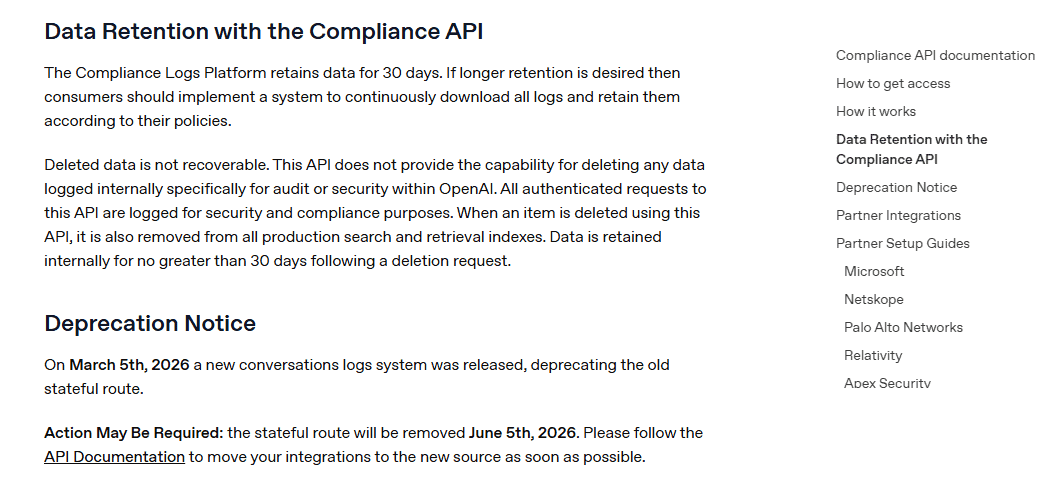
This is an important and often-missed operational constraint. Enterprise organizations that need to meet regulatory audit requirements, GDPR record-keeping obligations, HIPAA accountability rules, or SOC 2 control requirements often need conversation-level logs that go back 12 months or more. OpenAI’s built-in compliance tooling does not provide that. You have to build your own pipeline to download logs continuously and store them elsewhere. That is an engineering cost that appears nowhere in the product pricing but is a real infrastructure requirement for regulated industries.
And here is where it gets philosophically tangled: you are being asked to keep your own copies of data that OpenAI is simultaneously promising to delete after 30 days on its side. The customer has to maintain what the vendor is erasing. That is a coherent architecture, but it is one that requires a level of technical planning that most mid-market enterprise buyers are not equipped for when they first sign an OpenAI contract.
What Enterprise Customers Actually Need to Know
The pattern across all of these issues is the same. OpenAI’s enterprise privacy controls are real, but they are not automatic. They require active steps, specific approvals, contractual instruments, and in some cases architectural decisions about which API endpoints and features are used. The default state for any new enterprise customer is a data-handling arrangement that most compliance teams would not have approved if it had been described plainly in the sales pitch.
Here is the practical checklist that any enterprise customer should work through before deploying OpenAI in a regulated environment.
Every enterprise engagement should include a signed Data Processing Addendum. OpenAI12 offers one, and it aligns with GDPR, CCPA, and other major privacy frameworks, but it must be explicitly executed. It does not apply automatically on account creation.
Zero Data Retention must be requested and approved. It is not a self-serve toggle. The process involves contacting the OpenAI sales team, being evaluated for eligibility, and waiting for explicit approval. Only then does the Data Retention tab appear inside your organization settings. This can take weeks.
ZDR does not cover all endpoints. After approval, you must cross-reference your integration architecture against OpenAI’s endpoint eligibility table to identify any features that remain outside ZDR scope. This includes audio outputs, extended prompt caching, background mode, and Code Interpreter.
Legal holds can override contractual deletion timelines. The NYT litigation demonstrated that OpenAI’s own 30-day deletion promise can be superseded by court order. Your contractual ZDR agreement is more durable, since the court in the NYT case explicitly exempted ZDR customers from its preservation order, but standard enterprise customers operating under the default 30-day window have no such protection.
The Compliance Logs Platform has a 30-day ceiling. If your regulatory obligations require longer audit trails, you need to build and operate your own log-export pipeline. This is a material engineering cost that should appear in any honest cost-benefit analysis of an enterprise deployment.
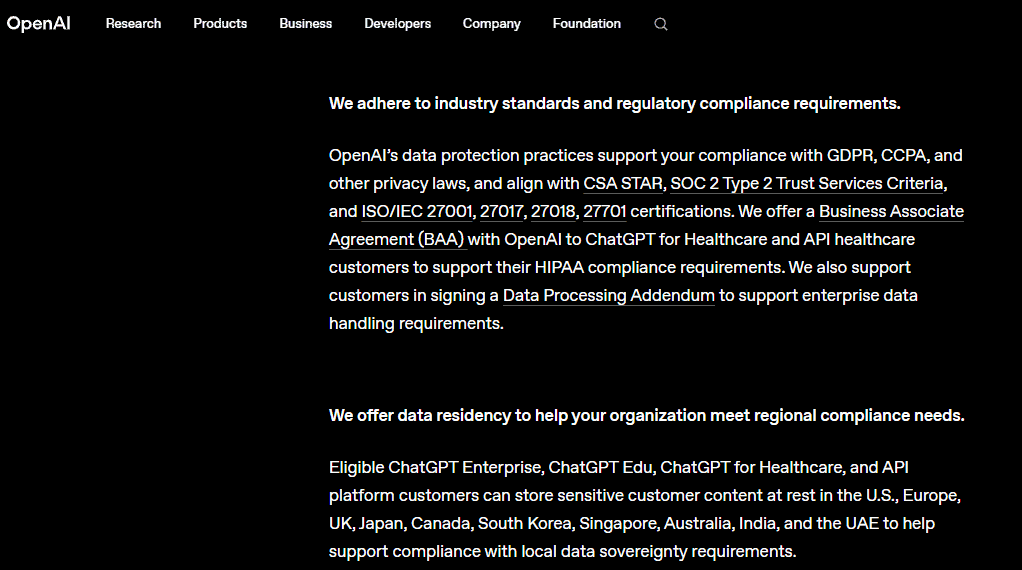
Data residency is available but must be configured. OpenAI13 does offer data residency options for eligible Enterprise and API customers across a range of regions including the US, Europe, UK, Japan, and several others. But residency controls must be set at the project level and require eligible status. They are not applied by geography by default.
The Trust Deficit Is Structural
What strikes me most about all of this is not that OpenAI is being malicious. The company clearly has invested in enterprise compliance infrastructure. SOC 2 Type 2, ISO 27001, GDPR Data Processing Addenda. These are real certifications that reflect real work. The issue is architectural, not intentional.
OpenAI built a consumer product first, then layered enterprise controls on top of it. The consumer architecture is built for engagement, continuity, and feature richness: stored conversations, memory, multi-device synchronization. The enterprise controls are overlays on that architecture, not replacements for it. So when you enable ZDR, you’re not switching to a purpose-built enterprise data pipeline. You’re disabling specific storage behaviors within a system that was fundamentally designed to retain.
That distinction matters because it means the default always pulls toward retention, and every privacy protection requires deliberate configuration to activate. The burden is on the customer to know what to ask for and how to ask for it. The burden should be on the vendor to configure for minimum retention by default and require explicit opt-in for the data collection that benefits the vendor’s interests.
This is not a new problem in enterprise software. Cloud providers have navigated similar tensions for 20 years. But AI tools are different in one important way: the data being sent through them is qualitatively more sensitive than most enterprise software traffic. People use ChatGPT Enterprise to draft legal strategy documents, analyze confidential financial data, review HR decisions, and work through product roadmaps. The stakes of a retention ambiguity are higher than a cloud storage configuration error.
The Edelman Trust Barometer14 from 2025 found that only 32% of Americans trust AI. A separate Deloitte15 survey from late 2024 found that 90% of people want companies to do more to protect their personal data. These numbers exist in the same market that OpenAI is trying to sell enterprise contracts into. The gap between the privacy controls that exist and the privacy controls that are activated by default is exactly the gap that erodes that trust.
OpenAI would argue that the controls are there. And they are. But the question I keep coming back to is: what does a responsible vendor look like in a market where most customers don’t know what they need to ask for? The answer is a vendor that tells them, upfront, in plain language, before the contract is signed. Not in a footnote inside a developer documentation table. Not buried inside a ZDR eligibility matrix. At the top of the conversation, in the first sales call, in the onboarding checklist.
Until that happens, the gap between what enterprise customers are told and what they need to know will keep widening, one court order, one class action, one compliance audit at a time.
Sources
- Medium, medium.com/@jeffkessie50/openais-zero-data-retention-policy-916ff04a3599. Accessed 20 May 2026. ↩︎
- Marshall, Jason. “What the OpenAI Court Order Means for Cybersecurity and Privacy” Huntress, 1 July 2025, www.huntress.com/blog/openai-court-order-cybersecurity-privacy. Accessed 20 May 2026. ↩︎
- “Zero Data Retention Information” OpenAI Developer Community, 30 Mar. 2024, community.openai.com/t/zero-data-retention-information/702540. Accessed 20 May 2026. ↩︎
- OpenAI, platform.openai.com/docs/guides/your-data. Accessed 20 May 2026. ↩︎
- “Azure OpenAI Data Retention Privacy 2025” Microsoft Q&A, learn.microsoft.com/en-us/answers/questions/2181252/azure-openai-data-retention-privacy-2025. Accessed 20 May 2026. ↩︎
- Stout, Dustin W. “OpenAI’s Court-Ordered Data Retention: What It Means for AI Users and Why Magai Remains Your Privacy-First Choice” Magai, 19 June 2025, magai.co/openai-court-ordered-data-retention-policy/. Accessed 20 May 2026. ↩︎
- OpenAI, openai.com/index/response-to-nyt-data-demands/. Accessed 20 May 2026. ↩︎
- Jahner, Kyle. “OpenAI Must Turn Over 20 Million ChatGPT Logs, Judge Affirms” 5 Jan. 2026, news.bloomberglaw.com/ip-law/openai-must-turn-over-20-million-chatgpt-logs-judge-affirms. Accessed 21 May 2026. ↩︎
- Cybersecurity News, cybersecuritynews.com/openai-chatgpt-privacy-lawsuit/. Accessed 21 May 2026. ↩︎
- Cybernews, cybernews.com/ai-news/openai-chatgpt-privacy-lawsuit/. Accessed 21 May 2026. ↩︎
- OpenAI, help.openai.com/en/articles/9261474-openai-compliance-platform-for-enterprise-customers. Accessed 21 May 2026. ↩︎
- OpenAI, openai.com/policies/data-processing-addendum/. Accessed 21 May 2026. ↩︎
- OpenAi, openai.com/business-data/. Accessed 21 May 2026. ↩︎
- “The AI Trust Imperative: Navigating the Future with Confidence” 10 Mar. 2025, www.edelman.com/trust/2025/trust-barometer/report-tech-sector. Accessed 21 May 2026. ↩︎
- “New Deloitte Survey: Increasing Consumer Privacy and Security Concerns in the Generative AI Era – Press Release” Deloitte US, 2 Dec. 2024, www.deloitte.com/us/en/about/press-room/increasing-consumer-privacy-and-security-concerns-in-the-generative-ai-era.html. Accessed 21 May 2026. ↩︎