
There is a math that food delivery drivers know in their bones, even if they can’t always articulate it. You accept an order, drive three miles to a restaurant, wait ten minutes for the food, then drive six more miles to a customer who tips two dollars. You pocket maybe seven dollars before gas, before the wear on your transmission, before the forty minutes of your life that just passed. The app told you it would take twenty-two minutes. You knew better, and you took the order anyway, because the alternative was sitting in a parking lot earning nothing while the clock on your scheduled block ticked down.
This is life on Grubhub in 2025, and it is a life shaped as much by routing software and algorithmic sleight-of-hand as it is by traffic, weather, or the whims of tippers. The company, once the dominant name in American food delivery, has spent years watching its market share bleed out to DoorDash and Uber Eats while its own drivers complain about being sent on routes that make no financial sense, penalized for rejecting bad orders, and kept in the dark about the precise math behind their paychecks. The problems are structural; they compound each other, and they have now attracted the attention of federal regulators.
Understanding how Grubhub got here requires sitting with a few uncomfortable facts about how the gig economy actually works once you strip away the marketing language about “flexible entrepreneurship” and “being your own boss.”
What the Algorithm Knows (and Doesn’t Tell You)
Grubhub’s pay model1 is built on a formula that combines estimated delivery time, estimated mileage from restaurant to customer, and a tip the customer has already entered before you accept. The keyword there is “estimated.” The company pays based on what it predicts the route will take, not what it actually costs you in time and fuel. If traffic turns a twenty-minute delivery into forty, you eat the difference. If the app routes you through a dead-end neighborhood or sends you to a restaurant on the wrong side of a highway interchange, that is your problem too.
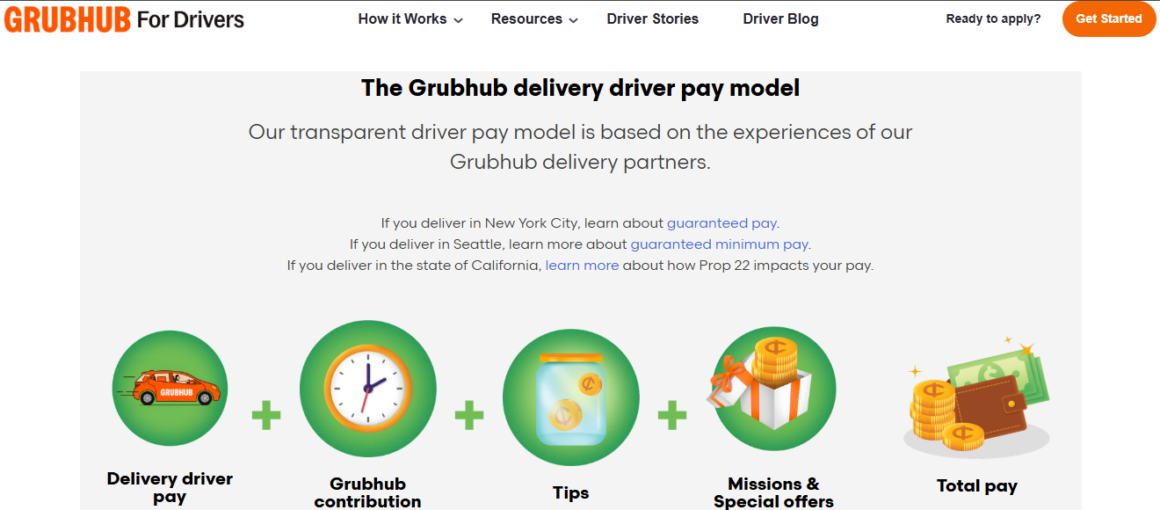
Grubhub’s pay model page used to give an example of paying 13 cents per minute and 22 cents per mile. But that example has since been taken down, and Grubhub no longer makes its total pay model transparent. The mileage rate visible in driver pay reports works out to roughly 23 cents per mile. The time component is never disclosed publicly. This opacity is not accidental. When a company stops showing you the math, it is usually because the math is not flattering.
Recurring driver feedback cites base offers as low as $2 to $3 per delivery, with heavy reliance on tips as the core of the pay model, making take-home pay volatile by shift and zone, forcing drivers to chase peak windows and high-tip areas to meet earnings expectations. An opaque algorithm driving volatile pay is not a bug in this system. It is the system.
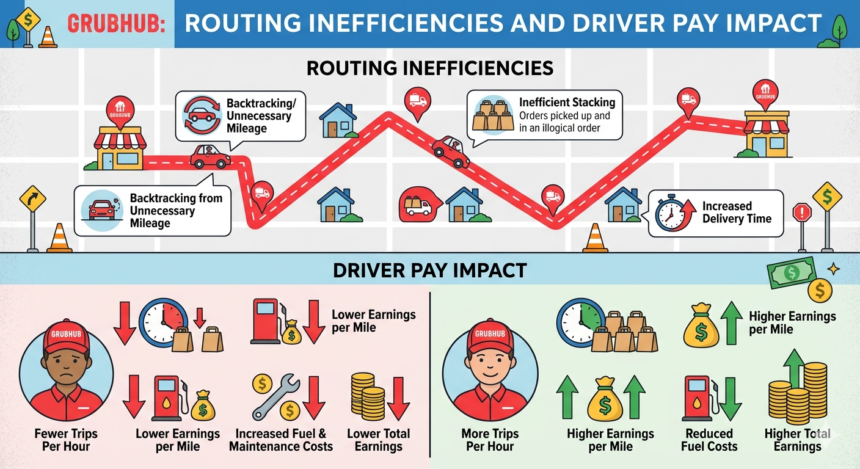
The routing problem is inseparable from the pay problem. When Grubhub dispatches a driver, it is solving what logistics researchers call the Meal Delivery Routing Problem, a real field of academic study. Georgia Tech researchers collaborated with Grubhub on this very problem for years, noting that it is complicated primarily by very tight service guarantees and only loosely controlled drivers who operate as individual contractors. That tension, between tight service guarantees and loosely controlled, independently operating drivers who have no obligation to accept any particular order, is the source of enormous inefficiency. The company is trying to optimize a supply chain in which the key workers can simply decline.
The result is a dispatch system that sometimes makes decisions that look rational from a platform perspective, optimizing for the fastest possible order completion across the whole market, while being deeply irrational from any individual driver’s perspective. Platforms can stack deliveries, routing a driver to complete several stops before reaching your order, producing long idle times. Drivers may accept multiple stacked orders, two pickups in the same plaza, for example, meaning your delivery is scheduled after the other drop. The driver earns the same either way. The customer waits longer. Nobody wins except the efficiency metric.
The Acceptance Rate Trap and the Numbers Nobody Advertises
Here is where things get genuinely predatory. Grubhub has built a penalty structure around order rejection that effectively forces drivers to accept unprofitable routes or face financial consequences that compound over time.
According to The Free-quent Flyer Blog2, to qualify for contribution pay, the platform’s safety net guarantee, drivers must maintain a 90% acceptance rate for the entire day the block falls on. Declining even one bad order can void contribution pay eligibility for the full day. This is a significant detail. It means that a driver on a four-hour scheduled block who declines one genuinely terrible order at 10 am, an order that would have lost them money on fuel alone, forfeits any safety-net pay for the entire day. The contribution pay guarantee exists precisely for slow periods, but accessing it requires accepting the kinds of orders that create slow, unprofitable periods.
Maintaining a high acceptance rate is the hardest metric to keep, because many drivers reject low-paying orders to protect their earnings, which pushes them into lower tiers. One driver with Premier status told an earnings tracker,
“I average $28 per hour compared to $21 per hour when I was Partner. The catering orders alone add $150 to $200 per week. But I have to accept almost everything, including $3 orders, to keep my rate above 85%.”
This is the acceptance rate trap in its purest form. To earn access to the lucrative catering orders and prime scheduling blocks, you must accept every $3 order that comes through, including the ones that send you on inefficient routes. Accepting bad orders keeps you eligible for good ones. The platform has designed a system in which your willingness to absorb losses is the price of admission for the best work.
Some drivers report getting caught in constant deliveries when acceptance rate is a concern, without the ability to pause availability. You cannot strategically wait for better offers without risking the tier status that makes those better offers available in the first place.
The headline pay figures for Grubhub look reasonable on paper. Base pay typically ranges from $3 to $7 before tips, depending on distance and complexity. Grubhub’s algorithm adjusts pay upward for longer deliveries and orders that have been declined by other drivers. According to Gridwise3, the median Grubhub driver earns $15.38 per hour in total trip pay, and tip earnings alone come to $8.46 per hour at the median.
But “per hour” in gig economy language is not what “per hour” means anywhere else. It means per hour of active delivery time, not per hour spent on the app. The driver who logs four hours but only has active deliveries for two of them earns against those two hours. Dead time, positioning drives, waiting for food to be prepared. None of that appears in the hourly calculation that Grubhub shows you.
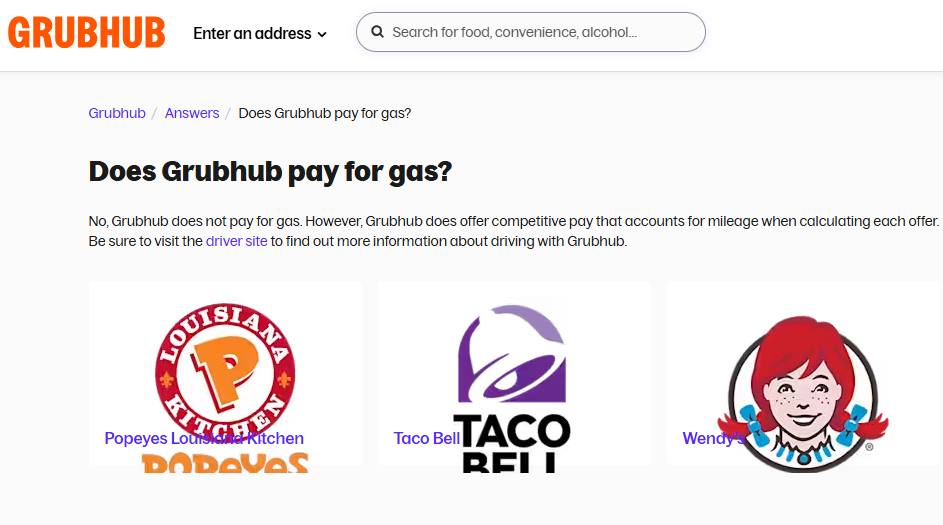
Then there are the costs. Grubhub4 does not directly reimburse drivers for gas, maintenance, or other vehicle-related expenses. The mileage component of base pay is intended to help offset these costs, but it is not a direct reimbursement. At 22 to 25 cents per mile from Grubhub’s mileage pay, against a real vehicle operating cost that AAA estimates at 17 to 22 cents per mile for fuel and maintenance combined on a mid-size sedan, the math leaves very little margin. And that is before insurance and depreciation, which can push per-mile vehicle costs considerably higher for drivers logging tens of thousands of miles annually.
The IRS5 recognized this in 2025 by setting its standard mileage deduction at 70 cents per mile for business driving, reflecting what it actually costs to operate a vehicle. Grubhub pays roughly a third of that. The gap between what the platform pays per mile and what it costs to drive that mile is a subsidy that every driver quietly provides to the platform on every order.
According to CBS News6, in 2023, the median Grubhub driver earned $11 per hour, and only the top 2% earned the hourly rates Grubhub advertised. It is a figure that surfaced in the FTC’s7 enforcement action. The company was advertising $26-per-hour earnings while its own data showed medians in the low double digits. This was not a rounding error. It was a recruiting tool.
The Federal Reckoning and the Relay Scheme
In December 2024, it all caught up with the company. The FTC8 and Illinois Attorney General Kwame Raoul charged that “Grubhub tricked its customers, deceived its drivers, and unfairly damaged the reputation and revenues of restaurants that did not partner with Grubhub. All in order to drive scale and accelerate growth,” FTC Chair Lina M. Khan said.
According to CNBC9, Grubhub agreed to pay $25 million of a $140 million judgment, which was partially suspended based on the company’s inability to pay the full amount. The settlement required the company to make substantial changes, including advertising driver earnings honestly and backing up any earnings claims with evidence. The judgment amount alone tells you something about the scale of the harm the agencies found. They sought $140 million. They accepted $25 million because that was apparently all the company could pay.
Grubhub agreed to only make driver earnings claims that are not misleading and that it can back up with evidence and in writing. The fact that a federal agency had to require a corporation to tell the truth in its job advertisements, under penalty of law, reflects how normalized the deception had become.
Even more revealing than the FTC case is what Grubhub was doing in New York City while federal investigators were closing in.
New York City10 passed a landmark law in 2021 guaranteeing app-based delivery workers a minimum hourly rate. The law initially required companies to pay delivery workers $17.96 an hour, raised to $19.96 in April 2025 and now $21.44 per hour, adjusted annually for inflation. This was a direct response to years of driver complaints about poverty-level earnings. DoorDash, Uber Eats, and Grubhub all fought the law, unsuccessfully suing the city to stop it.
When the legal fight failed, Grubhub took a different approach. In 2024, the company began outsourcing a percentage of its orders to Relay, another delivery app that operated under a court injunction exempting it from the city’s minimum wage requirements.
NYC Streetblog11 reported that Relay paid its private contractors just $13.35 per hour by October 2024, according to court filings, significantly below the $17.96 to $21.44 per hour required for standard app-based delivery workers during that period. The same work, carried out by different workers, paid six dollars less per hour because of which app dispatched the order.
The internal paper trail was damning. An internal email sent to Grubhub’s tech workers stated: “The partnership [with Relay] arises primarily to stem elevated driver pay costs in NYC, which have more than doubled since the new driver pay law was introduced.”
According to former Grubhub employees as noted by The New York Post12, 20 to 30 percent of orders were outsourced to Relay. An internal email said Grubhub expected to save 39 percent on the cost of each order sent to Relay, amounting to around $5 million annually.
The routing dimension of this is especially significant. Relay workers were sent on longer trips, further violating the city’s worker protection laws. Workers paid below the minimum wage were also being dispatched on less efficient routes, maximizing their miles and time while minimizing their compensation. The company was simultaneously paying less and asking more. James Parrott, a New School economist who helped write the minimum wage rule, put it bluntly: “Grubhub wanted to use Relay because they wouldn’t have to pay for the workers’ time.”
In June 2025, Wonder, which had by that point acquired both Relay and Grubhub, reached a settlement with the city’s Department of Consumer and Worker Protection, and agreed to drop Relay’s lawsuit against the minimum wage standard. The settlement was a concession dressed as a resolution.
A Company Falling Through Its Own Floor
All of this played out against the backdrop of Grubhub’s slow-motion collapse as a competitive business. The company that launched in Chicago in 2004 and once commanded the food delivery market has become a distant third behind DoorDash and Uber Eats, a position that has affected both the volume of orders available to drivers and the platform’s ability to invest in better routing technology.
In 2021, European delivery giant Just Eat Takeaway acquired Grubhub for $7.3 billion. It was not a match for either organization, and in November 2024, Wonder13, a food hall and delivery startup owned by former Walmart executive Marc Lore, bought Grubhub for $650 million, representing a roughly 90% drop from its pandemic peak.
The mass layoffs that followed in February 2025 were the second in two years for Grubhub, which had let go of about 400 people in 2023. The 2025 cuts eliminated about 500 more positions, representing about 23% of the workforce, spanning all teams. Grubhub14 CEO Howard Migdal framed the cuts as necessary to “reduce management layers and remove duplication,” but the cumulative effect on the engineering and product teams responsible for routing and dispatch is harder to quantify. Less investment in engineering, at a company already trailing its competitors in technology, compounds the routing inefficiencies that drivers experience every day.
The Wonder acquisition introduced another complication. Since the acquisition, some drivers on tech forums have noted a rise in shadow kitchens and a delivery confirmation PIN requirement that adds friction to each dropoff. These are small details, but they are the kinds of small details that, accumulated across millions of orders, eat into the time-per-delivery metrics that determine whether a driver’s shift is profitable.
Spend time on any forum where Grubhub drivers congregate, and the complaints cluster around the same themes. Routes that seem designed by someone who has never driven them. Stacked orders that make sense on paper but fall apart the moment restaurant wait times diverge from estimates. An acceptance rate metric that punishes good judgment.
On Glassdoor, one driver captured the bind precisely:
“Pay is highly dependent on tips. Certain areas can be high on calls, but very low on offers. Any rejection or missed call can forfeit any contribution made by Grubhub to ensure a minimum hourly rate.”
Another driver on a forum noted that the tip-as-bid dynamic creates its own routing distortions: customers who tip more get faster service, while low or no-tip orders cycle through multiple driver rejections before the platform adds a bonus to make them worth accepting. A zero-tip order is rejected by many drivers, so Grubhub is forced to subsidize the delivery pay, sometimes adding an $11 bonus to a McDonald’s order with no tip. That subsidized order has already been declined multiple times, sitting in the queue, the food getting colder, before it finds a taker. The routing decision to assign that order in the first place was a failure. The bonus is an expensive bandage on a systemic wound.
In a technology forum on Teamblind15, one user summarized the broader experience:
“Grubhub is extremely subpar. The service is only good in East Coast metro cities. Everywhere else it falls apart.”
One restaurant owner reported that Grubhub took an advance order five hours before delivery time and still could not find a driver, leaving the owner to deliver the food himself to avoid the financial loss.
The routing inefficiencies and pay problems at Grubhub are not separable issues. They are two expressions of the same structural tension at the heart of every gig delivery platform: the company wants reliable service, but it employs no one. It wants workers to absorb losses on bad routes, but it offers no employment protections in return. It wants drivers to accept every order, but it pays a fraction of actual vehicle operating costs per mile.
The problem is complicated primarily by very tight service guarantees and only loosely controlled drivers. Solving that problem in a way that is fair to drivers would require either employing them, thus incurring the full cost of labor, or paying them enough per mile and per minute to make any route worth accepting. Grubhub has chosen neither.
Instead, the platform has built elaborate behavioral incentives (the tier system, contribution pay, the acceptance rate metric) to nudge independent contractors toward behaviors that benefit the platform at the expense of those contractors’ individual economics. When those incentives prove insufficient, as they did in New York City, the company’s next move is to find a legal arbitrage through which it can pay even less.
Data from Gridwise Analytics shows that many Grubhub drivers engage with multiple platforms to optimize their earning potential. A fact that the company implicitly acknowledges by not objecting to multi-apping. The drivers have responded rationally to a system designed to extract from them. They run multiple apps simultaneously, accepting orders on whichever platform pays best at a given moment. Grubhub gets part of their labor. So does DoorDash. Neither gets their loyalty, because neither has earned it.
The Wonder Era
It would be easy to treat Grubhub’s current problems as the hangover of mismanagement under Just Eat Takeaway, a European company that never understood the American market and watched $6.65 billion in enterprise value evaporate over three years. But the Relay scheme began in January 2024, well into the period when Grubhub was aware it was under FTC scrutiny, and continued through the acquisition closing in early 2025. The new ownership was aware of what it was buying.
Wonder’s pitch for Grubhub is a vertical integration play: combine first-party restaurants, third-party delivery, and meal kit services under one platform. The theory is that owning the food and the delivery network creates margin opportunities that a pure logistics play cannot achieve. Wonder intends to shift Grubhub’s focus from primarily being a third-party delivery platform to combining third-party delivery capabilities with first-party restaurants, prepared meals, and grocery all under a vertically integrated food delivery platform.
What this means for drivers in practice is still unclear. The engineering teams most likely to improve routing technology lost nearly a quarter of their colleagues in the February 2025 layoffs. The pay structure has not been publicly revised upward. The contribution pay requirements remain strict. And the settlement with New York City over the Relay scheme, while a step in the right direction, came only after the practice had run for over a year.
The FTC settlement required Grubhub to tell the truth in its advertisements, disclose all mandatory delivery fees, refrain from blocking accounts without notice, stop misrepresenting driver earnings, and comply with consumer protection law. These are baseline requirements. They are not a driver pay reform program.
I keep coming back to the math. The median Grubhub driver earns $15.38 per hour in total trip pay before expenses. After vehicle costs that AAA conservatively estimates at $0.17 to $0.22 per mile, after the self-employment tax that independent contractors pay at 15.3% on net earnings, after the unpaid time between orders that the hourly figure excludes, the take-home number for a typical Grubhub driver is considerably smaller than any of the advertised figures.
Grubhub’s delivery zones tend to be larger, particularly in Northeast markets, so the company compensates accordingly with higher base pay per order. This sounds like a feature. In practice, it means driving more miles per order in markets where Grubhub’s coverage is thinner and order density is lower, and getting 22 cents per mile toward a cost that runs nearly three times that figure by IRS standards.
The routing problem is, at its core, a cost-externalization problem. Every inefficient route, every estimated delivery that takes twice the predicted time, every order dispatched to a driver positioned far from the restaurant, represents a real cost. That cost is not borne by the platform. It is borne by the driver, in fuel, in wear, in time. The platform’s algorithm does not minimize total delivery cost. It minimizes platform cost. The driver pays the difference.
That is not a technical limitation. Georgia Tech researchers16 have been studying Grubhub’s routing challenges since at least 2017, and the mathematical tools to optimize these routes exist and are well understood. The choice to pay based on estimates rather than actuals, to withhold the full pay model, to build an acceptance rate penalty structure that coerces drivers into taking unprofitable routes, these are design decisions. They are made in favor of the platform. They are paid for by the people with the apps on their phones and the food in their back seats.
New York City tried to put a floor under that arrangement. Grubhub found a door in the floor. The door has since been closed, at least in New York, at least for now. Everywhere else, the math continues as before.
Sources
- “Grubhub Driver Pay Calculation” How Much Do Delivery Drivers Make, driver.grubhub.com/driver-pay/. Accessed 13 July 2026. ↩︎
- Flyer, Free-quent. “grubhub — My So-Called Gig Economy — The Free-quent Flyer” The Free-quent Flyer, 10 Dec. 2023, freequentflyerbook.com/my-socalled-gig-economy/category/grubhub. Accessed 14 July 2026. ↩︎
- “How Much Do Grubhub Drivers Make? (2025 Data)” Gridwise, gridwise.io/blog/how-much-do-grubhub-drivers-make. Accessed 13 July 2026. ↩︎
- “Prepare your taste buds…” www.grubhub.com/answers/does-grubhub-pay-for-gas. Accessed 13 July 2026. ↩︎
- “Standard mileage rates” Internal Revenue Service, www.irs.gov/tax-professionals/standard-mileage-rates. Accessed 13 July 2026. ↩︎
- Mar, Megan De. “Grubhub to pay $25 million to settle claims of deceiving diners, drivers, restaurants” CBS Chicago, 17 Dec. 2024, www.cbsnews.com/chicago/news/grubhub-settlement-deceptive-practices-lawsuit-deliver-drivers-diners/. Accessed 13 July 2026. ↩︎
- FTC, www.ftc.gov/system/files/ftc_gov/pdf/www.ftc.gov/system/files/ftc_gov/pdf/2024-12-17-GrubhubComplaint.pdf. Accessed 13 July 2026. ↩︎
- FTC, www.ftc.gov/news-events/news/press-releases/2024/12/ftc-illinois-attorney-general-take-action-against-grubhub-harming-diners-workers-small-businesses. Accessed 13 July 2026. ↩︎
- Burt, Kristian. “Grubhub to pay $25 million in FTC settlement over harmful practices against diners, workers” 17 Dec. 2024, www.cnbc.com/2024/12/17/grubhub-ftc-settlement-harmful-practices-diners-workers.html. Accessed 14 July 2026. ↩︎
- 4 May 2025, www.nyc.gov/mayors-office/news/2025/04/mayor-adams-full-minimum-pay-rate-app-based-restaurant-delivery-workers-now-in. Accessed 13 July 2026. ↩︎
- Lebowitz, Sophia. “Grubhub ‘Outsourced’ Delivery Work To Skirt Minimum Wage” 31 Mar. 2026, nyc.streetsblog.org/2026/03/31/maximum-rage-grubhub-outsourced-delivery-work-to-skirt-city-minimum-wage-docs-show. Accessed 14 July 2026. ↩︎
- Wigle, Reda. “Your GrubHub courier might not actually work for GrubHub — so the company can avoid paying minimum wage” 1 Apr. 2026, nypost.com/2026/04/01/lifestyle/grubhub-exploited-legal-loophole-to-avoid-paying-minimum-wage/. Accessed 13 July 2026. ↩︎
- “Wonder Announces Acquisition of Grubhub” Grubhub, 13 Nov. 2024, about.grubhub.com/news/wonder-announces-acquisition-of-grubhub/. Accessed 14 July 2026. ↩︎
- “A message from Grubhub CEO Howard Migdal on the integration with Wonder” Grubhub, 28 Feb. 2025, about.grubhub.com/news/a-message-from-grubhub-ceo-howard-migdal-on-the-integration-with-wonder/. Accessed 14 July 2026. ↩︎
- “Your Anonymous Workplace Community” Blind, www.teamblind.com/post/why-is-grubhub-not-getting-all-the-love-it-deserves-khvmgnuz. Accessed 14 July 2026. ↩︎
- Erera, Alan. “Meal Delivery Routing Problem Instances” Alan Erera, 2 Apr. 2018, www2.isye.gatech.edu/faculty/Alan_Erera/research/2018/04/02/mdrp-grubhub-instances.html. Accessed 14 July 2026. ↩︎