
There was a time when Bandcamp felt like a secret. A place you told friends about in hushed, conspiratorial tones, like a restaurant that still hadn’t found the food critics. Independent artists set their own prices. Fans paid more than they had to. A jazz drummer in Detroit could sell vinyl to someone in Osaka and keep most of the money. No algorithmic gatekeeping. No fractions-of-a-cent payouts that required a calculator just to understand.
- Before the Sale: What Made Bandcamp Worth Wanting
- The Epic Games Chapter: The Good Sale
- The Songtradr Acquisition: When the Other Shoe Dropped
- The Fee Architecture: What Actually Changed
- The Pricing Shift: Not a Fee Hike, But Not Nothing
- The Bandcamp Clubs Experiment
- The AI Ban: The Clearest Signal
- The Harder Question Nobody Is Asking Out Loud
That time still exists, technically. Bandcamp1 is still running and he platform has paid out more than $1.7 billion to artists and labels since launch. Bandcamp Fridays, the monthly event when the platform waives its revenue share entirely, generated $19 million for artists in 2025 alone. On the surface, those numbers look great. But the story under the surface is one of corporate churn, broken union promises, a payment system overhaul that left artists in countries without Stripe support scrambling, and a slow, quiet erosion of what made the platform feel like it belonged to the people who used it.
This is the story of what happened when two different companies, in two different years, bought something that wasn’t theirs to sell.
Before the Sale: What Made Bandcamp Worth Wanting
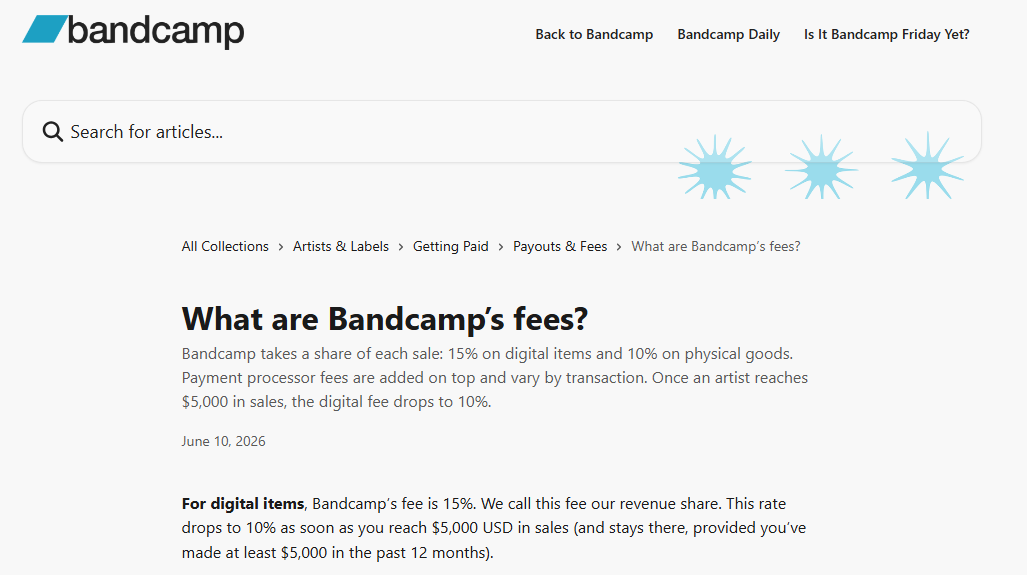
To understand what’s at stake, you need to understand what Bandcamp was. Founded in 2008, the platform built its entire model around something deceptively simple: Bandcamp2 takes 15% on digital sales and 10% on physical goods, with that digital cut dropping to 10% once an artist clears $5,000 in cumulative sales. Payment processor fees added another 4-6% on top, but the math still landed most artists in the 80-85% range of every sale. On a platform like Spotify, the equivalent of $1 in revenue might require thousands of streams. On Bandcamp, it required one fan who cared.
The model drew a sharp contrast to what streaming had done to music economics. According to TechHQ3, Spotify’s per-stream rates, which typically hover between $0.003 and $0.005, meant that most independent artists needed millions of plays just to see meaningful income. Bandcamp’s direct-sale structure meant a sold-out limited cassette run or a twenty-dollar vinyl could actually change someone’s month.
The platform leaned into this identity hard. Its editorial arm, Bandcamp Daily, published serious long-form criticism about underground music scenes. Its “name your price” feature let artists set minimums while giving fans the option to pay more. And fans consistently did, often by substantial amounts. The platform became the spine of the underground economy for experimental electronic music, metal, hip-hop, noise, folk, and dozens of genres that streaming algorithms had no real interest in surfacing.
Then, in March 2020, Bandcamp did something that made them genuinely beloved in ways money can’t manufacture. At the height of the COVID-19 pandemic, with live music collapsing overnight, Bandcamp announced its first Bandcamp Friday: a single day when the company would waive its revenue share entirely, letting all money flow directly to artists. Fans spent $4.3 million on that first Bandcamp Friday alone, roughly fifteen times the amount they’d spend on a typical Friday. The initiative became monthly, and then permanent. It turned the platform from a good deal into a genuinely beloved institution.
That’s when the acquisition offers started.
The Epic Games Chapter: The Good Sale
In March 2022, Epic Games, the company behind Fortnite and Unreal Engine, acquired Bandcamp. The reaction from the music community was cautious but not panicked. Epic was a massive company, but it had a reputation for supporting independent creators through its own marketplace, and it pledged to let Bandcamp operate independently. By most accounts, it kept that promise. The platform continued to function as it always had. Bandcamp Fridays kept running. The fees didn’t change. The editorial team stayed intact.
In retrospect, the Epic era looks like the best version of the thing everyone feared. A large company bought an indie institution, shrugged, and let it keep doing what it was doing. It wasn’t interesting. It wasn’t a story. And precisely because it wasn’t a story, we barely noticed it happening. I think that’s what makes the next chapter so jarring. Because Epic proved the thing could survive acquisition intact, and what came next proved it didn’t have to.
The Songtradr Acquisition: When the Other Shoe Dropped
According to TechCrunch4, in September 2023, with Epic facing broader financial pressure and laying off 16% of its own workforce, the company announced it was selling Bandcamp to Songtradr. A Santa Monica-based B2B music licensing platform. The announcement came fast. The reassurances came faster. Songtradr CEO Paul Wiltshire told the press the acquisition would preserve Bandcamp’s artist-first model, including the 85% payouts and Bandcamp Fridays. “We share a deep passion for all things music,” Songtradr said in statements that would age poorly within days.
On October 16, 2023, Variety5 reported that the deal closed and 50% of Bandcamp’s employees were laid off. Not reduced. Not restructured. Cut in half, on the same day the ink dried. Songtradr’s explanation was straightforward: operating costs had “significantly increased” over the past few years. The layoffs, the company said, were necessary to build a sustainable business.
The people doing the math didn’t find the explanation satisfying. Of the employees who kept their jobs, Songtradr selected based on “the importance of roles for smooth business operations and pre-existing functions at Songtradr,” which, translated plainly, meant the new company was absorbing whichever Bandcamp employees fit into its existing structure and letting the rest go. The 50% who didn’t get offers received severance from Epic, but that did nothing to soften the broader signal.
What made the cuts particularly raw was who got hit. Bandcamp had, in 2023, been in the process of forming a union, Bandcamp United, affiliated with OPEIU Tech Local 1010. The union had been seeking recognition from Epic before the sale. When the layoffs came, KQED6 reported that 40 of the 67 union-eligible employees lost their jobs, including the entire bargaining committee. The union filed a complaint with the National Labor Relations Board, alleging discrimination on the basis of labor activity. Songtradr, as of late 2023, had not formally recognized the union.
Former Bandcamp employee Atoosa Moinzadeh wrote:
“Unsurprisingly there has been no humanity extended in this process.”
The sentiment was short and it was sufficient.
The editorial team at Bandcamp Daily was gutted. Former senior editor JJ Skolnik confirmed that only three members of the editorial staff remained after the cuts. Bandcamp Daily had been one of the few outlets covering underground music with genuine critical seriousness, publishing long-form pieces about noise artists, regional DJ cultures, and niche genres that get ignored by mainstream music press. Losing most of that team didn’t just hurt the people who worked there. It reduced a publishing operation that had been a real part of how people discovered music into something skeletal.
John Darnielle of The Mountain Goats, one of the artists most closely associated with Bandcamp’s DIY ethos, was blunt about what he saw happening: “I think these past couple of years have made it apparent that artists need alternatives: ideally something they control that operates solely for their own benefit,” he told 48 Hills7. Toronto producer DJ Hesk, who had been using Bandcamp since 2013, removed all his music from the platform in response to the layoffs.
“As someone who supports workers’ rights and fair compensation, I was deeply disheartened,” he told Billboard Canada8. He further added:
“It’s possible that my music’s reach may suffer as a result, but I believe it was the right decision.”
Not everyone left. Most stayed, and watched.
The Fee Architecture: What Actually Changed
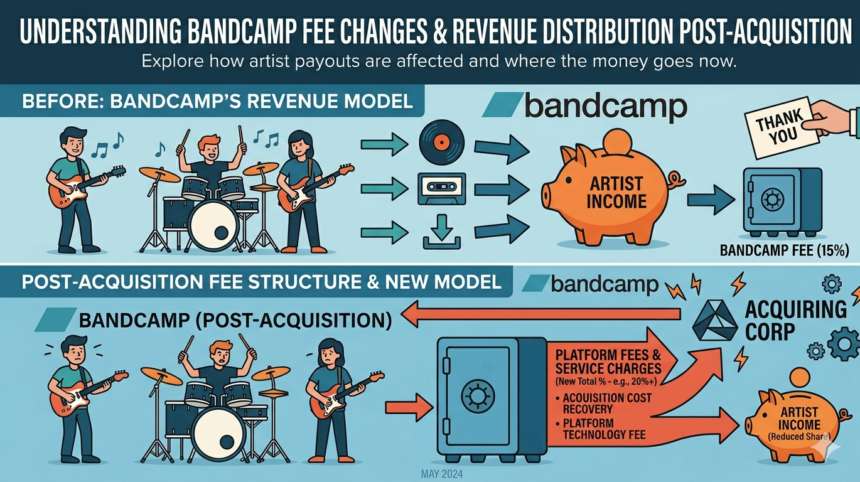
Here’s where it gets complicated. The core revenue share model did not change after Songtradr’s acquisition. The 15% digital cut and 10% physical cut remained in place. Bandcamp Fridays continued. On paper, the thing everyone was most worried about, the artist-first fee structure, survived the transition intact.
But survival and stasis are different things. The changes that came after the acquisition were real; they just arrived quietly, in ways that looked like updates rather than policy shifts.
The biggest structural change came in 2025, when Bandcamp9 announced it was transitioning all artist payouts from PayPal to Stripe, phasing out PayPal as a payout option entirely. The stated rationale made some sense: Stripe offered faster payouts, more payment options for buyers (Apple Pay, Google Pay), payouts in more than 135 currencies, and more transparent processing fees. PayPal’s fees, Bandcamp noted, were rising, and the platform said the switch would help artists avoid those increases.
But the reaction in artist forums was immediate and sharp. On the KVR Audio forum10, artists had already been noticing discrepancies in payment processor fees. One user who sold a £1 download on Bandcamp Friday found themselves paying 11% in processor fees despite Bandcamp’s stated range of 1-2%, which they attributed to cross-currency conversion costs. These weren’t new problems, but they highlighted how opaque the fee structure had become for artists selling internationally.
The Stripe migration added a new layer of friction. Artists who had spent years building their financial infrastructure around PayPal now needed to set up Stripe accounts, link banking details they hadn’t previously shared with the platform, and navigate what many found to be a less intuitive interface. Artists in countries where Stripe doesn’t yet operate faced a harder version of the same problem. The official Bandcamp11 help page became a clearinghouse for frustration: users posted that they were uncomfortable sharing banking information with Stripe, that Stripe’s onboarding process was confusing for small operations, that PayPal had simply worked better for managing finances without connecting to a bank account. One commenter posted with undisguised fury:
“Stripe sucks, stick to PayPal. If it ain’t broke don’t fix it.”
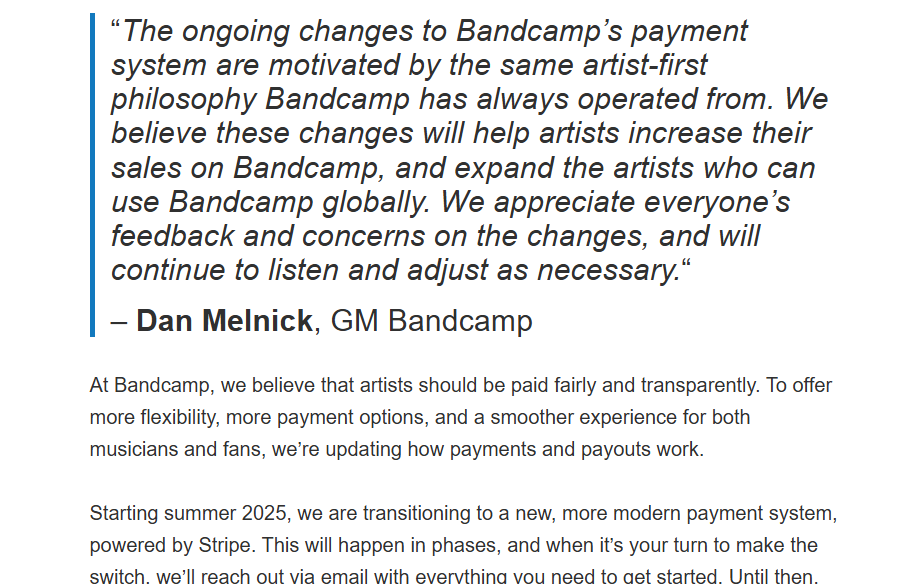
The platform’s messaging around the switch acknowledged these concerns with measured corporate calm. “The ongoing changes to Bandcamp’s payment system are motivated by the same artist-first philosophy Bandcamp has always operated from,” Bandcamp General Manager Dan Melnick said in a statement. “We appreciate everyone’s feedback and concerns on the changes, and will continue to listen and adjust as necessary.” The language was careful, the commitments non-binding. For artists in Stripe-unsupported countries, the practical meaning was clear: you’re on PayPal for now, until you’re not.
There’s also something worth naming about the timing. Stripe raised its Instant Payout fees in the US by 50% in June 2024, from 1% to 1.5% per payout. The standard payout schedule remains free, but the shift illustrates that the payment processor Bandcamp chose as its new backbone has its own fee trajectory, and artists are downstream of it.
The Pricing Shift: Not a Fee Hike, But Not Nothing
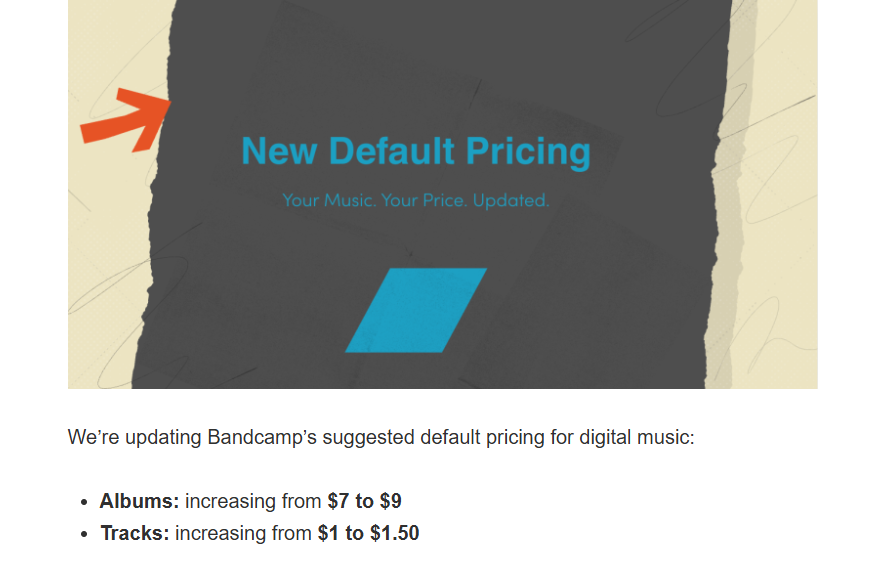
In April 2025, Bandcamp12 made another change that flew below the outrage radar but deserves attention. The platform raised its default suggested price for digital albums from $7 to $9, and for individual tracks from $1 to $1.50. The first adjustment to those defaults since 2014. Bandcamp framed this positively, and the framing was defensible: nearly 20% of fans already pay above the default price, and the new defaults align with Luminate’s updated requirements for Billboard chart reporting eligibility.
Artists retain full control over their pricing. This was not a fee increase in any direct sense. You can still set your album to whatever price you want. Nothing about the change forces artists to charge more.
But default prices matter psychologically. The suggested price is the number a new artist setting up their page will see first. It’s the mental anchor for what a digital album costs on this platform. Raising that anchor for the first time in eleven years, in the same period the platform changed its payment processor and shed half its staff, reads differently than it would have in 2019. The context has shifted. What was once an update coming from a company you trusted lands differently from a company you’re watching carefully.
The company’s own data is worth engaging with honestly here. Fans paid an average of 18% above the default album price during Bandcamp Fridays in 2024, which means that on Bandcamp Fridays, when a $9 minimum is set, the average buyer pays closer to $10.60. Artists keep all of that, minus processor fees, on those days. The math is real. But it applies to Bandcamp Friday, which is one day a month. The rest of the month, Bandcamp collects its 15%, and the new default price affects how new artists enter the market.
The Bandcamp Clubs Experiment
Not everything Songtradr did with Bandcamp was negative. In September 2025, the platform launched Bandcamp Clubs, a curator-led subscription service that charges fans $13 per month per club. Four clubs launched initially, each helmed by a respected tastemaker: Dance Around the World with BBC Radio’s Jamz Supernova, Jazz-Ish Jazz Club with journalist and broadcaster Tina Edwards, Kosmos Klub with producer Ajay Saggar, and The Hard Stuff with NTS Radio resident J. Bennett. Each subscription included a monthly record selection, an exclusive artist interview, and a live listening party. The records became permanent parts of the subscriber’s library.
The concept was deliberately positioned against algorithmic discovery. “Instead of algorithms, fans get human-curated picks from some of the best DJs and journalists in their respective areas,” Melnick said. For a platform that had always positioned itself against the streaming model, this was a coherent move. Not a betrayal of the mission, but an extension of it into subscription territory.
The $13 price point is not nothing. Each club costs $13 per month, and the launch offered four separate clubs, meaning a devoted fan who joined all four would spend $52 monthly before touching a single artist’s storefront. That’s in the neighborhood of Spotify’s premium tier, which still pays artists fractions of a cent per stream. Whether Bandcamp Clubs cannibalize the kind of direct artist spending that makes the platform meaningful is a real question that only time can answer. But as a product concept, it’s coherent. Whether the execution will sustain it depends on how carefully Songtradr invests in the curation layer that makes it work.
The AI Ban: The Clearest Signal
In January 2026, Bandcamp did something that no major music distribution platform had yet done. In a post titled “Keeping Bandcamp Human,” the platform announced a complete ban on AI-generated music. Both music generated wholly or substantially by AI, and any use of AI tools to impersonate other artists or styles. The policy was clear. The language was deliberate. The platform showed Spotify how easy it was to do something they had refused to do.
The ban positioned Bandcamp explicitly and firmly on the side of human artists at a moment when that position was anything but guaranteed from a revenue perspective. AI-generated music had been flooding distribution platforms. Deezer reported processing 60,000 AI uploads daily by 2026. Spotify had issued soft guidelines but no prohibition. Bandcamp drew a line.
The reaction from human artists was largely positive. The announcement drew comparisons to Bandcamp Friday. A decision that cost the platform something in the short term to demonstrate its values in the long term. According to TechCrunch13, Bandcamp’s statement declared:
“We want musicians to keep making music, and for fans to have confidence that the music they find on Bandcamp was created by humans.”
For an artist community that had watched AI eat into every adjacent creative field, the clarity was meaningful.
It was also good strategy. Bandcamp’s core value proposition has always been trust. Between artist and fan, between creator and platform. An AI-contaminated catalog would corrode that trust faster than any fee change. The ban is ideologically consistent with everything Bandcamp has said about itself. It is also, perhaps not coincidentally, a differentiator that costs the platform nothing financially.
The Harder Question Nobody Is Asking Out Loud
After all of this,the layoffs, the payment system overhaul, the pricing adjustments, the Clubs rollout, the AI ban, Bandcamp is still operating. The platform paid out over $19 million to artists in Bandcamp Friday events in 2025. Total payouts have crossed $1.7 billion. The platform expanded Bandcamp Fridays to eight events in 2026, up from the prior year’s total.
As First Floor’s14 Shawn Reynaldo wrote in November 2025, surveying two years of post-Songtradr Bandcamp: the platform had been “supposed to be dead by now” and wasn’t. The doom was real in 2023 and the doom had not materialized as predicted. By some measures, the platform had stabilized.
But stability and health are not the same thing. The editorial operation that made Bandcamp Daily a real cultural voice is a skeleton of what it was. The union was gutted before it could bargain. The PayPal-to-Stripe migration created real problems for artists in countries where Stripe doesn’t yet operate, problems the platform acknowledges will resolve as “quickly as possible,” which is the language companies use when they don’t have a timeline. The default pricing shift, small as it is in isolation, added to a cumulative sense of drift.
The deeper issue is one of ownership and accountability. Songtradr is a B2B licensing company. Its core business is not the same as Bandcamp’s core business. The alignment that made Bandcamp’s model work, a platform that only made money when artists made more money, depends on the people running the platform genuinely caring about that alignment, not just preserving the fee structure as a brand asset. Artists cannot audit that care. They can only watch the decisions.
And some of what they’ve seen since October 2023 has been promising: the Clubs launch, the AI ban, the continuation of Bandcamp Fridays. Some of what they’ve seen has been hard to defend: the mass layoffs, the union destruction, the payment system change that displaced artists in unsupported markets.
The platform exists in a strange position. It is, by most objective measures, still the most artist-favorable distribution and direct-sales platform available to independent musicians. The 85% average payout on non-Friday sales puts it miles ahead of streaming. The direct fan relationship is irreplaceable. The community, battered as it is, remains. But it is now owned by a company with different primary interests, staffed by a smaller team operating under what appears to be financial constraint, and undergoing infrastructure changes that prioritize operational efficiency over the preferences of the existing artist base.
That is not the same as Bandcamp being destroyed. It is also not the same as Bandcamp being fine.
The Stripe migration will be completed. Artists in currently unsupported countries will eventually get access, or they won’t and they’ll leave. Bandcamp Clubs will either grow into a meaningful revenue driver or it will be quietly shuttered. The AI ban will be tested every time someone figures out a technical workaround and uploads something machine-made that slips through the reporting system.
What won’t change is the fundamental problem that Bandcamp’s model has always been fragile because it was built on one company’s good intentions, and good intentions don’t survive ownership changes intact. The platform’s founder Ethan Diamond once built a business on the premise that the interests of the company and the interests of the artists were genuinely aligned. That was true when he controlled the company. It is less obviously true when the company is a property of a B2B licensing firm trying to find a sustainable cost structure.
The musicians who depend on Bandcamp, the ones for whom it is not a secondary distribution channel but a primary source of income and fan relationships, deserve to understand that the ground has shifted. Not collapsed, but shifted. The revenue share model is intact. The Fridays are intact. But the people who once ran the editorial operation that helped fans discover music, the workers who tried to organize for better conditions, the community leaders who made Bandcamp feel like a scene rather than a marketplace. They are largely gone.
What you have left is the infrastructure of a good idea, owned by a company you don’t know, run by a smaller team you haven’t met, making decisions about payment systems and default pricing in ways that affect your income and your relationship with your audience. That is worth paying attention to.
The platform is still running. Whether it is still yours is a harder question.
Sources
- “Fair Trade Music Policy” Bandcamp, bandcamp.com/fair_trade_music_policy. Accessed 6 Aug. 2026. ↩︎
- Center, Bandcamp Help. “What are Bandcamp’s fees?” Bandcamp Help Center, 10 June 2026, get.bandcamp.help/en/articles/15263193-what-are-bandcamp-s-fees. Accessed 6 Aug. 2026. ↩︎
- TechHQ, techhq.com/news/what-do-layoffs-mean-after-songtradr-bandcamp-acquisition/. Accessed 6 Aug. 2026. ↩︎
- Coldewey, Devin. “Bandcamp’s new owner lays off half the company” TechCrunch, 16 Oct. 2023, techcrunch.com/?p=2615105. Accessed 6 Aug. 2026. ↩︎
- Aswad, Jem. “Half of Bandcamp’s Staff Laid Off After Songtradr Acquisition” 16 Oct. 2023, variety.com/2023/music/news/bandcamps-layoffs-songtradr-1235758123/. Accessed 6 Aug. 2026. ↩︎
- Voynovskaya, Nastia. “’Idiotic and Cruel’: Musicians Slam Layoffs at Bandcamp, Union Files Complaint” KQED, 11 Jan. 2024, www.kqed.org/arts/13936509/idiotic-and-cruel-musicians-slam-layoffs-at-bandcamp. Accessed 6 Aug. 2026. ↩︎
- Ruskin, Zack. “Bandcamp layoffs paint bleak picture for indie musicians and union organizers” 48 Hills, 6 Nov. 2023, 48hills.org/2023/11/bandcamp-layoffs-paint-bleak-picture-for-indie-musicians-and-union-organizers/. Accessed 6 Aug. 2026. ↩︎
- Decter, Rosie Long. “Artists Respond to Songtradr Purchase of Bandcamp and Layoffs” Billboard Canada, 26 Oct. 2023, ca.billboard.com/bandcamp-songtradr-sale. Accessed 6 Aug. 2026. ↩︎
- Says:, Mark. “Bandcamp Payment Updates: What You Need to Know” Bandcamp Updates, 11 Aug. 2025, blog.bandcamp.com/2025/08/11/a-better-way-to-get-paid-on-bandcamp/. Accessed 6 Aug. 2026. ↩︎
- KVRAudio, www.kvraudio.com/forum/viewtopic.php?t=608909. Accessed 6 Aug. 2026. ↩︎
- Says:, Mark. “Bandcamp Payment Updates: What You Need to Know” Bandcamp Updates, 11 Aug. 2025, blog.bandcamp.com/2025/08/11/a-better-way-to-get-paid-on-bandcamp/. Accessed 6 Aug. 2026. ↩︎
- “Bandcamp Default Pricing Update: What Artists Need to Know” 25 Apr. 2025, blog.bandcamp.com/2025/04/25/default-album-price-change-what-artists-need-to-know/. Accessed 6 Aug. 2026. ↩︎
- Silberling, Amanda. “Bandcamp takes a stand against AI music, banning it from the platform” TechCrunch, 14 Jan. 2026, techcrunch.com/2026/01/14/bandcamp-takes-a-stand-against-ai-music-banning-it-from-the-platform/. Accessed 6 Aug. 2026. ↩︎
- Reynaldo, Shawn. “Bandcamp Was Supposed to Be Dead by Now” First Floor, 4 Nov. 2025, firstfloor.substack.com/p/bandcamp-was-supposed-to-be-dead. Accessed 6 Aug. 2026. ↩︎