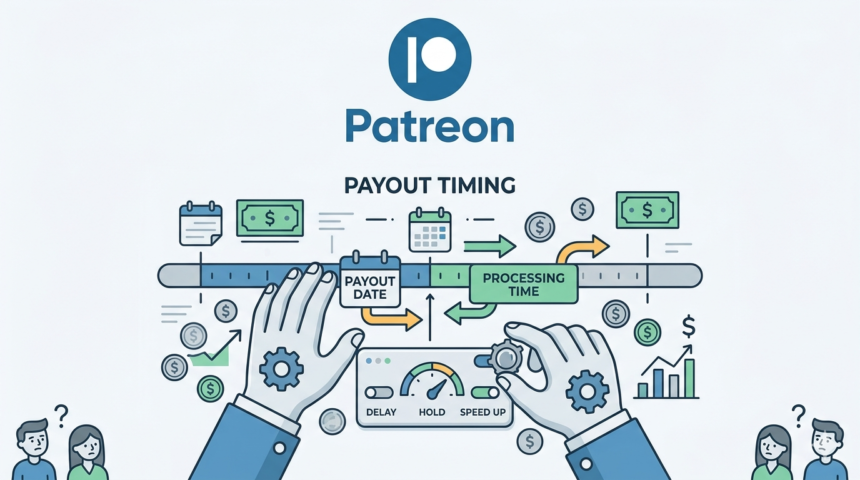

The creator economy runs on promises. Patreon’s payout system reveals something more complicated.
- The Standard Hold: A Five-Day Gap by Default
- The Trigger Stack: How Delays Compound
- The iOS Trap: 75 Days
- The Billing Model Migration: A Forced Transition with New Timing Risks
- What Happens to Money That Sits Too Long
- The Fee Architecture Around the Float
- The Timezone Correction That Revealed the Problem
- The Terms That Authorize the Delay
- What Creators Are Actually Asking For
- The Structural Logic
The money hits your fans’ credit cards at midnight on the first of the month. You can see it on your dashboard. The number is right there, sitting in a column labeled “Available Balance.” But you will not see it in your bank account until at least the fifth. And if any of your fans subscribed through an iPhone, you could be waiting two and a half months.
That is not a glitch. It is policy.
Patreon1, the San Francisco-based subscription platform that has paid out more than $10 billion to creators since 2013, operates a payout architecture that introduces multiple tiers of delay between when fans pay and when creators collect. For the majority of the platform’s 280,000-plus active creators, many of whom are musicians, writers, and podcasters building freelance careers, these delays are not just an inconvenience. They are a structural feature that concentrates financial benefit at the platform level while pushing cash-flow risk onto the people the platform claims to serve.
Understanding how this works requires sitting with the mechanics for a moment. Then the picture becomes harder to dismiss.
The Standard Hold: A Five-Day Gap by Default
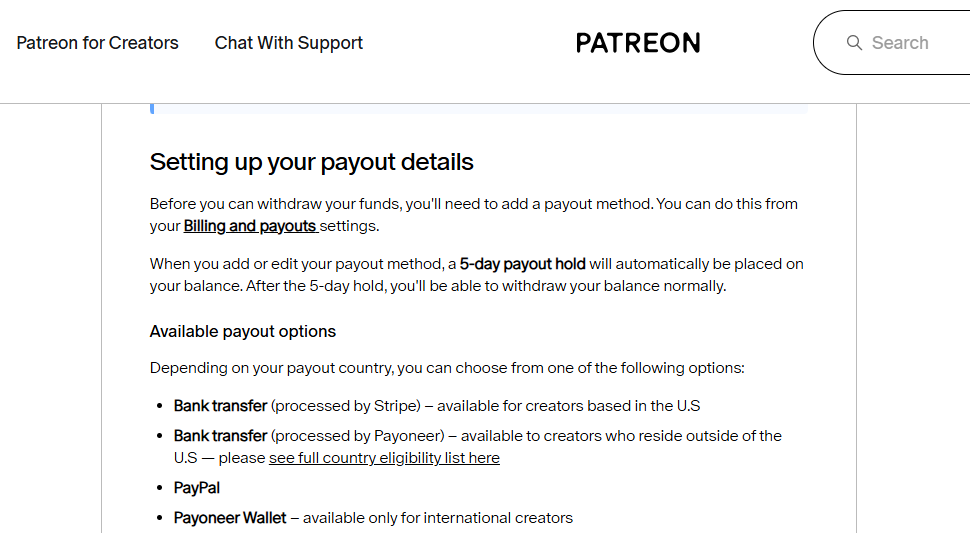
When Patreon processes membership payments on the first of the month, it does not immediately transfer funds to creators. Instead, Patreon Support2 states that the platform sets an automatic payout date of the fifth of each month. Once the payout is initiated on that day, creators then wait an additional one to five business days for funds to clear into their personal bank accounts. Under the most optimistic scenario, a creator might see their January earnings reach their bank account by January 7th or 8th. Under normal circumstances, it often stretches further.
The official rationale is predictability. Patreon’s help documentation frames the fifth-of-the-month schedule as a feature: creators can “opt in to automatic payouts” and avoid having to manually request transfers. This is true. What ElectroIQ3 reports is that their documentation does not dwell on is that across a platform moving roughly $24 million in monthly payouts as of late 2024, those five or more days of float. The period when patron money has been collected but not yet dispersed to creators, represent a meaningful pool of liquid capital sitting in Patreon’s accounts.
The term for this in finance is “float.” Banks and payment processors have leveraged float for decades. The logic is simple: money in transit earns interest, or at minimum offsets the cost of holding other liabilities. No credible evidence exists that Patreon explicitly markets this practice. But the architecture exists. The float exists. And Patreon’s financial disclosures ,it is a private company, do not exist in any public form that would allow independent verification of how that pooled cash is managed during settlement periods.
When you add up every payout cycle across a year, the cumulative days during which Patreon holds collected-but-undisbursed creator funds are considerable. Creators have noted it. Some have moved on. Others keep raising it in forum threads that go unanswered.
The Trigger Stack: How Delays Compound
The five-day standard gap is only the beginning. Patreon’s payout system includes multiple triggers that can extend the hold on a creator’s funds significantly.
The Method Update Lock: Every time a creator updates or adds a payout method, Patreon automatically places a five-day lock on the account balance. Update your bank account information on the first of the month and your automatic fifth-of-the-month payout will be blocked. This is framed as fraud prevention. It may well serve that function. But the effect is that any routine banking change, a new account, a switch from PayPal to direct deposit, resets the clock and extends the hold.
The Verification Delay: For high-volume payouts or accounts that trigger internal review flags, Patreon can hold funds for up to 10 additional business days. The criteria for what qualifies as “unusual activity” are not published. The creator receives an email saying a transfer may take up to ten business days and that “checks” are being run. There is no mechanism to appeal, expedite, or challenge the hold.
The Stripe-Payoneer Gap: For creators outside the United States, the primary payout route runs through Payoneer rather than Stripe. As Patreon’s own documentation acknowledges, Payoneer may impose additional fees and delays that vary by region. According to The Verge4, in 2023, Patreon’s relationship with Payoneer broke down in a way that affected creators’ ability to access earnings for an extended period, with the platform temporarily pausing payouts from that partner entirely. International creators were left waiting with no clear timeline for resolution.
The Commerce Hold: For digital products sold through Patreon’s Commerce feature on web and Android, funds remain pending for up to seven days before they can be withdrawn. This is separate from the membership payment cycle. A creator selling a digital download on the fifteenth of the month cannot withdraw those specific funds until at least the twenty-second, regardless of what else is happening in their account.
Each of these delays operates independently. A creator who updates their bank details in late January, sells a digital product, and earns through standard memberships could theoretically face staggered pockets of inaccessible funds across three separate timelines simultaneously. None of this is clearly disclosed at the point when creators set up their accounts. The information lives in a labyrinthine help center that most creators only consult after something goes wrong.
The iOS Trap: 75 Days
The single most significant development in Patreon’s payout architecture in recent years arrived in November 2024, when Apple forced the platform to route all new iOS in-app purchases through Apple’s payment system.
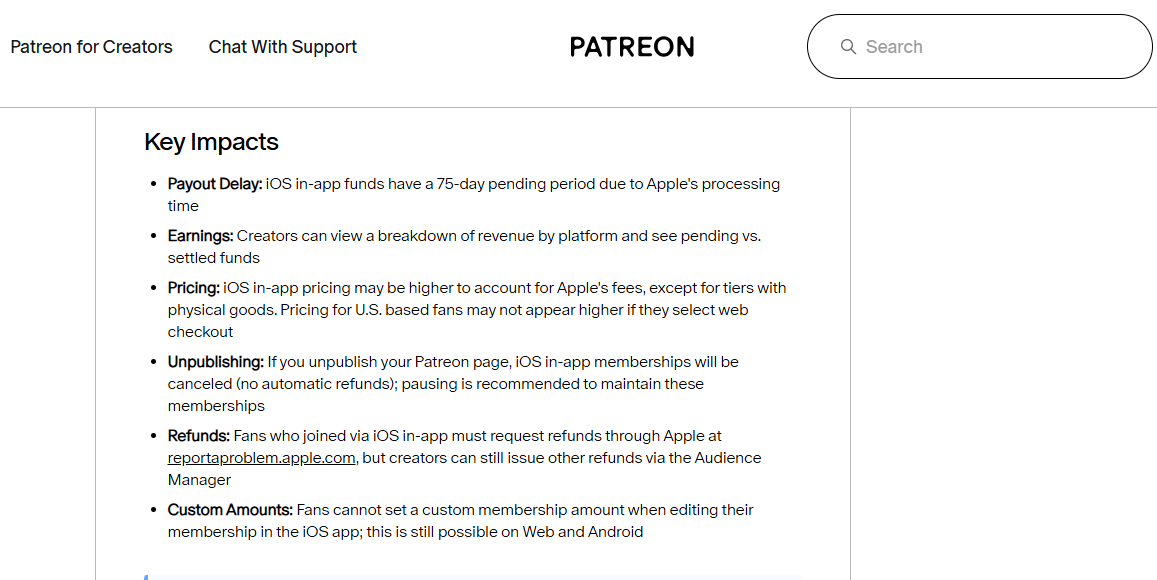
The consequences for payout timing are severe. Funds from memberships or product sales made via iOS in-app purchases remain pending for up to 75 days before they become available for withdrawal. This is because Apple processes the transactions and then remits payment to Patreon on its own schedule. Patreon acknowledges it cannot expedite this timeline. Creators who built audiences that skew heavily toward iPhone users can now find themselves waiting more than two months for a portion of each month’s earnings.
The 75-day hold runs alongside Apple’s 30 percent commission on those same transactions. So for a creator whose fan subscribes at a $10 tier through the iOS app, Apple takes $3 off the top, and then holds the remaining proceeds for 75 days before they reach the creator’s Patreon balance. After which the standard payout cycle introduces additional days before the funds hit a bank account.
For international fans outside the United States, there is no opt-out. Apple prohibits alternative payment methods for non-US iOS users, which means international creators who built fanbases of iPhone users have no path around this structure. US fans technically can use Patreon’s web checkout on mobile, but that requires knowing to do so, finding the browser link, and accepting friction that most subscription platforms are specifically designed to eliminate.
One writer summarizing the situation on Patreon’s5 own platform put it plainly: Apple holds subscription revenue for an estimated 75 days before releasing funds, and during this time, the money likely earns interest. Profits that provide no value to the people who actually create and support content.
Apple would be the primary beneficiary of this particular float. But the architecture is one that Patreon chose to accept rather than contest in any public, legal, or technical way. The platform absorbed the policy. The creators absorbed the consequences.
The Billing Model Migration: A Forced Transition with New Timing Risks
Patreon is currently in the middle of a forced migration. The Verge6 reported that all creators on the platform’s legacy billing model must switch to subscription billing by November 1, 2026, or face removal from the iOS App Store. Apple’s requirement that subscription billing be the sole payment model for in-app purchases drove this decision.
Subscription billing changes how and when members are charged. Instead of all payments processing on the first of the month, each patron is billed on the anniversary of their own subscription date. This means, in theory, creators see a steadier stream of incoming payments throughout the month rather than one large batch on the first.
In practice, the transition creates new timing complexity. A creator who had built their workflow around receiving one large payment on the first of the month and spending the rest of the month creating content now faces uncertainty about precisely when funds will accumulate. Patreon7 removed its payout progress bar from the dashboard in 2025, citing “confusion”, an admission that the new billing architecture makes it harder for creators to track what they have earned and when it will arrive.
The platform’s justification for the migration centers on predictability for patrons, not creators. A patron on subscription billing sees a clear renewal date tied to their own sign-up anniversary rather than the first of the month. This is a genuine improvement for patron experience. What it does not address is that creators, the people who actually built the audiences Patreon monetizes, now navigate a more fragmented earnings picture with less visible tooling.
What Happens to Money That Sits Too Long
There is one more category of delay that operates over a longer timeframe: dormant funds.
If a creator’s account shows no login activity for an extended period, any balance remaining in their Patreon account is classified as “unclaimed” and eventually remitted to their state’s unclaimed property division. For creators outside the United States, the threshold is 60 months of inactivity. The platform sends email notices before this happens, but the consequence is stark: a creator who paused their page, had a health crisis, or simply stopped monitoring email could lose access to funds that are genuinely theirs.
The process for recovery is not simple. Creators have to file claims with state unclaimed property divisions, provide documentation sourced through Patreon’s support team, and hope the timeline has not yet lapsed. This is not a theoretical risk. It is a documented feature of the platform’s terms.
Meanwhile, a creator whose account has been suspended, for policy violations, “suspicious activity,” or content disputes, may find their balance frozen entirely. Trustpilot8 is full of these accounts. One creator wrote that a suspended account left them with €700 in their balance that they could not access despite having violated no policies. Another described the support system as an AI loop: Patreon has over $500 of my money and not one human being has contacted me with a remedy. These are not outliers. The pattern is persistent enough that Trustpilot summarizes billing and payout issues as among the most common complaints across the platform’s nearly 900 reviews.
More striking is what happens when negative reviews arrive: Patreon responds to zero percent of negative reviews on Trustpilot, the lowest response rate among major creator platforms. Every comparable platform, Ko-fi, Buy Me a Coffee, OnlyFans, Substack, engages publicly with complaints within 48 hours. Patreon’s silence is not accidental. It is a posture.
The Fee Architecture Around the Float
The payout delay conversation cannot be separated from the broader fee structure that surrounds it. Patreon does not just delay payment. It charges multiple layers of fees on the money it holds.
For new creators who published pages after August 4, 2025, the Patreon9 platform fee is a flat 10 percent. Payment processing adds another roughly three percent. A creator earning $5,000 a month loses $650 to fees before the payout cycle even starts. roughly $7,800 a year. At that scale, even a week’s delay in payment represents a material cash-flow consequence for someone relying on that income to cover rent, equipment, or freelance assistants.
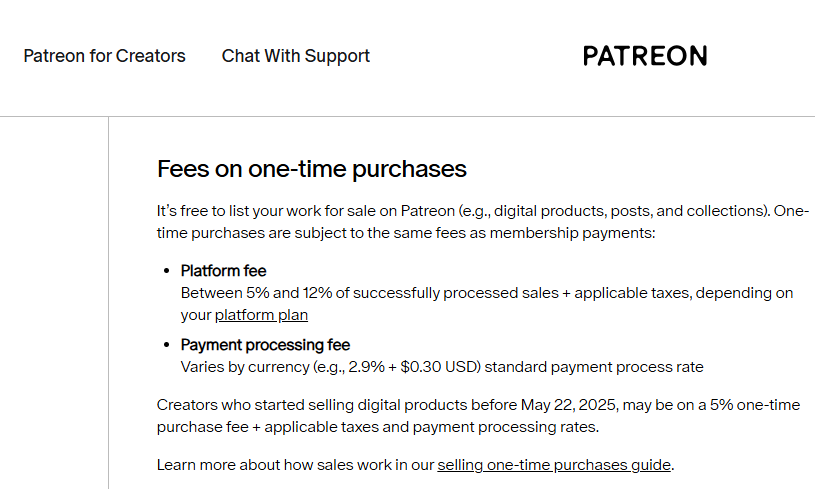
According to Backlinko10, Patreon is estimated to have generated $228 million in revenue in 2024. That revenue comes entirely from the percentage it clips from creator earnings, not from subscription fees to creators, not from advertisers, but from money that belongs to artists, writers, educators, and podcasters before the platform takes its cut. The blended take rate has climbed over time, from roughly 7 percent in 2020 to around 8.5 percent currently, according to analysis firm Sacra11. The platform has quietly expanded its effective margin on the same creator relationships while the payout architecture has grown more complex, not simpler.
For the median creator on the platform, none of this is abstract arithmetic. According to Fast Company12, most Patreon creators earn under $100 per month. Fewer than two percent earn over $1,000 per month. For someone making $80 a month, a five-day hold and $10 in fees is proportionally significant. These are not the creators Patreon names in its press materials. They are the base on which the platform’s aggregate numbers rest.
The Timezone Correction That Revealed the Problem
In the summer of 2025, Patreon13 made a small but revealing change to how it processes billing.
Through July and August of 2025, first-of-the-month charges were processed at midnight UTC. Which meant that many US creators saw their earnings appear later in the day than expected. Some charges effectively landed the evening before the first, in late December Pacific Time. Others landed after 5 PM Pacific on the first. The result was that billing periods appeared to contain fewer earnings than expected, causing creators to believe their subscriber numbers had dropped.
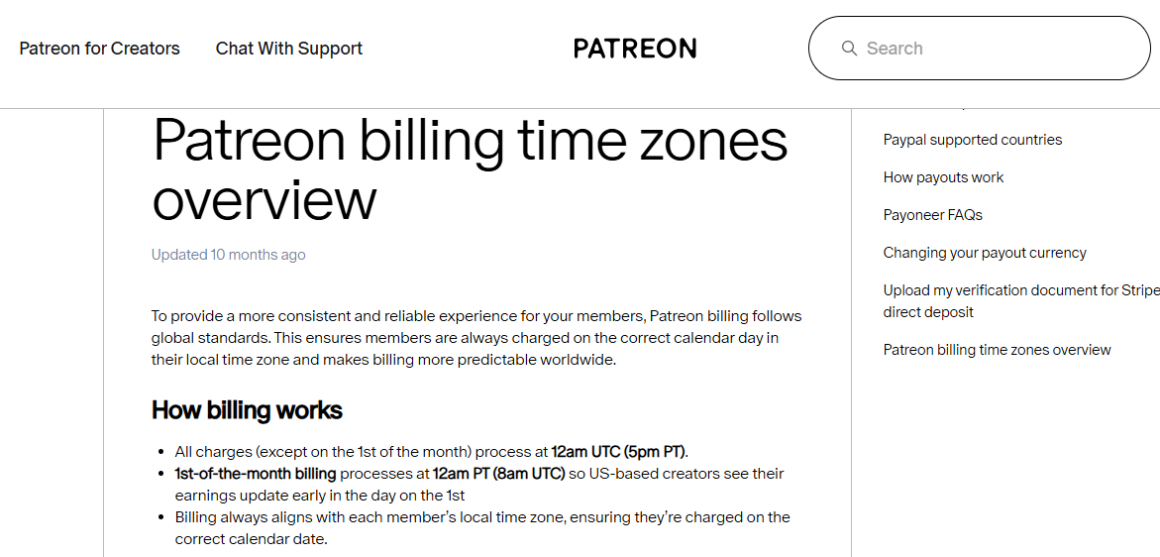
Starting September 1, 2025, Patreon shifted first-of-the-month charges to midnight Pacific Time. The fix resolved the display confusion. But the episode exposed something worth examining: the difference of a few hours in processing time was enough to make creators believe they had lost income. The timing of transactions on this platform is not trivial. Creators watch these numbers the way small business owners watch their bank balances. When the platform adjusts the clocks, even for legitimate infrastructure reasons, the effect is disorienting enough that Patreon had to issue a formal explanation clarifying that no one had actually lost patrons. The money was there. It just looked like it had disappeared.
That moment of visible instability is instructive. It shows what creators are navigating every billing cycle: a system in which the timing of transactions is controlled entirely by the platform, updated without advance notice, and explained only after creators begin noticing anomalies.
The Terms That Authorize the Delay
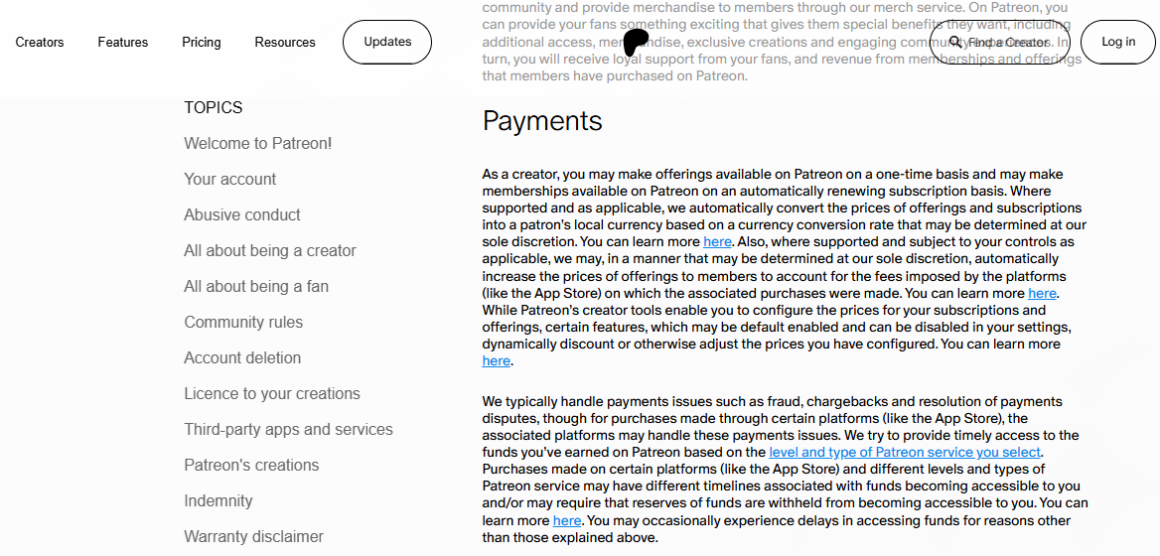
None of this is hidden in a legal sense. Patreon’s Terms of Use, updated May 2026, include language that gives the platform broad discretion over fund access:
“You may occasionally experience delays in accessing funds for reasons other than those explained above. We may also block or withhold access to these funds for violations of our Terms or policies or for compliance reasons.”
The phrase “or for compliance reasons” is wide enough to accommodate most scenarios the platform might encounter. Patreon14 also states it “tries to provide timely access to the funds you’ve earned” — the operative word being “tries,” a standard that is more aspiration than obligation. There is no SLA. There is no defined maximum hold period beyond the specific timelines published for iOS and Commerce transactions. There is no penalty mechanism if Patreon holds funds beyond its own stated windows.
This is the architecture of a financial intermediary that has drafted its obligations to itself broadly and its obligations to creators narrowly. It is legal. It is common in the fintech industry. It is also worth naming clearly: Patreon is not a passive conduit for money between fans and creators. It is a financial intermediary that decides when creators access their own earnings, takes a percentage before that access is granted, and bears no contractual consequence for delays that extend beyond its own published guidelines.
What Creators Are Actually Asking For
Spend enough time reading creator forums, Patreon’s own community boards, Reddit’s r/patreon, professional creator Discord servers, and the complaints are consistent. Creators are not primarily upset that payout cycles exist. They are upset at the opacity: why does a particular payout take longer than usual with no notification? Why does updating a bank account reset the clock? Why is there no way to reach a human when something goes wrong?
One Trustpilot15 reviewer described reaching support about missing payouts this way:
I am missing almost $300 that shows ‘payout successful’ but never hit my PayPal account. I have submitted two support tickets in the past five days and not a single response.
Another described a circular pattern of being told by Patreon to contact Stripe and being told by Stripe that the account did not exist, while the platform sat on their money with no human remedy forthcoming.
The support infrastructure does not match the financial infrastructure. A platform that processes tens of millions of dollars monthly and holds creator earnings across multiple pending windows has, by most creator accounts, a support system closer to that of a small startup than a fintech company handling people’s livelihoods. There are no phone numbers. The chat function leads to automated responses. Email tickets go unanswered for days during billing periods, which is precisely when creators are most likely to need help.
The Structural Logic
The payout delay architecture at Patreon is not a conspiracy. It is a structural preference, baked into the business model at every layer, that consistently favors the platform’s interests over the creators’ need for timely access to their own money.
The float between collection and disbursement accumulates at the platform level. The compliance reviews that trigger extended holds have no published criteria and no appeal process. The iOS mandate handed Apple a 75-day float opportunity on every iPhone subscription. The billing model migration creates new timing complexity without adding new transparency tools. The support response rate on public platforms is zero.
Each of these is individually defensible. Fraud prevention is real. Apple’s rules are external. Billing migrations are complex. But the cumulative picture is a company that earns its revenue from the labor of 280,000 active creators and has organized its payment architecture to maximize its own operational flexibility at the cost of creator predictability.
The creator economy, as Patreon built it, was supposed to disrupt the old patron model. The one where artists waited for gatekeepers to cut checks on the gatekeepers’ schedules. What Patreon built instead is a new version of the same dynamic: a platform that collects on your behalf, takes its percentage, and releases the rest when it decides it is ready.
The fans paid in January. You will get the money in February. Probably.
Sources
- “The story of Patreon — Patreon” www.patreon.com/about. Accessed 22 June 2026. ↩︎
- Patreon, support.patreon.com/hc/en-us/articles/208656246-How-payouts-work. Accessed 22 June 2026. ↩︎
- Dey, Maitrayee. “Patreon Statistics And Facts (2025)” 21 May 2025, electroiq.com/stats/patreon-statistics/. Accessed 22 June 2026. ↩︎
- 22 Dec. 2023, www.theverge.com/2023/8/3/23818598/patreon-payment-blocked-processing-declined-subscription-canceled. Accessed 22 June 2026. ↩︎
- Patreon, www.patreon.com/posts/patreons-apple-86700395. Accessed 22 June 2026. ↩︎
- 22 Nov. 2026, www.theverge.com/tech/870022/patreon-creator-apple-ios-subscription-billing-november-2026. Accessed 22 June 2026. ↩︎
- Patreon, support.patreon.com/hc/en-us/articles/360058429051-Payout-Dashboard. Accessed 22 June 2026. ↩︎
- Trustpilot, www.trustpilot.com/review/www.patreon.com. Accessed 22 June 2026. ↩︎
- Patreon, support.patreon.com/hc/en-us/articles/36426991446797-A-standard-platform-fee-for-new-creators-effective-after-August-4-2025. Accessed 22 June 2026. ↩︎
- Dean, Brian. “Patreon: Subscriber and Creator Statistics for 2026” 16 Mar. 2023, backlinko.com/patreon-users. Accessed 22 June 2026. ↩︎
- “Patreon revenue, valuation & funding” Sacra, sacra.com/c/patreon/. Accessed 22 June 2026. ↩︎
- “Fastcompany.Com” www.fastcompany.com/40517584/most-patreon-creators-make-less-than-100-a-month. Accessed 22 June 2026. ↩︎
- Patreon, support.patreon.com/hc/en-us/articles/36755487985677-Patreon-billing-time-zones-overview. Accessed 22 June 2026. ↩︎
- “Terms of Use” May 27, 2026 Patreon, www.patreon.com/policy/legal. Accessed 22 June 2026. ↩︎
- Trustpilot, ca.trustpilot.com/review/www.patreon.com?page=10. Accessed 22 June 2026. ↩︎