


Poshmark has 130 million registered users and a decade-plus of goodwill built on the premise that selling your old clothes online should be simple. In October 2024, the company decided to test how much of that goodwill it could burn in under three weeks.
The answer was: most of it.
According to Modern Retail1, on October 3, 2024, Poshmark announced a new fee structure it called the biggest change to its marketplace since the company launched. The old model was simple enough: sellers paid 20% on any sale over $15 and a flat $2.95 fee on sales under that. The new plan replaced that with a 5.99% seller fee, a mirrored 5.99% “Buyer Protection Fee” charged directly to buyers, and a tiered flat fee of $1, $2, or $3 applied to both sides based on the total order size. The company framed this as relief for sellers and transparency for buyers. What it delivered was a cash register shock that sent buyers abandoning their carts at checkout and sellers watching their sales fall off a cliff.
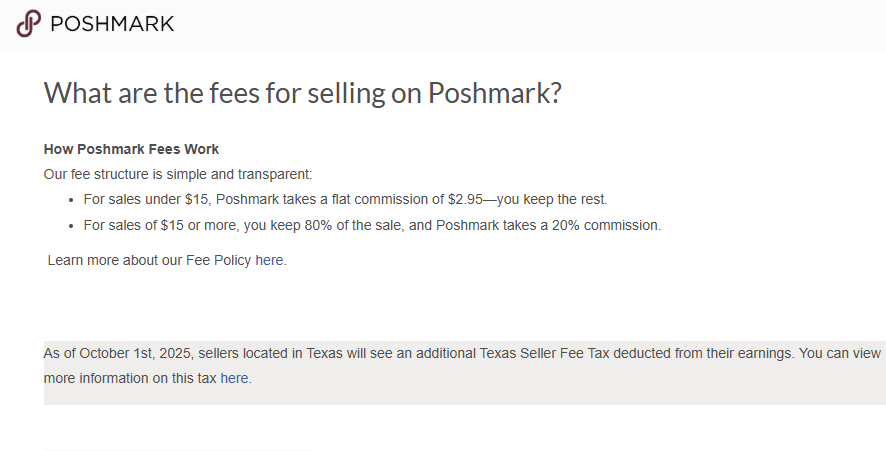
The platform reversed itself nineteen days later. CEO Manish Chandra sent an apology letter. The fees went back to the way they were. Sellers got a partial rebate. Buyers who paid the new fees got nothing back.
What happened in those nineteen days is worth examining closely. Not because of the reversal. Marketplace fee experiments are common, but because of what the episode revealed about the structural relationship between Poshmark and the people who built it.
The Math Nobody Wanted to Do
When Poshmark announced the new fee structure, it presented the numbers in a way that made sellers feel like they were winning. Dropping from 20% to 5.99% looks significant on paper. The problem was that the fee didn’t disappear. It moved. Ecommercebytes2 stated that Poshmark was now collecting fees from both ends of the transaction, and for many items, particularly those under roughly $90, the combined take was actually higher than the old flat 20% structure.
Power sellers Jon Anthony and Brad Schwibner, who operate under the name The Posh Kings and have been selling on Poshmark since 2014 with over 46,000 active listings, called it “mathematically confusing by design.” The duo were outspoken critics almost immediately. Anthony told Modern Retail at the time that he believed buyers would abandon their carts once they saw the new totals. “A lot of people feel deceived,” he said.
He was right. Poshmark found that while buyers still spent roughly the same total dollar amount per transaction, a bigger portion of that money was going toward the new fees rather than toward the merchandise. The seller’s cut, even with a lower seller fee rate, shrank. The platform was, in effect, extracting more total revenue from each transaction while leaving less for the people doing the work.
The checkout experience made things worse. According to Value Added Resource3, Poshmark buried the Buyer Protection Fee inside the tax line at checkout, only revealing the breakdown if you clicked on a small info icon. Consumer protection experts and state tax regulators increasingly require that fees be disclosed separately from actual tax amounts. Several states mandate it explicitly. The FTC and state attorneys general had been ramping up enforcement against so-called junk fees for precisely this kind of opacity. Whether Poshmark knew this and made the design choice anyway, or simply didn’t think it through, is unclear. The effect was the same: buyers felt blindsided.
Sellers on Reddit, in Poshmark’s own app store reviews, and across social media documented their experience in real time. One seller on Reddit wrote:
“I was selling a lot more with the 20 percent fee as opposed to the new system where I made like two sales in three weeks.”
Another put it plainly:
“I’d rather live with the 20 percent than face significantly fewer sales because of the buyer fees being astronomical.”
One commenter on ChannelX4 captured the buyer perspective in a way that sticks:
“I was shocked when I bought an item for $50 — plus paying $8 for shipping and on top of that an extra $10 for tax and buyer protection — which made my $50 purchase amount to $66. These are used items, not retail.”
Another buyer wrote that she watched her daughter put a purse in a cart, see the protection fee stack on top, and walk away.
“Poshmark, PLEASE reverse this silly additional fee to the buyer!!! You are driving business AWAY!!”
The “Protection” in the Fee That Protected Nothing New
Central to the Poshmark rollout was the concept of “protection.” The Buyer Protection Fee, the company said, covered Posh Protect, Posh Authenticate (when applicable), 24/7 customer support, and ongoing platform improvements. The problem with that framing is that Posh Protect already existed. Posh Authenticate already existed. Customer support already existed. As one seller told Modern Retail5:
“Poshmark is calling this a ‘buyer protection fee,’ yet they’re not offering anything new in this fee.”
This matters. When you charge a fee and call it protection, buyers reasonably assume they are getting something they didn’t have before. When what they’re actually paying for is rebranded access to the same services they already received, it’s a label designed to make an extraction look like a benefit. Riley, a Poshmark seller since 2015, told Modern Retail she would have preferred to absorb even higher seller fees rather than watch buyers walk. “I think it’s a terrible idea to charge your buyers a fee to buy,” she said.
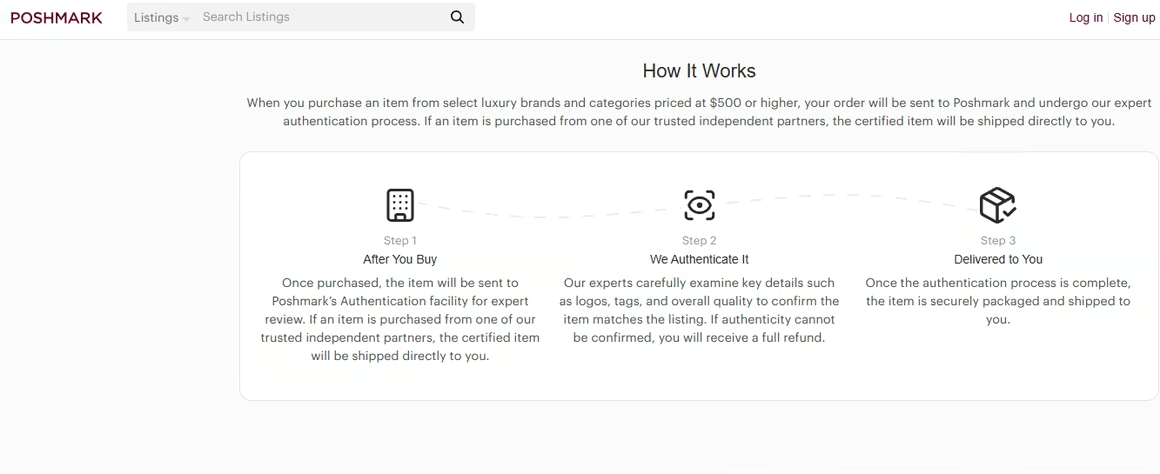
Posh Authenticate, the program at the heart of the Buyer Protection Fee’s supposed value, is worth examining on its own. The service applies to luxury items priced at $500 or more, routing them through Poshmark’s authentication center before delivery. For qualifying items, Poshmark’s6 team examines logos, tags, hardware, stitching, and materials. If an item fails authentication, Poshmark cancels the order and refunds the buyer. And the item is returned to the seller and cannot be relisted.
That last clause is the one sellers talk about the least but should think about the most.
When Authentication Fails a Genuine Item
The authentication service sounds reassuring until you are the seller with a genuine item that doesn’t pass.
This is not a hypothetical. A seller complaint filed with the Better Business Bureau7 lays it out plainly:
“Poshmark has informed me that they are closing or restricting my account based on an allegation that I sold unauthentic or counterfeit items. The issue is that I was not provided with evidence supporting this accusation. My understanding is that a buyer claimed an item was not authentic, and Poshmark took action against my account based on that claim. I was not given documentation, authentication findings, or any other evidence explaining how this determination was made. As a result of this action, I have lost access to my account and have been unable to access funds that belong to me.”
The complaint ends with five specific demands: evidence used to make the determination, the reason for account restriction, clarity on the status of held funds, an appeal process, and release of earned money not tied to any active dispute. Poshmark’s response was to acknowledge the complaint and say a team member would follow up. There is no indication in the public record of what happened next.
On the PurseForum, a community for handbag enthusiasts that functions as one of the more rigorous secondhand luxury authentication communities online, a buyer wrote in 2023 about receiving a response from Poshmark after disputing an item’s authenticity. According to Purse Blog8, Poshmark told the buyer:
“Our team and Louis Vuitton brand experts have confirmed this item to be authentic. We stand behind our verification process and believe the error rate is extremely low.”
The same thread includes other users who describe purchasing Poshmark-authenticated bags that later came back as fakes from third-party services. The stories cut in every direction: buyers who feel unsupported, sellers who feel accused without evidence, and a platform that appears confident in its own processes regardless of what third-party experts find.
The structural problem with Posh Authenticate is that it functions as the final word with no formal appeal mechanism. If an item fails and you believe that assessment is wrong, Poshmark’s published policy says the item is returned and cannot be relisted. There is no documented process by which a seller can present additional evidence, seek an independent review, or contest the outcome. Poshmark’s support documentation9 notes that the authentication process takes 1-3 business days and that the order is canceled and a full refund issued if authenticity cannot be verified — but it says nothing about what recourse exists for sellers who disagree with that verdict.
Compare this to how some other platforms handle high-value authentication. eBay, for all its faults, publishes clearer dispute pathways for contested authenticity decisions. Rebag and The RealReal both disclose the basis for authentication decisions and allow some form of dialogue when sellers contest findings. Poshmark’s model is black-box in a way that creates both policy and perception problems. When the process is opaque, every failed authentication raises the same question: was this right?
A comment on a Poshmark listing10 from a user named akilah_saunders puts the frustration directly:
“I sold an authentic Christian Dior Bucket Hat for $625 originally $1000. It was sent to Poshmark for authentication with original receipts and tags. However, they couldn’t authenticate the hat and gave no explanation as to why they couldn’t.”
The hat came back. The sale was canceled. No explanation was given. That is the entire story for this seller.
There is a less-discussed dimension to the fee structure debate that deserves attention. The October 2024 fee experiment wasn’t simply about the percentages. It was about what Poshmark collects, from whom, and when.
Under the old structure, Poshmark took 20% from the seller after a sale completed. That was the transaction. Under the new structure, Poshmark proposed collecting a fee from the buyer at the moment of purchase and a separate fee from the seller at the moment of sale. This means Poshmark was holding more money from more parties simultaneously. And in a marketplace that processes hundreds of millions of transactions, the aggregate float from holding buyer fees even for a few days represents meaningful financial value.
When Poshmark reversed course, buyers who paid the new Buyer Protection Fee between October 3 and October 23 were not refunded. The platform offered sellers a rebate for the difference in fees on listings created during the change period that sold after the reversal. But buyers who absorbed the protection fee got nothing. Poshmark kept it. A spokesperson confirmed:
“At this time, we are not offering refunds on the Buyer Protection Fee for purchases made between October 3-23, 2024.”
A policy that the platform itself called a failure, admitting it led to fewer sales and hurt sellers, nonetheless generated fee revenue that Poshmark held onto. That is a difficult position to defend publicly, and to Poshmark’s credit, the company largely didn’t try. But it also didn’t give the money back.
After the Reversal: The Problems That Stayed
When Poshmark went back to its original fee structure on October 24, sellers exhaled. The Posh Kings and other vocal critics called it a win. But Jon Anthony of The Posh Kings told Modern Retail11 something that stuck:
“I would say about 90% of sellers are furious that Poshmark promised some relief of the high fees, and in the end, it all was taken away.”
He added that many top sellers had already started setting up shows on Whatnot, a competing live-selling platform.
The damage from three weeks of fee chaos during pre-holiday selling season was real. Sellers who depended on October and November for a significant portion of their annual revenue watched buyers disappear at exactly the wrong moment. A seller named Cassandra told Modern Retail that she’d had an “overall reduction in sales” during the period and that the new fee structure had hurt lower-priced sellers the most. The rebate covered fee differences. It did not cover lost sales.
The deeper issue, though, is that the October 2024 episode was just the most visible of a series of moves that left Poshmark’s seller community feeling like the ground kept shifting beneath them. What followed in 2025 was arguably worse.
In 2025, Poshmark12 introduced an Excessive Listing Removal policy that prohibited sellers from “repeatedly removing and/or relisting the same items within 60 days” and from “mass listing removals, whether manually or through automation.” Violations triggered six-day suspensions. Severe cases could result in permanent account restrictions.
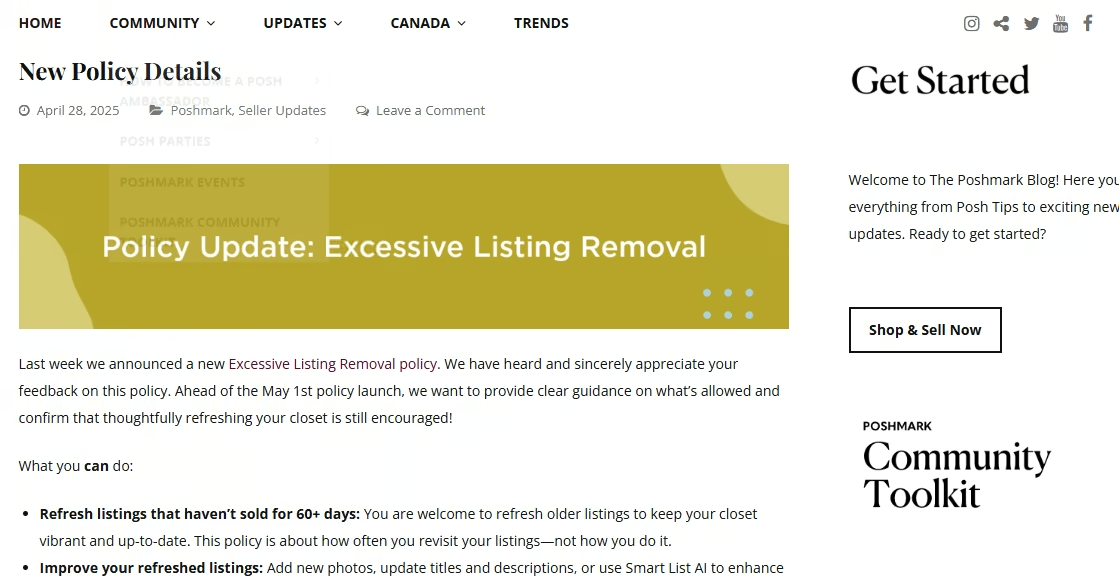
The policy was intended to clean up search results and discourage bots. The execution was a mess. The platform did not define what constituted “excessive” or “mass.” Multiple sellers who deleted items because they had sold them on eBay or Depop, a legal, common cross-posting practice, found themselves suspended anyway. One seller named Katie told Modern Retail she had been suspended for deleting four items she sold on eBay. She said she “certainly didn’t delist a mass amount of listings.”
A Reddit user wrote:
“The only things I delisted were items that sold elsewhere. So overall, nothing abnormal.”
They had been suspended. Poshmark’s own blog post from April 28 explicitly stated: “If your item sells elsewhere or is out of stock, you can delete it from Poshmark.” The policy and the enforcement didn’t match.
One seller who had been on the platform for seven years and asked to remain anonymous put it to Modern Retail this way:
“I do find the vague rules a bit much. How many delists of stale inventory constitutes excessive?”
In November 2025, a technical incident caused mass listing deletions across accounts that used third-party tools. Sellers who had done nothing wrong woke up to find their inventories gone and their accounts suspended. The cause turned out to be a security issue involving third-party access, but Poshmark’s response was slow and communication was thin.
Also in late 2025, Value Added Resource13 stated that Poshmark quietly updated its cancellation policy without announcing the change. The updated policy added language about “timely shipping” and warned that repeated cancellations could result in “temporary account restrictions” and eventually “permanent account suspension.” The change had no public announcement. Sellers discovered it when they started receiving suspensions. Independent investigation via the Wayback Machine showed the language hadn’t been there as recently as August 2025.
Sellers took to the phrase “rug pull” to describe the cumulative experience. They weren’t wrong.
The Naver Complication
The larger backdrop to all of this is a platform in transition that has struggled to be honest about what that transition means for the people who built it.
According to Reuters14, Poshmark was acquired by South Korean internet giant Naver in January 2023 for $1.2 billion. At closing, founder Manish Chandra said he was “thrilled.” Naver’s CEO cited AI recommendations, search capabilities, and e-commerce tools as areas where the company would enhance Poshmark’s platform. The companies talked about becoming an industry leader in livestreaming commerce.
What happened instead was a slow executive exodus. By late 2025, Chandra had stepped down as CEO, co-founders Chetan Pungaliya and Tracy Sun had left the company, and Naver’s President of Investments, Namsun Kim, had taken the executive chairman role. Poshmark also brought in a first-ever Chief Product Officer, Heather Friedland, an alum of eBay and Glassdoor. The founding team was effectively gone. Naver was steering.
With Naver more directly in control, the policy changes accelerated. Promoted listing fees went up. New restrictions on seller behavior multiplied. The platform began hosting its own live selling shows with staff running closets for large brand partners. A move sellers described publicly as Poshmark “competing against us.”
In January 2026, Poshmark acknowledged the problem. The platform launched something called Posh Preview, a quarterly update format designed to give sellers advance notice of changes. It was a direct response to complaints that policies were appearing without warning and that enforcement was happening before anyone knew the rules. As the AIM Group15 noted, Poshmark had 5.1 million active sellers and 7.9 million active buyers in early 2025. The gap between those two numbers, more sellers than buyers on a peer-to-peer platform, is a structural pressure that explains a lot about why Poshmark keeps trying to solve a fee problem it can’t actually solve.
The 20% seller fee was always the number everyone complained about. It was high. Mercari, Depop, and eBay were all moving away from comparable fees. Poshmark’s October 2024 experiment was a direct response to competitive pressure. The platform had been working on the new structure, a spokesperson told Modern Retail, for more than a year.
But here is the problem Poshmark has never publicly addressed: the 20% fee exists because someone has to pay for authentication, buyer protection, dispute resolution, customer support, and the platform itself. When you cut the seller fee without finding a genuine new revenue source, you are not lowering fees. You are moving them. And if you move them to buyers in a price-sensitive secondhand marketplace, buyers leave.
Mercari tried exactly the same thing in March 2024, eliminating seller fees and replacing them with buyer fees. The experiment failed within two months. Poshmark knew this. A spokesperson even acknowledged the competitive context. They launched anyway. The outcome was predictable and predicted, by the sellers themselves, in real time, in public forums, while the experiment was still running.
The authentication fee dispute is, in this sense, a story about a platform that knows what its sellers think but often moves as if it doesn’t. When the move fails, the platform reverses course and calls the reversal a win for community responsiveness. What it rarely does is engage with the underlying mechanics before the damage is done.
One seller in a ChannelX comment thread put it as plainly as anyone:
“How unethical! I’ve purchased before from Poshmark, but no more! This new fee for buyers is atrocious. Sellers will be making less because we aren’t buying now! I’ll bet you didn’t ask buyers and sellers about this before assessing.”
They almost certainly didn’t. Or they did and proceeded anyway. The result was the same either way.
What Sellers Are Left With
According to NRF16, Poshmark is still the largest peer-to-peer fashion resale marketplace in the United States. It has over 130 million registered users and sellers have moved over 300 million items on the platform. It has real infrastructure, real buyer protections, and a real authentication process that catches genuine counterfeits. None of that is nothing.
But the period between October 2024 and early 2026 has left a community in a position of structural distrust. Sellers who built entire businesses on the platform, who set prices, cultivated follower bases, and built reputations over years, now operate knowing that the rules can change without warning, that the enforcement of those rules can outpace the announcement of them, and that when something goes wrong with authentication, there is no clear path to contest it.
A seller on Trustpilot summarized it in a line that has aged badly for Poshmark:
“I’ve been selling on Poshmark for about 5 years and didn’t run into issues until this year. In addition to increasing shipping fees which is deterring as both a buyer and seller, their customer support is horrible.”
Another seller on Reddit tracked her own numbers:
“My February 2025 was half of what it was last year. I haven’t sold anything in March. Last year was $900 that month alone.”
These are not outliers. They are what happens when a platform designed around community trust treats policy changes as A/B tests.
The Posh Authenticate program is a genuine asset. The authentication fee dispute of October 2024 was a genuine mistake. But the deeper problem is the gap between Poshmark’s stated commitment to sellers and what sellers actually experience when the platform decides to move quickly and course-correct later. Nineteen days of bad fees, three weeks of lost sales, a reversal, an apology, and no refund for buyers who paid the fee the company called a failure.
That is not a community platform. That is a landlord raising rent on tenants who have nowhere to go.
Sources
- Waldow, Julia. “‘Buyers are going to leave’: Poshmark sellers are irate about the new fee structure” 7 Oct. 2024, www.modernretail.co/technology/buyers-are-going-to-leave-poshmark-sellers-are-irate-about-the-new-fee-structure/. Accessed 30 June 2026. ↩︎
- Steiner, Ina. “Poshmark Cuts Seller Fees, Adds Buyer Fees” EcommerceBytes, 5 Oct. 2024, www.ecommercebytes.com/2024/10/05/poshmark-cuts-seller-fees-adds-buyer-fees/. Accessed 30 June 2026. ↩︎
- Morton, Liz. “Poshmark Rethinks New Fee Structure Split Between Sellers & Buyers After Only 2 Weeks” 16 Oct. 2024, www.valueaddedresource.net/poshmark-rethinks-new-fee-structure/. Accessed 30 June 2026. ↩︎
- Dawson, Chris. “Poshmark fee update to boost seller earnings” ChannelX, 3 Oct. 2024, channelx.world/2024/10/poshmark-fee-update-to-boost-seller-earnings/. Accessed 30 June 2026. ↩︎
- Waldow, Julia. “‘Buyers are going to leave’: Poshmark sellers are irate about the new fee structure” 7 Oct. 2024, www.modernretail.co/technology/buyers-are-going-to-leave-poshmark-sellers-are-irate-about-the-new-fee-structure/. Accessed 30 June 2026. ↩︎
- “Posh Authenticate” poshmark.com/posh_authenticate. Accessed 30 June 2026. ↩︎
- BBB, Better Business Bureau, www.bbb.org/us/ca/redwood-city/profile/consignment-clothes/poshmarkcom-1116-442251/complaints. Accessed 30 June 2026. ↩︎
- Purse Blog, forum.purseblog.com/threads/bought-a-fake-from-posh.1065733/. Accessed 30 June 2026. ↩︎
- “Customer Support Center” support.poshmark.com/s/article/663399974?language=en_US. Accessed 30 June 2026. ↩︎
- “Authentication of Designer Items (under $500)” Authentication Of Designer Items Under 50, poshmark.com/listing/Authentication-of-Designer-Items-under-500-55beaa30a06f802641013d3d. Accessed 30 June 2026. ↩︎
- Barkho, Gabriela. “Poshmark reverses new fee structure after seller backlash” 21 Oct. 2024, www.modernretail.co/operations/poshmark-reverses-new-fee-structure-after-seller-backlash/. Accessed 30 June 2026. ↩︎
- “New Policy Details” Poshmark, 28 Apr. 2025, blog.poshmark.com/2025/04/28/new-policy-details/. Accessed 30 June 2026. ↩︎
- Morton, Liz. “Poshmark Stealth Cancellation Policy Change Leads To Seller Restrictions Without Warning” 12 Dec. 2025, www.valueaddedresource.net/poshmark-stealth-cancellation-policy-update/. Accessed 30 June 2026. ↩︎
- “Reuters.Com” www.reuters.com/markets/deals/skoreas-naver-says-it-will-acquire-poshmark-us-16-bln-2022-10-03/. Accessed 30 June 2026. ↩︎
- 30 Mar. 2026, aimgroup.com/2026/01/28/new-poshmark-previews-aims-to-quell-seller-discontent/. Accessed 30 June 2026. ↩︎
- “Poshmark’s new take on secondhand retail” nrf.com/blog/poshmarks-new-take-secondhand-retail. Accessed 30 June 2026. ↩︎


