

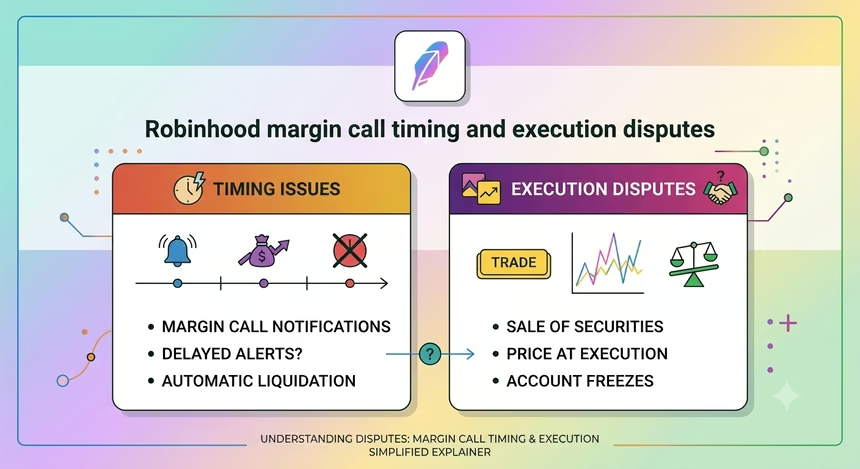

I keep coming back to one sentence, buried in a PDF nobody reads before they click “I agree.” Robinhood’s1 own margin disclosure statement tells you, in capital letters, that the company can sell your securities without warning you first. Not might. Can. The document goes further. It says you are not entitled to choose which asset gets sold. You are not entitled to extra time. You are not even entitled to a phone call.
I read that language and thought about how strange it is that millions of people signed something like that without blinking, on a phone, standing in line for coffee, thumb moving faster than judgment. That’s the real story here. Not that Robinhood breaks rules. Mostly it doesn’t. The story is what happens in the gap between what the contract allows and what a person reasonably expects, and how that gap gets measured in minutes and dollars when a position gets liquidated at a price nobody chose.
A Sale that Already Happened Before You Knew It Started
Start with a case that shows up in a legal Q&A thread rather than a courtroom, which is where most of these disputes actually live. A user described getting a warning in September 2024 that Robinhood needed a negative balance covered by a certain date or the firm would step in and liquidate the account’s holdings. On the date given, Robinhood tried. The sale failed. No notice came through. A day later a system message reported the liquidation had been “rejected by the market.” Hours after that, an email arrived saying the opposite, that the sale had gone through fine and no further action was needed. The account owner believed the account was settled. It wasn’t. According to Just Answer2, more than a month later, Robinhood iquidated the position anyway, with no new warning, according to the account of the dispute posted to a consumer legal help site.
I want to be careful here, because I can’t verify every detail of one person’s account beyond what’s published. But the shape of that story rhymes with a pattern that shows up again and again in complaints filed with the Better Business Bureau3, where customers describe frozen funds, contradictory messages, and an app that will not let you speak to a human being when the number on the screen is your own money. One filer wrote about a five-figure deposit reversed without a clear explanation, weeks of “inconsistent explanations,” and a support system built almost entirely around chat windows and email queues. Another described a locked account holding thousands of dollars in limbo with, in their words, no phone number and no online resolution path.
None of this is technically a violation. That’s what makes it interesting to me as a writer, not just as someone annoyed on behalf of strangers. The contract permits the behavior. The dispute isn’t about whether Robinhood broke the rules. It’s about whether the rules were ever built to give a person a fair shot at protecting their own money.
The Mechanics, Plainly
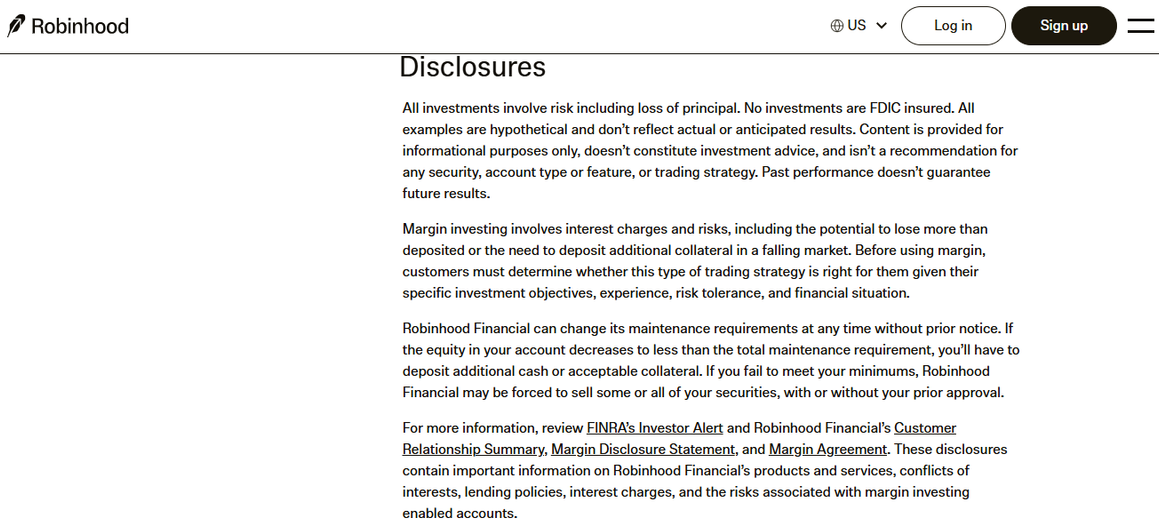
Here’s how a margin call actually works on the platform, stripped of jargon. You borrow against your portfolio to buy more than your cash alone would allow. If the value of your holdings drops and your equity falls below what Robinhood calls the “maintenance requirement,” you’re in a call. Robinhood’s4 own support documentation states plainly that the company can change that maintenance requirement at any time, without prior notice, and if you don’t bring your account back into line, Robinhood “may be forced to sell some or all of your securities, with or without your prior approval.”
Read the futures side of the business and the language sharpens further. Robinhood Derivatives “retains the right to cancel orders and liquidate your positions at any time, without prior notice,” according to Robinhood’s5 futures margin call guidance. Futures margin calls get issued at night, after the trading session closes, based on a settlement price that has nothing to do with where the market closed. You can check your app, see positive buying power, and still be sitting inside an unresolved call, because the call is calculated off the previous day’s numbers while your buying power updates in real time. Two clocks, running on different tracks, and only one of them is visible to you at any given moment.
That mismatch is the whole ballgame. A customer can do everything right by the information in front of them and still get liquidated, because the information in front of them was never the whole picture.
I don’t want to lean on tragedy to make a point, and I’m not going to spend paragraphs on it. But it would be dishonest to write about margin call miscommunication on this platform and skip the case that forced Robinhood to change its own systems.
In June 2020, a twenty-year-old college student named Alex Kearns saw his Robinhood account showing a negative cash balance of $730,000. He had been trading a multi-leg options strategy, and the number displayed was, according to CNN’s6 reporting at the time, a temporary artifact of how the app displayed unsettled trades rather than money he actually owed. He emailed Robinhood’s support address three times that night. He got automated replies. Hours later, a message went out demanding he take “immediate action” and pay over $170,000 within days, as later detailed in CBS News’s7 investigation. He died that night. The next day, Robinhood sent an automated email telling him, “Great news,” that his margin call had been resolved.
His family’s lawsuit alleged the company’s interface and its automated communications misled him into believing he faced a debt that didn’t exist. Robinhood settled with the family and pledged changes to how it displays account information and handles escalations. I bring this up not because every margin dispute carries this weight, almost none do, but because it establishes something important for everything that follows: Robinhood’s own regulator later found, independently, that the company had a documented, sustained problem telling customers the truth about their account status.
What the Regulators Actually Found
In June 2021, the Financial Industry Regulatory Authority fined Robinhood roughly $70 million, the largest penalty the organization had ever levied against a member firm, according to CNBC’s8 report on the settlement. Of that, $57 million was a fine and nearly $13 million went to restitution for customers. FINRA’s finding wasn’t vague. The regulator said Robinhood had, since 2016, given customers false or misleading information covering exactly the categories that matter for this story: whether they could trade on margin, how much cash sat in their accounts, how much buying power they had, and whether they faced a margin call at all, as laid out in FINRA’s own statement carried by CBS News9.
According to Bloomberg10, following a state regulatory probe triggered by 2020 service disruptions, Robinhood will pay up to $10.2 million to settle claims regarding technical and operational shortcomings.
A multistate task force led by Alabama’s securities regulator investigated Robinhood’s operations between late 2019 and early 2021 and found what a Maryland securities commissioner’s order describes as deficiencies in how the firm supervised margin trading eligibility and approval, plus a failure to report tens of thousands of customer complaints to FINRA as required. Tens of thousands. That number is the part I keep sitting with. It suggests the individual stories, the BBB posts, the legal forum threads, aren’t outliers bumping up against an otherwise clean system. They’re samples pulled from a much larger, mostly invisible pile.
There’s a second kind of execution dispute that doesn’t involve any individual account falling below a maintenance requirement. It’s what happened in January 2021, when GameStop and a handful of other stocks became the center of a retail trading frenzy fed by the Reddit community r/WallStreetBets. On January 28, Robinhood restricted purchases, though not sales, of GameStop and several other volatile names. Users could get out. They could not get in, and in many cases could not add to positions they already held while the price was moving fastest.
Robinhood’s own securities filings describe the cause as “unprecedented market volatility and related portfolio margin demands imposed on RHS by the clearinghouse,” meaning the National Securities Clearing Corporation had demanded a massive increase in collateral from Robinhood to keep clearing trades in those names, according to the company’s registration statement filed with the SEC11. The company says it restricted trading to meet that collateral call, not to protect Wall Street short sellers, as many furious users believed at the time. Within days, roughly 49 separate class actions and three individual lawsuits had piled up against the firm, per that same filing.
One of the first came from a plaintiff named Brendan Nelson, who filed in the Southern District of New York the same day the restrictions hit, alleging Robinhood had “abruptly, purposefully, willfully, and knowingly” pulled GameStop from the app to slow its rise, according to coverage from the Expert Institute12. Multiple suits were consolidated into a multidistrict litigation. In August 2022, a federal judge ruled the case could proceed, finding the allegations cleared what she called the threshold for market manipulation claims, as reported by Forbes13. By 2024, the parties were reportedly nearing a settlement, according to trading press coverage of court filings in Miami.
I think about this case differently than I think about the individual margin call stories, but they share a root. In both situations, Robinhood made a unilateral, largely unreviewable decision about a customer’s ability to control their own position, at the exact moment that control mattered most, and the customer had no real-time way to contest it. The mechanism is different. The powerlessness is identical.
Why the Contract is Written this Way
It would be easy to write this as a simple villain story, but the incentives are more tangled than that, and I think that’s worth sitting with rather than smoothing over. Robinhood is a broker-dealer, not a bank, and when it lends money on margin, it’s carrying real counterparty risk. If a customer’s account goes deeply negative and the customer walks away, Robinhood eats the loss, not the customer’s original deposit. Regulators require firms to hold sufficient capital against exactly this risk, and the fastest way to protect that capital is the power to liquidate first and explain later.
That’s a legitimate structural reason for the contract to read the way it does. What’s harder to defend is the layer sitting on top of that structural reason, the customer experience layer, where a mobile-first platform built to gamify trading with confetti animations and instant notifications, as Forbes14 described the interface in its reporting on the Kearns case, gives customers almost no real-time visibility into which of the two clocks, buying power or maintenance requirement, actually governs whether they’re about to lose control of their account.
Securities litigation attorneys who handle these disputes describe the practical reality to prospective clients in blunt terms. One firm’s website, aimed at investors considering a claim, states that brokers decide “what and when to sell” once a margin call goes unmet, and that acting first, before the firm acts for you, is usually the only leverage a customer actually has, according to a MDF Law15. Another securities fraud blog, walking through Robinhood’s specific agreements, notes that the company holds “quite a bit of power over margin accounts” precisely because its user agreements require no advance notice for a maintenance requirement increase and no consultation before a forced sale, as described in a review of Robinhood’s margin agreement published by Savage Law16.
Legal complaint filings and lawsuits give you the outline. Forums and complaint boards give you the texture, the actual language people reach for when they think nobody official is listening. Reading through the BBB complaint archive17 for Robinhood, certain phrases repeat with a consistency that stopped feeling like coincidence somewhere around the twentieth entry. People describe funds being held “hostage.” They describe wanting to close an account and finding no button for it. They describe calling and finding no number to call, only a call-back request buried in the app.
That last detail matters more than it sounds like it should. During its 2024 settlement with a multistate task force of securities regulators, Robinhood disclosed that its internal target was to call customers back within thirty minutes of a support request, and that a senior compliance official is briefed on that metric regularly, according to the Maryland order18. Thirty minutes is a fine target for a routine account question. It is an eternity when a margin call is actively liquidating positions on a market moving by the second, and it’s an eternity Alex Kearns didn’t get the chance to test, because there was no number to call at all in 2020.
The Part Nobody Wants to Say Out Loud
Here’s my own honest read on this, for whatever it’s worth, and I’ll own it as mine rather than pretend it’s settled fact. A company that built its brand on commission-free trading, on stripping friction out of investing so a nineteen-year-old with a part-time paycheck could feel like a Wall Street player, was never going to build a support and disclosure system suited to the seriousness of margin trading. Speed was the entire pitch. Removing friction is the same thing as removing the pause where a person might have caught their own mistake, or caught Robinhood’s.
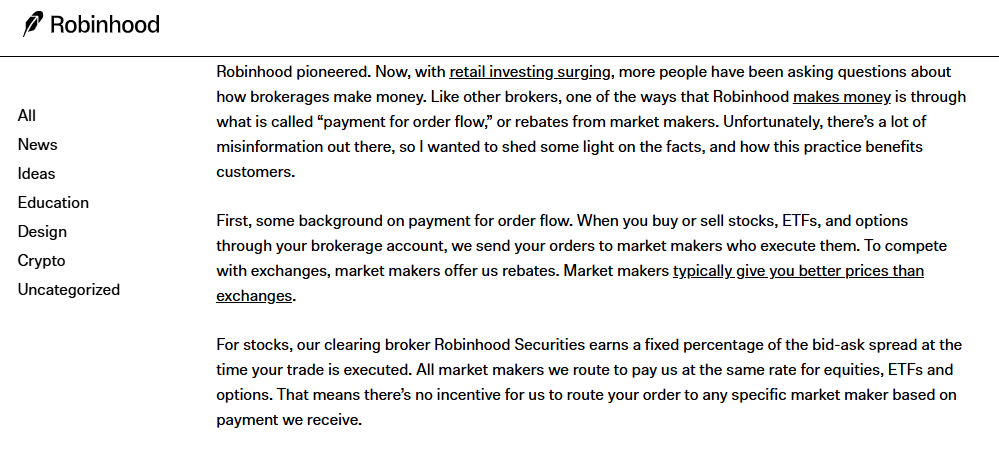
Free trades were never actually free. Robinhood makes money largely through payment for order flow, a practice that drew its own separate string of lawsuits and disclosures, per the ongoing docket tracked by ClassAction.org19. The cost of “free” showed up somewhere else, in interface choices, in support wait times, in a maintenance requirement that can move without warning. Somebody always pays. On this platform, it’s frequently the person who finds out, after the fact, that the sale already happened.
I don’t have a tidy ending for this one, and I’m not sure it deserves one. Robinhood has made real changes since 2020. It added a customer support phone line. It adjusted how options and margin balances display. It paid its fines and its restitution and it kept growing anyway, because for most users, most of the time, none of this ever comes up. The failure mode is rare. It’s also completely unpredictable from the inside of any single account, right up until it isn’t.
What stays with me is the asymmetry built into the fine print, the fact that a company can tell you, in advance, in writing, that it owes you no warning before it sells what’s yours, and that this disclosure functions as full legal cover no matter how confusing the interface built on top of it turns out to be. The contract says one thing. The app, with its instant notifications and real-time numbers that don’t actually reflect your real-time risk, implies another. Somewhere in that gap is where every one of these disputes lives, and I don’t think it closes just because a fine gets paid.
Sources
- “RHF and RHS Margin Disclosure Statement” 27 Aug. 2026, cdn.robinhood.com/assets/robinhood/legal/cdn.robinhood.com/assets/robinhood/legal/RHF%20and%20RHS%20Margin%20Disclosure%20Statement.pdf. Accessed 10 Sept. 2026. ↩︎
- “Justanswer.Com” www.justanswer.com/consumer-protection-law/tse2m-robinhood-unauthorized-asset-liquidation.html. Accessed 11 Sept. 2026. ↩︎
- Better Business Bureau, www.bbb.org/us/ca/menlo-park/profile/financial-services/robinhood-1116-881958/complaints. Accessed 10 Sept. 2026. ↩︎
- “What does it mean if I get a margin call?” Robinhood, robinhood.com/us/en/support/articles/margin-calls/. Accessed 11 Sept. 2026. ↩︎
- “Futures deficits and margin calls” Robinhood, robinhood.com/us/en/support/articles/futures-deficits-and-margin-calls/. Accessed 11 Sept. 2026. ↩︎
- “CNN International” CNN International, www.facebook.com/cnninternational/posts/a-20-year-old-college-student-died-by-suicide-last-summer-after-he-saw-a-negativ/10159101100064641/. Accessed 12 Sept. 2026. ↩︎
- Dokoupil, Tony. “Alex Kearns died thinking he owed hundreds of thousands for stock market losses on Robinhood. His parents have sued over his suicide.” CBS News, 8 Feb. 2021, www.cbsnews.com/news/alex-kearns-robinhood-trader-suicide-wrongful-death-suit/. Accessed 11 Sept. 2026. ↩︎
- Fitzgerald, Maggie. “Robinhood to pay $70 million for outages and misleading customers, the largest-ever FINRA penalty” 30 June 2021, www.cnbc.com/2021/06/30/robinhood-to-pay-70-million-for-misleading-customers-and-outages-the-largest-finra-penalty-ever.html. Accessed 11 Sept. 2026. ↩︎
- Kaplan, Michael. “Financial regulator hits Robinhood for $70 million for “widespread and significant harm” to customers” CBS News, 1 July 2021, www.cbsnews.com/news/robinhood-finra-70-million-fine/. Accessed 11 Sept. 2026. ↩︎
- “Bloomberg” Robinhood will pay as much as $10.2 million in…, www.facebook.com/bloombergbusiness/posts/robinhood-will-pay-as-much-as-102-million-in-penalties-for-operational-and-techn/650895023563261/. Accessed 12 Sept. 2026. ↩︎
- “SEC.gov”, www.sec.gov/Archives/edgar/data/1783879/000162827921000185/filename1.htm. Accessed 11 Sept. 2026. ↩︎
- Expert Institute, www.expertinstitute.com/resources/insights/robinhood-hit-with-class-action-lawsuit-after-restricting-gamestop-trading/. Accessed 11 Sept. 2026. ↩︎
- “Forbes.Com” 11 Aug. 2022, www.forbes.com/sites/dereksaul/2022/08/11/class-action-suit-moves-forward-against-robinhood-over-halting-meme-stock-trading/. Accessed 11 Sept. 2026. ↩︎
- “Forbes.Com” 17 June 2020, www.forbes.com/sites/sergeiklebnikov/2020/06/17/20-year-old-robinhood-customer-dies-by-suicide-after-seeing-a-730000-negative-balance/. Accessed 11 Sept. 2026. ↩︎
- “You May be Able to Recover Your Options Trading Losses” MDF Law, mdf-law.com/practice-groups/financial-advisor-negligence/margin-disputes/. Accessed 12 Sept. 2026. ↩︎
- SEO, Growth Lab. “Margin Investing with Robinhood – Do the Risks Outweigh Rewards?” April 12, 2021, 12 Apr. 2021, savagelaw.us/blog/margin-investing-with-robinhood-do-the-risks-outweigh-rewards/. Accessed 12 Sept. 2026. ↩︎
- Better Business Bureau, www.bbb.org/us/ca/menlo-park/profile/financial-services/robinhood-1116-881958/complaints. Accessed 12 Sept. 2026. ↩︎
- 28 May 2024, oag.maryland.gov/i-need-to/Documents/pdfs/Securities/2024/oag.maryland.gov/i-need-to/Documents/pdfs/Securities/2024/20220171_Robinhood_CO_012624.pdf. Accessed 12 Sept. 2026. ↩︎
- Classaction.org, www.classaction.org/news/category/robinhood-financial-llc. Accessed 12 Sept. 2026. ↩︎


