

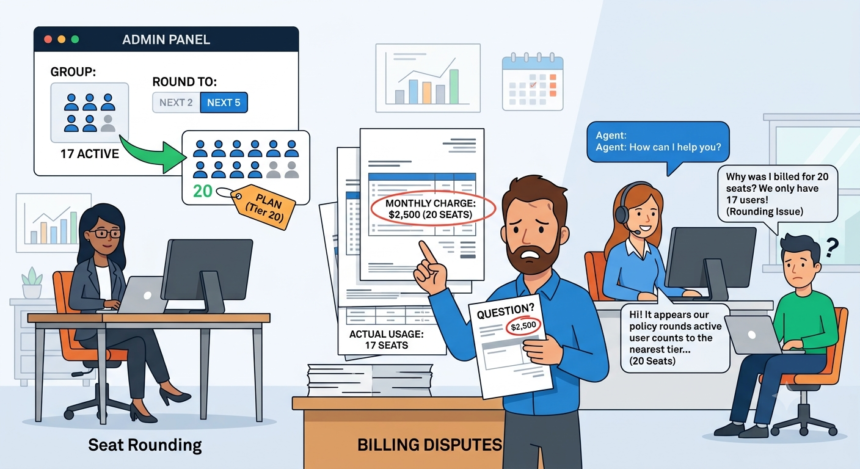

I started this piece the way I start most of these pieces. Somebody sent a screenshot of an invoice from Intercom, the customer messaging company that support teams love and finance teams have learned to fear. The number at the top did not match the number the customer expected. Nobody had done anything wrong, not exactly. And that is the story. Not fraud. Arithmetic that nobody agreed to in plain language.
Intercom sells seats. A seat is a login, a person on your support team who can see and answer a conversation. It sounds like the simplest unit in software pricing. You have twelve agents, you buy twelve seats, you pay for twelve seats. But the seat is where Intercom’s billing model gets its hooks in, because a seat is never really a fixed number. People get hired mid-month. People leave. People get moved onto a project and off the support queue for six weeks. And Intercom, like most seat-based software, has to decide what happens to the fraction of a seat that a person actually used. That decision, repeated across thousands of workspaces, is where the disputes start.
What a Seat Actually Costs
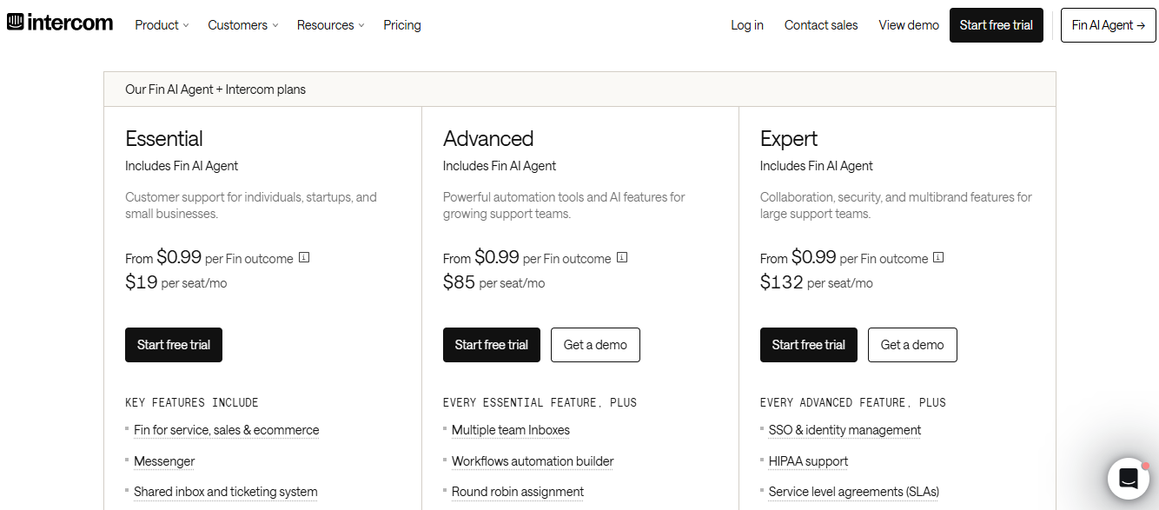
The headline numbers are simple enough. Intercom runs three tiers of its Customer Service Suite. Essential lists at $29 a seat on an annual plan, or $39 month to month. Advanced runs $85 annual, $99 monthly. Expert is $132 annual, $139 monthly, according to Intercom’s pricing FAQ1 and independent trackers who audit the live pricing page regularly. Every plan comes bundled with Fin, Intercom’s AI agent, but Fin is billed on top, separately, at 99 cents per resolved outcome, with a floor of about fifty resolutions a month for standalone deployments, roughly $49.50 before you’ve done anything else.
That second number, the Fin number, is the one most writers have chased this year, and for good reason. Aimdoc2 documented a legacy customer whose bill rose from $119 to $854 a month after migrating onto the new AI-priced model, and a third case where a team projected a jump from $1,200 to $10,000, according to a breakdown of Fin’s resolution pricing. I am not here to relitigate Fin. Other people have done that math well. I am here because underneath the AI story sits an older, quieter one. The seat.
Here is the part of Intercom’s billing terms that most customers never open until they are angry. If you sign a contract, meaning you are not on the self-serve monthly plan but have negotiated a term with an account manager, Intercom’s terms state plainly that the company will bill for “the full number of seats agreed upon, even if you do not use all of them,” according to Intercom’s3 own help article on contract billing. That is not a bug or a rounding error. It is the point. A contract is a commitment, and Intercom treats the seat count in that contract as a floor, not a ceiling, and definitely not a live headcount tracker. If you contracted for twenty seats and only staffed sixteen for three months while you hired, you paid for twenty.
The same logic shows up in the legal terms of service, where the company writes that seat-based subscription fees get prorated when a contracted quantity changes mid-period, but that overages, meaning any seat you activate beyond your committed number, are billed as additional usage and are non-refundable once incurred, per Intercom’s terms and policies4. Add a seat on day two of a thirty-day cycle and you pay for twenty-eight days of it. Remove a seat on day two, and depending on whether you are contracted or self-serve, you may or may not see that credit until the following invoice.
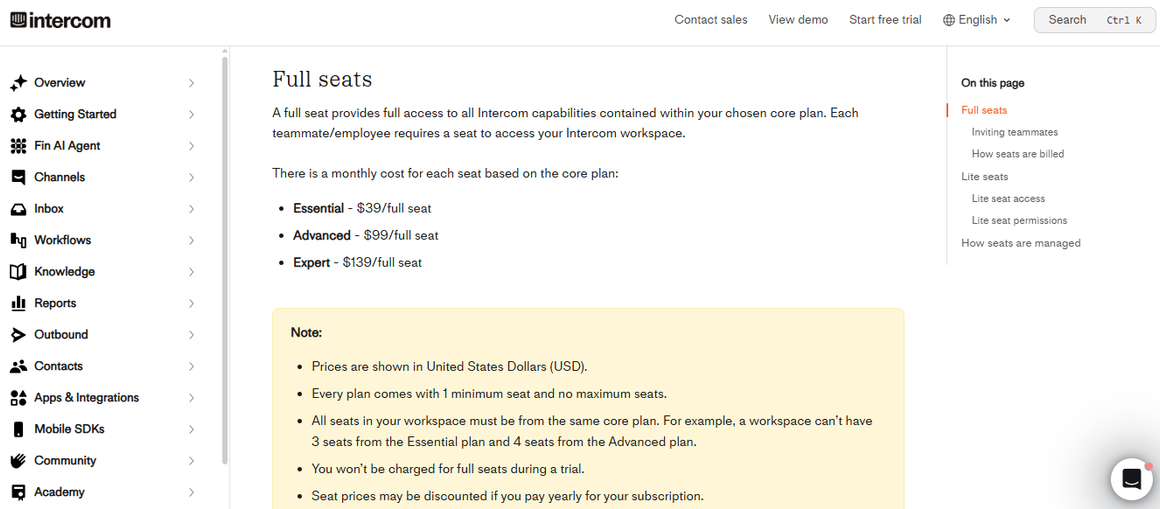
I want to be precise here, because Intercom’s documentation is actually more transparent than most vendors I have covered. Intercom’s5 seats help article walks through the exact mechanics with an example. Start the month with one Essential seat at $39. Add five seats on day fourteen. You pay only for the days those five seats were active, and the charge shows up as a proration on the following invoice, not the current one. Reassigning a seat from one teammate to another costs nothing extra, as long as you stay within your paid total. Remove a full seat and you get a prorated credit, though the credit is described as “not refundable,” only usable to offset a future bill, according to the same billing FAQ.
None of that is deceptive on its face. It is standard proration math, the kind every SaaS vendor with per-seat billing runs. The trouble is that the math only becomes visible to a customer after the invoice lands, and the invoice and the in-app subscription page do not always agree. Intercom’s own documentation admits this directly. “If you change your seat count mid-period, the estimated seat cost on the Subscription page and the actual invoice won’t match,” the seats article states, because the dashboard shows your most recent seat count while the invoice reflects actual usage days. That gap, small as it sounds, is exactly where a finance team spots a number it did not forecast and starts asking questions nobody in the support org can answer.
The billing dispute I keep coming back to is not about Fin at all. It is a short, plaintive post buried in Intercom’s own community forum6, from a customer who signed up late one night in July, expecting the standard fourteen day trial window most software runs, and got billed before that window closed by their own count. The post lays out the timeline with the specificity of someone who has already done the math twice. They signed up at roughly 11:40pm on the eighteenth. The charge landed in the early hours of August first. By the customer’s count, that skipped the safety margin they thought the trial promised.
After describing an earlier attempt to reach support that went nowhere, they wrote:
“I am disheartened as I do not feel heard here.”
What happened next tells you something about how these disputes actually get resolved, or don’t. A community moderator, not an Intercom billing employee, replied that the forum could not touch account specific billing questions and pointed the person back toward direct support. That is a structural problem as much as a customer service one. The place where users go to compare notes on a strange charge is explicitly not the place with the authority to fix it. The actual seat and billing team lives behind the in-app Messenger, one on one, invisible to the next person who searches for the same problem and finds only a dead end.
The Fin Resolution Problem
I promised not to relitigate the Fin pricing debate, but one thread of it matters here because it is the same argument wearing a different unit. Intercom’s community has hosted a discussion, referenced across several pricing trackers, titled bluntly about Fin’s “assumed resolved” logic, where paying customers argue that a human agent stepping in to rescue a bad AI conversation can still get logged, and billed, as a resolution the bot achieved on its own. One operator who shared their dashboard in that community reported confirmed resolutions running around six to seven percent of total volume, with assumed resolutions closer to sixty percent, meaning the category carrying almost all the billing weight was the one where nobody actually confirmed the outcome.
I bring this up not as a tangent but because it is the exact same shape as the seat dispute. In both cases, Intercom has built a billing unit, a seat or a resolution, that looks countable and objective from the outside. And in both cases, the actual event triggering the charge, a person accepting an invite or an AI closing a chat, gets counted in the company’s favor by default, and the customer has to notice, dispute, and prove otherwise to get it corrected. The seat is binary. Either you paid for it or you did not. But the moment the seat gets activated, deactivated, reassigned, or contracted for more than you staff, the binary becomes a negotiation, and the negotiation happens on Intercom’s clock, not yours.
A Reddit user posting in r/AIStartupAutomation summarized the frustration in a way that stuck with several of the pricing writers I read while reporting this.
One of them wrote, in a comment collected by Comms Advisor7:
“The tech is great, but the pricing is an absolute joke for small businesses.”
On Hacker News, one commenter described dropping Intercom entirely over a counting dispute that had nothing to do with seats directly but everything to do with the same instinct, that the company counts in whatever unit maximizes the bill. In their case, quoted in Costbench, the issue was that the platform counted every visitor shown a form, not every visitor who actually engaged with it. Trustpilot reviewers collected in the same audit complained separately about slow support response times from a company that sells support software for a living, one calling it “extremely slow to get support from them.”
None of these voices are talking about the same line item. One is Fin. One is form impressions. One is seats. But read together, across a year of Reddit threads, G2 reviews, and forum posts, the pattern holds. It is not that Intercom’s pricing is secretly predatory. Multiple analysts who have gone through the terms line by line, including the team at ClearFeed8, conclude that the model is not deceptive so much as layered, built from seats, Fin outcomes, add-ons, and channel usage that each behave reasonably in isolation and unpredictably in combination. The seat, the oldest and simplest of those layers, is the one customers assume they already understand, which is exactly why it produces the most personal, most aggrieved disputes when it does not behave the way they expected.
The Contract Trap
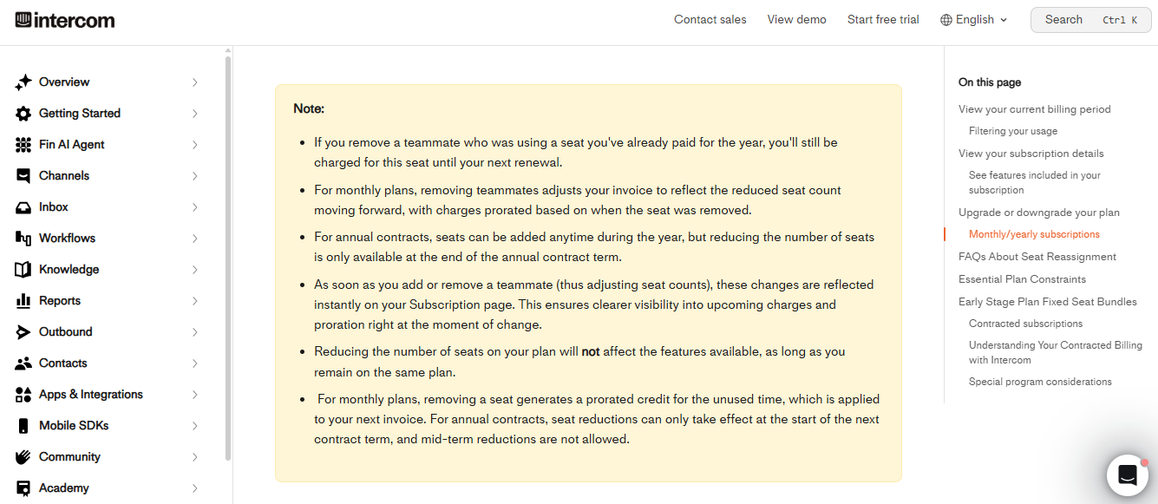
Talk to anyone who has negotiated an enterprise deal with Intercom and you will hear a version of the same warning. Once you sign a contract for a fixed seat count, you have effectively pre-purchased headcount you may not staff evenly across the term. Intercom’s billing help pages are honest about this, more honest than most vendors bother to be, stating that seat reductions on annual contracts can only take effect at the start of the next term, and that mid-term reductions are simply not allowed, per Intercom’s9 subscription management guide. If your support team shrinks in month four of a twelve month contract, you keep paying for month twelve’s staffing level until renewal.
The company’s suggested remedy, tucked into its own contract billing article, is almost apologetic in tone. It recommends customers “consider removing unused seats where permissible, reviewing your contract terms for errors, and switching to a flexible plan if needed,” which is a reasonable list of options that all require the customer to notice the mismatch first and then do the work of unwinding it, usually through an account manager rather than the self-serve dashboard available to month to month customers. That asymmetry, self-serve customers can fix their own seat count in a few clicks, contracted customers need a human on Intercom’s side to approve every change, is where a lot of the friction in these disputes actually lives. It is not the rounding rule itself that makes people angry. It is discovering that fixing the rounding requires an email and a wait.
I want to widen the lens for a moment, because it would be unfair to write this as if Intercom invented the seat dispute. Seat based billing produces the same argument on nearly every platform that uses it. A user on Figma’s own support forum ran into an almost identical situation after accidentally assigning a colleague to a more expensive Dev Mode seat instead of a standard Design seat, then reverting it within minutes. The seat had not actually been used in its more expensive form, but the charge for the remainder of the term stuck anyway. One customer wrote in a public thread on Figma’s10 forum, when the mistake never resulted in a single minute of real use:
“It feels unreasonable to be charged for an extra Dev seat.”
A Figma staffer replied within the day, acknowledging the situation but explaining that account specific billing decisions could not be resolved in a public forum either, an answer that will sound familiar to the Intercom customer from earlier in this piece.
I mention Figma not to spread blame but to make a point about the industry. Per-seat software pricing was built for a world of stable headcount, where a company bought forty seats in January and kept forty people using them through December. That world does not exist anymore, not for support teams that flex with seasonal volume, not for design teams that shuffle contractors on and off a project, not for any team that hires and loses people the way modern companies actually do. The rounding disputes are not glitches in the system. They are the system working exactly as designed, applied to a workforce that no longer matches the assumptions the pricing model was built on.
What a Fair Fix Would Look Like
If I were advising a support ops lead heading into a renewal, and several of the pricing consultants I read while reporting this effectively are doing that job in blog form, the advice converges on a few concrete habits. Audit your actual seat usage against your contracted minimum every quarter, not just at renewal, because the gap between staffed seats and paid seats only grows quietly until someone in finance asks about it. Push for monthly rather than annual seat commitments if your team size is genuinely unpredictable, even if it costs a few points more per seat, because the flexibility of self-serve seat management is worth more than the discount in a volatile hiring year. And read the proration language in your specific order form rather than the general help center article, since Intercom’s11 terms explicitly state that contracted usage changes prorate from the effective date of the change, which means the exact date you notify your account manager, not the date you actually stopped using the seat, is what starts the clock.
None of this requires Intercom to be a villain. The company’s own documentation is more forthright about its proration mechanics than the industry average, and multiple independent reviewers give real credit to Fin’s actual performance when it is implemented well, citing case studies like Synthesia’s reported 96 percent drop in resolution time. But transparency in a help center article is not the same as transparency at the moment of signing, and a rounding rule that is technically documented somewhere is still a rounding rule that most customers discover for the first time on an invoice they did not expect.
I never did find out how the original invoice in this story got resolved. That is common in this kind of reporting. Billing disputes rarely end in a clean public statement. They end in a support ticket, a credit that shows up two invoices later, an account manager call that nobody records. What stays consistent, across the Reddit threads, the G2 reviews, the Intercom community posts, and the Figma forum entry that reads like it could have been copy pasted from any seat based platform in existence, is the shape of the complaint. Somebody thought they understood what they were paying for. The vendor’s system counted a slightly different thing. And the distance between those two numbers, whether it is a seat activated for one day or a resolution the AI claimed without proof, became the whole argument.
That is the real cost of seat based billing in 2026. Not the dollar figure on any single invoice, but the hours a support ops lead spends every quarter reconciling what her dashboard says against what her invoice says, defending a budget line to a CFO who reasonably expected a fixed number to stay fixed.
Sources
- Sher, Beth-Ann. “Pricing FAQs” Intercom Help, 27 Aug. 2026, www.intercom.com/help/en/articles/8344190-intercom-pricing-faqs. Accessed 22 Sept. 2026. ↩︎
- “Intercom Fin Pricing: What $0.99 Per Resolution Really Costs” 19 June 2026, aimdoc.ai/blog/intercom-resolution-pricing-explained. Accessed 24 Sept. 2026. ↩︎
- Sher, Beth-Ann. “Understand how billing works on contract” Intercom Help, 4 Aug. 2026, www.intercom.com/help/en/articles/9271870-understand-how-billing-works-on-contract. Accessed 24 Sept. 2026. ↩︎
- “Terms and Policies” Intercom, www.intercom.com/legal/terms-and-policies. Accessed 24 Sept. 2026. ↩︎
- Sher, Beth-Ann. “Seats” Intercom Help, 8 Sept. 2026, www.intercom.com/help/en/articles/8205716-seats. Accessed 24 Sept. 2026. ↩︎
- “How can I get a refund of an invoice that was charged on the 14th day of the trial period?” Community, 2 Aug. 2022, community.intercom.com/customer-faq-28/how-can-i-get-a-refund-of-an-invoice-that-was-charged-on-the-14th-day-of-the-trial-period-3063. Accessed 24 Sept. 2026. ↩︎
- Zhang, Owen. “Intercom Review 2026: Is It Worth $99/Month Per Seat?” Comms Advisor, 16 Sept. 2026, commsadvisor.com/intercom-review/. Accessed 25 Sept. 2026. ↩︎
- Das, Happy. “Intercom Pricing in 2026: What Are You Actually Paying For” 23 July 2026, clearfeed.ai/blogs/intercom-pricing. Accessed 24 Sept. 2026. ↩︎
- Sher, Beth-Ann. “How to manage your subscription” Intercom Help, 10 June 2026, www.intercom.com/help/en/articles/8344189-how-to-manage-your-intercom-subscription. Accessed 24 Sept. 2026. ↩︎
- Do, Hugh. “Billing Dispute: Accidental Dev Mode seat assignment on Organization Plan” Figma Forum, 27 Dec. 2025, forum.figma.com/report-a-problem-6/billing-dispute-accidental-dev-mode-seat-assignment-on-organization-plan-49038. Accessed 25 Sept. 2026. ↩︎
- “Terms and Policies” Intercom Help, www.intercom.com/legal/terms-and-policies. Accessed 25 Sept. 2026. ↩︎


