

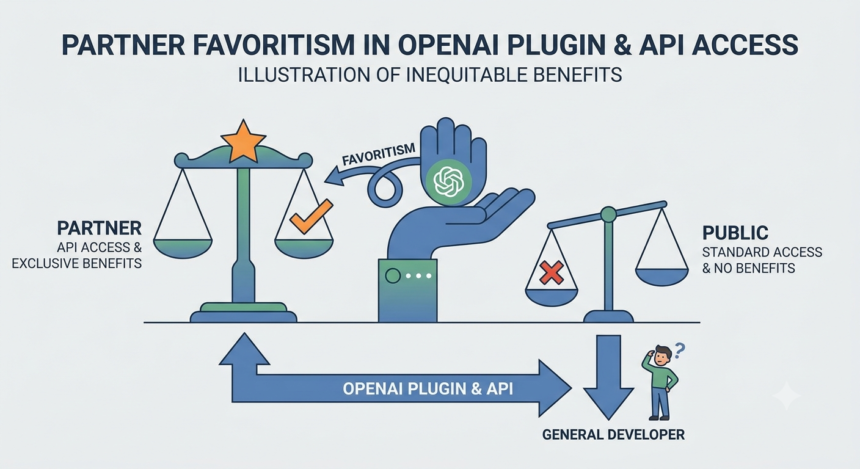

A founder posted his grievance on the OpenAI Developer Community forum1 in September 2025. He had built two products on top of OpenAI’s platform. Both times, he said, OpenAI shipped a feature that did what his product did, for free, inside ChatGPT itself. His flashcard and quiz tool, built for medical students, lost its userbase overnight when OpenAI rolled out its own study tools. He asked OpenAI six questions in public. He asked for a 90-day notice period before OpenAI competes with its own developers. He asked for revenue share. He asked, plainly, for the platform to admit what had happened to him.
Nobody from OpenAI answered. Other developers did. One told him to build on the raw API instead of a Custom GPT, because the API gives you control the Custom GPT store never will. Another called his complaint “whinning” and told him his business model was never sustainable. A third compared him to a man who paints Nike sneakers and gets angry when Nike ships the same shoe. The thread ran for a day, filled up with insults and advice, and then died the way most developer forum threads die: unresolved, unanswered by the company whose name is in the title.
That thread is a small thing. But it captures something true about how OpenAI treats the people who build on top of it. There is no single villain here, no memo ordering staff to crush the little guy. What there is, instead, is a platform that has built, layer by layer, a system where access, visibility, and survival depend enormously on who you already are. Big investors get invited in. Big cloud partners get a phone number. Big companies get the featured slot. Everyone else gets a blog post about “learnings” and a countdown clock.
I have spent weeks reading these forum threads, this trail of quiet emails and killed features, and one thing keeps striking me. Nobody at OpenAI has to say the word “favorite” out loud. The favoritism shows up in what gets built, what gets funded, and what gets a phone call back. It shows up in silence, too, in the founders who never hear from anyone at all. A platform this size doesn’t need a policy document to pick winners. It just needs to keep doing what it’s already doing, and let the compounding advantages sort themselves out.
I want to walk through how that system actually works, because it is not one policy. It is at least six, stacked on top of each other, each one defensible on its own and troubling in combination.
The Plugin Store: A Courteous Execution
In March 2023, OpenAI2 opened ChatGPT to plugins, small pieces of software that let the chatbot book a flight, order groceries, or query a database. More than a thousand were built in the following year, according to OpenAI’s own history of the feature. A handful of companies got the marquee treatment at launch: Expedia, Instacart, Kayak. Everyone else built on the same open specification, publishing a manifest file at a fixed URL and hoping ChatGPT’s plugin picker would surface their work to users.
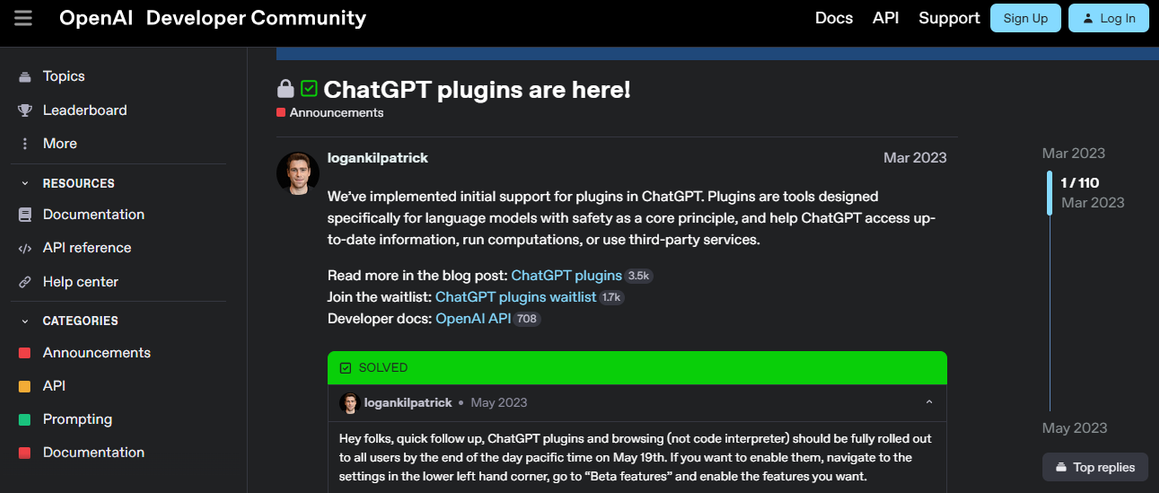
It did not go well for most of them. By late 2023, OpenAI had quietly pulled plugins off the ChatGPT home screen, making them harder to find. According to Guizmodo3, days before Christmas that year, the company emailed plugin developers and asked them to convert their work into something called a GPT instead. New plugin conversations stopped in March 2024. Old ones stopped working in April. Sam Altman had reportedly told an interviewer, months earlier, that plugins “don’t have product market fit,” a comment OpenAI later asked the publication to take down.
I don’t think there was anything sinister in ending plugins. Products get killed all the time, and a lot of those plugins really were half-finished. What stands out is the shape of the exit. The companies that got featured treatment at launch, the Expedias and Instacarts, had the leverage and the engineering teams to absorb a pivot. The developer building a niche research tool alone in the evenings did not. Both got the same form email. Only one of them had a business that could survive it.
The GPT Store: The Algorithm Has Favorites
OpenAI’s answer to the plugin mess was the GPT Store, launched in January 2024 as a marketplace for custom chatbots. Sam Altman had promised, before launch, that top creators would eventually get paid. Later, Wired4 reported that OpenAI had invited only a small, undisclosed group of developers into a monetization pilot. Josh Brent Villocido, whose Books GPT had been featured at the store’s launch, was not one of them. Most creators told Wired they had no analytics beyond a rough chat count, no clear performance data, and no idea what qualified a GPT for the “High Potential” label OpenAI had apparently assigned to some builders and not others.
The discoverability problem sits on top of the money problem. One developer, writing at Medium5, six months after the store opened, put it plainly: there is an evident bias toward big companies building GPTs. He singled out Canva’s GPT, which he considered mediocre next to what independent builders were producing, yet it stayed lodged in the trending section for months.
There is an evident bias towards big companies building GPTs. I am a huge fan of Canva but their custom GPT is subpar, and yet, it’s been cherrypicked as a trending GPT for months. I don’t blame Canva, it makes far more sense to focus on embedded AI features in their core product which generates revenue. We see so much more creativity and talent coming from individuals.
A separate review of the store’s front page found the same handful of picks sitting in the “trending” slot for so long that one reviewer, as reported by XDA6, couldn’t remember ever seeing it show anything else. There is no published ranking algorithm. There is no appeals process for a builder who thinks the store buried them unfairly. There is a featured shelf, and whoever OpenAI puts on it gets the users.
Compare that to how OpenAI treats its officially anointed partners. OpenAI’s7 Startups page lists a set of “partner” venture firms, among them Thrive Capital, Sequoia, a16z, Kleiner Perkins, and Conviction. If your startup is in one of those firms’ portfolios, OpenAI will hand you free API credits, an upgraded rate limit, and time with a solutions engineer, no pitch required. If you built your company on a bootstrap round, a small angel check, or a fund not on that list, you get the standard signup form. The favoritism, in this instance, is not even hidden. It is a documented benefit of raising money from the right people.
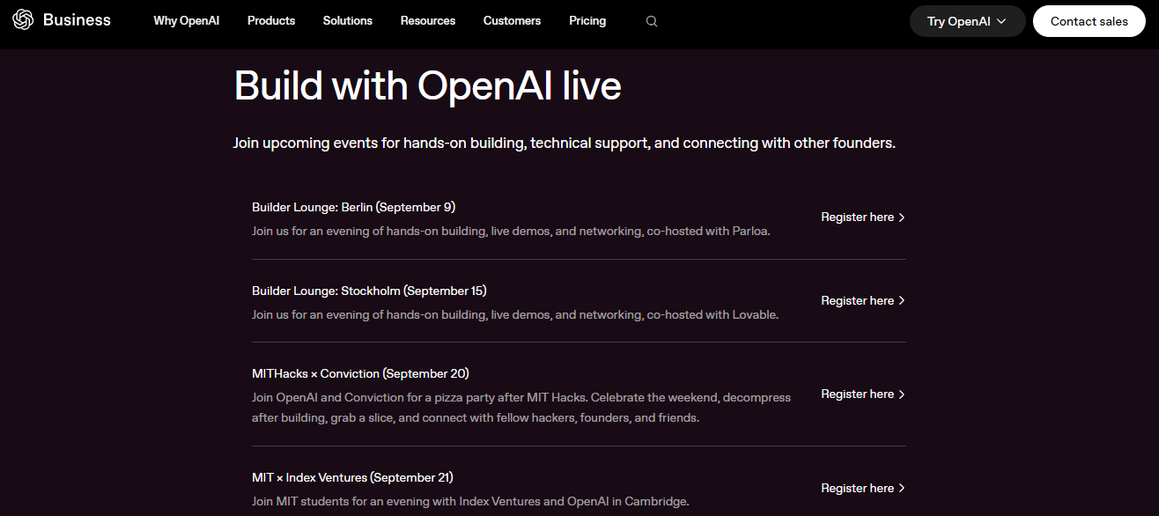
Every November, OpenAI holds a developer conference, and every November, a chunk of the developer community watches OpenAI announce a feature that makes their product redundant. After the November 2023 event, Tyler’s8 post calling it “total carnage for AI startup founders” went semi-viral, and the phrase “OpenAI just killed my startup” became something of a running joke, except that it wasn’t funny to the people living it. The 2025 DevDay prompted the same reaction from a different set of founders, this time working in the agent-building space, with commentators asking outright whether OpenAI had wiped out a slew of startups in a single afternoon.
The uncomfortable truth is that some of that carnage is just how platforms work. Anyone who builds a business entirely on top of someone else’s API takes on platform risk, and OpenAI has never pretended otherwise. But the pattern of who survives that risk and who doesn’t tracks suspiciously well with who had capital and distribution before DevDay ever started. A well-funded agent company can pivot fast, re-market, raise a bridge round. A two-person team running a Custom GPT cannot. When the platform expands into your lane, the platform doesn’t apologize. It publishes a keynote clip.
Three Ters, 150 Million Dollars, and a Velvet Rope
In June 2026, OpenAI made its most formal statement yet about who counts as a favored partner and who doesn’t. The company launched the OpenAI Partner Network9, backed by $150 million, designed to help systems integrators and consultancies sell and deploy OpenAI’s technology to enterprise clients. The network sorts partners into three named tiers, Select, Advanced, and Elite, based on sales performance and technical capability. OpenAI’s own language, reported by outlets covering the launch, says the program exists to recognize partners for the value they create and to give them the resources and support to build a business around OpenAI’s tools.
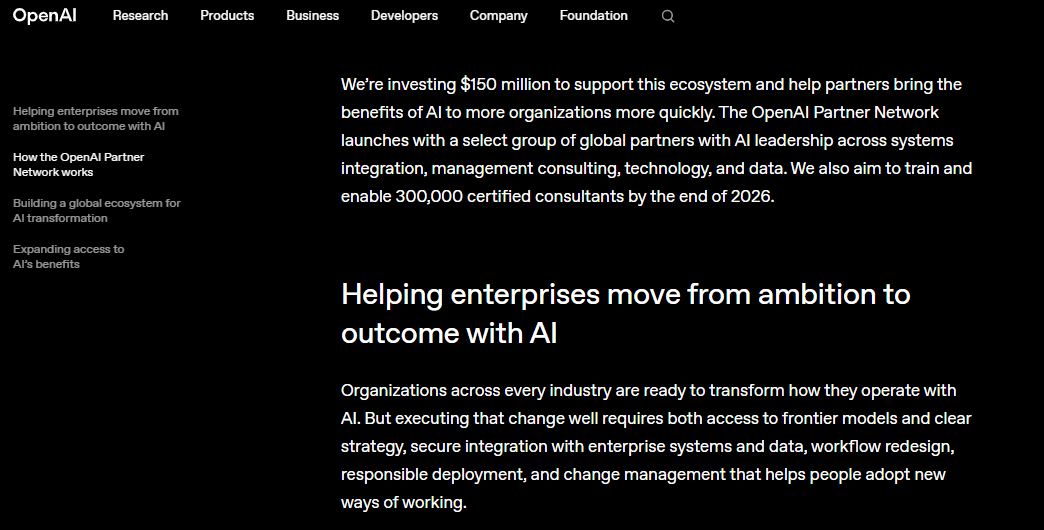
That is a reasonable thing for a company to build. Salesforce, Microsoft, and Amazon have run tiered partner programs for decades, and nobody calls it a scandal. What’s worth noticing is what the program makes explicit: OpenAI has now formally codified, in a public press release, that some organizations get more support than others based on a ranking OpenAI itself controls. There is no equivalent tiered, published program for the individual developer building on the raw API, the same person watching a DevDay keynote wondering if their product will exist by lunchtime. The consultancies get a name, a tier, and a badge. The solo builder gets a signup form and a rate limit that resets at OpenAI’s discretion.
The contrast becomes sharper once you notice who was already moving through an informal version of this system years before the Partner Network had a name. During the “wrapper boom” of 2023 and 2024, thousands of founders built entire companies on nothing but a prompt and the OpenAI API, chasing the same access everyone else had. Almost none of them survived, and the DEV10 community eventually turned that into its own dark joke, with one retrospective calling the whole era a graveyard of “prompt-as-a-startup” companies built on cardboard foundations.
Most of the startups buried in the GPT graveyard made the same mistake:
They built their entire product on someone else’s brain.
Some of those failures were pure execution problems, no differentiation, no defensible product. But plenty of the founders who failed were doing exactly what OpenAI’s own marketing had encouraged them to do: build fast, ship fast, trust the platform. The platform, in the meantime, was quietly building relationships with the venture firms and systems integrators who would end up controlling the credits, the introductions, and eventually the tiers.
Every OpenAI API account sits inside a usage tier, and your tier decides how many requests you can send per minute before you get a 429 error and your application stalls. OpenAI’s documentation frames tier graduation as automatic, tied to how much you’ve spent. In practice, developers who hit a wall sometimes need a human being at OpenAI to manually raise the ceiling. In March 2026, according to Surf AI11, an AI instructor named Jason Liu tweeted about “Tibo resetting rate limits,” a reference to Thibault Sottiaux, an OpenAI engineer who has become something of an informal pressure valve for developers stuck behind the automated system. Liu has a following large enough that his complaint traveled. Most developers hitting the same wall don’t have that following, and their tweets go nowhere.
This is the part of the favoritism story that rarely makes headlines because it isn’t a scandal, exactly. It’s a system that runs on documentation for everyone and relationships for the people who know which engineer to tag. If you have a large audience, or a warm introduction, or a name OpenAI recognizes, your problem gets solved in an afternoon. If you don’t, you wait, or you leave for a competitor, which is exactly what some developers on that same thread said they were considering.
Favoritism Starts at the Top
None of this happens in a vacuum. OpenAI’s own governance has been under a floodlight in 2026, as the company prepares for a possible IPO, and what has surfaced is a pattern of favoritism that starts with the CEO himself. Sam Altman holds no direct equity in OpenAI, but the Wall Street Journal’s12 reporting, cited across multiple outlets, found he holds stakes worth more than two billion dollars in companies that have gone on to sign deals with OpenAI. Helion Energy is the clearest case. Altman was a Helion shareholder years before he proposed OpenAI commit roughly $500 million to the company’s funding round, a proposal that reportedly unsettled some of his own staff. Microsoft, OpenAI’s largest backer, later signed a power deal with Helion too.
Reid Hoffman resigned from OpenAI’s board back in 2023 specifically to avoid this exact problem, writing at the time that his venture firm was funding companies that pay OpenAI for tools, and that stepping down would settle any downstream conflict for both OpenAI and his portfolio. Sam Altman has not made the same move. He remains chairman of the OpenAI Startup Fund, sits on the board of Merge Labs, a brain-computer interface company OpenAI helped launch, and is a disclosed shareholder in Reddit, whose data-licensing deal with OpenAI13 carried a rare disclaimer noting the CEO’s stake and stating the deal was approved by the independent board.
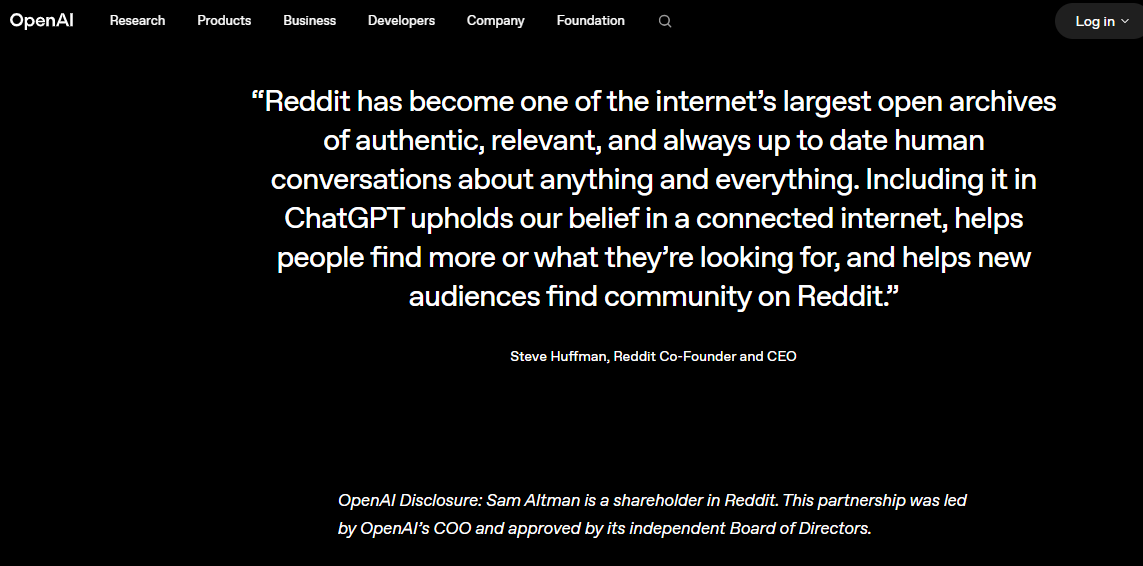
If the person running the platform has a personal financial stake in which companies succeed downstream of it, then the favoritism developers complain about in the GPT Store and the plugin graveyard is not a bug in the system. It is the same instinct playing out at a much larger scale, with much larger numbers attached.
If you want to see partner favoritism at its most explicit, look at what happened in June 2026. OpenAI released its GPT-5.6 model series, its most capable at the time, and instead of shipping it broadly, the company opened access first to a small group of trusted partners whose names had been approved by the U.S. government under the Trump administration’s new AI executive order. Cybernews14 reported the rollout covered roughly twenty partners, with access flowing in part through Amazon’s Bedrock platform. OpenAI did not publish the list of who made the cut.
To OpenAI’s credit, the company said outright that it did not want this to become normal.
“It keeps the best tools from users, developers, enterprises, cyber defenders, and global partners who need them,” the company wrote in its own announcement, describing the government-mandated preview as a short-term step it was taking under pressure rather than by choice.
That’s a fair defense, and I believe it. But intent doesn’t change the shape of the outcome. Whatever the reason, a subset of well-connected organizations got OpenAI’s best model weeks before everyone else, and the rest of the market had to build, sell, and compete without knowing exactly who their better-equipped rivals were.
Even the Biggest Partners Aren’t Safe
It would be a mistake to read all of this as a story about big companies winning and small ones losing, full stop. OpenAI’s relationship with Apple, arguably its most prestigious partner, shows that favoritism cuts in more directions than that. The two companies announced a splashy ChatGPT integration into iOS at Apple’s 2024 developer conference. According to TechCrunch15, two years later, OpenAI is reportedly exploring legal action against Apple, frustrated that the integration got buried inside Siri settings and never delivered the subscriber growth OpenAI expected. Around the same time, Apple sued OpenAI directly, alleging OpenAI poached former Apple hardware executives and used confidential manufacturing techniques to build a rival device.
The lesson there isn’t that Apple got mistreated the way a solo GPT builder does. Apple has the resources to sue back. It’s that OpenAI’s entire posture toward the people and companies around it, indie developer or trillion-dollar hardware maker, is transactional in a way that treats every relationship as provisional. The favorites list is real, but nobody’s name stays on it for free.
I don’t think OpenAI sat down one day and decided to build an unfair platform on purpose. I think it built a company at extraordinary speed, on top of a technology that changes what it can do every few months, and never slowed down long enough to build the guardrails a platform of its size actually needs. Apple’s App Store took years of complaints, congressional hearings, and lawsuits before it published a real set of rules for developers. OpenAI is a fraction of that age. It is discovering, in public, in real time, what it means to have an ecosystem of dependents at all.
That’s an explanation. It isn’t an excuse. Because the pattern across plugins, the GPT Store, the rate limit desk, the venture partner program, and now the government-gated model previews is consistent: access follows relationships, not merit, and the people with the least leverage find that out the hardest way, after they’ve already built something and after their customers have already started to leave. A platform that wants developers to keep betting their businesses on it needs to publish its rules before it breaks someone’s company, not after. Right now it does the opposite, and the founder on that forum thread, still waiting for someone at OpenAI to answer him, is proof of exactly how that feels from the other side of the API key.
Sources
- “OpenAI, why are you killing my startup — for the second time?” OpenAI Developer Community, 1 Sept. 2025, community.openai.com/t/openai-why-are-you-killing-my-startup-for-the-second-time/1355491. Accessed 3 Oct. 2026. ↩︎
- “ChatGPT plugins are here!” OpenAI Developer Community, 23 Mar. 2023, community.openai.com/t/chatgpt-plugins-are-here/115731. Accessed 3 Oct. 2026. ↩︎
- Zeff, Maxwell. “OpenAI Pissed Off Developers by Phasing Out Plugins for GPTs” 26 Dec. 2023, gizmodo.com/openai-pissed-off-developers-by-phasing-out-plugins-for-1851124124. Accessed 3 Oct. 2026. ↩︎
- Goode, Lauren. “OpenAI’s GPT Store Has Left Some Developers in the Lurch” WIRED, 11 Oct. 2024, www.wired.com/story/openai-gpt-store/. Accessed 3 Oct. 2026. ↩︎
- Medium, toproad.medium.com/openai-gpt-store-6-months-later-6a23f2deed20. Accessed 3 Oct. 2026. ↩︎
- Iyer, Karthik. “How OpenAI can improve its GPT store and make it less of a pain to navigate and find useful chatbots” 7 June 2024, www.xda-developers.com/how-openai-can-fix-custom-gpt-store/. Accessed 3 Oct. 2026. ↩︎
- OpenAI, openai.com/business/why-openai/startups/. Accessed 3 Oct. 2026. ↩︎
- Bryden, Tyler. “OpenAI Killed Startups At DevDay | Tyler Bryden” Tyler Bryden | Marketing | Research | Analytics | , 8 Nov. 2023, tylerbryden.com/openai-kills-everything-you-should-just-give-up/. Accessed 3 Oct. 2026. ↩︎
- OpenAI, openai.com/index/introducing-openai-partner-network/. Accessed 3 Oct. 2026. ↩︎
- Community, DEV. “The Graveyard of AI Startups: Startups That Forgot to Build Real Value” DEV Community, 23 Apr. 2025, dev.to/dev_tips/the-graveyard-of-ai-startups-startups-that-forgot-to-build-real-value-5ad9. Accessed 3 Oct. 2026. ↩︎
- AI, Surf. “Developer Complains About OpenAI Rate Limits, Says Manual Resets Required” Surf, 30 Mar. 2026, asksurf.ai/pulse/en/developer-complains-openai-rate-limits-manual-resets. Accessed 3 Oct. 2026. ↩︎
- WSJ, www.wsj.com/tech/ai/chatgpt-openai-ipo-altman-029ae6d5?eafs_enabled=false. Accessed 3 Oct. 2026. ↩︎
- OpenAI, openai.com/index/openai-and-reddit-partnership/. Accessed 3 Oct. 2026. ↩︎
- Cybernews, cybernews.com/ai-news/openai-new-models-us-gov-request/. Accessed 3 Oct. 2026. ↩︎
- Loizos, Connie. “OpenAI is reportedly preparing legal action against Apple; it wouldn’t be the first partner to feel burned” TechCrunch, 14 May 2026, techcrunch.com/2026/05/14/openai-is-reportedly-preparing-legal-action-against-apple-it-wouldnt-be-the-first-partner-to-feel-burned/. Accessed 3 Oct. 2026. ↩︎


