
I found the old emails first. Subject line: “Your Quora Partner Program earnings.” Dozens of them, stretching back years, each one a small deposit slip for a currency that no longer exists. Two dollars here. Eleven cents there. A person somewhere had read a question I asked, and Quora had decided that counted as labor worth paying for. For a while, it did.
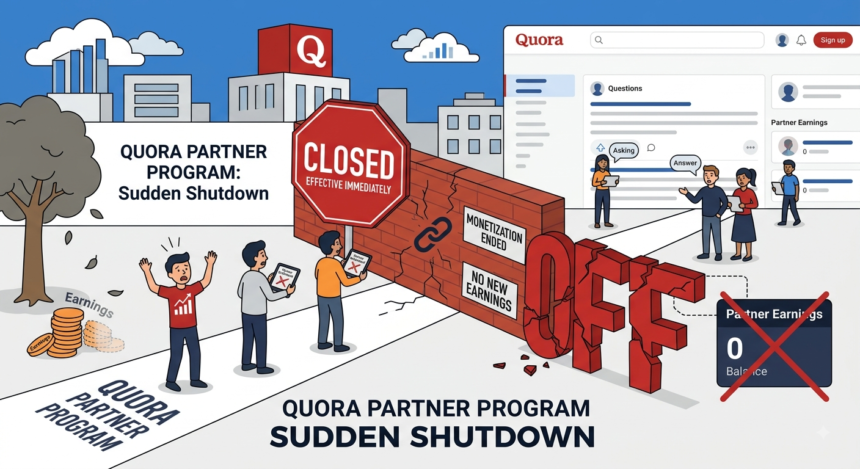
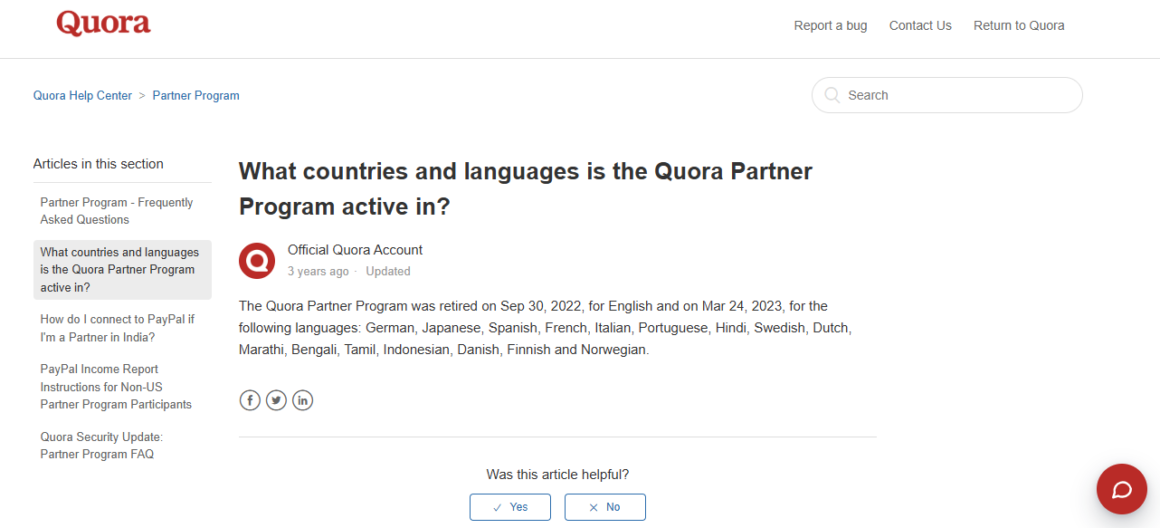
Then, on a Thursday in August 2022, the company that built its entire identity on the sanctity of the question decided the questions had stopped being worth anything. Quora1 announced it was shutting down the English-language version of its Partner Program, the invite-only scheme that had paid ordinary users, not for answering, but for asking. Seven months later, in March 2023, the company finished the job and killed the program in every other language too. German, Japanese, Hindi, Bengali, Tamil, Indonesian. All of it, gone.
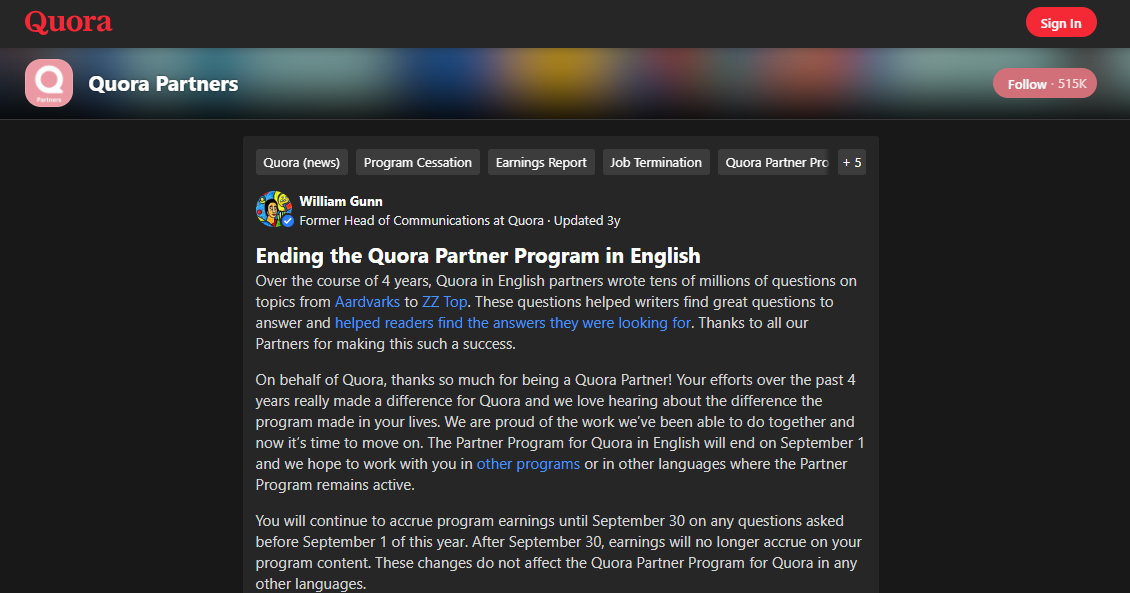
There was no press conference. There was no shareholder letter. There was a blog post, an email, and a slow, uneven bleed of confusion across a platform that had spent four years training its most devoted users to think of curiosity as a job.
I want to tell you what that program was, why it worked the way it did, and what its death says about the platforms we have all quietly agreed to work for without ever signing anything resembling a contract.
A Marketplace Built on Curiosity
Quora launched the Partner Program in 2018 as a strange kind of experiment. Most platforms pay creators to make things. YouTube pays for videos. Substack takes a cut of subscriptions. Patreon lets fans fund artists directly. Quora did something almost inverted. It paid a select group of users, chosen by invitation, to ask good questions. Not to answer them. To ask them.
The logic, once you sit with it, is not as odd as it first sounds. Quora’s entire business model depends on having a deep well of unanswered, well-phrased questions sitting around so that its enormous unpaid army of answerers has something to write about, and so that Google has something to index. A platform that only has answers with no questions to attach them to is just a pile of essays. A platform with sharp, specific, well-targeted questions becomes a search-traffic machine. The Partner Program was Quora paying people to manufacture the raw material its whole economy ran on.
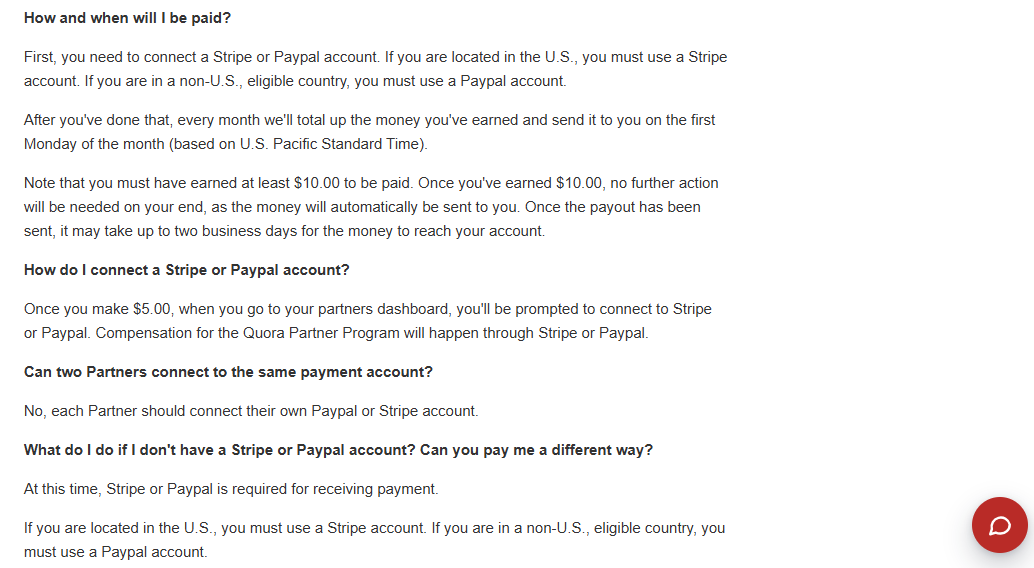
It worked through a points-and-Stripe system. You got invited. You asked questions. Quora placed ads against the traffic those questions generated, mostly external traffic pulled in from Google searches, and you got a cut. Payouts came through Stripe or PayPal once you crossed a small threshold, as low as five dollars in some markets, ten dollars in the U.S. version described in Quora’s own help documentation2.
One writer on Vocal Media3, describing his four years inside the program, put the mechanics plainly. He joined in 2018 and quickly saw how unpredictable the money could be. As he wrote it, “a question with 200 views and 8 ads and no answers could generate 2 dollars and the other with 50k views 15+ answers and 1000+ ads would generate only 0.08 cents.” External traffic paid. Internal traffic, the kind generated by Quora’s own users clicking around the site, paid almost nothing. He described watching his earnings crawl along at fractions of a cent a day, forgetting the program even existed, then rediscovering it months later still limping along in the background of his account.
That unpredictability was not a bug. It was the entire design. Quora needed a wide net of question-askers producing content across every conceivable topic, because nobody at the company could predict which obscure question about tax law in Estonia or the mating habits of octopuses would suddenly catch a wave of search traffic. The Partner Program outsourced that guesswork to thousands of individual humans, each betting small amounts of unpaid labor on the hope that one of their questions would hit.
The Reasoning, According to Quora
When the English shutdown came in August 2022, Quora’s head of communications at the time, William Gunn, gave the company’s explanation in a post that TechCrunch4 and his framing was almost triumphant. The program, he said, had done its job. As Gunn put it,
“The program did what it was supposed to do in the English language version of Quora, which was to get more good answers written to questions that we know people are searching for but which hadn’t yet been asked on Quora, and so it was time to bring it to a close.”
Read that sentence twice. It is a company describing an entire cohort of paid contributors as a task that has been completed, like scaffolding removed once a building stands on its own. Gunn added that other language versions of Quora were “newer and smaller, so there’s more room to promote growth by stimulating question asking to balance the supply and demand side of the knowledge market.”
Supply and demand. That phrase is worth sitting with. Quora had, in effect, built an internal labor market for curiosity itself, and it was now telling its workers that the market had cleared. English Quora, by the company’s own account, had accumulated tens of millions of partner-generated questions over four years. The inventory was full. The warehouse didn’t need more stock.
Seven months later, when Quora5 pulled the plug on every remaining language version in March 2023, there was even less explanation offered. The help center notice reads like a utility bill. Program retired March 24. Last payout April 3. Connect your Stripe account before December 1 if you haven’t already, or lose what you’re owed.
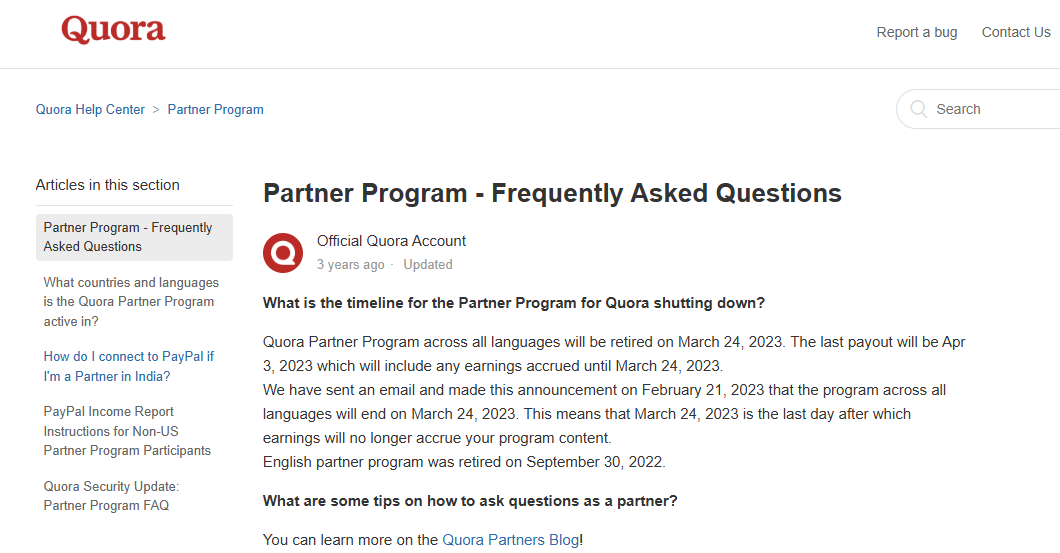
No interviews. No farewell letter to the German or Hindi partners the way there had been, sort of, for the English ones. Just a countdown clock and a payment deadline.
What the Program Actually Meant to People
Here is where the official language and the lived experience start to pull apart, and where I think the real story sits.
Quora’s own framing treated the Partner Program as a tool, something turned on to solve a content gap and turned off once the gap closed. But for a meaningful number of people, it had become something closer to a small, irregular paycheck. Not life-changing money. Rarely was it that. But real money, arriving in a Stripe account on a schedule, tied to labor that felt, at least some of the time, like a genuine contribution.
A writer on Medium6 who published under the ILLUMINATION collective described earning almost 10,000 dollars from the program over the years before the English shutdown, even as he grew disillusioned with it. His critique cut in an interesting direction. He didn’t just mourn the money. He questioned whether the program had ever made sense as designed. Quora, he pointed out, was paying people to ask questions rather than to write the answers that actually constituted the platform’s content. He estimated that less than one percent of program participants who signed up ever went on to generate meaningful engagement, meaning the vast majority of the “market” Quora had built was closer to a lottery than a labor system.
Then there is the cottage industry that sprang up around the program while it was alive, the part of this story that tells you something honest about how desperate the online hustle economy had become by the early 2020s. On Gumroad7, sellers hawked guides with names like “Quora Partner Program Profits,” promising buyers a repeatable system for turning fifteen or thirty minutes a day into a couple hundred dollars a month. One such listing claimed the seller made over 100 dollars in his first 30 days, then admitted his average earnings settled around three to five dollars a day, occasionally spiking to ten. He sold that modest, unglamorous outcome for 100 dollars a copy. Medium8 accounts with names like “EARN CHECK” built entire content strategies around teaching people how to become a partner and chase those payouts, treating question-asking as a legitimate side hustle alongside YouTube and Instagram monetization.
That ecosystem, the guides, the case studies, the earnings screenshots, is the tell. It shows how thoroughly the Partner Program had been absorbed into the broader gig economy imagination, the same mental category as driving for a delivery app or flipping thrifted clothes on Depop. People built modest financial expectations around it. Some built entire monetization identities around teaching other people to chase it. And Quora, when it decided the market had cleared, owed none of them anything beyond the balance already sitting in their dashboard.
The Community’s Verdict, In Its Own Words
Quora is, if nothing else, a machine for generating opinions about itself, and the shutdown of its own Partner Program produced some of the platform’s most unfiltered self-reflection.
One answer to the question “Has the Quora Partner Program been discontinued?” opened with a kind of grim satisfaction. As one respondent wrote, “I told you so. Finally. Even if it’s just in the English language Quora, the Quintessentially Putrid Pyramid scam is being laid to rest. It took, what, four years? Four years of grumbling from users. Four years of trying and failing to moderate spambots that make inane” questions purely to farm views.
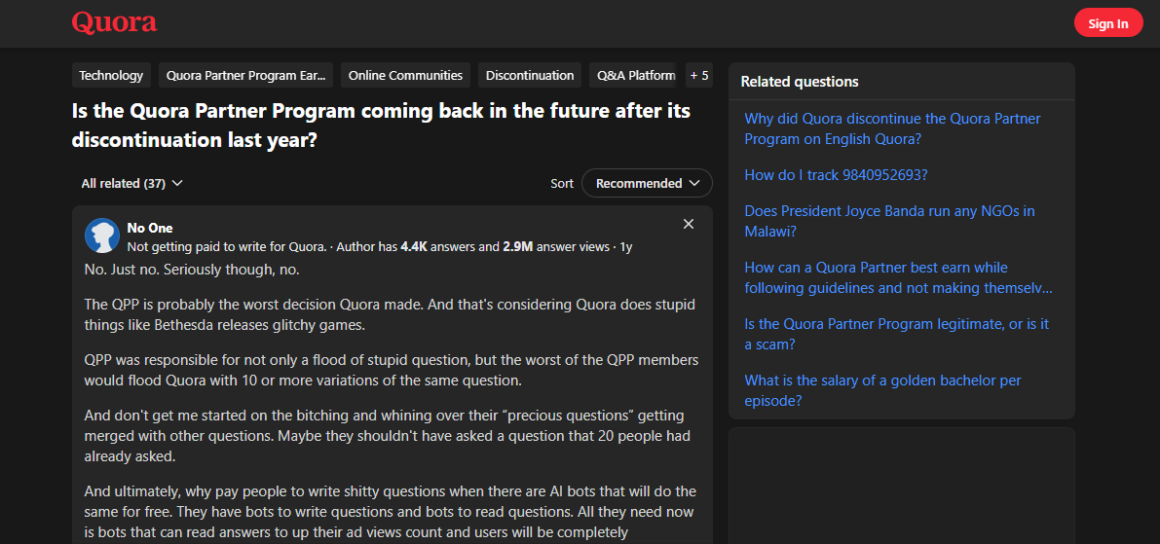
That framing, a pyramid scheme dressed up as a knowledge marketplace, showed up again and again across the platform’s own threads. Another Quora9 user, answering a follow-up question about whether the program might ever return, was blunt about it, calling the QPP “probably the worst decision Quora made” and blaming it for flooding the site with low-quality, engagement-farmed questions written purely to trigger a payout rather than genuine curiosity.
A different theory circulated in the threads too, one with a sharper, more contemporary edge. Some users speculated that the real purpose of the program was never really about balancing supply and demand for human readers at all. It was about training data. One Quora10 answer argued the company achieved “their (unstated) goal, to get the volume of questions they needed to train their AI to be able to ask questions on par with what humans ask,” pointing to formatting, syntax, and logical structure as the specific things being harvested. I cannot confirm that theory as fact. Quora never confirmed it either way in its public statements. But the timing lines up in an uncomfortable way. Four years of unpaid and paid human labor, generating tens of millions of naturally phrased questions across dozens of languages, arriving right as the broader tech industry was racing to build large language models hungry for exactly that kind of structured, human-generated text. Whether or not that was the actual intent behind killing the program, the suspicion itself tells you something about how little trust remains between platforms and the people who built them.
Even outside Quora’s own walls, the reaction carried real bitterness. On the workplace forum Blind11, in a thread about Quora’s broader monetization pivot toward its paywalled Quora+ product, one commenter, self-identified as a three-time Top Writer on the platform, didn’t mince words. “I think Quora is dead,” they wrote, calling it “a follow on to the other garbage program that motivated spam questions.” Another compared the platform unfavorably to Reddit, arguing Reddit had gone from being “nothing a few years back” to being “10 times better than Quora.” A third dismissed the entire site as “no better than Yahoo Answers,” just no longer free to read.
None of this is a scientific survey. Forum comments never are. But taken together, the tone across Quora’s own answer threads and the outside commentary on Blind paints something consistent. Even people who had once made real money from the Partner Program, or built content businesses teaching others to chase it, mostly did not mourn its passing as a betrayal. They mourned it, if they mourned it at all, as the predictable end of a scheme that had always felt slightly rigged, slightly spammy, slightly too good to be sustainable.
The Deeper Pattern
I have spent a long stretch of my career writing about platforms that build entire economies on top of user behavior, then dismantle those economies the moment the underlying math stops working in the company’s favor. Patreon shifting payout timing. YouTube tightening demonetization rules. Substack redefining what counts as acceptable content after building its brand on hands-off moderation. Quora’s Partner Program belongs in that same lineage, but it carries one distinguishing feature that makes it worth its own chapter.
Most creator monetization programs pay for output. A video. An article. A photo set. Quora’s program paid for input, for the raw expression of not knowing something. That is a genuinely unusual thing to commodify. Curiosity, packaged and metered and paid out through Stripe. And because the thing being paid for was so intangible, so easy to manufacture in bulk with a little creativity and a spam-adjacent mindset, the program was almost designed from birth to eventually collapse under its own incentive structure. Pay people to ask questions and you will, with total predictability, get an enormous volume of low-effort, engagement-baited questions. Quora built the trap, watched people walk into it exactly as any economist could have predicted, and then closed the trap and called it a success story about market equilibrium.
There’s a version of this piece that ends with outrage, and I considered writing that version. But sitting with these forum threads, the Gumroad guides, Gunn’s carefully bloodless corporate language, I don’t think outrage is quite the right note. What I keep coming back to instead is how thin the whole arrangement always was. There was never a real relationship between Quora and its partners. There was a dashboard, a threshold, and a payment rail. The moment the company decided it no longer needed the inventory those thresholds were producing, there was nothing else holding the relationship together. No severance. No transition period beyond a payment deadline. No acknowledgment, in the languages that shut down in 2023, that actual people on the other end had built small routines, small hopes, sometimes small side businesses, around those payouts.
Platforms that build markets out of unpaid or lightly paid attention rarely think of those markets as containing people. They think of them as containing supply. And supply, once it has served its purpose, gets shut off with the same tone you’d use to announce a change to a shipping policy.
A Familiar Shape
Anyone who has spent time reporting on platform economics will recognize the shape of what happened to Quora’s partners, because it is not really a Quora story. It is a template.
Look at what happened with Patreon’s12 payout timing changes, which quietly shifted when creators could actually access money they had already earned, or the years-long drift in YouTube’s demonetization appeals process, where creators describe waiting weeks for a human reviewer to look at a strike that took an algorithm seconds to issue. Look at Substack’s13 moderation policies, built for years on a promise of near-total hands-off freedom before the company began drawing lines under pressure, leaving writers who had built entire followings on that original promise scrambling to understand new rules retroactively applied to old work. Look at Spotify’s Discovery Mode14, which asks artists to accept a lower royalty rate in exchange for algorithmic promotion, dressing up a pay cut as an opportunity. Each of these follows the same basic arc. A platform builds a program that depends on user behavior it cannot generate on its own. The program works, sometimes for years. Then the platform’s needs change, or the math stops favoring generosity, and the program either quietly withers or gets shut off with a press release written entirely in the passive voice.
What makes the Quora case unusually clean, almost a textbook version of the pattern, is the total absence of ambiguity in the company’s own reasoning. Gunn did not claim the program was too expensive to run, or that it had been abused beyond repair by spammers, even though both of those things were likely true to some degree based on what partners themselves described. He said, plainly, that the program had done its job and the job was done. Supply had met demand. That is about as honest as corporate communications ever get about treating a user base as an input rather than a relationship, and it is worth remembering the next time a platform frames the end of a monetization program as some kind of graduation ceremony for its most loyal contributors.
There is also a scale problem worth naming directly. Quora never disclosed exactly how many people participated in the Partner Program globally, or how much total money changed hands over its roughly five year run. That silence is itself part of the story. A program that touched, by the company’s own description, tens of millions of pieces of content, run across sixteen or more languages, shut down with almost no public accounting of its total footprint. Compare that to how carefully companies report user growth numbers or engagement metrics when those figures make them look good. The absence of a similar accounting here, a final tally, a thank you with real numbers attached, tells you which kinds of statistics platforms consider worth sharing and which kinds they would rather let fade quietly into a help center archive.
What Partners Were Actually Owed
None of this is to say Quora broke any laws or violated any written agreement. It almost certainly did not. The Partner Program terms, like nearly every creator monetization scheme built by a venture-backed platform, gave the company essentially unlimited discretion to change or end the arrangement at will. That is standard. It is also, I think, exactly the problem worth sitting with.
The entire creator and gig economy, the delivery drivers, the Quora question-askers, the Mechanical Turk workers, the Upwork freelancers burning through inflated Connects, runs on agreements that are legally airtight for the platform and functionally meaningless as protection for the person doing the work. Nobody signed a Quora Partner Program contract expecting lifetime income. But plenty of people built modest, real financial habits around a revenue stream that Quora was always free to shut off without notice beyond a two-week grace period to link a payment account. The gap between what a platform is legally obligated to provide and what its users reasonably come to expect, based on years of consistent behavior, is where nearly every one of these shutdown stories lives. Quora’s Partner Program is a small, almost quaint example of it, a few dollars a month rather than a livelihood. But the shape of the betrayal, if betrayal is even the right word, is identical to the much higher stakes versions playing out across gig delivery apps and AI data labeling platforms right now.
Quora still exists. It still runs on unpaid answers from people chasing reputation rather than money, the same engine that powered the site long before the Partner Program ever launched and the same one that will presumably keep powering it long after most people have forgotten the program existed at all. The company has pivoted hard toward Quora+, its subscription paywall product, and toward whatever role its accumulated archive of human-phrased questions and answers plays in the current AI training economy. Neither of those newer strategies pays ordinary users anything at all for their contributions.
I still have the old emails. Two dollars here. Eleven cents there. I don’t know what I’ll do with them. Probably nothing. That, in the end, might be the truest ending this story has. Not a resolution. Just a folder of small deposits from a market that decided, one Thursday in August, that it didn’t need to keep buying what it used to buy.
Sources
- Quora, quorapartners.quora.com/Ending-the-Quora-Partner-Program-in-English. Accessed 15 Aug. 2026. ↩︎
- Quora, help.quora.com/hc/en-us/articles/360000673263-Partner-Program-Frequently-Asked-Questions. Accessed 15 Aug. 2026. ↩︎
- “Quora Partner Program and Here’s why it’s kicking people out” vocal.media/01/quora-partner-program-and-here-s-why-it-s-kicking-people-out. Accessed 15 Aug. 2026. ↩︎
- Malik, Aisha. “Quora shutting down English version of Partner Program” 18 Aug. 2022, techcrunch.com/2022/08/18/quora-shutting-down-english-version-partner-program/. Accessed 15 Aug. 2026. ↩︎
- Quora, help.quora.com/hc/en-us/articles/360000673263-Partner-Program-Frequently-Asked-Questions. Accessed 15 Aug. 2026. ↩︎
- Medium, medium.com/illumination/discontinuation-of-the-quora-partner-program-71fff25e5cae. Accessed 15 Aug. 2026. ↩︎
- “Quora Partner Program Profits” Gumroad, gregjeffries.gumroad.com/l/quorapartnerprogramprofits. Accessed 15 Aug. 2026. ↩︎
- Medium, medium.com/earn-check/5-ways-to-earn-money-from-quora-151831919138. Accessed 15 Aug. 2026. ↩︎
- Quora, www.quora.com/Is-the-Quora-Partner-Program-coming-back-in-the-future-after-its-discontinuation-last-year. Accessed 16 Aug. 2026. ↩︎
- Quora, www.quora.com/Why-did-Quora-discontinue-the-Quora-Partner-Program-on-English-Quora. Accessed 16 Aug. 2026. ↩︎
- “Your Anonymous Workplace Community” Blind, www.teamblind.com/post/your-thoughts-on-recent-quora-monetization-strategy-mgkgle2z. Accessed 16 Aug. 2026. ↩︎
- Patreon, support.patreon.com/hc/en-us/articles/27992332293517-How-to-move-from-1st-of-the-month-to-subscription-billing. Accessed 16 Aug. 2026. ↩︎
- “Content Guidelines” substack.com/content. Accessed 16 Aug. 2026. ↩︎
- “Discovery Mode – Spotify for Artists” artists.spotify.com/en/discovery-mode. Accessed 16 Aug. 2026. ↩︎