


I have a confession before we start. I put off writing this piece for a week because I kept opening the Duolingo app to check, one more time, whether Video Call had finally shown up for a language it still doesn’t support. It never did. That small, stupid ritual is the whole story in miniature. A company sells you a premium product built on the promise of AI abundance, and then the abundance turns out to be a rounding error away from scarcity.
Duolingo1 is the most downloaded education app on earth teaching over 280 courses in more than 40 languages, all free, all funded by ads and a subscription business that now pulls in real money. According to Stock Titan2, in the second quarter of 2026 the company reported $298.5 million in revenue, up 18 percent year over year, with 12.7 million paid subscribers. That is not a scrappy app anymore. That is a Nasdaq-listed education company with a market capitalization in the billions and a CEO who talks about AI the way oil executives used to talk about drilling.
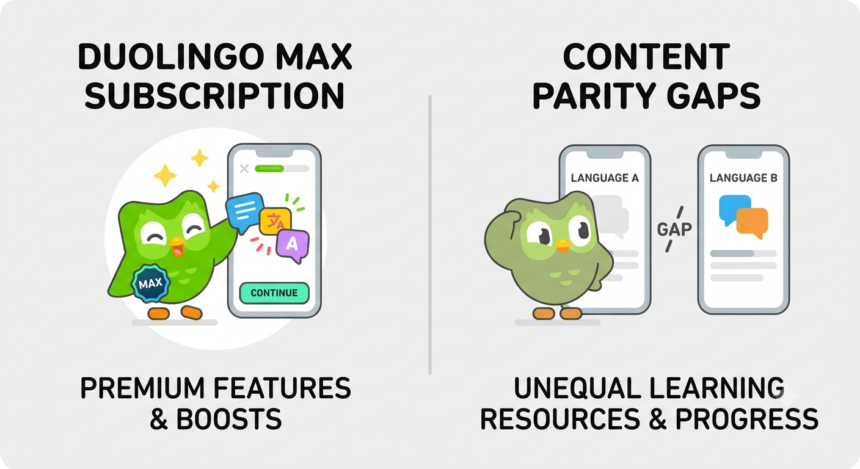
At the top of Duolingo’s subscription ladder sits Max. Tool Radar3 says that it costs $168 a year, or about $30 a month if you pay monthly, which puts it well above Super Duolingo’s roughly $60 to $96 a year and firmly into premium-app territory. Max is supposed to be the AI showcase, the tier where OpenAI’s models turn a gamified vocabulary drill into something closer to a private tutor. It offers Video Call, a live spoken conversation with an AI character, and Roleplay, a scripted scenario where you order coffee or ask for directions and get a feedback report afterward.
Here is the problem. You can pay full price for Max while learning Russian, Arabic, Hindi, Vietnamese, Turkish, Swahili, Hawaiian, Polish, Greek, Hebrew, Thai, Indonesian, Ukrainian, Welsh, Irish, Navajo, or dozens of other languages Duolingo happily teaches for free, and you will get almost nothing extra for your money. As of this writing, English speakers get the full Max experience, Video Call and Roleplay together, only in Spanish, French, German, Italian, and Portuguese. Japanese, Korean, and Chinese learners get Video Call but not Roleplay. Everyone else gets the Super Duolingo experience wearing a more expensive badge.
The Math Doesn’t Work in the Buyer’s Favor
Duolingo4 doesn’t hide this if you go looking for it and the company’s own blog states plainly that Max is available in 188 countries on iOS and Android, but that only English speakers learning Spanish, French, German, Italian, and Portuguese get full access to Explain My Answer and Roleplay.
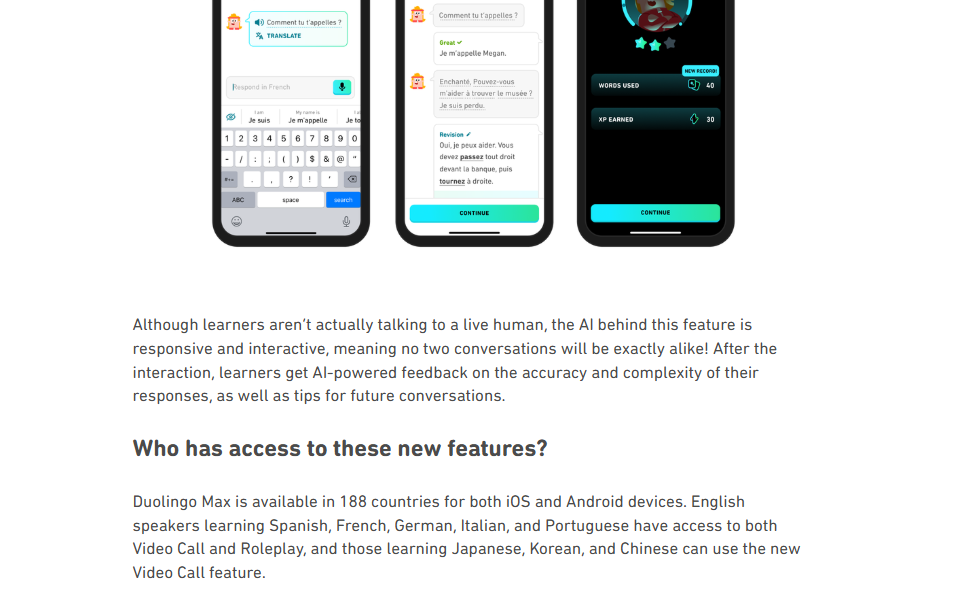
That single sentence, buried in an FAQ, is doing an enormous amount of quiet work. It means five languages, out of a roster north of forty, carry the weight of the entire premium tier’s marketing promise.
And even that math just got worse for Duolingo’s sales pitch. In January 2026 the company made Explain My Answer, the AI grammar explainer that used to be a Max exclusive, free for everyone learning Spanish, French, German, Japanese, Portuguese, Italian, or Korean. One reviewer put it bluntly: the paid value of Max now rests almost entirely on Video Call and Roleplay, because everything else you’re paying for either already lived in Super or just got handed out for free. Strip away the marketing copy and you are buying two features, in five to eight languages, for $168 a year.
I want to sit with that number for a second, because I think it is the whole scandal, dressed up as a footnote. Duolingo advertises Max as an upgrade available to a global audience of learners. In practice, if your target language is Korean, you get half of Max. If it’s Russian or Arabic or literally most of the languages Duolingo built its reputation teaching for free, you get none of it. You are paying premium price for the Super tier’s ad removal and a badge.
I spent a chunk of my research time in Duolingo’s user forums, and the tone there is less outrage than exhaustion. On the fan-run Duome5 forum, a place learners go to complain and compare notes since Duolingo shut down its own official forum years ago, the frustration around the broader “energy” system and the sense that paying customers are treated like an afterthought comes up constantly. One user wrote about :
“trying to decide how much longer I’m willing to put myself through the hell of constantly watching my energy drop even when I get all the answers correct.”
Another, posting under the name DaniDePons at CkeckThat.AI6, said flatly that they couldn’t make it through two full lessons before running out. A third, Lagarto, echoed the same complaint about not being able to maintain their position without running out of what they called “stupid energy.”
Those quotes are about the energy system, not Max specifically, but they set the emotional register for how a certain slice of Duolingo’s user base currently feels about the company. It is the register of people who used to love a product and now feel nickel-and-dimed by it. Layer the Max language gap on top of that mood and you get a predictable reaction. On the language-learning blog Duoplanet7, readers responding to a Video Call feature post asked, with a kind of tired hopefulness:
“Do you have any information about when it might come available for the Russian lessons? I find it helps me a lot for French and Spanish, but my main target language is Russian.”
Another reader learning Greek noted dryly that “it’s not available in Greek. Not much of anything is available in Greek.” A third asked for the feature in both Russian and Arabic, calling it something they’d like “ASAP.”
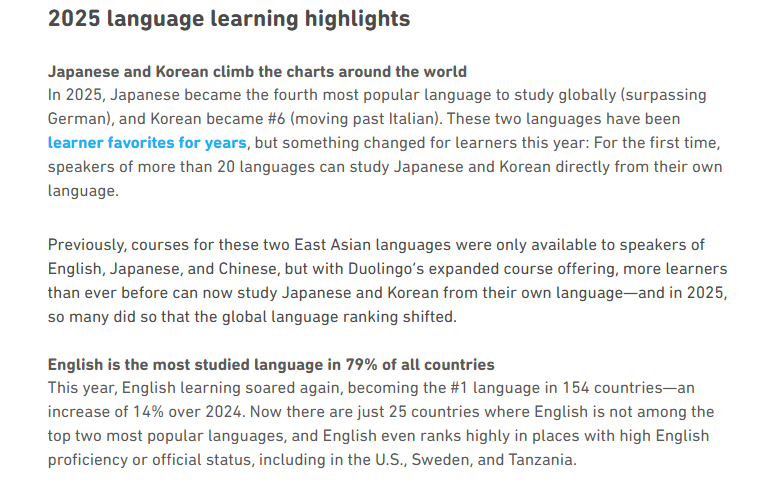
None of these are rare complaints buried deep in obscure threads. They are the first comments under the first article most people find when they search for Duolingo Max and their target language. The demand is right there, publicly stated, and Duolingo’s own language report shows exactly why it matters. In the Duolingo’s8 telling, Japanese climbed to the fourth most popular language studied globally in 2025, surpassing German, and Korean moved past Italian into sixth place. These are not niche courses nobody uses. They are among the most popular languages on the platform, and Korean learners specifically only get half of what Max promises.
An AI Company that Can’t Put Its AI Where Its Users Are
Here’s the part that made me want to write this piece instead of just grumbling about it privately. Duolingo is not a company that lacks AI capacity. It is, by its own repeated public statements, an AI-first company, arguably the most aggressively AI-first company in consumer education. According to Entrepreneur.com9, in April 2025, CEO Luis von Ahn sent an internal memo, later posted to LinkedIn, announcing that Duolingo would become “AI-first” and gradually stop using contractors to do work that AI can handle. The memo said headcount would only grow if a team couldn’t find a way to automate more of its own work, and that AI would factor into hiring and performance reviews going forward.
The backlash was immediate and, by most accounts, genuinely damaging to the brand. Buzz Radar10 reported that Duolingo lost more than 400,000 TikTok followers within weeks and eventually wiped its TikTok and Instagram accounts down to almost nothing, an extraordinary retreat for a company that had built its entire marketing identity on a chaotic, meme-fluent mascot. Social listening data cited by one marketing analysis showed sentiment flipping from roughly 24,000 positive mentions against 14,000 negative ones to overwhelmingly negative practically overnight. Von Ahn later told the New York Times11 the internal reaction hadn’t been controversial, but that externally, “some people assume that it’s just for profit. Or that we’re trying to lay off humans. And that was not the intent at all.” He also said, in that same interview, that Duolingo had “never laid off any full-time employees” and had no plans to.
That statement is true in the narrowest possible sense, and I think it’s worth pausing on why. Duolingo’s aggressive use of AI shows up most clearly not in its full-time headcount but in its contractor and volunteer ranks, the people who built the company’s content in the first place. Back in January 2024, well before the AI-first memo made headlines, the Washington Post12 reported that Duolingo had been steadily firing contract writers and translators and replacing them with AI, in what the paper called one of the most high-profile instances yet of a company swapping human workers for AI. Benjamin Costello, a Russian-language translator let go in that round, went back into the app to check the course he used to help write. His verdict, quoted across multiple outlets covering the layoffs:
“There are tons and tons of errors in it.”
A different worker, a longtime content writer laid off later in 2024 and speaking anonymously to journalist Brian Merchant, described watching a tool she didn’t trust yet get put in charge of the job anyway.
“We had been working with their AI tool for a while, and it was absolutely not at the point of being capable of writing lessons without humans,”
She’d been told to stop producing new content specifically so her work could help train the system that would replace her. Of the output that replaced her own, she said the AI text was flat where Duolingo lessons used to be playful, and that it made mistakes “even on things that you would think” a model should get right.
I want to be fair to Duolingo13 here, because the company would point out, correctly, that in April 2025 it used its AI tooling to launch 148 new courses in under a year, more than doubling its total course library and making seven of its most popular non-English languages available to speakers of 28 different interface languages. Von Ahn called it proof that “generative AI can directly benefit our learners,” and in a narrow sense he’s right. If you speak Vietnamese and want to learn Korean, a course that didn’t exist a few years ago now does, because AI made building it economical.
But that is exactly what makes the Max gap so strange. This is a company that has demonstrated, publicly and repeatedly, that it can pour AI resources into course expansion at a pace that took twelve years to achieve the old-fashioned way and then a single additional year to double. And yet the AI conversation features that define its most expensive subscription tier have crawled from two languages at launch to somewhere between five and eight, over roughly three years, while the free course catalog exploded. The company has shown it can move fast with AI when the AI is generating free content that drives growth and press coverage. It has moved considerably slower when the AI is the thing subscribers are actually paying for.
I went looking for a straightforward explanation, something like a technical constraint that would make this all feel less like a business decision and more like an engineering reality. It’s partly there. Video Call and Roleplay depend on real-time voice processing and a language model that can hold a coherent, level-appropriate conversation, which is a meaningfully harder problem than generating a static translation exercise. Building that experience well for a lower-resource language, one with less training data and fewer existing speech models to draw on, is genuinely more difficult than doing it for Spanish or French. I don’t think Duolingo is lying when it implies that expansion takes engineering time.
What I don’t buy is that this explains the gap between what Duolingo says about its AI capabilities and what Max subscribers actually receive. A company that told its own employees it would judge them by how much of their job AI could absorb, a company that used AI to build 148 courses in under a year, is not a company that lacks the technical confidence to say it can solve harder AI problems. It’s a company that chose, for now, to prioritize free top-of-funnel content expansion, which drives download numbers and press coverage, over premium-tier depth, which drives the harder and slower work of actually retaining a paying subscriber in a less-popular course. That’s a defensible business choice. It is not, however, the choice implied by charging every Max subscriber the same $168, regardless of which of the app’s 40-plus languages they actually study.
There’s also a pattern here that echoes the AI-first backlash almost exactly, just shifted from labor to product. In both cases, Duolingo made an aggressive, headline-grabbing claim about what AI could do for the company. In both cases, the on-the-ground experience for the people closest to the work, whether that’s a laid-off translator finding errors in his old course or a Russian learner finding no Video Call button at all, told a more limited story. Costello found errors where he used to find craftsmanship. Reddit and forum users learning Russian, Greek, and Arabic find silence where Duolingo’s marketing promised conversation practice. Different departments, same gap between promise and delivery.
What “worth it” Actually Means When the Answer Depends on Your Language
Every review site I found runs some version of the same disclaimer, usually in fine print near the bottom: Max is only worth it if you’re studying one of a handful of languages. Max doesn’t support all languages, and for English speakers, only Spanish, French, German, Italian, and Portuguese get the full Video Call and Roleplay combination, while Japanese, Korean, and Chinese get Video Call alone. If your language isn’t on that list, the review essentially tells you not to bother, which is a strange thing to have to say about a company’s flagship paid product.
A separate buyer’s guide put it even more starkly, noting that if your target language isn’t among the roughly seven or eight Max supports, “Max offers no benefit over Super,” meaning you would be paying roughly $70 to $100 more per year for literally nothing beyond what the cheaper tier already gives you. That’s not a minor asterisk. That’s most of the subscription’s value proposition evaporating based on a variable, your target language, that Duolingo knows before you ever hit “subscribe,” and that its checkout flow does essentially nothing to warn you about.
I tried to find the moment where Duolingo tells a prospective Max subscriber, clearly and before payment, that their specific language might not include Video Call or Roleplay at all. I couldn’t find one. The information exists, technically, on a blog post and inside app screens you’d only see after you’ve already committed to learning a course. It is not on the pricing page in a way that would stop a Vietnamese or Swahili learner from paying full freight for a feature set they’ll never actually use.
Step back far enough and this stops being a story about one app’s feature list and starts looking like a pattern worth watching across the whole AI product landscape. Companies are increasingly comfortable selling “AI-powered” as a blanket premium tier, priced identically regardless of what the AI can actually do for any individual customer. Duolingo just happens to make the gap unusually visible, because language is inherently comparative. You can watch, language by language, exactly which customers get the full product and which get a shell of it, in a way that’s harder to spot in, say, an AI writing assistant that works roughly the same regardless of your industry.
It’s also a story about who bears the cost of a company’s AI transition. Duolingo’s shareholders are doing fine. Bookings and revenue are both growing at double-digit rates, subscriber counts keep climbing, and the company raised its full-year profitability outlook even after absorbing a brand crisis that cost it hundreds of thousands of social followers. The cost of the AI transition instead landed on two much smaller groups. It landed on contractors like Costello, whose paid expertise got replaced by a system he watched make mistakes he used to catch. And it landed on subscribers who trusted that “Max” meant the maximum version of the product, only to find out that the maximum version was reserved for the five or six languages Duolingo’s growth numbers already favored.
I don’t think Duolingo is a villain here, exactly. I think it’s a company that got very good, very fast, at using AI to do the cheap, visible, growth-driving thing, and considerably slower at using AI to do the expensive, quiet, retention-driving thing. Free courses generate headlines about doubling a catalog. Premium AI conversation practice generates a much smaller, much less flattering headline: most of your paying customers can’t use the feature they’re paying the most for.
If you’re paying for Max right now and your language isn’t Spanish, French, German, Italian, Portuguese, Japanese, Korean, or Chinese, you already know this. You’ve probably already checked, the way I keep checking, for a Video Call button that isn’t coming. The rest of us should probably know it too, before we hand over $168 for a feature list that, for most of the languages Duolingo teaches, quietly isn’t there.
Sources
- Blanco, Cindy. “2025 Duolingo Language Report” 1 Dec. 2025, blog.duolingo.com/2025-duolingo-language-report/. Accessed 29 Aug. 2026. ↩︎
- Stock Titan, www.stocktitan.net/sec-filings/DUOL/8-k-duolingo-inc-reports-material-event-96560f3ef7ef.html. Accessed 29 Aug. 2026. ↩︎
- “Duolingo Pricing 2026: Plans, Hidden Costs & Alternatives” toolradar.com/tools/duolingo/pricing. Accessed 29 Aug. 2026. ↩︎
- Team, Duolingo. “Introducing Duolingo Max, a learning experience powered by GPT-4” 14 Mar. 2023, blog.duolingo.com/duolingo-max. Accessed 29 Aug. 2026. ↩︎
- Duome, duome.eu/. Accessed 29 Aug. 2026. ↩︎
- Wartnaby, Saskia. “Duolingo Pricing 2026: Cost & Top Competitors” Duolingo, 7 Aug. 2026, checkthat.ai/brands/duolingo/pricing. Accessed 29 Aug. 2026. ↩︎
- Duoplanet, duoplanet.com/duolingo-video-call/. Accessed 29 Aug. 2026. ↩︎
- Blanco, Cindy. “2025 Duolingo Language Report” 1 Dec. 2025, blog.duolingo.com/2025-duolingo-language-report/. Accessed 29 Aug. 2026. ↩︎
- Davis, Erin. “Duolingo CEO Clarifies AI Stance After Backlash: Read Memo” 23 May 2025, www.entrepreneur.com/business-news/duolingo-ceo-clarifies-ai-stance-after-backlash-read-memo/492141. Accessed 29 Aug. 2026. ↩︎
- Radar, Buzz. “How Duolingo’s AI pivot shattered the brand that mastered viral moments” Buzz Radar, 28 July 2025, buzzradar.com/blog/how-duolingos-ai-pivot-shattered-the-brand-that-mastered-viral-moments. Accessed 29 Aug. 2026. ↩︎
- “Nytimes.Com” 17 Aug. 2025, www.nytimes.com/2025/08/17/business/duolingo-luis-von-ahn.html. Accessed 29 Aug. 2026. ↩︎
- Post, The Washington. “Duolingo cuts workers as it relies more on AI” 10 Jan. 2024, www.washingtonpost.com/technology/2024/01/10/duolingo-ai-layoffs/. Accessed 29 Aug. 2026. ↩︎
- “Duolingo Launches 148 New Language Courses” Duolingo, Inc., 30 Apr. 2025, investors.duolingo.com/news-releases/news-release-details/duolingo-launches-148-new-language-courses. Accessed 29 Aug. 2026. ↩︎


