


Sonos built its reputation on a specific promise. Buy into the ecosystem, the pitch went, and it will grow with you. Add a speaker to the bedroom next year. Add a soundbar when you get the new TV. The system remembers you and rewards your loyalty.
More than a decade later, the company that built its reputation on that promise is being sued by its own customers for breaking it.
This is a story about what happens when a hardware company becomes a software company without telling anyone, and what “warranty” starts to mean once the thing you bought can be switched off by someone else, on a schedule you don’t control, for reasons you’re rarely given in full.
The Word Sonos Won’t Say
In January 2020, Sonos announced it would stop pushing software updates to a list of its oldest products come May of that year. The list included the original Zone Players, the Connect and Connect:Amp, the first-generation Play:5, the CR200 controller, and the Bridge. Some of these had been sold as recently as 2015. Customers who had built whole-home systems around them were told, effectively, that the clock had run out.
The backlash arrived within hours. People pointed out that a company selling itself on interoperability had just announced it would break that interoperability for anyone who kept an old unit plugged in next to a new one. Worse, Sonos had floated a “Trade Up” program that offered a 30 percent discount toward new gear, but only after the old speaker was pushed into what the company called “recycle mode,” a self-destruct sequence with a 21-day countdown that ended with the device permanently and irreversibly dead. Consumer Reports1 later confirmed that any device already run through recycle mode stayed bricked even after Sonos reversed course on everything else.
CEO Patrick Spence spent that week doing what CEOs do when a decision blows up in public. He apologized. He wrote a long open letter that used the word “bricking” three times, each time to deny it was happening.
“We are not bricking them,” he wrote, “we are not forcing them into obsolescence, and we are not taking anything away.”
The letter promised bug fixes and security patches for the legacy line “for as long as possible” and pledged a way to split old and new devices onto separate, non-interfering systems. You can still read the full clarification thread on the Sonos community forum2, preserved like a fossil from the company’s first brush with this exact crisis.
Here’s the detail that got buried under the apology tour. Sonos had already told its own investors, in writing, that this was coming. The company’s 2019 10-K filing stated plainly that “we expect that in the near term, this backward compatibility will no longer be practical or cost-effective, and we may decrease or discontinue service for our older products.” The Register3 dug this up at the time, and it reframes the whole episode. This wasn’t a surprise the company stumbled into. It was a plan, disclosed to shareholders as a risk factor and disclosed to customers as an inconvenience.
That gap is worth sitting with. A warranty is supposed to be a promise about the future. A 10-K risk disclosure is also a promise about the future, just aimed at a different audience, and written in the plainer language companies reserve for people who might sue them for not knowing something. Sonos knew. It just knew in two different vocabularies at once.
The Controller Nobody Remembers, and the One Lawsuit That Actually Won
Before the app was ever a headline, there was the CR100.
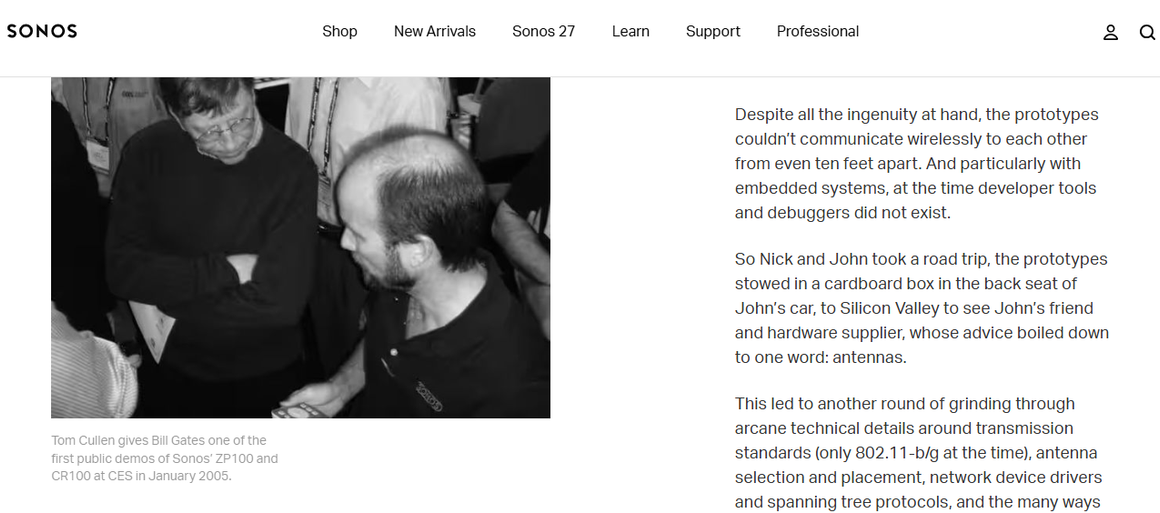
Released in 2005, the CR100 was a dedicated handheld remote for Sonos systems, sold for close to 350 dollars back when smartphone apps weren’t yet a substitute for physical controls. Sonos stopped selling it in 2009 once its own smartphone app matured. Owners kept using it anyway, because it still worked, right up until a July 2018 firmware update that a lawsuit later claimed was written specifically to make the CR100 fail.
The case, filed by a consumer named Matthew Steiner, alleged that the code wasn’t just an oversight but an act of design.
“Sonos purposely caused the Class Devices to fail,” the complaint reads, arguing the company wanted to “gain an advantage over its competition” by forcing owners of the controller back into the market for something new. You can read the breakdown of the original filing at ClassAction.org4 and at Top Class Actions5, which both cover Steiner’s claim that price and continued function are inseparable in a consumer’s mind. Nobody buys a 350 dollar remote expecting the manufacturer to kill it by remote control nine years later.
What makes this case worth dwelling on is what a Sonos forum regular said about it years afterward, in the middle of yet another bricking argument. A poster going by jgatie, clearly a longtime defender of the company against what they viewed as forum hysteria, laid out the actual track record with more precision than most of the plaintiffs’ lawyers bothered to. In a 2024 Sonos community thread6 they wrote:
“The number of times a class action lawsuit was threatened numbers in the hundreds, if not thousands. The number of times an actual class action suit was attempted, meaning actually filed? Once. And the class consisted of a single owner.”
He lost, according to that same poster, but the case had teeth for a reason most others didn’t. It involved “actual damages,” a specific dollar figure tied to a specific dead device, not a vague sense of betrayal.
That distinction matters more than it sounds like it should. American product liability law does not have a cause of action for feeling let down. It has causes of action for money you spent on a thing that stopped doing what it was sold to do. The CR100 suit understood that. Most of the online outrage since has not.
The App That Ate a CEO
By the time Sonos launched its redesigned mobile app in May 2024, the company had a decade of practice apologizing for backward-compatibility decisions. It had none, apparently, in shipping software that actually worked.
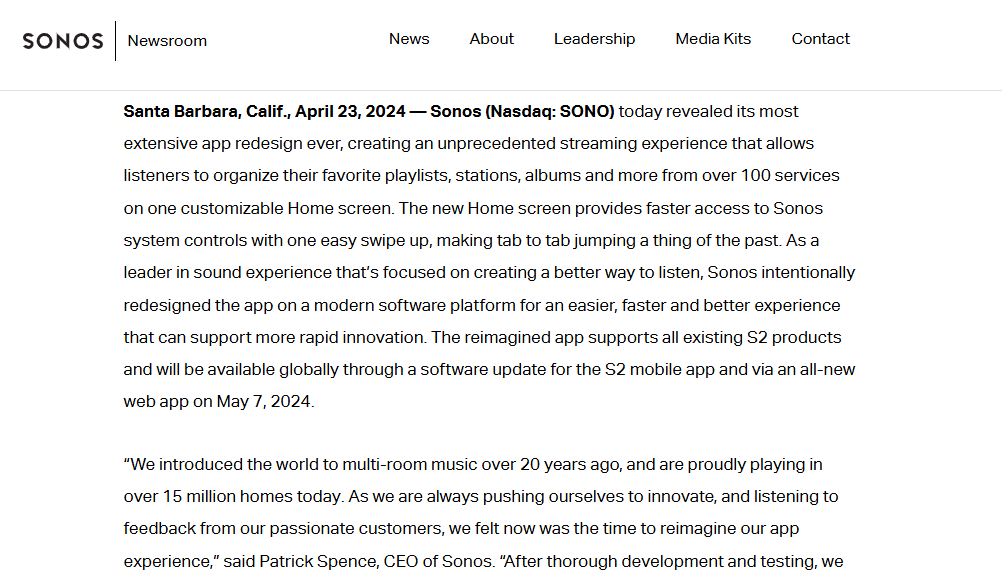
The new app was rebuilt from the ground up to support the company’s first headphones, the Sonos Ace, and to modernize what Sonos called a “faster, easier, personalized experience.” What it delivered instead, according to MacRumors’ reporting7, was the removal of sleep timers, alarms, and accessibility features that some users depended on daily, layered on top of connectivity failures that left long-standing multi-room systems “effectively unusable.” This wasn’t a fringe complaint. Revenue fell 16 percent in the fiscal fourth quarter of that year, the stock dropped roughly 13 percent on the news, and the company laid off around 100 employees that August.
Spence’s early response did not help. He called the redesign “courageous” in late May, a word choice that aged about as well as anything said in public that decade. By July he had reversed field entirely, publishing an apology that read almost like a hostage letter written by a company that had run out of other options. “I want to begin by personally apologizing for disappointing you,” he wrote, a line quoted across nearly every outlet that covered the fallout, including Tom’s Guide8. The company published a “seven-step plan” to rebuild trust that October, appointed a “quality ombudsperson” to publish biannual reports on app performance, and had its board publicly forgo bonuses until the software actually worked. What Hi-Fi9 noted that critics saw the plan as a list of things a functioning company should never have needed to promise in the first place, like more rigorous testing before launch.
None of it saved Spence’s job. He stepped down in January 2025 after eight years running the company, replaced on an interim basis by board member Tom Conrad, a former Pandora and Snap executive. Design writer Roger Wong, who covered the collapse for his own site, framed the stakes with more clarity than most of the trade press managed. When the Music Stopped10.
“The fall of Sonos isn’t as simple as a botched app redesign. Instead, it is the cumulative result of poor strategy, hubris, and forgetting the company’s core value proposition.”
Wong, who described himself as both a designer and a longtime customer burned by the same update, added a line that stuck. “A little piece of me died inside each time I read the word ‘redesign.'” That’s the kind of sentence you only write about a product you actually loved once.
Litigation Catches Up
The app disaster did what a decade of forum threats never managed. It produced multiple real lawsuits, filed by real law firms, moving through real federal courts.
In mid-2025, three consumers named Scott Blair, Ryan Bolanowski, and John Welch filed a class action against Sonos in the Central District of California, alleging the redesigned app rendered the company’s products “unreliable or unusable.” According to Top Class Actions’ coverage11, the complaint specifically calls out the disappearance of alarm scheduling, music library access, playlist editing, and cross-device search, all features that existed in the old app and simply vanished in the new one. Bloomberg Law12 also picked up the filing, treating it as a straightforward performance and merchantability claim rather than a novel legal theory. A separate mass arbitration effort, tracked by ClassAction.org13, argues that Sonos effectively forced the update on users with no ability to roll back to the version that worked, and pegs first-year damages across the affected user base at north of 5 million dollars based on lost functionality and replacement costs alone.
Then, earlier this year, a new CR100-style suit landed in Los Angeles County Superior Court, later removed to federal court, alleging almost the identical theory that the 2018 case did. Sonos “acted by force to limit consumer choice instead of competing lawfully,” the complaint states, language ClassAction.org’s14 most recent writeup quotes directly from the filing. The fact that this argument is being made again, against the same company, over what is functionally the same conduct, seven years apart, tells you something about how little the underlying incentive structure has changed. A software update is cheap. Compatibility is expensive. Companies will keep choosing cheap unless a court, a regulator, or enough lost customers makes them choose otherwise.
Reading through the Sonos community forum15 from this period is its own kind of education in how corporate crises actually metabolize among the people living through them. One thread, simply titled “Class Action Lawsuit”, has a small business owner describing music going silent in her salon for months on end, unable to get a straight answer from support. “They keep trying to make it my router, internet, music app,” she wrote, “the problem. They are gaslighting us all by acting like they have nothing to do with the problem.” Another poster in a different thread put the math in blunter terms. “I have many thousands invested in players that are now essentially bricked because of a 100% non-functioning app,” they wrote in a Sonos16 thread about compensation.
“I don’t make a lot of money, but I bought Sonos speakers for all around the house so my family can have music all the time.”
That sentence does more work than any press release Sonos ever put out about “commitment to quality.”
What “Warranty” Actually Covers, and What It Never Did
Sonos17 does, to its credit, maintain an active warranty program, and it recently extended it. In October 2024, the company announced a one-year warranty extension on certain products purchased within specific windows, ranging from October 2022 through October 2024 in the UK, EU, and a handful of other European territories, and October 2023 through October 2024 everywhere else.
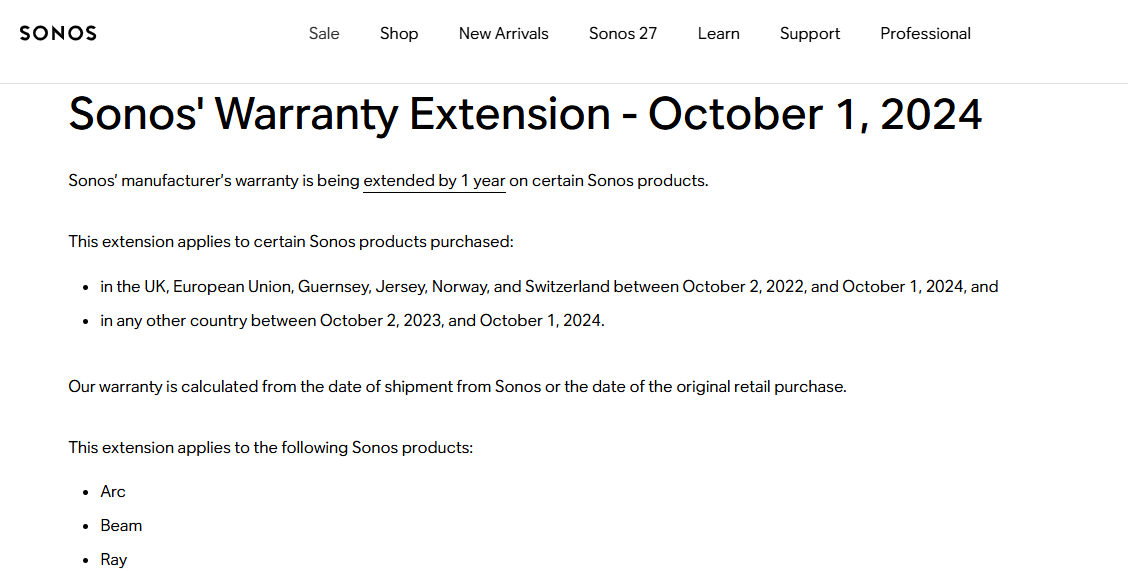
That’s a real, material benefit for customers who bought in that narrow band. But it’s also worth noting what the standard warranty language, posted plainly on Sonos’s support site18, actually says. Coverage length and terms vary by country. It covers hardware defects. It does not, and structurally cannot, cover the thing that has actually generated the most anger over the past six years, which is a company’s unilateral decision to stop supporting software on hardware that still functions perfectly.
That’s the trick at the center of this whole saga. A warranty is a promise about manufacturing defects. It says nothing about product philosophy. When your speaker’s amplifier fails, the warranty protects you. When the company decides your speaker’s amplifier is fine but its firmware no longer merits investment, you’re outside the warranty’s jurisdiction entirely, standing in a gap the contract was never written to fill. One forum poster who bought a refurbished Sonos Arc directly from the company described spending months getting conflicting answers from different agents about whether their warranty extension even applied, writing in a 2025 Sonos19 thread that “every sonos agent had a different story” and that they were close to switching to Bose entirely. If a company’s own support staff can’t consistently explain what’s covered, the average customer has no chance.
The Repairability Question Nobody Asked At Checkout
There’s a quieter thread running under all of this, and it’s about hardware, not software. iFixit20, the online repair community that scores consumer electronics on how easily an owner can actually fix them. It noted that while the battery is refreshingly replaceable, other parts of the build, particularly the headband assembly, are not designed with independent repair in mind. Its battery replacement guides for the Roam and Roam 2 speaker lines both walk owners through prying apart layers of adhesive with heat and picks, the kind of process that voids any illusion that “user serviceable” and “user friendly” mean the same thing.
None of that shows up in a Sonos ad. It shows up two years later, when the battery in a portable speaker won’t hold a charge and the owner discovers that “repair” means an afternoon with a heat gun and a specialty toolkit, assuming the part can be found at all.
Why This Keeps Happening
Sonos isn’t uniquely villainous here. It’s an unusually visible example of a problem baked into how connected hardware gets sold. The company makes speakers, but it also, increasingly, makes the software those speakers depend on to be anything more than an expensive paperweight. When a traditional appliance breaks, the failure lives somewhere identifiable, in a motor, a switch, a wire. When a Sonos speaker “breaks” because of a firmware decision made in a product meeting three thousand miles away, the failure lives in a place the customer has no visibility into and no leverage over.
That’s the actual power asymmetry underneath every one of these stories, from the CR100 in 2018 to the app disaster in 2024 to whatever the next version of this will be called in 2027 or 2028. The company controls the update cadence. The company decides what counts as “legacy.” The company writes the warranty language and decides, unilaterally, what it does and doesn’t extend to. The customer controls almost nothing except the decision to keep buying, or to finally stop.
Spence, for what it’s worth, made a specific pledge in that 2020 apology letter that’s worth holding the company to now. He wrote that Sonos would support products “for a minimum of five years after we stop selling them.” Five years is not a small commitment, and it’s more than plenty of hardware companies offer in writing. But a promise made in the middle of a public relations fire is still just a promise, backed by nothing more binding than the next earnings call. The 2024 app collapse proved that even inside that five-year window, “supported” can mean something has technically not been discontinued while functionally being made worse.
That’s the real inheritance of this whole saga. Not a single bricked speaker here or there. A permanent low hum of not knowing, for any piece of connected hardware anyone owns, whether the company on the other end of that firmware pipe still considers them worth the update.
Sources
- Consumer Reports, www.consumerreports.org/speakers/sonos-ends-recycling-program-that-disabled-older-devices/. Accessed 7 Oct. 2026. ↩︎
- S, Ryan. “End of Software Support – Clarifications” Sonos Community, 22 Jan. 2020, en.community.sonos.com/speakers-228992/end-of-software-support-clarifications-6835969. Accessed 7 Oct. 2026. ↩︎
- Claburn, Thomas. “Remember that Sonos speaker you bought a few years back that works perfectly? It’s about to be screwed for… reasons” 21 Jan. 2020, www.theregister.com/2020/01/21/sonos_bricking_laudio_gear/. Accessed 7 Oct. 2026. ↩︎
- Classaction.org, www.classaction.org/news/sonos-docked-with-class-action-after-forced-phase-out-of-cr100-speaker-controller. Accessed 7 Oct. 2026. ↩︎
- Sortor, Emily. “Sonos Class Action Says Speaker Controllers Fail” 29 July 2019, topclassactions.com/lawsuit-settlements/consumer-products/electronics/sonos-class-action-says-speaker-controllers-fail/. Accessed 7 Oct. 2026. ↩︎
- “Class Action Suit over the destruction of the controller app, rendering many of the customers’ products useless” Sonos Community, 22 May 2024, en.community.sonos.com/controllers-and-music-services-228995/class-action-suit-over-the-destruction-of-the-controller-app-rendering-many-of-the-customers-products-useless-6895114. Accessed 7 Oct. 2026. ↩︎
- Charlton, Hartley. “Sonos CEO Steps Down Following Disastrous App Redesign” MacRumors, 13 Jan. 2025, www.macrumors.com/2025/01/13/sonos-ceo-steps-down-after-app-redesign/. Accessed 7 Oct. 2026. ↩︎
- Younker, Scott. “Sonos CEO exits following major app fail — but there’s good news” Tom’s Guide, 13 Jan. 2025, www.tomsguide.com/audio/speakers/sonos-ceo-exits-following-major-app-fail-but-theres-good-news. Accessed 7 Oct. 2026. ↩︎
- Svetlik, Joe. “Sonos boss resigns following disastrous app redesign” What Hi-Fi?, 13 Jan. 2025, www.whathifi.com/news/sonos-boss-resigns-following-disastrous-app-redesign. Accessed 7 Oct. 2026. ↩︎
- Wong, Roger. “When the Music Stopped: Inside the Sonos App Disaster” Roger Wong, 19 Feb. 2025, rogerwong.me/2025/02/when-the-music-stopped-inside-the-sonos-app-disaster. Accessed 7 Oct. 2026. ↩︎
- Topclassactions, topclassactions.com/lawsuit-settlements/consumer-products/mobile-apps/sonos-customers-say-app-redesign-renders-products-unreliable-or-unusable/. Accessed 7 Oct. 2026. ↩︎
- Green, Elleiana. “Sonos Hit With Class Suit Alleging Performance, Device Issues” 25 June 2025, news.bloomberglaw.com/litigation/sonos-hit-with-class-suit-alleging-performance-device-issues. Accessed 7 Oct. 2026. ↩︎
- Classaction.org, www.classaction.org/sonos-app-update-arbitration. Accessed 7 Oct. 2026. ↩︎
- Classaction.org, www.classaction.org/news/sonos-docked-with-class-action-after-forced-phase-out-of-cr100-speaker-controller. Accessed 7 Oct. 2026. ↩︎
- “Class Action Lawsuit against Sonos” Sonos Community, 24 July 2024, en.community.sonos.com/general-feedback-and-conversation-229090/class-action-lawsuit-against-sonos-6900475. Accessed 7 Oct. 2026. ↩︎
- “Compensation / lawsuit” Sonos Community, 25 June 2024, en.community.sonos.com/controllers-and-music-services-229131/compensation-lawsuit-6898645. Accessed 7 Oct. 2026. ↩︎
- “Sonos’ Warranty Extension – October 1, 2024” Sonos Support, support.sonos.com/en-us/article/sonos-warranty-extension-october-1-2024. Accessed 7 Oct. 2026. ↩︎
- “The Sonos Warranty” Sonos, support.sonos.com/en-us/article/the-sonos-warranty. Accessed 7 Oct. 2026. ↩︎
- PAnswer, Corry. “Be careful when buying refurbished item from Sonos” Sonos Community, 10 Feb. 2025, en.community.sonos.com/speakers-229128/be-careful-when-buying-refurbished-item-from-sonos-6927039. Accessed 7 Oct. 2026. ↩︎
- “Sonos Ace Repair Help: Learn How to Fix It Yourself.” www.ifixit.com/Device/Sonos_Ace. Accessed 7 Oct. 2026. ↩︎


