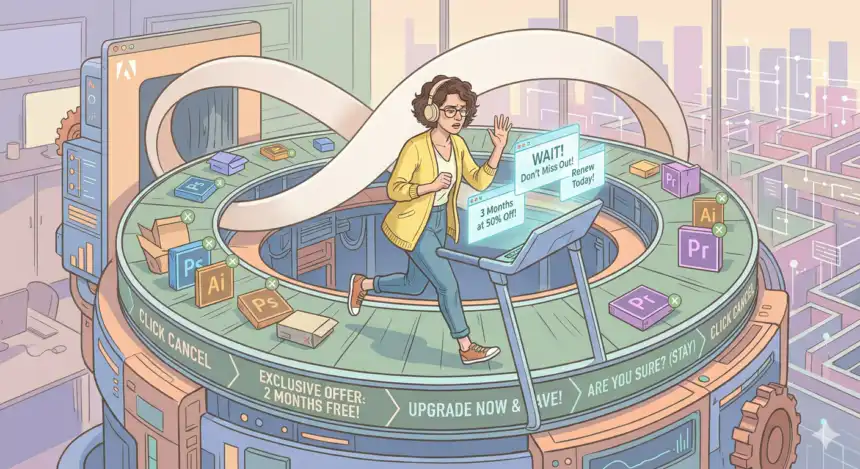

Adobe built the world’s most indispensable creative software. Then it engineered a subscription so difficult to leave that the U.S. Department of Justice stepped in. Here is what the company built, how it works on your brain, and why a $150 million settlement may not change a thing.
Try it yourself some evening when you have an hour to spare and a high tolerance for frustration. Log in to your Adobe account, navigate to the plans section, and click the button marked “Cancel Plan.” What follows is not a cancellation. It is a choreographed performance, a small theater of retention, designed by people whose job title may well include the word “growth” and who have almost certainly A/B tested every pixel of what you are about to see.
First comes the reminder of what you stand to lose. Your fonts, your cloud storage, your saved presets, your years of Lightroom catalogs. Then a survey asking why you want to go. Then an offer: a month free, a price reduction, a pause option. Then another screen. Then, if you called or opened a chat instead of navigating the web flow, you might get transferred. Or the chat might drop. Or the agent on the other end might offer you yet another deal, then a different one, and then a third, each delivered with the practiced warmth of someone who is, beneath the pleasantries, working against you.
This is the Adobe cancellation experience. It has been this way, in one form or another, since the company bet its entire future on recurring subscription revenue in 2013. And in March 2026, it cost the company $150 million.
How a Software Company Became a Toll Booth
To understand what Adobe built, you have to understand what it replaced. Before 2013, buying Photoshop meant buying Photoshop. You paid somewhere around $700 for a boxed license, and that copy worked for years. You owned it the way you owned a hammer. Adobe updated the product every eighteen months or so, and you could upgrade if you wanted, or not. The company had to keep earning your money with each new version.
Then Adobe watched what Salesforce did with enterprise software and decided the same logic applied to creative tools. Abacus News1 reported that the transition to Creative Cloud in 2013 was controversial at the time but ultimately proved highly profitable, transforming Adobe from a company that had to convince you to upgrade into a company that got paid whether or not you clicked a single button in any of its apps. The business logic was impeccable. The ethics of how it was implemented would take another decade to fully surface.
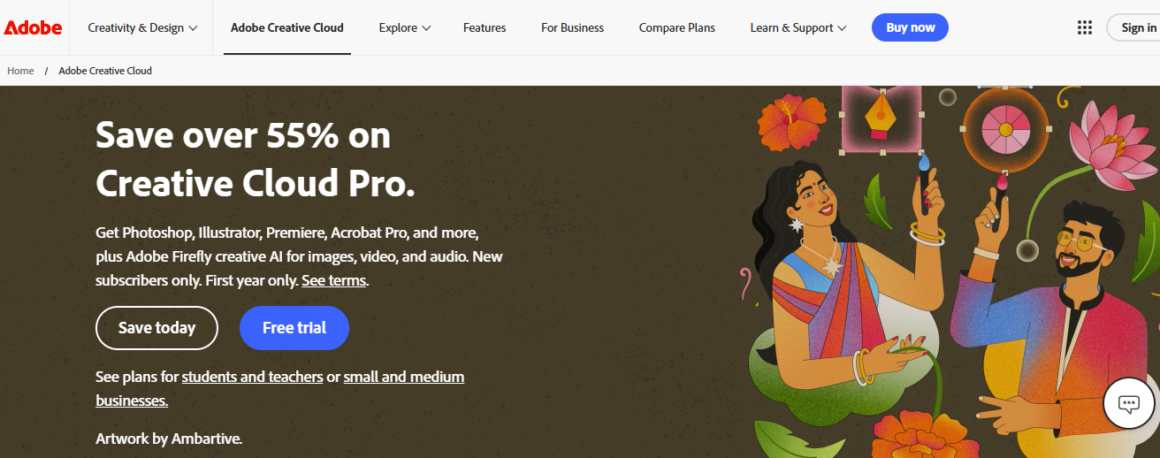
The specific plan at the center of the government’s case is called the “Annual, Paid Monthly” plan, and it is a masterpiece of misdirection. According to FTC2, Adobe prominently showed the plan’s monthly cost during enrollment, but buried the early termination fee and its amount, which amounts to 50 percent of all remaining monthly payments if you cancel in your first year. Adobe’s ETF disclosures were buried on the company’s website in small print, or required consumers to hover over small icons to find the disclosures.
The plan was also pre-selected as the default option during enrollment. You had to actively choose not to take it. Most people did not read far enough to understand what they were agreeing to. Many discovered the consequences only when they tried to leave.
User on Adobe Community Forums, January 2026:
“I signed up for so many subscription-based services but this is the first time I fell trap to this kind of dark pattern. This is terrible.”
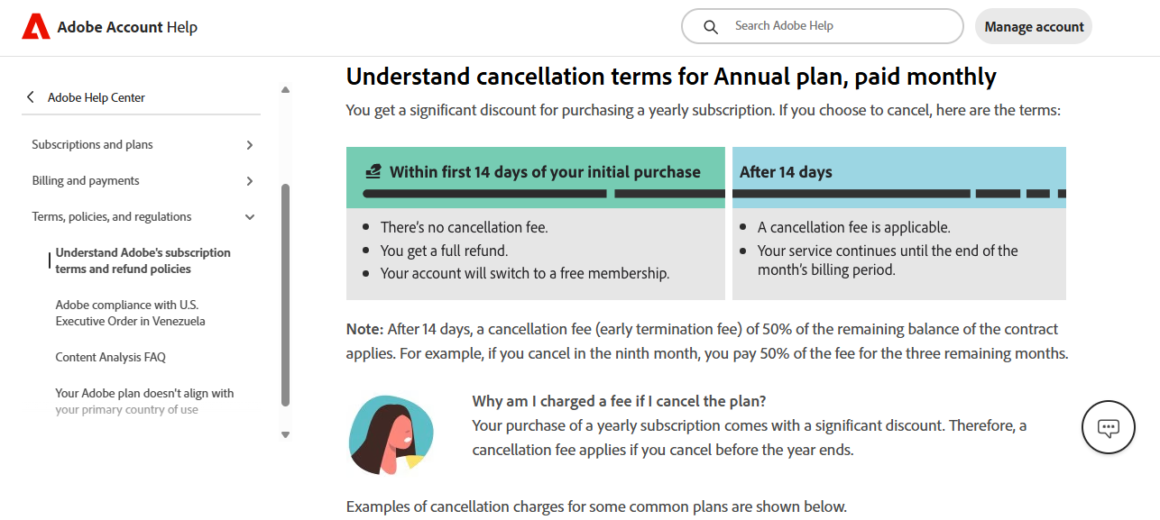
The numbers are stark. Adobe’s Help Centre3 states that after 14 days, a cancellation fee equal to 50% of the remaining balance of the contract applies. Cancel in the ninth month of a year-long plan at the standard rate and you owe 50 percent of the remaining three months. On a plan priced at $69.99 per month, that is not a trivial sum. One user on the FTC’s4 consumer alert page described their experience plainly: “I feel ashamed at 63 years old to have been taken like this.”
The Anatomy of a Retention Machine
The early termination fee was only the foundation. What the government’s lawsuit described in detail was an entire architecture of friction, a system where every moment of hesitation was an opportunity to prevent you from reaching the exit.
The DOJ complaint, filed in June 2024 on behalf of the FTC, laid it out with clinical precision. Consumers attempting to cancel online were forced to navigate numerous pages in order to cancel, including hidden cancellation buttons and multiple unnecessary steps such as pages devoted to password reentry, retention offers, surveys, and warnings. Consumers attempting to cancel via phone or chat experienced dropped calls, significant wait times, and repeated transfers.
An Adobe executive once described the early termination fee internally as “a bit like heroin for Adobe.”
The complaint also revealed something more damning than a UX design choice. According to Business Times5, an Adobe executive once described the early termination fee internally as “a bit like heroin for Adobe,” reflecting how heavily the company relied on the charge to retain subscribers. This was not an accidental system. It was a deliberate design, maintained by a dedicated “Retention” team whose job was to discourage subscribers who tried to cancel.
The third-party service Pine AI, which helps users navigate cancellation battles, noted in its customer guide that Adobe’s support bot “can loop on certain issues,” and that if the bot offers you the same link three times without resolution, users need to type “escalate” or “supervisor” to break the loop. That instruction existing at all, a guide on how to escape a loop, tells you something important about the nature of what Adobe built.
The academic study published in 2025 at ACM DL6 that analyzed six major subscription cancellation flows, including Adobe Creative, identified cancellation flows stuffed with patterns from 10 thematic categories, including: Complexity and Friction, Emotional Manipulation, Exploiting Time and Effort, Forced Continuity and Retention, and Psychological and Cognitive Overload. Adobe was selected for the study specifically because of user complaints and reports from industry watchdogs and Reddit threads. The finding was not surprising to anyone who had tried to leave.
The DOJ’s description of Adobe’s cancellation flow
“Consumers attempting to cancel online are forced to navigate numerous hurdles, including hidden cancellation buttons and multiple, unnecessary steps such as pages devoted to password reentry, retention offers, surveys, and warnings.”
— From the DOJ complaint, June 2024, as cited in Where’s Your Ed At7.
Some users on Adobe’s own community forums described the experience of realizing, after navigating a long cancellation chat, that they had not actually cancelled. Some subscribers who had contacted customer service even thought they had successfully canceled, only to find out later that Adobe was still charging them. The charges showed up on credit card statements weeks or months later. By then, the 14-day refund window was long gone.
What This Does to Your Brain
The retention architecture Adobe built did not work by accident. It worked because it was designed with a sophisticated, if cynical, understanding of behavioral psychology. Every element of the cancellation flow maps onto a documented cognitive bias.
The sunk cost fallacy is the first hook. When consumers pay an upfront fee or make an initial investment in a subscription, they tend to remain subscribed even if the service no longer provides the same value, stemming from a desire to justify their previous spending. When Adobe reminds you that you have three years of Lightroom catalogs in their cloud, they are not informing you of a practical concern. They are activating a psychological anchor.
Loss aversion is the second. Losses are often perceived as more painful than the pleasure gained from an equivalent win. Customers are more motivated to stay subscribed due to the fear of losing benefits or access they currently enjoy. Research by behavioral economist Dan Ariely8 suggests that once consumers integrate a subscription service into their routine, perceived cancellation “losses” outweigh actual costs. Adobe’s cancellation screens are built to trigger exactly this feeling at maximum intensity.
Then there is plain friction. A 2025 behavioral study at the ACR Journal9 found that when presented with cancellation friction in a multi-step process, 42 percent of participants chose to delay cancellation, even when dissatisfied. And sunk-cost framing, telling a subscriber “You’ve already invested X months,” increased retention intention by 18 percent in the same study. Adobe employed both, layered on top of a surprise fee that most people did not know existed when they signed up.
“Americans are tired of companies hiding the ball during subscription signup and then putting up roadblocks when they try to cancel.”Samuel Levine, Director, FTC Bureau of Consumer Protection
The retention offers that pop up during the cancellation flow deserve their own examination. A discount of 40 percent sounds generous until you realize you were already paying what the company hoped you would pay. Accepting a retention offer feels like a win. You negotiated. You got a deal. You stay. The company collects a slightly reduced fee from a subscriber who, without the offer, would have been paying nothing. This is not customer service. It is an arbitrage on your ambivalence, and it works on most people most of the time.
Digital subscriptions turn behavioral principles, defaults, sunk-cost effects, and choice overload into retention mechanisms. Adobe did not invent this. But it deployed it against people who, in many cases, were freelancers and small creative businesses with tight margins, people who needed the software to work, had no real alternative, and could not afford to keep paying for something they no longer used.
What $150 Million Looks Like When You Make $21.5 Billion
In March 2026, the Department of Justice10 announced that Adobe agreed to a $150 million settlement to resolve the government’s case. The figure broke down to $75 million in civil penalties and $75 million in free services for affected customers. Headlines called it a landmark enforcement action. And measured against past cases, it was significant.
Measured against Adobe’s finances, it was something else. According to WebProNews11, the company reported $21.5 billion in revenue for fiscal year 2024, with the overwhelming majority coming from its Digital Media segment, which includes Creative Cloud. The settlement amounts to roughly 0.7 percent of a single year’s revenue. As one sharp-penned industry commentator at Where’s Your Ed At12 put it, the $150 million amounts to roughly 0.345 percent of the $43.4 billion that Adobe made in 2024 and 2025 combined.
More critically, the settlement did not appear to require fundamental redesign of how Adobe conducts its business. CineD13 reported that Adobe’s stock dropped approximately 7.5 percent following the settlement announcement, and shares fell roughly 32 percent over the prior 120 days, which tells you that markets read something in the settlement terms beyond a simple regulatory slap.
The injunctive relief in the order requires clearer disclosure of termination fees and simpler cancellation. Whether that produces real change or a cosmetically adjusted flow that still achieves the same behavioral outcomes is a question that will be answered in practice, not in court filings. History with these kinds of settlements is not encouraging. The obligation to be transparent is easy to satisfy in the letter while violating it entirely in spirit.
User on FTC Consumer Alert page14, recountied their experience as:
“I nearly canceled, but then noticed the 50% ETF for unused months. They also stated that I would immediately lose access to the Creative Cloud apps, even for the current month. It appears that I am stuck until May 2025.”
The broader regulatory context makes the picture more complicated still. The FTC’s “Click-to-Cancel” rule, which would have required cancellation to be as simple as signup, was finalized in October 2024 but struck down by the U.S. Court of Appeals for the Eighth Circuit in July 2025 on procedural grounds. According to Coulson15, the new FTC leadership has not re-issued the rulemaking or filed a new appeal. As of late 2025, the rule is not in effect. The most powerful lever regulators had forged is, for now, gone. What remains are enforcement actions under existing statutes, state laws in California and New York, and the threat of private class action suits.
Adobe Is Not Alone, But It Is Special
It would be convenient, and wrong, to treat Adobe as an isolated bad actor. It is not. An FTC study16 of 642 subscription websites and apps found that 76 percent used at least one dark pattern, and 67 percent used more than one. Amazon built what internal documents called the “Iliad Flow” for Prime cancellations, named after Homer’s epic poem because of how labyrinthine it was. Amazon settled with the FTC for $2.5 billion in September 2025. Gyms, streaming services, newspapers, fitness apps: they all play versions of the same game.
What makes Adobe’s version distinct is its position in the market and who it traps. Adobe’s products are not entertainment subscriptions you might forget you have. They are professional tools essential to the work of millions of photographers, filmmakers, designers, and small studios. The company holds something close to a monopoly in several of its key categories. Until recently, there was simply no practical alternative to Photoshop for professional image editing, no substitute for InDesign in high-end publishing workflows, no replacement for Premiere Pro in many post-production pipelines.
That market power changes the moral weight of the retention tactics considerably. A newspaper using dark patterns to keep you from canceling your subscription is one thing. A software company that controls the tools of your profession and uses hidden exit fees to hold you there is something different. You are not just a consumer choosing a product. You are a professional whose livelihood depends on access to this software, and the company knows it.
“These are egregious, deceptive and manipulative techniques that shouldn’t be deployed against anyone, let alone creatives and consumers.”Ed Zitron, Where’s Your Ed At newsletter, on Adobe’s early termination practices
The Walls Are Coming Down, Slowly
The competitive landscape around Adobe has, for the first time in a decade, become genuinely interesting. In October 2025, Canva17 relaunched the Affinity suite it had acquired in 2024 as a completely free platform, combining photo editing, vector illustration, and page layout without any subscription fees. Within four days, over a million people signed up.
The Affinity V3 app costs nothing. It requires no ongoing fees, no mandatory renewals, no hidden costs. The timing was pointed: Canva launched at the close of Adobe’s own MAX event. If Adobe needed a signal that its subscription model is vulnerable, this was it sent in neon.
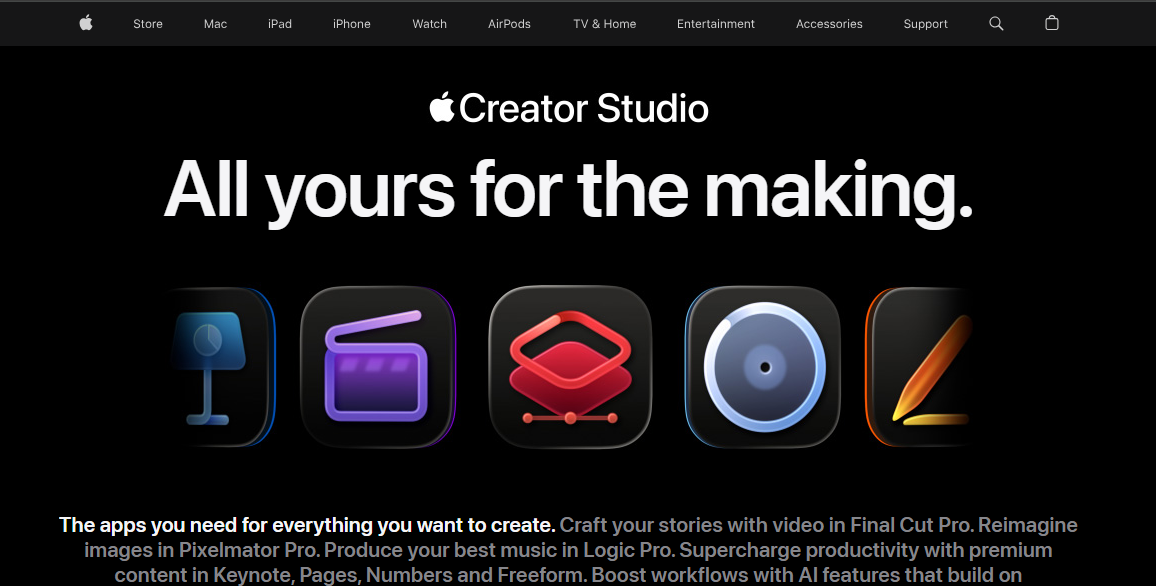
Figma has taken the UI design category entirely. DaVinci Resolve has made serious inroads in video editing. Apple18 launched Creator Studio, a subscription bundle including Final Cut Pro, Logic Pro, and Pixelmator Pro for $12.99 per month, maintaining one-time purchase options alongside subscriptions as a pointed contrast to Adobe’s approach. The one-time payment structure of competing tools means you pay once, own it forever, with updates within major versions included free.
This competitive pressure will do more to reform Adobe’s behavior than any single government settlement. The $150 million fine is a tax on past conduct. The possibility of losing 37 million subscribers to free alternatives is an existential question. Markets enforce behavioral change more efficiently than regulators, and the creative software market is finally becoming a real market again after years as a Adobe-controlled fiefdom.
What Actually Needs to Change
The fix for what Adobe built is not complicated to describe, even if it is expensive to implement. Cancellation should take one click, the same number it takes to sign up. The early termination fee should be disclosed in the same font size and visual prominence as the monthly price, on the same screen where you enter your payment details, before you agree to anything. Retention offers should come after a confirmed cancellation, not as roadblocks in the path to one. Dropped chat sessions during a cancellation attempt should automatically register as a cancellation request.
None of this is technically challenging. Adobe’s engineers could build it in a sprint. The only reason it has not existed until now is that it would cost the company retention revenue, and retention revenue is the lifeblood of the subscription model as Adobe has operated it. The DOJ settlement order requires some version of these changes. Whether the changes that emerge will be genuine or merely cosmetic is something consumer advocates and regulators will need to watch closely.
As regulations tighten, transparency and frictionless cancellation may become not only ethical best practice but legal requirement. The operative word there is “may.” The vacating of the Click-to-Cancel rule means the federal safety net has a hole in it. State laws in California and New York provide some protection, but they are patchwork. The burden of enforcing a right that should be simple falls, for now, primarily on individual consumers navigating systems designed to exhaust them.
The User at the End of the Loop
I want to end where this whole thing actually lives: not in a courtroom, not in an FTC press release, but in the experience of the person sitting at their computer at 11 p.m. trying to cancel a subscription they no longer need, watching the retention offer screen appear for the third time, wondering if clicking “I still want to cancel” will actually produce a cancellation or just another screen.
The Trustpilot19 rating for Adobe sits at 1.2 stars across thousands of reviews, with subscription cancellation problems consistently among the top complaints. One thousand, two hundred Better Business Bureau complaints in three years. A flood of Adobe community forum posts from people who cannot understand how a company this large can make something this simple feel so hard.
The answer, of course, is that it does not feel hard by accident. The industry has spent two decades engineering every friction point to maximize retention, and that cost of opacity is only now beginning to go up. Adobe built a machine that treated customer confusion as a feature and customer inertia as revenue. It worked, for years, because it had to. Not because Adobe had no other option, but because the option it had was harder and less profitable.
That calculus is changing. The fine is real, even if modest. The competition is real. The regulatory attention is real, even if temporarily weakened. And the users who have spent years fighting through retention loops are real, and they are talking to each other, on Reddit and forums and review sites, passing along the tricks: type “agent,” type “escalate,” call at this hour, say these words. They have built a folk knowledge of escape routes through a system that was never meant to let them go. That, in the end, is the sharpest indictment of what Adobe built. When your customers need a community-sourced guide on how to stop paying you, you have built something worth examining in the light.
Sources
- Abacus News, www.abacusnews.com/the-subscription-trap-why-adobe-is-paying-75-million-over-cancellation-fees/. Accessed 16 June 2026. ↩︎
- Nguyen, Stephanie T. “FTC Takes Action Against Adobe and Executives for Hiding Fees, Preventing Consumers from Easily Cancelling Software Subscriptions” 17 June 2024, www.ftc.gov/news-events/news/press-releases/2024/06/ftc-takes-action-against-adobe-executives-hiding-fees-preventing-consumers-easily-cancelling. Accessed 16 June 2026. ↩︎
- “Understand Adobe’s subscription terms and refund policies” Adobe Account, 27 Jan. 2026, helpx.adobe.com/account/individual/terms-policies-and-regulations/adobe-subscription-terms.html. Accessed 16 June 2026. ↩︎
- FTC, consumer.ftc.gov/consumer-alerts/2024/05/adobe-used-hidden-fee-trap-people-paying-subscription-plans-ftc-says. Accessed 16 June 2026. ↩︎
- Times, Business. “Adobe Agrees to $150 Million DOJ Settlement Over Hard-to-Cancel Subscriptions Under ROSCA Probe” 14 Mar. 2026, www.btimesonline.com/articles/176864/20260314/adobe-agrees-to-150-million-doj-settlement-over-hard-to-cancel-subscriptions-under-rosca-probe.htm. Accessed 16 June 2026. ↩︎
- ACM DL, dl.acm.org/doi/10.1145/3746175.3746211. Accessed 16 June 2026. ↩︎
- Zitron, Ed. “Premium: The Hater’s Guide To Adobe” Ed Zitron’s Where’s Your Ed At, 20 Mar. 2026, www.wheresyoured.at/hatersguide-adobe/. Accessed 16 June 2026. ↩︎
- Emerald, www.emerald.com/fttom/article/18/3-4/214/1326584/Behavioral-Retail-Operations-Tactics-to-Win. Accessed 16 June 2026. ↩︎
- Kalita, Trinkul. “Understanding Subscription Models: How Psychology Shapes Customer Loyalty, Value Perception, and Cancellation Patterns” Advances in Consumer Research, acr-journal.com/article/understanding-subscription-models-how-psychology-shapes-customer-loyalty-value-perception-and-cancellation-patterns-1475/. Accessed 16 June 2026. ↩︎
- “Adobe Agrees to $150 Million Settlement and Injunction to Resolve Alleged Violations of the Restore Online Shoppers’ Confidence Act” United States Department of Justice, 13 Mar. 2026, www.justice.gov/opa/pr/adobe-agrees-150-million-settlement-and-injunction-resolve-alleged-violations-restore-online. Accessed 16 June 2026. ↩︎
- WebProNews, www.webpronews.com/adobes-4-95-million-settlement-over-hidden-cancellation-fees-exposes-the-dark-economics-of-subscription-traps/. Accessed 17 June 2026. ↩︎
- Zitron, Ed. “Premium: The Hater’s Guide To Adobe” Ed Zitron’s Where’s Your Ed At, 20 Mar. 2026, www.wheresyoured.at/hatersguide-adobe/. Accessed 17 June 2026. ↩︎
- Leitner, Nino. “The $150 Million Price of “Cancel”: Adobe Settles DOJ Lawsuit Over Subscription Practices Every Filmmaker Knows Too Well” CineD, 16 Mar. 2026, www.cined.com/the-150-million-price-of-cancel-adobe-settles-doj-lawsuit-over-subscription-practices-every-filmmaker-knows-too-well/. Accessed 17 June 2026. ↩︎
- FTC, consumer.ftc.gov/consumer-alerts/2024/05/adobe-used-hidden-fee-trap-people-paying-subscription-plans-ftc-says. Accessed 17 June 2026. ↩︎
- Coulson, Nicholas. “Dark Patterns Online: How Companies Trick Users — and Why Private Lawsuit Enforcement is Our Best Hope” Coulson P.C.| Complex Litigation & Class Action La, 14 Oct. 2025, www.coulsonpc.com/coulson-pc-blog/dark-patterns-ftc-click-to-cancel-rule. Accessed 17 June 2026. ↩︎
- FTC, www.ftc.gov/news-events/news/press-releases/2024/07/ftc-icpen-gpen-announce-results-review-use-dark-patterns-affecting-subscription-services-privacy. Accessed 17 June 2026. ↩︎
- “Canva” www.canva.com/en_in/newsroom/news/all-new-affinity/. Accessed 17 June 2026. ↩︎
- “Apple Creator Studio” Apple (IN), www.apple.com/in/apple-creator-studio/. Accessed 17 June 2026. ↩︎
- Trustpilot, www.trustpilot.com/review/www.adobe.com. Accessed 17 June 2026. ↩︎