

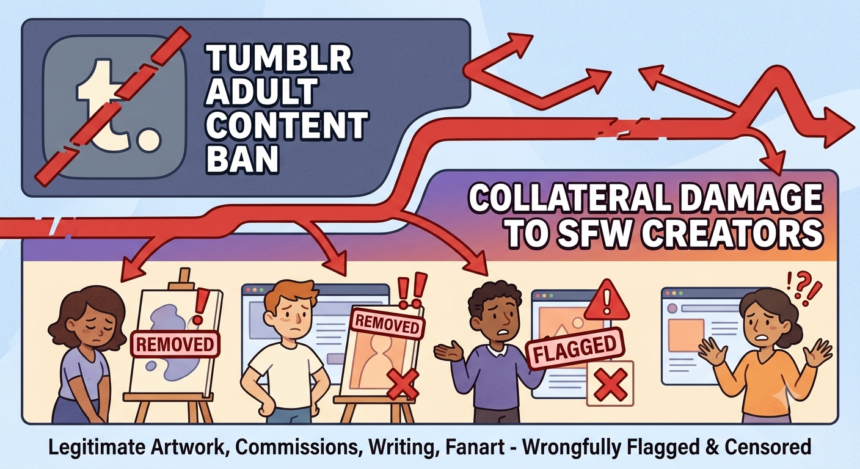

I went looking for old Tumblr threads the way you go looking for a photo album in a flooded basement. Most of it was still there, water damaged, half legible, but there. A drawing of a dragon flagged as adult content. A painting of fruit with teeth flagged as adult content. Garfield, the cat, flagged as adult content. Seven years later, the site is still doing it. Only now the artists posting the complaints are using a different filter, a newer app update, the same broken promise.
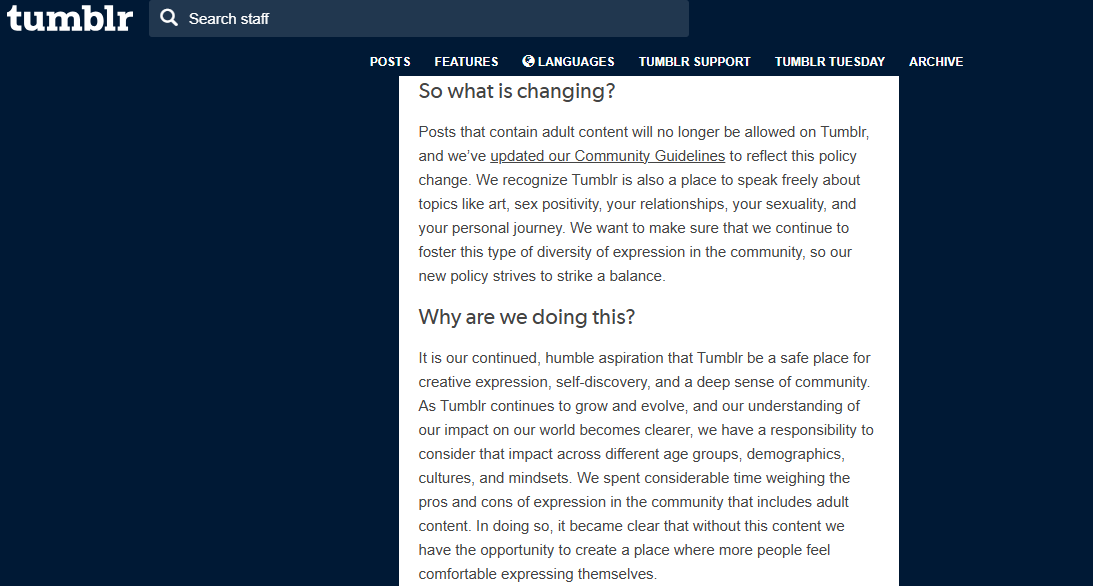
On December 3, 2018, Tumblr’s then CEO Jeff D’Onofrio published a post titled “A better, more positive Tumblr.” According to TechRadar1, he announced that starting December 17, the platform would purge all “adult content,” a category defined mostly by what he called real-life human genitals or female-presenting nipples, along with anything depicting sex acts. The company carved out exceptions for breastfeeding, health related nudity, political speech, classical sculpture, and written erotica. Everything else got swept into a dragnet run largely by machines.
The timing told its own story. According to IndyStar2, weeks earlier, Apple had yanked the Tumblr app from its App Store after child sexual abuse material turned up on the platform, material that had slipped past the company’s filters. D’Onofrio insisted the ban had been in the works for months and wasn’t a reaction to that scandal. Almost nobody believed him. And even if he was telling the truth, the sequence mattered more than the intent. A company facing an existential threat from Apple’s gatekeeping had every incentive to overcorrect, and overcorrect it did, with an algorithm that could not tell the difference between a Playboy shoot and a Steven Universe fan comic.
The Comedy That Wasn’t Funny for Long
The flagging began almost immediately, and it was, briefly, very funny. Kotaku3 catalogued a growing list of casualties: a fully clothed woman, a drawing of a dragon, Haikyu fan art, illustrations from a published children’s book, a painting of fruit with mouths, an abstract video, and Garfield. One artist tweeted that a book illustration that had appeared in stores nationwide had been flagged as explicit by the same tool that was supposed to protect children. Another posted a screenshot with the caption that read, more or less, look at all the explicit sex and nudity in these dragons and dinosaurs.
The jokes had a bitter aftertaste. Behind every screenshot was a working artist whose visibility had just been switched off. A flagged post gets pushed behind a warning label. Search and recommendation algorithms deprioritize it. For anyone building an audience or trying to sell commissions, that is not an inconvenience. That is lost income.
TechCrunch4 reported that Tumblr’s own machine learning classifier and human moderation team could not keep pace with the volume, and the company admitted as much, saying it understood there had been too many wrongfully flagged posts since the policy change. The company asked users to help report the errors, which is a strange kind of outsourcing, asking the people whose work you just mislabeled to help you fix the tool that mislabeled it.
Some artists found workarounds. PiunikaWeb5 documented a loophole where posts tagged SFW seemed to dodge the censoring bots entirely, at least for a while, and users on Twitter swapped screenshots of the trick along with warnings that Tumblr appeared to be shadow banning visual artists even when their material was safe for work. One post described searching a popular fandom tag before the ban and finding it full of art from well known creators. After the ban, the same search returned almost nothing but text posts and memes. The artists hadn’t deleted their blogs. They had simply been buried.
A Tumblr user running a small help blog, itsdelicate6, put together an informal guide for other creators explaining how to appeal a flag, because the process wasn’t obvious and the support queue was slow.
A ton of posts are now being flagged as sensitive content thanks to Tumblr’s new idea to make it adult content free. However, you can request a review so they can fix it. I know it’s tiring, and I know it’s not our fault that Tumblr can’t do a simple thing right, but I refuse to have any of my SFW creations being taken down just because Tumblr doesn’t know how to write an algorithm.
The post read like something written by someone tired of watching friends lose their work for nothing. I refuse to have any of my SFW creations being taken down just because Tumblr doesn’t know how to write an algorithm, the post said, before walking through the review request process step by step. That is what collateral damage looks like from the inside. Not a company blog post. A stranger writing a how-to guide because the platform wouldn’t.
Nudity, Art, and Who Gets to Decide
Tumblr tried to draw a line between pornography and art, allowing “nudity found in art, such as sculptures and illustrations” while banning photographic and video depictions of sex acts. Academic critics pointed out that this line has never been neutral. Writing in The Conversation7, researchers Zahra Stardust and colleagues argued that the distinction between art and pornography was influenced by the spread of photography in the nineteenth century, when painting was treated as legitimate and photography was treated as dangerously close to the real thing. Pornographic photography, in their telling, became a scapegoat used to separate lowbrow culture for the masses from highbrow culture for the elite. Tumblr’s 2018 policy reproduced that old hierarchy in code. A marble statue survives. A photograph of a body in the same pose does not.
The same piece noted something that got lost in the initial coverage: adult content reportedly drove roughly 20 percent of all traffic to Tumblr at the time. Sex workers, kink communities, and independent porn producers had built entire subcultures on the platform, and the policy erased them along with the SFW creators who happened to share the same tags, the same aesthetic, the same digital neighborhood. When a city bulldozes a block to get rid of one bad building, everyone on that block loses their home.
The Electronic Frontier Foundation offered the clearest technical explanation for why the collateral damage was baked in from the start. In a piece examining the ban’s aftermath, EFF8 pointed to the passage of FOSTA and SESTA earlier that year, laws that made platforms liable for user content tied to sex trafficking. Large companies, EFF wrote, are risk averse, and when you are being cut off from potential customers and could be held liable for anything related to sex, it becomes much easier to build a filtering tool that is over-inclusive, one so broad it winds up flagging the very content the company says it wants to protect. The dragon and the Garfield meme weren’t a bug in that logic. They were the predictable output of it. A cautious lawyer would rather overblock ten thousand harmless posts than underblock one that leads to a lawsuit, and the artist whose dinosaur drawing gets buried never gets a seat at that table.
The Fandom Exodus Nobody Coordinated
Tumblr had spent a decade becoming something closer to a cultural commons for fan communities than a generic blogging tool. People wrote fanfiction rated everywhere from G to NC-17, posted accompanying art, ran fan podcasts, built entire archives around ships and characters that existed nowhere else in that form. Engadget’s9 culture desk described it as a haven where a story about, say, two characters from a beloved franchise slipping off to a bar together might simply stop mid scene if the author lost interest, the same way it might on any personal blog, because there are few rules in fanfiction beyond the ones a community sets for itself. That informality was the point. It could not survive an algorithm trained to treat ambiguity as risk.
When the ban hit, that community didn’t relocate so much as scatter. Some writers and artists moved to Dreamwidth. Some tried Pillowfort, a smaller platform that struggled with its own growing pains. Most converged, at least for fiction, on Archive of Our Own, the nonprofit fan fiction repository that had spent a decade building infrastructure specifically so that no single corporate platform could hold fandom hostage again. The organization’s leadership had lived through this exact scenario once before, when LiveJournal cracked down on adult content in 2007 and drove a wave of fans to found what eventually became AO3. Engadget quoted OTW’s Betsy Rosenblatt McGuire making the point plainly: commercial platforms will always serve their own interests over the interests of fans, and that’s why AO3 is a nonprofit, because we own the servers.
Harvard’s Berkman Klein Center10 ran a shorter but sharper piece under the headline “Fandom’s Fate Is Not Tied to Tumblr’s,” arguing that the pattern was not new and Tumblr should have known better, since LiveJournal’s own crackdown on fan and LGBTQ content a decade earlier had already written the playbook that Tumblr proceeded to follow anyway. History doesn’t usually repeat with this much precision. This time it basically photocopied itself.
The visual artists who stayed on Tumblr, because their audience was there, because rebuilding a following from zero on another platform felt impossible, absorbed the brunt of the algorithm’s confusion in a way fiction writers largely did not. Text is hard for an image classifier to misjudge. A drawing is not. That single technical asymmetry meant the ban fell heaviest on illustrators, comic artists, and anyone whose SFW work happened to involve human bodies, skin tones, or anything vaguely figure-drawing adjacent.
LGBTQ+ creators absorbed a particular kind of damage that had nothing to do with nudity at all. Fortune11 quoted illustrator and writer Anthony Oliveira reacting to the announcement in real time, writing that Tumblr was one of the few vectors for grassroots queer art, and banning adult content would disproportionately stunt and hamstring those artists, so of course that is happening in 2018, a line that reads now less like a complaint and more like a forecast. The BBC’s12 technology desk made a related point about who gets abandoned when a platform decides to give up rather than invest in better moderation, noting plainly that Tumblr’s porn ban abandons the marginalised, the same populations who had few other places willing to host their work in the first place.
The Educators Nobody Warned
The ban’s collateral list didn’t stop at fan artists. It reached into public health. Tumblr had, for years, been one of the more permissive homes for sex education blogs, the kind run by nurses, peer educators, and survivors trying to fill a gap that most school curricula leave wide open. A retrospective on the ban published years later noted that the crackdown ended up restricting sex education blogs that had served as a backbone for LGBTQ youth who had no other reliable way to learn about safe sex. The same piece pointed out a detail that rarely made it into the initial headlines. Figure drawing references, the kind art students use to study anatomy, got caught in the same net as pornography, because a nude body photographed for instructional purposes looks, to a blunt classifier, identical to a nude body photographed for anything else. Blogs that had spent years building libraries of reference material for working artists disappeared overnight, not because anyone objected to their content, but because the software couldn’t tell life drawing from a centerfold.
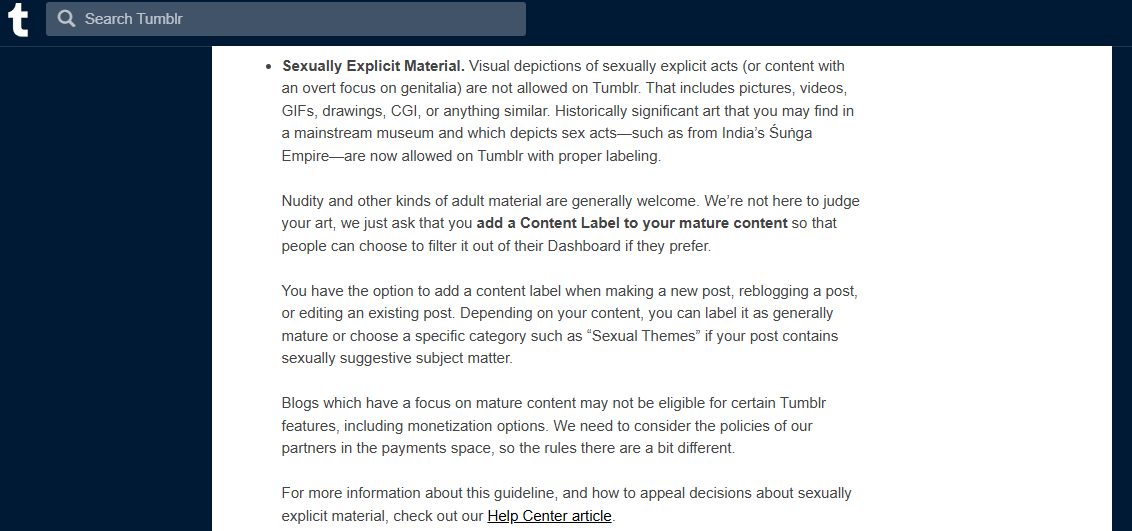
Tumblr’s own written policy tried to carve out room for this. The company said it would keep allowing nudity connected to breastfeeding, birth, post-mastectomy recovery, and gender confirmation surgery, categories that read, on paper, like a genuine attempt at nuance. In practice, the exceptions depended on the same automated system that flagged Garfield. A mastectomy awareness post and a pornographic image can share lighting, framing, and skin tone in ways that mean nothing to a human moderator with context and mean everything to a model trained on pixels. The exception existed in the policy document. Whether it existed in the actual moderation queue was a different question, and the artists and educators who got flagged anyway rarely got a clean explanation for why.
Not everyone treated the flood of nipple memes and apocalypse GIFs as pure comic relief. A 2022 study in New Media & Society13 by Elena Pilipets and Susanna Paasonen took the meme culture seriously as a form of protest. Users had turned the phrase female-presenting nipples, lifted straight from Tumblr’s own guidelines, into a running joke, pairing it with GIFs of collapsing buildings and burning cities to mark December 17 as what the community nicknamed doomsday. The researchers described how the hashtag tumblr purge mobilized a series of derivative tags through apocalyptic humor and nipple memes, a coordinated, distributed, and largely leaderless expression of grief dressed up as a joke because grief alone doesn’t trend.
That reframing matters. It is easy to read a wave of memes as evidence that nobody took the ban seriously. The more accurate reading is that a community used humor because outrage alone rarely moves a platform, and because laughing at your own eviction is sometimes the only leverage you have left.
Fast Company14 checked back six months later and found Tumblr’s web traffic had plummeted by roughly a third since the ban took effect, a drop steep enough to reshape the surrounding internet, spinning up a small ecosystem of replacement sites competing to catch the runoff. Most of those replacements were built explicitly for adult content, not for the SFW fandom artists who had also fled. There was no equivalent boomtown for them. They didn’t need a new home for porn. They needed a platform that could recognize their own work when it saw it, and none of the scrappy 2019 startups were built to solve that particular problem.
A retrospective published by G2’s15 research team traced the broader arc of the company’s decline, from a $1.1 billion acquisition by Yahoo in 2013 down to a $3 million sale price six years later, and named the adult content ban as the clearest inflection point in that collapse. Verizon, which had inherited Tumblr through its acquisition of Yahoo, sold the platform to Automattic, the company behind WordPress, in 2019 for a price that made the original purchase look almost absurd in hindsight.
The Same Mistake, Running on New Hardware
Here is the part of the story that should not still be true and is. In June 2025, TechCrunch16 reported that Tumblr’s content filtering systems were once again falsely flagging posts as mature, years after the original ban and years after Automattic had taken over. The false positives read like a rerun of 2018 with a new cast. Cat GIFs. Fandom art. A photo of someone’s hands. Reporter Sarah Perez tied the issue to an Android app update that was quietly testing an added layer of moderation on top of Tumblr’s existing Content Labels system, and users, not the company, were the ones who noticed something had broken.
Tumblr’s own staff account acknowledged the problem on the company’s internal feedback blog, admitting to what it called incorrect classification issues and promising an appeals process overhaul. It was said that the company aimed to respect a diverse set of interests and content preferences, language that sounds almost identical to what the company said in 2018, except this time there was less staff behind it to fix anything.
That last detail is the real story, and it is easy to miss if you are only looking at the algorithm. TechCrunch’s own reporting connects the dots. Following the 2019 Automattic acquisition, Tumblr underwent repeated rounds of layoffs, with employees reassigned to other Automattic projects and the platform eventually running on a skeleton crew while the company migrated Tumblr’s entire back end to WordPress infrastructure to cut costs, all while trying to stem financial losses reported at roughly $30 million a year. An understaffed moderation team leaning harder on automated classifiers is not a coincidence. It is what happens when a company decides that fewer humans reviewing content is an acceptable trade for lower payroll, and the artists whose work gets misclassified are the ones who absorb that trade.
I don’t think Tumblr’s engineers wanted to flag a photo of someone’s hands as mature content. I think the people paid to prevent that outcome kept getting laid off, and the machine kept running anyway, because a platform with half a billion blogs cannot simply stop moderating while it figures out who’s left on the team.
The Pattern is Bigger Than One Company
Perez’s reporting placed Tumblr’s 2025 flagging spree alongside near identical complaints at Pinterest and Instagram in the same news cycle. Pinterest eventually admitted its mass user bans were caused by an internal error, while Instagram declined to comment on its own wave of complaints. Three different platforms, three different moderation stacks, the same basic failure mode. Automated systems built to catch a narrow category of genuinely harmful content, deployed at a scale that makes human review impractical, tuned to err on the side of over-blocking because a false negative is a headline and a false positive is just some artist’s bad week.
That asymmetry is the actual subject of this story. It isn’t really about Tumblr’s policy on female-presenting nipples, a phrase that was always more meme than moderation standard. It is about what happens when a company weighs the cost of catching bad content against the cost of silencing good content, and decides the second cost is one that mostly other people will pay. The SFW fandom artist losing visibility on a flagged post, the sex educator whose mastectomy awareness content gets buried, the illustrator whose book art trips the same wire as pornography, none of them show up in a quarterly earnings call. Legal risk does.
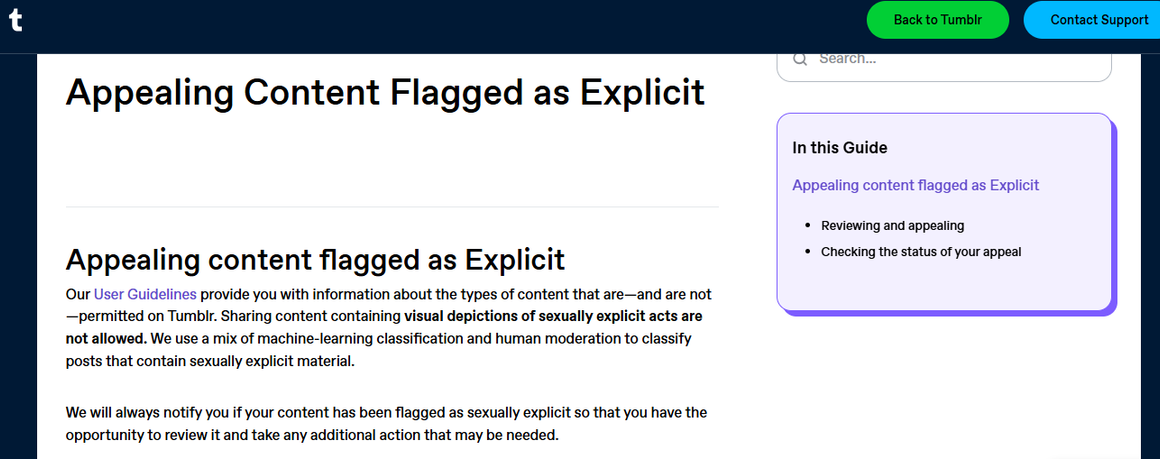
Tumblr’s Help Center17 still runs a page dedicated to appealing content flagged as explicit, a quiet monument to how routine the error has become. You do not build a standing appeals process for a rare mistake. You build one because you know, going in, that the net will catch things it was never meant to catch, and you’d rather manage the complaints than fix the net.
I keep coming back to that dragon. Somewhere in 2018, an artist drew a dragon, posted it to a platform that had been home for their work for years, and watched an algorithm decide it was pornography. Seven years and one corporate sale later, someone else posted a picture of their own hands and watched the same thing happen. The company changed hands. The apology language barely changed at all. Whatever comes after Tumblr, whatever platform eventually inherits the fandom artists still holding on there, it will have to solve a problem that has now survived two owners, one lawsuit-driven panic, and one round of layoffs. I don’t know what that solution looks like yet. I’m not sure anyone building these systems does either.
Sources
- Domanski, Harry. “Tumblr announces adult content ban” TechRadar, 4 Dec. 2018, www.techradar.com/news/tumblr-announces-adult-content-ban. Accessed 18 Oct. 2026. ↩︎
- “IndyStar” Three weeks earlier, Tumblr’s app was removed…, www.facebook.com/indianapolisstar/posts/three-weeks-earlier-tumblrs-app-was-removed-from-apples-app-store-following-some/10158658159549852/. Accessed 18 Oct. 2026. ↩︎
- Jackson, Gita. “Tumblr’s New Algorithm Thinks Garfield Is Explicit Content” Kotaku, 4 Dec. 2018, kotaku.com/tumblrs-new-algorithm-thinks-garfield-is-explicit-conte-1830854912. Accessed 18 Oct. 2026. ↩︎
- Perez, Sarah. “Tumblr’s content-filtering systems have been falsely flagging posts as ‘mature,’ users blame AI” TechCrunch, 17 June 2025, techcrunch.com/2025/06/17/tumblrs-content-filtering-systems-have-been-falsely-flagging-posts-as-mature-users-blame-ai/. Accessed 18 Oct. 2026. ↩︎
- 13 Dec. 2018, piunikaweb.com/2018/12/13/tumblr-accused-of-censoring-shenanigans-as-users-find-loop-holes/. Accessed 18 Oct. 2026. ↩︎
- “Posts being flagged as sensitive content and how to fix it” Tumblr, 4 Dec. 2018, itsdelicate.tumblr.com/post/180794791144/posts-being-flagged-as-sensitive-content-and-how. Accessed 18 Oct. 2026. ↩︎
- Stardust, Zahra. “Sexual subcultures are collateral damage in Tumblr’s ban on adult content” 6 Dec. 2018, theconversation.com/sexual-subcultures-are-collateral-damage-in-tumblrs-ban-on-adult-content-108169. Accessed 18 Oct. 2026. ↩︎
- “What Tumblr’s Ban on ‘Adult Content’ Actually Did” Electronic Frontier Foundation, 20 May 2019, www.eff.org/tossedout/tumblr-ban-adult-content. Accessed 18 Oct. 2026. ↩︎
- Fingas, Roger. “Engadget” Technology News & Expert Reviews, 11 Dec. 2018, engadget.com/2018/12/11/tumblr-fanfiction-fandom-purge-2018. Accessed 18 Oct. 2026. ↩︎
- Fiesler, Casey. “Fandom’s Fate Is Not Tied to Tumblr’s” Berkman Klein Center, 7 Dec. 2018, cyber.harvard.edu/story/2018-12/fandoms-fate-not-tied-tumblrs. Accessed 18 Oct. 2026. ↩︎
- Stampler, Laura. “Tumblr to Ban ‘Adult Content.’ Some Users Aren’t Happy” Fortune, 3 Dec. 2018, dc.fortune.com/2018/12/03/tumblr-ban-porn-adult-content. Accessed 18 Oct. 2026. ↩︎
- “Bbc”, feeds.bbci.co.uk/news/technology-46435975. Accessed 18 Oct. 2026. ↩︎
- SagePub, journals.sagepub.com/doi/10.1177/1461444820979280. Accessed 18 Oct. 2026. ↩︎
- “Fastcompany.Com” www.fastcompany.com/90358305/six-months-after-tumblrs-nsfw-ban-these-kink-communities-are-coming-out-on-top. Accessed 18 Oct. 2026. ↩︎
- Betz, Jazmine. “The Past and Future of Tumblr” 17 Sept. 2019, research.g2.com/insights/history-of-tumblr. Accessed 18 Oct. 2026. ↩︎
- Perez, Sarah. “Tumblr’s content-filtering systems have been falsely flagging posts as ‘mature,’ users blame AI” TechCrunch, 17 June 2025, techcrunch.com/2025/06/17/tumblrs-content-filtering-systems-have-been-falsely-flagging-posts-as-mature-users-blame-ai. Accessed 18 Oct. 2026. ↩︎
- “Appealing Content Flagged as Explicit” Tumblr Help Center, 2 Nov. 2016, help.tumblr.com/hc/en-us/articles/231885248-Appealing-content-flagged-as-explicit. Accessed 18 Oct. 2026. ↩︎


