

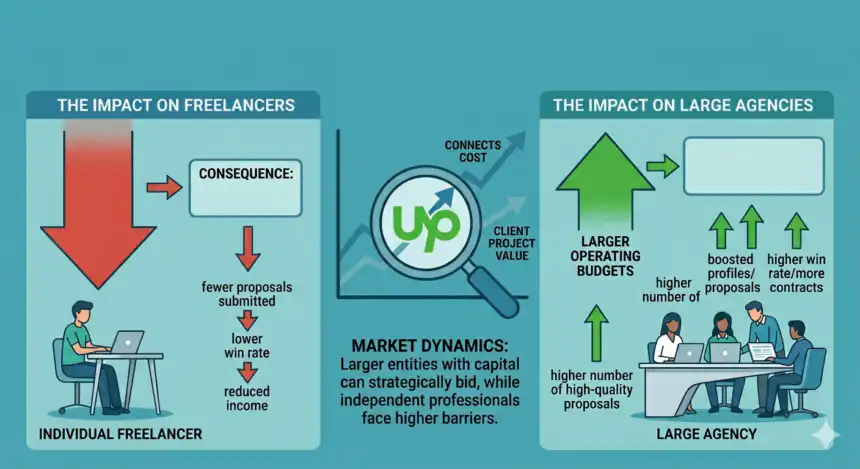

There is a line you cross somewhere around your thirtieth rejected proposal on Upwork where the math stops being theoretical and starts being personal. Say, you are staring at a job post for a 2,000-word blog article. The fee to submit a bid: 16 Connects, or $2.40. The job’s posted budget: $50. Before typing a single word for a client, you have already spent nearly five percent of the potential contract’s value just to raise your hand. That is not a bidding system. That is a toll booth placed in the middle of a highway that used to be free, and the trucks are getting through fine while the cyclists are turning back.
This is the story of how Upwork, the world’s largest freelance marketplace, has systematically inflated the cost of bidding on work to the point where solo operators are bleeding Connects dry while established agencies, with their larger budgets, dedicated bidding staff, and automation tools, absorb the same costs as a rounding error on a quarterly P&L.
A Brief History of the Bid
Upwork’s Connects system did not begin as a money-maker. When the platform first rolled out paid Connects, the stated logic was clean and reasonable: proposals used to be free, which meant clients received hundreds of generic, copy-pasted bids per job. Paid Connects would raise the cost of applying, filter out low-effort spam, and ensure that clients saw only serious candidates. At $0.15 per Connect, it sounded like a nominal speed bump. Not a structural barrier.
And for a while, it was. According to Upwork Support1, a standard proposal used to cost 1–2 Connects. At $0.15 each, a busy freelancer sending twenty proposals a month was spending perhaps $6. Annoying, but survivable.
Then the numbers started moving.
By November 2023, freelancers in Upwork’s own community forum2 were alarmed.
“I noticed something very troubling when I started applying for jobs yesterday,” wrote one user. “The number of connects required to bid for the work that I do has gone up sharply. I used to bid on things for 6 connects. Now the cost has climbed up to 12 to 16 connects or more.”
The thread, which Upwork eventually closed for becoming “unproductive,” captured the exact moment the community realized this was not a glitch. It was a feature.
According to Snipe Work3, today, in 2026, each Connect still officially costs $0.15, but the number of Connects required per proposal is anything but stable. Higher-budget or competitive jobs cost 10 to 16 Connects per proposal: $1.50 to $2.40 per bid.
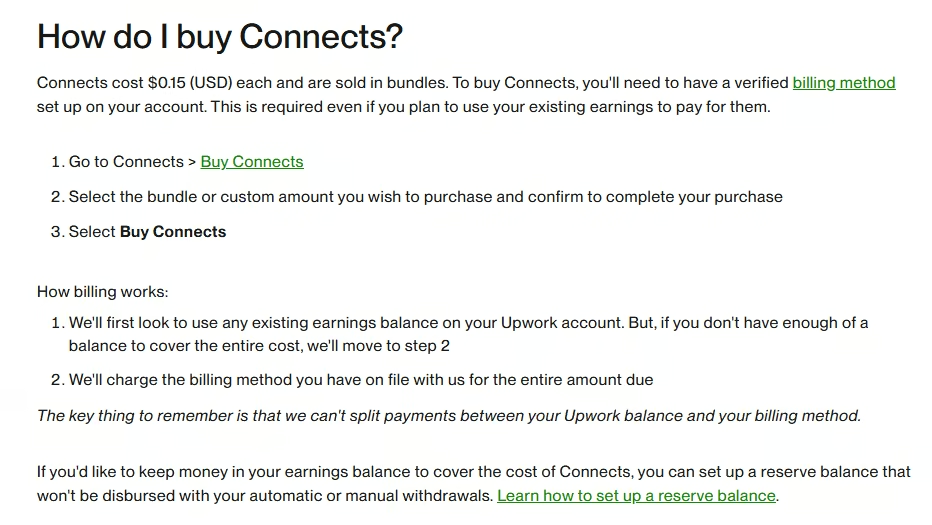
The Free plan gives freelancers just 10 Connects per month, which translates to roughly one or two applications before you need to open your wallet. And perhaps most maddening: the Connect requirement on a given job can increase mid-posting, without any changes to the job description itself, purely based on proposal volume or demand signals. One user’s complaint, quoted in a recent analysis, summed it up bluntly:
“Applied to a job yesterday for 19 connects. Checked today — same job is now 24 connects. No edits to the job. Just increased the price to apply.”
There is no warning. There is no refund if you applied earlier at the lower rate.
The Invisible Tax on Losing
What makes the Connects system uniquely punishing for solo freelancers is not the cost-per-bid in isolation. It is the compounding effect of a low reply rate with a non-refundable token system.
GigRadar4 reported that Upwork’s platform average reply rate hovers around 5% for freelancers bidding broadly. That means for every 20 proposals sent, 19 vanish into the void. And every single one of those 19 took Connects with it. At 16 Connects per proposal and $0.15 per Connect, a single successful reply from 20 bids costs $48 in Connects before the freelancer has exchanged a single message with a human being. At a 25% close rate from first reply, the cost per hire on a $2,000 contract climbs to $192 in Connects alone. Nearly 10% of the contract value gone before a single deliverable is written.
A benchmark often cited for healthy bidding economics is keeping the cost per hire below 5% of average contract value. For a typical $1,500 Upwork contract, that means a target of under $75 in total Connect spend per win. That is achievable for a disciplined solo freelancer in a tight niche. But it is a knife’s-edge operation that requires tracking metrics, targeting well, and responding to new job posts within the first hour of their going live.
Most solo freelancers do not work that way. They browse in the evenings after a day job. They apply broadly while building a client base. They are, by definition, doing this without a system. And the platform they are operating on was, in its early years, designed with exactly that kind of casual, exploratory freelancer in mind.
That freelancer is now subsidizing the platform for everyone else.
Here is where the structural asymmetry becomes impossible to ignore.
A large agency on Upwork does not treat Connect spend as a variable personal expense. It treats it as a customer acquisition cost (CAC), baked into a marketing budget. At 16–20 Connects per proposal, 100 Connects covers 5–6 proposals, less than one week of moderate bidding for a single profile. But a well-funded agency running 40–100 proposals a month is not buying Connects one subscription at a time. It is buying them in volume, tracking reply rates, using third-party automation tools that fire proposals within minutes of job postings going live.
Speed is a structural agency advantage. So is specialization. Development agencies working in Shopify, React, or mobile see reply rates of 15–25% when proposals match the client’s stack precisely. At that reply rate, the math transforms. The cost per hire on a $2,000 contract drops to $64. A 3.2% acquisition cost that any growth-focused operation would happily accept.
Data from Getmany5 shows that agencies with at least five members enjoyed a 22% higher win rate on Upwork in 2024. It also shows that for projects above $5,000, 63% of clients prefer agencies, valuing the ability to deliver multi-skill solutions. As Upwork pivots toward larger contracts and enterprise clients, agencies are positioned directly in the sweet spot. Solo freelancers are, increasingly, bidding for the shrinking slice of smaller jobs. The exact jobs where Connect costs represent the highest percentage of potential earnings.
The analogy that keeps coming to mind is the supermarket checkout line when self-checkout arrived. Superficially, it looked like efficiency for everyone. In practice, it transferred the cost of labor onto the consumer while freeing up the retailer’s bottom line. Upwork’s Connects inflation does something structurally similar: it transfers the risk and cost of platform prospecting entirely onto the freelancer, while giving well-capitalized agencies the tools to absorb that cost as ordinary business.
Upwork’s Revenue Tells the Real Story
Upwork is a publicly traded company, and its financials narrate exactly where the platform’s priorities lie.
According to Etcetera6, in Q2 2025, Connects revenue grew 19% year-over-year. Freelancer Plus subscription revenue grew 13%. Ad and monetization revenue grew 17%. In short: the platform earned substantially more from the act of freelancers trying to win work than it did from the work itself. Subscriptions to Freelancer Plus increased 58%, not because the platform became dramatically more useful but because the alternative, trying to bid competitively on just 10 free Connects a month, became increasingly untenable.
Electro IQ7 reported that Upwork’s marketplace take rate climbed from 13.2% in 2021 to 18.5% by Q2 2025. A stunning increase that captures the full sweep of platform monetization. The company’s gross services volume held roughly steady between 2022 and 2024 (around $4 billion annually), but revenue kept climbing. The difference is extracted, in meaningful part, from the bidding economy.
Enterprise revenue grew 4% to $107.2 million in 2024, and Managed Services revenue grew 12%. The platform is not growing by adding more clients or more projects. It is growing by squeezing more revenue from the same volume of activity. And by moving upmarket toward the large, enterprise clients that agencies are better equipped to serve.
This strategic direction was telegraphed years ago. In a 2019 investor call, Upwork CEO Hayden Brown said outright that Upwork would be focusing more on serving the needs of Fortune8 500 companies rather than smaller companies looking for a quick job with a single gig worker. In 2020, the platform removed 1.8 million freelancers it deemed “less skilled”. The community understood what that meant. The platform understood what that meant. The direction of travel was not ambiguous.
What has changed since 2019 is only the velocity of that drift.
The Pay-to-Boost Problem
On top of the base Connects cost, Upwork operates an optional boosting auction that lets freelancers bid additional Connects to appear at the top of a client’s proposal list. The boost works like an auction: you see the current fourth-place bid and need to bid higher to hold a visible slot. You do not pay your full bid. You pay enough to beat the next highest bidder. But the Connects spent on the boost are non-refundable, whether you get the job or not.
Matt Cates9, a freelance writer with over $150,000 in historical Upwork earnings, described the boosting system as potentially wrongful in a widely shared 2025 essay:
“Imagine paying to have your resume viewed over someone else’s when applying for jobs!” He is describing a pay-to-play visibility layer that, once again, rewards volume bidders and well-capitalized agencies over individual freelancers operating with tight monthly Connect budgets.
Newer freelancers outside the U.S. are hit especially hard, effectively getting priced out of even trying for competitive roles. A freelancer in Manila or Nairobi earning $20–$30 per hour faces the same nominal Connect costs as a New York agency billing $200 per hour. But the Connects represent a wildly different percentage of their operating margins. The system is dollar-denominated in a way that systematically disadvantages the global freelance workforce it nominally exists to serve.
The frustration is not theoretical. It is documented, repeatedly, across Upwork’s own forums, Reddit threads, and independent blogs.
A 2024 forum thread on Upwork’s community site10 drew a direct response from one established freelancer:
“I am in agreement. There is something fundamentally and seriously wrong about Upwork’s business model in its current form. Its a 100% race to the bottom and a funnel for sending every opportunity overseas to the lowest bidder. Nobody can make decent money on this site from North America. I sent 33 proposals that cost me say around $100 bucks and nada.”
LittleBizzy11, a developer forum that tracks platform trends, reported in 2024 that “posts like these are popping up on r/Upwork almost daily.” Freelancers reported massive drops in profile views and invites following Upwork’s 2024 policy changes. A key change that year: Upwork began requiring Connects even when a client had manually invited a freelancer to apply. Previously, a client invitation was free to respond to. Now, it costs the freelancer the standard proposal fee to reply to someone who specifically sought them out.
Freelancers noticed the timing. One comment in the LittleBizzy thread captured the consensus: “Every ‘personal stats’ graph I’ve seen shows near the same thing. Around April, May, June 2024 suddenly no invites. That is exactly the same time when Upwork changed to requiring connects even when you’re invited to a gig.”
That single change, charging for client-initiated contact, is perhaps the most telling signal about Upwork’s current philosophy. It is not a spam-reduction mechanism. It is a revenue mechanism dressed in the language of quality control.
The Fee Layer on Top of the Connects Layer
The Connects story does not exist in isolation. It compounds with Upwork’s parallel overhaul of its service fee structure.
According to Freelancer Files12, on May 1, 2025, Upwork eliminated its flat 10% fee and replaced it with a dynamic model ranging from 0% to 15%. The fee is now determined by factors Upwork describes vaguely as including supply and demand, market conditions, and client requirements. Jobbers13 state that the average effective rate landed around 12–13% for most freelancers based on 2025 surveys, though the opacity of the calculation means freelancers cannot reliably forecast their net earnings on any given contract until the moment of proposal submission.
A $50,000 earner now faces between $6,000 and $10,000 in total annual platform fees once Connects costs and service fees are combined. For a solo freelancer, that number is not a customer acquisition cost allocated across a team. It is money out of a single person’s pocket, extracted by a platform that is simultaneously making it harder to win any work.
For agencies, the calculus is different. Their service fee is folded into margin calculations from the start. The unpredictability of the dynamic fee is, for a large agency with a diverse client base, statistical noise that averages out across dozens of contracts. For a solo freelancer depending on two or three clients at a time, a 15% fee on a contract they priced at 10% is a real and immediate loss.
In July 2025, Upwork14 added a $49 monthly charge for client-initiated direct contracts. The very off-platform arrangements that many mid-career freelancers had used to transition long-term Upwork clients into sustainable direct relationships. That pathway has now been priced away.
The Upwork the Platform Wants to Build
None of this is accidental. Upwork is a company with shareholders and a quarterly growth obligation, and its strategic decisions make coherent sense from that vantage point.
Upwork’s15 Fall 2024 product updates expanded its Expert-Vetted talent pool specifically for Enterprise customers, offering them greater access to pre-screened talent in AI, Design, and IT. The platform launched “Upwork Business Plus.” A client-facing plan that provides shortlisted candidates within 48 hours and access to the top 1% of talent. It introduced Uma16, an AI assistant that automates initial screening and matches candidates to job postings. A tool that, in practice, further reduces the visibility of mid-tier solo freelancers who lack the volume of reviews and earnings history that makes an AI matching algorithm favorable.

According to Etcetera17, the platform’s active client count actually declined from 868,000 in Q2 2024 to 796,000 in Q2 2025. But average annual spend per client climbed to $5,002. Upwork is not trying to grow through volume. It is trying to grow through value. Specifically, the value delivered by larger, more reliable, more enterprise-ready service providers. That means agencies. It means teams. It means the kind of managed service operations that a Fortune 500 procurement department can write a check to without thinking twice.
Demandsage18 reported that the company explicitly projects 6–8% revenue growth in 2026, despite a shrinking active client base. The math requires extracting more from each transaction — which is exactly what rising Connects costs, dynamic service fees, and subscription upsells accomplish.
Who Actually Survives This?
According to a Vollna19 analysis of 2.2 million Upwork projects in 2025, about 50% of projects require 6–10 Connects to apply, while 30% require 11–15. The pattern is clear: the platform has normalized Connect costs that would have been considered extreme just three years ago. Projects requiring more than 15 Connects have a median budget of $1,200, while projects requiring fewer Connects have a median budget of just $150. High-value work costs more to bid on. Low-value work costs almost the same amount.
This creates a trap for the solo freelancer. The small jobs ($100 essays, $200 websites, $150 social media packages) carry Connect costs that eat directly into margins. The large jobs, $5,000 app builds, $10,000 SEO campaigns, require not just Connect spend but the kind of portfolio, review volume, and response speed that agencies have structurally built into their operations.
The middle ground is collapsing. The freelancer who wants to build gradually, submitting targeted proposals on $500–$1,500 projects until they accumulate enough reviews to command better rates, faces a system designed to price that learning period out of existence.
The number of applications per project on Upwork dropped 14% in 2024, and writing projects fell 26%. That is not a platform getting less spammy. That is a platform losing participation from the casual, exploratory freelancer who has decided the math no longer works.
It would be dishonest not to sit with the opposing view for a moment. Some of what the Connects system does is real and valuable. When proposals were free, clients were drowning. The volume of low-effort bids made the platform functionally useless for many buyers. A friction cost that weeds out applicants who never read the job description is not inherently bad.
The Vollna20 data does show that the average number of applications per project has declined, which theoretically means that each remaining proposal has a better chance of being read. And for freelancers with a strong niche and a high reply rate, the math of Connects can work. Gigradar21 stated that development and UX agencies hitting 15–25% reply rates keep their cost per hire manageable. The tool rewards precision.
The problem is not friction. Friction can be useful. The problem is that the friction is calibrated in absolute dollar terms that do not scale with the size of the opportunity or the economic circumstances of the person bidding. The same 16 Connects that represents a trivial acquisition cost for a Manila-based agency billing $50-per-hour to American clients represents a materially different burden for a first-year freelancer in the same city trying to earn their first $500.
Upwork built a toll road and charged every vehicle the same toll, whether it was a bicycle or a freight truck.
What Comes Next
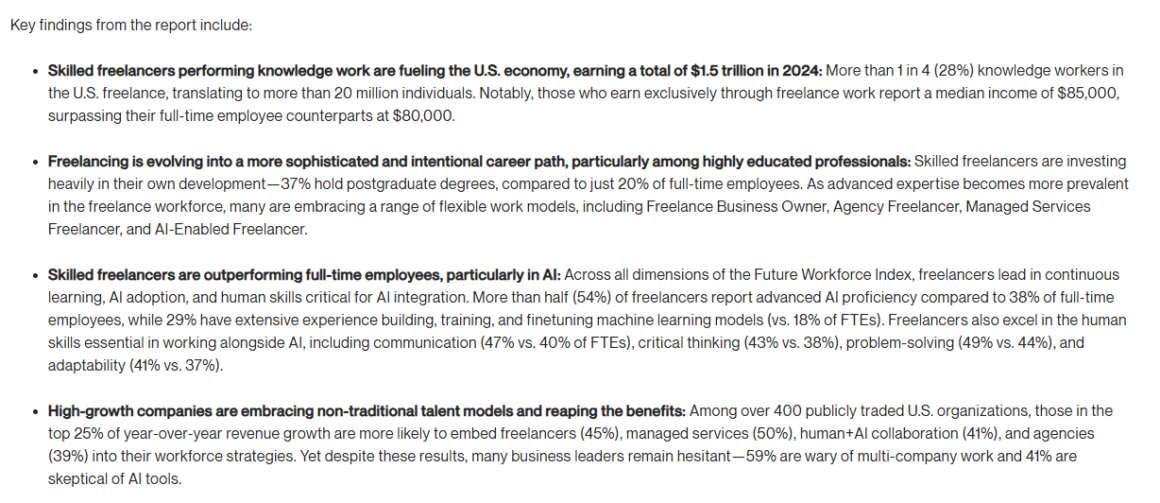
The momentum here is not stopping. In Q2 2025, Connects revenue grew 19% year-over-year. The platform has discovered that the bidding economy is a reliable revenue stream that grows in proportion to the desperation of a competitive freelance market. Upwork’s22 own data states that as more skilled workers enter freelancing, over 28% of U.S. knowledge workers now freelance, generating $1.5 trillion in earnings in 2024. This means that the competition for Upwork jobs will intensify, reply rates will fall further, and freelancers will spend more Connects chasing the same contracts.
The agencies, meanwhile, are building the infrastructure to dominate that environment. Automation tools, dedicated proposal writers, AI-assisted targeting, bulk Connect purchasing, round-the-clock response systems. Agencies using proposal automation report landing premium projects that their manually-operating competitors never even saw. They are competing in a different league while the entrance fees look the same.
For the solo freelancer, the honest answer is that Upwork is no longer the platform it was in 2015 or even 2020. It is a maturing marketplace that has made a strategic bet on enterprise clients and the agencies equipped to serve them. The infrastructure that remains for individual operators — the Freelancer Plus subscription, the badge system, the occasional Direct Contract — is not a growth strategy. It is a retention mechanism for the long tail of independent workers whose collective Connect spend still adds up.
Upwork’s23 own data suggests 48% of CEOs are planning to increase freelance hiring in the coming year. The demand is real and growing. But the question of which freelancers capture that demand — the solo operator grinding through proposals, or the agency that spent the last two years building a machine to win at exactly this game — is increasingly being answered by the structure of the platform itself.
The toll booth has a VIP lane. It does not say so anywhere. But it is there.
Sources
- Upwork Support, support.upwork.com/hc/en-us/articles/211062898-Understanding-and-using-Connects. Accessed 12 July 2026. ↩︎
- “Challenge” Upwork, community.upwork.com/t5/Freelancers/Why-has-the-cost-of-connects-gone-up/m-p/1435184. Accessed 31 May 2026. ↩︎
- Team, SnipeWork. “Upwork Connects Cost 2026: $0.15 Per Connect — Everything You Need to Know” SnipeWork, 12 Apr. 2026, snipework.com/blog/upwork-connects-cost-2026. Accessed 12 July 2026. ↩︎
- “Free Upwork Connects Calculator: Actual connects cost per contract” GigRadar, 3 July 2026, gigradar.io/blog/upwork-increased-connects-price-is-for-the-benefit-of-agencies. Accessed 12 July 2026. ↩︎
- “Agencies on Upwork Guide: Success Strategies for 2025” Getmany, 6 Nov. 2025, getmany.com/blog/agencies-on-upwork-guide-success-strategies-for-2025. Accessed 12 July 2026. ↩︎
- “Upwork Q2 2025: What Changed and What It Means for Freelancers” Etcetera Agency: The best Upwork Agency of Ukraine, etcetera.kiev.ua/blog/upwork-q2-2025-what-changed-and-what-it-means-for-freelancers/. Accessed 12 July 2026. ↩︎
- Dey, Maitrayee. “Upwork Statistics and Facts By Revenue, GSV, Employee, Take Rate, Clients And Trends (2025)” 22 Oct. 2025, electroiq.com/stats/upwork-statistics/. Accessed 12 July 2026. ↩︎
- Brady, Diane. “Upwork CEO Hayden Brown: ‘There will be plenty of work for humans, even as AI agents do more’” Fortune, 6 Oct. 2025, fortune.com/2025/10/06/upwork-ceo-hayden-brown-there-will-be-plenty-of-work-for-humans-even-as-ai-agents-do-more/. Accessed 12 July 2026. ↩︎
- Medium, medium.com/@catesbury/matts-upwork-2025-series-post-1-is-upwork-still-worth-it-in-2025-782d815bd4c1. Accessed 12 July 2026. ↩︎
- “Challenge” Upwork, 12 July 2024, community.upwork.com/t5/Freelancers/Upwork-2024-Update-pros-and-cons/m-p/1640739. Accessed 12 July 2026. ↩︎
- “Upwork seems to be crashing out after 2024 changes for freelancers” LittleBizzy, 25 Dec. 2024, www.littlebizzy.com/forum/topic/upwork-seems-to-be-crashing-out-after-2024-changes-for-freelancers. Accessed 12 July 2026. ↩︎
- “Upwork Just Increased Fees AGAIN – 4 Things You Should Do About It Right Now” 30 Apr. 2025, freelancerfiles.com/blogs/news/increased-upwork-fees-15. Accessed 12 July 2026. ↩︎
- Jobbers, www.jobbers.io/upwork-fees-explained-hidden-costs-freelancers-dont-know-about/. Accessed 12 July 2026. ↩︎
- “Challenge” Upwork, www.upwork.com/pricing/client. Accessed 12 July 2026. ↩︎
- “Challenge” Upwork, www.upwork.com/updates/fall-2024. Accessed 13 July 2026. ↩︎
- “Challenge” Upwork, www.upwork.com/uma. Accessed 13 July 2026. ↩︎
- “Upwork Q2 2025: What Changed and What It Means for Freelancers” Etcetera Agency: The best Upwork Agency of Ukraine, etcetera.kiev.ua/blog/upwork-q2-2025-what-changed-and-what-it-means-for-freelancers/. Accessed 13 July 2026. ↩︎
- Demandsage, www.demandsage.com/upwork-statistics/. Accessed 13 July 2026. ↩︎
- “Upwork Projects Analysis 2025 – Freelance Market Report” Vollna, 16 Dec. 2025, www.vollna.com/reports/upwork-projects-overview-2025. Accessed 13 July 2026. ↩︎
- “Upwork Projects Analysis 2024: Freelance Market Insights” Vollna, 7 Jan. 2025, www.vollna.com/reports/upwork-projects-overview-2024. Accessed 13 July 2026. ↩︎
- “Free Upwork Connects Calculator: Actual connects cost per contract” GigRadar, 3 July 2026, gigradar.io/blog/upwork-increased-connects-price-is-for-the-benefit-of-agencies. Accessed 13 July 2026. ↩︎
- “Upwork Study Finds 1 in 4 U.S. Skilled Knowledge Workers Now Work Independently, Generating $1.5 Trillion in Earnings” Upwork Inc., 23 Apr. 2025, investors.upwork.com/news-releases/news-release-details/upwork-study-finds-1-4-us-skilled-knowledge-workers-now-work. Accessed 13 July 2026. ↩︎
- “Challenge” Upwork, www.upwork.com/resources/freelancing-stats. Accessed 13 July 2026. ↩︎


