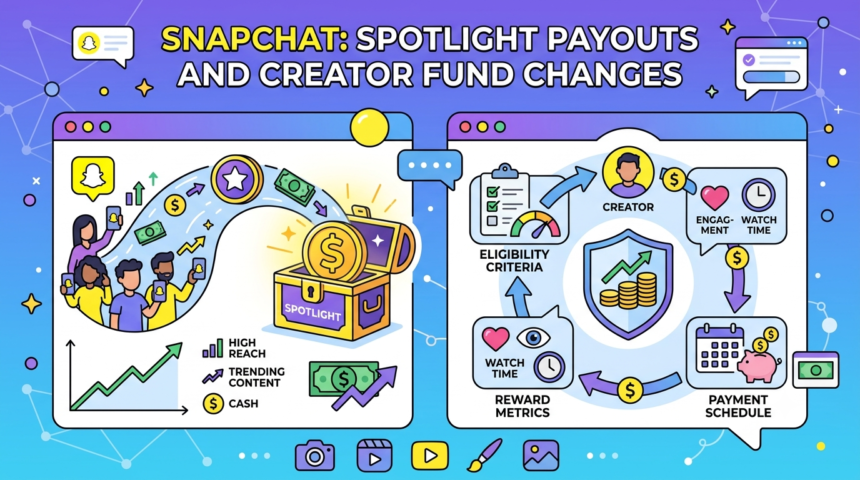

Joseph Melles was working at Wendy’s when he posted his first Spotlight video. It was March 2021. He was 18 and lived in Colorado. He wanted a piece of the $1 million a day that Snap said it would hand out. One clip pulled 300,000 views in 24 hours. Snap sent him a message. The payment, CNBC1 reported, came to $19,600. He quit Wendy’s a few days later.
By August he had stopped posting to Spotlight. He had once uploaded as many as 100 videos a day. Now he was making videos for YouTube.
I keep coming back to Melles because his story has the whole shape of the thing. A big number. A rush of unpaid labor. A quiet cut. A shrug from the company. Five years later, Snap has changed the rules of Spotlight pay again. This time the change looks small on paper. One hundred hours. Twenty-eight days. It is easy to read past.
I did not read past it. What follows is what I found when I laid every version of the Spotlight deal side by side. The pattern is not subtle. And the newest rule tells you more than the old headline numbers do.
The Bait
Snap launched Spotlight in November 2020. The pitch was simple. Post a video. If people watch it, get paid. Variety2 reported that Snap would pay out more than $1 million every day, at least through the end of that year and possibly longer. Earnings followed a proprietary formula. The main input was how many unique people watched your video that day compared with everyone else’s.
Think about what that offer was. Snap had a messaging app that teenagers loved. It did not have a place where strangers went to watch strangers. TikTok did. Instagram was building Reels. Snap needed video, and it needed it fast. It could not wait for creators to arrive on their own. So it bought them.
The money worked. By May 2021, CNN3 reported, more than 5,400 creators had earned over $130 million. A high school student named Katie Feeney said she made more than $1 million in two months. A creator named Dominic Andre stated that TikTok said it could make you famous overnight, while Snapchat was going to make you “rich overnight.”
Others were found. According to CNBC4, Neda Anvar, then 23, got a first payment of $3,000 in February 2021. A friend of hers got $100,000 for two videos. Jhordyn Gaddy, 25, had his phone service cut off and his car about to be repossessed. He posted 10 videos after reading about the program on Twitter. One went viral and paid nearly $19,000. Later a Pikes Peak clip shot on Snap Spectacles paid him $93,000 across two payments.
Read those numbers again. They are not wages. They are lottery tickets that paid out. Snap knew it, and so did the creators. Anvar described her method as posting many videos a day and hoping one would take off. Her rule of thumb was 100,000 views in 24 hours. Before June 1, she told CNBC, that was roughly the line that meant a payment was coming.
Then the line moved.
The First Cut
On May 20, 2021, Snap said it would stop committing to $1 million a day. Starting June 1, it would pay “millions” per month as reported by Bloomberg Opinion5.
Snap called this a restructuring. Creators called it something else. In the weeks after June 1, several of them gathered in a Discord group named “Snapchat Spotlight.” CNBC talked with members. They said videos with millions of views in a single day had gone unpaid. Other videos with far fewer views had been paid. Nobody could find the rule. The moderator of the group, who said he had earned about $250,000 from Spotlight, said he just wanted to know why he was not getting paid. Creators said the only way to reach Snap was a support email, and it sent back automated replies.
Anvar put the new system in a sentence I have not been able to improve on. Now, she said, it seems like it’s a random raffle who gets paid.
Trouble had started earlier. In April, Social Media Today6 reported that a group of Spotlight creators on Discord said payments had stalled since April 11. Snap denied it had stopped paying and admitted its payment systems had at times been a problem.
Snap’s public answer to CNBC was a defense of the numbers. The company said daily submissions had tripled from one quarter to the next. It said more creators were being paid than ever. It said the new structure let it support niche communities rather than paying only on raw engagement. All of that can be true. It is also what a company says when a fund built for a small crowd has to stretch across a large one.
The payout was not the only change. In October 2021, Snap introduced Spotlight Challenges, cash prizes for content built around specific Lenses, sounds or topics. TechCrunch7 noted that the move followed complaints about delayed payments and shrinking earnings. Snap said prizes were not replacing payouts. But a Challenge is a different thing from a fund. Snap chooses the theme. Snap chooses the tool. Snap picks the winners. The creator’s job shifts from finding an audience to following a brief.
Here is the first idea I want to plant, and it is my own. The Spotlight fund was never pay. It was customer acquisition cost.
Look at how Snap described it. CNBC reported that Snap said investing in Spotlight added about $76 million to its cost of revenue in the second quarter of 2021. Spotlight had reached 125 million monthly users by April. Time spent on it in the United States had grown more than 60% since the first quarter. As CNBC put it, the prize money created a flywheel. Spotlight now had a steady stream of content and might no longer need the boost.
Once you see the fund as an acquisition cost, the cuts stop being a betrayal. They are just accounting. You pay for supply until supply exists. Then you stop. The creators who arrived first were not employees. They were a marketing channel with a payment plan.
Snap’s own chief executive said as much, in his way. Reporting in December 2021 noted that Evan Spiegel had told an audience in September that Snap reduced the original payouts because it was paying for too much “copycat content.” That is a revealing phrase. The company that launched a TikTok clone with a pile of cash complained that the people it paid were making TikTok clones.
The year-end totals tell the same double story. Snap said it paid over $250 million to more than 12,000 creators in 2021. Tubefilter8 did the division and got an average of about $20,833 per creator. Then it warned that averages hide a lot. A few people made millions. Most did not come close. A mean is a comfortable number for a company to publish. It is a poor way to describe how a few lucky people and a large crowd shared a pot.
The Second Cut, and the Quiet Pivot
In early 2022, Spiegel told analysts that Snap was testing ads on Spotlight. He said something else on that call that I think matters more than the ads. He described creators using Spotlight to get more distribution and attract more subscribers to their story. Keep that line in mind. It comes back.
In October 2022, TechCrunch9 reported that Snap had cut the Spotlight fund a second time. Business Insider broke the news. A source told TechCrunch the pool would now be measured in millions per year, down from millions per week in 2021 and $1 million a day in 2020. The same source stressed that Snap was paying more creators in more markets. Snap had cut its workforce by 20% in August. It had just reported a quarterly net loss of $360 million. TechCrunch’s own read was that the cut was another way to spend less and improve profit.
I want to be careful here. The “millions per year” figure came from an unnamed source. Snap did not put a number on the record in that report. I have not found one since. That is part of the story too. The most important number in a creator’s life, the size of the pot, was reported through anonymous leaks twice.
By then the direction was clear. Spotlight stopped being a fund and started being a slot machine that Snap could dial down. Ad revenue sharing on Stories had launched in late 2021. Ads on Spotlight came after. The plan, stated openly, was for creators to earn from ads and not from Snap’s own wallet.
There is nothing crooked in that. It is what YouTube did. It is what TikTok eventually did. But it moves the risk. Under a fund, Snap carries the risk that its money buys too little content. Under ad revenue share, the creator carries the risk that ads sell too little. One is a cost line. The other is a weather report.
The Unified Program
On December 16, 2024, Snap announced the end of the old Spotlight Rewards program. It would close on January 31, 2025. A single Monetization Program would start the next day. Ads would run inside eligible Stories and inside Spotlight videos longer than one minute. Creators would get a share. Snap’s blog said Spotlight viewership had grown 25% year over year and called that “a unique and growing opportunity” for creators.
The gates were what stood out. The old program asked for 1,000 followers, 10,000 unique video views and a public profile. The new one asked for 50,000 followers. Twenty-five posts a month. Posts on at least 10 of the last 28 days. And one of three big numbers over 28 days: 12,000 hours of view time, 10 million Snap views, or one million Spotlight views. Tubefilter10 summed it up plainly. The new program requires a lot more from creators. Anyone who had been earning regularly would probably qualify. Anyone new would have a much harder climb.
Snap also told the public that the number of creators posting publicly had more than tripled over the year. eMarketer11 read that alongside the steep requirements and said Snap would reward the ones who invest heavily in producing on the platform.
Put those two facts next to each other. Creators tripled. The gate rose fifty-fold on followers. That is not a coincidence. When supply triples, you raise the price of admission.
The fund had also already been shrinking in a second way. Social Media Today12 noted that Snap had turned its Spotlight bonus into a monthly payout, which cut into what creators could make from short clips. So by the time the old program closed, it was a shell of what launched in 2020.
The Hundred-hour Rule
Now to the change that got the least attention.
Snapchat’s13 help page for the program says that beginning May 7, 2026, you must maintain at least 100 hours of total Spotlight view time on your posts over the last 28 days to qualify for maximum Creator Rewards.
- Have at least 50,000 followers; and
- Achieve 15,000 hours of view time over the last 28 days, with at least 3,000 of those hours coming from Spotlight.
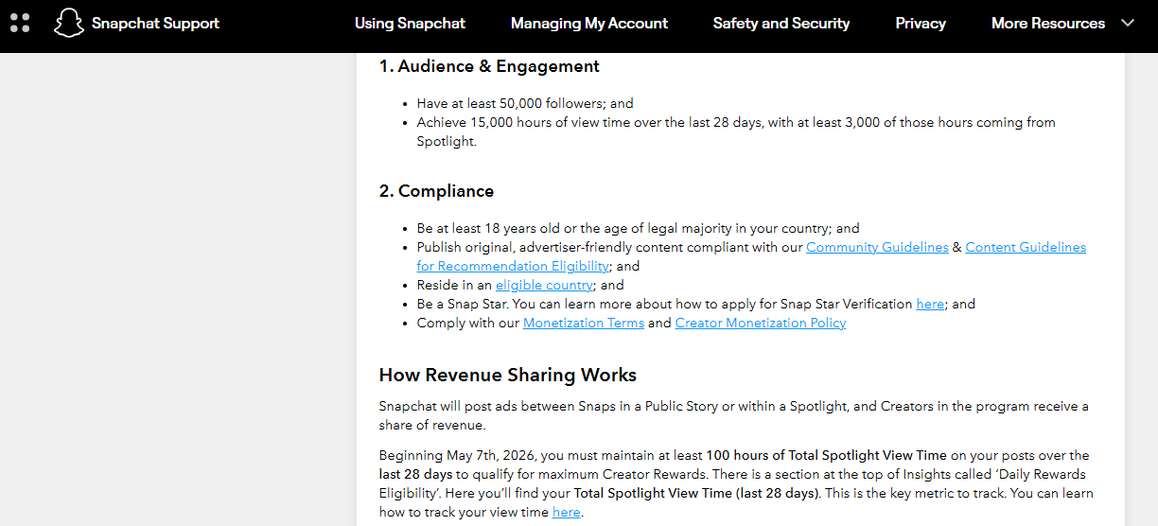
A companion page tells enrolled creators where to look. A new section at the top of Insights, called Daily Rewards Eligibility, shows the running total. Snapchat calls it the key metric to track.
A hundred hours across 28 days is about 3.6 hours a day. That is the arithmetic. What it means is less obvious.
Here is my second original point. I do not think this rule is aimed at people trying to get in. Look at the invitation rules. To be invited at all, a creator needs 15,000 hours of view time over 28 days, and at least 3,000 of those must come from Spotlight. So the entry bar on Spotlight hours is 3,000. The maintenance bar is 100. That is about 3% of the entry number.
A creator who cleared 3,000 Spotlight hours to get invited will not stumble over 100 by accident. Someone would have to fall very far. So who is the rule for?
My read is this. It is for the creator whose money moved to Stories. Recall what Spiegel said in 2022. Creators post to Spotlight to feed their Story audience. Now consider the money. Third-party estimates, and I stress they are estimates, say Stories with mid-roll ads pay far better than Spotlight. One creator earnings calculator called Elev8or14 built on creator-reported numbers puts Stories near $2.20 per 1,000 views and Spotlight at $0.05 to $0.08. Snap publishes no rates, so I cannot verify that. But if the shape is right, an invited creator has every reason to live on Stories and let Spotlight go quiet.
Snap does not want that. Spotlight is the feed Snap needs to fill. A floor of 100 hours ties the better-paying Stories money to a steady supply of Spotlight content. It makes feeding the recommendation feed a condition of getting paid at the best rate.
I could be wrong. Snap has not explained the reasoning in anything I could find. But the design fits the incentives too neatly to ignore.
Two more things bother me about the rule.
The first is one word. Snap says 100 hours is needed for maximum rewards. It does not say what happens below. One trade site called Social Day15 noted that Snap does not specify whether reduced rewards continue under the line or whether earnings stop. I looked for a public answer and did not find one. That matters. A creator who dips to 95 hours needs to know if she loses a slice or the whole loaf. And the eligibility panel is named for daily rewards, which suggests the check runs every day, not once a month.
The second is smaller, and it is a sign of how loose the rules are. Snap’s own help page now says Spotlight videos must be at least 30 seconds long to earn revenue. The 2024 announcement said one minute. Several current guides, including one from Creators Agency16, still say one minute. Either the rule changed without a public announcement, or the help page and the guides are out of step. I cannot tell which from where I sit. A creator planning a 45-second video would want to know.
Kompozy17 put the general problem better than I can. It said Snap has been “moving these goalposts often” and told readers to confirm the live rule before building a plan. That is decent advice. It is also a strange thing to have to say about a program that pays people.
The Number Nobody Publishes
Ask what Snapchat pays per Spotlight view and you find a wall of guesses.
One says $0.10 to $0.30 per 1,000 views. The calculator I mentioned earlier says $0.05 to $0.08. Another claims $1 to $5 per 1,000. Those cannot all be right. The gap between the low and high figures is fifty-fold. A guide by Lilach Bullock18, a marketer who writes about creator income, says the quiet part. Snap has never published a per-view rate. Two videos with the same view count can earn very different amounts. Anyone quoting a clean figure is guessing.
Snap’s own page says ads are served primarily based on the time people spend watching your Stories and Spotlights. It does not say how much of the ad money reaches the creator. On that point Snap is silent, and trade sites repeat the silence. Compare that with YouTube, which TechCrunch19 noted offers a 55% cut of ad revenue on its partner program. YouTube tells you the split. Snap tells you it exists.
This is the core of what I would call the asymmetry problem. A creator is asked to plan their week around a system with three hidden dials. She cannot see the rate. She cannot see the share. And she cannot see the rule for what happens if she falls below the floor. The company sees all three. When one side of a deal holds every number, the other side is not a partner. She is a supplier with no price list.
There is one more piece of hard information about how Snap pays. The help page says creators can cash out $100 at a time, and only when fully onboarded for payouts. That is a modest floor. It is also a reminder of who Snap is designing for. A $100 minimum is fine if you earn thousands. It is a wall if you earn tens.
I also came across claims that creators’ incomes fell 80 to 95% within two years of launch, or that per-video pay dropped from thousands to tens of dollars. I am not putting weight on them. The documented history is bad enough. A drop from $1 million a day, to millions a month, to millions a year, to a rule that changes with a help-page edit, needs no embellishment.
Where Snap Stands Now
Here is the money side, and it explains a lot.
In its second quarter of 2026, Snap’s SEC Files20 reported revenue of $1.6 billion, up 19% from a year earlier. Its net loss narrowed to $164 million from $263 million. Adjusted EBITDA hit $250 million, compared with $41 million a year before. The company counted 971 million monthly users. Investors liked it. Shares jumped 17.3% the next trading day.
Evan Spiegel, co-founder and CEO remarked:
We grew revenue by 19%, expanded margins, and generated positive free cash flow while improving advertising performance and rapidly growing our direct revenue business. We remain focused on serving our 971 million monthly active users, delivering measurable value for advertisers, and investing with discipline to increase free cash flow per share over time.”
Look at where the growth came from. Advertising revenue rose 9%. What the company calls other revenue, meaning Snapchat+, Memories Storage and Lens+, rose 85% to $316 million. Management said in its prepared remarks that it had restructured its cost base early in the quarter. It described a pivot toward profitable growth.
Now look at Spotlight in the same document. The company said the number of people posting to Spotlight in the United States grew more than 115% year over year. Daily viewers grew more than 20%. Snap credited its “investment in creators and AI-powered recommendations.” In the first quarter, it had reported that Spotlight posters were up nearly 74% in the U.S. and over 61% worldwide. It tied that to a push for authentic content made with the Snapchat camera.
So here is the picture. Posters are more than doubling. Viewers are growing at a fifth of that pace. The company is under pressure to show margins. And the pay rules are being tightened at the edges.
I will say what I think that adds up to, and I will mark it as my inference, not a finding. When the number of people supplying content grows five times faster than the number watching it, the value of each new supplier falls. A platform in that position has two choices. It can pay everyone a little. Or it can pay a smaller group a decent amount and let the rest work for free. Snap’s history says it prefers the second. Each rewrite, from the fund to the gated program to the hundred-hour floor, has narrowed who gets paid and made the paid group prove itself more often.
That is a legitimate business choice. It is also worth saying out loud, because the company’s language is soft. “Investment in creators” sounds like a wage. The record says it is closer to a marketing budget that can be scaled up and down as the feed fills.
I read the help pages, the newsroom posts, the earnings documents and a stack of coverage going back to 2020. There are questions I could not answer from any of them. If you cover this company, they are the ones to ask.
What share of ad revenue on Spotlight reaches the creator? Snap has never said. What happens to a creator’s payouts when Spotlight view time falls below 100 hours? The help page says only that 100 is needed for maximum rewards. Is the check run daily, as the name Daily Rewards Eligibility implies, or over the full 28 days? Does the minimum length for a paid Spotlight video stand at 30 seconds or a minute? Why do the help page and the earlier announcement disagree? And how much money in total does Snap now put into creator rewards? Reporters had to lean on anonymous sources in 2022 to learn the size of the pool. The public has had no number since.
None of these questions is hostile. They are what a person needs to know before deciding whether to spend a month of her life making videos for a company.
Back to the Raffle
Melles is 23 now, if he kept his birthday. I do not know where he is. I do not know if he still makes videos. What I know is what he told CNBC in 2021. He worked hard every day, and then the checks stopped, and he left.
There is a temptation to end a story like this on a moral. I will resist it. Snap did not break a law. It made a promise that was always going to be temporary, and it said so, in the small print of the phrase “at least through 2020.” Creators heard “$1 million a day.” Snap said “experiment.”
What I can say is that the pattern holds. Each time the terms change, the change lands on the person with the least information. The fund becomes a raffle. The raffle becomes a gated program. The gated program gets a floor. And at each step the rate stays private.
The next change will come. It might be a longer minimum video. It might be a higher floor. It might be a cut to the share. It will arrive on a help page, in a section most creators will not read until their income dips.
So a working rule for anyone who builds a living on Spotlight. Check the panel. Save a screenshot of the rules. And treat any number you cannot see as a number that can move.
Sources
- Rodriguez, Salvador. “Snap creators say they’re leaving the app’s Spotlight feature as payments dry up” 11 Aug. 2021, www.cnbc.com/2021/08/11/snap-creators-say-theyre-leaving-the-apps-spotlight-feature-as-payments-dry-up.html. Accessed 29 Sept. 2026. ↩︎
- Spangler, Todd. “Snapchat Takes on TikTok: Snap Launches Spotlight, Will Pay Creators Over $1M Daily for Top Videos” 23 Nov. 2020, variety.com/2020/digital/news/snapchat-spotlight-pay-creators-1-million-daily-1234837976/. Accessed 29 Sept. 2026. ↩︎
- Flynn, Kerry. “Snapchat’s TikTok competitor will no longer give away $1 million daily. Here’s what’s next” CNN Business, 20 May 2021, www.cnn.com/2021/05/20/media/snapchat-spotlight/index.html. Accessed 29 Sept. 2026. ↩︎
- Rodriguez, Salvador. “Snap creators say they’re leaving the app’s Spotlight feature as payments dry up” 11 Aug. 2021, www.cnbc.com/2021/08/11/snap-creators-say-theyre-leaving-the-apps-spotlight-feature-as-payments-dry-up.html. Accessed 1 Oct. 2026. ↩︎
- Bloomberg Opinion on Instagram, www.instagram.com/reels/CH8VPm7jdEM/. Accessed 1 Oct. 2026. ↩︎
- Hutchinson, Andrew. “Snapchat Creators Report Frustration With Spotlight Payments as Spotlight Usage Soars” Social Media Today, 6 July 2021, www.socialmediatoday.com/news/snapchat-creators-report-frustration-with-spotlight-payments-as-spotlight-u/602906/. Accessed 29 Sept. 2026. ↩︎
- Perez, Sarah. “Snapchat revamps creator payouts by offering chance to win prizes with Spotlight Challenges” TechCrunch, 6 Oct. 2021, techcrunch.com/2021/10/06/snapchat-revamps-creator-payouts-by-offering-chance-to-win-prizes-with-spotlight-challenges. Accessed 29 Sept. 2026. ↩︎
- 14 Dec. 2021, www.tubefilter.com/2021/12/14/snapchat-spotlight-250-million-dollars-12000-creators/amp/. Accessed 29 Sept. 2026. ↩︎
- Forristal, Lauren. “Snapchat reduces payouts for Spotlight creators” TechCrunch, 27 Oct. 2022, techcrunch.com/2022/10/27/snapchat-reduces-total-payouts-for-spotlight-creators. Accessed 29 Sept. 2026. ↩︎
- 16 Dec. 2024, www.tubefilter.com/2024/12/16/snapchat-new-monetization-program-shutting-down-spotlight-rewards/. Accessed 29 Sept. 2026. ↩︎
- Konstantinovic, Daniel. “Snap simplifies creator payments as it looks to seize on spending” 16 Dec. 2024, www.emarketer.com/content/snap-simplifies-creator-payments-looks-seize-on-spending. Accessed 29 Sept. 2026. ↩︎
- Hutchinson, Andrew. “Snapchat Launches Streamlined Creator Monetization Process” Social Media Today, 16 Dec. 2024, www.socialmediatoday.com/news/snapchat-launches-streamlined-creator-monetization-process/735668/. Accessed 29 Sept. 2026. ↩︎
- “About Snapchat’s Monetization Program” help.snapchat.com/hc/en-us/articles/14669003687444-About-Snapchat-s-Monetization-Program. Accessed 29 Sept. 2026. ↩︎
- “How Much Does Snapchat Pay per View? Check Yours” www.elev8or.io/tools/snapchat-money-calculator. Accessed 29 Sept. 2026. ↩︎
- Hall, Lucy. “Snapchat adds 100-hour threshold creators must maintain to keep earning from Spotlight” SocialDay, 25 Aug. 2026, socialday.live/features/snapchat-adds-100-hour-threshold-creators-must-maintain-to-keep-earning-from-spo. Accessed 29 Sept. 2026. ↩︎
- Crider, Apple. “Snapchat Monetization in 2026: Followers, View-Time Requirements, and Payouts” Creators Agency, 28 July 2026, creatorsagency.co/blog/snapchat-monetization-requirements-2026. Accessed 29 Sept. 2026. ↩︎
- “Snapchat Monetization 2026: Eligibility & Payouts” Kompozy, kompozy.io/creator-growth/snapchat-monetization-2026. Accessed 29 Sept. 2026. ↩︎
- Bullock, Lilach. “How Much Does Snapchat Pay For Spotlight Views? (Real 2026 Numbers)” Lilach Bullock | AI Implementation Consultant, 14 Sept. 2026, www.lilachbullock.com/how-much-does-snapchat-pay-for-spotlight-views/. Accessed 29 Sept. 2026. ↩︎
- Silberling, Amanda. “Snapchat is trying to profit off of its TikTok clone” 22 Apr. 2022, techcrunch.com/?p=2305174. Accessed 29 Sept. 2026. ↩︎
- “SEC.gov”, www.sec.gov/Archives/edgar/data/0001564408/000156440826000047/snap-20260803xexx991pressr.htm. Accessed 29 Sept. 2026. ↩︎