
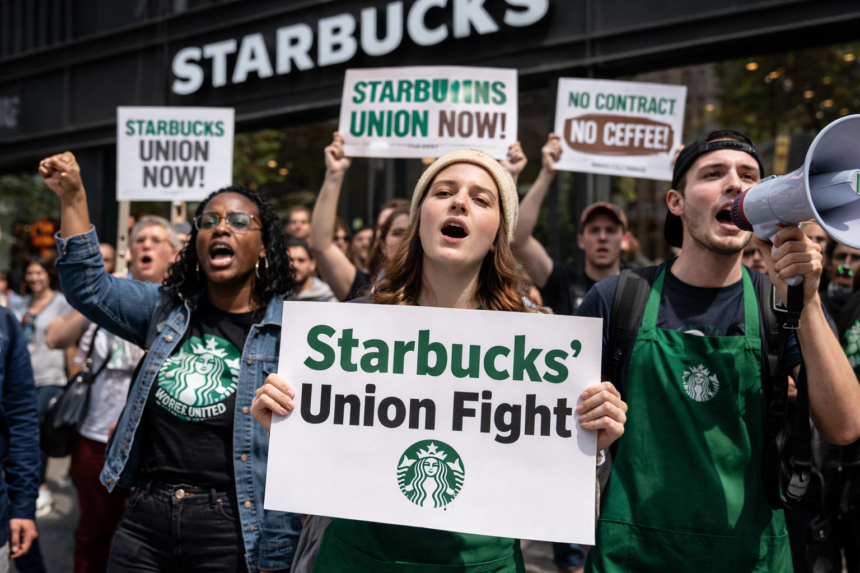

Since late 2021, when a Starbucks store in Buffalo, New York, voted to unionize, workers at one of the world’s most recognized brands have challenged corporate resistance to collective action. The movement has spread fast, with hundreds of stores filing for union elections and many asserting that Starbucks responded with closures, scheduling shifts, aggressive policy enforcement, and management changes after organizing activities.
This piece investigates the pattern of those allegations, the corporate response, and the unfolding legal battles before federal labor authorities.
How the Union Wave Grew
The union drive at Starbucks began in Buffalo, New York, in 2021, when baristas partnered with Starbucks Workers United, an affiliate of the Service Employees International Union. Reuters1 reported that in December 2021, workers at a Buffalo store voted to unionize under the supervision of the National Labor Relations Board, marking the first successful union election at a company-owned Starbucks in the United States. The victory was widely viewed as a breakthrough in a sector where union density is extremely low, particularly in food service.
The Buffalo win quickly triggered organizing activity across the country. Within months, dozens and then hundreds of Starbucks locations filed union election petitions with the NLRB2. After the first successful vote in Buffalo in December 2021, Starbucks Workers United rapidly expanded its campaign through 2022. According to tallies compiled from National Labor Relations Board election data and widely reported by outlets such as Reuters and The New York Times, workers at more than 250 Starbucks stores voted in favor of union representation by the end of 2022. That first year alone saw hundreds of election petitions filed and well over 250 certified bargaining units.
NLRB3 statistics from 2022 and 2023 show that Starbucks elections accounted for a notable share of all union representation petitions and wins in the retail and food service sector. While not a majority of all private sector elections nationally, the campaign represented one of the largest and most geographically dispersed organizing drives at a single U.S. retail brand in decades. In scale, visibility, and sustained momentum across multiple years, the Starbucks campaign stands out as one of the most significant service sector union efforts in recent American labor history.
Workers consistently cited similar motivations for organizing. Many described unpredictable scheduling practices that made income unstable and complicated childcare, education, and second jobs. Others pointed to chronic understaffing that increased workloads and customer pressure, particularly during peak hours and mobile order surges. Workplace safety concerns, amplified during the COVID-19 pandemic, were also central. Baristas reported feeling exposed to health risks while lacking meaningful input into store-level decisions. More broadly, employees framed unionization as a way to secure a formal voice in negotiations over wages, staffing levels, benefits, and disciplinary processes.
The rapid spread of union petitions turned the Starbucks campaign into a national flashpoint in the debate over labor rights in the service economy. Media coverage, NLRB filings, and public statements from both Starbucks leadership and union organizers underscored how unusual it was for a large, brand-conscious retailer to face coordinated organizing on such a scale. Regardless of ongoing legal disputes and bargaining challenges, the sheer number of election wins and geographic reach established the Starbucks campaign as a defining chapter in the resurgence of U.S. service-sector unionization.
Store Closures and Retaliation Claims
One of the most contentious chapters in the Starbucks union campaign involves store closures that occurred during or shortly after organizing drives, prompting retaliation claims from Starbucks Workers United.
According to CNBC4, in July 2022, Starbucks announced it would permanently close 16 U.S. stores, including several in Seattle, Los Angeles, Portland, and Philadelphia. The company said the decision was based on employee safety concerns, citing incidents involving drug use, crime, and threats to staff.
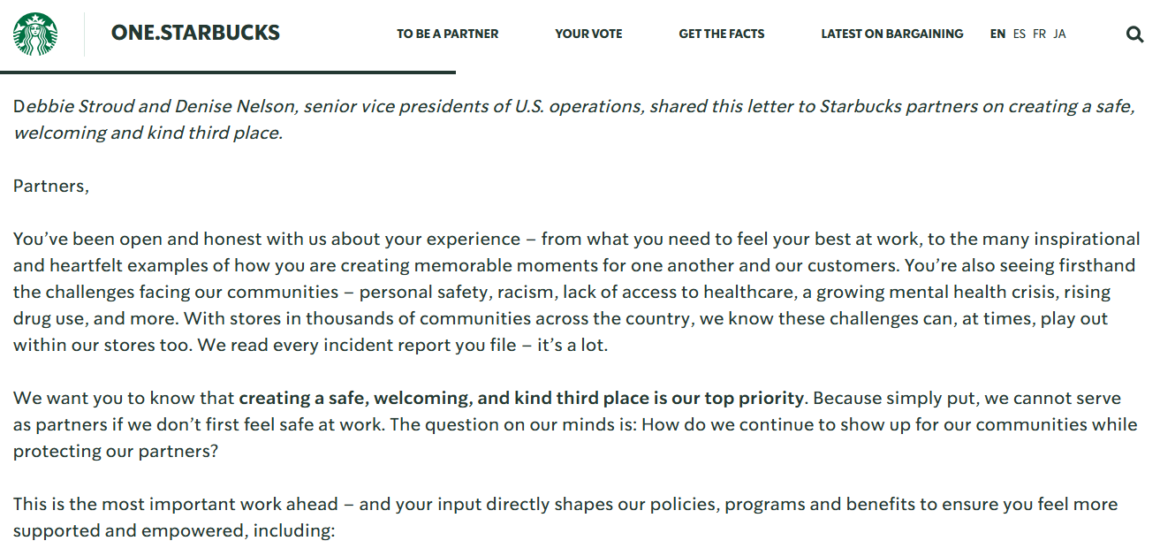
In a public letter on Starbucks.com5, senior vice presidents of U.S. operations, Debbie Stroud and Denise Nelson, wrote that the company could not “serve as partners if we don’t first feel safe at work,” framing the closures as part of a broader review of store conditions.
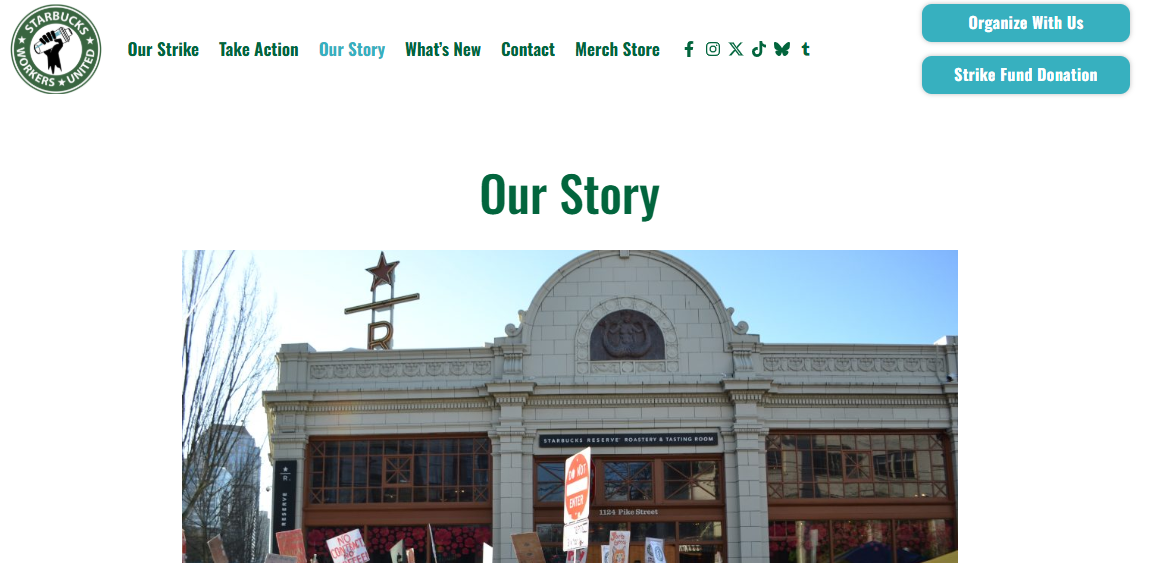
Union supporters quickly challenged that explanation. Starbucks Workers United filed unfair labor practice charges with the National Labor Relations Board, alleging that at least 16 closures were motivated not by safety but by an intent to chill organizing. In public statements and filings, the union argued that stores with union activity appeared to be disproportionately targeted. On worker forums and Reddit threads dedicated to Starbucks partners, employees voiced suspicion about the timing.
One self-identified Seattle barista wrote that their store had “raised safety concerns for years” but only saw closure discussions “after we started organizing.”
Another worker in the Midwest posted that management had “never once mentioned shutting us down” until after union authorization cards were filed, adding, “It’s hard not to see the connection.”
The dispute intensified in December 2023 when Reuters6 reported that Starbucks had illegally closed 23 stores in retaliation for union activity. The complaint sought remedies, including reopening affected locations and making workers whole for lost earnings and benefits. Reporting by The New York Times7 and Reuters described the complaint as one of the most significant enforcement actions tied to the Starbucks campaign. According to the NLRB’s filing, the agency believed the closures, along with stricter enforcement of policies and surveillance in union stores, constituted violations of federal labor law.
The Ithaca, New York, case became emblematic. After workers at a downtown Ithaca store voted to unionize in 2022, Starbucks announced the store’s closure, citing operational concerns. The union alleged retaliation, and an administrative law judge later found multiple labor law violations tied to that store, including discriminatory enforcement of rules and unlawful retaliation against pro-union employees. News coverage from outlets such as CNN detailed the judge’s findings, which added legal weight to workers’ claims that the pattern of closures could not be divorced from organizing activity.
Data compiled by labor analysts and cited in media reports indicate that a substantial share of the initial 16 announced closures in mid-2022 involved stores that had unionized or filed for elections. While Starbucks has maintained that correlation does not prove causation, union advocates argue that statistical clustering around organizing locations strengthens their case. On worker forums, some employees described closures as having a chilling effect. One post read,
“People at neighboring stores are scared. They think if we push too hard, we’ll be next.”
Others described feeling that safety concerns, while real in some locations, were selectively invoked.
From Starbucks’ perspective, executives have repeatedly stated that store decisions are based on safety data, business performance, and partner well-being, not labor representation status. The company has denied retaliatory intent in filings and public statements, arguing that it is legally entitled to close stores for legitimate operational reasons.
For union supporters, however, the question remains centered on timing and pattern. When stores that recently unionized or filed petitions are closed or threatened with closure, they argue, the optics and impact are inseparable from the broader labor campaign. With NLRB litigation ongoing and administrative rulings continuing to emerge, the clash over closures has become one of the defining legal battlegrounds in the Starbucks union movement, shaping national debate about employer power, safety justifications, and the limits of lawful opposition to unionization.
Allegations of retaliation at Starbucks have not been limited to high profile store closures. A recurring and more difficult to measure claim involves reduced hours, sudden scheduling changes, and shifts in benefit eligibility after union activity began. Because scheduling in food service is inherently variable, these claims often unfold quietly, one weekly roster at a time, rather than through dramatic announcements.
Organizers with Starbucks Workers United, affiliated with the Service Employees International Union, have argued that cuts to hours became a pressure point in some organizing stores. The Economic Policy Institute8 has published analyses and commentary noting that hour reductions can function as a powerful deterrent in low wage service work, where eligibility for health insurance and other benefits often depends on maintaining minimum average weekly hours. Under Starbucks’ benefits structure, workers generally must meet hour thresholds over a measurement period to retain coverage, making even small sustained reductions consequential.
In sworn affidavits and unfair labor practice complaints filed with the National Labor Relations Board, some baristas alleged that their weekly hours dropped sharply after they signed union cards or participated in organizing meetings. In several cases summarized in NLRB regional complaints and later administrative decisions, judges concluded that reductions were not adequately explained by business fluctuations and occurred in close temporal proximity to union activity.
On worker forums and partner message boards, some baristas described the experience in personal terms. One poster in a Midwest organizing store wrote,
“I averaged around 28 to 30 hours before we filed. Two weeks after management found out, I was scheduled for 12.”
Another wrote that after speaking publicly in favor of unionization, “my shifts were suddenly all clopens and four hour blocks,” adding that the unpredictability made it impossible to plan rent and childcare. While such accounts are anecdotal, similar narratives appear across multiple cities and filings.
In at least one Board summary order, the NLRB9 found that Starbucks violated Section 8(a)(1) of the National Labor Relations Act by threatening employees with store closure if they supported unionization and by reducing a worker’s hours in connection with union activity, ultimately leading to that employee’s termination. Administrative law judges in several regions have cited evidence that disciplinary actions, shift assignments, and hour allocations changed after organizing began, concluding in specific instances that the timing supported an inference of unlawful motive.
Quantifying the broader pattern remains difficult. Retail schedules routinely shift due to sales volume, seasonality, and staffing changes. Starbucks has consistently denied retaliatory intent, stating in legal filings and public responses that scheduling decisions are based on legitimate operational needs and that any reductions were unrelated to employees’ protected activity. The company has also argued that isolated findings do not establish a systemic practice.
Still, labor economists note that in industries where take-home pay and benefits hinge on weekly hours, even marginal reductions can have an outsized impact. For workers attempting to organize, that creates a structural vulnerability. Because a schedule can be adjusted without a public announcement or formal termination, critics argue that hour reductions function as a subtler lever than store closures. As NLRB cases continue to work through hearings and appeals, the question of whether scheduling shifts were routine business adjustments or unlawful retaliation remains central to the legal and public battle surrounding the Starbucks union campaign.
Changes in store management or heightened enforcement of policies are documented phenomena during union drives.
Workers often recount experiences where policies previously applied loosely suddenly became strict once a union campaign gained visibility. Public filings and legal decisions have noted situations where enforcement of attendance policies appeared selective or punitive.
In one widely reported legal case, Starbucks was found to have unlawfully discharged a pro-union barista while disciplining others for similar conduct inconsistently. The judge concluded that the company used attendance and safety rules discriminatorily against union supporters.
The broader legal context also shifted in 2024 when the NLRB10 ruled in Siren Retail Corp. (associated with Starbucks) that many employer statements about the potential negative impact of unionization constitute unlawful threats instead of permissible opinions. This revised standard places stricter limits on how employers talk about unionization with employees.
Reduced Hours, Scheduling Shifts, and the Retaliation Debate
While store closures generated headlines, many union supporters at Starbucks argue that a quieter and more pervasive form of alleged retaliation unfolded through scheduling. Reduced hours, abrupt shift changes, and altered benefit eligibility became central complaints in unfair labor practice charges filed during the nationwide campaign led by Starbucks Workers United, an affiliate of the Service Employees International Union.
In the service industry, hours are income. They are also the gateway to benefits. Starbucks ties eligibility for health insurance and certain benefits to average weekly hours over a defined measurement period. That structure means even modest reductions can push a worker below eligibility thresholds. In low wage retail sectors, schedule manipulation can serve as a powerful management tool because it affects both paychecks and long term security without the visibility of a firing.
As union drives spread from Buffalo across dozens of states, workers in multiple cities alleged that their hours dropped soon after filing union petitions or publicly supporting organizing efforts. According to reporting by Reuters and The New York Times, NLRB complaints in several regions included claims that pro union employees saw significant scheduling reductions in the weeks following campaign activity. In sworn affidavits cited in those reports, some baristas described going from near full time schedules to single digit weekly hours.
On worker forums and social media groups dedicated to Starbucks partners, similar narratives appeared. One worker posted,
“They did not fire me. They just stopped scheduling me. It felt like being pushed out slowly.”
A Seattle partner commented that after attending a union meeting, “my schedule went from consistent mornings to random four hour closes and clopens,” referring to back to back closing and opening shifts that many retail workers find disruptive.
These accounts are anecdotal, but federal labor officials have in certain cases found legal merit in similar claims. The National Labor Relations Board has issued complaints and administrative decisions concluding that some hour reductions and disciplinary actions violated federal labor law. Administrative law judges in multiple regions have cited timing and disparate treatment as evidence that certain scheduling changes were linked to protected activity.
Data from BBC11 indicate that hundreds of unfair labor practice charges have been lodged against Starbucks since late 2021, many alleging retaliation through discipline, surveillance, or scheduling. While not all charges result in findings against the employer, several regional rulings have required remedies including back pay for lost hours. News coverage has described these rulings as part of a broader pattern of aggressive labor litigation between the company and union organizers.
From the company’s perspective, scheduling fluctuations are inherent to retail. Starbucks has consistently denied retaliatory intent, arguing in public statements and legal briefs that hour allocations depend on store traffic, seasonality, staffing levels, and operational performance. Company representatives have said that isolated findings do not establish systemic wrongdoing and that managers must retain discretion to adjust labor hours based on business needs. They have also emphasized investments in wages and benefits during the same period, asserting that the company remains committed to partner well being.
The difficulty lies in quantification. Retail schedules shift week to week. A dip in customer volume or a temporary overstaffing situation can legitimately reduce available hours. Distinguishing between routine adjustments and unlawful retaliation requires close factual analysis, which is why these disputes often hinge on timing, comparative treatment, and internal communications revealed during NLRB proceedings.
Still, labor economists argue that the structure of service work makes hour reductions uniquely potent. Because income and health coverage are tied to average weekly hours, even a drop of five to ten hours per week can mean hundreds of dollars in lost pay each month and potential loss of insurance eligibility.
The broader context matters. The Starbucks union campaign has resulted in hundreds of election victories across the United States, representing more than ten thousand workers. At the same time, the company has faced an unprecedented wave of labor litigation. According to NPR12, Starbucks has been one of the most frequently charged private employers during this period. The agency has pursued consolidated complaints alleging unlawful threats, surveillance, discipline, and discriminatory scheduling in certain cases.
Whether reduced hours represent strategic retaliation or standard retail management remains a central legal and public question. For union supporters, patterns of cuts that cluster around organizing timelines appear too consistent to dismiss. For Starbucks, operational complexity and fluctuating demand offer an alternative explanation.
What is clear is that scheduling has become a frontline in the dispute. Unlike a store closure, which draws immediate national attention, a weekly roster change unfolds quietly. Yet for workers whose livelihoods depend on those posted hours, the impact can be just as consequential. As NLRB cases continue through hearings and appeals, the debate over reduced hours and scheduling shifts remains a defining element of the broader struggle between Starbucks and its unionizing workforce.
Worker Actions Amidst the Conflict
Unionized Starbucks workers have undertaken strikes and public actions to emphasize their grievances. In late 2025 on Red Cup Day, Reuters13 reported that more than 1,000 unionized baristas struck at stores citing stalled negotiations and unfair labor practices.
These actions highlight not just legal conflict but also the public relations battle shaping how customers and future workers view the company.
The allegations of retaliation at Starbucks involve multiple layers: store closures, scheduling shifts, heightened disciplinary enforcement, management changes, and evolving legal interpretations. Federal labor decisions issued through the National Labor Relations Board have sided with workers in key areas, finding violations of the National Labor Relations Act and ordering remedies such as reinstatement and back pay. Yet Starbucks continues to contest many findings through appeals and public statements, framing its actions as legitimate business judgments tied to safety, performance, and operational needs.
This story is not merely a catalog of events. It reflects structural tensions embedded in modern service work: decentralized store management, fluctuating labor hours, and a legal framework built for mid-20th-century industrial workplaces now being tested in a 21st-century retail environment. The scale of organizing by Starbucks Workers United has placed unusual strain on enforcement systems that rely on case-by-case adjudication.
What follows in this ongoing dispute will shape not just Starbucks’ labor relations but potentially the strategies of unions and employers across the service economy. If regulators continue to pursue aggressive remedies and courts uphold them, organizing models may accelerate in other national chains. If employers succeed in narrowing or overturning key rulings, corporate resistance strategies could become more entrenched. In either direction, the outcome will reverberate well beyond a single brand.
Sources
- “Reuters.Com” www.reuters.com/business/starbucks-loses-bid-stave-off-labor-union-buffalo-new-york-2021-12-09/. Accessed 13 Feb. 2026. ↩︎
- Bruenig, Matt. “The Starbucks Union Won 125 Elections in 2025” NLRB Edge, 19 Jan. 2026, www.nlrbedge.com/p/the-starbucks-union-won-125-elections. Accessed 13 Feb. 2026. ↩︎
- Board, National Labor Relations. “NLRB Performance and Accountability Report FY2022” 15 Nov. 2022, www.nlrb.gov/sites/default/files/attachments/pages/node-130/www.nlrb.gov/sites/default/files/attachments/pages/node-130/nlrb-fy2022-par-508.pdf. Accessed 13 Feb. 2026. ↩︎
- Cortés, Gabriel. “These are the 16 U.S. stores that Starbucks is set to close because of safety concerns” 14 July 2022, www.cnbc.com/2022/07/14/starbucks-is-set-to-close-these-16-us-stores-over-safety-concerns.html. Accessed 13 Feb. 2026. ↩︎
- Borges, Reggie. “Message to Starbucks partners: Safety in our stores” One.Starbucks, 11 July 2022, one.starbucks.com/get-the-facts/message-to-starbucks-partners-safety-in-our-stores/. Accessed 13 Feb. 2026. ↩︎
- “Reuters.Com” www.reuters.com/business/starbucks-closed-23-us-stores-deter-unionizing-agency-claims-2023-12-14/. Accessed 13 Feb. 2026. ↩︎
- “Nytimes.Com” 13 Dec. 2023, www.nytimes.com/2023/12/13/business/economy/starbucks-nlrb-stores.html. Accessed 13 Feb. 2026. ↩︎
- EPI, www.epi.org/publication/corporate-union-busting/. Accessed 13 Feb. 2026. ↩︎
- Bruenig, Matt. “02/25/2025: A Bunch of Starbucks Unfair Labor Practices” 28 Feb. 2025, www.nlrbedge.com/p/02252025-a-bunch-of-starbucks-unfair. Accessed 13 Feb. 2026. ↩︎
- “Board Restores Prior Standard Governing Employer Statements about Unionization’s Impact on Employer-Employee Relationship” National Labor Relations Board, 8 Nov. 2024, www.nlrb.gov/news-outreach/news-story/board-restores-prior-standard-governing-employer-statements-about. Accessed 13 Feb. 2026. ↩︎
- Kaye, Danielle. “Starbucks workers and unions in 10 countries to protest in support of US baristas” 9 Dec. 2025, www.bbc.com/news/articles/c62lqv3mvmjo. Accessed 13 Feb. 2026. ↩︎
- Yang, Mary. “Starbucks union organizing gave labor a jolt of energy in 2022” 9 Dec. 2022, www.npr.org/2022/12/09/1140424418/starbucks-union-organizing-gave-labor-a-jolt-of-energy-in-2022. Accessed 13 Feb. 2026. ↩︎
- “Reuters.Com” www.reuters.com/legal/litigation/starbucks-union-baristas-walk-out-40-cities-push-contract-talks-2025-11-13/. Accessed 13 Feb. 2026. ↩︎