

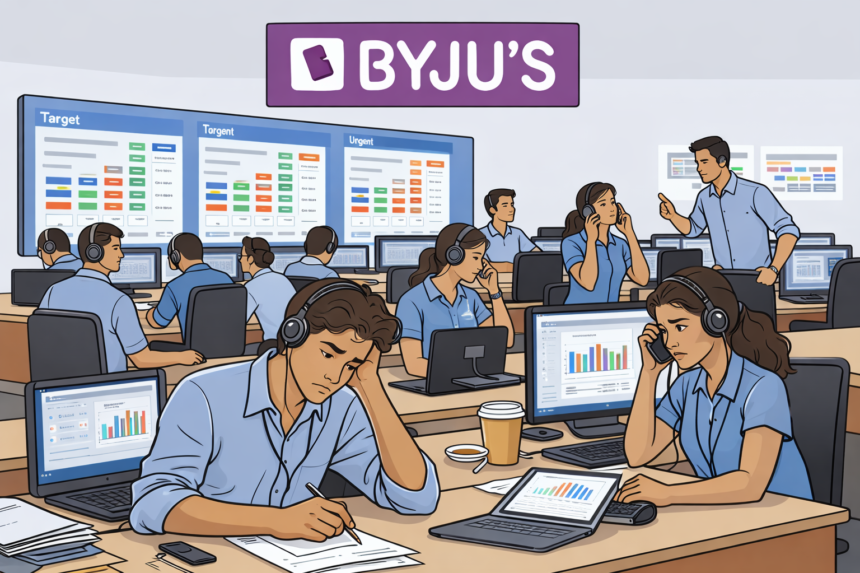

Byju’s did not become India’s largest edtech company by accident. Its growth relied on an aggressive sales apparatus designed to convert high volumes of inbound leads into paid enrollments. Sales teams were the revenue backbone. When pressure built anywhere in the organization, it tended to surface there first.
What caught my attention was how often Byju’s appeared in unrelated conversations about burnout, mis-selling, and startup excess. The name surfaced in labour reporting. It appeared in court coverage. It showed up repeatedly in online forums where former sales employees discussed anxiety and disillusionment. That consistency made it worth examining more closely.
The Scale and Structure of Byju’s Sales Workforce
At its peak growth phase, the scale and structure of Byju’s sales workforce in India were enormous, deeply integrated into how the company drove revenue, but also deeply controversial in practice. Reports from The Economic Times1 and investigative outlets reveal that Byju’s employed tens of thousands of sales staff, most of them inside sales executives whose primary role was to convert leads into subscriptions for the company’s learning products. These salespeople were often young graduates, many in their first salaried job, recruited with the promise of a fixed base salary plus performance-linked incentives that were marketed as substantial and life-changing for high performers.

The actual experience described by many former and current employees paints a very different picture from the polished recruitment messaging. From The Wire2, we find that inside sales staff described intense pressure to meet weekly sales targets of at least Rs 100,000, requiring them to sell multiple courses each week just to stay afloat. To meet these targets, staff worked long hours on calls and in public spaces like schools, malls, and temples, trying to persuade parents, often from lower-income backgrounds, to buy educational products they might not fully understand or afford.
One former salesperson recounted the emotional toll bluntly:
“You have to let go of your conscience and be absolutely shameless to do this job,” adding that the guilt from aggressive selling tactics was so severe it affected sleep and well-being.
Reuters3 reports another former employee describing instances where managers would lock bags or physically prevent people from leaving the workplace if sales targets were not met, and said lunch breaks were sometimes withheld as a penalty.
Sales contracts, according to the reporting, often did not specify reasonable working hours. According to The Times of India4 in Bengaluru, where Karnataka labour laws cap a workday at nine hours and a 48-hour workweek, many sales associates reported routinely working 12-hour days six or seven days a week without proper overtime pay. This workload and the linkage of pay so tightly to weekly revenue generated created a situation where base salaries were suspended, and employees only received a payout if they generated revenue in that week at all. Under a temporary policy as reported by ETHR World5, the company even moved to link sales employees’ pay directly to a percentage of weekly revenue generated, meaning if an associate did not sell anything in a week, they received no salary for that period.
The rapid scale of hiring, combined with intense targets and questionable selling practices, fuelled high attrition, frequent layoffs, and a persistent sense of insecurity. As the company faced financial challenges, further layoffs hit the sales department, with hundreds of roles cut and remaining staff under pressure to absorb more responsibilities.
Byju’s official statements have pushed back against these claims, emphasizing policies to protect worker wellbeing and disputing representations of their sales culture. Whether policies evolve or not, the picture drawn by investigative reporting and employee testimony suggests that the scale of the sales workforce was not just large but structurally demanding, and that aggressive targets and incentive structures were central to how the company pursued growth even as questions about workplace conditions and ethics persisted.
Escalating Targets and the Logic of Perpetual Pressure
Sales targets at Byju’s were often described as dynamic. Employees across different time periods reported that monthly or quarterly targets increased mid-cycle. This was particularly common during peak enrollment seasons.
Data points from reporting suggest that sales executives were expected to make hundreds of calls per week while maintaining conversion ratios that assumed consistently high lead quality. When lead quality declined, targets often did not adjust proportionally.
From a systems perspective, this creates what behavioural economists call asymmetric risk. The organization absorbs upside. Individuals absorb volatility.
One of the most emotionally charged aspects of employee accounts involves performance visibility. Sales dashboards tracked individual progress in real time. Numbers were reviewed during daily calls.
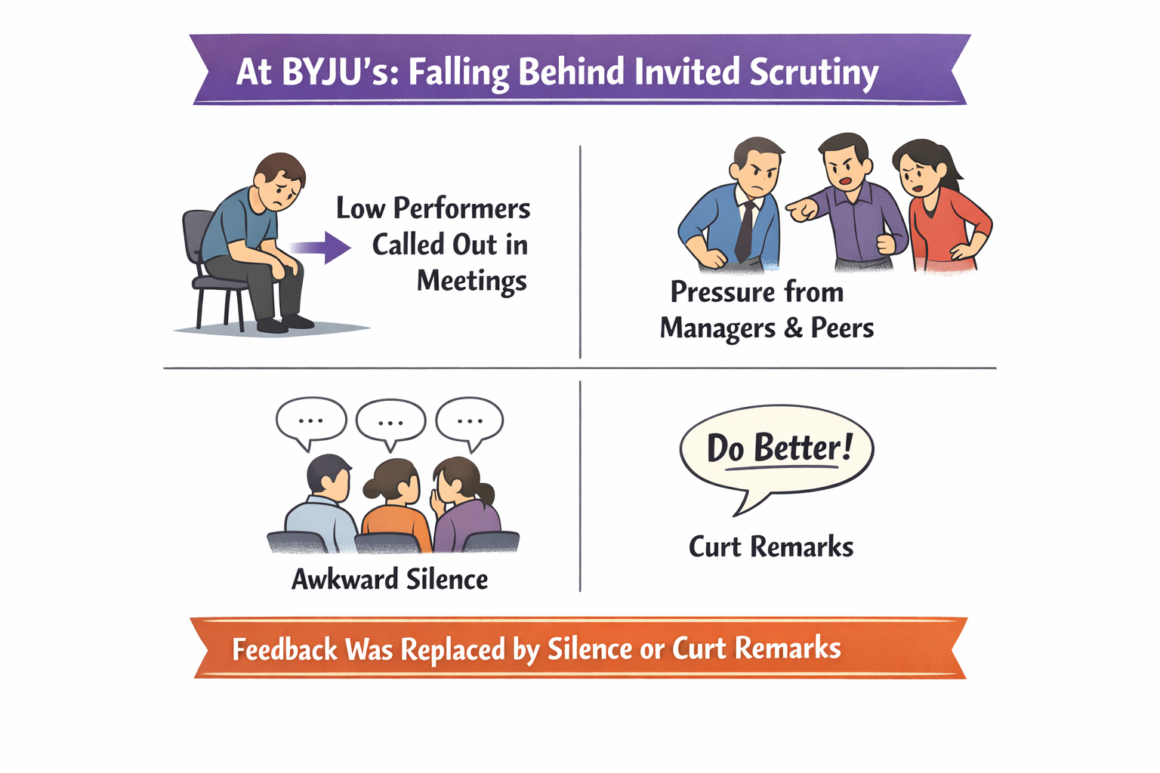
Several former employees have said that falling behind invited scrutiny not just from managers but from peers. Low performers were often called out during meetings. Silence or curt remarks replaced feedback. This approach is not unique to Byju’s, but its scale magnified the impact. Public accountability became a pressure multiplier.
Multiple investigations have examined how Byju’s courses were sold. The core allegation is not that employees were explicitly told to lie, but that they were trained to emphasize urgency and outcomes in ways that blurred ethical lines.
A widely cited BBC6 report from 2021 detailed complaints from parents who said they were promised academic improvements that did not materialize and were discouraged from seeking refunds.
Former sales employees interviewed in the Indian media described scripts that encouraged pushing parents to make decisions on the same call. One anonymos ex employee told,
“If the parent asked for time, we were trained to overcome that objection immediately.”
When incentives are tied tightly to closures, ethical hesitation becomes costly. This is a structural problem rather than an individual moral failing.
Compensation became a major flashpoint as Byju’s finances tightened. In 2024, the Times of India7 reported that the company had linked sales staff pay to weekly revenue generation during periods of cash stress.
This meant that employees who failed to close sufficient deals in a given week risked receiving little or no pay beyond minimal fixed components. Several former employees described this shift as destabilizing.
A former sales manager quoted in the same report said,
“Incentives stopped being motivation. They became rent money.”
There were also reports of delayed incentive payouts. Employees alleged that the criteria for incentives changed retroactively, making expected earnings uncertain.
Reddit and similar platforms provide longitudinal insight. Threads dating back several years describe similar experiences across cohorts.
“Every morning I felt sick before logging in. Not because I hated sales, but because I never knew if today would be the day I was put on a list.”
Another post described guilt over selling to families under financial stress.
“I quit because I could not reconcile my targets with my conscience,” the user wrote.
What is notable is that many posts appear months after the resignation. The emotional residue lingers.
Burnout Among Young Employees and Psychological Impact
Research in occupational and developmental psychology consistently shows that young workers are particularly vulnerable to environments with high pressure and low control, a combination that Byju’s sales model concentrated sharply through aggressive targets, long hours, and tight oversight. This mix of demands and minimal autonomy is a well-documented risk factor for stress, burnout, and mental health issues, especially among early-career professionals with limited experience in navigating work-life demands.
The Times of India9 reported that a clinical psychologist noted that sustained sales pressure without adequate recovery time can significantly increase the risk of anxiety disorders and depression among otherwise healthy young employees, particularly when they feel they have little control over their workload or outcomes. Chronic stress that is unrelieved by rest or supportive workplace practices can dysregulate mood, disrupt sleep, and impair concentration, seeding long-term psychological effects.
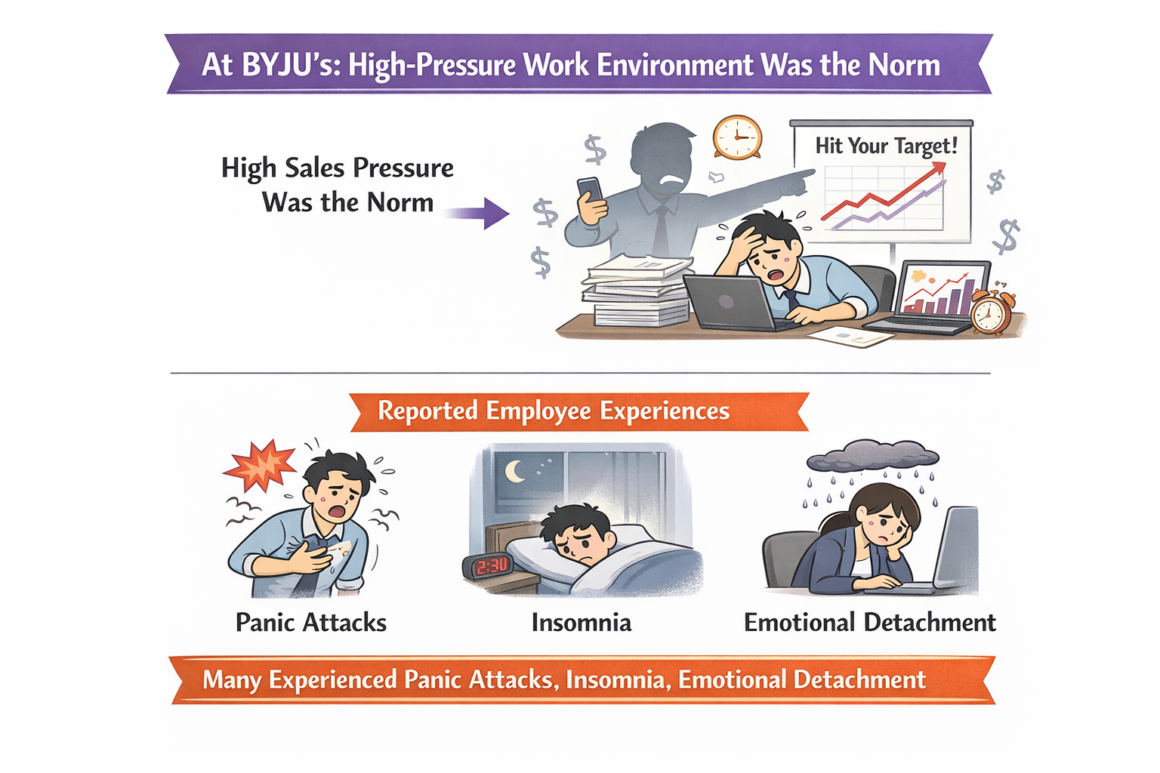
At Byju’s, multiple former employees described a culture where such pressure was the norm rather than the exception. Sales staff recounted experiences of panic attacks, insomnia, and emotional detachment tied directly to the high-pressure work environment. One former employee reflected that “even after leaving, phone calls triggered anxiety,” illustrating how the stress response did not simply disappear with departure from the job but became embedded in everyday life.
Investigative reporting by Reuters10 and Context further documents the intensity of that environment: salespeople described being pushed to work more than 72 hours a week, pressured with verbal abuse, and repeatedly reminded that their continued employment depended on meeting steep weekly targets. Many staff came from low-income backgrounds or were first-generation college graduates who felt they had little choice but to endure punishing conditions in a competitive job market.
The link between workplace stress and mental health is not unique to Byju’s, but the concentrated combination of high demands and low control can be particularly potent among young workers in sales roles. Broader data from The Hindu11 shows that a high percentage of employees under 25 report anxiety and stress due to work pressure, with younger workers more likely than older counterparts to experience distress, sleep disruption, and impacts on personal life.
Psychologically, this pattern makes sense. Stress models like the job-demands control theory predict that when workers face heavy demands without autonomy or support, they experience greater strain, which can manifest as emotional exhaustion, irritability, and symptoms of anxiety or depression. When this strain is paired with young workers’ relative inexperience in boundary-setting and coping strategies, the consequences can ripple beyond work into broader wellbeing.
Taken together, these insights suggest that organizations with high-pressure sales cultures and individuals working in such environments need to pay careful attention to mental health signals and recovery opportunities. Genuine support structures, reasonable workload expectations, and meaningful control over how work is executed are not just perks but essential components in protecting the psychological well-being of early-career professionals.
Byju’s Response and Corporate Position
Byju’s corporate response to allegations about workplace stress, sales practices, and employee treatment has consistently focused on denial of systemic wrongdoing and reassurance about internal safeguards, but the interaction between these statements and employee testimony highlights a broader gap between policy and lived experience.
When confronted with reports of harsh conditions and alleged mistreatment, Byju’s representatives have framed the concerns raised by former staff as unrepresentative outliers rather than evidence of widespread harm. In response to multiple interviews conducted by Context12 with 26 current and former salespeople describing abusive environments and extreme pressure, the company spokesperson said those speaking out represented an “infinitesimal percentage” of its workforce and maintained that the organisation has “zero tolerance for unpleasant behaviour at the workplace.” Byju’s also asserted that it upholds “the highest safe workplace standards at each of our business units.”
Byju’s has extended similar positions to its sales culture more broadly. In statements reported in DailyO13 and during scrutiny by the National Commission for Protection of Child Rights (NCPCR), the company insisted its sales training “has ethics ingrained in it” and that sales executives do not have authority to close deals, with final approvals subject to a central audit — a practice the company says safeguards customers and ensures ethical conduct. It also said that it never “encouraged, ordered, or incentivised” staff to pursue customers who were “uninterested in or unable to pay.”
On labour relations and restructuring, Byju’s has also contested narratives about coercion or forced resignations, telling The Economic Times14 that allegations of employees being compelled to quit were false, and emphasising that workforce rationalisation affecting around 5 percent of the company’s roughly 50,000 staff was part of broader efforts “to grow profitably and sustainably.” The company stated it was providing exit packages, extended benefits, outplacement services, and other support to affected employees.
These responses matter in several ways. They signal that the company is aware of criticism and is attempting to position itself as compliant with laws and human resources best practices. Acknowledging ethical sales standards, centralised checks, and support for employee well-being are all parts of a defensive corporate posture in the face of sustained media scrutiny and regulatory attention.
However, the gap between policy statements and the lived experience described by many former employees is also significant. The repeated framing of complaints as isolated incidents, combined with strong denials of systemic issues, can inadvertently obscure patterns that have been reported by multiple independent sources. Interviews with sales staff consistently reference long hours, excessive pressure to meet targets, and reluctance to take leave — conditions that, if widespread, suggest a structural issue rather than an isolated set of incidents.
The tension between the company’s stated policies and employee testimony also highlights a general challenge in corporate accountability: formal compliance does not always translate into consistent practice on the ground. A firm can have ethical guidelines, complaint mechanisms, and wellness programs on paper, yet still foster a high-pressure environment where employees feel unable to use those resources without fear of negative consequences. This dynamic is particularly salient in sales organisations where performance targets profoundly shape daily behaviour.
Byju’s emphasis on its internal processes and its contextualisation of complaints as isolated reflects a corporate defensive strategy common in cases of reputational stress. However, when multiple independent reports and employee narratives point to similar themes of pressure and distress, it both underscores the importance of ongoing scrutiny and raises questions about whether existing policies are effective in practice.
So, while Byju’s has formally denied wrongdoing and reiterated commitments to ethical practice and employee support, the contrast with reported employee experiences demonstrates how corporate position and workplace reality can diverge, and how broad policy language may not adequately address the nuanced, day-to-day impacts of a high-pressure sales environment.
Byju’s trajectory mirrors that of India’s edtech sector more broadly. During the pandemic, demand surged. Venture capital flowed freely. Hiring accelerated.
When demand normalized, revenue projections faltered. Sales teams were expected to bridge the gap. This is a familiar startup pattern. What makes Byju’s case distinctive is scale.
Labour Law Questions and Accountability
Labour experts and legal commentators have raised serious questions about the alignment of Byju’s revenue-linked pay structures with Indian wage protection norms, particularly when variable pay shifts from being a bonus to becoming the bulk of someone’s survival income. Indian labour law makes a clear distinction between fixed wages and variable incentives for a reason: basic wages provide a stable foundation for statutory protections such as provident fund, gratuity, minimum wage compliance, and overtime entitlements, while incentives reward performance on top of that foundation. When that balance collapses, the risk shifts unfairly to workers. A labour lawyer put it starkly as:
“When variable pay becomes the primary means of survival, the balance of risk shifts unfairly to employees.”
This observation underscores a deeper legal and ethical concern about employment design rather than isolated policy details.
The controversy around this structure intensified when reports from sources like NDTV15 emerged that, amid cash flow challenges, Byju’s temporarily linked salaries for its inside sales and exam preparation teams directly to weekly revenue generation, effectively suspending base pay and leaving employees to earn a percentage of what they collected in sales revenue each week. Internal documents reviewed by TOI16 show that associates could receive up to 50 percent of the revenue they generated, but if they failed to generate revenue in a given week, they could receive no salary at all for that period.
From a statutory perspective, this shift raises red flags because Indian wage law typically requires that a minimum portion of total compensation be treated as fixed wages subject to protective norms. When most of a worker’s income depends on weekly output, statutory protections tied to basic pay — including provident fund and gratuity — can be diluted. Labour experts argue that such arrangements are especially problematic for young sales workers with limited bargaining power, as they bear almost all of the financial risk of slow sales periods or broader market downturns.
Another contentious aspect of Byju’s sales compensation structure was how customer accountability often landed on individual sales executives rather than on organisational policy or systems. Media investigations and interviews with former staff describe situations where employees were pressured to resolve customer dissatisfaction or cancellation issues on their own, effectively pushing accountability down the hierarchy. In some reported cases, executives were left to manage refunds, handle complaints, or negotiate with stressed parents without clear escalation frameworks or managerial support.
This diffusion of accountability can have two problematic effects. First, it places disproportionate pressure on individual employees to absorb organisational failures or policy gaps. Second, from a legal standpoint, it muddies the boundaries of employer liability in disputes over customer treatment, refunds, and contractual obligations. Under Indian consumer protection law, the corporate entity — not a junior salesperson — holds ultimate responsibility for product representations, returns, and compliance.
Taken together, the debate around revenue-linked pay and accountability highlights a fundamental tension in Byju’s business model. On one hand, variable pay tied to revenue aims to create alignment between employee performance and company financial outcomes, especially during cash-strapped periods. On the other hand, when the variable component becomes the central determinant of livelihood, it raises legitimate concerns about wage security, statutory protections, and the distribution of risk between employer and employee. Labour lawyers and experts suggest that structures where incentives replace secure base wages should be carefully scrutinised for legal compliance and ethical fairness, particularly in sectors like edtech, where sales pressure intersects with broader social expectations of financial stability and early career opportunity.
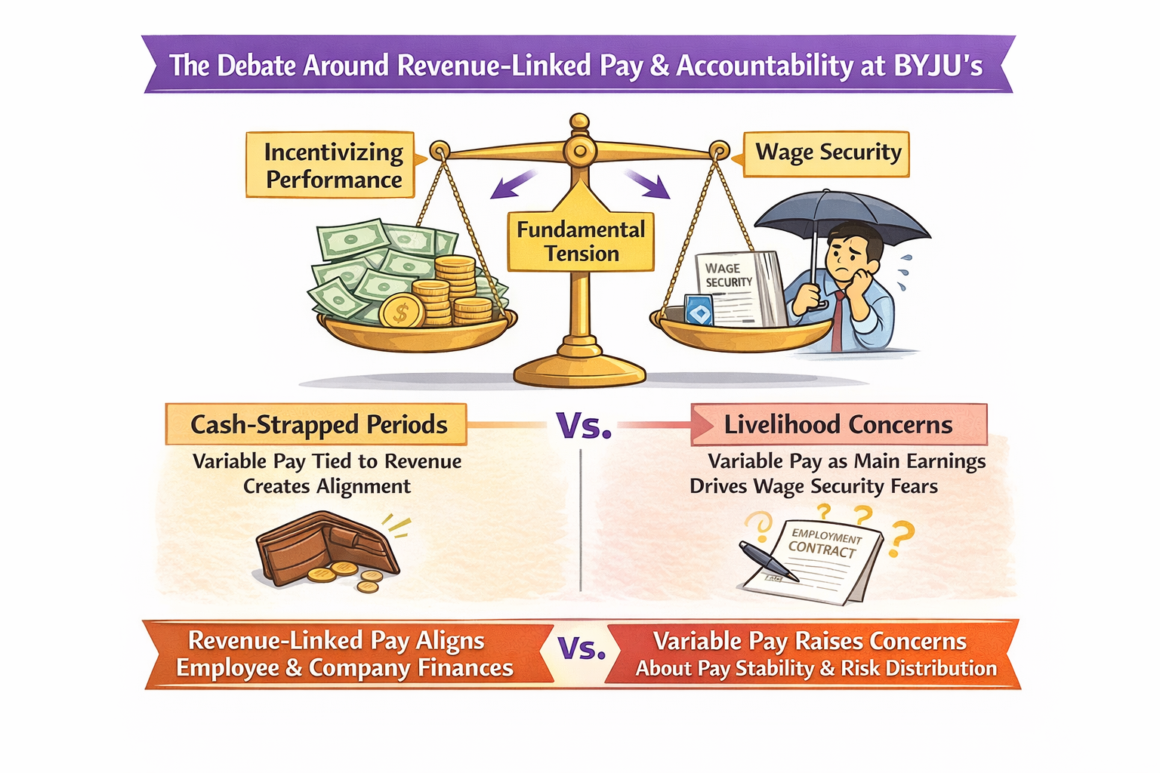
So, while Byju’s responses signal awareness of legal obligations and an attempt to retain flexibility amid financial stress, expert commentary and employee testimony point to an ongoing gap between formal pay structures and the lived reality of workers, raising important questions about wage law compliance, risk allocation, and organisational accountability.
What This Case Ultimately Reveals
I do not see Byju’s sales story as a morality play. It is a case study in incentives, pressure, and unintended consequences. Sales targets are not inherently abusive. Ambition is not unethical. But when targets escalate without transparency, when incentives become uncertain, and when emotional strain is normalized, damage accumulates quietly.
Most former sales employees quoted in this report wanted to succeed. They did not reject hard work. What they rejected was instability disguised as opportunity.
Byju’s experience offers a broader lesson for India’s startup ecosystem. Growth strategies need human guardrails. Sales cultures need ethical slack. Without them, burnout is not a side effect. It is the business model expressing itself.
Sources
- “Byjus work condition: Byju’s staff reveal harsh work conditions at edtech giant” The Economic Times, economictimes.indiatimes.com/tech/startups/byjus-staff-reveal-harsh-work-conditions-at-edtech-giant/articleshow/96220922.cms?from=mdr. Accessed 10 Feb. 2026. ↩︎
- Banerji, Annie. “‘Treated Like Slaves, Abusive Practices’: Byju’s Staff Reveal Harsh Work Conditions” The Wire, 15 Dec. 2022, m.thewire.in/article/business/poor-working-conditions-abusive-practices-byjus-staff-reveal-harsh-work-conditions. Accessed 10 Feb. 2026. ↩︎
- “Reuters.Com” www.reuters.com/world/investigation-byjus-staff-reveal-harsh-work-conditions-indian-tech-giant–trfn-2022-12-14/. Accessed 10 Feb. 2026. ↩︎
- India, Times Of. “Byju’s staff reveal harsh work conditions at tech giant” Times of India, 14 Dec. 2022, timesofindia.indiatimes.com/business/india-business/byjus-staff-reveal-harsh-work-conditions-at-tech-giant/articleshow/96216851.cms. Accessed 10 Feb. 2026. ↩︎
- “Embattled Byju’s links sales employees’ salaries to weekly revenue generation” 2 May 2024, hr.economictimes.indiatimes.com/news/industry/embattled-byjus-links-sales-employees-salaries-to-weekly-revenue-generation/109780809. Accessed 10 Feb. 2026. ↩︎
- Inamdar, Nikhil. “Byju’s and the other side of an edtech giant’s dizzying rise” 7 Dec. 2021, www.bbc.com/news/world-asia-india-58951449. Accessed 10 Feb. 2026. ↩︎
- India, Times Of. “Byju’s links pay of sales staff to weekly revenue” Times of India, 3 May 2024, timesofindia.indiatimes.com/business/india-business/byjus-links-pay-of-sales-staff-to-weekly-revenue/articleshow/109799247.cms. Accessed 10 Feb. 2026. ↩︎
- Reddit, www.reddit.com/r/StartUpIndia/comments/16velp8/i_worked_at_byjus_and_had_the_worst_experience/. Accessed 10 Feb. 2026. ↩︎
- “Workplace stress: Over 45 per cent of employees experience anxiety every Sunday evening” The Times of India, 28 Sept. 2024, timesofindia.indiatimes.com/life-style/health-fitness/de-stress/over-45-per-cent-of-employees-experience-anxiety-every-sunday-evening-finds-report/articleshow/113767884.cms. Accessed 10 Feb. 2026. ↩︎
- “Reuters.Com” www.reuters.com/world/investigation-byjus-staff-reveal-harsh-work-conditions-indian-tech-giant–trfn-2022-12-14/. Accessed 10 Feb. 2026. ↩︎
- Yasmeen, Afshan. “Over 90% of corporate employees aged below 25 experience signs of anxiety: Report” The Hindu , 22 Jan. 2025, www.thehindu.com/life-and-style/over-90-of-corporate-employees-aged-below-25-years-experience-anxiety-report/article69126927.ece. Accessed 10 Feb. 2026. ↩︎
- Banerji, Annie. “Byju’s staff reveal harsh work conditions at Indian tech giant” Context by TRF, 14 Dec. 2022, www.context.news/money-power-people/byjus-staff-reveal-harsh-work-conditions-at-indian-tech-giant. Accessed 10 Feb. 2026. ↩︎
- Bilal, Mohammad. “Insecurity, long hours, false promises: A Byju’s ex-employee spills the beans on its toxic work culture” 20 Dec. 2022, www.dailyo.in/news/job-insecurity-false-promises-long-working-hours-why-byjus-work-culture-is-problematic-38288http://www.dailyo.in/news/job-insecurity-false-promises-long-working-hours-why-byjus-work-culture-is-problematic-38288. Accessed 10 Feb. 2026. ↩︎
- “Byju’s: Bengaluru employee union alleges Byju’s forcing resignations; company denies claims” The Economic Times, economictimes.indiatimes.com/tech/startups/employees-not-forced-to-resign-its-part-of-5-workforce-reduction-byjus/articleshow/95166817.cms?from=mdr. Accessed 10 Feb. 2026. ↩︎
- NDTV www.ndtv.com/india-news/amid-byjus-money-crunch-employees-salaries-linked-to-weekly-earnings-report-5569734. Accessed 10 Feb. 2026. ↩︎
- India, Times Of. “Byju’s links pay of sales staff to weekly revenue” Times of India, 3 May 2024, timesofindia.indiatimes.com/city/mumbai/byjus-links-pay-of-sales-staff-to-weekly-revenue/articleshow/109796776.cms. Accessed 10 Feb. 2026. ↩︎


