

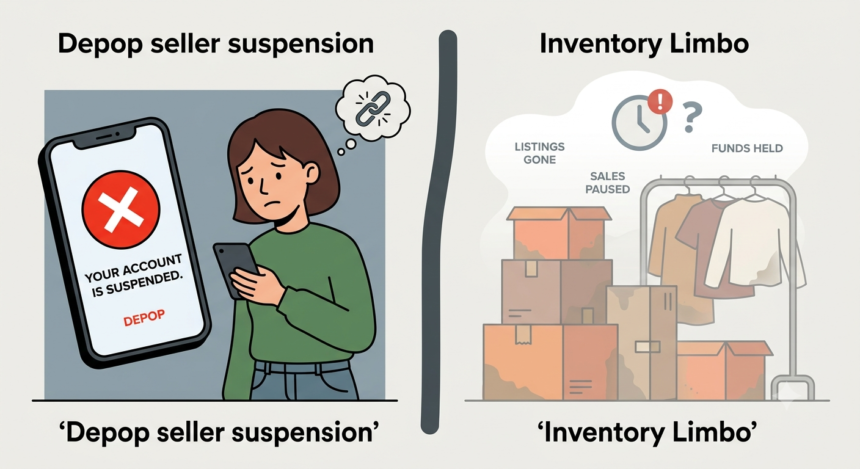

How a platform worth $788 million in gross merchandise sales built a moderation system that leaves small sellers with nowhere to go, and a pile of clothes they can’t move.
There is a specific kind of dread that secondhand sellers know. It arrives without warning. You open the app to check on a sale, and instead of your listings, you get a screen asking you to log in. You type your password. Error. You try again. “Account Inactive.” Your shop, your revenue, your inventory. Gone from the platform in the time it took you to make a coffee.
This is what happened to a seller in November 2025, according to a user account documented by Nifty.ai1. She had been on Depop for years, built a following, made consistent sales. Then Depop suspended her account wrongfully, which the platform later acknowledged was an error. They reinstated her. But by the time her shop came back online, the sales she had lost during the blackout were gone, and her visibility in search had tanked. The platform’s algorithm had quietly moved on without her.
Nobody at Depop called to explain. There was no timeline. There was no human being to speak to. There was a Zendesk form.
The Machine That Bans You
Depop’s2 Trust and Safety enforcement runs on automation. The platform is explicit about this: its content moderation strategy uses “human review, automated tooling and processes, quick action upon notice of an issue, cooperation with experts and regulators.” In that order of speed, if not priority. Algorithms scan listings, scan descriptions, scan private messages between buyers and sellers. They flag keywords, image patterns, pricing anomalies, login location changes, and the pace at which you list new items.
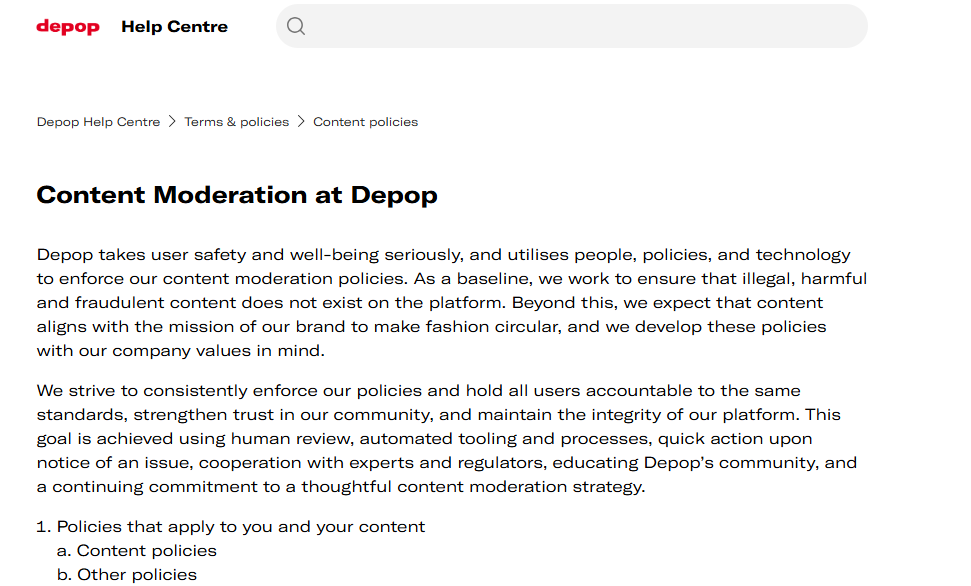
The result is a system that works quickly and errs frequently. Depop acknowledges this in its own moderation documentation, noting that “occasionally, wrong enforcement actions are taken.” That word does a lot of work. Search Reddit for “depop account suspended for no reason” and you find thousands of posts. The pattern is consistent enough to have earned its own folklore among resellers.
Some of the triggers are reasonable. Selling counterfeits will get you banned, and should. Off-platform payment solicitation, asking a buyer to pay via Venmo or CashApp rather than through Depop Payments, also results in suspension, because it lets sellers circumvent both buyer protections and Depop’s revenue from transaction fees. These rules make sense. The enforcement does not always follow the same logic.
One seller documented by the same platform noted that a friend was banned simply for typing the word “Venmo” in a message. Not to solicit payment, but to say “I don’t have Venmo.” The bot read the word and pulled the trigger. The user was gone.
This is the texture of automated moderation at scale. The system is not evaluating intent. It is pattern-matching against a keyword list, flagging images that look like stock photography, scanning for account behaviors that resemble bots. A real person making honest mistakes looks, to an algorithm, a lot like a fraudster running a scheme.
The Inventory Problem Nobody Talks About
When a digital seller gets banned from a platform like Instagram or YouTube, they lose access to an audience, a channel, a distribution network. That is painful. But the content itself still exists. The videos are still on a hard drive. The posts can be taken somewhere else.
Depop is different in a way that does not get enough attention. The sellers on this platform are dealing in physical goods. When a Depop account goes down, the inventory does not disappear, but it also cannot move. The items are sitting in a spare bedroom or a storage unit, photographed and ready to sell, priced and tagged. They are going nowhere. Fashion is seasonal. Trends shift fast, especially on a platform where approximately 90 percent of the active user base is Gen Z as reported by ALM Corp3. A vintage Y2K mini skirt that would have sold in three days in October might be harder to move in January.
This is the inventory limbo problem. And it compounds in ways that a digital content suspension does not.
Consider the physical economics of a serious Depop seller. They have likely invested real money sourcing their inventory, hitting thrift stores, estate sales, flea markets, vintage wholesalers. A seller in Los Angeles running a full-time Depop operation might carry $10,000 to $20,000 worth of inventory at any one time, according to reseller community estimates. That inventory is not sitting in a warehouse owned by a logistics partner. It is in their home. When their account goes down, it earns nothing. Rent does not pause for a Depop appeal.
The Better Business Bureau4 has accumulated a trail of complaints that illustrate exactly this squeeze. One seller wrote that she had complied with all of Depop’s requests during an account review, waited through the stated hold period, provided her banking details, and then found herself unable to update her bank information due to a system error, leaving her funds inaccessible for weeks. She contacted support multiple times. She received delayed or inadequate responses. Nothing moved.
Another seller on the same complaint board sold a jacket that a buyer later claimed was counterfeit based on “subjective observations regarding stitching and logo shape.” The item had serial tags, material tags, a QR code. The seller documented everything before shipping. Depop sided with the buyer anyway, approved the return, and then, here is the detail that should alarm anyone who sells on this platform, requested additional live photographs of tags and identifiers after the buyer already had the item. The seller had to prove the authenticity of an item no longer in their possession.
This is not an isolated consumer complaint. It is a structural design problem.
Money in Limbo
The cash problem runs parallel to the inventory problem, and in some ways it is worse.
Depop5 suspensions are usually indefinite, unlike the timed “Facebook jail” bans that social platforms often issue. There is no countdown. There is no auto-reinstatement. If you do not fight, you stay banned.
And while you fight, the money you earned, from sales you already completed, items you already shipped, buyers you already satisfied, sits in your Depop Balance, inaccessible. The platform can hold funds for up to 180 days to cover potential chargebacks or returns. The official line is that they cannot legally keep your money if the activity was not fraudulent, but “eventually released” is not the same as “released now,” and 180 days is six months.
Avvo6 preserves one of the more stark examples of this dynamic. A seller described having shipped all their items, tracked deliveries, and then not received a $1,600 payout. When they contacted Depop, they were told all funds were being held because of a single open dispute worth $26. They refunded the $26. They contacted support to confirm the issue was resolved. Depop then said the funds from completed deliveries would remain paused until they received the item back, despite the fact that those were separate, already-delivered transactions. When the seller asked for documentation of this policy, the support agent said:
“this isn’t in our guidelines, it’s just procedure.”
The seller asked two more times. Depop banned the account for harassment and breaking policies.
There is a word for a system where asking for written documentation of a policy becomes grounds for termination. That word is not “trust and safety.”
The Cost of No Phone Number
Finding a human at Depop is a skill resellers have to learn the hard way. The platform does not have an inbound call center for buyers or sellers. When you search for a Depop support number, you find their corporate office in London or New York, staffed by receptionists who will direct you to email. You find third-party “support lines” that are outright scams.
The actual path to human review runs through a Zendesk form, a support ticket labeled “My account has been suspended,” and then a wait. Appeals on complex cases, counterfeit allegations, payment disputes, can take a week or more to generate a response. If no reply arrives in 48 hours, the guidance from experienced sellers is to follow up exactly once. If you follow up too many times, the algorithm flags you as aggressive and the case moves even slower.
The only channel that sometimes bypasses the queue is the platform’s social media presence. Sending a public tweet to @askdepop, citing a ticket number, and flagging that a safety issue has been open for 72 hours can prompt a faster response from a social media team that works, apparently, in a different room than the support queue. This is the state of modern marketplace accountability: the fastest route to resolving a dispute that controls your livelihood is a tweet.
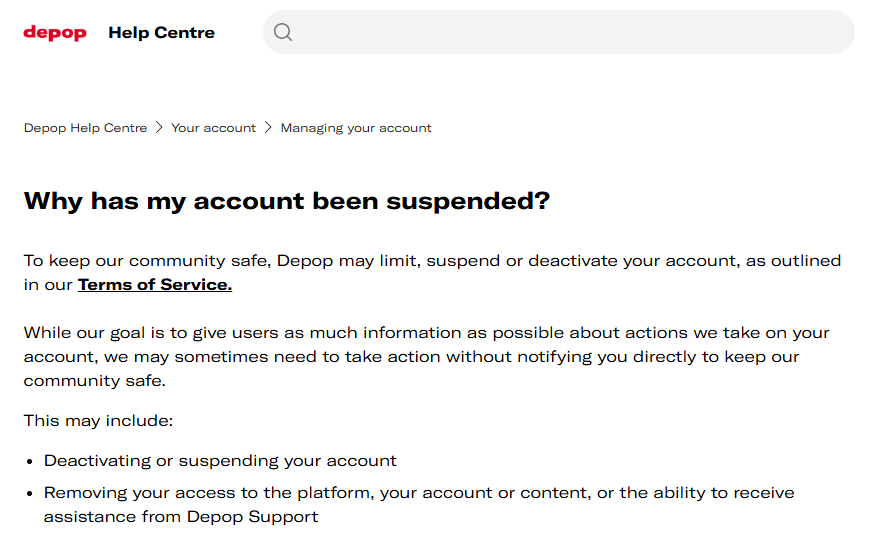
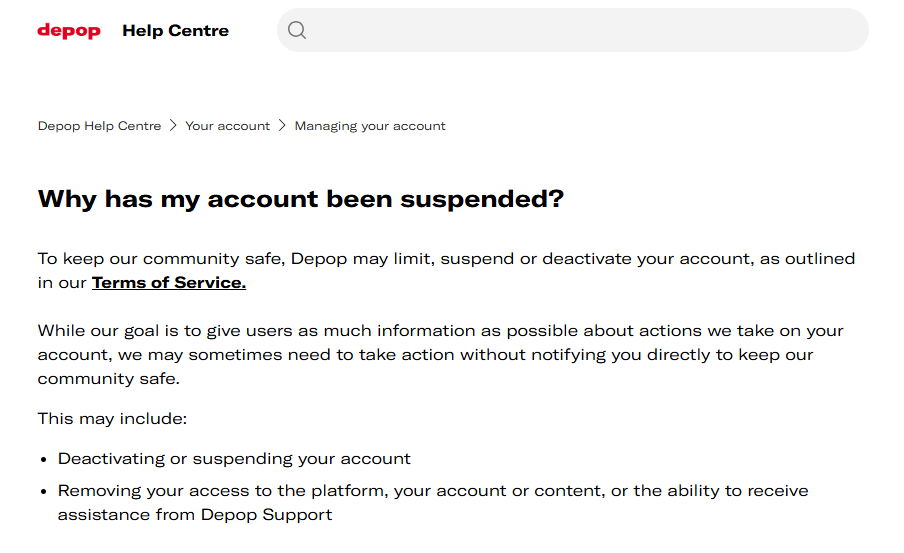
Depop’s7 own help center acknowledges that the platform may sometimes “take action without notifying you directly” in the name of community safety. The phrasing is careful. What it means in practice is that you can wake up one morning to a suspended account, no email, no explanation, no recourse except a form that feeds into a queue monitored by a team you cannot call.
The seller cited by CLOSO8 who got banned for saying “I don’t have Venmo” did not receive a warning. They received a suspension. Depop does not auto-reinstate accounts. The seller had to advocate for themselves in writing, calmly, without emotional language, to a support system designed to filter out complexity and close tickets.
According to Business of Apps9, Depop was acquired by Etsy in 2021 for $1.63 billion, its largest acquisition at the time. Etsy sold Depop to eBay in early 2026 for $1.2 billion, a transaction that valued Depop at less than what Etsy paid, after five years of ownership. The sale was part of what financial analysts described as a “return to the One Etsy philosophy,” a retreat from ambitious portfolio expansion. Depop had generated $788 million in gross merchandise sales in 2024, and the secondhand apparel market it operates in is growing, the U.S. secondhand market is projected to reach $53.7 billion in 2026. It is not a platform in decline. It is a platform in transition, which means the sellers building businesses on it are building on ground that keeps shifting.
The ownership change matters for more than corporate reasons. Every time a platform changes hands, policies migrate, teams restructure, enforcement systems get rebuilt or inherited. Sellers who have built muscle memory around one set of rules wake up to find the guidelines have quietly updated. Depop sellers are already advised to “revisit” policies often, since “rules change without clear notice”. Under eBay’s ownership, that volatility is unlikely to decrease.
There is also the question of what eBay’s culture of managed payments and long-standing seller dispute systems will mean for Depop’s relatively informal enforcement apparatus. EBay has its own history with seller holds and payment reserves. A history that eBay sellers have spent years protesting. The idea that Depop sellers under eBay ownership will gain more clarity or recourse is, to put it charitably, optimistic.
Shadowbans and Soft Suspensions
There is a tier of enforcement below full suspension that does not show up in most discussions of this issue. It is called a shadowban, and it is arguably worse than a hard suspension in one specific way: you do not know it is happening.
A shadowbanned seller can log into their account, see their listings, message buyers, but their items simply do not appear in search results. Their shop is invisible to anyone who does not already follow them. Sales drop to zero. The seller, not knowing what has happened, might re-photograph their items, adjust prices, add more listings. All of which changes nothing. The only way to confirm a shadowban is to search for a unique item from a second phone with a different account. If the listing does not appear, you are in a soft suspension state.
This typically happens for behaviors that Depop’s algorithm interprets as spammy. Overusing hashtags, relisting items too frequently, sending too many messages. It is an enforcement mechanism with no notification and no stated duration. It just happens. The seller spins in place, confused, while the platform quietly starves their visibility.
What makes all of this particularly acute on Depop is the nature of the inventory itself. Secondhand fashion is time-sensitive in a way that, say, books or electronics are not. A vintage Levi’s trucker jacket photographed in September for $85 will sell differently in April. Trends on a Gen Z platform move fast enough that a week of suspension can genuinely affect what an item is worth.
Depop updated its policies significantly in 2024 to crack down on dropshipping, pushing harder for sellers to have items physically in hand before listing. This is a sensible policy for platform integrity. But it means the sellers who are most invested in Depop, the ones who actually own the inventory, who have it sitting in their homes, are the ones most exposed when suspensions happen. They cannot reroute their supply chain. They cannot fulfill orders through a third party while they wait for their appeal. The clothes just sit there.
And unlike digital goods, physical inventory has carrying costs. Storage space. The time spent photographing, measuring, washing, storing. The sourcing investment. A seller who built their stock over months of weekend thrifting cannot pause that investment during a suspension and resume it cleanly when access is restored.
There is no mechanism on Depop to export your inventory data during a suspension. Your listings are not portable. The descriptions you wrote, the prices you set, the photographs you took. All of it lives inside a platform you cannot access. If the ban becomes permanent, you start over from nothing on whatever platform you migrate to.
The Structural Trap
This is the structural problem worth naming clearly. Depop’s business model depends on sellers investing deeply in the platform. Building followings, curating shops, photographing inventory specifically for Depop’s aesthetic and feed format. The more invested a seller becomes, the more dependent they are on continuous access. And the more dependent they are, the more catastrophic a suspension becomes.
Depop sellers are not classified as gig workers in any formal sense, but the dynamic is the same. The platform creates the conditions for deep dependence, and then maintains enforcement systems that can sever that relationship instantly, unilaterally, and sometimes incorrectly.
The appeal process exists. Depop’s10 moderation documentation explicitly states that there is no time limit on appealing prior enforcement decisions. But an appeal with no time limit on the platform’s response is not a right. It is a waiting room. And in fashion resale, time is the most expensive thing you can lose.
Experienced sellers have developed their own mitigation strategies. Cross-listing on Poshmark, Vinted, eBay, and Mercari simultaneously is now considered basic risk management, not a strategy for growth. Third-party tools like Closo and SellerAider11 exist specifically to push inventory across multiple platforms so that no single suspension kills a seller’s entire operation. The existence of this whole infrastructure of defensive selling is itself an indictment. You should not need to build a suspension survival kit to operate a thrift shop on an app.
The fixes here are not complicated, even if implementing them at scale is.
Automated systems should be checked by humans before a full account suspension fires, particularly for sellers with established track records. A seller with two years of five-star reviews, 400 completed transactions, and a first-time keyword flag should not be treated the same as a new account with no history. The data to make this distinction exists. The decision to use it is a policy choice.
Sellers should receive meaningful notice before suspension, except in cases where immediate action is required for genuine fraud or harm. “We may sometimes need to take action without notifying you” is a reasonable carve-out for extreme cases. It should not be the default setting.
Fund holds should have transparent timelines communicated at the moment of suspension, in writing, not after the seller asks twice and files a complaint. The 180-day window that Depop holds funds to cover potential chargebacks is defensible as a policy. Using it as an indefinite hold without clear communication is not.
Finally, sellers should be able to export their listing data. The photographs, descriptions, prices, and measurements a seller enters into Depop represent real labor. If a suspension is reversed, sellers should not have to rebuild their shops from scratch. If a suspension is permanent, sellers should at least be able to take their own work with them.
The Clothes Are Still There
The vintage North Face jacket is still folded in the bin. The Dior-adjacent miniskirt is still in the garment bag. The rack of Y2K denim is still tagged and measured and ready to ship to whoever buys it.
The seller who built a business around moving these things, who learned what photographs work for Depop’s square-format feed, who cultivated the kind of shop aesthetic that Gen Z shoppers follow. That seller is reading a form-letter email about their violation status and trying to figure out how to write a 150-word appeal that does not sound too emotional.
Depop’s own platform description tells sellers that their bans are “usually indefinite.” That is a strange phrase to build a marketplace on. But it is an honest one.
The secondhand fashion economy is real, growing, and doing something genuinely useful, keeping clothes out of landfills, providing income for people without traditional employment, building a resale culture among a generation that does not want to buy new. According to Textile Today12, the U.S. secondhand apparel market is projected to reach $154.3 billion by 2036.
The platforms that carry this economy, Depop, Poshmark, Vinted, Mercari, will capture enormous value from it.
They should at least be able to tell a seller why they lost access to their shop.
Sources
- Hernández, Lauren. “What to do if your Depop account is suspended?” Nifty, 30 Mar. 2026, nifty.ai/post/depop-account-suspended. Accessed 23 Aug. 2026. ↩︎
- Depop, depophelp.zendesk.com/hc/en-gb/articles/22567808120593-Content-Moderation-at-Depop. Accessed 23 Aug. 2026. ↩︎
- ALM Corp, almcorp.com/blog/depop-depoponomics-campaign-resale-platform-income-2026/. Accessed 23 Aug. 2026. ↩︎
- BBB, Better Business Bureau, www.bbb.org/us/ny/new-york/profile/online-consignment/depop-inc-0121-165594/complaints. Accessed 23 Aug. 2026. ↩︎
- Depop, depophelp.zendesk.com/hc/en-gb/articles/360001772948-Why-has-my-account-been-suspended. Accessed 23 Aug. 2026. ↩︎
- Avvo, www.avvo.com/legal-answers/can-i-sue-depop-for-wrongfully-holding-my-funds-an-6069949.html. Accessed 23 Aug. 2026. ↩︎
- Depop, depophelp.zendesk.com/hc/en-gb/articles/360001772948-Why-has-my-account-been-suspended. Accessed 23 Aug. 2026. ↩︎
- “Depop Account Ban: Get Unsuspended 2026” 1 Feb. 2026, closo.co/blogs/beginner-guides-how-tos/the-silence-of-the-ban-surviving-a-depop-account-suspension. Accessed 23 Aug. 2026. ↩︎
- Business of Apps, www.businessofapps.com/data/etsy-statistics/. Accessed 23 Aug. 2026. ↩︎
- Depop, depophelp.zendesk.com/hc/en-gb/articles/22567808120593-Content-Moderation-at-Depop. Accessed 23 Aug. 2026. ↩︎
- Te. “Depop Account Suspended – What You Need to Do (2026)” SellerAider, 5 July 2024, selleraider.com/depop-account-suspended/. Accessed 23 Aug. 2026. ↩︎
- “Textile Today” The global secondhand apparel market may…, www.facebook.com/textiletodayih/posts/the-global-secondhand-apparel-market-may-reach-1543-billion-by-2036-growing-stro/1753775349401838/. Accessed 23 Aug. 2026. ↩︎


