

Chargebacks are not new. They have existed since credit cards were first introduced as a consumer protection tool. In theory, they protect buyers from fraud, defective goods, or merchants who fail to deliver. In practice, they have long been a pressure point in e-commerce. According to Visa’s1 official dispute monitoring program, merchants can face fines or monitoring thresholds if their chargeback ratio exceeds certain limits, often around 0.9 percent of transactions, depending on network rules.
Mastercard operates a similar Excessive Chargeback Program, with its own thresholds and penalties.
In traditional online retail, sellers accept this as part of doing business. They build fraud buffers into margins. They use third-party fraud detection tools. They track dispute ratios obsessively.
But TikTok Shop changed the terrain.
Social commerce collapses discovery, entertainment, impulse buying, and checkout into a single scroll. Products appear mid-video. Influencers pitch them in real time. Buyers tap once and the purchase is complete. The friction is gone. So, sellers say, is much of the protection.
In Facebook seller groups, Reddit threads, Discord channels, and private Slack communities, a steady pattern of complaints has emerged. Sellers across the United States, the United Kingdom, and Southeast Asia describe the same cycle. Orders ship. Delivery confirmation appears. Then weeks later, a chargeback hits. The buyer claims fraud. The platform deducts funds. Appeals are denied.
I began reading through these accounts expecting routine merchant frustration. Instead, I found something more structural. Sellers do not just describe isolated disputes. Many describe a system where they believe buyer fraud is easier than ever, and where platform rules leave them exposed.
TikTok Shop is operated by ByteDance and is embedded inside the larger ecosystem of TikTok. The company describes TikTok Shop as a way to “discover and purchase products directly on TikTok through in-feed videos, LIVE, and the Showcase tab.”
TikTok also outlines dispute and chargeback procedures within its Seller Center policies.
On paper, the system looks familiar. There are timelines. There is evidence submission. There are appeal channels. There are seller protection rules in certain cases.
On the ground, sellers tell a different story.
The Rise of TikTok Shop and the Compression of Risk
TikTok Shop launched in Southeast Asia before expanding into the United Kingdom and later the United States. In Indonesia, Malaysia, Thailand, Vietnam, and the Philippines, TikTok rapidly integrated commerce with short-form video. According to reporting by Reuters2, TikTok’s e-commerce ambitions have been central to ByteDance’s growth strategy, particularly as it competes with Amazon and regional platforms like Shopee and Lazada.
In the United States, TikTok Shop expanded aggressively in 2023 and 2024, recruiting sellers with subsidized shipping, discounted commission rates, and heavy in-app promotion. CNBC3 reported that TikTok was pushing merchants to join by offering incentives and promising access to its massive user base.
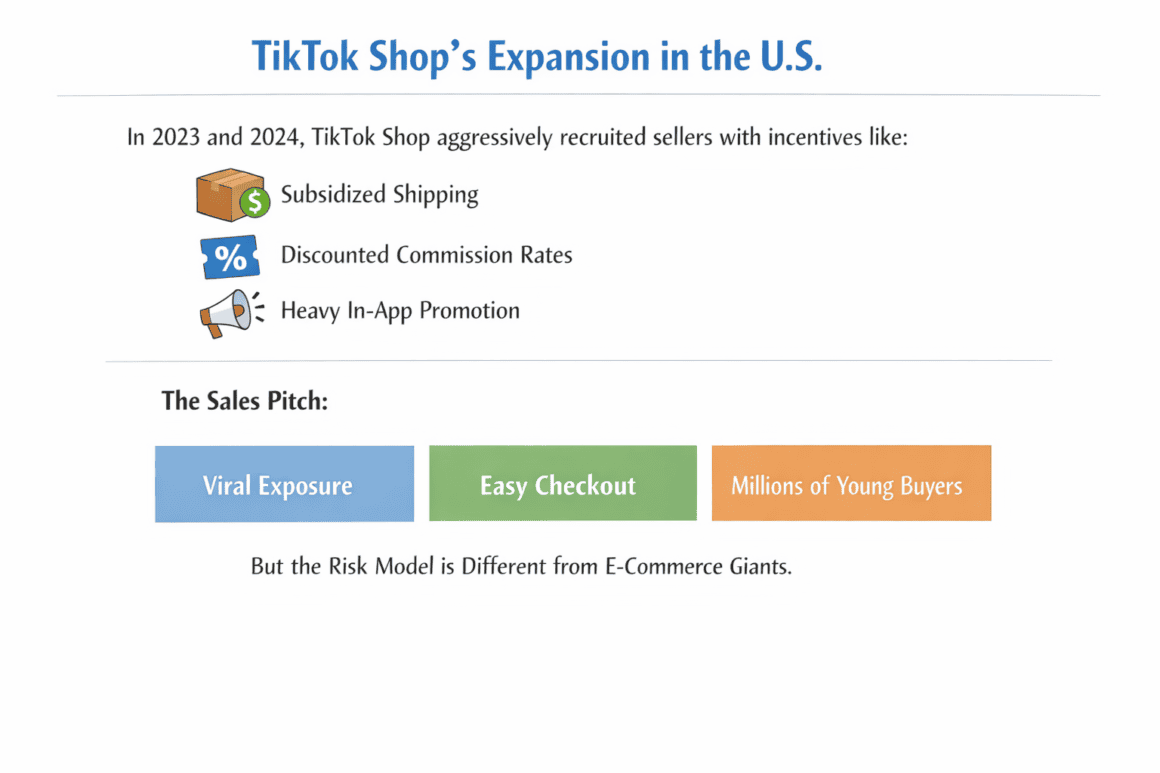
The pitch was simple. Viral exposure. Seamless checkout. Access to millions of Gen Z and millennial buyers. The risk model, however, differs from Amazon or Shopify.
On Amazon, sellers often use Fulfillment by Amazon, which centralizes shipping and gives Amazon strong delivery confirmation control. On Shopify, sellers typically integrate their own payment processors and fraud tools. TikTok Shop operates in between. Payments are processed through platform-controlled systems. Funds are held and released according to internal schedules. Disputes are mediated by TikTok.
When a buyer files a chargeback with their bank, the card network notifies the platform. The platform notifies the seller. Funds may be frozen. Evidence must be submitted within strict deadlines.
TikTok’s4 official guidance explains that sellers must provide proof of delivery, tracking information, and sometimes customer communication logs to contest disputes. The dispute policy outlines documentation requirements and possible outcomes.
On forums, sellers say the burden feels asymmetrical.
In one Reddit thread on r/TikTokShopSellers5 titled “Chargebacks killing my margins,” a seller wrote,
“We provide tracking and signature confirmation and still lose. TikTok says the bank decided.”
Another seller in a UK Facebook group posted,
“Buyer says fraud after delivery. TikTok deducts the funds instantly. Appeal rejected. No explanation beyond ‘insufficient evidence.’”
These posts reflect individual experiences. TikTok does not publicly disclose detailed chargeback win rates for sellers. But the consistency of the complaints is notable.
The Mechanics of a Chargeback
To understand the friction, it helps to understand how chargebacks work.
When a cardholder disputes a transaction, the issuing bank temporarily credits the buyer and sends a dispute code through the card network to the acquiring bank. The merchant or platform must then submit evidence to “represent” the charge. If the bank sides with the cardholder, the merchant loses the funds plus fees.
Stripe, one of the largest payment processors, provides a clear explanation of this lifecycle in its chargeback documentation. Shopify also explains that merchants bear the ultimate liability for fraud disputes unless covered by specific protections.
In theory, TikTok Shop operates under the same card network rules. But sellers say they have less visibility into the evidence loop. They submit documents into TikTok’s Seller Center. They do not communicate directly with the bank. They do not always receive detailed reasoning for losses.
In Southeast Asia, where cash on delivery remains common, fraud patterns differ. Sellers in Indonesia and Malaysia have described a wave of “return to sender” abuse where buyers refuse packages at the door, forcing merchants to absorb shipping costs twice. In some cases, according to local seller posts archived in regional forums, customers claim non-delivery despite courier confirmation.
Reuters6 reported in 2023 that TikTok faced regulatory scrutiny in Indonesia partly over concerns about its dominance in social commerce. The platform temporarily suspended direct transactions there before restructuring its local operations.
The regulatory story is separate from chargebacks. But it highlights how quickly TikTok Shop scaled before fully stabilizing its systems.
Where Sellers Say the System Breaks
Across markets, three recurring themes appear in seller accounts.
First, proof of delivery does not guarantee a win.
In multiple forum threads, sellers report submitting tracking numbers, delivery scans, and even signature confirmations, only to lose disputes coded as “fraud card absent environment.” Under card network rules, this code often favors cardholders unless strong authentication or additional verification exists.
Visa7 explains that card-not-present fraud disputes are common in online transactions and can be difficult to reverse without compelling evidence.
Second, response windows are tight. Sellers report being given limited days to upload documents before automatic deductions occur.
Third, repeated disputes can affect account health.
TikTok Seller Center policies mention performance metrics and potential penalties for high dispute rates. While the company does not publish exact public thresholds comparable to Visa’s monitoring programs, sellers report warnings and temporary fund holds after clusters of disputes.
In a LinkedIn8 post discussing TikTok Shop risk exposure, one e-commerce consultant wrote that “social commerce platforms compress the timeline between impulse and regret,” increasing the probability of post-purchase disputes.
Industry analysts have noted that impulse driven commerce can increase buyer remorse and disputes. PYMNTS.com9 has written about rising friendly fraud across digital platforms, where consumers dispute legitimate purchases, often claiming fraud to bypass return processes.
Friendly fraud is not unique to TikTok Shop. But sellers argue that TikTok’s viral velocity amplifies it.
An anonymous US based beauty seller stated that she built a six figure revenue stream within months through viral clips. Then three chargebacks hit in a single week.
“All delivered. All tracked. All reversed,” she said. “TikTok sided with the bank. I lost product, shipping, and the fee.”
She further added, “It feels like the system assumes we are guilty.”
TikTok’s policy language does not state that assumption. Official documentation emphasizes neutrality and adherence to card network rules. Yet perception matters. When enough sellers describe the same experience, it shapes trust.
In the United Kingdom, small business forums such as MoneySavingExpert and Seller Central style discussion boards include threads warning merchants about chargeback exposure on emerging marketplaces. While not all are specific to TikTok Shop, cross posting often mentions it alongside Amazon and eBay as platforms where dispute management feels opaque.
The UK’s Financial Ombudsman Service10 publishes data showing rising consumer disputes in digital transactions overall, reflecting a broader environment of contested payments.
In Southeast Asia, Shopee and Lazada sellers have long complained about return abuse. TikTok Shop entered that competitive environment with aggressive growth tactics. According to a TechCrunch11 report on TikTok’s commerce expansion, the company aimed to build a “full stack shopping ecosystem.”
Building infrastructure at that speed can create stress points.
E-commerce consultant reports from firms such as Chargebacks91112 note that friendly fraud now accounts for a significant share of disputes globally. It estimates that friendly fraud can represent up to 60 percent of total chargebacks in some sectors.
If that ratio applies inside TikTok Shop, sellers are battling not organized criminal fraud rings but individual buyers leveraging bank protections.
TikTok states that it has seller protections in certain cases, particularly when orders are fulfilled through approved logistics channels and when documentation requirements are met. Seller University13 materials outline appeal mechanisms and emphasize compliance with shipping standards.
The company also highlights community guidelines and enforcement tools against abusive buyer behavior. However, public transparency reports focus more on content moderation than commerce disputes.
Unlike Amazon, which publishes some seller performance metrics guidance and maintains large public forums, TikTok’s seller ecosystem feels younger and less documented.
To be fair, the platform operates within card network rules that ultimately place decision power with issuing banks. When a bank sides with a cardholder, even a large marketplace may have limited recourse.
Yet marketplaces can choose how they allocate losses internally. Amazon, for example, offers A-to-z Guarantee protections in certain circumstances. Shopify provides fraud analysis indicators and optional third-party integrations.
Sellers argue that TikTok’s internal buffers are thinner.
The Psychology of Scroll Commerce
When I scroll TikTok, I can see how easily a purchase happens. A creator applies a skincare serum while telling a story. A kitchen gadget slices fruit in seconds. A banner flashes that only a few items remain. The checkout button sits inches below the video. The distance between desire and payment is measured in taps.
That compression of time and friction matters.
Researchers who study social commerce have found that impulse buying increases in environments where users learn through observation and social reinforcement. A 2024 ScienceDirect14 study on online impulsive buying behavior found that social interaction and continuous exposure to product demonstrations significantly increase unplanned purchases. The authors concluded that in social commerce environments, “users are more likely to make spontaneous buying decisions due to observational learning and social influence”
Impulse buying itself has long been defined in consumer psychology as an unplanned purchase triggered by immediate stimuli rather than prior intent. According to research summarized in academic literature, such purchases are driven by emotional response and environmental cues rather than rational evaluation.
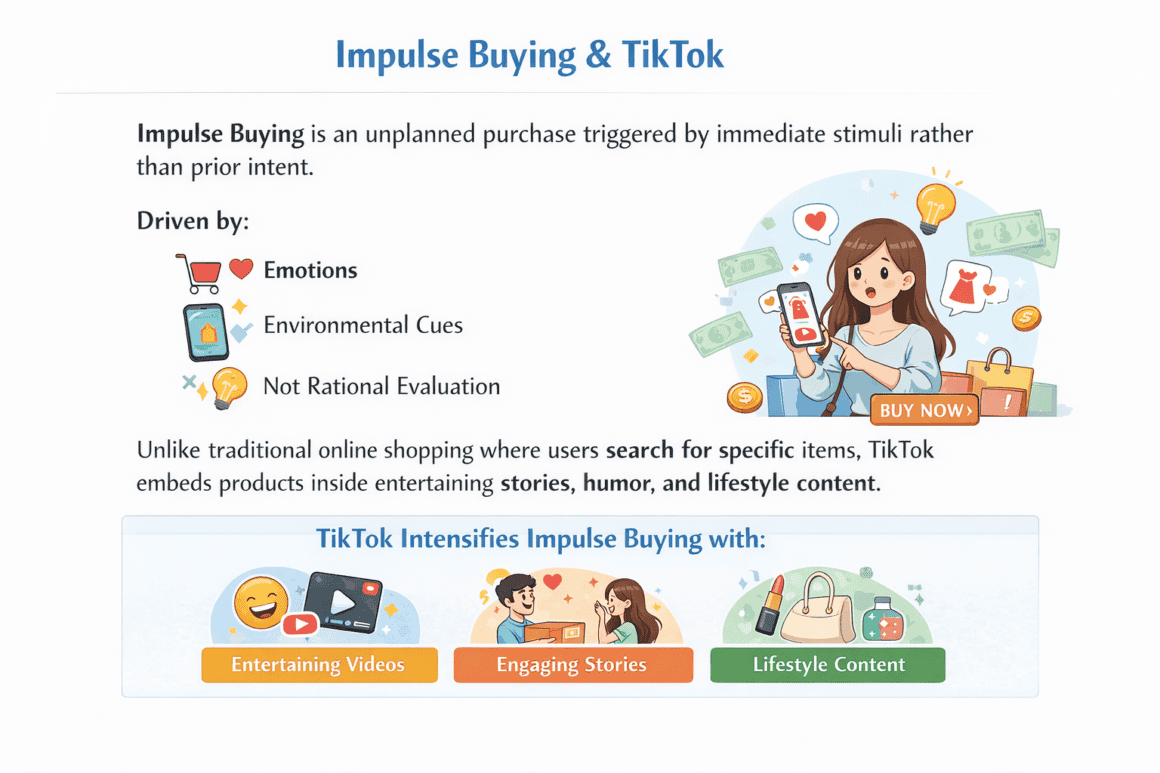
TikTok’s structure intensifies those cues. Unlike traditional e commerce where users search for items, TikTok places products inside stories, humor, and lifestyle content. One marketing professional described the platform’s design this way:
“TikTok Shop doesn’t wait for intent. It creates it. The algorithm turns discovery into desire before you even realize you’re shopping.”
Another industry observer wrote that TikTok’s algorithm “transforms casual scrolling into impulsive buying” and noted that billions in sales have been driven by short form content that blends entertainment with transaction.
The psychology behind this shift is not subtle at all. Buyer’s remorse has been associated with impulse purchases for a long time. Academic definitions describe it as a feeling of regret or anxiety after a transaction, especially when the purchase was made quickly or was based on emotions.
In digital commerce, the removal of friction amplifies this kind of pattern. Investopedia recently reported on a trend known as friction maxxing, where consumers intentionally slow down their digital spending habits because of regret tied to fast online purchases. Investopedia15 cited data showing that as many as 85 percent of online shoppers admit to making impulse purchases they later regret.
On Reddit, buyers describe the phenomenon in blunt terms. One user wrote,
“Over $2000 on impulse purchases through TikTok Shop this year. Half of it I forgot I even ordered until it showed up at my door. The algorithm knows my weaknesses better than I do”
That kind of admission reveals something important. Many purchases on TikTok Shop are not premeditated. They emerge from immersion. From flow. From entertainment.
Research into live stream commerce supports this. Studies show that immersive digital engagement increases impulse buying while also correlating with higher return intentions and post purchase regret. One JSBS16 paper examining live commerce environments found that “continuous exposure to persuasive stimuli increases impulse purchase intention and subsequent dissatisfaction.”
None of this makes fraud inevitable. But it does increase the likelihood of reconsideration.
If a buyer later scans a bank statement and does not recognize a merchant descriptor, or remembers a product that looked better on screen than in person, the emotional context has changed. The persuasive video is gone. The discount countdown is gone. What remains is a line item.
Card networks such as Visa designed chargeback systems to protect consumers from unauthorized transactions and merchant misconduct. Visa explains that chargebacks exist to allow cardholders to dispute transactions when they believe a charge is fraudulent or incorrect.
That framework was built for a world where shopping and entertainment were separate acts. It was not built for a feed where persuasion, checkout, and payment confirmation exist inside one uninterrupted stream.
In social commerce, the path from curiosity to commitment is shortened. The path from regret to dispute may be shortened as well.
For sellers, that psychological shift matters as much as any policy document.
A System Under Strain
Chargebacks were built as a shield for consumers. In the analog era, they protected cardholders from stolen numbers and mail order scams. In early e-commerce, they provided confidence in a risky frontier. That protection remains essential. No serious merchant argues otherwise.
What has changed is the velocity of commerce.
TikTok Shop compresses marketing, persuasion, checkout, and community into a single scroll. The transaction is often emotional. It is social. It is sometimes impulsive. That design is part of its power. It is also part of its risk profile.
When I step back from the individual complaints and look at the structure, the tension becomes clear. Card networks like Visa and Mastercard maintain consumer-first dispute frameworks. Banks default to protecting their cardholders. Platforms like TikTok Shop mediate the flow of evidence but do not control final issuer decisions. Sellers sit at the end of that chain. They absorb product loss, shipping costs, processing fees, and sometimes reputational penalties tied to dispute ratios.
In a traditional storefront, fraud risk is visible. In digital marketplaces, it is abstract until it hits a dashboard.
Sellers I reviewed across the United States, the United Kingdom, Malaysia, and Indonesia did not describe isolated bad luck. They described unpredictability. They described opacity. They described a sense that proof of delivery, even with tracking, does not always move the needle in card-not-present disputes. Visa’s own documentation acknowledges that such disputes are difficult to reverse without strong authentication data. That structural reality does not disappear because the sale happened inside a social feed.
TikTok Shop’s official materials emphasize compliance, documentation, and adherence to network rules. On paper, that framework mirrors the broader e-commerce ecosystem. In practice, sellers argue that the platform’s internal buffers are thinner than those of older marketplaces. Whether that perception reflects transitional growing pains or deeper architectural choices is still unclear.
What is clear is that social commerce has outpaced the risk conversation.
If friendly fraud now accounts for a large share of global disputes, then the problem is not malicious hacking alone. It is consumer behavior colliding with frictionless checkout. It is regret translated into a bank claim. It is confusion about merchant descriptors. It is buyers discovering that chargebacks can bypass standard return processes.
That does not make every dispute illegitimate. It does mean platforms must design for this reality.
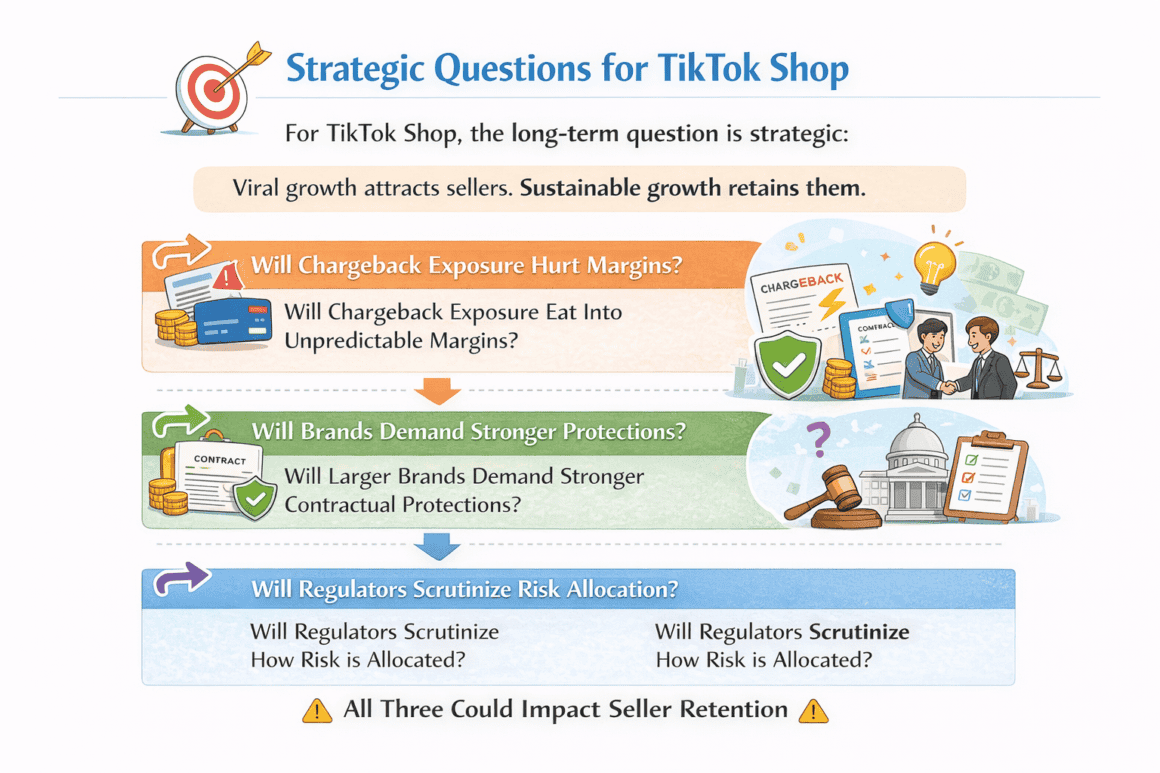
For TikTok Shop, the long-term question is strategic. Viral growth attracts sellers. Sustainable growth retains them. If chargeback exposure eats into margins unpredictably, smaller merchants may hesitate to scale. Larger brands may demand stronger contractual protections. Regulators may eventually scrutinize how digital marketplaces allocate risk between consumers and merchants.
For sellers, the lesson is less philosophical and more practical. Social commerce revenue cannot be evaluated in isolation from dispute risk. Margins must account for loss ratios. Documentation workflows must be tight. Delivery confirmation should be meticulous. Communication logs should be preserved. The optimism of a viral spike must be paired with the discipline of risk management.
I do not see a collapse. I see a platform in adolescence. TikTok Shop is moving fast, expanding across borders, adapting to regulatory pressure, and experimenting with commerce at scale. Adolescence is volatile. Systems strain. Policies evolve.
The sellers I read and spoke with are not asking for perfection. They are asking for predictability. They want transparency about why disputes are lost. They want clearer thresholds before penalties trigger. They want internal seller protections that reflect the unique dynamics of scroll-based buying.
If social commerce is the next chapter of retail, then chargeback governance is one of its unresolved footnotes. The platforms that solve it will not only reduce friction with merchants. They will build durable trust in an ecosystem built on speed.
Trust, in the end, is the real currency. Not views. Not clicks. Not even gross merchandise volume.
If TikTok Shop can align buyer protection with seller stability, it will mature into a serious global marketplace. If it cannot, sellers will adapt the way merchants always have. They will diversify. They will hedge. They will move where the risk is clearer.
The scroll will continue either way.
Sources
- “Visa Core Rules andVisa Product and Service Rules” 10 Nov. 2025, usa.visa.com/dam/VCOM/download/about-visa/usa.visa.com/dam/VCOM/download/about-visa/visa-rules-public.pdf. Accessed 5 Mar. 2026. ↩︎
- “Reuters.Com” www.reuters.com/business/retail-consumer/tiktok-launch-e-commerce-platform-us-sell-china-made-goods-2023-07-25/. Accessed 5 Mar. 2026. ↩︎
- Burris, Devan. “How TikTok Shop is beating Amazon and Temu in the social shopping space” 30 Mar. 2025, www.cnbc.com/2025/03/30/how-tiktok-shop-is-beating-amazon-and-temu-at-social-shopping.html. Accessed 5 Mar. 2026. ↩︎
- “Proof Of Delivery” 3 Mar. 2024, seller-us.tiktok.com/university/essay?knowledge_id=7903474563925806&lang=en. Accessed 5 Mar. 2026. ↩︎
- Reddit, www.reddit.com/r/TikTokShopSellers/. Accessed 5 Mar. 2026. ↩︎
- “Reuters.Com” www.reuters.com/technology/tiktok-violates-indonesian-in-app-transactions-ban-says-minister-2024-02-20/. Accessed 6 Mar. 2026. ↩︎
- “Visa Rules and policies | support & guidelines” Visa, www.visa.com/en-us/support/visa-rules. Accessed 6 Mar. 2026. ↩︎
- “LinkedIn, www.linkedin.com/. Accessed 6 Mar. 2026. ↩︎
- “Mastercard Targets ‘Friendly’ Fraud With Expanded Program” 25 June 2025, www.pymnts.com/mastercard/2025/mastercard-targets-friendly-fraud-with-expanded-program/. Accessed 6 Mar. 2026. ↩︎
- “Data and insight” www.financial-ombudsman.org.uk/data-insight. Accessed 6 Mar. 2026. ↩︎
- Mehta, Ivan. “TikTok Shop officially launches in the US” TechCrunch, 12 Sept. 2023, techcrunch.com/2023/09/12/tiktok-shop-officially-launches-in-the-u-s/. Accessed 6 Mar. 2026. ↩︎
- “Friendly Fraud: The 2026 Guide to Stop Chargeback Abuse” 11 Feb. 2026, chargebacks911.com/friendly-fraud/. Accessed 6 Mar. 2026. ↩︎
- Seller TikTok, seller.tiktok.com/university. Accessed 6 Mar. 2026. ↩︎
- “ScienceDirect” www.sciencedirect.com/science/article/pii/S0378720624000259?. Accessed 6 Mar. 2026. ↩︎
- Bio, Full. “’Friction Maxxing’ Is Going Viral—Here’s How It Could Transform Your Spending Habits” 7 Feb. 2026, www.investopedia.com/friction-maxxing-is-going-viral-heres-how-it-could-transform-your-spending-habits-11898285?. Accessed 6 Mar. 2026. ↩︎
- Kumar, Satinder. “Enchanted but Regretful: Exploring the Impact of Flow Induced Impulse Buying and Return Intention in the Domain of Live Streaming Commerce” Published in Journal of Small Business Strategy, 3 Sept. 2024, jsbs.scholasticahq.com/article/117663-enchanted-but-regretful-exploring-the-impact-of-flow-induced-impulse-buying-and-return-intention-in-the-domain-of-live-streaming-commerce. Accessed 6 Mar. 2026. ↩︎