


There is a company you may have interviewed with recently. It has a 4.2-star rating on Glassdoor. The reviews glow. “Great culture.” “Amazing leadership.” “Work-life balance is a priority here.” You accepted the offer. Six months in, you write your own review. You call the management style suffocating. You mention that the CEO’s door is never actually open. You say the turnover rate is something they never told you about in the interview.
- The Platform That Sells Both the Mirror and the Paint
- The Gray Market That Grew Up Around It
- How the Removal Playbook Works
- The Orosz Investigation and the “Company X” Case Study
- The Wall Street Journal Found This in 2019
- What the Review Removal Industry Actually Sells
- The 2024 Real Name Disaster
- The Business Model Question Nobody Wants to Answer
- What Workers and Job Seekers Are Left With
- The $1,500 Review and What It Actually Costs
Three weeks later, your review is gone.
You were not imagining it. And you are not alone.
The Platform That Sells Both the Mirror and the Paint
Glassdoor launched in 2008 with a singular and genuinely radical premise: give workers an anonymous venue to tell the truth about where they worked. The site attracted millions quickly. According to PR Newswire1, by 2018, Recruit Holdings, a Japanese HR technology conglomerate, purchased Glassdoor for $1.2 billion. Today, the platform hosts tens of millions of reviews across millions of companies.
The problem, the one nobody wants to say plainly, is that Glassdoor makes money from the very companies being reviewed.
In 2010, Glassdoor2 released a fee-based program called “Enhanced Employer Profiles,” which allows employers to include their own content on Glassdoor profiles, like executive biographies, classifieds, social media links, and referrals. Since then, the product line has expanded significantly. Glassdoor offers a free plan for employers, as well as two premium packages, with pricing available only by contacting the sales department. The primary purpose of the site for employers is now employer branding.
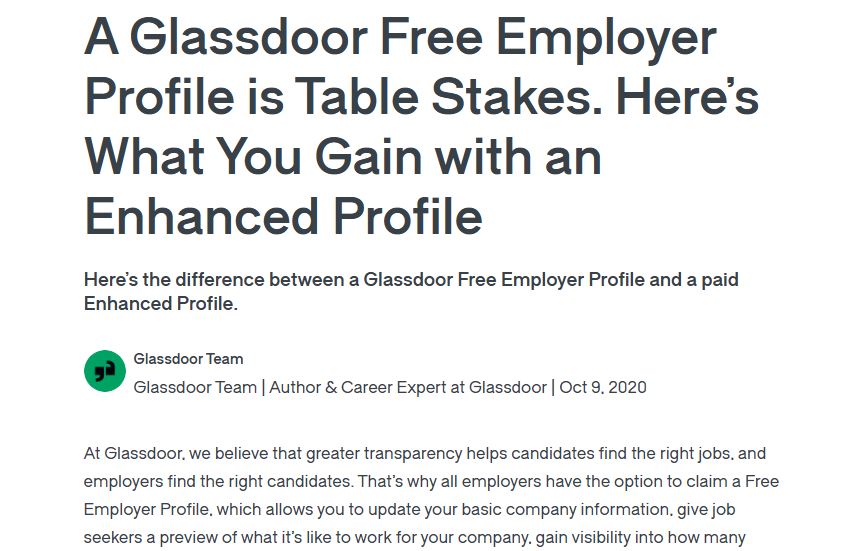
Paid plans include enhancements like video and social media, advanced analytics, and the ability to feature job ads on competitor websites. Plans can be expensive, with one quote placing a Select Branding Bundle at $15,000 per year for 21 to 50 job ads per month.
Think about that architecture for a moment. A job seeker opens Glassdoor expecting the unvarnished truth. The platform serves that job seeker content shaped, in part, by money paid by the company being reviewed. Some analysts believe Glassdoor has not created only a new platform but also a new market, one where employers are compelled to pay Glassdoor to build a nice reputation among employees, thus enhancing their chances to attract, recruit and retain talent.
While Glassdoor maintains that it does not allow review manipulation, the realities of its business model, which heavily relies on revenue from the companies being reviewed, raise questions about the platform’s ability to maintain absolute impartiality.
The Gray Market That Grew Up Around It
Before getting to what Glassdoor itself does or does not allow, it is worth understanding what has grown up around the platform to serve employers who want their ratings cleaned up.
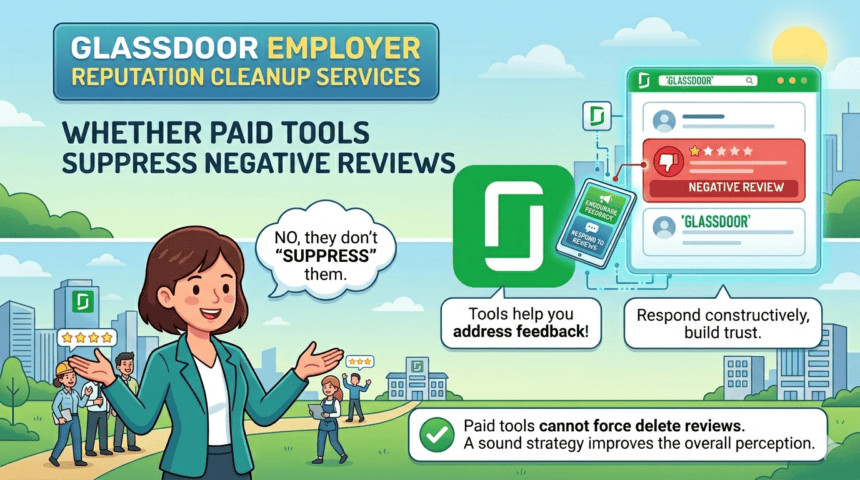
The online reputation management industry is booming. A significant slice of that business involves Glassdoor specifically. Dozens of firms now offer what they call Glassdoor cleanup, review removal, or reputation management services. They advertise openly. They have polished websites. Some even offer a payment model that would have seemed audacious in any other context.
According to Yahoo! Finanace3, Reputation Resolutions, named by Inc. Magazine as one of the fastest-growing companies in the Rocky Mountain Region in 2024, charges a one-time success fee of $1,500 per review removal, claims a 90 percent success rate, and promises removal within 30 days.
Read that sentence again. Fifteen hundred dollars. Per review. With a 90 percent success rate.
Other vendors on freelancer marketplaces describe their services as providing manual profile audits with tailored reputation strategies, targeted reporting based on Glassdoor policy violations, and safe suppression techniques to push down harmful or misleading content.
The word “suppression” is doing a lot of work in that sentence. These are not services that fix bad workplaces. They are services that fix bad optics. The distinction matters enormously to anyone making a career decision based on what they read.
How the Removal Playbook Works
Companies that want their Glassdoor profiles cleaned up do not usually go about it randomly. The approach, at least when done through legitimate channels, follows a clear script.
Most agencies assess reputation using tools such as the Glassdoor employer dashboard, then craft custom removal requests, matching language to platform policies before submission. Experts prepare detailed, policy-based requests or legal arguments to justify removal.
Glassdoor4 does allow removal of reviews that violate its community guidelines. That covers defamation, reviews that name non-executive employees by name, content that reveals proprietary business information, and reviews that can be demonstrated as factually false. In theory, those guardrails sound reasonable. In practice, they create a wide enough lane for a determined company to drive through.
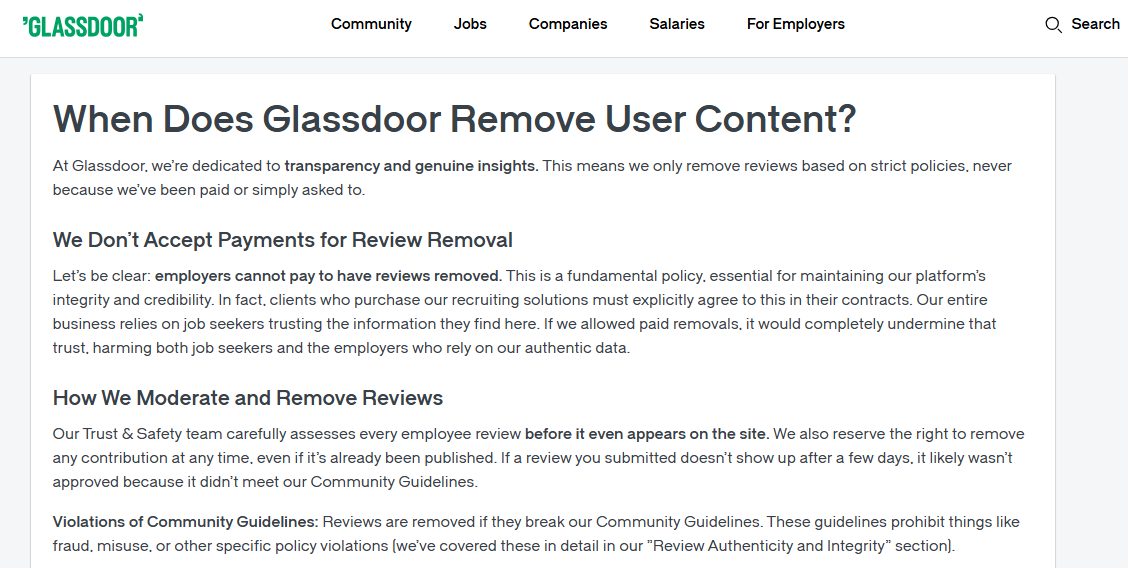
One documented strategy involves HR teams flagging all one-star reviews for potential removal. Glassdoor does not remove all of them, but will take down ones it also finds to violate guidelines, such as reviews that name someone below senior leadership, or reviews deemed non-factual. Glassdoor has declined to share exactly how it makes these decisions, writing only that “final content decisions are within our sole discretion.”
That phrase, “sole discretion,” is the crux of the problem. It is an opaque system with no audit trail.
There is no way to audit which reviews Glassdoor has deleted. The platform does not publish what reviews it removes or why. The unique URL scheme makes it close to impossible to track disappearing content. When a review vanishes, nobody outside Glassdoor can tell whether it was removed because it violated policy, because someone at a company flagged it persistently, or because money changed hands somewhere in the chain.
A user on a public forum captured the experience with blunt clarity:
“I’ve been wanting to get in with this one company for a while, and they had a rash of bad reviews that seemed to focus on a few things. Now a position has come up and I’m back looking on Glassdoor and suddenly all the bad reviews that were up last year are gone. Not even a reference to ‘has been removed due to…’ or anything.”
That silence, the absence of any trace that a review ever existed, is by design. And for companies paying to clean up their profiles, that silence is worth $1,500 a review.
The Orosz Investigation and the “Company X” Case Study
In May 2023, software engineering writer Gergely Orosz, who publishes The Pragmatic Engineer newsletter5, documented what he called a detailed case study of a company he designated “Company X.”
Company X fired 30 percent of its staff at the end of 2022. Its Glassdoor rating dropped to 2.3 by around March 2023. The HR team then launched a project to improve the rating, following Glassdoor’s official guidelines. They flagged all one-star reviews for removal. Simultaneously, the company generated a wave of new five-star reviews, either through HR efforts or through company events. Within two months, the rating climbed to around 2.8, and the company’s stated goal was to push above 3.0. Several employees who had worked at Company X saw their reviews removed and felt it was unfair.
Some of the documented strategies Orosz found were deeply unsettling: founders standing over employees’ shoulders as they left positive reviews at company events, and severance packages that banned employees from leaving negative reviews at all.
That last one deserves to sit on the page for a moment. A company firing you and then, as a condition of your severance payment, making you sign away your right to tell the next person what working there was actually like. Glassdoor’s promise of transparency, built into its founding premise, runs directly into the cold reality of corporate legal power.
Orosz also documented a cybersecurity company called Trustwave whose Glassdoor page had reached an all-time high rating, despite the fact that 12 out of the last 25 reviews were nearly identical, suggesting a coordinated positive review campaign. The “recommend to a friend” rate at another analyzed company rose from 50 percent to 87 percent in two years, despite layoffs of 10 to 20 percent of the team, coinciding with the arrival of a new Chief People Officer.
The Wall Street Journal Found This in 2019
None of this is new, which is part of what makes the continued existence of this system so dispiriting.
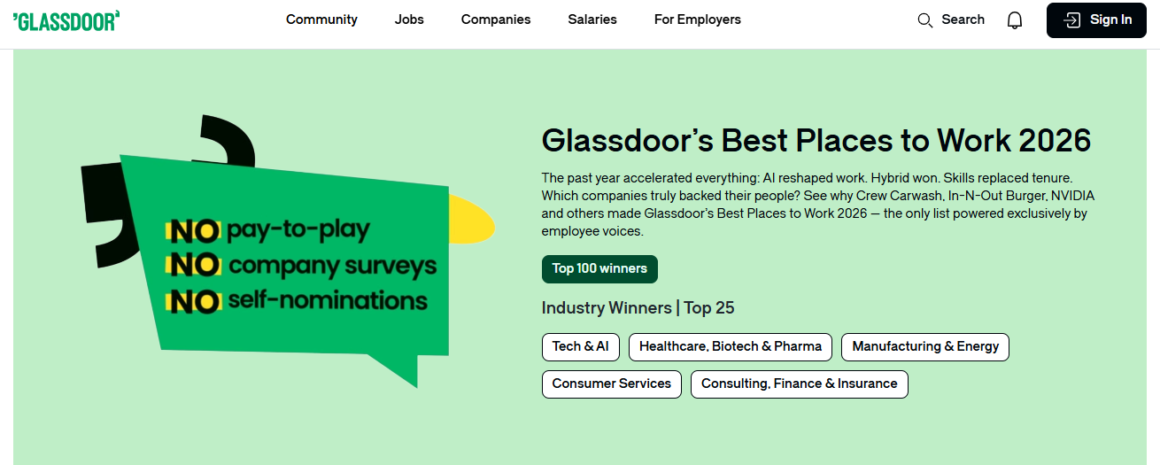
An analysis by WSJ6 of millions of anonymous reviews on Glassdoor’s site identified more than 400 companies with unusually large single-month increases in reviews. During the vast majority of these surges, the ratings were disproportionately positive compared with surrounding months.
The investigation described how Guaranteed Rate, a mortgage broker, saw its CEO’s approval rating drop to 43 percent after a wave of negative reviews. After the company sent an email asking employees to complete “a Glassdoor review with a strong five-star rating,” the CEO’s approval rating nearly doubled to 83 percent. Dozens of glowing reviews were written by people who listed their titles as managers.
The investigation also revealed that the percentage of five-star reviews on Glassdoor had been rising steadily, from 17 percent of all reviews in 2013 to 28 percent by the end of 2018. That is not an organic shift in how workers feel about their employers. That is a platform being gamed systematically, at scale, for years.
It found the same pattern at Amazon, Airbnb, SpaceX, SAP, Slack, LinkedIn, Anthem, Clorox, and Brown-Forman. This practice was not limited to a few nefarious players.
Glassdoor has suggested that review spikes may occur for reasons including hiring surges, company events, or what it called “internal encouragement.” It was identified that review numbers balloon specifically around each October, when Glassdoor hands out its annual Best Places to Work awards.
What the Review Removal Industry Actually Sells
The distinction between “removing” a review and “suppressing” a review matters more than most employer clients probably realize when they first pick up the phone.
In the reputation management industry, “delete” typically refers to permanent erasure from the platform, while “remove” may involve review suppression or moderation, meaning the content is not visible but not always deleted entirely.
For many companies, suppression is the more realistic outcome. Glassdoor’s domain authority is substantial, and its pages consistently rank at the top of Google searches for a company’s name. According to Clean Reputation7, suppression campaigns that use SEO and content production to push Glassdoor results down search pages often take years and can cost $50,000 to $60,000 or more. And given Glassdoor’s authority, the site consistently outranks most corporate websites, making suppression alone rarely enough.
The alternative, and what the most aggressive reputation firms sell, is direct removal through policy exploitation. One documented tactic involves using vague language against itself: if a negative review contains broad statements like “horrible management” or “toxic work culture” without specific examples, a company can argue to Glassdoor that the review lacks factual backing and does not meet the platform’s own content standards.
That is a clever legal-adjacent move, and it works often enough that firms charge $1,500 per success on it. What it produces, from the job seeker’s point of view, is a platform increasingly stripped of the frank, imperfect, irreplaceable employee testimony it was built to provide.
The 2024 Real Name Disaster
Glassdoor compounded all of this in early 2024 with a policy change that threatened to make the anonymity problem far worse from the other direction.
According to WIRED8, Glassdoor announced a new policy requiring users to sign up using their real name. The change came as a result of its 2021 acquisition of the professional networking app Fishbowl, which required user verification. Glassdoor told users that reviews would still be anonymous, but the company would now hold verified identity data on the back end.
Morning Brew9 posted that some users have claimed that their names were being added to their profiles without their consent.
1/ You might wanna rethink leaving a review on Glassdoor.
— Morning Brew ☕️ (@MorningBrew) March 21, 2024
The long-anonymous review site now asks for your full name "to make sure everyone is who they say they are."
But some users report their names being added to their profiles without consent.
Let's get into it. pic.twitter.com/Yv7lattuQ8
One user discovered the change after contacting Glassdoor support to remove her data. Instead of helping her get her information taken down, the company populated her account with her real name. “Glassdoor now requires your real name and will add it to older accounts without your consent if they learn it, and your only option is to delete your account,” she warned in a blog post that quickly spread across tech media.
Aaron Mackey, an attorney for the Electronic Frontier Foundation who had previously worked with Glassdoor on user protection cases, said the company had historically been an “industry leader” in protecting users’ identities. He told TechCrunch10:
“The latest news regarding Glassdoor’s policies raises concerns about whether users may be identified even if their information is never sought by an employer or law enforcement. Those policies also appear to conflict with, or at least be in tension with, Glassdoor’s goal of encouraging employees to candidly review their employers.”
The practical concern here is stark. If a company subpoenas Glassdoor to find out who left a one-star review, and Glassdoor now holds verified real identity data for that user, the gap between “anonymous” and “exposed” is much narrower than it was in 2023. If Glassdoor is subpoenaed, or given a request for information, the company will now have the data and will have to provide it.
This is not a theoretical risk. In 2022, The Guardian11 reported that a federal magistrate judge ruled in favor of toy company Zuru in its case against Glassdoor, ordering the platform to reveal the identities of users who had posted negative reviews. Zuru’s co-CEOs alleged that anonymous reviews calling the company a “burnout factory” with “incompetent” leaders materially harmed its business and complicated its recruiting process.
The Business Model Question Nobody Wants to Answer
What makes the Glassdoor situation genuinely troubling, beyond any individual act of review manipulation, is the structural conflict that sits at the center of the platform’s existence.
Glassdoor needs workers to post honest reviews. That is the product. Without credible employee testimony, the platform has no traffic, no influence, and no value to job seekers. But Glassdoor also needs employers to pay for premium profiles, branding packages, and advertising. Glassdoor generates revenue by selling job advertisements and company branding services to employers, but has stated that revenue from these services does not affect how reviews are displayed or moderated.
That denial is the expected corporate answer. But the structural reality is what it is. You cannot sell a company the tools to manage its reputation on a platform while simultaneously promising workers that platform is uncompromised. Both things cannot be fully true at the same time.
According to a study by One Hour12, 68 percent of HR professionals admitted to actively managing their company’s online reputation on review platforms. That is not fringe behavior. That is the norm. The employers buying Glassdoor’s premium services are the same employers whose HR teams are working the platform’s flagging and reporting tools to their advantage.
From one forum user quoted widely in coverage of this issue:
“You cannot trust Glassdoor anymore. I think they get paid by engaged employers to remove negative reviews. Their business model makes money on companies.”
What Workers and Job Seekers Are Left With
I want to be careful here not to declare Glassdoor useless. There are still genuine reviews on the platform, written by real people who wanted to help strangers make better decisions than they did. Harvard Business School13 researchers studying Glassdoor data from over 4,000 firms found that employee reviews can serve as canaries in the coal mine of corporate misconduct, pointing to cultural factors that might eventually result in scandal earlier than they would otherwise attract attention.
That research only holds if the underlying data is clean. Once reviews are systematically removed, once positive reviews are astroturfed in batches at company events, once former employees have signed severance agreements barring them from speaking, the data loses integrity faster than a Harvard algorithm can compensate for.
The clearest signal of manipulation is a cluster of positive reviews all posted during the same week, same month, or even the same day, especially if they are overwhelmingly five-star. But most job seekers are not cross-referencing posting dates against a company’s layoff history. They are reading star ratings on a phone screen between flights, trying to decide if a job offer is worth accepting.
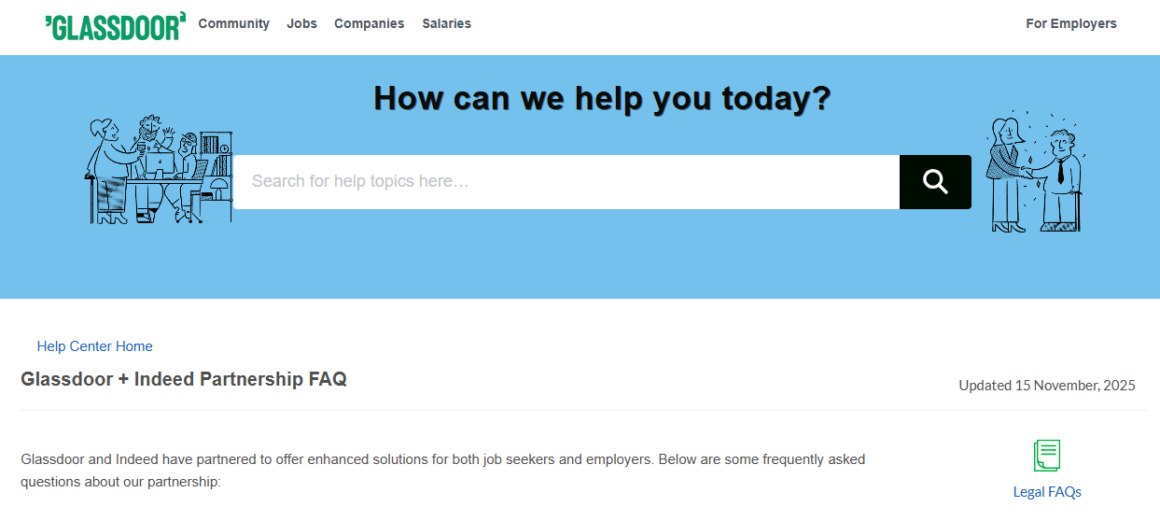
The advice to “do your research across multiple platforms” is sound but incomplete. The platforms are all susceptible to the same dynamics. Indeed, which now handles Glassdoor’s14 job postings through a partnership, faces identical pressures.
LinkedIn, where your future boss can see what you write, is structurally incapable of hosting candid employer reviews. The forums, Reddit threads, and anonymous messaging apps that survive as alternatives to Glassdoor are harder to fake but also harder to navigate and easier to dismiss.
The $1,500 Review and What It Actually Costs
The reputation management industry would prefer you think of its work as the digital equivalent of a defamation lawyer: a legitimate service that corrects factual errors and protects businesses from unfair attacks.
Sometimes, that is genuinely what happens. A disgruntled ex-employee who names a non-executive colleague by name in a review, or posts something demonstrably false, does not deserve permanent amplification. There is a real category of review that should come down.
But the firms charging $1,500 per Glassdoor removal are not marketing themselves exclusively to victims of defamation. They are marketing to any company that has a rating problem. Their pitch materials are explicit: if your Glassdoor score is hurting your recruiting, here is how to fix it. The question of whether that low score is an accurate reflection of how your company treats people is simply not part of the conversation.
Reputation Resolutions describes its membership program as designed to help companies proactively repair, improve, monitor, and manage their review profiles, retroactively working to remove as many current negative reviews as possible.
“As many current negative reviews as possible.” That is an industrial-scale operation. Not a legal defense. Not a targeted correction of verifiable falsehoods. A systematic effort to reduce the count of negative reviews on a platform that workers depend on to make career decisions.
The price of each successful removal is $1,500 to the client. The cost to the worker who reads a cleaned-up profile and takes a job at a company that should have been a warning is harder to calculate. It is measured in months of misery, in disrupted career trajectories, in the slow erosion of trust in institutions that claimed to be on your side.
Glassdoor operates a platform that workers trust to inform their career decisions. Employers pay Glassdoor for branding services. A parallel industry charges employers to remove or dilute negative reviews. Glassdoor’s own algorithm and moderation processes are opaque and unauditable. The platform now holds verified identity data on users who posted reviews under the expectation of anonymity. Courts have ordered Glassdoor to unmask reviewers. Severance agreements routinely contain clauses banning employees from posting negative reviews. A 2024 Forbes report reveals that 86 percent of job seekers research company reviews and ratings before deciding where to apply.
All of those things are true simultaneously. The platform that 86 percent of job seekers rely on is being worked on from every angle by the employers being rated.
This does not make Glassdoor the villain, exactly. The platform did not invent the incentive to game online ratings, any more than Amazon invented fake product reviews. But Glassdoor’s situation is peculiar because the stakes are so much higher than a misleading shampoo rating. Workers make decisions about where to spend the majority of their waking hours based partly on what they read there. Bad career decisions carry real costs: financial, psychological, and relational.
What the cleanup industry has built is a system where the companies most motivated to pay for reputation management are, almost by definition, the ones with the most to hide. The ones with happy workers in good environments do not need $1,500 review removals. The ones running what someone once described in a since-deleted Glassdoor post as “an American sweatshop” very much do.
When you read a Glassdoor profile with a 4.1-star rating and a suspiciously thin collection of recent negative reviews, it is worth asking who cleaned it, how recently, and at what price.
Sources
- “Glassdoor To Be Acquired By Recruit Holdings For $1.2 Billion” 8 May 2018, www.prnewswire.com/news-releases/glassdoor-to-be-acquired-by-recruit-holdings-for-1-2-billion-300645079.html. Accessed 4 May 2026. ↩︎
- “Glassdoor for Employers” Sign up for your free account today, www.glassdoor.co.in/employers/sign-up/?src=gdfoot. Accessed 8 Aug. 2026. ↩︎
- Yahoo! Finance, finance.yahoo.com/news/inc-magazine-names-reputation-resolutions-185300572.html. Accessed 11 Aug. 2026. ↩︎
- Glassdoor, www.glassdoor.com/about/trust/when-is-content-removed/. Accessed 11 Aug. 2026. ↩︎
- Orosz, Gergely. “The Pragmatic Engineer” Substack, newsletter.pragmaticengineer.com/. Accessed 4 May 2026. ↩︎
- WSJ, www.wsj.com/articles/companies-manipulate-glassdoor-by-inflating-rankings-and-pressuring-employees-11548171977. Accessed 11 Aug. 2026. ↩︎
- “GlassDoor” Clean Reputation, 17 Mar. 2000, www.cleanreputation.com/removal/glassdoor. Accessed 11 Aug. 2026. ↩︎
- Hoover, Amanda. “Glassdoor Wants to Know Your Real Name” WIRED, 20 Mar. 2024, www.wired.com/story/glassdoor-wants-to-know-your-real-name/. Accessed 11 Aug. 2026. ↩︎
- “Morning Brew ☕️ (@MorningBrew) on X” 21 Mar. 2024, x.com/MorningBrew/status/1770921508149350862. Accessed 11 Aug. 2026. ↩︎
- Whittaker, Zack. “Users say Glassdoor added real names to user profiles without their consent” TechCrunch, 20 Mar. 2024, techcrunch.com/2024/03/20/glassdoor-added-real-names-profiles-without-consent/. Accessed 11 Aug. 2026. ↩︎
- McClure, Tess. “Glassdoor ordered to reveal identity of negative reviewers to New Zealand toymaker” The Guardian, 19 July 2022, www.theguardian.com/world/2022/jul/19/glassdoor-ordered-to-reveal-identity-of-negative-reviewers-to-new-zealand-toymaker. Accessed 11 Aug. 2026. ↩︎
- “Social Proof Statistics for 2026: Hiring Impact, Candidate Influence, and Platform Trends” 26 Jan. 2026, onehour.digital/blog/social-proof-statistics-in-hiring. Accessed 11 Aug. 2026. ↩︎
- Blanding, Michael. “Company Reviews on Glassdoor: Petty Complaints or Signs of Potential Misconduct?” Working Knowledge, 13 May 2022, www.library.hbs.edu/working-knowledge/company-reviews-on-glassdoor-petty-complaints-or-signs-of-potential-misconduct. Accessed 11 May 2026. ↩︎
- Glassdoor, help.glassdoor.com/s/article/Indeed-Partnership-FAQ?language=en_US. Accessed 11 Aug. 2026. ↩︎


