

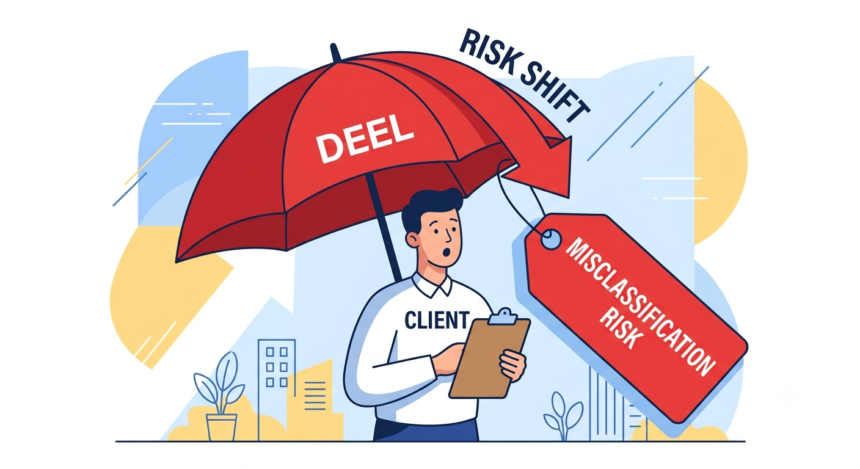

I spent a long time just reading contracts. Not novels, not longform journalism, just contracts. Master service agreements, terms of service, help center articles written in the calm, reassuring voice companies use when they want you to stop reading. I was looking for one sentence. I wanted to know who actually eats the loss when a company misclassifies a worker it hired through Deel, the global payroll and compliance platform that has become the default plumbing for remote hiring since 2019.
- What Deel Actually Sells
- The Paragraph That Matters
- The Company That Sells Compliance Kept Getting Accused of Skipping It
- The Regulatory Ground Keeps Shifting Under Everyone
- It Gets Harder Once You Leave the United States
- What the Caps Actually Mean in Dollars
- What the Market is Quietly Saying
- Why the Incentive Points One Direction
The short answer: usually you do.
The longer answer takes some unpacking, because Deel1 has built a nine-figure business on the opposite promise. Its marketing describes a platform that removes “misclassification risk” the way a good umbrella removes rain. Its help center offers products with names like Shield and Premium and Contractor of Record, each one pitched as a shield against the very problem the company was built to solve. Read the actual contract language, the kind filed with the Securities and Exchange Commission rather than published on a landing page, and the picture changes. The default product, the one most of Deel’s 35,000-plus customers actually use, leaves worker classification squarely in the client’s lap. The upgrades that promise real protection come with dollar caps, eligibility tests, and a catch that only pays out after you’ve already lost.
This is not a story about Deel breaking the law. It’s a story about what “compliance platform” quietly means when you follow the money and the liability instead of the marketing copy.
What Deel Actually Sells
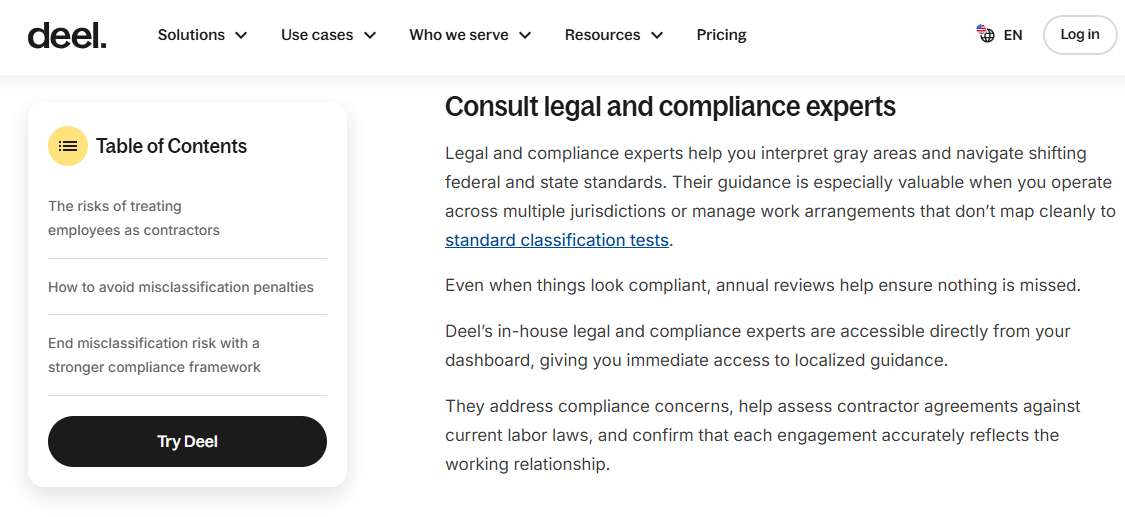
Deel’s basic pitch is simple enough to fit on a billboard. You want to hire someone in Lisbon or Lagos or Manila. You don’t want to open a foreign entity, learn foreign labor law, or guess wrong about whether that person counts as an employee or a contractor where they live. Deel2 handles the contract, the invoicing, the currency conversion, and, according to its own 1099 misclassification guide, gives you access to “in-house legal and compliance experts” who can flag red flags before they become fines.
There are, broadly, three tiers.
The base product is contractor management. Deel generates a contract template, runs payments, and hands you a self-serve dashboard. This is the $49-a-month tier that most small and mid-sized companies actually buy, and it’s the one where the classification call still belongs to the client, full stop.
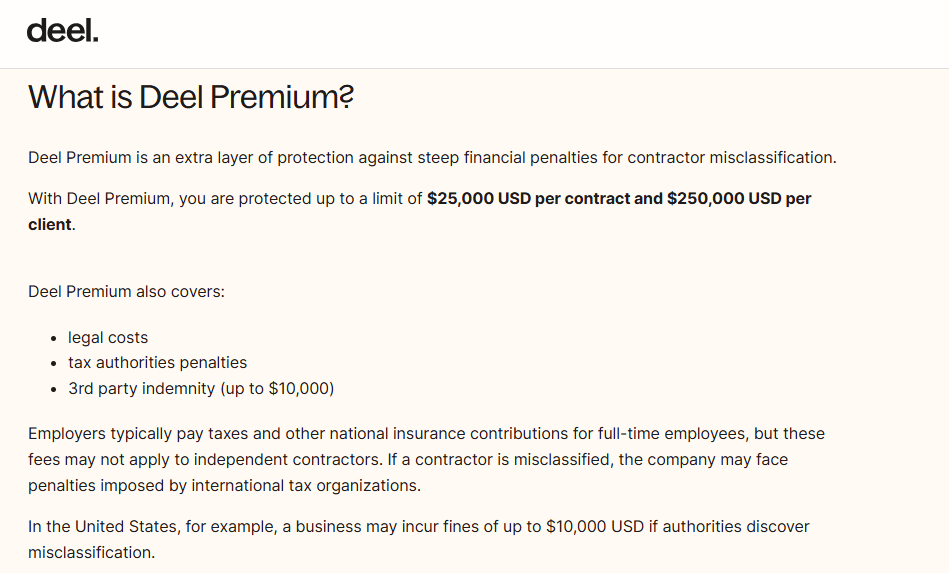
The middle tier is Deel Premium, an add-on that functions something like insurance. If a misclassification claim lands, Deel will cover legal defense costs and back taxes, but only up to $25,000 per contractor and $250,000 per client, and only if you used Deel’s unmodified standard contract and you keep retaking a classification questionnaire whenever local law shifts. Miss that questionnaire within 90 days of a notice and your coverage lapses.
The top tier is Employer of Record or Contractor of Record, where Deel’s own foreign entity becomes the legal hiring party. This is the product that gets to say, in its own marketing, “zero misclassification risks.” It is also the most expensive tier by a wide margin, and it comes with its own onboarding gauntlet: a worker classification questionnaire, eligibility review, and, per Deel’s3 own help documentation, a security deposit equal to a month of the contractor’s wages plus fees, held in case Deel has to eat the cost of a dispute.
Put plainly, the company sells three different versions of the same risk, priced according to how much of it Deel is willing to keep.
The Paragraph That Matters
I found the clearest picture of how this actually plays out not on Deel’s website but in a document nobody was supposed to read for color: a Master Services Agreement between Deel and a public medical device company, Firefly Neuroscience filed as an exhibit to Firefly’s 10-K with the SEC4 in April 2025. Public companies have to disclose material contracts. That obligation turned a private legal document into public record, and it reads nothing like the breezy help-center copy.
Section 8.1 lists the customer’s responsibilities. Buried in a list that includes “ensuring a safe work environment” and “timely payment of all fees,” clause (e) assigns the customer “the proper worker classification of the Consultant,” unless Deel has expressly taken on that duty through its Shield product. Section 9, the indemnification clause, runs it back the other way. The customer agrees to defend and hold Deel harmless for, among other things, “any act or omission by Customer… that causes damages to a Consultant or any third party.”
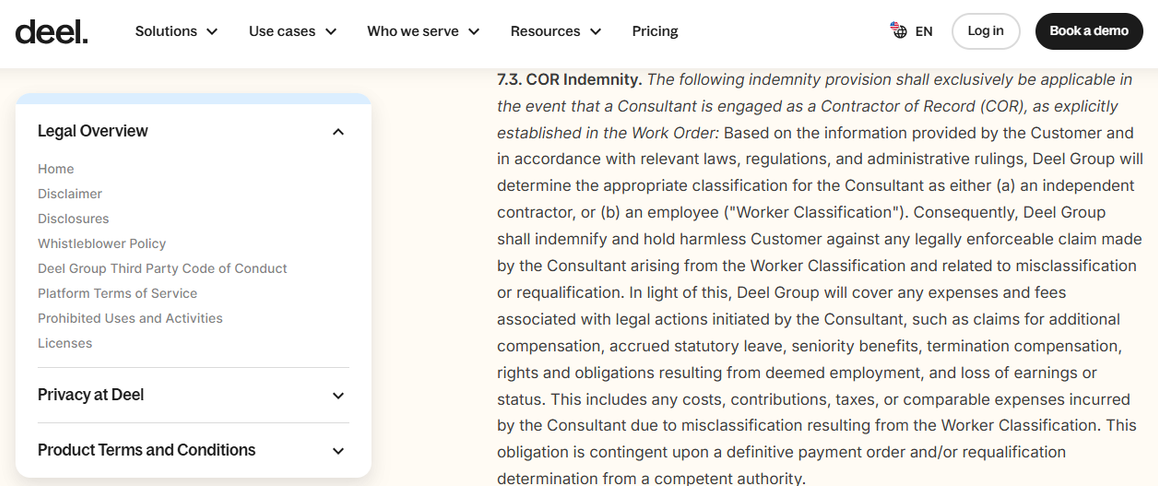
Then comes the part that should give any founder pause. The contract does carve out an exception for what it calls a Shield Contractor, someone Deel itself classified after reviewing the customer’s answers to an intake questionnaire. In that specific case, Deel agrees to cover the customer against a misclassification claim. But that promise comes with a condition, written into the same section: Deel’s5 obligation to pay “is contingent upon a definitive payment order and/or requalification determination from a competent authority.” In other words, before Deel’s money shows up, you have to have already lost, in front of a judge, a labor board, or a tax authority. The legal fees you spend getting to that point, the reputational hit, the time your team spends responding to subpoenas, none of that is covered by the promise of eventual reimbursement.
I called around to a couple of employment attorneys who handle small-business classification disputes to ask whether this structure is unusual. It isn’t, exactly. Indemnification clauses contingent on a final adverse ruling are common in commercial contracts generally. What’s unusual is the gap between that boilerplate and the marketing language sitting one click away, language that promises “100% protection” and “zero misclassification risks” without the asterisk.
The Company That Sells Compliance Kept Getting Accused of Skipping It
Here’s where the story gets uncomfortable for Deel specifically. In July 2023, California state senator Steve Padilla sent a letter to the state’s labor secretary asking for an investigation into Deel’s own hiring practices, not its customers’. According to Padilla’s6 public statement, Deel had hired hundreds of its own workers as independent contractors rather than employees, cutting them off from healthcare, unemployment insurance, and workers’ comp. Padilla went further, alleging that Deel’s own CEO had encouraged other companies to use contractor classification as a way to trim their tax bills.
Business Insider’s original reporting, cited in Padilla’s letter and summarized by Staffing Industry Analysts7, found that at least half of Deel’s roughly 2,000 workers at the time were classified as contractors, including the company’s own CEO. Deel disputed the characterization. A company spokesperson told that the allegations were “completely made up,” pointed to more than 50 in-house compliance staff, and noted that contractors made up less than 1% of Deel’s U.S. workforce specifically, even if the global figure told a different story.
The Padilla letter didn’t stay contained to Sacramento. Later that month, six members of Congress led by California representative Adam Schiff wrote to the acting U.S. Secretary of Labor asking for a federal investigation, a letter first reported by Bloomberg8. Around the same time, Deel drew a separate complaint in Florida alleging it had been operating as an unlicensed professional employer organization, and a plaintiffs’ firm, GradyLaw9, began soliciting current and former Deel workers with information about the company’s licensing and classification practices.
None of these actions produced a public finding of liability against Deel, and the company has continued to deny wrongdoing. But sit with the optics for a second. A company whose core sales pitch is “we know classification law better than you do” spent the back half of 2023 fielding accusations that it had misjudged its own classification decisions, at scale, for its own staff. If the experts who write your contracts can’t keep their own house in order, that is not proof they’re doing something illegal to their clients. It is a reasonable prompt to read the client contract a little more closely before you sign it.
The Regulatory Ground Keeps Shifting Under Everyone
Complicating things further, the rules Deel is grading your workers against have not stayed still. The Department of Labor’s 2024 rule on federal contractor classification, a Biden-era standard that made it harder to classify a long-term, closely supervised worker as a contractor, got effectively benched by the agency itself. In a Field Assistance Bulletin issued in May 2025, the department directed its own investigators to stop applying the 2024 rule and revert to older, friendlier guidance dating back to 2008 and 2019. A follow-up analysis from the law firm Crowell & Moring10 flagged the detail that matters most for anyone who thinks looser federal enforcement means less exposure: the 2024 rule “remains in effect for purposes of private litigation.” Federal investigators may be easier on you. A contractor’s employment lawyer, filing a private wage claim, is not obligated to care.
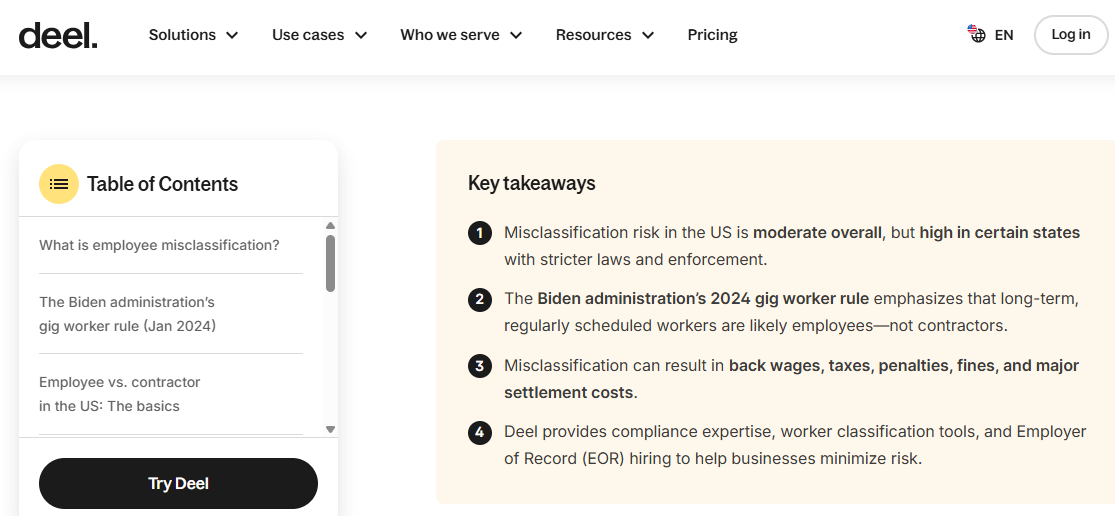
Layer state law on top of that and the picture gets messier still. California’s ABC test, the same standard Padilla invoked against Deel, remains one of the strictest in the country and doesn’t move just because Washington’s mood shifts. A worker who is comfortably a contractor under the federal government’s current posture can still be a misclassified employee the moment a California court gets involved. Deel’s11 own blog, to its credit, is candid about this patchwork. Its guide to U.S. worker classification describes risk as “moderate overall, but high in certain states,” which is accurate and also exactly the kind of complexity that a self-serve dashboard, filled out by a founder at 11 p.m. before a product launch, is not well equipped to navigate.
It Gets Harder Once You Leave the United States
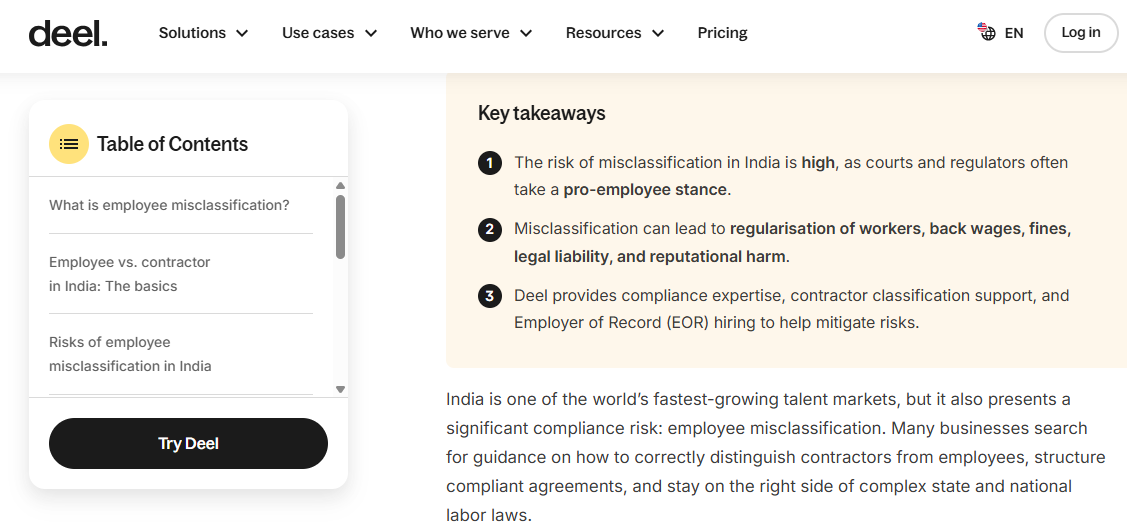
American classification law is messy. Outside the United States, it can be outright hostile to the contractor model Deel is built to sell. Deel’s12 own country guides admit as much when they aren’t trying to close a sale. Its breakdown of Indian classification risk describes courts and regulators there as taking “a pro-employee stance” by default, with consequences that include forced regularization of an entire contractor cohort, not just one worker.
The United Kingdom runs its own parallel regime, IR35, which shifts the burden of proving contractor status onto the end client in ways that have nothing to do with anything written into a Deel template. France, Germany, and Spain each run their own version of the same test, and each one weighs the same underlying question differently: who controls the work, who bears the financial risk, and how exclusive is the relationship.
This matters for the “risk shifted to clients” story because Deel’s base contractor product is explicitly designed to be one template, lightly localized, deployed across all of it. A single classification questionnaire, filled out once, is being asked to hold up against dozens of legal systems that don’t agree with each other about what a contractor even is. Deel’s compliance team can and does advise on the differences. But the contract still puts the classification call, and the liability that follows a wrong one, on the customer’s desk in the jurisdictions that matter most.
What the Caps Actually Mean in Dollars
I want to be specific about the math, because “$25,000 per contractor” sounds like real money until you compare it to what a misclassification finding actually costs.
An IRS determination that a contractor should have been an employee triggers the employer’s share of Social Security and Medicare taxes for every year of the arrangement, plus, in cases the agency deems willful, penalties that stack on top of the back taxes rather than replacing them. A tax controversy breakdown from Klasing & Associates13 walks through how a state unemployment audit in California can cascade into a federal one, because a single worker filing for unemployment benefits is often the first domino. Once one agency flags a company, others tend to follow, and the legal defense costs alone, before any settlement, can outstrip $25,000 in a matter of months for a single contested worker.
Now multiply that by every contractor engaged under the same flawed template. Class and collective actions in misclassification cases are common precisely because a template that misclassifies one worker usually misclassifies a dozen the same way. Deel’s14 own Premium cap tops out at $250,000 across an entire client relationship. For a company with twenty or thirty contractors hired off the same standard agreement, that ceiling can evaporate fast if a regulator or plaintiffs’ firm decides to look at the whole cohort rather than one worker.
What the Market is Quietly Saying
I don’t put much stock in star ratings, but the language people use in long-form reviews is its own kind of forum, and it tends to be more candid than a press release. An independent buyer’s guide from the HR consultancy Grou15 put the tiering problem about as plainly as I’ve seen it stated outside a law firm memo: the $49-a-month contractor management tier “flags worker misclassification risk before it becomes a liability,” while Contractor of Record, at roughly $325 a month per worker, is “a different product” that “shifts misclassification liability fully onto Deel.” Read that sentence twice. The word “fully” is doing a lot of work, and it’s only true once you’ve paid for the expensive tier. Everyone below that line is still holding the bag, no matter how reassuring the glossary page sounds.
A separate competitive teardown from rival provider Papaya Global16, admittedly not a neutral source given the two companies compete directly, nonetheless compiled a useful public record of Deel’s ongoing legal exposure: the Rippling corporate espionage litigation, the Justice Department’s reported interest in the alleged infiltration of a rival’s Slack channels, and the string of leadership hires Deel made through 2025, including a new chief compliance officer and chief risk officer, which the company has framed publicly as preparation for an eventual IPO. Read charitably, that’s a company professionalizing ahead of a listing. Read skeptically, it’s a company that needed the adult supervision.
Why the Incentive Points One Direction
Here’s my own read on the mechanics, after a week inside these contracts, and I’ll say plainly that this part is analysis rather than reporting. Deel makes money on volume. Every contractor added to the platform generates a subscription fee, a payment-processing spread, or both. The company’s entire value proposition rests on making it fast and cheap to add a worker to your team without opening a foreign entity. Speed and cheapness are in direct tension with the kind of careful, fact-specific classification analysis that actual compliance requires, the sort of analysis a good employment lawyer bills by the hour to get right.
Deel resolves that tension by selling you certainty in tiers. The cheap tier gets you speed and a template. The expensive tier gets you an actual risk transfer. That’s a defensible business model. Insurance companies work the same way. What makes it worth a second look is the gap between what the cheap tier’s marketing implies and what its contract actually says, a gap that only becomes visible if you go looking for a real, SEC-filed agreement instead of a landing page. Most founders never will. They’ll read the glossary entry, see the word “compliance” in the company name, and assume the platform is doing more legal thinking on their behalf than the fine print actually promises.
If you’re running contractors through Deel’s base tier, the practical takeaway isn’t “cancel your account.” It’s “read section 8, then call a lawyer who doesn’t work for Deel.” Ask specifically whether your working relationships would survive an ABC test in the states where your contractors’ clients, meaning you, are headquartered, not just where the contractor happens to live. Ask what a private wage claim would look like under the 2024 federal standard, since that rule still governs litigation even though enforcement has loosened. And if you’ve got more than a handful of contractors doing recurring, closely supervised work, run the actual math on Contractor of Record before you assume the cheaper tier is cheaper. A single bad finding, spread across a dozen workers hired off the same template, can make the $325-a-month product look like the discount option in hindsight.
The pitch that got Deel to a multibillion-dollar valuation was that global hiring didn’t have to be scary. It still doesn’t have to be, but scary and free are not the same thing, and the difference between them is written down, in plain contract language, for anyone willing to read past the glossary page.
Sources
- “Misclassification” Deel, www.deel.com/glossary/misclassification/. Accessed 19 Nov. 2026. ↩︎
- “1099 Contractor Misclassification: Penalties and Prevention” 6 Oct. 2026, www.deel.com/blog/1099-contractor-misclassification-penalties/. Accessed 19 Nov. 2026. ↩︎
- Deel, help.letsdeel.com/hc/en-gb/articles/9898022419473-About-Deel-Contractor-of-Record-COR. Accessed 19 Nov. 2026. ↩︎
- “SEC.gov”, www.sec.gov/Archives/edgar/data/803578/000143774925010818/ex_796343.htm. Accessed 19 Nov. 2026. ↩︎
- “Deel EOR, COR, and Global Payroll” www.deel.com/legal/eor-cor-gp/. Accessed 20 Nov. 2026. ↩︎
- “Senator Padilla Urges Investigation into Deel after Company Flaunts Skirting California Worker Protection Laws” California State Senator Steve Padilla, 6 July 2023, sd18.senate.ca.gov/news/senator-padilla-urges-investigation-deel-after-company-flaunts-skirting-california-worker. Accessed 19 Nov. 2026. ↩︎
- “Deel workers claim IC misclassification; firm says it complies with relevant laws (Business Insider)” www.staffingindustry.com/news/global-daily-news/deel-workers-claim-ic-misclassification-firm-says-it-complies-relevant-laws. Accessed 19 Nov. 2026. ↩︎
- “Bloomberg”, www.bloomberg.com/news/articles/2023-07-26/hr-startup-deel-s-labor-practices-should-be-investigated-lawmakers-say. Accessed 19 Nov. 2026. ↩︎
- “Deel Unlicensed Conduct Lawsuit | GradyLaw®” GradyLaw |, 23 Oct. 2025, www.gradylaw.com/deel-unlicensed-conduct-lawsuit/. Accessed 19 Nov. 2026. ↩︎
- “DOL Issues Revised Independent Contractor Misclassification Guidance” Crowell & Moring LLP, www.crowell.com/en/insights/client-alerts/dol-issues-revised-independent-contractor-misclassification-guidance. Accessed 19 Nov. 2026. ↩︎
- “United States Employee Misclassification: Risks & Best Practices” 9 June 2026, www.deel.com/blog/us-employee-misclassification-risks-and-best-practices/. Accessed 19 Nov. 2026. ↩︎
- “India Employee Misclassification: Risks & Best Practices” 9 June 2026, www.deel.com/blog/india-employee-misclassification-risks-and-best-practices/. Accessed 19 Nov. 2026. ↩︎
- “IRS and EDD 1099 Worker Misclassification Cases” 2 Apr. 2025, klasing-associates.com/irs-1099-worker-misclassification-cases/. Accessed 19 Nov. 2026. ↩︎
- Deel, help.letsdeel.com/hc/en-gb/articles/9651612366481-About-Deel-Premium. Accessed 20 Nov. 2026. ↩︎
- Peklaj, Aljaz. “Deel review 2026: an honest agency take” GROU, 6 May 2026, grouglobal.com/blog/deel-review. Accessed 19 Nov. 2026. ↩︎
- Papaya Global, www.papayaglobal.com/blog/papaya-global-competitive-analysis-2/. Accessed 19 Nov. 2026. ↩︎


