
I read the BBB complaint three times before I believed it. A merchant had been on BigCommerce for seven years, paying $79 a month, running a small store the way small stores are supposed to run. Then an email arrived. Their subscription price was changing to $16,200 a year. Not a typo. Not a misunderstanding. A number with three extra zeros bolted onto it, delivered with the tone of a company reading a weather report. The merchant called it price gouging. BigCommerce’s response, logged with the Better Business Bureau1, did not deny the number. It pointed to the contract. Both the general terms of service and the individual agreement required consent, the company wrote, whether or not the merchant agreed with the philosophy behind the price.
That sentence is the whole story, if you want it in miniature. The philosophy behind the price is not up for debate. Only the price is negotiable, and only within the walls BigCommerce built around it.
I have spent the last several weeks reading complaint boards, Trustpilot threads, BBB filings, and the company’s own communications about a pricing overhaul that landed on June 1, 2026. What I found was not a single scandal. It was a pattern, one that stretches back years and crystallized this spring into something merchants are now naming out loud: feature and pricing gates that shift underneath a live contract, timed to arrive exactly when a business has the least leverage to walk away.
The Pitch that Built the Platform
For most of its life, BigCommerce sold itself on one sentence. No transaction fees. Ever. While Shopify charged merchants a cut of every sale processed through a non-Shopify gateway, BigCommerce didn’t. It was the single cleanest argument in the company’s sales deck, repeated in reviews, comparison charts, and cold emails from agencies pitching a platform migration.
That pitch mattered because it was structural, not promotional. A store doing seven figures a year through Stripe or a regional processor kept every basis point BigCommerce would otherwise have skimmed. Agencies built entire migration pitches around it. It was the reason a meaningful slice of BigCommerce’s merchant base chose the platform over Shopify in the first place.
Then, on June 1, 2026, the pitch quietly retired itself.
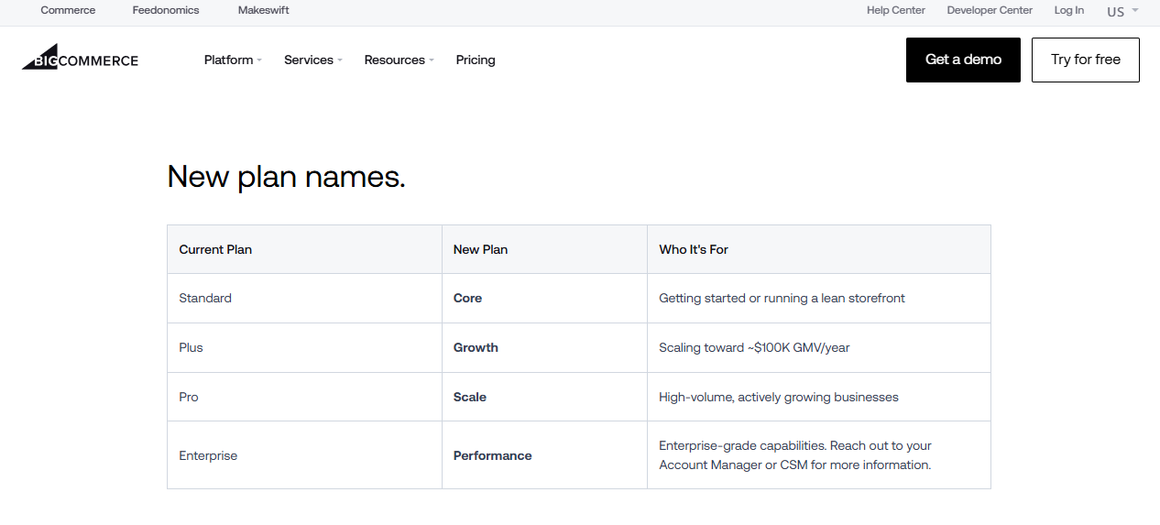
BigCommerce renamed every plan. Standard became Core. Plus became Growth. Pro became Scale. Enterprise became Performance. A rename alone is cosmetic, and nobody would have blinked. But underneath the new names, two mechanics shifted, and both cut toward the same outcome: more merchants paying more, without necessarily getting anything they asked for.
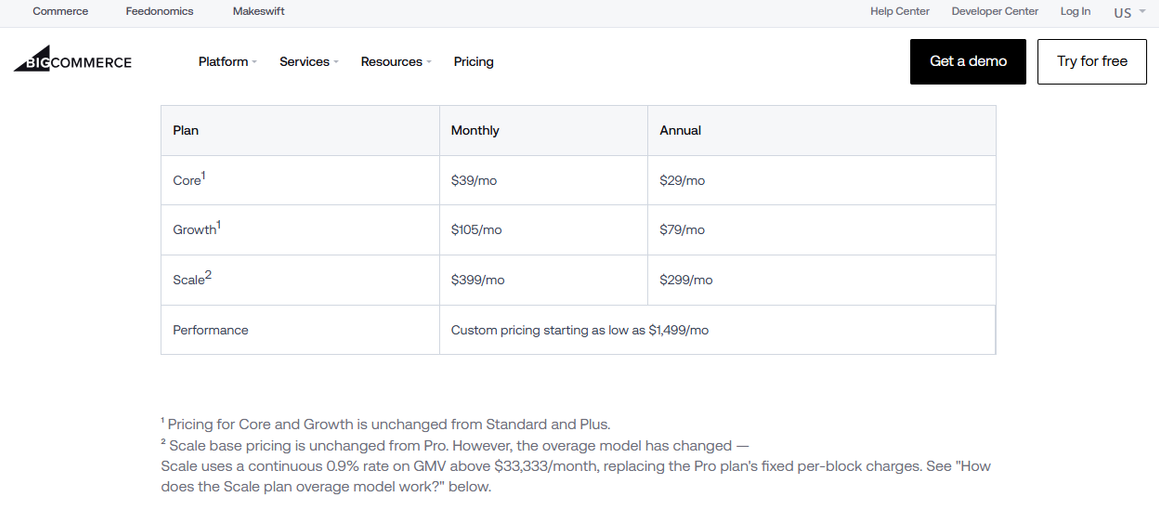
First, the revenue thresholds that decide which plan a store gets forced onto dropped. According to BigCommerce’s own updates page2, the trailing twelve-month sales ceiling on Core fell from $50,000 to $30,000. Growth’s ceiling dropped from $180,000 to $100,000.
A merchant who had comfortably fit inside their tier for years could wake up on the wrong side of the line without their revenue moving an inch, because the line itself had moved. MTN HAUS3, doing the math for clients, called it exactly what it looks like: a merchant doing $150,000 a year on the old $79-a-month Plus plan gets auto-upgraded to a $299-a-month Scale plan. A 278 percent jump in platform cost, and the merchant’s business did nothing wrong.
Second, and this is the part that broke the platform’s founding promise, BigCommerce introduced something it calls the Open Payment Provider Fee. Any order processed through a gateway that isn’t on the company’s approved list now costs the merchant a cut. Two percent on Core. One percent on Growth. Six tenths of a percent on Scale. Custom, and typically zero, for contracted Performance accounts. The approved list runs to roughly twenty providers and includes the obvious ones, Stripe, PayPal and Braintree, Adyen, Checkout.com. Anyone running Authorize.net, NMI, or a regional processor built for their market falls outside it, and every dollar that moves through that gateway now feeds a fee that did not exist a year earlier.
The fee has teeth in places merchants did not expect. It applies to offline orders. It applies to manual payment methods. Netalico4 found that every one of those transactions, none of which touch a card reader or a checkout button, is fee-eligible if the underlying processor isn’t on the approved list. One trade publication ran the numbers at $500,000 in annual sales: ten thousand dollars a year on Core, five thousand on Growth, three thousand on Scale, money that simply did not leave the merchant’s account in May and does in July.
The Part that Made People Angry
None of this, by itself, would have been unusual. Platforms adjust pricing constantly, and most merchants expect it. What turned a pricing update into a trust event, to borrow the phrase MTN HAUS5 used in its own breakdown, was where and how BigCommerce announced it.
The changes lived on a URL outside the platform’s normal navigation, at a link with no promotion, no press release, and no executive framing. Merchants found out through agency newsletters, LinkedIn posts, and word of mouth before they found out through their own dashboards. Just Pricing6, tracking the fallout, noted the backlash spread fast across r/bigcommerce and r/ecommerce, with merchants who had specifically chosen the platform to avoid Shopify’s fee structure watching that differentiation erode in real time.
BigCommerce7 eventually responded with a blog post titled, without apparent irony, “Setting the Record Straight”. The post pushed back on a circulating sales email that claimed a $2 million merchant would owe $40,000 a year in new fees, calling the math wrong because that merchant would never sit on the Core plan where the 2 percent rate applies. Fair enough, and worth saying. But the same post confirmed the core mechanics nobody was disputing. Thresholds dropped. A new fee arrived. CEO Travis Hess appeared in a video the company says explains the truth about its updates, a phrase that tells you the company understood exactly how this was landing before a single merchant complained on Reddit.
I want to sit with one detail from that response, because it is the kind of detail that reveals more than it means to. BigCommerce frames the threshold drop as generosity. Merchants moving into a higher tier, the post says, also get access to that tier’s features. Customer segmentation. Stored credit cards. Additional storefronts. It is true, technically. It is also exactly the logic of a landlord who raises your rent and calls it an upgrade because the building now has a doorman you never asked for and cannot decline.
Mid-contract, or the Illusion of Protection
Here is where the story gets interesting for anyone trying to understand what a contract actually protects you from.
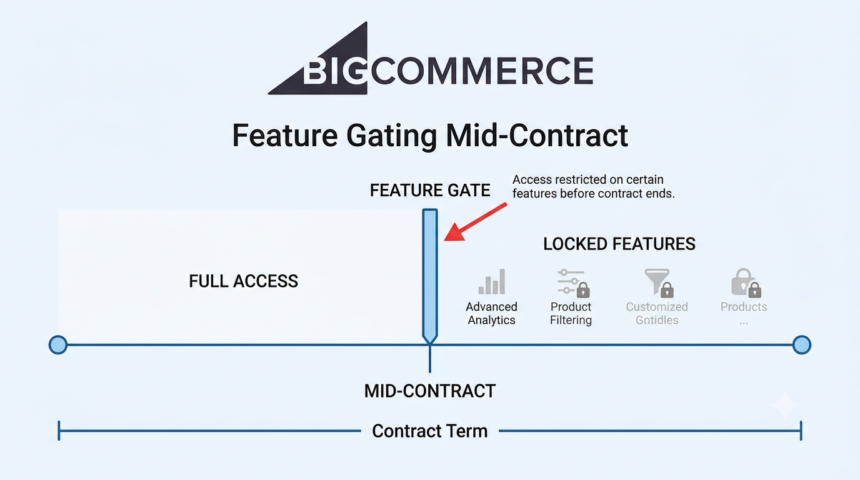
BigCommerce8 is careful, almost lawyerly, about timing. Monthly plans move onto the new structure at the next billing cycle. Annual plans don’t shift until the current service period ends. The company states outright that pricing won’t change mid-term. On paper, that sounds like a real protection, the kind of thing a merchant’s legal team would nod at.
In practice, it buys a few months of runway and nothing more. A merchant on a twelve-month contract signed in October 2025 gets to ride out the old terms until October 2026, then lands on the new one anyway, with no real alternative except leaving the platform entirely or renegotiating from a position where switching costs, months of migration work, redirect mapping, catalog rebuilding, are already baked into the decision. The contract didn’t protect the merchant. It delayed the invoice.
And for the BBB complainant with the seven-year-old $79 plan, there was no annual term standing between them and the new number at all. The subscription had grown, order by order, until it crossed an internal threshold the merchant never negotiated and could not see coming. BigCommerce’s own FAQ9 confirms that sales limits trigger automatic upgrades, and that trailing twelve-month figures update on the first of every month, quietly, in the background, whether or not anyone is watching the dashboard.
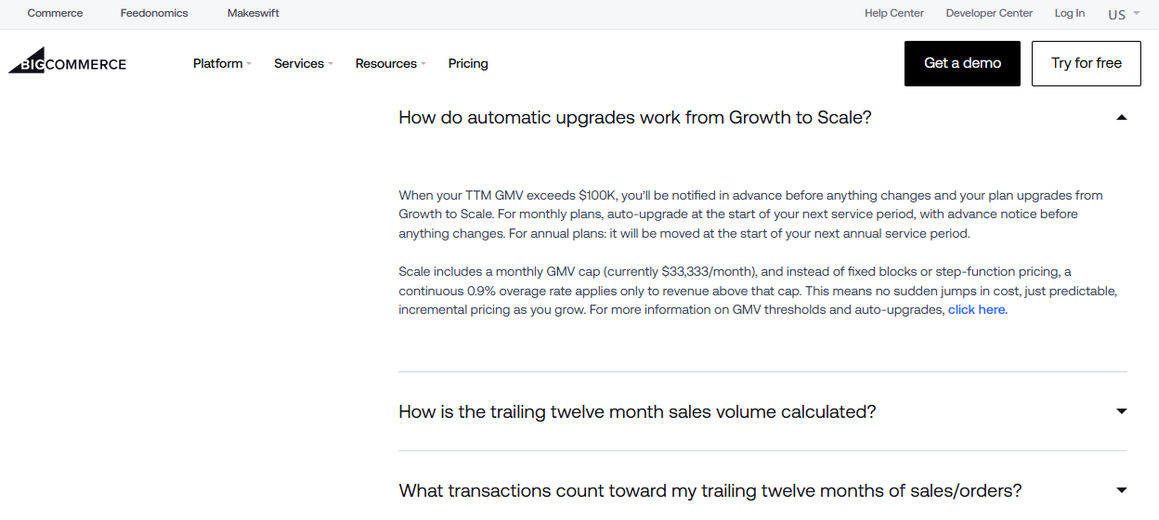
A second BBB10 complaint, filed separately, describes the mirror image of the same mechanic. That merchant’s sales fell below a billing tier, and BigCommerce kept charging the higher rate anyway. Automatic upgrades apply themselves without prompting. Automatic downgrades, in this merchant’s account, did not. The complaint calls it predatory billing, and whatever you think of that word, the asymmetry is hard to argue with. The gate swings one direction easily. It resists the other.
It Isn’t Only About Payments
Pricing is the loudest complaint, but it isn’t the only one, and the pattern underneath it shows up again once you start looking for it.
In early March 2026, BigCommerce discontinued its native Ads and Listings on Google integration, along with its native Meta integrations, and pointed merchants toward a third-party tool called Feedonomics, which the company happens to own. One UK merchant, writing on Trustpilot11, described what happened next in blunt terms. Their Meta conversion tracking pipeline broke completely after the forced migration. Coverage dropped to zero and stayed there for weeks. The legacy connectors that used to work were simply removed, and the merchant wrote that the rollout felt like marketing and upsells were being prioritized over fixing something core to their business. They filed two support tickets, one with BigCommerce and one with Feedonomics, and asked, in the review itself, for someone senior at either company to notice.
That is a small story next to a pricing overhaul affecting tens of thousands of accounts. But it is the same shape. A feature the merchant built their operation around gets pulled or restructured on a company-owned timeline, replaced with a company-owned alternative, and the merchant absorbs the cost of adapting whether they asked for the change or not.
EXPERTE.com12 lists this as a recognized weakness of the platform in its 2026 assessment, noting plainly that key tools like advanced filtering, B2B features, and automated tax calculations are restricted to higher plans or require paid third-party apps. That’s a design choice, not an accident, and every tiered SaaS platform makes it to some degree. The question worth asking isn’t whether gating exists. It’s whether the gate stays where a merchant can see it before they sign, or moves after they’ve already built a business on the other side of it.
What BigCommerce Would Say, and Where It Holds Up
I don’t want to pretend the company’s position is baseless, because parts of it aren’t. The old overage model on the Pro plan charged in fixed $200,000 blocks, which created ugly step-function jumps that punished merchants for growing by even a dollar past a line. The new continuous overage rate on Scale, 0.9 percent above a monthly threshold with no block jumps, is a genuinely more predictable model, and merchants who found the old system’s cliffs infuriating will likely prefer it. The company also points out, accurately, that more than twenty payment providers remain fee-free, and that a merchant who routes orders through one of them pays nothing new at all.
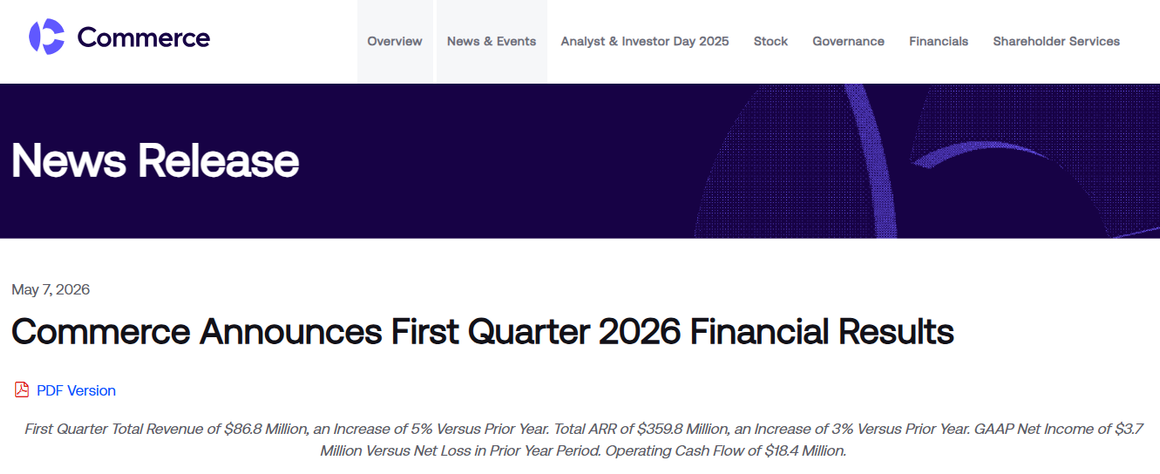
There’s also a business reality worth naming without cynicism. BigCommerce posted its first GAAP-profitable quarter in company history in early 2026, with revenue of $86.8 million against a shrinking base of roughly 37,000 active stores, down 8 percent year over year, while enterprise revenue climbed 10 percent. That is a company deliberately trading long-tail merchant volume for higher-value accounts, and net revenue retention sitting at 95.2 percent tells you existing customers are, on net, spending less even as new enterprise logos spend more. Every SaaS company that pivots this way eventually has to decide who absorbs the transition cost. BigCommerce decided, and the decision landed on the merchants least equipped to model a fee increase against their margins on short notice.
The bitterest irony sits in the platform BigCommerce spent a decade positioning against. Codified Commerce13 laid the new rates side by side with Shopify’s own transaction fee structure and found them, at the low end, nearly identical. Shopify charges 2 percent on Basic and 1 percent on Grow for third-party gateways, waived entirely if a merchant uses Shopify Payments. BigCommerce now charges the same headline numbers, with no equivalent waiver path that doesn’t involve routing through the company’s own approved list. The one structural advantage that justified choosing BigCommerce over its biggest rival, for a meaningful slice of merchants, no longer exists in the way it used to. That is not a rounding error in a pricing sheet. That is the erosion of the reason some of these businesses signed up in the first place.
A Pattern, Not an Accident
Once you notice the shape of this, you start seeing it everywhere in the platform economy, and BigCommerce is far from alone in running the playbook. The influencer marketing platform Upfluence14 uses a modular pricing structure where buying only one module locks you out of running actual campaigns, a fact many merchants only discover after signing a twelve-month contract they were told, verbally, they could cancel anytime. Reviewers on Trustpilot describe the same experience over and over, a sales call that promised flexibility followed by a contract that delivered none. The mechanism is different from BigCommerce’s GMV thresholds, but the outcome rhymes. A company sells the on-ramp, and only after the merchant is inside does the real shape of the commitment reveal itself.
What makes BigCommerce’s version notable isn’t originality. It’s scale, and it’s the specific betrayal of a promise the company spent a decade making its entire personality. A generic SaaS tool raising prices is background noise. A platform that built its market position on the explicit absence of a fee, then introduces that exact fee under a name engineered to obscure it, is doing something closer to a bait and switch, even if every lawyer in the building signed off on the language first.
I asked myself, reading through complaint after complaint, whether merchants have any real recourse beyond public shaming and slow migration. The honest answer is not much. Contract law in this space overwhelmingly favors the party who wrote the contract, and BigCommerce’s terms, like nearly every SaaS agreement of this kind, reserve the right to modify pricing, features, and thresholds with notice. Sixty days counts as notice. A buried URL counts as disclosure. Neither of those facts will comfort a merchant staring at an invoice that tripled, but both of them are, apparently, enough to satisfy a Better Business Bureau review and whatever legal standard the company’s own terms of service set for itself.
There is a version of this essay that ends with a tidy moral, something about reading the fine print before you sign. I don’t think that’s honest, because the fine print isn’t the problem here. The merchants in these complaints did read it. The problem is that the fine print was written to permit exactly what happened, and no amount of careful reading changes what a platform is legally allowed to do to a contract it authored, updates unilaterally, and enforces against a business with no seat at the table when the terms get rewritten. Reading the contract tells you the trap exists. It doesn’t get you out of it.
I keep coming back to a phrase from that first BBB response. Both our terms of service and individual contracts require agreement from customers. It’s true. It’s also beside the point. A contract you sign at $79 a month, written to permit unlimited future revision by the party writing it, isn’t really a contract in the sense most people mean when they use the word. It’s a door that only locks from one side.
Feature gating mid-contract works because the alternative, migrating an entire storefront, product catalog, customer database, and payment infrastructure to a new platform, costs real money and real time, and the company setting the new terms knows that better than anyone. The gate doesn’t need to be outrageous. It only needs to cost less than leaving.
Merchants who read their renewal date as a shield are learning, one BBB filing and one Reddit thread at a time, that the shield only covers the number on the invoice, not the definitions underneath it. GMV can be recalculated. Thresholds can drop. A payment provider can move from embedded to open with sixty days notice and a blog post nobody outside the industry press will read. The contract survives. The ground underneath it doesn’t have to.
I don’t have a clean ending for this one, and I’m not going to force one. Some merchants will route around the fee, some will renegotiate, some will migrate to Shopify and discover a different version of the same math waiting there. What I keep thinking about is the merchant who spent seven years building something on a $79 line item, and got a one-page notice telling them the number now had three more zeros, with the company’s only real defense being that they had technically agreed to let it happen.
Sources
- Better Business Bureau, www.bbb.org/us/tx/austin/profile/web-hosting/bigcommerce-inc-0825-90071869/complaints. Accessed 28 Aug. 2026. ↩︎
- “BigCommerce 2026 Pricing Update (Fees Explained)” www.bigcommerce.com/dm/plan-pricing-updates-2026/. Accessed 28 Aug. 2026. ↩︎
- Haus, Mtn. “BigCommerce Update” MTN Haus – A Shopify Platinum Partner, 15 Apr. 2026, mtnhaus.co/blog/bigcommerce-update/. Accessed 28 Aug. 2026. ↩︎
- “BigCommerce’s 2026 Pricing Update: What’s Changing & How Merchants Should Respond” Netalico, 21 Apr. 2026, netalico.com/blogs/netalico-digest/bigcommerce-2026-pricing-update. Accessed 28 Aug. 2026. ↩︎
- Haus, Mtn. “BigCommerce Update” MTN Haus – A Shopify Platinum Partner, 15 Apr. 2026, mtnhaus.co/blog/bigcommerce-update/. Accessed 28 Aug. 2026. ↩︎
- Laurinavicius, Tomas. “44 BigCommerce Statistics for 2026: Revenue, Stores & Market Share” Just Pricing, 2 June 2026, justpricing.com/bigcommerce-statistics. Accessed 28 Aug. 2026. ↩︎
- Hess, Travis. “Setting the Record Straight: What’s Actually Changing With Our Pricing on June 1” BigCommerce, 11 May 2026, www.bigcommerce.com/blog/bigcommerce-self-serve-pricing-changes/. Accessed 28 Aug. 2026. ↩︎
- “BigCommerce 2026 Pricing Update (Fees Explained)” www.bigcommerce.com/dm/plan-pricing-updates-2026/. Accessed 28 Aug. 2026. ↩︎
- “Questions and Answers on Plans, Accounts and Store Setup” BigCommerce, www.bigcommerce.com/pricing/faq/. Accessed 28 Aug. 2026. ↩︎
- Better Business Bureau, www.bbb.org/us/tx/austin/profile/web-hosting/bigcommerce-inc-0825-90071869/complaints. Accessed 28 Aug. 2026. ↩︎
- Trustpilot, www.trustpilot.com/review/bigcommerce.com. Accessed 28 Aug. 2026. ↩︎
- Gschwentner, Martin. “BigCommerce Review: A Good Ecommerce Software in 2026?” EXPERTE.com, 21 May 2026, www.experte.com/ecommerce/bigcommerce. Accessed 28 Aug. 2026. ↩︎
- “BigCommerce Just Added Transaction Fees. Is It Time to Switch to Shopify?” Codified Commerce, 22 Apr. 2026, wahoobootcamp.com/blogs/switch-to-shopify/bigcommerce-transaction-fees-switch-to-shopify. Accessed 30 Aug. 2026. ↩︎
- Garcia, Malena. “Upfluence Pricing & Review 2026: Features, Costs & Verdict” Creator Hero, 2 July 2026, www.creator-hero.com/blog/upfluence-pricing-and-review. Accessed 30 Aug. 2026. ↩︎