
Amazon built a system that lets sellers buy credibility before a single real customer touches the product. The reviewers doing the work didn’t know they’d be paying taxes on it.
There is a green badge on Amazon product listings that carries a lot of weight. It says “Vine Customer Review of Free Product.” Most shoppers see it and think: independent, vetted, trustworthy. That is exactly what Amazon wants them to think. The reality is considerably more tangled.
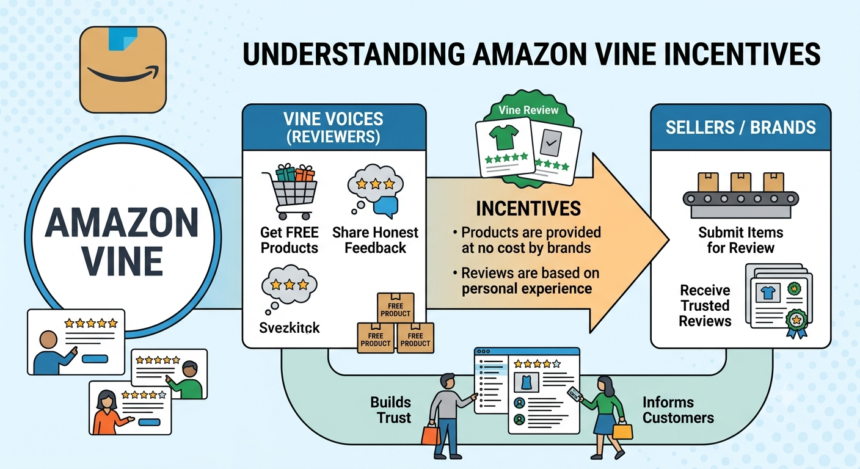
Amazon Vine is the company’s invitation-only review program, launched in the early 2000s and quietly expanded into one of the most influential forces in how products get launched, priced, and ranked on the world’s largest online store. On one side of the transaction, sellers pay to enroll their products and ship them free to approved reviewers. On the other side, reviewers receive goods in exchange for writing assessments of those goods. The arrangement is legal, disclosed, and closely managed by Amazon. It is also something that neither sellers nor reviewers fully understand until they are already inside it.
The more you look at Vine, the more it looks less like a neutral consumer review system and more like a paid trust infrastructure that Amazon operates, charges for, and benefits from in ways that go almost entirely unexamined.
How the Machine Works
The mechanics of Vine are not complicated, but they are deliberate. Sellers who want to enroll a product must be registered through Amazon Brand Registry, must use Fulfillment by Amazon, and must have fewer than 30 existing reviews on the listing. Then they pay. The fee structure has changed over the years. According to My Amazon Guy1, before October 2023, enrollment cost up to $2,500 per ASIN. Amazon cut that substantially: now, enrolling 1 to 2 units costs nothing. Three to 10 units run $75. Eleven to 30 units cost $200. The new pricing made the program accessible to far more sellers, which is precisely what Amazon intended.
Once enrolled, the product becomes available to a pool of reviewers Amazon calls Vine Voices. These are people Amazon has handpicked based on their reviewer rank, the helpfulness votes their past reviews received, and other factors the company never fully specifies. Vine Voices browse a catalog of available products, request what they want, and receive it at no cost. They then have to write a review. Amazon monitors the reviews manually before they go live. Sellers cannot contact reviewers or influence what they write.
The result, on paper, is a controlled experiment in pre-market social proof. In practice, it is something with more edges.
The Pre-Launch Maneuver
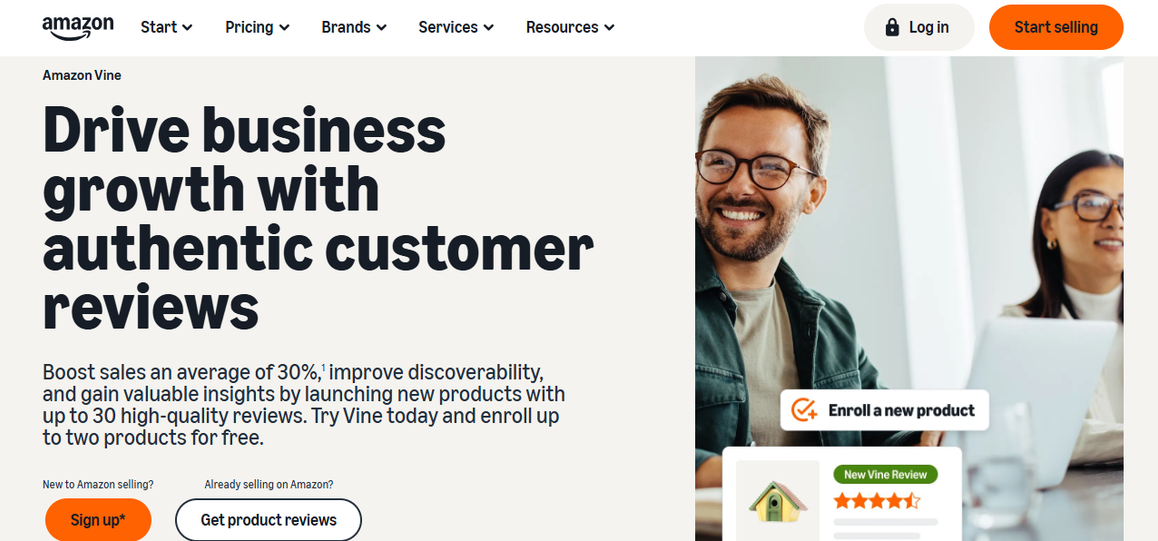
The most significant change Amazon2 made to Vine in 2025 was allowing sellers to collect reviews before a product listing even goes live. Previously, a new product had to be live on the marketplace before Vine reviewers could claim it. Now, sellers can enroll a product in Vine, send inventory to Amazon’s fulfillment centers, and begin accumulating reviews while the listing sits dormant. When the product launches publicly, it can arrive with up to 30 reviews already posted.
The practical meaning of this is significant. According to eCom Catalyst3, Amazon sellers describe the pre-launch review window as a way to eliminate what they call the “no-review desert”, that awkward early period when a new listing sits at zero reviews and customers won’t buy. Vine now lets sellers skip that phase entirely. A product can enter the marketplace already wearing the appearance of established credibility.
The industry language around this is revealing. Seller guides describe launching “with a crowd already cheering for you.” One network of Amazon sellers frames Vine as something elite sellers use to compress launch timelines and control their review ecosystem, calling it a “profit lever” and noting that properly executed Vine campaigns can reduce time-to-profitability by 40 to 60 percent on new launches. That language does not describe a neutral consumer feedback system. It describes a marketing operation.
The Bias Problem
The question of whether Vine reviews are biased has no clean answer, but the evidence points in a consistent direction.
Researchers at a data science consultancy analyzed a large dataset of Amazon reviews and found that incentivized reviews have a more balanced distribution of ratings than organic reviews, which tend to cluster heavily at five stars. That finding sounds favorable to Vine. But the same analysis found that Amazon’s overall rating system is polarized and not good at differentiating better from worse products, and suggested Amazon could improve accuracy by overweighting Vine reviews. It does not, or at least there is no visible evidence that it does.
A peer-reviewed study published in Information Systems Research4 examined Amazon Vine and seller-incentivized reviews and found that incentivized reviews do produce higher-quality text than organic ones: more coherent, more detailed, more structured. But the numerical ratings from those same reviews are biased upward. The researchers proposed that platforms keep the text from incentivized reviews while suppressing the star ratings entirely. Amazon has not done this.
Null Fake5 put the average Vine rating at 4.3 stars, against 3.8 stars for non-Vine reviews on the same products. That half-star gap persists even when controlling for product quality. The researcher tracked products that launched with 90 percent Vine reviews and found that six months later, after real customers bought and reviewed, the rating dropped by a full star. The Vine reviews were optimistic. They were not fake. They were structurally optimistic in the way that any review written by someone who chose a free product, with some hope of liking it, will tend to be.
A University of Florida6 study tried to put this in a more favorable frame. It found that because Amazon, not the seller, controls which Vine reviewers receive which products, the direct incentive to inflate ratings is weaker than in seller-run programs.The researchers noted:
“If you’re Amazon, you’re not interested in inflating the rating of one specific seller.”
Amazon wants the marketplace to feel fair and credible overall. But that observation coexists with the data showing Vine ratings run consistently higher. A system that produces upward-biased ratings remains upward-biased whether or not the bias was intentional.
The structural reason is simple. Vine Voices choose the products they want to review. They are not assigned random items. They self-select toward categories and products they expect to like. That is not manipulation. It is human nature applied at scale to a system that then presents the output as objective assessment.
Inside Vine Jail
From the reviewer’s side, Vine looks like a windfall at first. You receive products. You write reviews. You keep the products. The invitation comes because Amazon’s algorithm has tagged you as a high-quality reviewer, and there is real status in that. But the operational realities accumulate fast.
Vine reviewers are required to review a minimum percentage of the products they claim. According to Tommy Liquori7, since January 2024, that floor sits at 60 percent of all claimed items. If a reviewer falls below that threshold, they are placed in what the Vine community calls “Vine Jail,” a suspension of access that prevents claiming new products until the review backlog clears. The phrase is informal but widely used in Vine forums. It captures something real: the moment you accept a Vine product, you have a labor obligation attached to it.

To reach or maintain Gold tier, the highest reviewer status in the program, a Vine Voice must review at least 80 products with 90 percent of claimed items reviewed within the evaluation period. Amazon added a new metric to this in June 2025: a Review Insightfulness Score, rolled out to US reviewers and scheduled to factor into tier evaluations beginning September 1, 2025. The score runs from Poor to Fair to Good to Excellent, and the stated requirement for Gold tier is maintaining Excellent throughout the evaluation period.
The rollout itself was opaque. Amazon displayed the score in reviewers’ dashboards before explaining what it meant or how it would affect their standing. Months passed before the company communicated that the score would carry real consequences. In Vine community forums, members began trying to reverse-engineer how the scoring worked. One observation from Red Flag Deals8: someone had moved from a Poor score to Excellent simply by adding the word “good” to their reviews. The conclusion drawn was immediate. The scoring is AI-driven, and once you identify the right keywords to include, you can game it. One commenter put it plainly: “This isn’t going to do anything to improve reviews. It will just lead to more gaming the system.”
That is a recurring pattern in how Amazon manages its review ecosystem. It adds a new metric to address a perceived quality problem. Participants optimize their behavior for the metric. The metric no longer measures what it was supposed to measure. The cycle repeats.
The Tax Surprise
The part of the Vine story that generates the most genuine confusion, and the most anger, is the tax treatment of the products reviewers receive.
The IRS treats the free products as taxable income. The legal reasoning is that reviewing is a service, and the product is compensation for that service. Amazon formalizes this through a system called Estimated Tax Value, or ETV, which assigns a dollar figure to every product sent to a Vine reviewer. If the cumulative ETV in a calendar year exceeds $600, Amazon issues a 1099-NEC and reports the total to the IRS. The reviewer owes income tax on the declared value.
The first problem is that many reviewers did not know this when they joined. The framing of Vine, products in exchange for honest reviews, sounds like a barter arrangement at most, not employment compensation. People in forums describe receiving their first 1099-NEC with genuine shock. One TurboTax community thread has a reviewer who received $604.10 in products writing: “I have no monetary income. The Vine products I got, most are just some household items. Some of it is junk.” The estimated tax owed: $92. The product, by then, was largely used or broken.
The second problem is the ETV figures themselves. Multiple reviewers and one tax forum on FreeTaxUSA9 have documented that sellers inflate the ETV of their products because they can write off a higher amount as a business expense. One FreeTaxUSA user reported that after six months, the actual resale value of items they received was 25 to 30 percent of the ETV reported on their 1099-NEC. They asked Amazon to correct the value. Amazon declined.
According to Claimyr10, tax preparers who work with Vine reviewers confirm that ETVs are often 20 to 50 percent higher than the actual selling price on Amazon at the time of receipt. The IRS allows reviewers to dispute or adjust ETVs if they can document a lower actual value, but that requires spreadsheets, screenshots, and a willingness to engage with the IRS directly over what may amount to a few hundred dollars in disputed value.
The Bogleheads11 personal finance forum has an active thread on Vine taxes that captures the debate among experienced reviewers. One commenter argued that the whole thing is clearly self-employment income:
“You would not order vine items and write vine reviews for the enjoyment of it. You’re doing it for the items, the items are the income.”
Another disagreed, insisting it qualifies as hobby income. A third, who consulted a tax attorney who was coincidentally also a Vine member, reported that hobby income treatment seemed safest and that when the IRS sent a letter asking for clarification, the explanation that this was a hobby with no profit motive was accepted without further challenge.
The IRS itself has not issued explicit guidance specific to Vine. The ambiguity is real, and it falls entirely on reviewers to resolve it.
There is also a six-month holding rule. Reviewers cannot sell or give away Vine items for six months after receiving them. This matters for tax purposes because someone who receives a $150 item with an inflated ETV, owes income tax on the declared value, and cannot sell the item for half a year, faces a real cash cost on something that may be worth nothing by the time they can legally dispose of it. One Intuit Tax12 community poster made the point directly: “Amazon’s declared valuations are not likely appropriate valuations for the goods actually received by a small business who is not running the world’s largest online retail marketplace.”
The free products are not free. They are priced in tax liability at values that Amazon sets and that sellers can and do inflate.
What Amazon Gets Out of All This
Step back, and the structure of Vine is clarifying.
Amazon collects fees from sellers to enroll products. It receives a catalog of discounted-to-free items that it passes to reviewers. It generates reviews for those products, which are then available on the marketplace and drive purchasing decisions across its platform. The reviews carry a badge that signals trust to shoppers. The reviewers bear a tax burden that Amazon discloses but does not explain. The sellers shoulder the unit cost plus the enrollment fee.
Amazon, sitting in the middle, benefits from all three directions. Sellers pay for access. Reviewers provide labor and absorb tax liability. Shoppers are guided by a review corpus that is systematically tilted toward positivity in ways they cannot measure, and Amazon does not disclose.
Amazon13 says Vine reviews appear in the same location as other reviews and are labeled for full transparency.
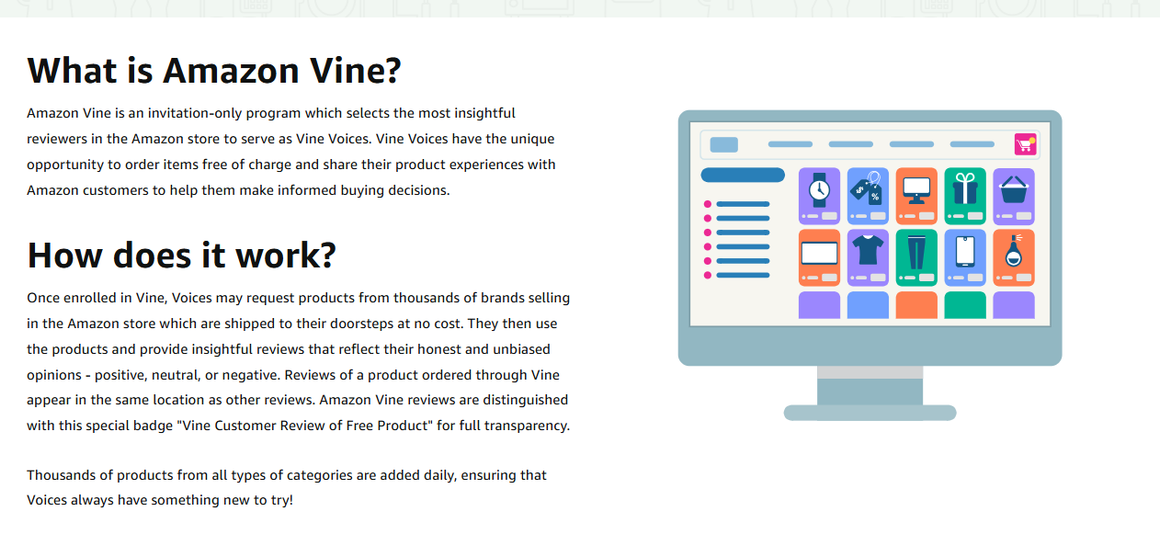
That is true. The label tells shoppers that the reviewer received the product for free. It does not tell them that reviewers self-selected into the product based on category interest, that ratings from Vine reviewers run systematically higher than organic ones, that the review was written under a labor quota with consequences for non-compliance, or that the star rating they are looking at may have been the first thing attached to a product before any real customer bought it.
Transparency in form is not the same thing as transparency in substance.
The Seller’s Perspective
It would be wrong to suggest that Vine is purely cynical from the seller’s side. For a small brand launching a genuine product in a crowded category, the review cold-start problem is real. Without early social proof, even a good product can vanish into search ranking obscurity before anyone gives it a chance. Vine provides a legitimate, Amazon-sanctioned path to early reviews that is preferable to the black market of fake review services that Amazon has spent years trying to suppress.
Sellers who use Vine honestly acknowledge the risks. Vine reviewers cannot be steered toward positive reviews. A bad product will receive bad reviews through Vine, and those reviews arrive early, with trusted-reviewer badges, and they can be brutal. There are documented cases where Vine reviews tanked products that sellers thought were solid. The system is not a guarantee of positive outcomes. It is a guarantee of early, high-visibility outcomes, whatever form those take.
Amazon prohibits sellers from contacting Vine reviewers or attempting to influence the content of reviews in any way, and violating these rules can result in account suspension. The structural protections are genuine. The question is whether those protections address the subtler ways the system can be gamed: product selection designed to maximize the chance of favorable reviews, ETV inflation that gives sellers a tax benefit at reviewers’ expense, and the aggregation of Vine reviews into a product’s overall star rating without any weighting adjustment.
The Bigger Question
Amazon reviews are the de facto purchasing signal for a market that handles hundreds of billions of dollars in annual transactions. The integrity of that signal matters not just to individual shoppers but to every brand, seller, and manufacturer that competes on the platform. When the signal is systematically shaped before the market even opens, through a program that lets sellers buy pre-launch credibility at a disclosed but structurally complex cost, the question is not whether any individual review was dishonest. Most Vine reviews are honest. The question is whether the system produces information that accurately reflects what real customers will experience.
The evidence suggests it does not. Vine ratings run higher than organic ratings for the same products. That gap closes when real customers arrive. The gap exists in part because of selection effects, in part because of the social dynamics of reviewing something you chose and received for free, and in part because a product that has been carefully selected, photographed, packaged, and enrolled in Vine is not the same product that will ship to the average customer in six months when quality control has drifted, packaging has changed, and the seller has moved on to the next launch.
Amazon has a version of this problem in its broader review ecosystem. Analysis of overall Amazon ratings has found them to be polarized, biased, and unreliable as quality signals. The same analysis found that Amazon could improve rating accuracy by overweighting Vine reviews, because Vine reviews are relatively less biased than the average organic review. That is a notable finding. Vine reviews, despite their structural problems, are still more informative than what Amazon’s broader review system produces.
What that tells you is not that Vine is working well. It tells you that the entire Amazon review ecosystem is broken in ways that Vine cannot fix and in some cases amplifies. Vine sits inside a larger system that Amazon has allowed to become a performance layer, where the appearance of trustworthiness has been separated from the substance of it, and where the company charges for the tools to manage that separation.
For reviewers who get invited and do not read the fine print on ETVs, for shoppers who see a green badge and feel reassured, for small sellers who enroll thinking they are buying real feedback and later realize they bought a launch signal that evaporates when actual customers arrive, the costs of that separation are distributed unevenly.
Amazon collects the fee either way.
Sources
- Pope, Steven. “Amazon Vine Program for Sellers: 2025 Complete Guide” Amazon Agency | Amazon Experts | Amazon FBA Agency, 9 Dec. 2019, myamazonguy.com/reviews/amazon-vine-on-seller-central/. Accessed 29 June 2026. ↩︎
- “Get customer reviews with Amazon Vine” Sell on Amazon, sell.amazon.com/programs/vine. Accessed 26 Aug. 2026. ↩︎
- “Is Amazon Vine Worth It for Getting Reviews in 2025? New Rules, Seller Tips, and Reviewer Truths” EComCatalyst – Amazon, e-Commerce Growth Agency –, 28 Aug. 2025, ecomcatalyst.com/2025/08/28/is-amazon-vine-worth-it-for-getting-reviews-in-2025-new-rules-seller-tips-and-reviewer-truths/. Accessed 26 Aug. 2026. ↩︎
- Pubs Online, pubsonline.informs.org/doi/10.1287/isre.2022.1146. Accessed 26 Aug. 2026. ↩︎
- Armitage, Derek. “Amazon Vine Program: Legitimate Reviews or Hidden Bias?” Null Fake, 28 Dec. 2025, www.nullfake.com/blog/amazon-vine-program-explained. Accessed 26 Aug. 2026. ↩︎
- Hamilton, Eric. “Incentivized online reviews inflate product ratings, sales, even when disclosed” University of Florida, 8 Dec. 2023, news.ufl.edu/2023/08/incentivized-online-reviews-deceive-consumers/. Accessed 26 Aug. 2026. ↩︎
- Liquori, Tommy. “Amazon Vine Voice Ultimate Guide” TommyLiquori.com, 1 Apr. 2024, www.tommyliquori.com/amazon-vine-voice-reviewer-ultimate-guide/. Accessed 27 Aug. 2026. ↩︎
- Red Flag Deals, forums.redflagdeals.com/so-i-got-selected-amazon-vine-2037850/9/. Accessed 26 Aug. 2026. ↩︎
- “Challenges reporting income from reviewing products for an online reseller, like Amazon Vine.” FreeTaxUSA Community | Tax Questions, Answers, and, 19 Aug. 2025, community.freetaxusa.com/discussion/2626/challenges-reporting-income-from-reviewing-products-for-an-online-reseller-like-amazon-vine. Accessed 26 Aug. 2026. ↩︎
- Taylor, Chloe. “Amazon Vine Program: Common Misconceptions Clarified for Tax Purposes (United States)” Claimyr, 2 May 2026, claimyr.com/government-services/irs/Amazon-Vine-Program-Common-Misconceptions-Clarified-for-Tax-Purposes-United-States/2025-04-11. Accessed 26 Aug. 2026. ↩︎
- Bogleheads, www.bogleheads.org/forum/viewtopic.php?t=454026. Accessed 26 Aug. 2026. ↩︎
- “Paying Taxes on Products Received to Review through Amazon Vine” Community, 25 Jan. 2025, ttlc.intuit.com/community/tax-credits-deductions/discussion/paying-taxes-on-products-received-to-review-through-amazon-vine/00/3434215. Accessed 26 Aug. 2026. ↩︎
- Amazon.com, www.amazon.com/vine/about. Accessed 26 Aug. 2026. ↩︎