
Amazon says brand gating fights counterfeits. The sellers getting quietly locked out of products they have legally sold for years tell a different story.
“On June 3, we woke up with an exaggerated amount of gated brands, brands we have sold for years, and brands we have never sold.”
This seller did not change anything in his Amazon account the night before it happened. He did not get a warning email. He did not trigger a complaint. He sold the same products he had sold for years, through the same supplier invoices he had always used. But on the morning of June 3, he opened Seller Central and found the door had been locked.
Dozens of his active listings now showed a message he had never seen before: “Qualifications Required.” Brands he had sold without issue, brands Amazon had already approved him to carry, were suddenly inaccessible. His FBA inventory sat stranded in Amazon’s warehouses. He could not replenish. He could not sell. He opened case after case with Seller Support and got nothing back. Two weeks later, without explanation, his account returned to normal. Then, exactly one month after the first lockout, it happened again.
“Clearly, this is a system problem,” Tony wrote in a post on Amazon Seller Central’s forum1. “I need to escalate this case to get an accurate solution to my problem. I cannot wait two weeks again for the system to return my account to its previous state. Our company cannot handle another situation like this.”
He is not alone. What Tony experienced is one face of a sprawling, largely opaque enforcement system that Amazon calls brand gating. And by nearly every signal available, that system is growing fast, reaching deeper into the marketplace, and leaving a trail of disrupted businesses, stranded inventory, and unanswered support tickets in its wake.
What Brand Gating Actually Is
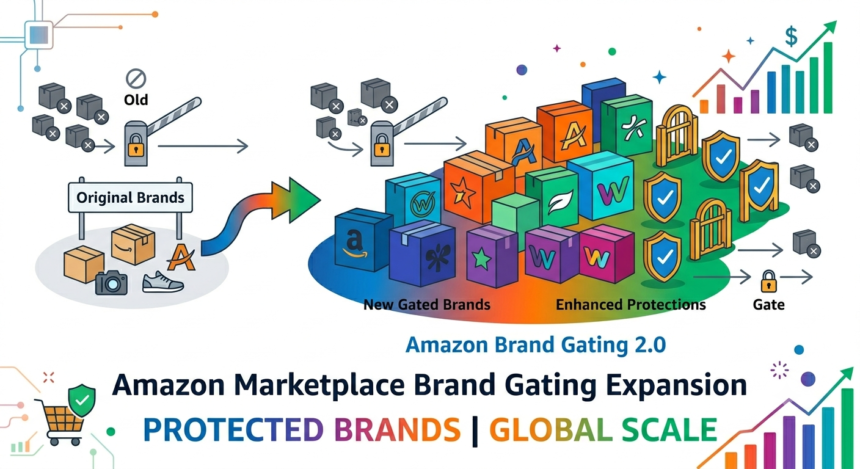
The concept sounds straightforward. When a brand is gated, any unauthorized seller who tries to attach to a listing sees an “Approval Required” message in Seller Central. They cannot proceed without submitting documentation and receiving Amazon’s green light.
Amazon launched the program at scale in 2016, after major brands including Birkenstock publicly threatened to pull out of the platform because of unchecked counterfeiting. Before that point, virtually any seller could list products under any brand name with no verification at all. The idea was to build a lock on the door. To get through, a reseller would need to prove they were legitimate: three invoices from an authorized distributor dated within the past 90 to 180 days, a Letter of Authorization on the brand’s official letterhead, and sometimes a non-refundable application fee of $1,500.
In theory, this is a sensible response to a real problem. According to Business Standard2, in 2024 alone, Amazon seized over 15 million counterfeit products, more than double the previous year’s figure of 7 million. The scale of that problem is genuine, and no one who has ever received a fake product through an Amazon order would argue the platform has no obligation to act.
But the way the system actually operates in practice is something different. The gating has expanded steadily from a handful of luxury and high-risk brands into a sprawling, automated system covering hundreds of everyday product categories. It now reaches brands that show up on discount shelves at Walgreens. It hits sellers retroactively, without warning, after they have already purchased inventory. And the criteria for who gets gated, and why, are opaque by design.
Amazon gates products at three distinct levels: by brand, by category, and by individual ASIN. Any of these can be triggered independently. A category may be open while specific brands within it are locked. A brand may be open while individual product listings within it require approval. This creates a system where sellers sometimes cannot know in advance what they are allowed to sell until they try to list it and hit a wall.

The number of brands enrolled in Amazon Brand Registry, which is a prerequisite for requesting gating, has grown from 500,000 to over 700,000 in a single year according to industry estimates. The practical implication, as one industry analysis put it, is that encountering gated brands will become more common, not less.
Amazon also gates brands through two separate channels. The first is Amazon-initiated gating, where the platform itself restricts a brand based on counterfeiting complaint volume, category risk, or brand visibility. The second is Brand Registry-initiated gating, where enrolled brand owners formally request that Amazon restrict access. These two mechanisms operate on different logic and timelines, and brands need to demonstrate a clear need and provide evidence of ongoing marketplace abuse before gating is approved. In theory. In practice, sellers report that brands seem to flip from open to closed with little public explanation.
One category of gating is particularly damaging: what sellers on Amazon forums have taken to calling “hard gating,” where brands are placed as “not available” in Seller Central, meaning no application process exists at all. Brands like Mattel, Lego, Revlon, and Funko have appeared on these hard-gated lists, with zero notice to sellers who may already have thousands of dollars of that inventory sitting in FBA warehouses.
“It’s VERY doubtful that any sellers will be able to sell those brands any time in the future unless the companies are bought out and new management changes the brand policies,” one veteran moderator told a seller asking about Mattel and Funko. “Spend more time on the Forum so you don’t get blindsided.”
The Stranded Inventory Problem
The most immediate financial damage from gating is stranded inventory. When a product a seller has already shipped to an Amazon fulfillment center gets gated, that inventory becomes inaccessible. The seller cannot sell it, cannot immediately retrieve it, and may face disposal fees if it sits too long.
I spent time in Amazon Seller Central forums reading through dozens of threads on this problem. They tell a consistent story. A seller wakes up to find that products they have sold for years now require fresh documentation. They spend days uploading invoices. Some listings get re-approved within minutes. Others take two weeks. A few never come back at all.
“Amazon blamed them, I reached out to them, they blame Amazon,” one seller wrote about a brand dispute. “It’s a total mess, because listings that break can’t be fixed anymore.”
Another seller described the experience as cyclical and arbitrary: approved one month, locked out the next, approved again after a wave of manual invoice uploads.
“It doesn’t look like account longevity or highly rated customer feedback matters in their decision. It is random brands too.”
What makes this financially brutal is the timing. Amazon encourages sellers to keep large stocks at FBA to maintain Prime eligibility and fast shipping speeds. Sellers who follow that advice and keep significant inventory on hand are the most exposed when a gating event hits without warning. The inventory that was an asset on Monday becomes a liability by Tuesday morning.
“I believe Amazon is slowly moving towards complete brand registry to sell a brand. That means the brand approval must be in your brand registry.”
The Death of Retail Arbitrage
Brand gating has not hit all seller types equally. The model it is most aggressively dismantling is retail arbitrage: the practice of buying discounted branded products at retail stores and reselling them on Amazon for a profit. For years, this was a viable entry-level e-commerce business. Someone could walk into a Target clearance aisle, scan products with the Amazon Seller app, identify profitable items, and build a real income from it. That model is now in serious trouble.
The fundamental problem is documentary. According to Sequence Commerce3, Amazon explicitly rejects “retail receipts, online order confirmations, packing slips, sales orders, pro-forma invoices, or sales quotes” as ungating documentation. A receipt from Walmart does not count. A receipt from Target does not count. Even a receipt from a Costco that sold the product at a discount does not count. Amazon wants commercial wholesale invoices from authorized distributors, the kind of paperwork that only exists in formal wholesale relationships, not clearance-aisle buying trips.
One seller shared the experience precisely. CLOSO4 reported that they bought 20 units of a popular electric toothbrush from a liquidation store, all brand new, listed them on Amazon, sold five, and then got gated. They submitted the retail receipt. Amazon rejected it. They had to recall the remaining 15 units and sell them on eBay at a loss.
“I found a stack of graphing calculators at a Staples in 2025,” the same seller wrote. The scanning app said profit. The listing went live. Then came the IP complaint from the brand owner, and the Amazon demand for documentation that a Staples receipt could never satisfy.
Amazon has started aggressively gating brands from resellers who don’t have permission to sell items. Industry analysis firm. It is great news for manufacturers and brands in Brand Registry. It is bad news for sellers who built a living through online arbitrage.
Store receipts are not accepted as proof of authenticity in the majority of category appeals. Accounts are frequently suspended for “inauthentic” complaints even when products are genuine. More brands are gated or aggressively pursuing IP claims. The risk of losing an account over one flagged ASIN is higher than ever.
This is not a minor inconvenience. Retail arbitrage was, for tens of thousands of small business owners, a real livelihood. Many of them used it as a stepping stone, building capital and Amazon sales history before moving into wholesale or private label. That on-ramp is being demolished.
The First Sale Doctrine and Its Limits
There is a legal principle at play here that most sellers know about but cannot use. The First Sale Doctrine holds that once a branded product is legitimately purchased, the buyer generally has the right to resell it. You bought it. It is yours. Selling it is legal.
Sellers invoke this constantly in forum debates about brand gating. They are not wrong about the law. But they are wrong about its practical application on Amazon’s platform. According to Brand Alignment5, the First Sale Doctrine limits what brands can do in a legal sense.
CopyCat Legal6 posted how there are exceptions to this doctrine.
Brands can still contractually restrict their authorized distributors and retailers from reselling to unauthorized third parties. If a distributor breaks those terms, the brand can pursue civil action for breach of contract.
More importantly, Amazon is a private platform with its own terms of service. Those terms can require documentation standards that go beyond what the law demands. You can have the legal right to resell a Neutrogena shampoo bottle you bought at Walgreens. Amazon can still require you to prove you sourced it from an authorized distributor before it lets you list it. The First Sale Doctrine does not reach inside Seller Central.
Trademark owners can stop unauthorized resellers from selling genuine products on Amazon when those products are materially different from authorized versions in ways that create consumer confusion. This “material difference” exception applies particularly well to supplements, cosmetics, and luxury goods with strict quality control requirements. Brands have used it aggressively, arguing that products purchased outside authorized channels may have been stored improperly, may be close to expiration, or may lack warranty coverage available to authorized buyers.
In a 2024 federal case as stated by Justia Law7, Conair LLC pursued exactly this kind of argument against a wholesale reseller. The doctrine is not dead, but it is being nibbled from the edges by well-resourced brand legal teams, while the small sellers who would need to fight back in court have neither the resources nor the time.
The Abuse Problem Amazon Does Not Like to Discuss
Brand gating also creates its own category of abuse and as posted by AlpVision8, there are multiple categories of this form of abuse.
Because the system gives Brand Registry holders significant power to flag and remove competing sellers, some actors use it as a competitive weapon rather than a consumer protection tool.
Bad actors use fake brand registry filings or unauthorized gating requests to knock competitors off listings. Amazon’s brand gating process can be abused, and unless a brand has airtight trademark enforcement and a Brand Registry team that cares, its ASINs could be removed from the catalog without warning.
One seller described the scenario in a forum post:
“Our main seller got brand gated by someone who claimed to ‘own’ our brand on Amazon. We’ve held the trademark for 4 years!”
In this scenario, a private label seller who has built a product and registered a trademark finds themselves locked out of their own listing because a bad actor filed fraudulent Brand Registry claims. The appeal process is slow, the support responses are often templated and unhelpful, and the sales loss accumulates every day while the dispute sits in a queue somewhere.
Gating is forward-facing: it stops new sellers from listing but does not automatically remove sellers who are already active on a gated ASIN. Brands often need to take additional enforcement steps to remove violators still operating under the radar. Gray market sellers operate in creative ways, listing products as used, renewed, or “open box” to avoid enforcement. Others exploit catalog gaps or outdated listings that fall outside the brand’s control.
The system is porous at the top and airtight at the bottom. The determined bad actor finds workarounds. The small legitimate seller gets caught in the machinery.
What Amazon Says
Amazon’s public position is consistent. Gating protects customers from counterfeits. It ensures safety in regulated categories. It maintains brand integrity by limiting access to authorized sellers. When sellers post in Seller Central forums asking why a brand has been hard gated, the moderator response is usually a variation of:
“In general the reasons why some categories, brands, and products that require approval aren’t accepting applications is internal to Amazon and won’t be shared.”
Amazon’s response to one forum thread noted:
“If the brand has a history of authenticity concerns or reports, Amazon may take actions to restrict the brand. Due to this it is important you continue to report correctly using Brand Registry so there is a record of these events.”
That response is worth sitting with. The burden of proof falls on sellers to maintain a paper trail of their good behavior. The decision to gate, retroactively, brands they have sold legitimately is made by an automated system whose logic is not disclosed. There is no public hearing. There is no appeals process with defined timelines. There is a support ticket queue and a waiting period measured in weeks.
According to The Economic Times9, Amazon spent over $1.2 billion fighting counterfeits in recent years and employed more than 15,000 people in anti-fraud efforts. At that scale, Amazon cannot fight counterfeits only with manual enforcement. It needs scalable systems. Brand gating, tied to Brand Registry and related programs, fits that strategy. That much is true and reasonable.
But scalable systems make mistakes at scale. And when they make mistakes, the costs land on individual sellers who may have no recourse and no alternative marketplace large enough to absorb the loss.
Step back from the specifics of brand gating and a larger pattern comes into view. Amazon began as an open marketplace where sellers of nearly any kind could reach a national audience. That openness was genuinely democratizing. Small businesses, individual entrepreneurs, and side-hustle resellers built real incomes on the strength of that access.
The platform is now systematically narrowing who can participate. Brand gating closes off one class of sellers. Rising FBA fees compress margins for everyone else. The Buy Box increasingly favors sellers who use Amazon’s own fulfillment, its own advertising, and its own branded programs. Counterintuitively, , with roughly two-thirds of sellers who started in that period having already left the platform.
The FTC’s10 antitrust lawsuit against Amazon, filed in 2023 and still working through discovery as of early 2026, makes a version of this argument at the macro level. Regulators allege that Amazon used several interlocking strategies, including anti-discounting policies, conditional Prime eligibility, search and Buy Box manipulation, and aggressive marketplace fees, to maintain monopoly power and prevent rivals from gaining the scale needed to compete. Brand gating is not a named pillar of that lawsuit, but it fits the pattern of mechanisms that raise barriers and concentrate control.
For now, a bench trial is currently scheduled to begin in February 2027 as reported by Credible Law11. The outcome may reshape how platforms can structure marketplace access. It may not. Amazon has deep legal resources and multiple avenues to delay and contest the case. In the meantime, the gates keep going up.
The sellers who bear the real cost of brand gating expansion are not the sophisticated wholesalers with lawyer-reviewed distributor agreements. Those sellers can navigate the system. They have the relationships and the paperwork. They were never the target of this article, and in many ways they have benefited from the reduced competition that gating creates.
The people paying the price are the ones who built businesses on open access and are now finding that access revoked. The single-person operation running retail arbitrage out of a spare bedroom. The small wholesale reseller who sources from a regional distributor that Amazon’s system no longer recognizes. The longtime seller who woke up one morning to find that products they have moved without incident for three years now require documentation they cannot provide.
They cannot afford legal counsel. They cannot survive weeks of stranded inventory while support tickets work through the queue. They do not have direct account manager relationships with Amazon’s seller teams. They are, in the language of the platform, “unverified,” and unverified, in the current architecture of Amazon Marketplace, is increasingly synonymous with unwelcome.
That is the thing about gates. They keep some people out. But they also tell you something about who is meant to be inside.
Sources
- “Massive Gating Brands, ERROR??” 8 July 2024, sellercentral.amazon.com/seller-forums/discussions/t/3bac40c6-7ccb-49ae-ab14-a671713e7ad0. Accessed 21 Aug. 2026. ↩︎
- Business Standard, www.business-standard.com/companies/news/amazon-seized-15-million-counterfeit-products-in-2025-using-ai-tools-126042201285_1.html. Accessed 22 Aug. 2026. ↩︎
- Sequence Commerce, sequencecommerce.com/brand-gating/. Accessed 26 Aug. 2026. ↩︎
- “Retail Arbitrage in 2026: Why I Stopped Scanning Everything and Started Using Data” 14 Jan. 2026, closo.co/blogs/casestudies/retail-arbitrage-in-2026-why-i-stopped-scanning-everything-and-started-using-data. Accessed 26 Aug. 2026. ↩︎
- Alignment, Brand. “Is It Legal to Stop Resellers?” Brand Alignment, 25 May 2026, www.brandalignment.com/is-it-legal-to-stop-resellers/. Accessed 26 Aug. 2026. ↩︎
- CopyCat Legal PLLC on Instagram, www.instagram.com/p/Cuz2Jc9MJQF/. Accessed 26 Aug. 2026. ↩︎
- Justia Law, law.justia.com/cases/federal/district-courts/connecticut/ctdce/3:2023cv01038/155467/55/. Accessed 26 Aug. 2026. ↩︎
- AlpVision – Counterfeit Protection Made Simple on Instagram, www.instagram.com/p/DYS2Mftlt-9/?__d=1. Accessed 26 Aug. 2026. ↩︎
- “Amazon invested $1.2 billion, hired 15,000 people to tackle counterfeit, fraud” The Economic Times, m.economictimes.com/tech/technology/amazon-invested-1-2-billion-hired-15000-people-to-tackle-counterfeit-fraud/articleshow/108791437.cms. Accessed 26 Aug. 2026. ↩︎
- “FTC Sues Amazon for Illegally Maintaining Monopoly Power” 26 Sept. 2023, www.ftc.gov/news-events/news/press-releases/2023/09/ftc-sues-amazon-illegally-maintaining-monopoly-power. Accessed 26 Aug. 2026. ↩︎
- Team, CredibleLaw Editorial. “Amazon Antitrust Lawsuit: Inside the FTC’s Case” Credible Law, 25 Apr. 2026, crediblelaw.com/amazon-antitrust-lawsuit/. Accessed 26 Aug. 2026. ↩︎