

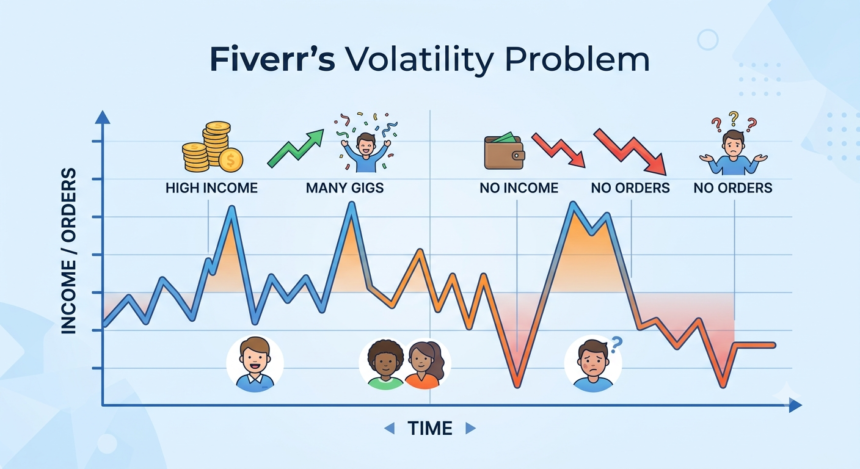

I spent a week reading Fiverr’s own community forum the way you’d read a hospital waiting room. Same complaint, different voice, over and over. A gig that sat on page one for months falls to page nine overnight. A seller with eight years on the platform and a near-perfect rating watches her order count drop to zero. Nobody at Fiverr tells her why. Nobody can, really, because the system that decides who gets seen was built to be a black box, and black boxes do not owe explanations to the people locked inside them.
This is the story of that box, and of the roughly three million buyers and unknown but much larger number of sellers who live or die by what it decides on any given morning.
The Gig Economy’s Strangest Marketplace
Fiverr is not like Upwork. On Upwork you write a proposal and pitch a client directly. On Fiverr you build a listing, called a gig, and you wait for the algorithm to decide whether anyone gets to see it. It is closer to selling on Amazon than freelancing in any traditional sense. You are not applying for work. You are a product on a shelf, and the shelf rearranges itself constantly, according to rules the store keeps to itself.
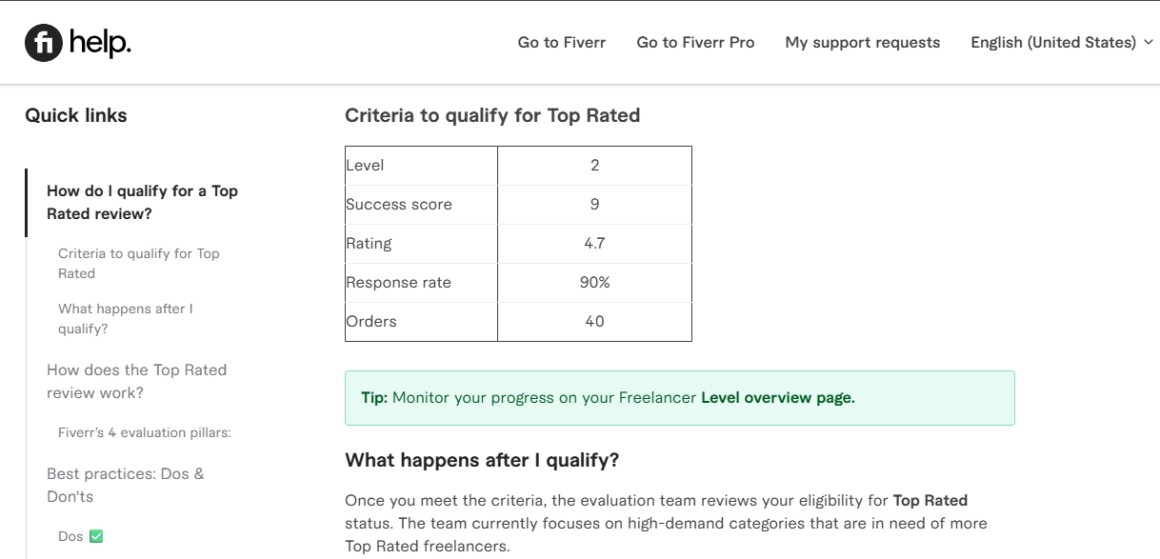
For years this arrangement worked well enough that people built full careers on it. Then, starting in February 2024, Fiverr1 rebuilt the shelf. The company introduced daily performance evaluations to replace its old fixed monthly review cycle, added a 30-day grace period before demotions take effect, and rolled out a private, seller-facing metric called the Success Score, a 1-to-10 composite drawn from client satisfaction, communication quality, cancellations, repeat business, private buyer feedback, and overall order experience. Levels now move up and down automatically for New Seller, Level 1, and Level 2 sellers the moment the daily check catches a metric crossing a threshold. Only Top Rated Seller status still requires a human review, and Fiverr’s own guide describes that queue as running on the company’s schedule, not the seller’s.
On paper, daily evaluation and a grace period sound like mercy. In practice, sellers describe something closer to weather. One Fiverr2 Community post from a seller with eight years on the platform and roughly $132,000 in lifetime earnings put it bluntly in its own title: the new level system had made Fiverr “officially dead” for them as a seller. Five straight years as Top Rated, and then the ground moved.
Later, the user updated the post:
Leaving fiverr was the best decision I made. Now I use fiverr to hire freelancers to outsource my work, how tables have turned.
The Success Score Problem
Here is the part that should bother anyone who thinks about how platforms govern the people who depend on them. The Success Score is calculated from private feedback. Buyers leave a public star rating that everyone can see, and they also leave a second, hidden set of signals that only Fiverr sees and that sellers cannot audit, dispute in detail, or fully understand. A seller can have a 4.9 average rating displayed proudly on their profile while their Success Score quietly falls below the threshold that keeps them at their level.
That gap between the public number and the private number produces exactly the kind of confusion you’d expect. In one Fiverr Community thread3, a seller described a strange inversion: their easiest, most pleasant gig for happy clients scored a 9, while the gig serving buyers going through something harder in their lives scored lower, even though both sets of clients seemed satisfied with the work. The seller wasn’t accusing Fiverr of malice. They were describing the basic problem with any hidden scoring system: you cannot optimize for a number you cannot see, and you cannot appeal a judgment you were never shown the evidence for.
Another seller, writing in March 2025, said their score began dropping “without any logic” right after testing an AI assistant that had, on its own, started recommending their basic package to buyers who actually needed custom work. The mismatch between what the tool suggested and what the client needed dragged the score down, and the seller had no clean way to explain to the algorithm that the confusion wasn’t theirs.
By April 2024, less than two months after the rollout, the frustration had become a running theme on the forum’s Freelancer Lounge board. A seller with eight years of history and nearly a thousand completed sales called the new level system and its Success Score “opaque, unclear and pathetic.” That is not the language of someone chasing a quick refund. That is the language of someone who built a livelihood on a set of rules and watched the rules get rewritten mid-career, with no public explanation of what changed or why.
Fiverr, for its part, has tried to address the volatility question directly, in its own community blog. The company’s official line is that fluctuation is normal, that the marketplace is curated and personalized for each buyer, and that sellers should focus on long-term trends instead of daily swings. The same post warns sellers against over-optimizing their gigs, since frequent changes can confuse the algorithm and should be given three to four weeks to settle before you judge whether they helped or hurt. It’s reasonable advice, as far as it goes. But it asks sellers to be patient with a system that gives them no visibility into what patience is even supposed to look like.
A Beast of Its Own
Outside Fiverr’s own channels, the people writing guides for sellers describe something closer to chaos than curation. One freelance marketing writer, describing the 2025 version of the algorithm on Medium4, called it “a beast of its own” that now rotates gig positions dynamically, sometimes moving a listing from page one to page ten within hours. The same piece cites a seller whose Instagram growth gig swung from page seven to page one and back in a single day, while impressions stayed roughly flat. The writer’s conclusion, and it’s a sharp one, is that organic ranking position is becoming a vanity metric. What matters now is what happens after the click: does the visitor message you, does the message become an order, does the order become a repeat client. Position on the page is theater. Conversion is the real economy underneath it.
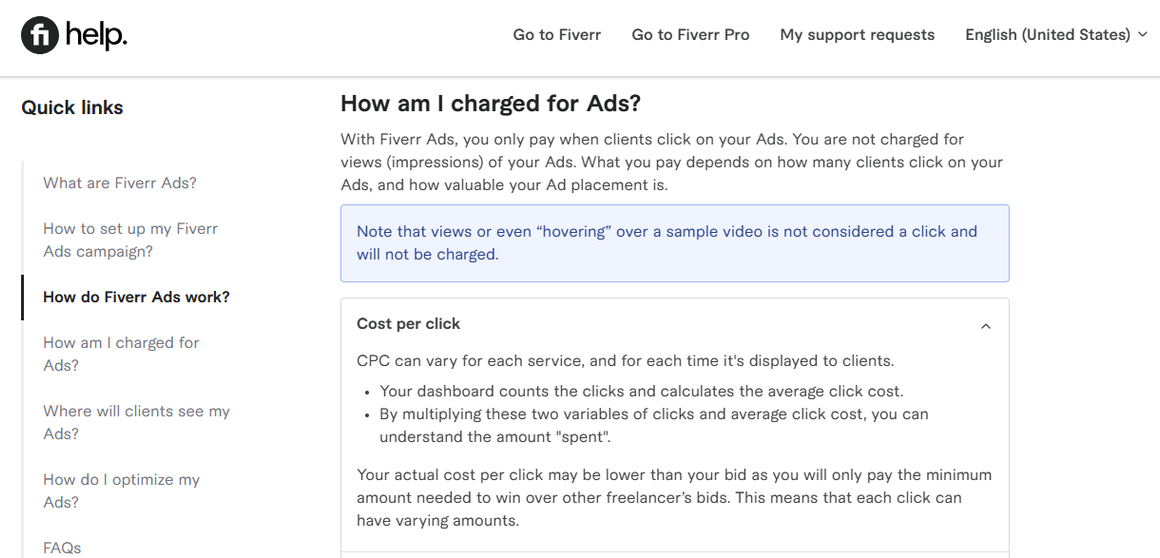
That reframing matters, because it points to where Fiverr has actually put its incentives. Fiverr’s Promoted Gigs system5, essentially pay-per-click advertising within Fiverr’s own search results, runs on a first-price auction where sellers bid for placement and pay only when a buyer clicks.

Fiverr’s automatic bidding formula weighs a seller’s conversion rate, revenue per click, and the competitiveness of their category, then sets the bid on their behalf, up to a $6 cap unless the seller intervenes. The catch, as one seller explained to another on the Fiverr community forum6, is that promoted gigs still ride on organic performance. A gig with poor organic traction gets poor ad traction too. You cannot simply buy your way out of a bad Success Score. You can only buy your way to more chances to prove the algorithm wrong, at your own expense, click by click.
Put those two systems together and you get a fairly elegant piece of platform design, elegant in the way a toll road is elegant. Success Score volatility keeps sellers uncertain about organic visibility. Uncertainty pushes sellers toward Fiverr Ads to protect the income they already have. Fiverr collects a fee either way, 20 percent flat on every order regardless of size or relationship length, plus click revenue from the ads layer on top. The company isn’t hiding this. It’s simply not explaining the mechanism in a way sellers can plan around, and “plan around” is the whole job of running a small business.
What the Money Says
Here is where the story stops being just a seller-forum grievance and becomes something closer to a structural shift, because the numbers back up what the forums are describing.
Fiverr’s own SEC filing7 for the first quarter of 2026 shows marketplace revenue at $67.1 million, down 13.6 percent from the same quarter a year earlier. Annual active buyers fell to 2.9 million, down 17.8 percent year over year, a drop of roughly 600,000 buyers in twelve months. And yet annual spend per buyer rose to $356, up 15.4 percent. Read those three numbers together and a picture forms: fewer people are shopping on Fiverr, but the ones who remain are spending noticeably more.
Stock Story8 analysts covering the earnings call noted the same pattern, that Fiverr’s active buyer base shrank by 600,000 in a single year, a 17.1 percent decline, even as average revenue per buyer climbed 18.8 percent. The Motley Fool’s9 read on the same quarter was more pointed still, noting the number of clients completing projects with budgets over $1,000 rose 18 percent year over year, even as the stock traded near a 52-week low, down 66 percent from its yearly high. Fiverr is not losing money the way it’s losing customers. It is losing customers while making more money from the ones who stay, and quietly reshaping itself around fewer, richer relationships. A Barchart10 research note framed the buyer decline as a genuine retention question, one that investors are watching closely to see whether it stabilizes or keeps accelerating.
This is not a Fiverr-only story. An analysis from IT Dukes11 puts Fiverr’s contraction next to Upwork, which lost about 47,000 active clients in a single year, the largest such drop in its history as a public company, and next to Freelancer.com’s parent, which reported group transaction volume down 7.1 percent. All three platforms are shedding buyers at once, and the piece points to generative AI as the biggest structural driver, citing Wharton research showing measurable displacement of freelance demand in writing, translation, and basic coding work since late 2022.
That last point deserves its own sentence, because it reframes everything the sellers are describing on the forum. If AI tools are absorbing the low end of demand, the kind of $5 logo tweak or quick blog post that used to fill a new seller’s first month on the platform, then the shrinking buyer pool isn’t evenly shrinking. It’s shrinking from the bottom. The buyers who remain are the ones with bigger, messier, higher-stakes projects that still need a human. Fiverr’s own numbers, more $1,000-plus projects, higher average spend, back this up directly.
A Marketplace Rationing Attention
So here is my read on what’s actually happening, and it’s not the read Fiverr would put in a press release.
Gig ranking volatility isn’t a glitch in an otherwise stable system. It’s the visible symptom of a marketplace that is rationing a shrinking, increasingly premium pool of buyer attention among a seller base that grew for years under a completely different set of assumptions. When Fiverr was adding buyers every quarter, a good gig with decent reviews could ride steady, predictable growth. Impressions compounded. New sellers had room to find their footing during that “honeymoon” visibility window one gig-ranking guide describes, typically the first one to four weeks after launch, when Fiverr temporarily boosts a fresh gig to gather performance data. That window still exists. What’s changed is what happens after it closes.
Now the buyer pool itself is contracting, and contracting unevenly, shedding the low-value, low-commitment shoppers first while concentrating what’s left among people spending real money on real projects. Fewer total buyers means less total attention to distribute. Fiverr’s algorithm, whatever its exact mechanics, is the rationing mechanism for that scarcer attention, and rationing mechanisms under pressure produce exactly the volatility sellers are reporting: sudden drops, unexplained recoveries, gigs that seem fine by every visible metric and still vanish from search.
The Success Score compounds this by making the rationing personal and opaque at the same time. It isn’t just that there’s less attention to go around. It’s that sellers can’t see the yardstick deciding who gets what’s left. A seller at, Fiverr Community Forum12, who joined recently and described several confusing interactions with the scoring system after four months of full-time work put their finger on the actual grievance, not that the system judges them, but that it judges them using inputs they can’t see and outputs they can’t verify.
And Fiverr Ads sits on top of all of this as the pressure valve the company profits from twice. Once from the 20 percent commission on the sale itself. Again from the cost-per-click if the seller decides, reasonably, that they can’t afford to gamble their income on an algorithm they don’t understand. It isn’t a conspiracy. It’s just what happens when you build a curated marketplace and then monetize the anxiety that curation naturally produces.
The Sellers Who Stay
What strikes me most, going back through months of forum posts, is how few of these sellers actually leave. They complain, loudly and specifically, and then most of them stay and try to reverse-engineer a system that was built not to be reverse-engineered. Guide after guide, written by sellers and marketers trying to make sense of the platform for others, all converge on roughly the same advice: keep response time low, avoid cancellations at almost any cost, deliver early when you can, ask happy clients for reviews because most won’t volunteer one, and treat every metric drop as diagnostic information rather than catastrophe. It’s sound advice. It’s also advice for surviving inside a system whose rules can change without notice and whose scoring you’re never shown.
There’s a kind of dignity in that persistence, and also something a little sad about it. These are, for the most part, skilled people who built something out of nothing on a platform that owed them no promises and gave none. The platform, in turn, is doing what platforms do when growth slows: squeezing more value out of fewer, better customers, and letting the algorithm sort out who among the sellers gets to serve them. Nobody signed a contract that guaranteed otherwise. But you can understand why a seller with five years at Top Rated status might feel, watching their impressions evaporate for no stated reason, like the ground rules changed after they’d already built their house on the old ones.
Fiverr will likely keep calling this normal fluctuation. The forums will likely keep filling with people who don’t experience it that way. Both things can be true. A curated marketplace personalizing results for each buyer is, by definition, going to look chaotic from the seller’s side of the glass. Whether that chaos is a fair price for a company trying to survive a shrinking, AI-squeezed buyer base, or whether it’s a cost quietly transferred onto the people least equipped to absorb it, depends a great deal on where you’re standing when you ask the question.
None of the seller guides I read, and I read a lot of them, ever quite say the thing plainly. They talk around it in cheerful, actionable language. Optimize your title. Respond within an hour. Deliver two days early. Build five gigs instead of one. Every tip assumes the seller is the variable that needs adjusting, and the marketplace itself is a fixed, neutral field they’re adjusting within. That framing isn’t dishonest, exactly. It’s just incomplete, and it leaves out the one fact that actually explains the volatility: the field itself is shrinking and reshaping at the same time the sellers are trying to stand still on it.
Think about what it means, structurally, for a marketplace to lose 600,000 buyers in a single year while raising average spend per remaining buyer by double digits. It means the marketplace is not simply smaller. It is a different marketplace, serving a different population of buyers with different expectations, and the algorithm sorting sellers into that new population was trained, in some sense, on the old one. Every seller who built their gig, their pricing, their whole approach to landing repeat clients around the platform’s 2020 or 2021 shape is now competing inside a structure that quietly redefined what “good fit” means, without ever announcing the redefinition. That, more than any single tweak to the Success Score formula, is why a gig that used to sit reliably on page one now bounces around like a cork in rough water. It isn’t being punished. It’s being re-sorted, buyer by buyer, into a population that no longer looks like the one it was built for.
This is also, I think, why Fiverr’s own advice about patience rings a little hollow to the people receiving it. Telling a seller to wait three or four weeks before judging whether a change helped assumes the underlying marketplace holds still long enough for that judgment to mean anything. If the buyer pool composition is shifting under everyone’s feet in the same window, then the seller isn’t testing their gig against a stable baseline. They’re testing it against a moving target, and losing track of which variable moved. Small wonder the forums read like a support group. The confusion isn’t a failure of individual sellers to understand the system. It’s what happens when a system built for a growing marketplace keeps issuing tips for a growing marketplace, three years into a period when it clearly isn’t one anymore.
What comes next probably depends less on any single algorithm update than on how far this buyer contraction goes and where it stabilizes. If the platform genuinely is settling into a smaller population of higher-spending, higher-stakes clients, as the $1,000-plus project growth suggests, then Fiverr’s future may look less like the freewheeling five-dollar bazaar it was named for and more like a leaner, vetted marketplace serving fewer people at real prices. That’s not necessarily a worse business. It might even be a healthier one, from a pure balance-sheet view. But it is a different business than the one hundreds of thousands of sellers built their working lives around, and nobody at the company has said so in those words. The volatility in the rankings is the sound of that transition happening in public, one dashboard graph at a time, with no announcement and no map for the people living through it.
I don’t think there’s a clean answer here, and I’m not sure Fiverr has one either.
Sources
- Fiverr, help.fiverr.com/hc/en-us/articles/15140188560913-Top-Rated-freelancers. Accessed 8 July 2026. ↩︎
- Sihag, Akshay. “After 6 years given to fiverr, $132K in earnings, Been a Top Rated Seller for straight 5 years, Fiverr is officially dead for me as a seller since they launched the new level system” Fiverr Community, 26 Dec. 2024, community.fiverr.com/public/forum/boards/freelancer-lounge-sry/posts/342192-after-6-years-given-to-fiverr-132k-in-earnings-been-a-top-rated-seller-for-straight-5-years-fiverr-is-officially-dead-for-me-as-a-seller-since-they-launched-the-new-level-system. Accessed 8 July 2026. ↩︎
- Crystal. “My Success Score Complaint” Fiverr Community, 27 Apr. 2024, community.fiverr.com/public/forum/posts/328765-my-success-score-complaint. Accessed 8 July 2026. ↩︎
- “How to Rank Your Fiverr Gig at the Top in 2025” Medium, 5 Feb. 2025, mitaboost.medium.com/how-to-rank-your-fiverr-gig-at-the-top-in-2025-27f03d58a69c. Accessed 8 July 2026. ↩︎
- Fiverr, help.fiverr.com/hc/en-us/articles/360017729338-Promoting-your-Gigs-with-Fiverr-Ads. Accessed 8 July 2026. ↩︎
- “Fiverr Community” community.fiverr.com/public/forum/boards/ask-the-community-xsm/posts/question-about-promoted-gig-visibility-for-a-level-one-seller-48w7ke03ar. Accessed 3 Sept. 2026. ↩︎
- “SEC.gov”, www.sec.gov/Archives/edgar/data/0001762301/000117891326002276/exhibit_99-1.htm. Accessed 8 July 2026. ↩︎
- Omotosho, Kayode. “Fiverr (NYSE:FVRR) Surprises With Q1 CY2026 Sales, Stock Jumps 10%” StockStory, 29 Apr. 2026, stockstory.org/us/stocks/nyse/fvrr/news/earnings/fiverr-nysefvrr-surprises-with-q1-cy2026-sales-stock-jumps-10percent. Accessed 3 Sept. 2026. ↩︎
- Bylund, Anders. “Should You Forget Fiverr International Stock Near a 52-Week Low?” The Motley Fool, 1 July 2026, www.fool.com/investing/2026/07/01/should-you-forget-fiverr-stock-near-52-week-low/. Accessed 3 Sept. 2026. ↩︎
- Barchart, www.barchart.com/story/news/1572316/what-has-fiverr-been-doing-with-all-those-missing-active-buyers. Accessed 3 Sept. 2026. ↩︎
- Dukes, IT. “The Upwork, Fiverr & Freelancer.com Collapse: Inside the Numbers” IT Dukes, 25 May 2026, insights.itdukes.com/insights/upwork-fiverr-decline. Accessed 3 Sept. 2026. ↩︎
- “Fiverr Community” community.fiverr.com/public/forum/boards/support-and-troubleshooting-by1/posts/concerns-regarding-the-success-score-and-conflict-free-orders-metric-e91pe15sb4. Accessed 4 Sept. 2026. ↩︎


