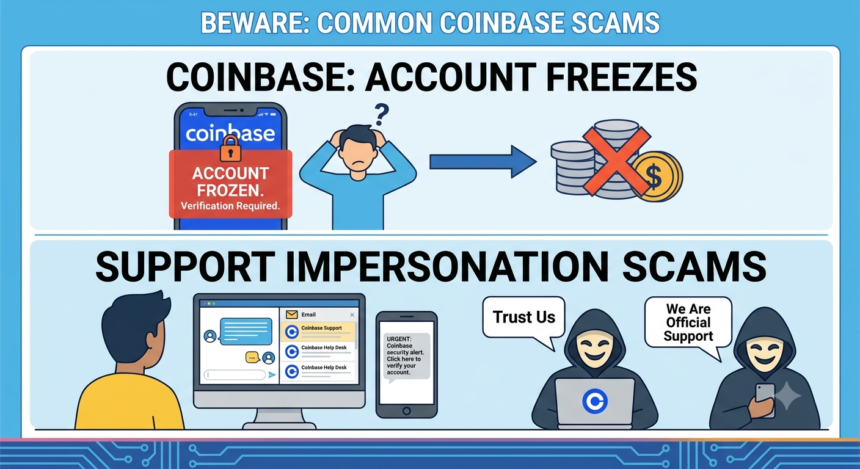

A locked account is a service failure. A fake support call is a crime. For some customers, the first leads straight to the second.
The man was in his sixties, and he had a problem. He could not trade the crypto he held on Coinbase. So he did what most of us would do. He searched Google for “Coinbase” and clicked the top result. It was an ad. It showed a support phone number. He called.
Within twenty minutes he had lost $100,000. That is the figure in Fortune’s1 reporting, which Molly White logged on her Web3 Is Going Just Great timeline. The voice on the line talked him into sharing his password and then into opening his online banking. A fraud alert finally broke the spell. It did not come from Coinbase. It came from his bank.
I have read a lot of scam stories. Most start with greed or fear. This one started with a man being sensible. He wanted help from the company that held his money. He went looking for a human being and found a thief.
That is the story I want to tell, and it has two halves. One half is the lockout, the frozen account and the ticket that goes nowhere. The other half is the impersonator, the caller who knows your name and your balance and has all day. I think the halves feed each other. I think customers pay for the gap between them.
The Locked Door
Start with the lockouts, because they come first.
Spend a week reading the Coinbase subreddit and you will see the same post wearing different clothes. A customer is locked out. A ticket sits. The customer posts on Reddit, because Reddit is the only place left that seems to answer.
Why does coinbase just close my support tickets without doing anything?
by in Coinbase
One user wrote in January that his account had been locked for more than a week with no reply, and that this happens “EVERY YEAR like clockwork.”
This is getting ridiculous. My account has been locked for over a week now, and my support ticket has been sitting there with zero response from Coinbase support. The worst part? This happens EVERY YEAR like clockwork. I’ve been a customer for years, and annually I go through the same nightmare – account gets locked, I submit a ticket, and then radio silence for weeks while I’m locked out of my own funds.
Another said he took about five hundred dollars in crypto for work he did, and his account has been locked since, more than a year now. Every attempt at contact, he wrote, led to a request to “please wait for senior support team” and then a ticket closed in silence.
A business user whose institutional account had gone missing said that after two weeks of nothing, they had “no idea what has actually happened.”
We have documentation proving the account existed and was active just weeks ago. The lack of communication is making a stressful situation far worse.
A fourth poster described an account put on hold after a run of large transactions, around $100,000. Support called it an error that would clear. His conclusion, in his words, was “I just have to wait.”
My account worked fine when I created it, but after a couple weeks of transactions it was put on hold due to the amounts (100k give or take). Support continues to say it’s some error that never got resolved and that it will, I just have to wait. Well, it’s been a year now and I’m done waiting.
Under a thread about a drained wallet, a commenter said an account lock “Took about 10 months to straighten out.” Another wrote that his case was taken seriously only after about ten days, and only after he went public on Reddit.
A November 2024 thread carried a title that says it all: “The Coinbase Locked Out Loop That Continues to Go Unaddressed for Thousands.” The Coinbase account that answers there replied that it does not handle direct messages on Reddit. It pointed the poster to Facebook, Twitter and Instagram. The poster said Reddit was the only social media he used. Elsewhere, a man locked out after recovering from a computer crash told a BleepingComputer2 forum:
I hope someone can help. My computer crashed and I recovered it. Since then I have been locked out of my Coinbase crypto account. Getting help from them is near impossible. I seem to be in some repetitive recovery loop. I keep reverifying my identity and getting recover emails. When I try and login this is what I get. I have been in the google settings and deleted all passkeys and turned on two way verification and turned off skip password. That should have resolved being asked for a key. I have never created an external key but this is what it keeps asking for, Any suggestions would be greatly appreciated. For the record there is no way to find my original passkey number.
None of this is new. In March 2021, The New York Times3 reported that Coinbase customers fell into two camps. Some had been robbed by attackers who got into their accounts. Others were shut out, sometimes by a glitch and sometimes for no reason they could find. One of them, Michael Pierre, a Brooklyn lawyer and former Coinbase employee, lost about $100,000 in coins after a strange text arrived and his phone service dropped. He told the Times that within a couple of minutes, “it was all taken away from me.”
Coinbase’s4 answer then was reasonable on its face. It said it faced a 24/7 market and a surge in demand. It said it had added 2,000 support employees. It said 0.004 percent of its users had suffered account takeovers in the past year. It said it rarely bars users and does so when it is investigating a terms violation or suspicious activity. I accept that. Nobody wants an exchange that never locks anything.
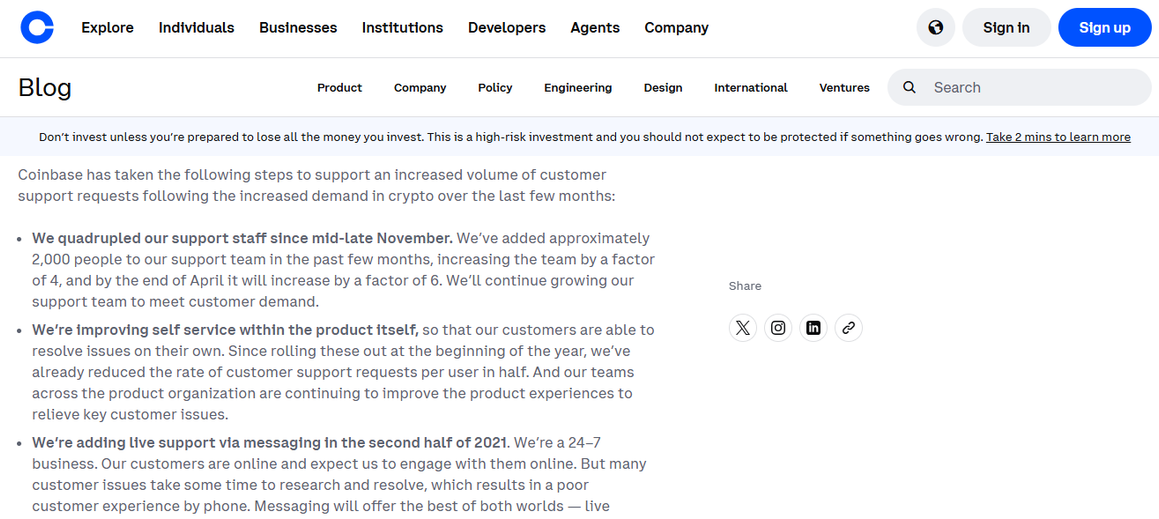
But the Times also quoted Christine Duhaime, a financial crimes expert, who argued that exchanges should behave like banks. Banks need legal reasons to freeze assets, and they must investigate missing or stolen funds quickly. Five and a half years later, the forum posts read like the same file reopened.
I should be fair about what these posts prove. Forums collect the angry. A satisfied customer does not start a thread to say nothing happened today. I have no denominator. I did not find a public figure from Coinbase on how many accounts are locked at any moment, or how long a typical lock lasts. Without that, I can only count voices. The voices are many.
Here is what I keep thinking about. A locked customer wants one thing. A human being who can say what happened. Not money first. An answer first. The longer the silence runs, the harder that need gets, and the less picky the customer becomes about whose voice picks up. A scammer does not have to break Coinbase. He only has to be easier to reach than Coinbase is.
The Phone That Rings
The numbers are large. In February 2025 the on-chain investigator ZachXBT said Coinbase users lost about $65 million to social engineering between December 2024 and January 2025, and he put the yearly toll above $300 million, as The Daily Hodl5 reported. That is one investigator’s estimate, not an audited count, and I treat it that way. But the case he walked through is concrete.
A victim lost about $850,000. The caller used a spoofed phone number and personal details pulled from private databases. He said the account had seen several unauthorized login attempts. A spoofed email followed, carrying a fake Case ID. The victim was told to move funds to a Coinbase Wallet and whitelist an address while “support” verified the account’s security.
Read that again with the lockout threads in mind. A case ID. A security review. An allowlist. These are the words of the real process. The impersonator did not invent a new language. He borrowed the one customers have been trained to wait on. His call sounds like the support the forums beg for.
In December 2025 ZachXBT tied a Canadian threat actor to more than $2 million stolen over a year, funds he said were spent on “rare social media usernames, bottle service, & gambling.” A Cointelegraph6 follow-up noted that the scheme leaned on urgency and authority, with warnings about suspicious access and a “security procedure.”
Then came Brooklyn. On September 23, 2026, a judge sentenced Ronald Spektor, 23, to four to 12 years in prison, Bitcoin.com News7 reported. Prosecutors put the losses at about $15.9 million across roughly 100 victims. Spektor told people a hacker was threatening their assets and steered them into moving funds to new wallets. The victims thought they controlled those wallets. He could empty them. Prosecutors said he recruited others on online forums to work as social engineers and boasted about it on Telegram. The district attorney’s office had asked for seven to 21 years, and the judge imposed the promised sentence over its objection. Brooklyn District Attorney8 Eric Gonzalez said “we will follow the digital trail wherever it leads,” in a statement on the case.
Some of these scams push. The caller finds you. Others pull. They wait for you to come looking. In January 2026 the law firm Silver Miller9 warned that fake Coinbase support numbers had appeared in Better Business Bureau listings and in search previews. The firm called the tactic dangerous because it exploits “platforms that are widely perceived as trustworthy sources of information.” Read that with care. Silver Miller is a firm that signs up crypto fraud victims, so it has a stake. But the mechanic matches the Google ad case in Fortune, and I found nothing that contradicts it.
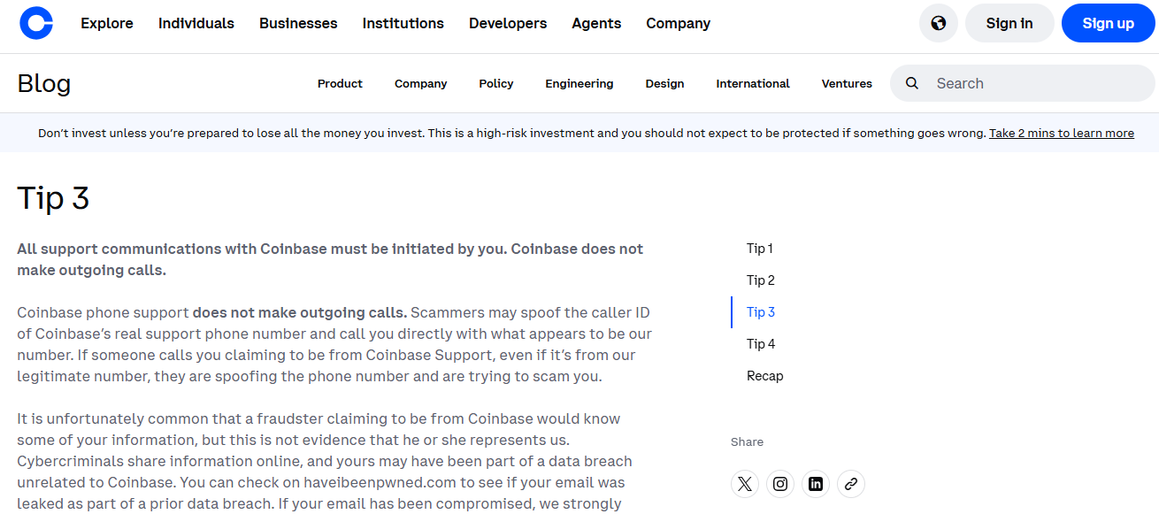
I ran my own searches on Coinbase escalation help. Among the results were documents dressed up as guides to escalating a Coinbase problem. Each was stuffed with phone numbers. I cannot tell you who answers those numbers and I will not print them. I can tell you the pages are not Coinbase’s. They look like spam dropped into web forms nobody was watching. Coinbase’s10 own guidance, which dates back years, says “All support communications with Coinbase must be initiated by you.”
The scale of brand abuse is hard to measure, but one count exists. Analysts at Mailsuite found that from January 2020 to March 2024 the Coinbase name was used in 416 scam schemes and phishing attacks, according to Forklog11. That is the floor, not the ceiling.
Put the pieces together. Search results, review sites, public file folders. Anywhere a desperate person might type “Coinbase phone number,” someone has planted one.
The Leak From Inside
If the impersonators only had a script, the scams would be easier to spot. They do not just have a script. For a while they had the customer file.
In May 2025 Coinbase12 told the SEC that criminals had bribed overseas support agents to hand over customer data for use in social engineering. The company put the cost of the incident at $180 million to $400 million, Fox Business13 reported. The criminals demanded a $20 million ransom. Coinbase refused and set up a $20 million reward fund instead. CEO Brian Armstrong said “No, we’re not going to pay your ransom,” on video. He also doubted that the location of support agents was the real fix, since the bribes on offer were powerful even to people in parts of the United States.
The data was the kind a caller can use. The Register’s14 account lists names, addresses, phone numbers and emails, masked bank account numbers, the last four digits of Social Security numbers, government ID images, balance snapshots and transaction histories. It also lists limited corporate data, including training material and communications available to support agents. A filing with the Maine attorney general put the number of affected people at 69,461. Passwords and private keys were not taken, Coinbase said, and it promised to reimburse customers who were tricked into sending funds to the attackers. It also said it would open a new support hub in the United States.
Now think about what that did to the idea of proof. For years, companies have told us that the real caller is the one who knows things about you. Your last four. Your recent trade. Your balance. After May 2025, at least 69,461 people could no longer rely on that. Knowledge became a costume. The only proof left is who started the call, and that is exactly the rule Coinbase has been repeating for years. I think the company has to say that louder than it says almost anything else. I also think it has to admit what the breach teaches. The people paid to help customers were the hole in the wall.
There is a second source of fuel. ZachXBT pointed in 2025 to TLOxp, a TransUnion data tool, as a primary instrument for criminals who build these calls. He urged legal action against it. I cannot verify how widely it is misused. I note it because it shows the problem is bigger than one exchange. Customers are being chased with data that came from everywhere.
Who Pays
When a customer sends crypto to a thief, the money does not come back. Coinbase told customers as much in 2020, when it warned on its Medium15 blog that transactions are irreversible and that neither the customer nor Coinbase can stop one once sent. That is a fact about the technology, and it deserves respect.
But the technology does not decide who absorbs the loss. Contracts do.
Coinbase’s user agreement sends disputes to private arbitration. Customers agree to settle disputes through arbitration or small claims court rather than class actions. Abraham Bielski lost more than $31,000 after a scammer posing as a PayPal representative got access to his account. He said he could never reach a human at Coinbase. According to Courthouse News16, he sued under the Electronic Fund Transfer Act. Judge William Alsup found the arbitration agreement “unconscionable,” in part because it bound users to arbitration but not the company. The fight did not end there. The Supreme Court sided 5-4 with Coinbase in 2023 on whether the case should pause during its appeal, per Business Insurance. In December 2023 the Ninth Circuit reversed the denial of arbitration on the delegation clause. Whether federal electronic transfer rules reach crypto is the very question Bielski raised. I found no ruling that settles it for customers.
Arbitration also swallowed much of the fallout from the 2025 breach, Blockworks17 reported, and Coinbase updated its terms in March. Molly White18 flagged a court filing that describes one customer’s arbitration over a drained account. In it, she noted allegations that Coinbase failed to stop suspicious transfers, blamed the customer, and refused to reimburse, and that the arbitration ended with zero dollars returned. Those are allegations in a filing, not findings I can confirm. But I put them next to the Bielski fight for a reason. Together they suggest a pattern worth asking Coinbase about directly.
Here is the structure as I read it. The customer can be locked out with little recourse. The customer can be defrauded with little recourse. The customer cannot easily sue. The exchange, meanwhile, has told its investors it wants to become, in Armstrong’s words, “the No. 1 financial services app in the world.” A financial app of that size is held to a different standard by the people who use it. They hear “bank” and they expect a bank’s help line.
What Would Help
ZachXBT has already offered a list. He asked Coinbase to make phone numbers optional for verified users who hold authenticator apps or security keys, since phone numbers feed the spoofing. He asked for “a beginner / elderly user account type that doesn’t allow withdrawals.” And he asked for legal action against the data brokers and the US-based scammers.
There is also proof that exchanges can intervene early. In Singapore, police working with crypto exchanges, including Coinbase, reached more than 145 potential victims before their money was lost. Authorities said the effort prevented more than $4.2 million in losses. That tells me the signals exist. An exchange can see a pattern of fresh wallets and urgent transfers. The question is whether it will act on them before the money moves, or explain them after.
My own list is short.
First, publish the lockout numbers. How many accounts are restricted. The median time to resolution. The share that end in closure. Sunlight is cheap, and silence is what the forums are reacting to.
Second, give every frozen customer a verified way to reach a person that never requires a search engine. A scheduled callback inside the app, started by the customer and confirmed on a logged-in screen, would remove the reason anyone needs to Google a number.
Third, slow down the most dangerous moves. In the $850,000 case, the victim was told to add an address to an allowlist and then send money. A security feature became a weapon. I do not know whether Coinbase applies a delay to new allowlist entries. In the case ZachXBT described, whatever friction existed did not stop the loss. A cooling-off period on new addresses, especially right after a support contact or a security alert, would cost honest customers a day. It might save a retirement.
Coinbase will say, with justice, that it cannot unwind a blockchain. It will say it warns users constantly. It will say lockouts protect customers and satisfy regulators. All true. None of it answers the man in his sixties.
I keep coming back to him. He did not click a strange link in a strange email. He did not chase a giveaway. He had a problem with a company he trusted, and he went looking for the front door. Someone had moved it. I do not know whether Coinbase will move it back. I know that for as long as the front door stays hard to find, someone else will be glad to stand in it.
Sources
- Roberts, Jeff John. “A Coinbase user thought he called customer support. Instead he lost $100,000 in 20 minutes to scammers” Fortune, 15 Aug. 2024, fortune.com/crypto/2024/08/15/a-coinbase-user-thought-he-called-customer-support-instead-he-lost-100000-in-20-minutes-to-scammers/. Accessed 30 Oct. 2026. ↩︎
- BleepingComputer, www.bleepingcomputer.com/forums/t/806084/google-is-asking-for-external-key/. Accessed 30 Oct. 2026. ↩︎
- “Coinbase users say crypto startup ignored their pleas for help” Jordan News|Latest News from Jordan, MENA, 24 Mar. 2021, www.jordannews.jo/Section-33/Trade-Industry/Coinbase-users-say-crypto-startup-ignored-their-pleas-for-help-398. Accessed 30 Oct. 2026. ↩︎
- Coinbase, www.coinbase.com/en-gb/blog/an-update-on-improving-our-customer-experience. Accessed 30 Oct. 2026. ↩︎
- 5 Feb. 2025, dailyhodl.com/2025/02/05/social-engineering-scams-costing-coinbase-users-300000000-per-year-on-chain-analyst. Accessed 30 Oct. 2026. ↩︎
- Peak, Bradley. “ZachXBT Exposes $2-Million Coinbase Impersonation Scam Onchain Clues” 5 Jan. 2026, cointelegraph.com/news/how-zachxbt-exposed-a-coinbase-impersonation-scam-using-onchain-clues. Accessed 30 Oct. 2026. ↩︎
- Bitcoin News, news.bitcoin.com/regulation-and-legal/100-coinbase-users-trusted-fake-support-lost-nearly-16m/. Accessed 30 Oct. 2026. ↩︎
- Pineda, Edwin. “Brooklyn Man Sentenced to up to 12 Years in Prison for Stealing Nearly $16 Million in Fraudulent Cryptocurrency Scheme” The Brooklyn District Attorney’s Office, 23 Sept. 2026, www.brooklynda.org/2026/09/23/brooklyn-man-sentenced-to-up-to-12-years-in-prison-for-stealing-nearly-16-million-in-fraudulent-cryptocurrency-scheme/. Accessed 30 Oct. 2026. ↩︎
- “Silver Miller Issues Consumer Alert on Fake Coinbase Support Phone Numbers Surfacing in BBB Search Results” SilverMillerLaw.com, 22 Jan. 2026, silvermillerlaw.com/press/in-the-news/silver-miller-issues-consumer-alert-on-fake-coinbase-support-phone-numbers-surfacing-in-bbb-search-results/. Accessed 30 Oct. 2026. ↩︎
- Coinbase, www.coinbase.com/blog/avoiding-phone-scams. Accessed 30 Oct. 2026. ↩︎
- “Scammers Impersonating Coinbase Representatives Steal Over $1.7 Million” ForkLog, 10 July 2024, forklog.com/en/scammers-impersonating-coinbase-representatives-steal-over-1-7-million/. Accessed 30 Oct. 2026. ↩︎
- Coinbase, www.coinbase.com/blog/protecting-our-customers-standing-up-to-extortionists. Accessed 30 Oct. 2026. ↩︎
- Compton, Sophia. “Coinbase estimates cyberattack could cost crypto exchange up to $400M” Fox Business, 16 May 2025, foxbusiness.com/markets/coinbase-estimates-cyberattack-could-cost-crypto-exchange-up-to-400-million. Accessed 30 Oct. 2026. ↩︎
- Jones, Connor. “Coinbase confirms insider breach affects 70,000 users” 21 May 2025, www.theregister.com/2025/05/21/coinbase_confirms_insider_breach_affects/. Accessed 30 Oct. 2026. ↩︎
- Medium, medium.com/the-coinbase-blog/empowering-customers-whilst-ensuring-their-safety-e4b66680184b. Accessed 30 Oct. 2026. ↩︎
- Courthouse News, www.courthousenews.com/coinbase-denied-arbitration-bid-in-cryptocurrency-theft-dispute/. Accessed 30 Oct. 2026. ↩︎
- Blockworks, blockworks.co/news/coinbase-class-action. Accessed 30 Oct. 2026. ↩︎
- “Molly White” Molly White, 27 May 2025, www.mollywhite.net/micro/entry/202505271318. Accessed 30 Oct. 2026. ↩︎