
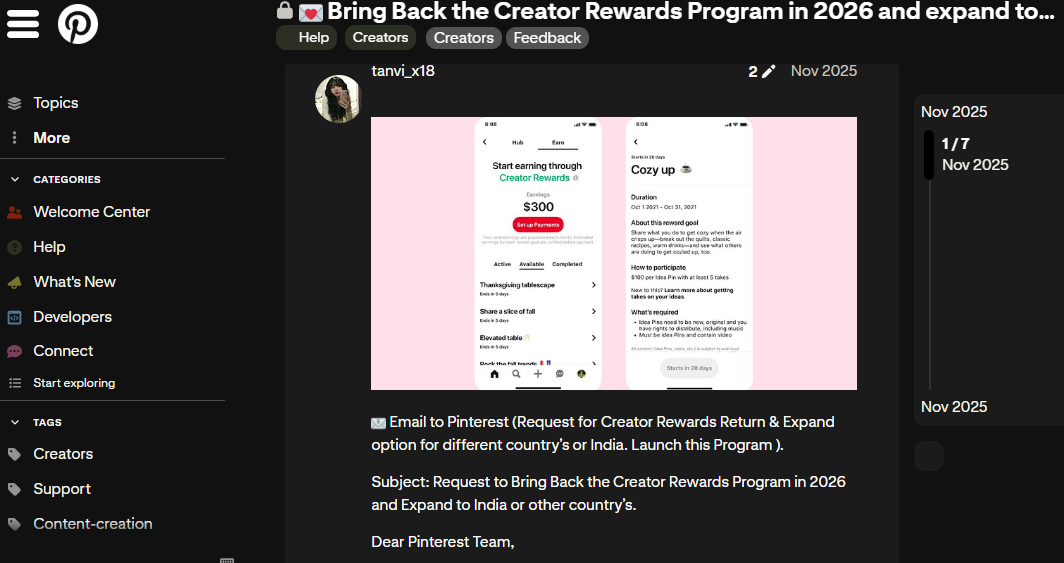
I keep coming back to a single post in the Pinterest Business Community forum1. It is dated late 2025. A creator writes a formal letter, the kind you’d send to a landlord or a school board, asking Pinterest to bring back a program the company killed three years earlier. The tone is polite. Almost apologetic. The creator addresses “the Pinterest Team” and signs off the way you’d sign a job application. Reading it, I felt the particular ache of watching someone ask, sincerely, for something that is never coming back.
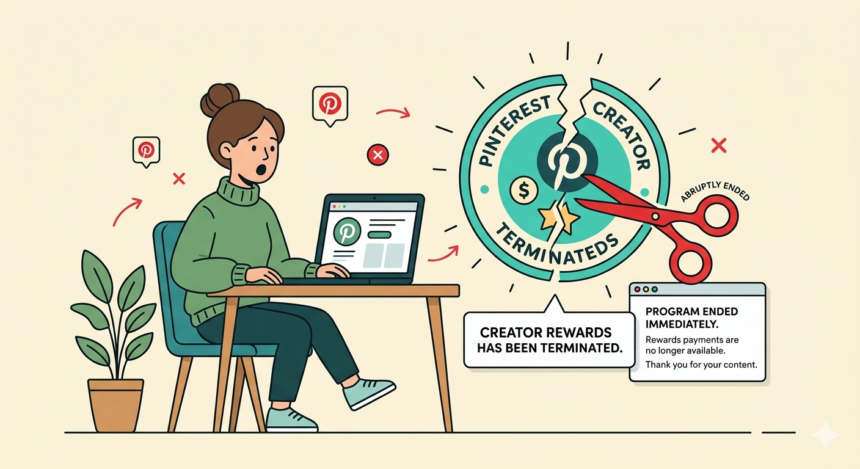
That something was Creator Rewards. For about a year, from late 2021 to the end of November 2022, Pinterest paid people cash to make short videos called Idea Pins, built around monthly themes the company handed down like assignments. Then, on November 30, 2022, Pinterest shut it off. Not with a press conference. Not with a blog post timed for maximum visibility. With a note quietly placed atop a help page, thanking creators for their partnership and wishing them luck finding success elsewhere, as reported by TechCrunch2.
I want to take that note apart. Not because Pinterest is uniquely villainous here. It isn’t. But because the shutdown of Creator Rewards is a clean specimen, almost a control group, for something that has happened over and over across the platform economy. A company builds a monetization program to attract creators during a growth phase. The growth phase ends. The program disappears. And the people who built their income, their content calendars, even their identities around that program are left holding nothing but screenshots.
The Pitch
Go back to April 2021. Pinterest announces its first Creator Fund, a $500,000 pool aimed at creators from underrepresented communities, paired with something called the Creator Code, a set of content guidelines creators had to accept before publishing video content, according to Pinterest’s own announcement filed with the SEC and reported by Stock Titan3. The framing was earnest. Alexandra Nikolajev, then Pinterest’s Creator Inclusivity Lead, talked about building a platform that reflected its community and committed to ensuring half of the creators Pinterest worked with came from underrepresented groups.
By the fall of that year, Pinterest went bigger. The company unveiled Idea Pins, a video format that TechCrunch4 described at the time as Pinterest’s answer to TikTok and Instagram Stories combined. Alongside it came the headline number: $20 million committed to a new program called Creator Rewards. The pitch was straightforward. Pinterest would hand creators a monthly theme. Hit certain engagement goals with Idea Pins built around that theme, and Pinterest would pay you. Aya Kanai, Pinterest’s head of content and creator partnerships, framed it as creators getting discovered and rewarded for the inspiration and sales they generated for brands, a quote that ran in TechCrunch’s coverage5 of the expansion.
Twenty million dollars sounds like a lot until you put it next to what everyone else was doing. TikTok had already committed $200 million to its creator fund. YouTube Shorts had a $100 million pool. Snap was, at one point, paying out a million dollars a day to creators. Pinterest’s $20 million was a rounding error by comparison, but it was new, it was real money, and for a certain kind of creator, the kind who had built an audience pinning recipes, home decor, and budgeting templates rather than dancing on TikTok, it was the first time Pinterest had ever paid them directly for anything.
The Money Was Real, Until It Wasn’t
I want to be specific about what “real” meant here, because the abstractions get slippery fast. On a Substack newsletter6 written by a creator named Jenn, I found a number that stuck with me. She wrote:
I made almost $40K from Pinterest Creator Rewards, including a record $10K+ month. I also had a chance to participate in other creator-based programs but, I’ve missed the boat on a few, as well. Not this one
That is not pocket change. That is rent. That is a car payment and a kid’s daycare bill. For a person making content from home, often around parenting, recipes, or budgeting niches that rarely get the glossy brand deals that flow to fashion and beauty influencers, that kind of money from a single platform program is transformative.
On another blog, Keep Calm and Chiffon7, the writer describes making over five figures from the Creator Rewards beta and calls its cancellation, in plain terms, a bummer for a lot of content creators. She’s right that it’s a bummer.
This was definitely a bummer for a lot of content creators, myself included—I made over five figures from the Pinterest creator rewards beta program.
But “bummer” is doing a lot of work in that sentence. It’s the word you use when you want to stay positive in front of an audience that depends on you for monetization advice, even as the ground shifts under your own feet.
Here is the thing about programs like this. They don’t just pay you. They shape you. If Pinterest tells you the theme this month is “budget-friendly meal prep” or “small space organization,” and hitting that theme with the right engagement numbers means a few hundred or a few thousand dollars, you make that content. You build your publishing calendar around Pinterest’s prompts. You learn the platform’s preferences the way a farmer learns a buyer’s preferences, planting accordingly. Then the buyer stops buying, and the crop you’ve spent months cultivating, the audience, the content style, the posting rhythm, all of it tuned to a program that no longer exists, doesn’t disappear. But its value to you collapses overnight.
The Announcement Nobody Saw Coming
What strikes me most about the shutdown is how little ceremony attended it. Social Media Today’s8 coverage notes that Pinterest declined to say how much money it had given away in total or how many creators had participated. Even the language of the shutdown notice, posted to a help page rather than announced through any of Pinterest’s usual creator communication channels, suggests a company that wanted this to be a footnote. AdWeek’s9 headline called it Pinterest “unpinning” the program, a pun that undercuts the seriousness of what had just happened to the people relying on it.
The timing tells its own story. Three weeks before the shutdown, in a piece for Benzinga republished on Yahoo Finance10, the framing was explicit. The headline read “Pinterest Pares Back On ‘Creator Rewards’ Program Amid Macro Slowdown.” Not “Pinterest evolves its creator strategy.” Not “Pinterest doubles down on commerce.” Pares back. Amid a slowdown. This was cost-cutting, dressed in the soft language of strategic focus.
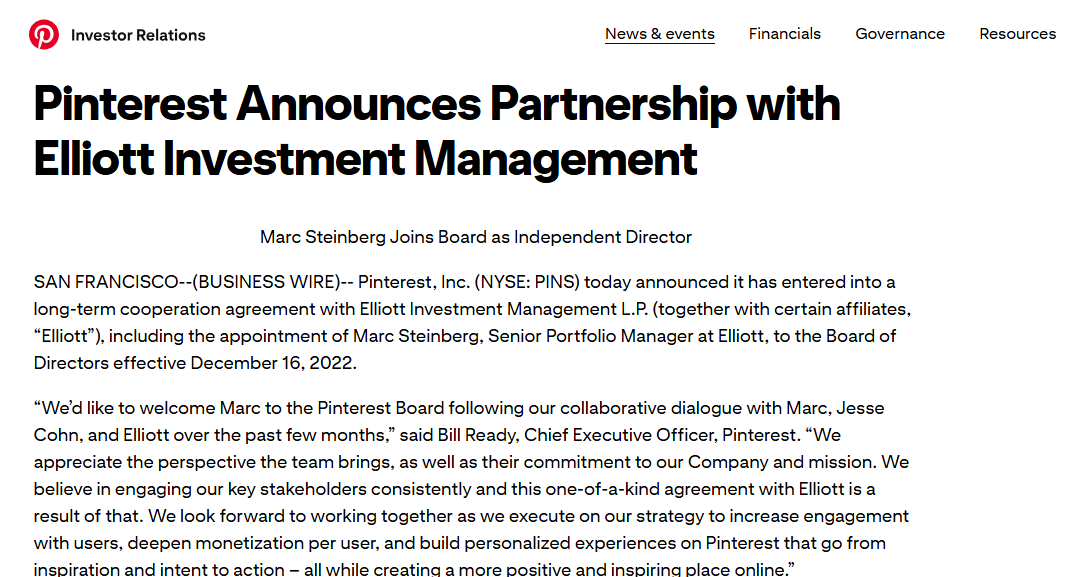
And the broader context matters. Five months before the Creator Rewards shutdown, Pinterest had replaced its CEO. Co-founder Ben Silbermann moved to executive chairman, and Bill Ready, fresh off running commerce and payments at Google, took over. Ready’s mandate, based on his own words in Pinterest’s Q2 202211 shareholder letter, was explicitly about balancing growth with profitability. Six weeks after Creator Rewards ended, Pinterest12 announced a cooperation agreement with Elliott Investment Management, the activist hedge fund known for pushing tech companies toward leaner operations and higher margins. A seat on the board went to Elliott’s Marc Steinberg.
I don’t think you need a conspiracy here. You just need a timeline. A new CEO arrives with a commerce background and a profitability mandate. An activist investor with a reputation for cost discipline gets a board seat. And in the gap between those two events, a $20 million creator payment program, one that had been running for barely a year, gets switched off with a help-page notice. The creators who built their content strategies around Pinterest’s prompts were never part of that conversation. They were a line item that got reviewed during a macro slowdown and found wanting.
This Was Never Just a Pinterest Story
What makes the Creator Rewards shutdown worth writing about, three years after the fact, is how unoriginal it turned out to be. The same TechCrunch article that broke the Pinterest news mentioned, almost as an aside, that Snapchat had recently cut its creator payouts from millions of dollars per week to millions of dollars per year, an order-of-magnitude reduction. Meta had just closed its Live Shopping program and shut down its Instagram affiliate program, the one that let creators earn commissions when followers bought tagged products.
Later coverage from TechCrunch13 noted that Meta, which had committed a full billion dollars to creator bonus programs, paused its Reels bonuses on both Facebook and Instagram. TikTok, meanwhile, was busy retiring its original creator fund, the one launched in 2020 with a billion-dollar, three-year commitment, replacing it with something called the Creativity Program after years of creator complaints about how little the original fund actually paid out.
Look at that list again. Snap. Meta. TikTok. Pinterest. Four of the largest platforms on earth, each running a version of the same play within roughly the same eighteen-month window. Launch a creator fund during a period of growth and investor enthusiasm for “the creator economy.” Generate headlines about millions or billions of dollars in commitments. Let creators build content strategies and, in some cases, entire livelihoods around the program. Then, when the macro environment sours, when interest rates rise, when growth slows, and investors start asking harder questions, quietly wind the program down.
None of these companies frames it as a betrayal. Pinterest said it was closing Creator Rewards “in order to focus on other creator programs and features.” That phrase, “other creator programs and features,” is doing enormous work. It implies continuity. It implies that creators are simply being redirected to a different door, when in fact the building behind that door often doesn’t pay cash at all.
What Replaced It (Spoiler: Not Much, Then Something Else)
For roughly three years, Pinterest’s answer to “how do creators get paid” was, essentially, “they don’t, not directly.” Pinterest no longer offers a platform-wide direct payout system, and the end of Creator Rewards in late 2022 was not replaced by any permanent pay-per-post mechanism. Instead, creators were pushed toward affiliate marketing, shoppable pins, and brand partnerships, the same toolkit available to anyone with a blog and a Pinterest account, creator program or not.
The company did keep the Creator Fund alive and even expanded it. A 2025 announcement marked five years of what Pinterest now calls the Inclusion Fund, an incubator-style program connecting creators in beauty, fashion, and lifestyle with merchants, running across more than a dozen countries. The numbers sound impressive in aggregate. Pinterest says the program has supported over 350 creators since 2021 and that merchant participants increased their saves by 250 percent after completing it.
But read that against what Creator Rewards offered. Creator Rewards was open, in principle, to any eligible creator who hit a monthly engagement target. It was a standing offer. The Inclusion Fund, by contrast, is application-based and cohort-limited. A 2026 strategy guide by BlogGrower14 for new Pinterest creators describes grants of up to $25,000 going to selected cohorts, alongside ad credits and brand mentorship, but frames it as something you apply for and might not get, not something you earn through consistent output. The guide’s own language is telling: as a Pinterest creator today, you don’t get paid for views, you get paid for intent, meaning the platform’s commerce engine, not Pinterest itself, is now the thing standing between a creator and a dollar.
That is a fundamentally different relationship. Creator Rewards, whatever its flaws, was Pinterest saying: make this kind of content, hit this kind of number, and we will pay you, directly, from money we have set aside for that purpose. What exists now is Pinterest saying: build an audience, hope they buy something through your links, and we will take none of the risk and most of the upside in ad revenue regardless of how your personal numbers shake out.
The Forum Post, Revisited
Which brings me back to that forum post from late 2025. The creator writing it isn’t asking for something exotic. They’re asking Pinterest to bring back a program that existed, briefly, three years earlier, and to expand it to new markets, specifically mentioning India. Read the full Pinterest thread15, and you get the sense of someone writing into a void. There’s no indication that Pinterest staff responded. There’s no indication this request went anywhere. It sits in a community forum, one post among thousands, a small monument to the gap between what creators remember and what platforms are willing to offer again.
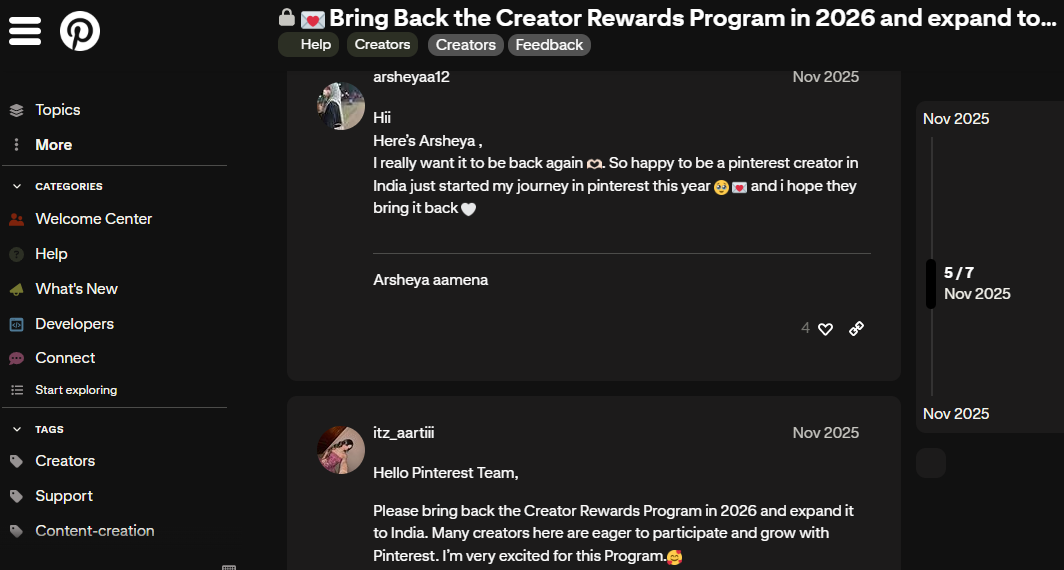
I think about this gap a lot, and here is where I’ll offer my own read on it, for whatever it’s worth. Platforms love the word “community” when they’re building these programs and love the word “ecosystem” when they’re winding them down. A community implies mutual obligation. An ecosystem implies a set of organisms that adapt or die, with no party responsible for the others’ survival. Creator Rewards was announced using community language, partnership, inclusivity, and uplifted underrepresented voices. It was retired using ecosystem language, “other creator programs and features,” a phrase so vague it could mean anything or nothing.
The creators who showed up for Pinterest during the Creator Rewards era weren’t wrong to take the program seriously. Forty thousand dollars, ten thousand in a single month, that’s not a side hustle for most people. That’s a meaningful chunk of household income, the kind of money that gets spent on real things before it gets spent on anything discretionary. When that income disappears via a quiet edit to a help page, the disruption isn’t abstract. It’s a budget that no longer balances.
What This Pattern Actually Costs
There’s a broader cost here too, one that’s harder to put a number on. Every time a platform launches and then kills a creator payment program, it teaches the next generation of creators a lesson, whether the platform intends to or not. The lesson is: don’t build anything that depends on this. Don’t plan your content calendar around the platform’s prompts. Don’t treat this income as real until it’s in your bank account, and even then, don’t count on it next quarter.
That’s a rational response from creators, and it’s also corrosive to the thing platforms claim to want, which is creators who invest deeply in the platform’s specific format and audience. A creator who has internalized that lesson hedges everything. They post the same content across five platforms simultaneously, optimized for none of them specifically. They build email lists and Patreon pages as fast as possible, treating any single platform’s audience as borrowed, not owned, because it is. Pinterest, TikTok, Snap, and Meta all, in their own ways, spent the early 2020s asking creators to trust them with cash incentives, and then spent the back half of the decade watching those same creators build their actual businesses somewhere the platform couldn’t touch.
I don’t think Pinterest set out to teach that lesson. I think a company under new leadership, with a profitability mandate and an activist investor watching the spreadsheet, looked at a $20 million line item with no proven return on advertiser revenue and cut it, the way companies cut things during slowdowns. That’s a defensible business decision in isolation. But business decisions don’t happen in isolation for the people on the other end of them. For the creator who made $40,000 in 2022 and watched that number go to zero in December, the macro slowdown wasn’t macro at all. It was the most personal thing in the world.
Where Things Stand Now
As of this writing, in mid-2026, Pinterest has not brought Creator Rewards back, despite at least one public request to do so. The company’s creator monetization strategy now runs through the Inclusion Fund, affiliate links, shoppable pins, and paid partnerships, all of which place the burden of conversion, and therefore the burden of risk, on the creator rather than the platform. Pinterest’s broader business has, by most financial measures, stabilized since the rocky 2022 period, with the company continuing to report revenue growth and expanding its commerce ambitions.
What hasn’t been restored is the simple, direct relationship Creator Rewards offered for its brief life: do this specific thing, hit this specific number, get paid this specific amount, by the platform, no middleman, no algorithm-dependent affiliate click required. That kind of program is expensive, and it’s the first thing to go when a company needs to show investors it’s serious about margins. Pinterest proved that in November 2022. Snap, Meta, and TikTok proved versions of it around the same time. The lesson, for anyone building a career on a borrowed platform in real estate, isn’t really about Pinterest at all. It’s about how little any of these companies are willing to commit to, once the bill comes due.
Sources
- X18, Tanvi. “💌 Bring Back the Creator Rewards Program in 2026 and expand to India and other countries” Pinterest Business Community, 21 Nov. 2025, community.pinterest.biz/t/bring-back-the-creator-rewards-program-in-2026-and-expand-to-india-and-other-countries/40618. Accessed 24 June 2026. ↩︎
- Mehta, Ivan. “Pinterest shuts down its ‘Creator Rewards’ program” TechCrunch, 30 Nov. 2022, techcrunch.com/2022/11/30/pinterest-shuts-down-its-creator-rewards-program/. Accessed 24 June 2026. ↩︎
- StockTitan, www.stocktitan.net/news/PINS/pinterest-launches-creator-code-new-comment-moderation-tools-and-a-q8trnig94y6n.html. Accessed 24 June 2026. ↩︎
- Perez, Sarah. “Pinterest gets more TikTok-like with a ‘Watch’ tab for videos, announces $20M in creator rewards” TechCrunch, 20 Oct. 2021, techcrunch.com/?p=2220913. Accessed 24 June 2026. ↩︎
- Perez, Sarah. “Pinterest rolls out new features that let creators make money from pins” TechCrunch, 27 July 2021, techcrunch.com/?p=2181909. Accessed 24 June 2026. ↩︎
- Leach, Jennifer. “Meta is paying creators up to $5,000 to post – no minimum followers required” Jenns Newsletter, 22 Jan. 2025, jennleach.substack.com/p/meta-is-paying-creators-up-to-5000. Accessed 24 June 2026. ↩︎
- Keep Calm and Chiffon, keepcalmandchiffon.com/blog/monetize-pinterest/. Accessed 24 June 2026. ↩︎
- Hutchinson, Andrew. “Pinterest Ends its Creator Rewards Program for Idea Pins” Social Media Today, 29 Nov. 2022, www.socialmediatoday.com/news/Pinterest-Ends-Creator-Rewards-Program/637578/. Accessed 24 June 2026. ↩︎
- AdWeek, www.adweek.com/media/pinterest-unpins-its-creator-rewards-program/. Accessed 24 June 2026. ↩︎
- Yahoo Finance, finance.yahoo.com/news/pinterest-pares-back-creator-rewards-152903621.html. Accessed 24 June 2026. ↩︎
- “SEC.gov”, www.sec.gov/Archives/edgar/data/0001506293/000150629322000097/q2-22xshareholderletter.htm. Accessed 24 June 2026. ↩︎
- Pinterest, investor.pinterestinc.com/news-and-events/press-releases/press-releases-details/2022/Pinterest-Announces-Partnership-with-Elliott-Investment-Management/default.aspx. Accessed 26 Aug. 2026. ↩︎
- Malik, Aisha. “Pinterest expands its Creator Fund for underrepresented groups to five more countries” TechCrunch, 4 Apr. 2023, techcrunch.com/?p=2523900. Accessed 24 June 2026. ↩︎
- “How to Become a Pinterest Creator and Get Paid (2026 Strategy)” BlogGrower, bloggrower.com/blog/how-to-become-pinterest-creator-get-paid. Accessed 24 June 2026. ↩︎
- X18, Tanvi. “💌 Bring Back the Creator Rewards Program in 2026 and expand to India and other countries” Pinterest Business Community, 21 Nov. 2025, community.pinterest.biz/t/bring-back-the-creator-rewards-program-in-2026-and-expand-to-india-and-other-countries/40618. Accessed 24 June 2026. ↩︎