
There is a particular cruelty in promises that expire. In cities from Jakarta to Manila, from Kuala Lumpur to Singapore, hundreds of thousands of drivers signed up to work for Grab in the mid-2010s with a calculation that seemed, at the time, almost too good to be true. It was. The company spent years flooding its markets with cash incentives, building an army of driver-partners who had, in many cases, taken out loans to buy cars or motorcycles specifically to work the platform. Then, once dominance was secured, those incentives began to shrink. In some markets they vanished almost entirely. The drivers who had restructured their lives around Grab’s early promises were left holding the debt and the shortfall.
This is not an accident or a miscalculation. It is a strategy. It has a name in the tech industry, “money burning,” and Grab executed it with more precision and more scale than almost any company in the world. Understanding what happened to Grab drivers across Southeast Asia requires understanding that strategy, the human cost it leaves behind, and the regulatory reckoning that is only now beginning to take shape.

The Honeymoon Period
When Grab and its main rival Gojek launched their money-burning campaigns across Southeast Asia between 2015 and 2019, the numbers were extraordinary. According to research published by Asian Labour Review1, car drivers on Indonesian platforms could earn gross income of around 581,892 rupiah per day during the peak incentive period, while motorcycle drivers made roughly 381,712 rupiah daily. These were incomes approximately three times the average minimum wage in Indonesia at the time. For workers with limited formal employment options, the opportunity appeared transformative.
The logic behind the generosity was straightforward. Both Grab and Gojek were in a land-grab phase, competing ferociously for driver supply, passenger loyalty, and market share across eight countries simultaneously. The cash had to keep coming. Incentives were structured not just as bonuses but as psychological anchors. Drivers who hit daily trip targets earned additional payouts. Weekly streaks rewarded consistency. Referral bonuses encouraged existing drivers to recruit friends and family. The whole architecture was designed to maximize time spent on the platform and to make the prospect of switching, or quitting, feel costly.
A 2019 study from the National University of Singapore’s Centre for Governance, Institutions and Organisations2 found that when competitive pressure in Singapore eased following the Grab-Uber merger of 2018, 87 percent of drivers reported a decrease in their earnings, with 77 percent of those drivers seeing earnings fall by more than 10 percent. The study found that nearly 40 percent of drivers were dissatisfied with their incentives in the post-merger period, compared to just 24 percent before the merger.
The lesson was plain: market dominance and incentive generosity moved in opposite directions.
When the Music Stopped
Nuryani is a 48-year-old woman who drives for both Grab and Gojek in Indonesia. She remembers with some clarity what the early days felt like. As she told the International Trade Union Confederation3, she once earned 300,000 rupiah a day on the platform. Now a 17-hour shift can net less than 100,000 rupiah. Barely seven US dollars. “Gasoline is not included, food is not included, sometimes parking is also required, and the customer doesn’t want to pay for parking,” she said. Her experience is not unusual. It is representative.
The pattern played out similarly across Indonesia, the Philippines, Malaysia, and Singapore, with local variations in timing and intensity. Academic research from Notes from Below4 documents that during the money-burning period, driver income was high enough to suppress organized protest — there was no particular reason to fight when the pay was good. The problems began when the incentive phase ended.
In Indonesia, that shift triggered one of the most sustained waves of labor protest in the country’s gig economy. Between March 2020 and March 2022, a study on ResearchGate5 documented 71 separate protests by app-based drivers, with 34 of them, nearly half, directly involving Grab drivers. The forms of protest ranged from mass street demonstrations to blockades of Grab offices to coordinated app log-offs. Among the drivers who participated in surveys, 89.23 percent reported that Grab’s policy changes had cost them financially. The flexibility that had been sold as one of the platform’s core benefits turned out, in practice, to be largely illusory. Grab retained the ability to deactivate accounts, deprioritize drivers it deemed undisciplined, and restructure pay at will — all without the consultation processes that would be standard in any conventional employment relationship.
Igun Wicaksono, a representative of Indonesian gig worker organizations, put the shift bluntly. Speaking to the ITUC6, he described how the platforms first drew drivers in with attractive rates. “But after time,” he said, “the platforms turned out to be carrying out business practices that are detrimental to online motorcycle taxi driver partners.”
The Philippines: Street Protests and Suspended Accounts
In the Philippines, the confrontation between Grab and its drivers took on a particular sharpness. In October 2023, INQUIRER.net7 posted that hundreds of GrabFood delivery riders gathered in Quezon City to protest an impending base fare reduction.
The company had announced plans to cut the minimum delivery fare from 45 pesos to 35 pesos, a reduction of more than 22 percent, while also reducing the per-kilometer rate from 10 pesos to 7 pesos.
A representative from the Kapatiran sa Dalawang Gulong (Kagulong) group captured the collective frustration. “Riders’ meager income must be increased because they could no longer cope with the high prices of basic commodities, but instead Grab unfairly reduced them without even conducting enough consultations with the riders they fondly called partners,” the representative said in a statement.
The protest in Quezon City was not a one-off. By December 2023, food delivery riders were again in the streets, backed by the National Union of Food Delivery Riders, demonstrating against what they described as unfair management practices and demanding that colleagues suspended or terminated for participating in protests be reinstated. The union’s position was unambiguous: Grab had used its power over account access as a weapon against workers who dared to organize.
The Philippines protests were also echoed months earlier in Cebu City. In November 2022, The Freeman8 reported that around 100 Grab delivery drivers held a unity ride at Fuente Osmeña Circle to protest cuts in delivery pay and changes to the “Gems” incentive system. Driver Jefren Abalo, who organized the United Delivery Riders of the Philippines, described the specific betrayal of the Gems program: 55 gems had once been worth 120 pesos, a reliable conversion that drivers had built their daily calculus around. The terms changed without meaningful notice.
In response to the Cebu protests, Grab Philippines said it had been “balancing the prices of fares due to the tough economy” and that the company wanted to “attract and support our consumers who have been tightening their belt because of the increasing prices of commodities.” It was a response that placed the interests of consumers explicitly ahead of workers and made that prioritization feel like a natural law.
Malaysia: The Restructured Fee Row
Malaysia’s confrontation came with its own bureaucratic texture. According to Technode9, in January 2024, Grab Malaysia restructured its delivery fee and bonus framework, a move that triggered protest calls from delivery partners who said the new structure reduced their overall take-home pay. The company defended the changes as a response to driver feedback, arguing that bookings requiring “more time and effort will be more fairly compensated” under the new model.
Grab Malaysia offered a suite of adjustments in response to the backlash. A 20 to 30 percent increase in far pick-up bonuses, greater emphasis on peak-hour performance bonuses, and improved wait-time compensation. But drivers who had been on the platform for years recognized the pattern: each restructuring tended to reframe pay in ways that looked better on a spec sheet than in an actual week’s earnings.
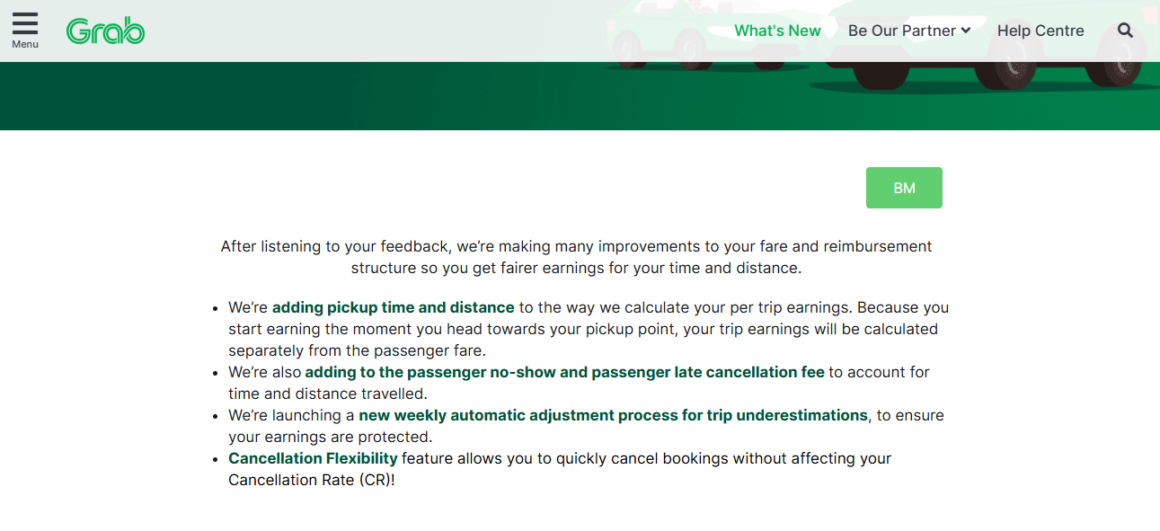
By mid-2024, the company was trialing a new earnings structure for Malaysian drivers in cities including Klang Valley, Penang, Johor Bahru, and Kota Kinabalu. According to Grab Malaysia’s10 own platform documentation, the new structure was described as offering “fairer earnings for time and distance” and had received approval from the relevant Malaysian authorities. Drivers could opt in but were committed to the new structure for a minimum of seven days at a time.
What the polished language obscured was the deeper structural shift that had been underway for years: Grab had spent the early part of the previous decade paying drivers more than it collected in commissions from them. Burning investor capital to buy loyalty and market share. That era was over. Every restructuring since then has moved, in aggregate, in one direction.
Singapore: Falling Fares and a Legal First
Singapore presents the clearest case study in how market structure shapes incentive policy. After Grab absorbed Uber’s Southeast Asian operations in 2018, it controlled roughly 50 percent of Singapore’s ride-hailing market. According to Yahoo! News11, in 2024, Channel News Asia interviewed eight private-hire drivers and found that all of them, without exception, reported that fares and incomes had fallen over the previous six months. Lee Chin Chye, a 56-year-old Grab driver, had seen his income fall by 10 percent. He told the outlet that lower earnings had forced him to take personal loans to manage his finances. A 31-year-old Gojek driver, who declined to be named, described the 10-percent reduction in his earnings as “tough” but said he continued driving to support his family.
Significantly, drivers using TADA, which operates on a zero-commission model, reported no such decline. The difference was structural. Grab’s take-rate, combined with the steady erosion of its incentive programs following the consolidation of market power, had narrowed the income available to its drivers in ways that non-commission platforms simply did not replicate. Neither Grab nor Gojek responded to queries about whether they had reduced fares, according to the same report.
The Singapore government, to its credit, chose to act rather than simply observe. On January 1, 2025, Singapore’s Platform Workers Act came into force, creating a new legal category for ride-hailing and delivery workers. The law mandates CPF contributions from both platform operators and workers, provides mandatory work injury compensation insurance, and establishes the right to form platform work associations that can collectively negotiate with operators on pay and conditions.
The Lee Kuan Yew School of Public Policy at NUS12 described the law as one of the first of its kind globally, a significant step in addressing the classification dilemma that has frustrated gig worker advocates worldwide. The Act does not reclassify drivers as employees. It instead creates a third category, between employee and independent contractor, that carries some of the protections of employment without the full suite. For Grab drivers in Singapore, this means the company must now make CPF contributions for younger workers and provide injury coverage for accidents that occur during active pick-up and delivery tasks.
The immediate knock-on effect was a platform fee increase. The Star13 reported that ride-hailing operators in Singapore raised platform fees by up to S$0.50 starting January 1, 2025, passing part of the cost of compliance onto passengers. This was predictable and probably inevitable. What remains to be seen is whether the new collective representation rights will give drivers enough leverage to push back against the longer-running erosion of their effective pay.
The Numbers Grab Wants Investors to See
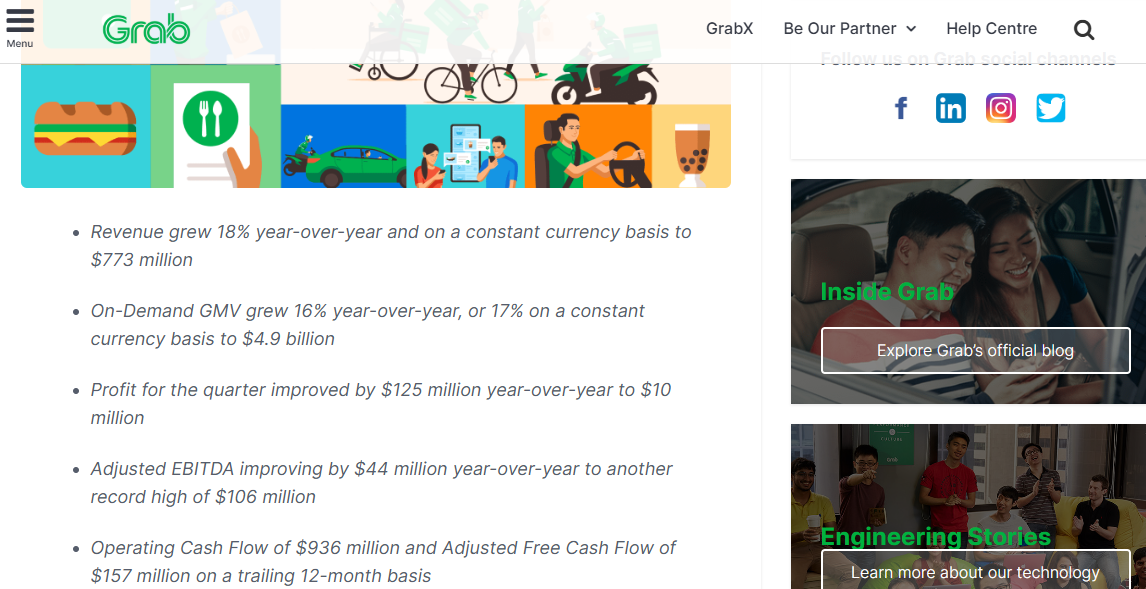
There is a certain ruthless clarity in the way Grab presents its incentive strategy to investors. Its quarterly filings to the US Securities and Exchange Commission treat incentives as a cost line to be managed down, not as a commitment to the workers on whom the entire business depends. In the first quarter of 2024, Grab14 reported that on-demand incentives as a proportion of on-demand gross merchandise value had fallen to 9.7 percent, compared to 10.7 percent in the same period of 2023. The company called this “our focus on reducing our cost to serve while improving the health of our marketplace.”
By the second quarter of 2024, the incentive ratio had held at 10.1 percent, down from 10.5 percent a year earlier. Full-year 2024 saw Grab’s Mobility segment adjusted EBITDA grow 22 percent to $569 million, driven partly by “greater operational efficiencies.” The euphemism that covers, among other things, paying drivers less relative to what passengers pay.
The company did note in its Q4 2024 report that monthly active driver supply had reached an all-time high, increasing by 16 percent year-over-year. It also reported improvements in driver earnings per transit hour. These figures, however, need to be read carefully. Earnings per transit hour can improve even as total daily earnings stagnate, if drivers are kept busier during the hours they are online. A driver who earns more per hour but works fewer bonus-productive hours may actually take home less.
Grab’s public-facing narrative is that it has “committed to fostering economic growth” for its partners and that it introduced a new driver fare structure to ensure “fair compensation.” The ESG framing it deploys is sophisticated. Its 2024 ESG report15 announced a target to enable 300,000 women and partners with disabilities to earn income through its platform by 2030. The announcement is, on its own terms, admirable. It becomes harder to read charitably when set against the Indonesian driver earning less than seven dollars after 17 hours on the road.
The view from the driver communities themselves, Telegram groups, WhatsApp channels, Reddit threads, and Facebook groups organized by market tends to be rawer and less curated than anything the company produces. Research into Indonesian platform driver protests documented by Arif Novianto in Notes from Below16 drew directly from around 44 social media groups in which drivers organize, complain, plan, and sometimes coordinate collective action. The conversations in those groups tell a story the earnings-per-transit-hour metrics do not.
Drivers in these spaces talk about the treadmill effect: to maintain the same income as previous years, they must now drive longer hours, decline fewer orders, and game the incentive structures more aggressively. They talk about the arms race of multi-apping, running Grab alongside Gojek, foodpanda, or Deliveroo simultaneously to maximize the probability of receiving an order. In Singapore, guides for drivers now routinely recommend running three or more apps simultaneously, accepting whichever platform offers the best-paying job in a given moment. This is a rational response to the narrowing of margins on any single platform. It is also a signal that the platforms have pushed the unit economics of gig work to the point where no single one of them can sustain a livable income on its own.
Filipino drivers on forums have documented the emotional weight of the Gems system collapse in Cebu. Not just as a financial loss but as a betrayal of an understood social contract. “We relied on the incentives to make ends meet,” said Jefren Abalo in a Rappler interview. The past tense is doing a lot of work in that sentence.
The Structural Trap
The deepest problem for Grab drivers is not any single fare cut or incentive restructuring. It is the structural position they occupy in a market that Grab, through years of aggressive subsidization, has now come to dominate.
A study from Labour Review17 found that 76.92 percent of Grab drivers in Indonesia felt that the platform’s promises of flexibility, high income, and better livelihoods were not reflected in reality. The flexibility is real, in the narrow sense that drivers can log on and off when they choose. But the algorithms that determine which drivers receive which orders, which accounts get prioritized and which get sidelined, and what levels of activity are required to qualify for performance bonuses. These are not flexible at all. They represent a form of management control that is arguably more intrusive than anything a conventional employer would attempt, precisely because it is invisible and encoded rather than human and negotiable.
The Asian Development Bank has noted that the risks facing gig workers in the Philippines extend beyond income to safety. A survey by ADB18 of GrabFood drivers across Metro Manila, Cebu, and Davao found that about a third had been in an accident in the past 12 months. Drivers absorb all vehicle maintenance costs, fuel costs, and accident risk personally. When Grab trims its incentive budgets, those fixed costs do not shrink.
Research on Indonesian gig workers published in academic journals has found that the end of the money-burning period resulted in a drastic drop in driver income and an increase in vulnerability. The Ministry of Transportation in Indonesia found that 50.1 percent of surveyed ojol drivers earned daily gross income in the range of only 50,000 to 100,000 rupiah, roughly three to seven US dollars, while 44.1 percent admitted their operating costs fell in the same range. Net income for many drivers has approached zero.
What hangs over all of this is the question of worker classification. Grab’s SEC filings acknowledge the risk explicitly. The company has noted in its filings that the independent contractor status of its drivers is “currently being challenged in courts, by government agencies, non-governmental organizations, groups of drivers, labor unions and trade associations” across the world, and that interest from Southeast Asian regulators is growing.
Singapore’s Platform Workers Act is the region’s most substantive response to this question so far, but it deliberately stopped short of employee classification. The choice reflects a compromise: lawmakers were unwilling to disrupt the flexibility that the gig model provides, for workers as well as platforms, but also could not ignore the welfare gaps that a pure independent contractor model creates.
The harder question is whether even Singapore’s approach goes far enough. CPF contributions and injury insurance address specific vulnerabilities. They do not address the core issue of algorithmic power. The company’s ability to change pay structures, adjust incentive thresholds, and deprioritize drivers who step out of line, without any meaningful avenue for challenge or negotiation beyond the fragile new collective representation rights the Act establishes.
The arc of Grab’s incentive story in Southeast Asia is, in some respects, a compressed version of a story that has played out more slowly in older industries: a disruptive entrant buys loyalty with subsidized pricing, achieves market dominance, then uses that dominance to extract more value from the workers and customers it now controls. What makes the Grab story distinctive is the speed, the scale, and the degree to which it was executed across economies with limited labor protections and large populations of workers with few alternatives.
There are drivers in Manila who took out loans to buy motorcycles when GrabFood’s incentive structure made the investment look rational. There are drivers in Jakarta who shifted from informal ojek work to the Grab platform when the bonuses made it the obvious choice. There are drivers in Kuala Lumpur who structured their lives around weekly streak bonuses that no longer exist in the same form.
None of them signed a contract that promised those incentives forever. That is precisely the point.
The gap between the story Grab tells of economic empowerment, of flexible entrepreneurship, of a triple bottom line, and the story its drivers live narrows with every quarterly filing that celebrates lower incentive spending as evidence of marketplace health. The real measure of marketplace health is whether the people doing the work can afford to keep doing it.
In Jakarta, in Manila, in Kuala Lumpur, and in Singapore, that question is still very much open.
Sources
- Novianto, Arif. “Resistance is Possible: Lives of Grab Workers in Indonesia” 19 Jan. 2023, labourreview.org/grab-in-indonesia/. Accessed 14 July 2026. ↩︎
- NUS, bschool.nus.edu.sg/blog/press-release/article/healthy-competition-gives-singapores-ride-hailing-market-a-boost-nus-business-school-study/. Accessed 17 July 2026. ↩︎
- ITUC, www.ituc-csi.org/long-silenced-gig-workers-in. Accessed 17 July 2026. ↩︎
- Novianto, Arif. “The Rise of Gig Worker Protests in Indonesia” Notes From Below, notesfrombelow.org/article/rise-gig-worker-protests-indonesia. Accessed 17 July 2026. ↩︎
- “ResearchGate”, www.researchgate.net/publication/370130433_Resistance_is_Possible_Lives_of_Grab_Workers_in_Indonesia. Accessed 21 July 2026. ↩︎
- ITUC, www.ituc-csi.org/long-silenced-gig-workers-in. Accessed 21 July 2026. ↩︎
- “INQUIRER.net” Hundreds of food delivery riders, backed by…, www.facebook.com/inquirerdotnet/posts/hundreds-of-food-delivery-riders-backed-by-the-national-union-of-food-delivery-r/752770320367259/. Accessed 21 July 2026. ↩︎
- “The Freeman” LOOK: Scenes during the unity ride and…, www.facebook.com/thefreemannews/posts/look-scenes-during-the-unity-ride-and-protest-of-grab-riders-under-the-united-de/6061587920574857/. Accessed 26 July 2026. ↩︎
- 19 Jan. 2024, technode.global/2024/01/19/grab-malaysia-says-it-commits-to-enhancing-earning-opportunities-based-on-partners-feedback-after-protest-calls-from-riders/. Accessed 23 July 2026. ↩︎
- “Improved Driver-Partner Earnings Structure | Grab MY” Grab MY , www.grab.com/my/improved-earnings-structure/. Accessed 22 July 2026. ↩︎
- Yahoo! News, malaysia.news.yahoo.com/e-hailing-drivers-singapore-see-044444509.html. Accessed 23 July 2026. ↩︎
- NUS, lkyspp.nus.edu.sg/gia/article/singapores-platform-workers-act-strikes-crucial-balance-for-future-of-gig-economy. Accessed 23 July 2026. ↩︎
- “The Star” Commuters using four taxi or private-hire…, www.facebook.com/TheStarOnline/posts/commuters-using-four-taxi-or-private-hire-platforms-to-book-their-rides-will-con/1514494654046388/. Accessed 23 July 2026. ↩︎
- “Grab Reports First Quarter 2025 Results | Grab SG” Grab SG , 29 Apr. 2025, www.grab.com/sg/press/others/grab-reports-first-quarter-2025-results/. Accessed 23 July 2026. ↩︎
- 23 Apr. 2025, s205.q4cdn.com/179588156/files/doc_news/s205.q4cdn.com/179588156/files/doc_news/Grabs-ESG-progress-in-2024-Building-an-ecosystem-for-all-2025-1rCkiYAP8V-2025.pdf. Accessed 23 July 2026. ↩︎
- Novianto, Arif. “The Rise of Gig Worker Protests in Indonesia” Notes From Below, notesfrombelow.org/article/rise-gig-worker-protests-indonesia. Accessed 23 July 2026. ↩︎
- Novianto, Arif. “Resistance is Possible: Lives of Grab Workers in Indonesia” 19 Jan. 2023, labourreview.org/grab-in-indonesia/. Accessed 23 July 2026. ↩︎
- “Gig Economy Employment during the Pandemic: An Analysis of GrabFood Driver Experiences in the Philippines” Asian Development Bank, 13 July 2023, www.adb.org/publications/gig-economy-employment-pandemic-grabfood-philippines. Accessed 23 July 2026. ↩︎