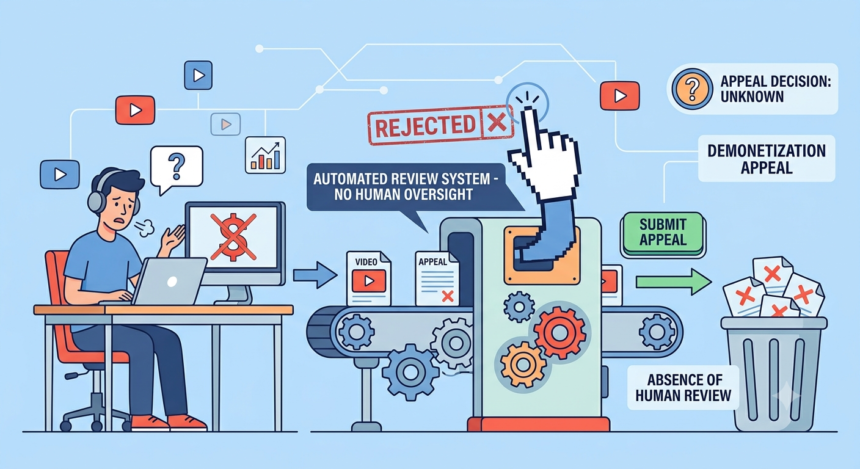

YouTube tells creators that demonetized content will receive human review. But when appeals come back rejected in five minutes flat, creators are left asking: who, exactly, is doing the reviewing?
- The Yellow Dollar Sign and What It Took to Get Here
- What Human Review Actually Means
- The Scale Argument and Why It Holds Water, Barely
- The Numbers That Don’t Add Up
- Who Pays the Price: Marginalized Creators and Algorithmic Bias
- Neal Mohan, Time Magazine, and the Gap Between the Message and the Machine
- The Structural Question No One Wants to Answer
- What Creators Are Left With
On November 13, 2025, an animator named Nani Josh1 lost everything. Not metaphorically. His YouTube channel, built over years of original hand-drawn work and carrying 650,000 subscribers, was terminated for what the platform called “spam and scam violations.”
I'm devastated. A heartbreaking 💔 News for every creator.
— Nani josh (@mister_manners_) November 27, 2025
My original animation channel was terminated for "Spam/Scam" on Nov 13, despite every video being 100% created by me (modeling, rigging, animation took 2-4 days each!).
My appeal was rejected in 5 mins. I desperately… pic.twitter.com/YYYfWfmEQP
He submitted an appeal the same day. The rejection came back in five minutes. Not five hours. Not five days. Five minutes, for years of work. PPC Land2 reported that he wrote publicly: “My life’s work is gone.”
Five minutes is not enough time to watch a single video on his channel, let alone audit years of original content for policy violations. It is, however, more than enough time for an automated system to read a flag, match it against a rule set, and issue a form denial. The math is brutal and simple. YouTube processes more than 500 hours of video every minute. There are not enough human beings on earth to staff a review queue at that volume. So when YouTube insists, as it repeatedly does, that appeals are “manually reviewed” by human staff, what exactly does that mean? And when the evidence from creators suggests otherwise, what is a creator supposed to do?
Those questions sit at the center of one of the quieter power asymmetries on the internet. The demonetization system YouTube built was never really about content policy. It was always about advertiser confidence. And the appeals process that followed was never really about fairness. It was, from the start, about managing volume at scale, which is another way of saying it was built to be handled by machines. Creators are just now beginning to understand what that means for them.
The Yellow Dollar Sign and What It Took to Get Here
The demonetization era on YouTube has a rough origin point: 2017, the year advertisers fled the platform after their ads ran alongside extremist content. According to Berkeley Political Review3, in the scramble to appease brands, YouTube deployed machine learning algorithms to identify content that didn’t meet its new advertiser-friendly guidelines. The yellow dollar sign, signaling limited or no ad revenue, became the platform’s most feared icon. Creators named the event the Adpocalypse, and the name stuck because the collateral damage was real.
In those early days, the errors were almost comical in their randomness. The Verge4 reported that tech reviewer Ben Schmanke published a video comparing cameras on the iPhone X, the Samsung S8, and the LG V30. YouTube initially classified it as suitable for all advertisers. By morning, the green dollar sign had turned yellow. He’d lost 10,000 to 20,000 views worth of ad revenue overnight. He told The Verge: “YouTube said this shouldn’t happen, but obviously it keeps happening.” His was not an isolated case. Dozens of iPhone X review videos from reputable channels were hit in the same sweep. Dylan Hong, who ran a small tech channel, had a video about iPhone X accessories flagged immediately. “I make super advertiser-friendly, family-friendly videos,” he said. “It was just an algorithm fail.”
YouTube responded then by creating a system that let creators appeal. Humans would review the machine’s decision. According to the BBC5, the company said it had used information from those appeals to train its algorithm, resulting in a 30 percent reduction in the number of videos receiving limited ads. That framing was telling. The creator’s appeal was not primarily a path to reinstatement. It was training data. The human review was a correction mechanism for the machine, and the creators doing the appealing were, functionally, unpaid data laborers helping YouTube build a better classifier.
What Human Review Actually Means
YouTube’s public-facing language around appeals is careful but consistent. The company maintains that appeals are reviewed by human staff. The official guidance states that when a creator requests review, a human reviewer will check the video content, title, thumbnail, description, and tags, considering the context, focus, tone, realism, and graphicness of the video. The framing is clinical and reassuring. It implies a person watching your video, thinking about it, making a judgment.
The evidence from the ground tells a different story. In November 2025, the @TeamYouTube6 account responded to a creator named JAm imran, whose channel appeal had been sitting unresolved since October 1, a full 37 days of silence. “Appeals are manually reviewed so it can take time to get a response,” the team wrote publicly. The response prompted immediate backlash from creators who shared experiences directly contradicting the claim: appeals rejected in minutes, automated-sounding form denials, and timestamps that made human review physically impossible.
Sorry to hear this. Appeals are manually reviewed so it can take time to get a response. Just hang tight, you'll hear back soon
— TeamYouTube (@TeamYouTube) November 8, 2025
Creator GBYT posted on X that YouTube uses AI to process appeals, calling the “manual review” claim misleading. Fantasy author John A. Douglas, whose channel was permanently banned without a single prior strike, saw his appeal rejected within moments of submission. He wrote: “After years on this platform with not a single violation, not only did you take down the channel, you rejected the appeal within FIVE MINUTES. Your automated system needs to be thrown into the sun.” One creator support interaction, published in full on Substack7 by the creator involved, begins with a customer service agent introducing themselves by first name and asking “How are you doing today?” The creator who shared the transcript wrote:
“My conversation with YouTube creator support who I’m 99% sure is a chatbot.”
PiunikaWeb.com8, on the Minecraft and Roblox demonetization wave, stated:
“When AI is both flagging content and reviewing appeals, there’s no human in the loop to catch obvious mistakes.”
The Minecraft and Roblox incident in late December 2025 made the structural problem visible at scale. Popular creator KreekCraft tagged YouTube CEO Neal Mohan directly on X:
“YouTube’s AI Moderation has started demonetizing a lot of Roblox and Minecraft channels.”
These weren’t fringe or controversial creators. They were the kind of family-friendly gaming channels that form the platform’s most advertiser-friendly demographic. TeamYouTube said they were “looking into it.” Creators submitting appeals received instant automated rejections. As one analysis noted:
“When AI is both flagging content and reviewing appeals, there’s no human in the loop to catch obvious mistakes.”
The Scale Argument and Why It Holds Water, Barely
It is worth giving YouTube the argument it would make, because the argument is not completely wrong. According to YouTube’s own data as presented by Creator Handbook9, more than 12 million channels were terminated in 2025. In Q3 alone, 7.4 million channels were removed, along with over 74 million videos. The platform acknowledged that over 97 percent of those video removals originated from automated flagging. With 500 hours of video uploaded every minute, the argument that no human workforce could scale to this volume is not a dodge. It is arithmetic.
TeamYouTube even pushed back on the 12 million figure publicly, noting in a December 2025 post that “channels terminated doesn’t equal creators terminated” and that in Q4 2023 alone, 20.5 million channels were removed, many of them linked to coordinated bot networks and spam operations.
You're right that over 12 million channels have been terminated this year, but it varies. For example, 20.5M channels were terminated in Q4 2023 alone.
— TeamYouTube (@TeamYouTube) December 11, 2025
Channels terminated doesn’t = Creators terminated, sometimes a scammy account can have hundreds of channels.
This quarter, the…
The company’s point is that the large numbers reflect success against industrialized bad actors, not a war on legitimate creators. That is probably true for the majority of terminations. The problem is that “the majority” is cold comfort when you are in the minority, and the minority represents millions of real people with real livelihoods.
The deeper issue is what happens when the system is wrong. YouTube did not provide data on how many terminations are overturned following review. It acknowledged that enforcement decisions can be frustrating. It said work is ongoing to improve how policy explanations are communicated. These are the words of an institution that has decided the occasional false positive is an acceptable cost of doing business at scale. That calculus might make sense from a platform engineering standpoint. It does not make sense if you are the animator whose channel just disappeared.
The Numbers That Don’t Add Up
There is a structural absurdity buried inside the appeals process that rarely gets named directly. A creator typically needs at least 1,000 views in the past seven days on a flagged video to trigger manual review. Read that again. To get a human to look at your demonetized video, you need the video to already be performing. The creator who most needs human intervention, the one whose video was incorrectly flagged before it found its audience, is often the one least likely to qualify for it.
Channel-level appeals carry their own punishing clock. Mediacube10 says tha the first appeal must be submitted within 21 days. If it is rejected, the creator must wait at least 90 days before submitting another. That is a three-month revenue freeze for a creator who may have done nothing wrong, with one appeal already spent. For full channel demonetizations, the timeline from suspension to potential reinstatement can stretch to months. The 14-day pause-while-reviewing window only applies if the creator appeals within seven days of the suspension notice. Miss that window, and the penalties begin immediately while the clock on a review is still running.
One reator case study report on YouTube AI demonetization, 2026 presents the quote:
“My channel still gets nearly a million views per month. But zero ad revenue. Current status: Under appeal with no timeline for review.”
A real estate exam preparation channel, producing educational content with clear factual value and direct user benefit. The creator was actively involved in every video: tweaking content, fact-checking AI-assisted scripts where accuracy was critical, fixing pronunciation issues, ensuring audio quality. The channel pulled nearly a million views a month. It was demonetized anyway, for pattern-based reasons connected to production style rather than content quality. Status when the report was written: under appeal, no timeline for review.
Who Pays the Price: Marginalized Creators and Algorithmic Bias
The opacity of YouTube’s demonetization algorithm has always fallen hardest on communities the algorithm cannot properly read. According to The Next Wave11, in 2019, a group of LGBTQ content creators filed a federal lawsuit against Google, claiming the platform’s systems flagged content with words like “gay,” “lesbian,” “bisexual,” and “transgender” for age-restriction and demonetization. Age-restricted videos are not eligible for monetization. The creators alleged they were being financially penalized not for what their content showed, but for what it was about.
The lawsuits were followed by independent audits from creators themselves. Business Insider12 reported that when LGBTQ keywords in video titles were swapped out for neutral words like “friend” or “happy,” the same videos became eligible for monetization. YouTube’s response: “We use machine learning to evaluate content against our advertiser guidelines.” That line has not changed much in eight years. Academic research from the University of Massachusetts Amherst13 found that the opacity of YouTube’s demonetization algorithm had generated lawsuits from LGBTQ, Black, and conservative creators alike, all alleging bias in recommendation and demonetization systems. When everyone across the political and cultural spectrum is complaining about the same thing, the problem is probably structural rather than ideological.
Research published through NSF-funded studies confirmed what creators had been saying: algorithms were stereotyping content featuring vulnerable demographics as “unsafe” for children or families, generating what researchers described as economic, social, and personal harms. Creators wanted more reliable information about demonetization errors, more control over their content and advertising, and better economic recourse when the machine got it wrong. They got none of those things. They got a 90-day wait window and a form letter.
Neal Mohan, Time Magazine, and the Gap Between the Message and the Machine
On December 10, 2025, YouTube CEO Neal Mohan sat down with Time Magazine14, which had just named him CEO of the Year.
The interview covered a lot of ground, but the part that landed hardest in the creator community was his defense of AI moderation. According to PPC Land15, Mohan told Time that AI moderation capabilities improve “literally every week” and help the platform “detect and enforce on violative content better, more precise, able to cope with scale.” YouTube, he noted, was generating over $10 billion in quarterly advertising revenue. The machine was working.
The backlash was immediate. Creator MoistCr1TiKaL called the defense “delusional” in a video watched by more than 1.5 million people. His point was not that AI moderation is inherently wrong. His point was that defending it as precise in the same week creators like Nani Josh were watching years of work disappear inside five-minute appeal rejections was a credibility failure. The CEO was describing a different system than the one creators were living inside.
Creator Master Oogway (5.74 million subscribers), on YouTube, denying his YPP appeal, said
“I made thousands of videos. On this account, I made 5,000. On other accounts, I made a total of 20,000 and then you say I make unoriginal content. Frankly, f**k you guys. Is this how you reward me?
What YouTube is actually doing is running a system built around asymmetric cost tolerance. As It’s Foss16 put it, the platform’s incentives penalize false negatives, content that should have been removed but wasn’t, far more than false positives, content that was removed but shouldn’t have been. An ad running next to a harmful video costs real money in brand reputation and partner flight. An innocent creator losing their channel costs nothing to the platform. The machine is not calibrated around fairness. It is calibrated around advertiser confidence. Those are not the same thing, and they never were.
The Structural Question No One Wants to Answer
YouTube is technically correct that it offers an appeals process. You can click “Request Review” in YouTube Studio. You can submit your case within the allotted window. You can explain, clearly and in good faith, why your content meets the guidelines. The process exists. What does not exist is any mechanism for knowing whether a human ever reads what you write, any obligation on YouTube’s part to explain its reasoning in specific terms, and any recourse beyond a single appeal before a long mandatory wait. YouTube did not provide data on appeal overturn rates. That number, if it exists, has never been made public.
The European Union is beginning to move on this. The Digital Services Act17, which took full effect in 2024, requires platforms to transparently inform users when their content is removed from search or recommendations. It mandates meaningful appeals mechanisms for content removal decisions. Whether those obligations will extend to demonetization decisions with the same rigor is still playing out in regulatory interpretation. But the direction is clear: the era of platforms being able to remove creators’ income with a form denial and no explanation is, in the EU at least, drawing to a close. The United States has no equivalent framework.
There is a legal argument crystallizing around the five-minute rejection problem. One legal analysis by Metamorphix Design18 noted that YouTube’s updated Terms of Service require “reasonable belief” before channel termination, and that five-minute automated rejections of original content may not satisfy that standard.
“A creator builds an animation channel over years. Original work. Human-made, frame by frame. YouTube terminates it for spam and scam violations. The appeal comes back rejected. One creator who documented this experience reported the rejection arrived in under five minutes, less time than it would take a human reviewer to watch a single video, let alone years of original work. That timeline matters. It’s the kind of evidence that puts YouTube’s legal argument in trouble.”
What Creators Are Left With
When the appeal fails, the playbook is grim and familiar. Build a Patreon. Start a Substack. Grow an email list. Diversify revenue. These are the things every creator guide recommends after the yellow dollar sign appears, and they are good advice, but they are also a quiet acknowledgment that the platform cannot be trusted as a primary income source. The advice is structurally identical to telling a delivery worker to keep a second job in case the app deactivates them. It places the burden of platform risk entirely on the worker while the platform retains full discretion over the terms.
The creator MxR Plays, a large comedy commentary channel that was demonetized and eventually reinstated after their community bombarded YouTube with requests on their behalf, put their survival down to one thing: Patreon income that kept them afloat during the appeal window. Not all creators have that. The smaller the creator, the less likely they have diversified revenue, and the less likely their appeal generates enough community noise to attract platform attention. The appeal process, in practice, works best for creators who least need it. The smaller creator, the one for whom ad revenue is the margin between a viable channel and a dead one, is the one most likely to be swallowed by the queue and forgotten.
I find myself thinking about what the word “appeal” actually means. In a system with real accountability, an appeal implies a review body with the power and obligation to reverse a wrong decision. What YouTube calls an appeal is, at best, a request for a machine to reconsider its own output. At worst, it is a procedural placeholder, a gesture toward due process that satisfies the legal language of the Terms of Service without delivering its substance. The button exists. The human does not.
YouTube will not say how many appeals result in reinstatement. It will not say what percentage of demonetizations are errors. It will not commit to a definition of “manual review” that includes a human being watching a video. It will say, again and again, that the system improves every week, that scale demands automation, and that the appeals process is available to every creator. All of this is true. None of it answers the question Nani Josh was asking on November 13, 2025, when his five-minute rejection arrived and his years of work went dark.
Sources
- Josh, Nani. “Nani josh (@mister_manners_) on X” 27 Nov. 2025, x.com/mister_manners_/status/1994029494383071602. Accessed 21 July 2026. ↩︎
- Rijo, Luis. “YouTube CEO defends AI moderation as creators lose channels overnight” 14 Dec. 2025, ppc.land/youtube-ceo-defends-ai-moderation-as-creators-lose-channels-overnight/. Accessed 17 July 2026. ↩︎
- Cantz, Randy. “Adpocalypse: How YouTube Demonetization Imperils the Future of Free Speech” Berkeley Political Review, 1 May 2018, bpr.studentorg.berkeley.edu/2018/05/01/adpocalypse-how-youtube-demonetization-imperils-the-future-of-free-speech. Accessed 17 July 2026. ↩︎
- 14 Nov. 2017, www.theverge.com/2017/11/14/16648348/youtube-demonetizing-iphone-x-videos. Accessed 17 July 2026. ↩︎
- News, BBC. “YouTube tweaks advertising algorithm” BBC News, 30 Oct. 2017, www.bbc.co.uk/news/technology-41801705. Accessed 17 July 2026. ↩︎
- “TeamYouTube (@TeamYouTube) on X” 8 Nov. 2025, x.com/TeamYouTube/status/1987188138402336975. Accessed 20 July 2026. ↩︎
- “Youtube issues warning, does not warn that deleting content after an appeal cancels the appeal” Exulansic, 14 Nov. 2022, exulansic.substack.com/p/youtube-issues-warning-does-not-warn. Accessed 14 July 2026. ↩︎
- 25 Dec. 2025, piunikaweb.com/2025/12/25/youtube-looking-into-moderation-error-that-demonitized-several-minecraft-and-roblox-channels/. Accessed 14 July 2026. ↩︎
- Salinas, Gen. “YouTube addresses AI moderation concerns after reporting 12 million channel terminations in 2025” Creator Handbook, 20 Dec. 2025, www.creatorhandbook.net/youtube-addresses-ai-moderation-concerns-after-reporting-12-million-channel-terminations-in-2025/. Accessed 17 July 2026. ↩︎
- Mediacube, mediacube.io/en-US/blog/youtube-demonetization. Accessed 17 July 2026. ↩︎
- Kaser, Rachel. “LGBTQ+ creators file lawsuit against YouTube for discrimination” 14 Aug. 2019, thenextweb.com/news/lgbtq-youtube-discrimination-lawsuit. Accessed 17 July 2026. ↩︎
- Dodgson, Lindsay. “YouTubers have identified a long list of words that immediately get videos demonetized, and they include ‘gay’ and ‘lesbian’ but not ‘straight’ or ‘heterosexual’” Business Insider, 1 Oct. 2019, www.businessinsider.com/youtubers-identify-title-words-that-get-videos-demonetized-experiment-2019-10. Accessed 17 July 2026. ↩︎
- University of Massachusetts Amherst, par.nsf.gov//servlets/purl/10348425. Accessed 14 July 2026. ↩︎
- Luscombe, Belinda. “Neal Mohan Is TIME’s CEO of the Year” 8 Dec. 2025, time.com/7338621/ceo-of-the-year-2025-neal-mohan/. Accessed 20 July 2026. ↩︎
- Rijo, Luis. “YouTube CEO defends AI moderation as creators lose channels overnight” 14 Dec. 2025, ppc.land/youtube-ceo-defends-ai-moderation-as-creators-lose-channels-overnight/. Accessed 17 July 2026. ↩︎
- “YouTube’s AI is Breaking the Creator Ecosystem” 14 Dec. 2025, itsfoss.com/news/youtubes-ai-mod-enshittification/. Accessed 17 July 2026. ↩︎
- “The Digital Services Act” Shaping Europes digital future, digital-strategy.ec.europa.eu/en/policies/digital-services-act. Accessed 17 July 2026. ↩︎
- Gerber, Jeandre. “We Build Digital Systems That Work For You” Metamorphix Design, 12 May 2026, metamorphixdesign.com/blog/youtube-legal-case/. Accessed 17 July 2026. ↩︎