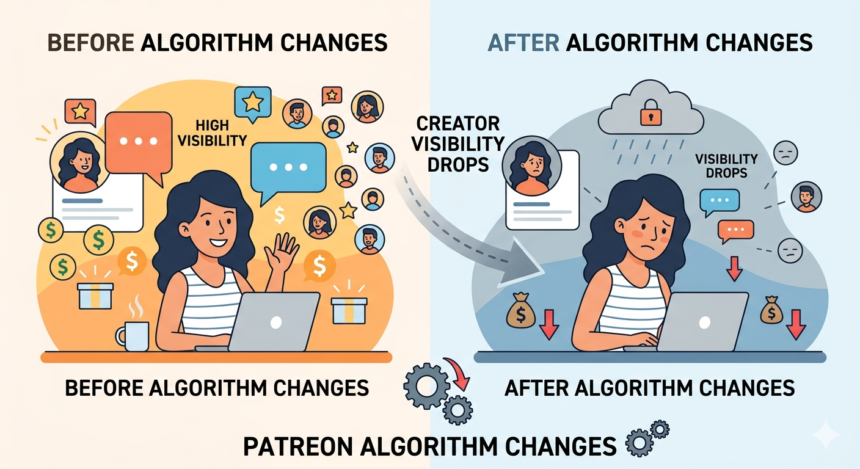

Patreon’s algorithm changes, its fee overhaul, and the slow erosion of creator visibility reveal a company drifting from its founding promise toward the same extractive logic it was built to escape.
What happens when something that was supposed to be the alternative starts looking like the original problem? Patreon was built in 2013 on a specific and seductive premise: that creators should not have to survive on the algorithmic mercy of YouTube, or beg for brand deals, or chase trending audio on TikTok. Jack Conte, the musician and co-founder who coded the first version at his kitchen table, said the platform would give creators a direct financial relationship with the people who cared about their work. No intermediary. No advertiser logic shaping what got made. Just a clean transaction between artists and their audiences.
That story held for a long time. And then, slowly, it didn’t.
Over the past two years, Patreon has made a sequence of product and policy decisions that have each, in isolation, carried a plausible business rationale. Together, they amount to something harder to dismiss: a platform that has started behaving like the platforms it claimed to replace. Creators are discovering that their visibility on Patreon is no longer simply a function of how good their work is or how loyal their audience has become. It is now shaped by an algorithm they cannot see, can only partially influence, and which can dramatically reset without warning.
The damage is real. It shows up in patron counts. It shows up in the forum posts of people who built modest, stable creative businesses on Patreon and are now watching the numbers slip.
The Discovery Problem Nobody Was Supposed to Have
For years, Patreon made a virtue of not having a discovery algorithm. The pitch was elegant in its simplicity: a fan finds you through your public work on YouTube or Twitter or wherever, they click through to your Patreon page, and they subscribe. The platform’s job was to hold the money and deliver the content. It was not supposed to be a gatekeeper. It was not supposed to decide who got seen.
Patreon’s own Help Center documentation1 now tells a different story. The platform’s Explore tab, which surfaces creators to browsing users, uses an automated categorization system that creators cannot directly control. According to that documentation, creators are categorized “based on their content, descriptions, and taglines,” and there is no option to opt out of being featured in Explore. You cannot manually change the category in which you are placed. If the algorithm miscategorizes you, your recourse is to update your bio and hope for the best, or contact support.
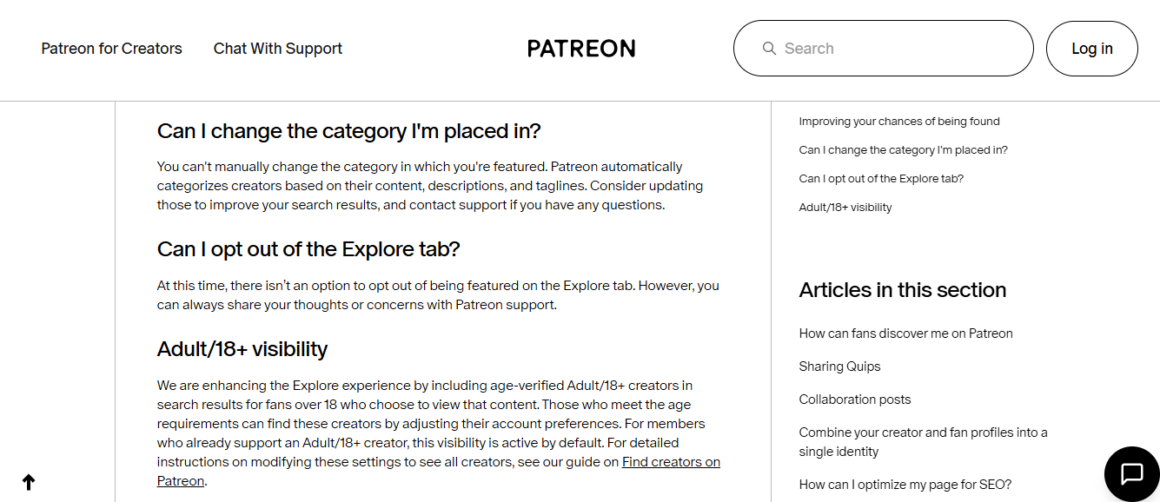
This shift matters because the Explore tab has become one of the primary ways new patrons find creators. Patreon’s March 2025 blog post2 on discovery reported that on-platform discovery was driving over $200 million in annual creator earnings, and that creator recommendations had driven over two million new memberships since the feature launched. Those are impressive numbers. They also mean that algorithmic decisions about who surfaces in Explore translate directly into income for some creators and income losses for others, with no transparent criteria governing which way the coin lands.
Tubefilter’s3 reporting from September 2024 noted that Patreon had not been clear about how it selects which creators are featured in the Explore tab, only saying that featured creators “on average saw an increase in free and paid memberships.” That framing is revealing: it tells you that the algorithm produces winners. What it doesn’t tell you is how it produces losers, or how many of them there are, or what a creator can do about it.
When the Feed Broke
In November 2025, Patreon launched Quips. A new short-form post format described as lightweight public content designed to sit in a redesigned Home feed and reach fans who don’t yet follow you. The format was ambitious. Engadget’s4 coverage from the launch reported that early results showed only “somewhere in the 5 to 10 percent” range of new paid memberships coming from the new feed. Some creators in the early access period did well. Many did not. Patreon’s own network vice president, Drew Rowny, described the system as built around signals including fan engagement, shared fandoms, and creator interaction. Netinfluencer5 noted his framing that the algorithm optimizes for connection, not attention, a line that sounds appealing until you examine what connection means in practice when it is encoded in a recommendation engine.
Then April 28, 2026, arrived. Patreon mass-onboarded a huge wave of new creators into the network simultaneously. The feed dynamics shifted fast. Creators who had been getting over a thousand views on their Quips suddenly saw that number crater. Some reported dropping to under 20 views per post. Patreon6 acknowledged this directly in its Network FAQs post, writing that the company was “actively recalibrating” and promising to tune the algorithm in the short term, bring more fans into the app in the medium term, and build community spaces in the longer term so creators are not “all competing in one giant feed.”
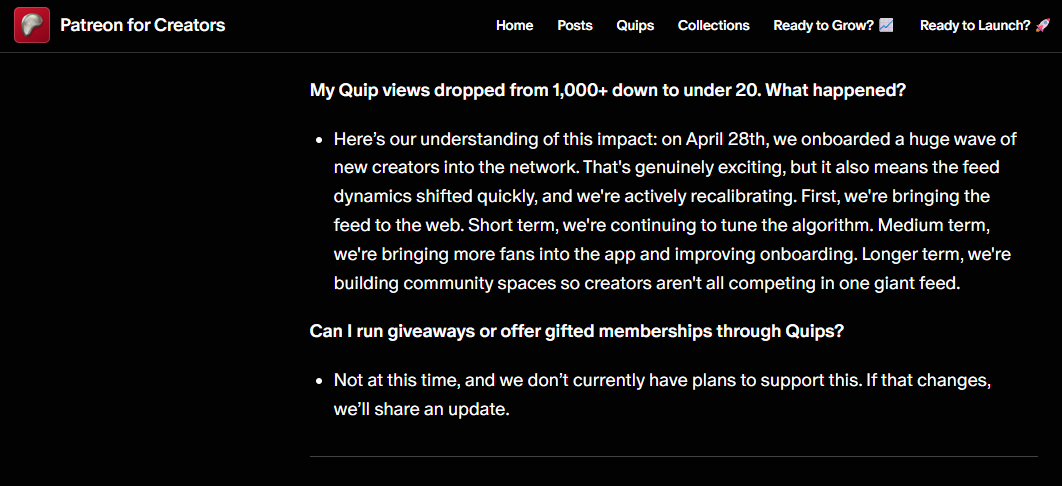
That last phrase deserves attention. Patreon is describing, in its own documentation, a situation where creators are competing against each other for algorithmic visibility in a single feed. That is a precise description of the dynamic Conte built Patreon to escape. The logic that punishes niche creators on YouTube for not hitting a watch-time threshold has arrived, in a softer but structurally similar form, on the platform that was supposed to be their refuge.
What makes this especially hard for affected creators is the opacity. There is no dashboard that shows you where you rank in the algorithm’s prioritization, no score that explains why your Quips reach 900 people one week and 17 the next. The platform tells you to engage with other creators, to post Quips regularly, to use collaboration posts. Patreon’s Help Center guidance on discovery7 states that fan engagement is more than five times higher when posts are boosted through creator interactions. That is not guidance. That is a behavioral nudge toward a pattern of platform-serving activity that benefits Patreon’s engagement metrics regardless of whether it benefits the creator.
Adult Creators and the Visibility Tax
The visibility problem hits adult content creators with particular force. In November 2024, Patreon restructured how Adult/18+ creators appear in discovery surfaces. According to Patreon’s support documentation on the change8, adult creators are no longer shown in the Explore tab by default. Fans must be 18 or older and must actively opt in to see adult creators in search and discovery results. Members who already pledge to an adult creator have the setting enabled by default, but new users browsing Patreon have no exposure to adult creators unless they go looking for them.
This change was framed as a safety measure, and in narrow terms it has that rationale. Patreon had to adjust its iOS app age rating to maintain App Store availability, and separating adult content from the default discovery experience was part of that adjustment. But the practical effect on adult creator visibility has been significant. Patreon’s current Help Center guidance9 acknowledges explicitly that adult creators “may not be shown in discovery surfaces the same way as all-audience creators,” and that some features, including Quips, may not be available to adult creators at all.
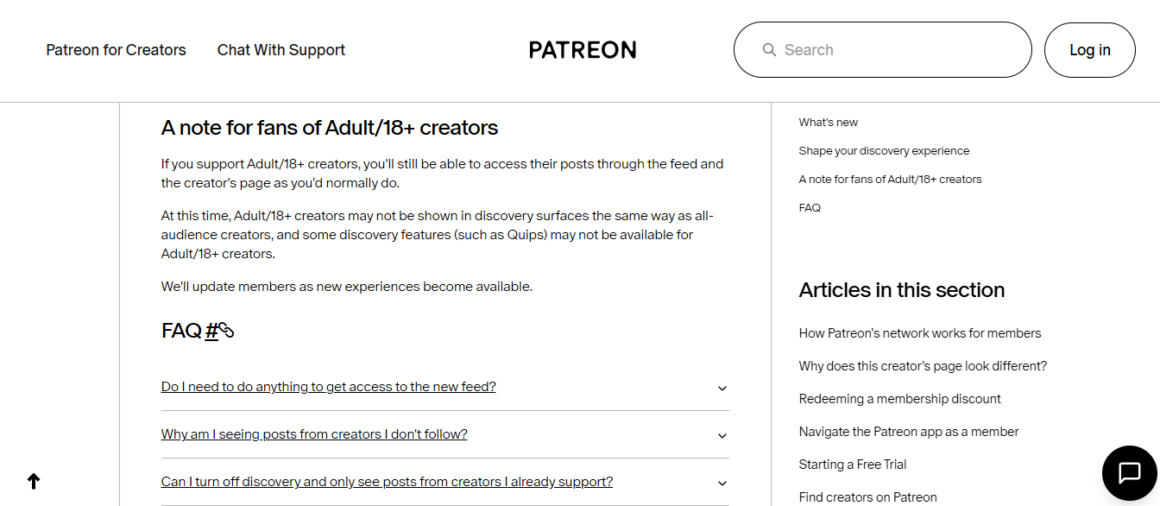
Artists, writers, and illustrators who work in adult categories built their businesses on Patreon in part because the platform had historically treated adult content as a legitimate creative category rather than something to suppress. The November 2024 changes did not ban adult content. But they effectively built a two-tier discovery system, one where adult creators are invisible to anyone who hasn’t already found them somewhere else.
The Apple Tax and What It Tells You
The visibility problem cannot be separated from the financial pressure that has been compounding simultaneously. According to Comics Beats10, in November 2024, Apple began enforcing its 30 percent commission on all new Patreon subscriptions purchased through the iOS app. Apple had previously allowed Patreon to use its own payment system; the requirement to use Apple’s in-app purchase infrastructure changed that. Patreon CEO Jack Conte explained in a video that Apple had threatened to remove the app from the App Store if the company did not comply, describing iOS as the most-used platform for Patreon communities.
The practical outcome was described simply by MacRumors11: creators will either absorb a 30 percent haircut on every iOS transaction, or they raise prices and risk losing patrons who are sensitive to cost. Patreon offered a pricing adjustment tool, but the choice was essentially lose-lose: either your income drops or your patrons pay more.
For a creator earning $2,000 a month with a significant iOS subscriber base, this was not a rounding error. It was a structural income cut dressed up as a compliance issue. The fact that Patreon had no real leverage over Apple does not change what it meant for individual creators. And the Apple issue arrived alongside, not before, a series of Patreon’s own fee changes.
The Platform Fee and What Changed
According to TechCrunch12, in August 2025, Patreon announced a simplified pricing structure for new creators: a flat 10 percent platform fee replacing the previous tiered plans that had offered 5, 8, or 12 percent cuts depending on the plan. Existing creators kept their legacy rates as long as they maintained a continuously published page. The catch, documented by CheckThat.ai’s analysis13 of Patreon alternatives, is that any unpublishing of a page, even briefly, triggers the new 10 percent rate on republishing.
That mechanism deserves scrutiny. Patreon has always had a pause feature, allowing creators to temporarily put their page on hold without losing their settings. But pausing preserves legacy pricing only in certain circumstances. Unpublishing does not. For creators managing life circumstances that require temporary breaks, whether illness, family obligations, or professional transitions, the pricing structure now imposes a financial penalty on the act of returning to the platform. That is not described as a penalty in Patreon’s own documentation. It is described as how the fee structure works.
Combined with payment processing fees, new creators can face total platform deductions reaching 13 to 14 percent, and in some instances 20 to 30 percent. The platform holds a 1.2 out of 5 rating across 873 reviews on Trustpilot, with zero official responses to negative reviews, and the Better Business Bureau has recorded 205 complaints over three years, with 64 closed in the last 12 months.
What the Numbers Say
The creator count data tells a quiet story. Backlinko’s14 tracking of Patreon statistics reports that based on Graphtreon data, 286,287 creators had at least one paying member as of February 2026, representing a drop of roughly 5 percent since June 2025. Monthly creator payouts, which peaked at around $24.14 million in January 2025, dropped to $23.97 million by January 2026, a decline of 0.72 percent over the year.
These are not catastrophic numbers. Patreon is not collapsing. But they represent a platform that has stopped growing in the way that would justify the accumulated friction of its recent changes. Patreon’s own February 2025 State of Create report acknowledged that 53 percent of creators say it is harder to connect with their followers than it was five years ago. That figure came from Patreon’s own research. A platform admitting, in its own published report, that the majority of its creators find audience connection harder than before is a platform that has not solved its core problem.
Subscribfy.ai’s15 reporting on the creator migration cited Statista data suggesting Patreon lost approximately 180,000 creators between October 2024 and March 2025, representing roughly 15 percent of its creator base. Some of this was driven by the fee changes, some by the Apple Tax, and some by creators deciding that building a business on Patreon was no longer a reliable long-term bet. One Reddit user whose account was deactivated after two years put it plainly:
“A company having the right to destroy your livelihood on a whim is a basket you don’t wanna put all your eggs in.”
That person was talking about account deactivation specifically. But the sentiment extends to everything discussed here. The fear is not that Patreon will explode. It is that it will gradually shift in ways that benefit the platform’s growth metrics at the expense of the creator relationships it was built to serve.
The Deeper Structural Tension
Here is what I think is actually happening, and it is worth saying plainly. Patreon is under pressure to justify its valuation and demonstrate the kind of growth that venture capital expects. The company has raised over $413 million in funding. Platforms that raise that kind of money do not get to be modest, steady subscription businesses forever. They get pushed toward engagement metrics, time-on-platform, network effects, and the kinds of features that attract new users at scale.
The discovery network, the Quips format, and the Home feed are all expressions of that pressure. They are good features in the abstract. A platform where creators can grow organically without relying entirely on external social media makes sense as an idea. Patreon VP Drew Rowny has articulated this clearly, telling Axios16 that the platform should not require creators to choose between owning their audience and growing their audience.
The problem is execution and transparency. When you roll out a network algorithm at scale without adequate communication, when you mass-onboard creators in a single day and watch Quip views crash from four figures to single digits, when you cannot explain to a creator why their visibility dropped, you are not running a platform that serves creators. You are running a platform that uses creators to generate engagement data that serves the platform.
The categorization opacity is a specific failure here. Patreon’s Help Center17 states that the platform automatically categorizes creators and that creators “can’t manually change the category in which you’re featured.” That design choice concentrates power in the platform. A creator who has spent years building an audience for a specific kind of work is subject to algorithmic reclassification with no appeal path beyond contacting support. If the algorithm decides your horror fiction newsletter belongs in a general writing category, you compete against thousands of creators who have nothing in common with your audience. Your niche disappears into a crowd.
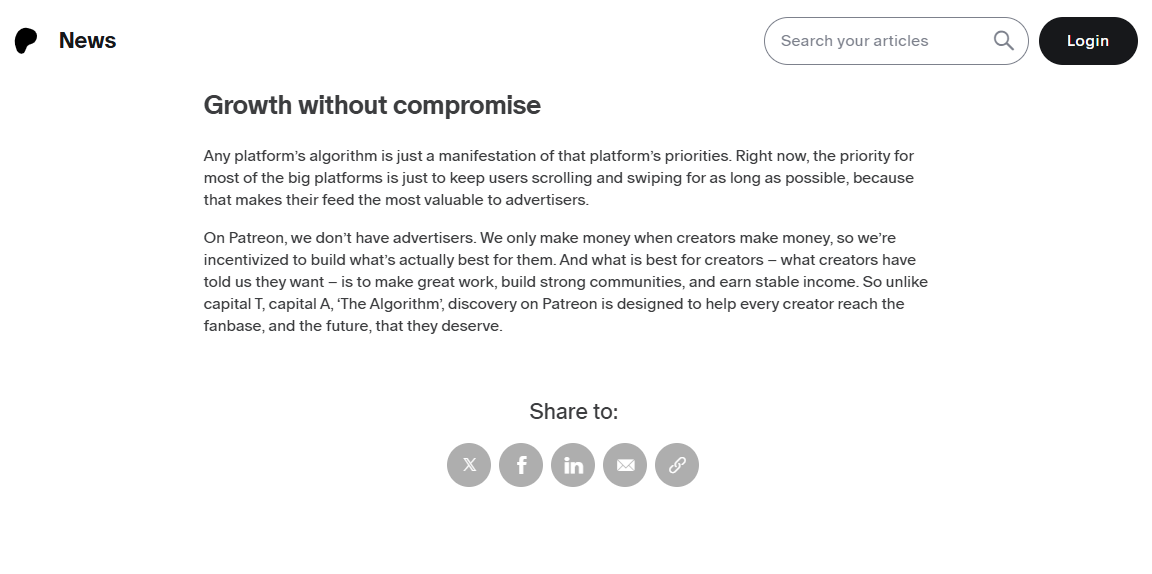
Patreon’s discovery feed blog post18 stated that “any platform’s algorithm is just a manifestation of that platform’s priorities.” The sentence was meant as a contrast with social media platforms that optimize for advertiser attention. But it is just as true applied to Patreon itself. An algorithm that rewards engagement signals, that amplifies creators who collaborate publicly, that suppresses adult creators in default discovery surfaces, and that periodically resets visibility when the platform decides to scale a new product launch is manifesting a set of priorities that is not simply “help every creator succeed.”
The alternatives are not as simple as leaving. Subscribfy.ai’s reporting19 found that Ko-fi experienced significant growth in new creator sign-ups during the Patreon exodus period. Substack, which attracted a wave of Patreon writers, has since developed its own algorithm problems, prompting a counter-migration back toward Patreon. TechBuzz.ai20 noted that Patreon was actively recruiting high-profile Substack writers, including Anne Helen Petersen of the Culture Study newsletter, at the same time that Substack’s own algorithmic features were generating the same frustrations that drove creators to Substack in the first place.
The pattern here is not specific to Patreon. It is structural. Platforms that raise significant venture capital and operate subscription models eventually face pressure to capture more of the value they facilitate. They build discovery features, because discovery features create platform lock-in. They introduce algorithmic feeds, because algorithmic feeds generate behavioral data. They adjust fee structures, because higher fees are the fastest way to grow revenue from an existing creator base. Each step is individually defensible. Collectively, they change what the platform is.
McKinsey21 research found that successful creators in 2026 average 3.2 revenue platforms, compared to 1.7 platforms in 2023. That is not a coincidence. It is the rational response to a decade of watching platforms change their terms, adjust their algorithms, and shift incentives in ways that benefit the platform’s investors before the creators the platform hosts. Diversification is the hedge against decisions you can’t control.
What Patreon Still Does Right, and Why That Makes This More Important
It would be unfair to write this story without acknowledging what is genuinely true on the other side of the ledger. Patreon has paid out over $10 billion to creators since its founding. Patreon’s data shows that podcasters alone earned $472 million on the platform in 2024, growing 33 percent year over year. For writers, musicians, illustrators, and independent journalists, Patreon has provided real, reliable income that other platforms could not. The company has maintained a more serious policy engagement process than most of its competitors, running a Creator Policy Engagement Program that provides creators advance notice of policy changes and creates feedback loops before finalization.
These are not trivial things. And they are precisely why the visibility problem matters. A platform that has done genuine good for working creators is more worth scrutinizing, not less. The critique here is not that Patreon is bad. It is that Patreon is becoming something it said it would not become, in ways that are slow enough to miss if you’re not watching, and fast enough to damage livelihoods once they land.
A creator who builds their business around the assumption that the platform’s incentives are aligned with their own is taking a specific kind of risk. Patreon has historically justified that trust better than its competitors. The changes of the past two years represent a real, measurable erosion of that justification. The April 2026 Quip visibility crash was not a catastrophe. But it was a demonstration of exactly how much individual creator visibility can shift based on a product decision made in a meeting room the creator will never be invited into.
That is what platform risk looks like. Not a sudden ban, not a dramatic shutdown, but a quiet redistribution of visibility and income driven by algorithm changes that are announced in FAQ posts after they have already taken effect.
The practical advice that follows from all of this is not complicated, but it requires honesty about the situation. Any creator who relies on Patreon as their sole income source is taking on concentrated platform risk that has become harder to justify. The fee structure, the Apple Tax on iOS transactions, the opacity of the discovery algorithm, and the demonstrated willingness to reshape the feed at scale with limited warning are all reasons to treat Patreon as one channel in a broader income architecture rather than the whole structure.
Building and maintaining a direct email list is the oldest advice in this space and still the best. An email list is the one audience relationship that a platform algorithm cannot intermediate. Whatever Patreon does with its Explore tab or its Home feed, a creator with 5,000 people on an email list has a direct line to those people that no product decision at Patreon headquarters can disrupt.
Diversification across platforms, whether that means a Ko-fi page for direct purchases, a Substack newsletter as a parallel channel, or a direct-to-fan site built on something like Shopify, reduces the exposure to any single platform’s decisions.
And for creators who remain on Patreon, the April 2026 Quip visibility collapse offers a specific tactical lesson: the platform’s algorithm responds to engagement signals between creators, not just between creators and fans. The five-times engagement multiplier for posts boosted through creator interactions, documented in Patreon’s own Help Center22, is a real mechanic. So is the collaboration post format. Creators who build genuine connections with peer creators in their category will get more out of Patreon’s current algorithm than creators who operate in isolation.
None of this is what Patreon said the deal would be. The original promise was simpler: make good work, find an audience, and the platform stays out of the way. That promise is still partially true. It is just no longer completely true. And the distance between those two things is where creator livelihoods currently live, somewhere between what the platform says it is and what it is increasingly becoming.
Sources
- Patreon, support.patreon.com/hc/en-us/articles/30306733879949-How-can-fans-discover-me-on-Patreon. Accessed 3 Aug. 2026. ↩︎
- “Discovery on Patreon is driving $200M+ to creators per year” Discovery on Patreon is driving $200M+ to creators, 3 Mar. 2025, news.patreon.com/articles/discovery-on-patreon-is-driving-over-200-million-to-creators-per-year. Accessed 3 Aug. 2026. ↩︎
- “Sucuri WebSite Firewall” Access Denied, 17 Sept. 2024, www.tubefilter.com/2024/09/17/patreon-is-finally-trying-to-establish-a-network-effect/. Accessed 3 Aug. 2026. ↩︎
- Bell, Karissa. “Patreon is adding a discovery feed to help creators avoid social media platforms” 10 Nov. 2025, www.engadget.com/social-media/patreon-is-adding-a-discovery-feed-to-help-creators-avoid-social-media-platforms-173000049.html. Accessed 3 Aug. 2026. ↩︎
- Gandola, Karina. “Patreon Rolls Out Network Features To Drive Fan Discovery, Creator Membership Growth” 30 Apr. 2026, www.netinfluencer.com/patreon-rolls-out-network-features-to-drive-fan-discovery-creator-membership-growth/. Accessed 3 Aug. 2026. ↩︎
- “Network FAQs” Patreon for Creators on Patreon, 1 May 2026, www.patreon.com/PatreonforCreators/posts/network-faqs-143425481. Accessed 3 Aug. 2026. ↩︎
- Patreon, support.patreon.com/hc/en-us/articles/30306733879949-How-can-fans-discover-me-on-Patreon. Accessed 3 Aug. 2026. ↩︎
- Patreon, support.patreon.com/hc/en-us/articles/31715323400077-Understanding-Patreon-s-mobile-app-age-rating. Accessed 3 Aug. 2026. ↩︎
- Patreon, support.patreon.com/hc/en-us/articles/45256719857293-How-Patreon-s-network-works-for-members. Accessed 3 Aug. 2026. ↩︎
- “Safeguarding Your Website — BigScoots” www.comicsbeat.com/patreon-creators-will-be-forced-to-pay-the-apple-tax-on-ios-subscriptions-from-november/. Accessed 3 Aug. 2026. ↩︎
- “MacRumors” Apple Will Soon Take Up to a 30% Cut From All…, www.facebook.com/MacRumors/posts/apple-will-soon-take-up-to-a-30-cut-from-all-patreon-creators-on-ios-apple-has-s/1319982000164780/. Accessed 5 Aug. 2026. ↩︎
- Silberling, Amanda. “Patreon will increase the cut it takes from new creators” TechCrunch, 16 June 2025, techcrunch.com/2025/06/16/patreon-will-increase-the-cut-it-takes-from-new-creators. Accessed 3 Aug. 2026. ↩︎
- “Patreon Alternatives: Top Competitors Compared” Patreon, 13 May 2026, checkthat.ai/brands/patreon/alternatives. Accessed 3 Aug. 2026. ↩︎
- “Patreon Alternatives: Top Competitors Compared” Patreon, 13 May 2026, checkthat.ai/brands/patreon/alternatives. Accessed 3 Aug. 2026. ↩︎
- Dean, Brian. “Patreon: Subscriber and Creator Statistics for 2026” 16 Mar. 2023, backlinko.com/patreon-users. Accessed 3 Aug. 2026. ↩︎
- Axios, 28 Apr. 2026, www.axios.com/2026/04/28/patreon-discovery-network-creator-growth. Accessed 3 Aug. 2026. ↩︎
- Patreon, support.patreon.com/hc/en-us/articles/30306733879949-How-can-fans-discover-me-on-Patreon. Accessed 3 Aug. 2026. ↩︎
- “Discovery on Patreon is driving $200M+ to creators per year” Discovery on Patreon is driving $200M+ to creators, 3 Mar. 2025, news.patreon.com/articles/discovery-on-patreon-is-driving-over-200-million-to-creators-per-year. Accessed 3 Aug. 2026. ↩︎
- “What Is The Patreon Controversy? The 2024-2026 Creator Exodus Explained” subscribfy.ai/blogs/what-is-the-patreon-controversy-the-2024-2026-creator-exodus-explained. Accessed 3 Aug. 2026. ↩︎
- “Patreon Launches ‘Quips’ to Challenge Social Platforms” The Tech Buzz, www.techbuzz.ai/articles/patreon-launches-quips-to-challenge-social-platforms. Accessed 3 Aug. 2026. ↩︎
- McKinsey, www.mckinsey.com/capabilities/strategy-and-corporate-finance/our-insights/six-breakthrough-business-models-reshaping-global-growth. Accessed 3 Aug. 2026. ↩︎
- Patreon, support.patreon.com/hc/en-us/articles/30306733879949-How-can-fans-discover-me-on-Patreon. Accessed 3 Aug. 2026. ↩︎