

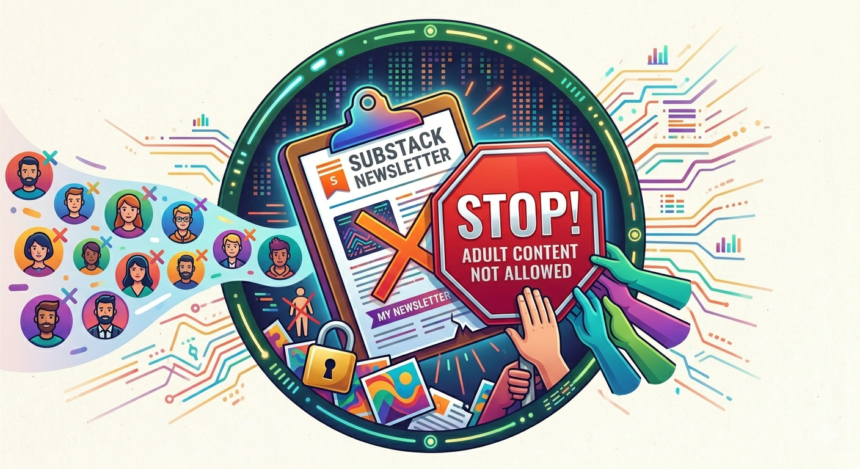

Substack built its brand on freedom. Then it quietly let Stripe start deciding who gets paid.
- The Policy That Was Always There
- When Stripe Becomes the Real Editor
- What Enforcement Actually Looks Like
- Discovery Suppression Is Enforcement by Another Name
- The UK Online Safety Act Adds a New Layer
- The Pattern Platforms Keep Running
- What “Erotic Literature” Means When Nobody Is Watching
- The Hypocrisy Question
- What Comes Next
There is a certain kind of platform story that repeats itself so often it has started to feel like myth. A company launches, makes a lot of promises about openness and creative independence, attracts the kinds of writers and creators the mainstream will not touch, grows powerful on their labor, and then, when the money gets serious, begins to push them toward the exit. It happened to Patreon. It happened to OnlyFans. And now it is happening, in slower motion and with considerably more rhetorical sleight of hand, on Substack.
Substack1 has told us for years that it believes in writers. The company’s co-founders, Chris Best, Hamish McKenzie, and Jairaj Sethi, built an entire identity around the idea that their platform would resist the content moderation overreach that had made the rest of the internet feel like a strip mall run by nervous lawyers. “All things in moderation — including moderation,” they wrote in 2021. The line became something close to a manifesto. It was repeated in pitch meetings, cited in essays about the future of independent media, and used to recruit writers who had grown exhausted by the arbitrary cruelties of algorithmic social platforms.
What nobody fully interrogated at the time was the phrase buried in the same document: “Of course, there are limits. We do not allow porn on Substack, for example, or spam.”
That sentence has aged into something much more consequential than it first appeared.
The Policy That Was Always There
To understand what is happening to adult content creators on Substack right now, it helps to understand how the platform has always officially described itself. Substack’s content guidelines2 draw a distinction that has always been philosophically unstable. The platform says it does not allow “porn or sexually exploitative content,” which it defines as “any visual depictions of sexual acts for the sole purpose of sexual gratification.” But it also says it does allow “erotic literature.”
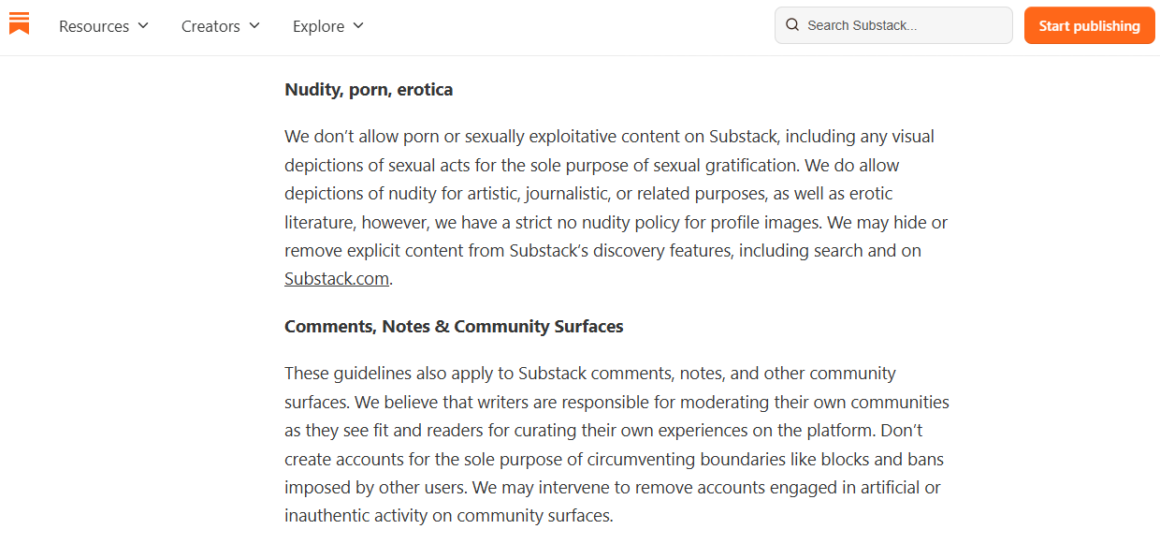
That carve-out for erotic literature looked, for several years, like a genuine concession to literary tradition. Erotica is as old as writing itself. Anaïs Nin and Henry Miller were banned and prosecuted. The Story of O became a serious literary object of cultural study. The distinction between literature and pornography is real, even if contested, and Substack’s original policy seemed to acknowledge that a subscription newsletter platform for writers might reasonably host the kind of adult fiction that sits in the “literary” category.
The trouble is that Substack3 reserved the exclusive right to interpret and enforce these guidelines, without offering any transparent mechanism by which writers could predict how that interpretation would be applied to them. A policy that sounds generous in the abstract can become punitive in practice when enforcement is opaque and appeals processes are slow or nonexistent.
Writers started to learn this the hard way.
When Stripe Becomes the Real Editor
The clearest account of what adult content writers on Substack actually face comes not from the platform’s own moderation team but from the payment infrastructure behind it. Substack’s payments are processed through Stripe, and Stripe’s restricted businesses list explicitly prohibits
“[p]ornography and other mature audience content (including literature, imagery and other media) depicting nudity or explicit sexual acts.”
Notice what that includes: literature.
Erotica writer Cornelia Quick4 documented her experience when the collision between Stripe’s rules and Substack’s nominally permissive policy made contact with her actual livelihood. In December 2023, she received a notice that her account was in violation of the Stripe Services Agreement for selling adult content, with a closure date of December 20 unless her appeal succeeded. She had been writing consensual adult fiction for a paying audience on a platform that said erotic literature was allowed.
“I already had very little in common with Mr. Spencer,” she wrote, referring to neo-Nazi Richard Spencer, who at the time maintained a functioning, monetized Substack, “and it appears that being able to sell words on Substack is just one more thing that differentiates us. While I accept that Stripe and Substack are well within their rights to have rules that allow them to profit off vile Nazi dreck while banning fun and filthy erotica, I do have to question what moral calculus would bring one to that position.”
The irony was hard to miss and impossible to defend. This was not a fringe complaint. It was a precise description of a structural absurdity: a platform committed to free expression could host content that had historically motivated real-world violence, while a writer publishing consensual make-believe was getting her payment account shut down.
As Quick put it plainly:
“The use of the payment processor gauntlet to strangle perfectly legal but ‘unsavory’ services is a scary development. Even when the platform itself doesn’t prohibit adult content — Substack and Medium are both open to the whole gamut of sexually explicit literature — having the possibility to be compensated for your work cut off is stifling and restrictive.”
She was already scanning the horizon for alternatives. SubscribeStar, a platform with somewhat more lenient policies, came up in the same breath as a potential refuge. The erotica exodus, as she called it, was already underway.
What Enforcement Actually Looks Like
The pattern that emerges from talking to creators and reading their accounts is not one of uniform, rule-based moderation. It is something messier and, in some ways, more damaging: inconsistent enforcement, automated flags, vague notices, and appeals processes that offer little transparency or recourse.
A writer documented on a Substack5 post in 2025 that her account had been suspended twice over “erotic material.” Not exploitation, not trafficking, not nonconsensual content. Adult conversations and trauma-informed reflections on sexuality, healing, embodiment, and intimacy. The second suspension, she wrote, was the one that broke the illusion.
“The first time, I still wanted to believe it was a misunderstanding,” she wrote. “A moderation mistake. An overly cautious algorithm. Something that could be clarified and resolved by a human being willing to actually read the work in context. But after the second ban, it became impossible to ignore the larger pattern emerging across the internet: payment processors and platforms are quietly becoming the moral authorities of modern speech.”
What she described is exactly the kind of enforcement that content moderation researchers have long flagged as the most dangerous form of platform censorship. Not the visible kind, where a government bans a book or a regulator issues an order, but the quiet kind, where an algorithmic flag and a payment processor clause combine to make someone’s work economically unviable without anyone having to make a conscious decision to silence them.
Another Substack6 creator who was suspended after posting artwork wrote that the platform appeared to be tightening its image as it sought new rounds of financing.
“I think as they seek out advertisers, institutional financing, they may want to present a certain image of the people who write newsletters for their platform,” he wrote. “This is, of course, somewhat a speculation, since there isn’t transparency concerning the suspensions.”
The speculation, when you look at the broader picture, does not seem unreasonable.
Discovery Suppression Is Enforcement by Another Name
Even for adult content writers who have not been suspended outright, Substack has a quieter tool: algorithmic invisibility. The platform’s content guidelines explicitly state that it “may hide or remove explicit content from Substack’s discovery features, including search and on Substack.com.”
Discovery suppression does not generate the same headlines as an account ban. There are no suspension notices to screenshot, no appeals to document, no clear moment of conflict that can be described to a journalist. There is just the slow drain of new subscribers arriving less frequently, the plateau in growth that looks like organic market saturation but might be something more deliberate.
Sex-positive writer Zachary Zane, who has been publishing erotica and sex-positive essays on Substack since 2020 under the BOYSLUT banner, described exactly this experience to Dazed7 in December 2025. “For the first three years, my Substack grew steadily and healthily,” he said.
“But once I reached 10,000 subscribers, I plateaued. I had close to 900 paid subscribers, and now that number is down to 550. I have no idea why I’m losing subscribers. I have more essays than before. I have additional writers contributing to the BOYSLUT Substack. I pay queer authors to illustrate each piece.”
He could not say definitively that discovery suppression was the cause. He could say that the numbers stopped making sense against the quality and quantity of the work. That ambiguity is part of how this kind of enforcement operates: it produces no receipts.
The UK Online Safety Act Adds a New Layer
Just when it seemed the situation could not become more complicated for adult content creators, the regulatory environment intervened with new enthusiasm.
According to Expose News8, from late November 2025, Substack began requiring users in the United Kingdom to upload a government-issued ID or a selfie to access content categorized as sexually explicit, violent, promoting self-harm, or constituting hate speech. This was mandated by the UK’s Online Safety Act, which came into full enforcement that summer and required platforms to restrict minors’ access to potentially harmful content.
Substack9 CEO Chris Best was not quiet about his feelings. In a December 2025 essay, he wrote that complying with the UK Online Safety Act shocked him in its scope and implications. He described the experience of implementing the rules and found that readers, in his platform’s case, overwhelmingly adults reading lawful material, now faced demands to prove their age through third-party checks involving facial scanning, identification documents, or financial verification.
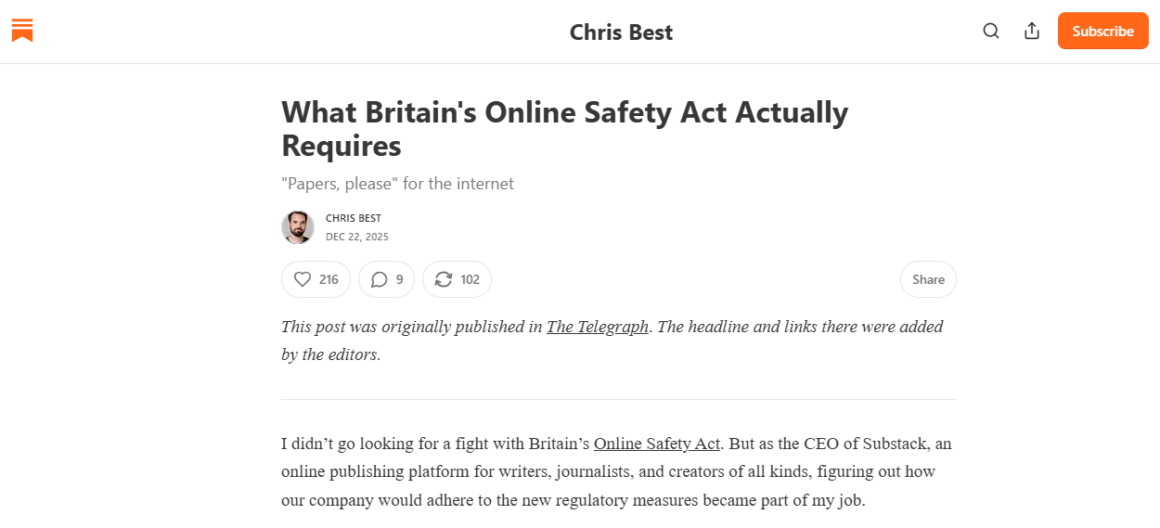
Best’s opposition to the UK law was vocal and sincere. But the fact remains: Substack chose to comply. The age-verification gates went up. And the burden fell, as it always does in these situations, on the creators whose work triggered the classification, not on the platform that made the business decision to implement it.
For writers of erotica with significant UK audiences, this created a new friction point. Age-gated content does not just mean inconvenience for existing readers. It means reduced discoverability, lower conversion rates for new subscribers, and the psychological weight of having your work classified alongside content that encourages self-harm and eating disorders. The law bundles these categories together. It does not distinguish between literary erotica and genuinely dangerous material. A subscription newsletter about consensual adult sexuality can end up behind the same ID wall as instructions for self-harm, simply because both require age verification under a regulatory framework written by people who did not think particularly carefully about the difference.
Horror writers found themselves swept up in the same net. “This is affecting ALL Substacks,” noted one British Horror Authors Guild10 post, “and horror is a genre that is disproportionately targeted due to its content.” The classification problem is not just an erotica problem. It is a genre fiction problem, a trauma-narrative problem, and, in a broader sense, a problem for any writer whose work engages with the parts of human experience that regulators and payment processors find uncomfortable.
The Pattern Platforms Keep Running
What is happening on Substack is not unique, and that is precisely what makes it worth examining carefully. The sequence of platform promises openness, uses adult content creators to build audience and cultural credibility, then cedes to payment processor pressure and/or regulatory compliance to push those same creators toward the margins has a documented history.
OnlyFans ran the same sequence in August 2021. The platform announced it would prohibit sexually explicit content to comply with requests from banking partners and payment providers, according to Reuters11. Sex workers who had built their entire income on the platform were given weeks to adapt. The backlash was swift enough that OnlyFans reversed the decision five days later, but the reversal came with a caveat: it had “secured assurances necessary to support our diverse creator community,” with no clarity about what those assurances were or how durable they would prove.
The Electronic Frontier Foundation12 documented a similar dynamic in 2012 when Stripe suspended the Nifty Archive Alliance, a nonprofit supporting a free archive of erotic fiction for LGBTQ readers. Stripe had feared that some fiction on the site might violate Visa and MasterCard brand protection rules, which ban content that is “patently offensive and lacks serious artistic value.” The EFF intervened, and Stripe reinstated the account. But the episode illustrated how the payment layer had already become the de facto content moderation layer, without anyone electing it to that role.
SubscribeStar, long considered the erotica-friendly alternative to Substack and Patreon, updated its own prohibited content rules in March 2026 to ban fictional content previously permitted, incest, rape scenarios, certain furry content, and gore, citing compliance with payment processor requirements. Creators recognized the pattern immediately. “SubscribeStar just changed their TOS making them as restrictive as Patreon,” one creator wrote in a post that accumulated over 600,000 views. Patreon had spent most of 2018 suspending creators and openly blamed pressure from PayPal and Stripe. Now SubscribeStar was following the same path.
There is nowhere left to run. That is not hyperbole. It is an accurate description of the infrastructure problem facing adult content creators in the subscription economy. The platforms differ in their branding and stated values. They share the same payment processor stack and, increasingly, the same regulatory exposure. When Mastercard and Visa decide they are uncomfortable with a category of content, every platform that depends on those networks has to decide whether its principles are worth the cost of standing by them. So far, no major platform has decided they are.
What “Erotic Literature” Means When Nobody Is Watching
Substack’s distinction between “porn” and “erotic literature” is philosophically interesting but practically useless. There is no published definition of what moves a piece of writing from the protected category to the prohibited one. There is no rubric, no escalation process, no panel of editors applying a consistent standard. There is Substack’s trust and safety team, operating under guidelines that the platform reserves the exclusive right to interpret, and there is Stripe’s restricted businesses list, which does not care about artistic merit at all.
The result is enforcement that falls hardest on the most vulnerable creators: independent writers without legal representation, without the leverage of large subscriber bases, without the financial cushion to survive a payment freeze while an appeal winds through an automated support system. A novelist with a major publishing contract and a Substack newsletter announcing their book tour has no risk of losing their income to a Stripe flag. A writer who makes their living by selling erotic fiction subscriptions to a few hundred readers has nothing but that income and no institutional recourse if it disappears.
As one creator described it:
“You don’t need to outlaw someone’s voice if you can simply make sure they cannot survive financially. That’s the part people don’t understand until it happens to them personally.”
The chilling effect travels further than the individual suspensions. Writers who have not been flagged watch what happens to those who have and quietly begin editing themselves. They soften language. They remove the most explicit passages. They shift their best work to free posts to avoid having it processed by payment infrastructure. The suppression becomes self-administered, which is more efficient and leaves no record.
The Hypocrisy Question
It is impossible to report on this subject without confronting the hypocrisy problem. Substack’s13 co-founders have written at length about their commitment to free expression, their resistance to deplatforming writers for political views, their willingness to host voices across the full spectrum of opinion. The company has been criticized, including by some of its most prominent writers, for hosting newsletters that spread medical misinformation and others that express views sympathetic to white nationalism.
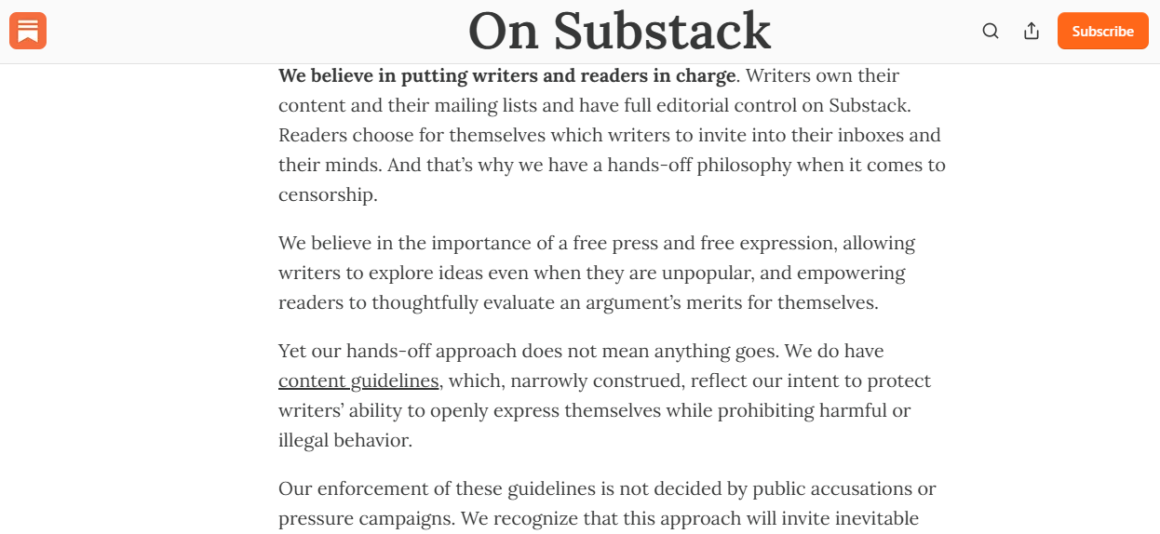
The platform has, on multiple occasions, defended those hosting decisions on free expression grounds. And yet, the same company’s infrastructure has been used to demonetize and suspend writers of consensual adult fiction. Fiction that is legal, fiction that is explicitly permitted by the platform’s own stated guidelines, fiction that has caused no documented harm to any reader.
A useful way to frame this: Substack has, in practice, treated the political and ideological preferences of certain writers as deserving robust protection, while treating the genre preferences of adult fiction writers as a business liability to be managed. The asymmetry is not incidental. It reflects a real set of values that differ from the stated ones.
Commenters on Substack’s14 own platform have noticed. “To clarify, the Substack folks almost certainly don’t believe that porn is less acceptable than Nazis,” one commenter wrote in a 2023 thread on Radley Balko’s newsletter.
“The problem, as anyone who works for a site that allows photo sharing will tell you… is that hosting porn requires significant cost investments (in both systems and personnel). [And] it’s likely because Stripe is their payments processor and they will shut off accounts that process payments for porn, cannabis, sex work, etc.”
The candor there is useful. The real explanation for the asymmetry is not a moral judgment but a financial one. Hosting controversial political content does not risk Stripe cutting off your payment processing. Hosting erotica does. The decision is not about values. It is about risk management.
That admission, if it were made openly by Substack’s leadership, would be honest. It would also be a significant retreat from the company’s stated identity. So instead the platform sits with the contradiction: a free speech absolutist on political content, a risk-management operator on sexual content, and a company that has never fully reconciled the two.
What Comes Next
The trajectory here is not encouraging. Regulatory pressure on adult content is intensifying, not relaxing. The UK Online Safety Act is a template that other jurisdictions are watching. Australia has already implemented similar provisions, and Substack15 has specific country-level obligations under the Australian Online Safety Act 2021 as well. The United States has seen legislative proposals aimed at platforms hosting adult content, and the political climate is not one in which those proposals are expected to weaken.
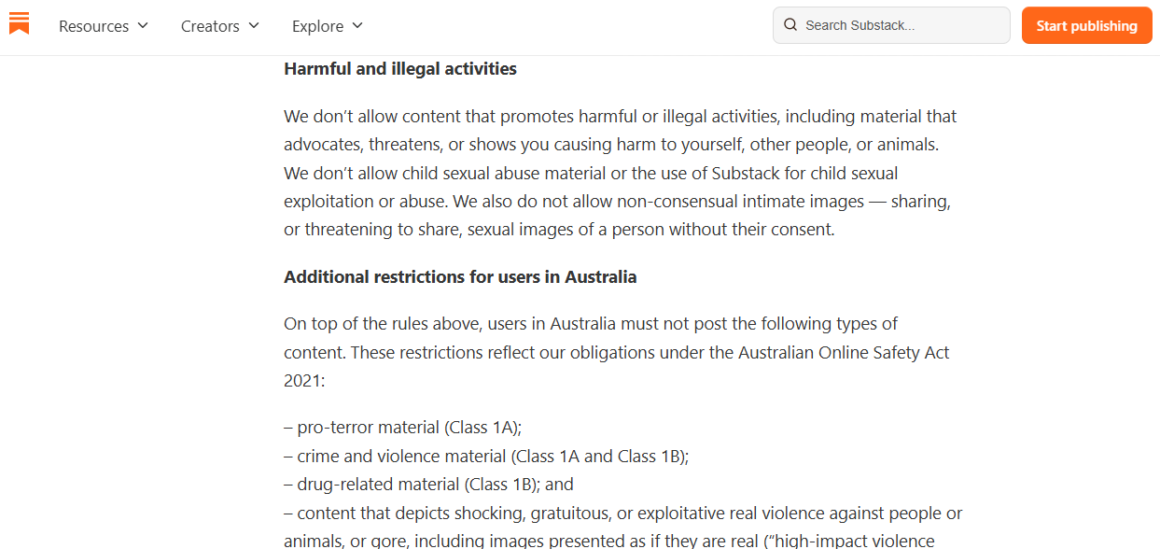
For adult content creators on Substack, the question is no longer whether the platform will continue to enforce its terms more aggressively. The question is how long the platform’s stated commitment to erotic literature survives the combined pressure of Stripe’s restricted businesses list, UK and Australian regulatory mandates, and the company’s need to attract institutional investment and advertising interest.
The departure of notable writers from Substack toward Patreon and other platforms, documented by Nieman Journalism Lab16 in October 2025, suggests the broader creator trust is already eroding. For writers whose work carries the specific legal and payment-processor risk that sexual content carries, the erosion is happening faster.
There may be no satisfying solution within the current infrastructure. The payment processor layer sits beneath every platform, and Mastercard, Visa, and Stripe have more leverage over the economics of online content than any individual company’s terms of service. Until that layer is either replaced or regulated differently, adult content creators will continue to find that the platforms competing for their work lack the ability or the will to protect them when it matters.
What Substack could do, and has not, is be honest about that constraint. It could stop presenting itself as a free expression platform that simply draws a line at “you know it when you see it” and acknowledge that its actual content policies are substantially determined by Stripe’s restricted businesses list and the regulatory requirements of the jurisdictions it operates in. It could offer transparent, human-reviewed appeal processes, published enforcement criteria, and clear documentation of when Stripe’s rules override its own stated guidelines.
It has not done these things. Instead, it continues to market itself as a home for independent voices while quietly allowing payment infrastructure to evict the ones whose independence looks risky on a balance sheet.
Writers deserve better than that. The good ones always have.
Sources
- Team, Substack. “How we approach moderation decisions” On Substack, 25 Mar. 2021, on.substack.com/p/how-we-approach-moderation-decisions. Accessed 12 June 2026. ↩︎
- “Content Guidelines” substack.com/content. Accessed 1 Aug. 2026. ↩︎
- “Content Guidelines” substack.com/content. Accessed 12 June 2026. ↩︎
- Quick, Cornelia. “One more thing I don’t have in common with Richard Spencer …” The Eroticist’s Notebook, 15 Dec. 2023, corneliaquick.substack.com/p/one-more-thing-i-dont-have-in-common. Accessed 12 June 2026. ↩︎
- Substack, whereibreakopen.substack.com/p/the-new-gatekeepers-how-substack. Accessed 1 Aug. 2026. ↩︎
- Sebesta, Edward H. “Will resume publishing provisionally. What I think happened.” Dallas Gay Liberation , 18 July 2025, dallasgayliberation.substack.com/p/will-resume-publishing-provisionally. Accessed 1 Aug. 2026. ↩︎
- “Is Substack still a space for writers and readers?” Dazed, 3 Dec. 2025, www.dazeddigital.com/life-culture/article/69204/1/is-substack-still-a-space-for-writers-and-readers. Accessed 1 Aug. 2026. ↩︎
- 4 Dec. 2025, expose-news.com/2025/12/04/substack-caves-into-the-uk-censorship-regime/. Accessed 1 Aug. 2026. ↩︎
- Best, Chris. “What Britain’s Online Safety Act Actually Requires” Chris Best, 21 Dec. 2025, cb.substack.com/p/what-britains-online-safety-act-actually. Accessed 1 Aug. 2026. ↩︎
- “Substack Age Verification (for UK and AUS readers) by Newton Webb” British Horror Authors Guild, 1 Mar. 2026, britishhorror.substack.com/p/substack-age-verification-for-uk. Accessed 1 Aug. 2026. ↩︎
- “OnlyFans reverses ban on posting ‘sexually explicit’ content” Euronews, 25 Aug. 2021, www.euronews.com/next/2021/08/25/us-social-media-onlyfans. Accessed 1 Aug. 2026. ↩︎
- Opsahl, Kurt. “Payment Provider Stripe Upholds Free Speech, Reactivates Nifty Archives” Electronic Frontier Foundation, 2 Nov. 2012, www.eff.org/deeplinks/2012/11/payment-provider-stripe-upholds-free-speech-reactivates-nifty-archives. Accessed 3 Aug. 2026. ↩︎
- Team, Substack. “How we approach moderation decisions” On Substack, 25 Mar. 2021, on.substack.com/p/how-we-approach-moderation-decisions. Accessed 3 Aug. 2026. ↩︎
- Strause, Gordon. “Some thoughts on the Substack controversy” Some thoughts on the Substack controversy, 27 Dec. 2023, radleybalko.substack.com/p/some-thoughts-on-the-substack-controversy/comments. Accessed 3 Aug. 2026. ↩︎
- “Content Guidelines” substack.com/content. Accessed 3 Aug. 2026. ↩︎
- Nieman Lab, www.niemanlab.org/2025/10/top-substack-writers-depart-for-patreon/. Accessed 3 Aug. 2026. ↩︎


