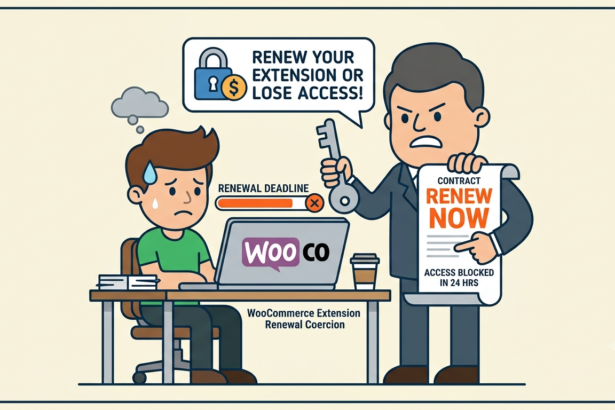

In 2025, a coding nonprofit called Hack Club got a phone call from Slack. Pay $50,000 by the end of the week, the caller said, and commit to $200,000 a year after that. Refuse, and Slack would deactivate the workspace and delete eleven years of message history. Not archive it. Delete it. This was something that happened last September.
Mahad Kalam1, a volunteer at Hack Club, wrote about it that same night in a blog post titled “Slack is extorting us with a $195k/yr bill increase.” He didn’t mince his words and claimed that:
“Salesforce (a $230 billion company) is strong-arming a small nonprofit for teens, by providing less than a week to pony up a pretty massive sum of money, or risk cutting off all our communications.”
He ended his statement by saying, “That’s absurd.”
The post hit Hacker News and racked up hundreds of thousands of views on X within hours. Slack’s CEO, Denise Dresser, personally intervened. The company called it a billing mistake, restored nonprofit pricing, and eventually upgraded Hack Club to a multi-year Enterprise+ deal. A happy ending, more or less. But the ordeal exposed something that a lot of Slack customers already suspected and rarely said out loud. The messages your team writes every day, the decisions made in DMs, the institutional memory of a company or a community, none of it is really yours until Slack decides you’re allowed to have it.
I spent the better part of a week reading Slack’s own export documentation, sysadmin forums, eDiscovery vendor blogs, and the wreckage of the Hack Club story, and the picture that emerged wasn’t one of a company hoarding data out of malice. It’s stranger than that. It’s a tiered permission system, dressed up as a compliance feature, that quietly makes data portability a luxury good.
The Tier You’re on Decides What You Own
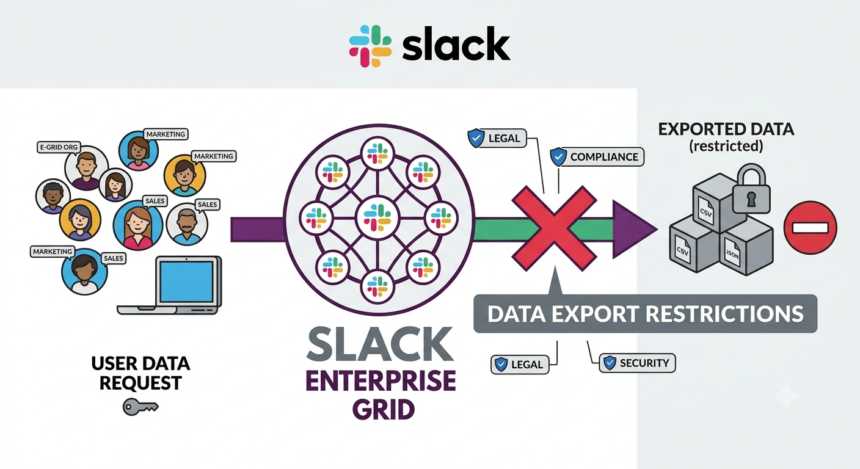
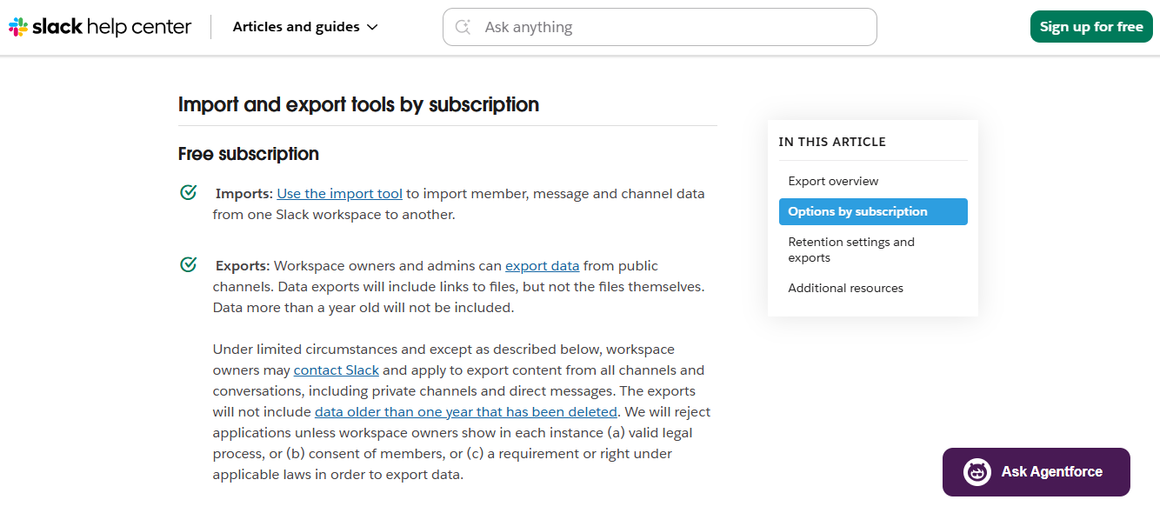
Here’s the part that surprised me most. On Slack’s Free and Pro plans, an admin can export messages from public channels only. Private channels? Direct messages? Off limits, unless you can prove to Slack’s satisfaction that you have “valid legal process, consent of members, or a requirement or right under applicable laws,” according to Slack’s2 own guide to import and export tools. You don’t export your data. You petition for it.
Move up to Business+ and the story improves only slightly. Workspace owners can apply for a self-serve export tool that covers private channels and DMs, Business+ does not hand you private-channel exports at checkout. Approval isn’t guaranteed. And even once approved, these exports cannot limit data sets to specific channels or users, according to Mimecast’s3 breakdown of the feature. You get everything or you get a very slow, very expensive fishing expedition.
Only Enterprise Grid customers get what most people would consider basic data ownership: the ability to filter exports by channel, by user, by conversation type, and to schedule them automatically. Only Enterprise Grid gets the Discovery API, the tool that actually lets a company pull its own communications into a third-party archive in a structured, searchable way. And Enterprise Grid, per industry pricing guides, runs somewhere north of $15 a seat a month, often reaching custom, quote-only territory that most small organizations never see clearly until they’re already locked in.
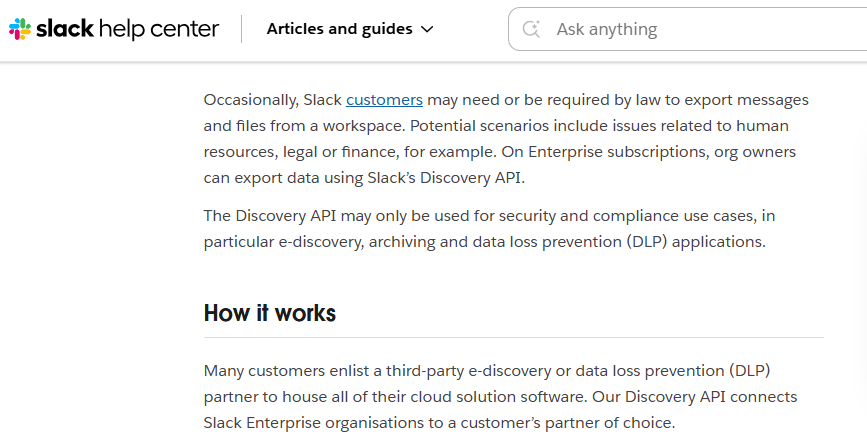
Think about what that structure actually optimizes for. It’s not security. Slack’s own Discovery API documentation says the tool “may only be used for security and compliance use cases,” and lists eDiscovery, archiving, and data loss prevention as the approved reasons, per Slack’s guide to Discovery APIs4. Fine. Those are legitimate needs. But the practical effect is that the customers with the least leverage, the small nonprofits, the scrappy startups, the community Slacks run on volunteer time, are the ones stuck applying to Slack support and waiting, while the customers who can afford the premium tier get to just take their own data and go.
Where there’s friction, someone builds a business. A whole ecosystem of eDiscovery and compliance vendors, Onna, Mimecast, SysCloud, Logikcull, and others, exists largely to solve the problem Slack’s export limits create. One legal blog from Logikcull describes the workaround for organizations that aren’t on Enterprise Grid this way: “If a producing party isn’t on Slack’s Enterprise Grid, they won’t have access to Slack’s Discovery API. But that doesn’t mean they can’t collect and review Slack data,” the post explains, before walking through manual review processes as an alternative, per Logikcull’s5 guide to Slack eDiscovery without Enterprise Grid.
That manual alternative isn’t pretty. Standard exports arrive as a ZIP file broken into folders, one per channel, further split into individual JSON files, one per day. Logikcull’s own description is unsentimental about it. Those files are “basically illegible on their own,” and they come “in batches of hundreds or potentially thousands.” A company facing a lawsuit or a harassment investigation and stuck below Enterprise Grid isn’t handed a searchable archive. It’s handed a data dump and a bill from a law firm to make sense of it.
Onna’s6 advice to prospective customers reads almost like a warning label. “If you find that none of Slack’s native export options meet your needs,” the company writes, “we urge you to think about the bigger picture,” in its blog on Slack export options for eDiscovery. Translation: upgrade, or budget for a permanent workaround. Either way, someone gets paid. It’s just not always the customer who benefits.
The JSON format itself deserves a moment of scrutiny, because it does a lot of quiet work in this story. Every native Slack export, aside from the single-user version available only on Enterprise Grid, comes back as raw JSON. That’s a perfectly reasonable machine-readable format, and it’s also close to useless to a harried HR manager or a small nonprofit’s volunteer treasurer trying to read what actually happened in a channel before a dispute. One export guide describes the result plainly. Slack’s export is “raw JSON, no search, technical users only,” while paid third-party viewers promise something “searchable, readable, exportable, accessible to anyone,” according to a comparison published by ViewExport7. Notice the shape of that sentence. The native export is functionally unusable without a translator, and the translator is sold separately. That’s not a technical limitation. Rendering JSON into readable text is a solved problem that costs almost nothing to build into a product. Leaving it unsolved is a business decision, one that hands an entire market to third-party vendors instead of Slack’s own customers.
What “your data” Quietly Excludes
Even at the top tier, the exports aren’t complete in the way most people would assume. Files themselves are never included in a standard export, only links to them, and if a file has been deleted from Slack, the link in your export is dead too, according to Salesforce’s own Trailhead8 documentation on the feature. So the record you’re legally required to preserve for a regulator, or the evidence you need for an internal investigation, can vanish the moment someone on your team clicks delete, unless you’ve separately paid for a Discovery API integration that captures deletions in real time.
I found this particular wrinkle tucked into a forum thread on the Mattermost community boards, where someone attempting to migrate off Slack ran into the limitation from the other direction. “After exporting all of my Slack workspace data, including DMs and private channels, and doing an import using this guide, I can see my public channels and files, but I can’t find private channels anywhere,” the user wrote in a Mattermost9 forum thread from January 2023. No answer in the thread resolves it cleanly. That’s the quiet tax of platform lock-in. It’s not that Slack refuses to let you leave. It’s that leaving cleanly, with your full history intact, is a project nobody fully solves, and Slack has no incentive to make it easier.
It’s tempting to read the Hack Club story as an isolated billing screw-up, and Salesforce framed it that way too. A spokesperson told Cybernews10 the pricing spike was “the result of an oversight in our billing process,” and promised clearer guidance and grace periods going forward. Slack’s Chief Product Officer, Rob Seaman, showed up in the Hacker News11 thread himself and wrote, simply,
“This was a mistake. We’re fixing it.”
I believe that. I don’t think Slack set out to threaten a teenage coding nonprofit. But the reason the mistake was even possible, the reason a five-day countdown to permanent deletion of eleven years of history could exist as a live option inside Slack’s systems, is that the platform’s entire export and retention architecture treats data preservation as a privilege tied to your invoice, not a right tied to your ownership of the content. Hack Club didn’t get to say “fine, deactivate us, we’ll just export everything and move on.” They didn’t have Discovery API access. They were on a Pro-tier nonprofit plan. Their full history, DMs included, was hostage to a payment decision made in a sales conversation, not a technical safeguard.
Kalam said as much himself, once the crisis passed. “This experience has taught us that owning your data is incredibly important, and if you’re a small business, especially, then I’d advise you move away too,” he wrote, in the same post that started the whole firestorm. Hack Club is now running a self-hosted Mattermost12 instance in parallel, hedging against a repeat.
There’s a second, quieter version of this story that doesn’t involve a nonprofit or a viral post. It plays out inside ordinary companies, when an employee asks what their employer can see and export from their own DMs.
The honest answer, per Slack’s documentation, is more than most employees assume and less than most IT departments would like. On Enterprise Grid, an org owner can request a single-user export covering “all conversations that a single user is part of,” public channels, private channels, and DMs alike, according to Slack’s13 guide to import and export tools. No warrant required. No court order. Just an internal application process and a stated business reason. Slack asks companies to make sure “appropriate employment agreements and corporate policies have been implemented” before they pull the trigger, but that’s a compliance checkbox, not an employee protection.
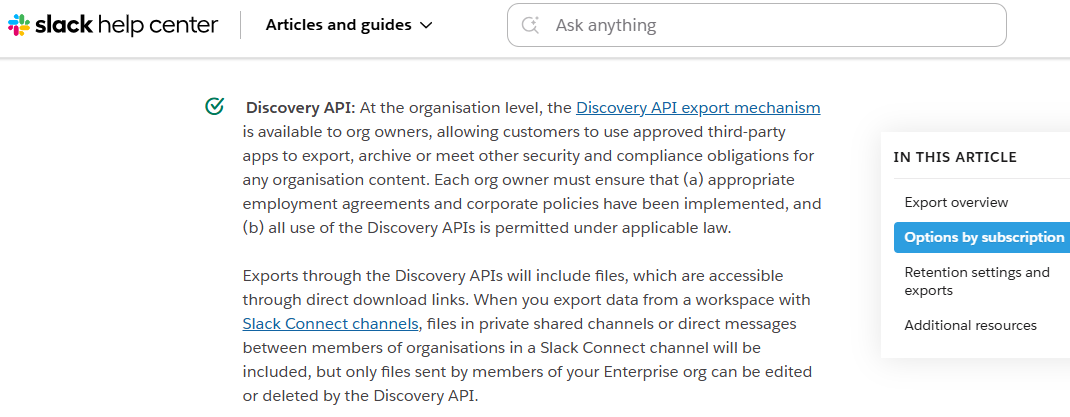
Meanwhile, ordinary employees on a Free or Pro workspace, the plan tier most likely to be used by a small business without a dedicated legal team, have essentially no self-serve way to export even their own conversation history for their own records. The asymmetry runs one direction. Management, on the right plan, can pull a comprehensive dossier on a single worker’s communications. That same worker, in most configurations, cannot easily pull a copy of their own DMs to keep for themselves. It’s a strange inversion of how most people think about a messaging platform. You’d assume the content you wrote belongs to you at least as much as it belongs to your employer’s admin console. Slack’s architecture doesn’t really agree.
Deleted Doesn’t Mean Gone, Until It’s Your Turn to Ask
There’s an irony buried in Slack’s retention design that took me longer than it should have to untangle. On the one hand, Slack keeps a permanent, versioned record of every message edit. A user in a channel sees only the latest version, tagged “(edited),” but every prior draft still exists behind the scenes and can be produced in a legal export, a point Logikcull makes explicitly in its guide for litigators building a discovery request. “Even though users in the channel can only see the most recent version of a particular message, along with the tag ‘(edited)’, all previous iterations of that message can be produced in discovery by way of a Slack data export,” the firm writes. So nothing an employee typed and then quietly softened is actually gone. It’s sitting in a version history that only the company, on the right plan, can retrieve.
On the other hand, when a workspace itself is deactivated, or a plan lapses without an export completed first, that same meticulously preserved history can disappear for good. SysCloud’s14 admin guide is blunt about the failure mode facing most customers below Enterprise Grid.
“Data from private channels and direct messages are lost forever in case of an outage,” the guide warns, and adds that admins “might leave out important data while exporting which can result in data loss.”
Nothing about the underlying data changed between those two states. What changed was who was asking, and what they were willing to pay to ask.
That inversion matters more than it might seem. A regulator or opposing counsel, backed by a Discovery API subscription, can reconstruct a message you thought you’d revised into something more careful. An ordinary employee trying to preserve their own record before a layoff, or a nonprofit trying to keep a community’s history intact before a billing dispute goes sideways, can lose everything with a single missed renewal. The permanence of Slack’s data works asymmetrically. It’s permanent for the people with export access, and fragile for everyone else.
A Wider Pattern Than Just Slack
None of this happens in a vacuum. Slack has been on both sides of the interoperability argument. In 2020, the company filed an antitrust complaint against Microsoft with the European Commission, arguing that bundling Teams with Office 365 amounted to anticompetitive tying.
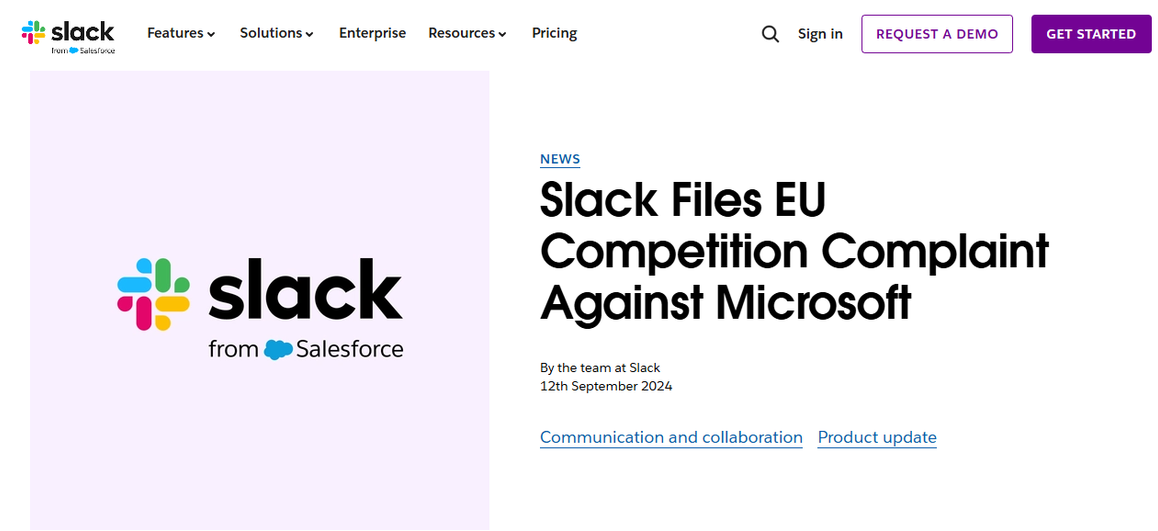
A Hacker News15 commenter, responding to that news, made an observation that has aged well.
“Slack’s walled garden is also effectively anti-competitive, trying to create a monopoly via vendor lock-in to the Slack product and ecosystem,” they wrote, adding that a better outcome would be open interoperability standards “so users can avoid being locked into any single vendor, and have full sovereignty over their conversation data.”
That’s the tension in one sentence. Slack was right that bundling is anticompetitive. Slack has also spent a decade building a product where full sovereignty over your own conversation data is a paid feature, gated behind an application process, and where the failure mode, as Hack Club found out, can be total deletion on five days’ notice.
I don’t think Slack is uniquely villainous here. Ask anyone who has tried to get a clean export out of a proprietary CRM, a legacy HR platform, or an enterprise email archive, and you’ll hear a version of the same complaint. Data portability has never been a strong incentive for a SaaS company, because the harder it is to leave, the stickier the customer becomes. What makes Slack’s case worth writing about is the specific shape the friction takes. It isn’t a missing export button. Slack has export buttons everywhere. It’s a permission structure calibrated almost perfectly to your spending tier, dressed in the neutral language of compliance and security, that leaves the customers with the least money and the least legal firepower holding the least control over their own institutional memory.
What Would Actually Fix This
The technical fix isn’t complicated, and Slack has already built most of it. Every plan tier could get scheduled, filterable exports of full conversation history, files included, the same tools currently reserved for Enterprise Grid. The company doesn’t lose much by extending that. What it loses is leverage. Enterprise Grid’s Discovery API and granular export controls aren’t really a technical moat. Mimecast’s own write-up admits as much when it describes granular export control as simply “one of the Enterprise Grid subscription’s advantages,” a marketing line as much as a technical one, per Mimecast’s16 guide to Slack data collection.
A more modest fix would be procedural. Give every customer, regardless of tier, a guaranteed right to a full, one-time export of their complete workspace, files and all, with reasonable notice before any deactivation or plan downgrade that would otherwise trigger deletion. Hack Club got that only because their story went viral and a CEO personally stepped in. Most workspaces facing a billing dispute don’t have that kind of luck. They just lose the data.
Until something like that becomes standard, the safest assumption for any organization running its operations through Slack, especially on a Free, Pro, or even Business+ plan, is that the message history isn’t fully yours. It’s yours on loan, for as long as the invoice clears and the plan holds. Hack Club learned that with eleven years on the line and a five-day clock. Most organizations won’t get the warning shot. They’ll just get the email.
I keep coming back to one detail from the Hack Club timeline, the part that doesn’t get repeated as often as the dollar figures. Denise Dresser didn’t just fix the price. She agreed to show up at Hack Club’s hackathon in New York in November, a gesture that reads, depending on how charitable you’re feeling, either as genuine goodwill or as a very effective way to close the loop on a public relations problem before it could compound. Both things can be true. What strikes me is that the resolution depended entirely on a viral blog post and a CEO’s personal attention, not on any structural guarantee built into the product. Every other nonprofit running a coding club or a mutual aid network or a hobbyist Discord alternative on Slack’s free or discounted tiers doesn’t have a following large enough to force that kind of intervention. They just have the fine print, and the fine print says the data goes away on Slack’s schedule, not theirs.
That’s the real story here, underneath the eye-catching dollar figures and the viral thread. It isn’t really about one billing mistake, or even about Slack specifically. It’s about what happens when a company treats communication infrastructure, the actual record of how a team or a community made its decisions, as a retention lever instead of a possession. Export tools that scale with your spending tier aren’t a compliance feature dressed up as pricing. They’re pricing, dressed up as compliance. Once you see the distinction, it’s hard to unsee it in every other SaaS product your organization depends on.
Sources
- “Slack is extorting us with a $195k/yr bill increase” Mahad Kalam, 18 Sept. 2025, mahadk.com/posts/slack. Accessed 20 Sept. 2026. ↩︎
- Slack. “Guide to Slack import and export tools” Slack, slack.com/help/articles/204897248-Guide-to-Slack-import-and-export-tools. Accessed 21 Sept. 2026. ↩︎
- Team, Mimecast Blog. “How to Collect, Preserve, and Export Slack Data” Mimecast, 20 Nov. 2024, www.mimecast.com/blog/retain-preserve-export-slack-data/. Accessed 21 Sept. 2026. ↩︎
- Slack. “A guide to Slack’s Discovery APIs” Slack, slack.com/help/articles/360002079527-A-guide-to-Slacks-Discovery-APIs. Accessed 21 Sept. 2026. ↩︎
- Downing, Kyle. “How to Conduct Slack eDiscovery—Without Enterprise Grid” 27 Feb. 2026, www.logikcull.com/blog/slack-ediscovery-without-enterprise-grid. Accessed 21 Sept. 2026. ↩︎
- “Slack exports for eDiscovery: What are my options?” Onna Blog, 25 May 2026, onna.com/blog/slack-exports-for-ediscovery-what-are-my-options. Accessed 21 Sept. 2026. ↩︎
- Viewexport, viewexport.com/post/export-slack-conversations. Accessed 21 Sept. 2026. ↩︎
- “Optimize Slack Data Exports and Compliance” trailhead.salesforce.com/content/learn/modules/data-protection-with-slack/natively-export-data. Accessed 21 Sept. 2026. ↩︎
- “Slack migration does not import private channels or DMs” Mattermost Discussion Forums, 26 Jan. 2023, forum.mattermost.com/t/slack-migration-does-not-import-private-channels-or-dms/14905. Accessed 21 Sept. 2026. ↩︎
- Cybernews, cybernews.com/news/slack-price-raise-hack-club/. Accessed 21 Sept. 2026. ↩︎
- “Hey, I’m Rob, the CPO at Slack (for real tho, this is my 3rd time posting this s…” Hacker News, news.ycombinator.com/item?id=45291980. Accessed 21 Sept. 2026. ↩︎
- “Mattermost Discussion Forums” Discussion forums for Mattermost and our open sour, forum.mattermost.com/. Accessed 21 Sept. 2026. ↩︎
- Slack. “Guide to Slack import and export tools” Slack, slack.com/help/articles/204897248-Guide-to-Slack-import-and-export-tools. Accessed 21 Sept. 2026. ↩︎
- “Admin’s Guide to Export Slack Conversation” SysCloud, 30 Mar. 2022, www.syscloud.com/saas-data-protection-center/slack/export-slack-conversation/. Accessed 21 Sept. 2026. ↩︎
- “Slack Files EU Competition Complaint Against Microsoft” Hacker News, news.ycombinator.com/item?id=23916729. Accessed 21 Sept. 2026. ↩︎
- Team, Mimecast Blog. “How to Collect, Preserve, and Export Slack Data” Mimecast, 20 Nov. 2024, www.mimecast.com/blog/retain-preserve-export-slack-data/. Accessed 21 Sept. 2026. ↩︎